


 Скачать презентацию Cross-Cultural Communication Ellen Hake Change communication and cross-cultural
23c4dbea5c4c5cd2637b3c6a50e7217a.ppt
- Количество слайдов: 19
 Cross-Cultural Communication Ellen Hake Change communication and cross-cultural management 1 © Ellen Hake 2009
 Why culture is a business issue 1. More than 80% of cross-border mergers fail to add value (compared to more than 50% of all mergers) (KPMG study 1999) 2. People without cross-cultural training are twice as likely to fail in international assignments. (Brody, Pachter, Complete Business Etiquette Handbook, 33 -66% success rate, compared to 98% for those with training) Ellen Hake 2
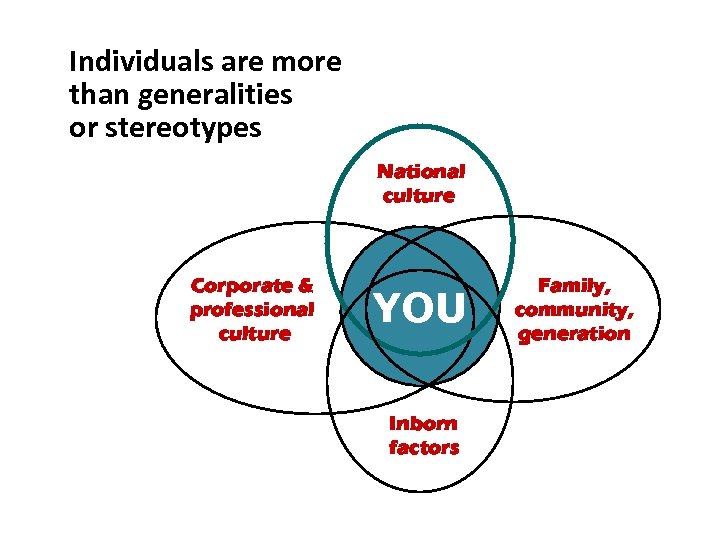 Individuals are more than generalities or stereotypes National culture Corporate & professional culture YOU Inborn factors Family, community, generation
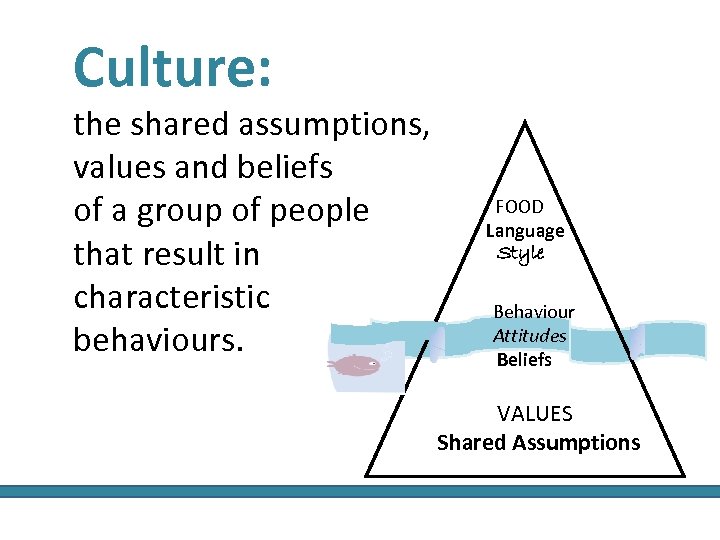 Culture: the shared assumptions, values and beliefs of a group of people that result in characteristic behaviours. FOOD Language Style Behaviour Attitudes Beliefs VALUES Shared Assumptions
 Language and style ABOVE THE SURFACE Ellen Hake 5
 Language: ‘global English’ • Speak slowly and pause often • Consider British versus US English • Use native speaking translators— then check translation with your local staff • Avoid: – Idioms, slang, uncommon words (soup/broth… initiative/project…a slam dunk/an easy victory) – Double negatives, long and complex sentences (it won’t be impossible in the event of unexpected developments) – Expressions from popular culture (lollipop lady, 24/7) Ellen Hake 6
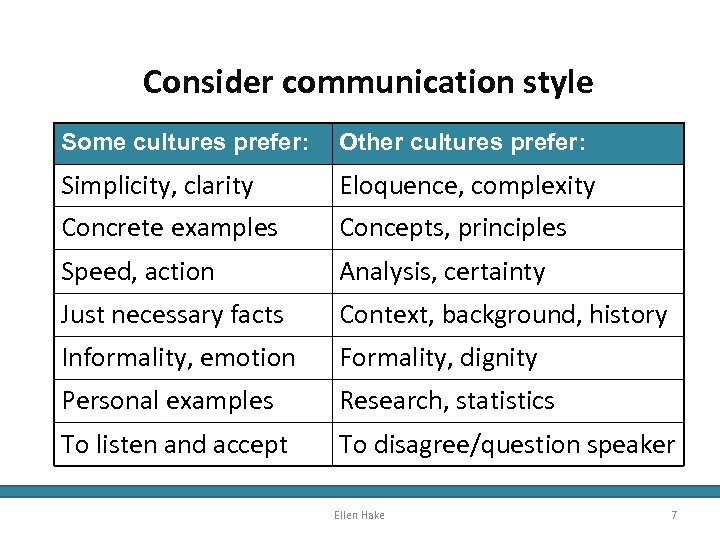 Consider communication style Some cultures prefer: Other cultures prefer: Simplicity, clarity Concrete examples Eloquence, complexity Concepts, principles Speed, action Analysis, certainty Just necessary facts Context, background, history Informality, emotion Formality, dignity Personal examples Research, statistics To listen and accept To disagree/question speaker Ellen Hake 7
 Values and assumptions BELOW THE SURFACE Ellen Hake 8
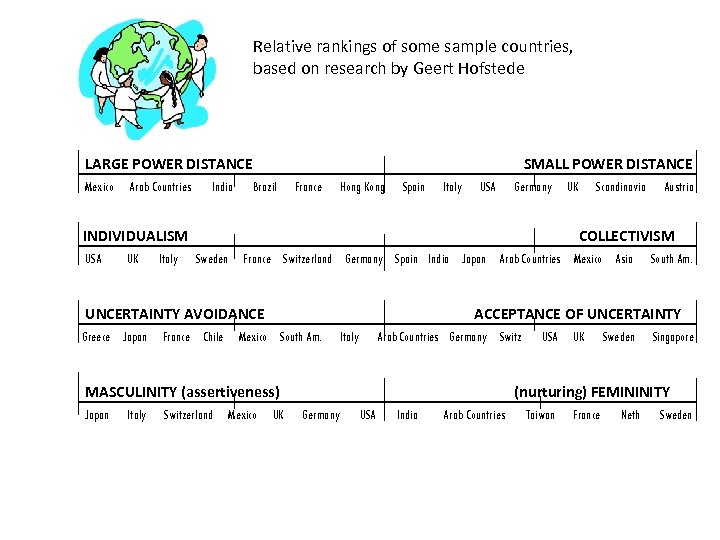
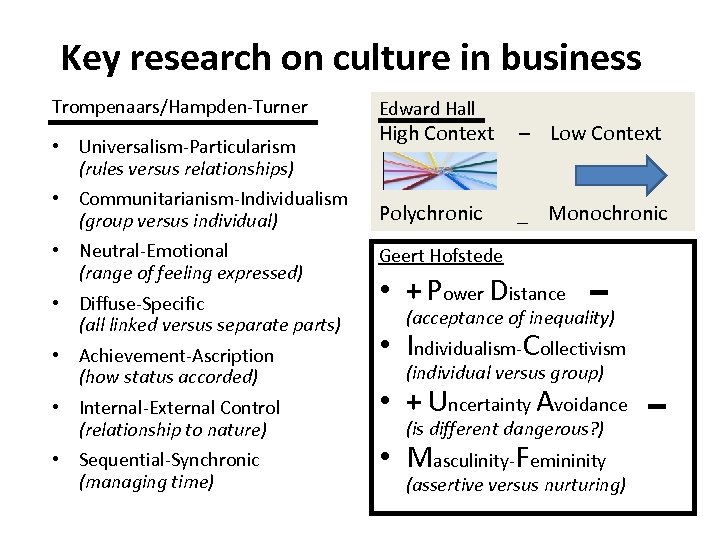 Key research on culture in business Trompenaars/Hampden-Turner • Universalism-Particularism (rules versus relationships) • Communitarianism-Individualism (group versus individual) • Neutral-Emotional (range of feeling expressed) • Diffuse-Specific (all linked versus separate parts) • Achievement-Ascription (how status accorded) • Internal-External Control (relationship to nature) • Sequential-Synchronic (managing time) Edward Hall High Context – Low Context Polychronic _ Monochronic Geert Hofstede • + Power Distance (acceptance of inequality) • Individualism-Collectivism (individual versus group) • + Uncertainty Avoidance (is different dangerous? ) • Masculinity-Femininity (assertive versus nurturing)
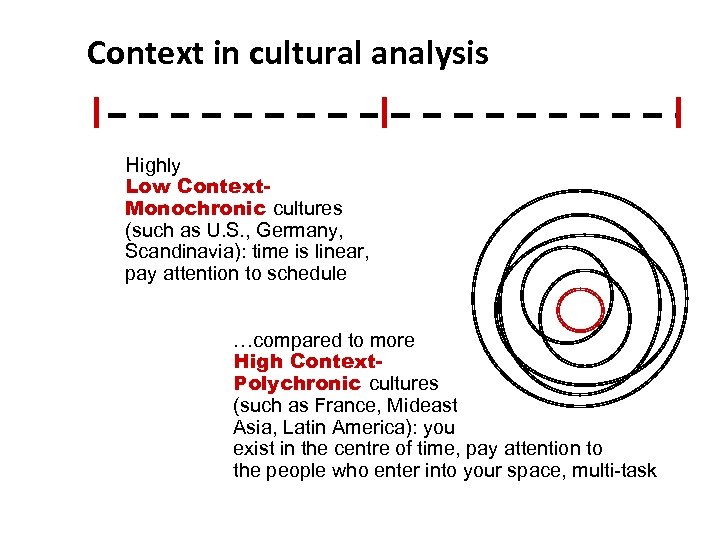 Context in cultural analysis Highly Low Context. Monochronic cultures (such as U. S. , Germany, Scandinavia): time is linear, pay attention to schedule …compared to more High Context. Polychronic cultures (such as France, Mideast Asia, Latin America): you exist in the centre of time, pay attention to the people who enter into your space, multi-task
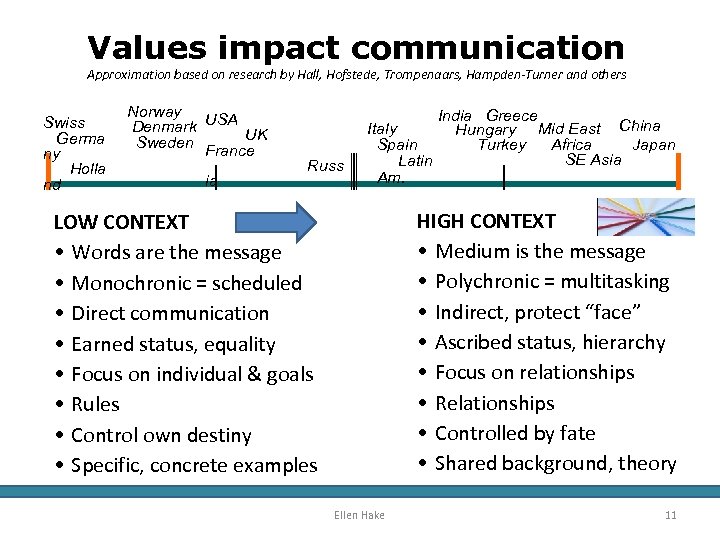 Values impact communication Approximation based on research by Hall, Hofstede, Trompenaars, Hampden-Turner and others Swiss Germa ny Holla nd Norway Denmark USA UK Sweden France ia Russ Italy Spain Latin Am. India Greece Hungary Mid East China Africa Turkey Japan SE Asia HIGH CONTEXT • Medium is the message • Polychronic = multitasking • Indirect, protect “face” • Ascribed status, hierarchy • Focus on relationships • Relationships • Controlled by fate • Shared background, theory LOW CONTEXT • Words are the message • Monochronic = scheduled • Direct communication • Earned status, equality • Focus on individual & goals • Rules • Control own destiny • Specific, concrete examples Ellen Hake 11
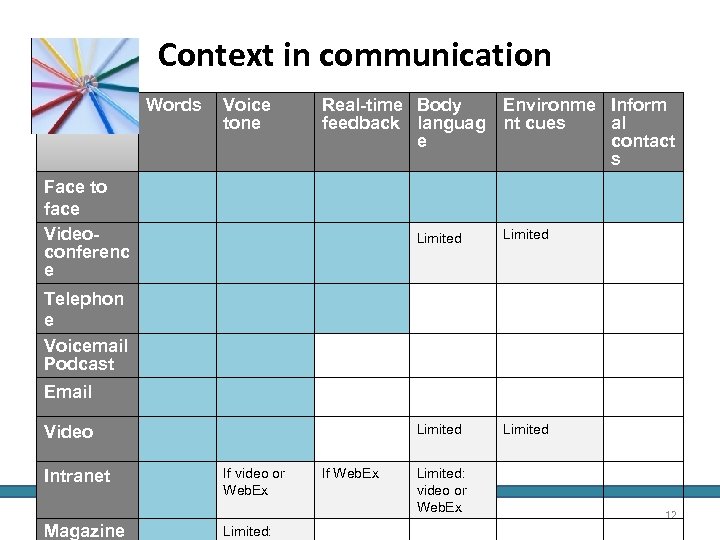 Context in communication Words Voice tone Real-time Body Environme Inform feedback languag nt cues al e contact s Face to face Videoconferenc e Limited Telephon e Voicemail Podcast Email Video Intranet Magazine If video or Web. Ex If Web. Ex Ellen Hake Limited: video or Web. Ex 12
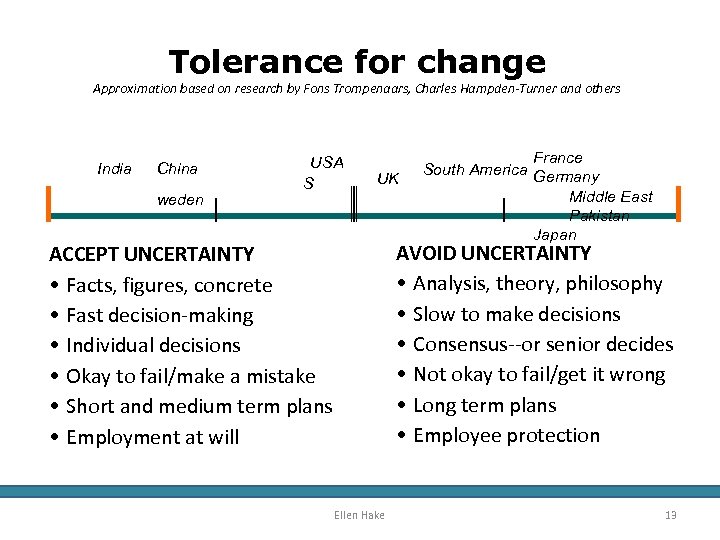 Tolerance for change Approximation based on research by Fons Trompenaars, Charles Hampden-Turner and others India China weden USA S UK France South America Germany Middle East Pakistan Japan AVOID UNCERTAINTY • Analysis, theory, philosophy • Slow to make decisions • Consensus--or senior decides • Not okay to fail/get it wrong • Long term plans • Employee protection ACCEPT UNCERTAINTY • Facts, figures, concrete • Fast decision-making • Individual decisions • Okay to fail/make a mistake • Short and medium term plans • Employment at will Ellen Hake 13
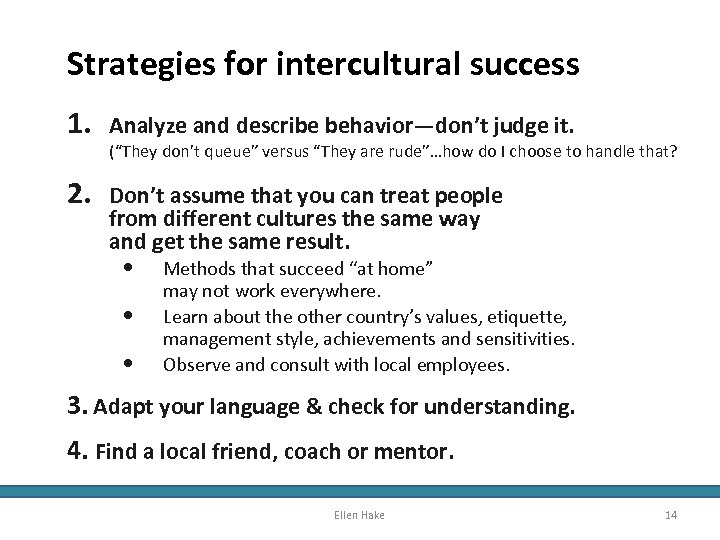 Strategies for intercultural success 1. Analyze and describe behavior—don’t judge it. 2. Don’t assume that you can treat people from different cultures the same way and get the same result. (“They don’t queue” versus “They are rude”…how do I choose to handle that? • • • Methods that succeed “at home” may not work everywhere. Learn about the other country’s values, etiquette, management style, achievements and sensitivities. Observe and consult with local employees. 3. Adapt your language & check for understanding. 4. Find a local friend, coach or mentor. Ellen Hake 14
 Resources • Riding the Waves of Culture: Understanding Cultural Diversity in Business, Trompenaars/Hampden-Turner, Nicholas Brealey Publishing • Cultures and Organizations, Geert Hofstede, Mc. Graw-Hill • Understanding Cultural Differences: Germans, French and Americans, Hall, Intercultural Press • Culture Shock USA (or other specific country), Graphic Arts Center • Kiss, Bow or Shake Hands, Morrison, Conaway, Borden, Bob Adams, Inc. Publishing Ellen Hake, ehake@ccmcglobal. com, 0785 071 8695 Ellen Hake 15
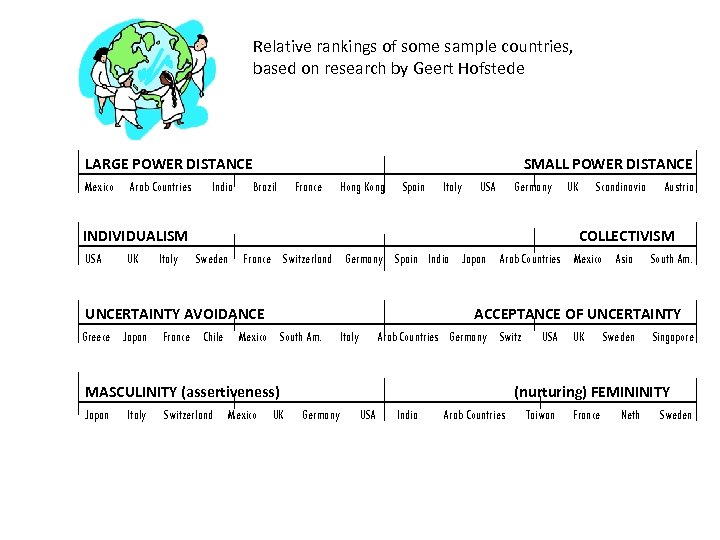 Relative rankings of some sample countries, based on research by Geert Hofstede LARGE POWER DISTANCE Mexico Arab Countries India SMALL POWER DISTANCE Brazil France Hong Kong Spain Italy USA Germany INDIVIDUALISM USA UK Italy Sweden France Switzerland Germany Spain India Japan Arab Countries Mexico Asia Italy Austria France Chile Switzerland Mexico South Am. ACCEPTANCE OF UNCERTAINTY Italy Arab Countries Germany Switz MASCULINITY (assertiveness) Japan Scandinavia COLLECTIVISM UNCERTAINTY AVOIDANCE Greece Japan UK UK USA UK Sweden Singapore (nurturing) FEMININITY Germany USA India Arab Countries Taiwan France Neth Sweden
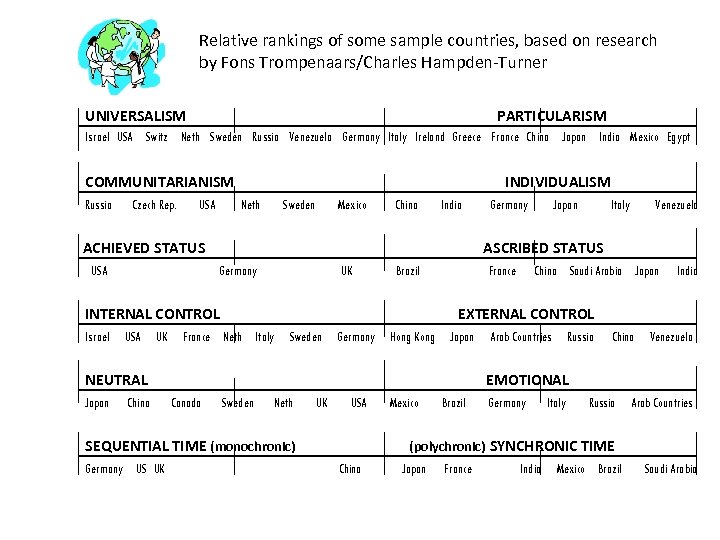 Relative rankings of some sample countries, based on research by Fons Trompenaars/Charles Hampden-Turner UNIVERSALISM PARTICULARISM Israel USA Switz Neth Sweden Russia Venezuela Germany Italy Ireland Greece France China Japan India Mexico Egypt COMMUNITARIANISM Russia Czech Rep. USA INDIVIDUALISM Neth Sweden Mexico China India ACHIEVED STATUS USA Germany USA UK UK Brazil France China France Neth Italy Sweden Germany Venezuela China Saudi Arabia Japan India Hong Kong Japan Arab Countries Russia China Venezuela EMOTIONAL Canada Sweden Neth UK USA SEQUENTIAL TIME (monochronic) Germany US UK Italy EXTERNAL CONTROL NEUTRAL Japan ASCRIBED STATUS INTERNAL CONTROL Israel Germany Mexico Brazil Germany Italy Russia Arab Countries (polychronic) SYNCHRONIC TIME China Japan France India Mexico Brazil Saudi Arabia
 Relative rankings of some sample countries, based on research by Geert Hofstede LARGE POWER DISTANCE Mexico Arab Countries India SMALL POWER DISTANCE Brazil France Hong Kong Spain Italy USA Germany INDIVIDUALISM USA UK Italy Sweden France Switzerland Germany Spain India Japan Arab Countries Mexico Asia Italy Austria France Chile Switzerland Mexico South Am. ACCEPTANCE OF UNCERTAINTY Italy Arab Countries Germany Switz MASCULINITY (assertiveness) Japan Scandinavia COLLECTIVISM UNCERTAINTY AVOIDANCE Greece Japan UK UK USA UK Sweden Singapore (nurturing) FEMININITY Germany USA India Arab Countries Taiwan France Neth Sweden
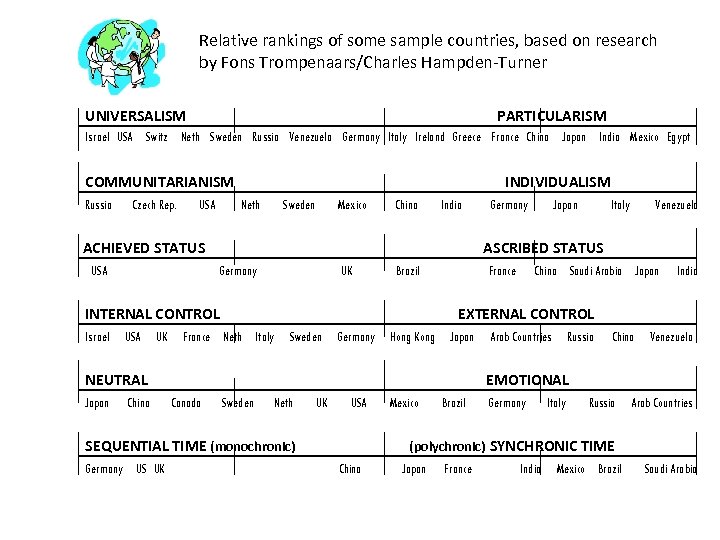 Relative rankings of some sample countries, based on research by Fons Trompenaars/Charles Hampden-Turner UNIVERSALISM PARTICULARISM Israel USA Switz Neth Sweden Russia Venezuela Germany Italy Ireland Greece France China Japan India Mexico Egypt COMMUNITARIANISM Russia Czech Rep. USA INDIVIDUALISM Neth Sweden Mexico China India ACHIEVED STATUS USA Germany USA UK UK Brazil France China France Neth Italy Sweden Germany Venezuela China Saudi Arabia Japan India Hong Kong Japan Arab Countries Russia China Venezuela EMOTIONAL Canada Sweden Neth UK USA SEQUENTIAL TIME (monochronic) Germany US UK Italy EXTERNAL CONTROL NEUTRAL Japan ASCRIBED STATUS INTERNAL CONTROL Israel Germany Mexico Brazil Germany Italy Russia Arab Countries (polychronic) SYNCHRONIC TIME China Japan France India Mexico Brazil Saudi Arabia