


 Скачать презентацию Crop Insurance Overview for 2008 Paul D Mitchell
f47ce149ff2f5a5cb4fc492ee07cfeef.ppt
- Количество слайдов: 43
 Crop Insurance Overview for 2008 Paul D. Mitchell Assistant Professor Agricultural and Applied Economics University of Wisconsin-Madison These slides are a conglomeration of slides from presentations made in Jan-Feb 2008
 Goal Today n n n Overview current crop insurance programs for corn, soybeans and wheat Crop Insurance Hints for 2008 Crop Insurance changes coming
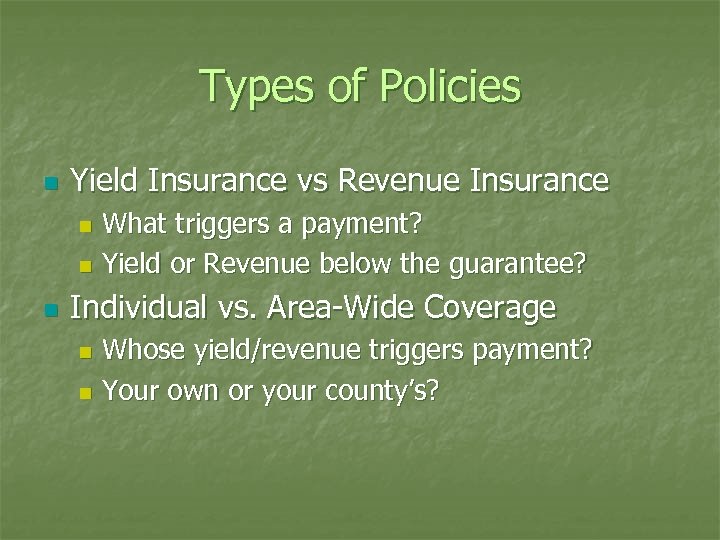 Types of Policies n Yield Insurance vs Revenue Insurance What triggers a payment? n Yield or Revenue below the guarantee? n n Individual vs. Area-Wide Coverage Whose yield/revenue triggers payment? n Your own or your county’s? n
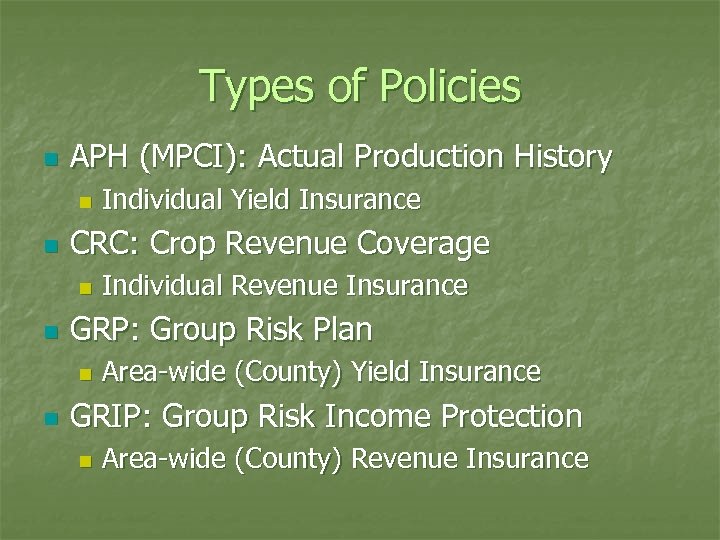 Types of Policies n APH (MPCI): Actual Production History n n CRC: Crop Revenue Coverage n n Individual Revenue Insurance GRP: Group Risk Plan n n Individual Yield Insurance Area-wide (County) Yield Insurance GRIP: Group Risk Income Protection n Area-wide (County) Revenue Insurance
 APH: Actual Production History n n If your harvested yield is less than your yield guarantee, receive an indemnity Yield guarantee: average of your actual harvested yields for last 4 -10 years Coverage Level: Choose percentage of your average yield as your guarantee, from 50% to 85% by 5% intervals Price Election: Choose price paid for each bushel below your guarantee, from 100% to 55% of established APH price
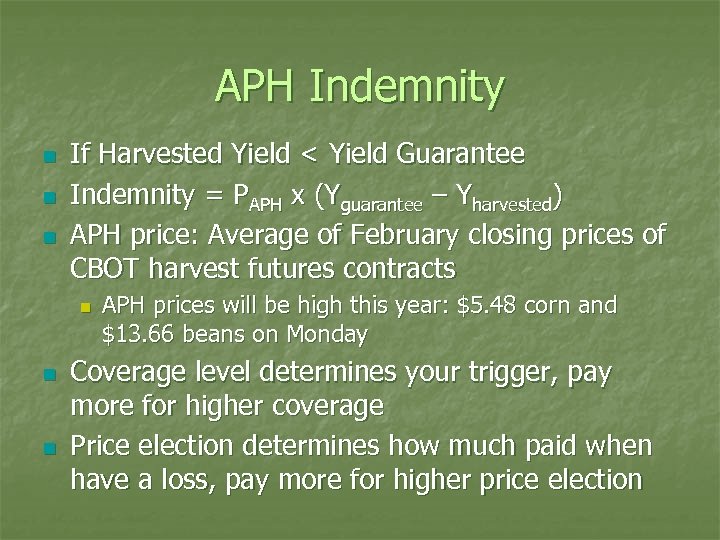 APH Indemnity n n n If Harvested Yield < Yield Guarantee Indemnity = PAPH x (Yguarantee – Yharvested) APH price: Average of February closing prices of CBOT harvest futures contracts n n n APH prices will be high this year: $5. 48 corn and $13. 66 beans on Monday Coverage level determines your trigger, pay more for higher coverage Price election determines how much paid when have a loss, pay more for higher price election
 If you have a loss n If you think you have a loss, contact your crop insurance agent n n n Documentation of losses and practices is key Likely leave corn standing for loss adjustment Stalk rot/lodged corn, Aflatoxin a loss Wildlife damage a loss: deer, wild hogs, geese Alternative uses: Be careful before you graze Lots of rules, don’t forfeit your indemnities by making a mistake
 Unit Structure n Each unit Planted to same crop during insurance period n Cannot cut across a county line n Separate production records for each unit n n Three unit types (smallest to largest) n n Optional Unit, Basic Unit, Enterprise Unit Lots of rules on units, know them. Your crop insurance agent should be able to help
 CRC Crop Revenue Coverage n n n Combines APH with price protection based on CBOT futures prices Your APH yield history and CBOT prices set your preliminary revenue guarantee Same coverage level options, same unit structures Your revenue at harvest is your yield x CBOT prices (e. g. , Nov average of Dec corn) If your harvest revenue is below your guarantee, triggers an indemnity payment
 CRC protects against price increases and decreases n n n If price falls or have low yield, know will have grain or money to buy grain to fulfill contracts If price increases by harvest, revenue guarantee increases too, so again know will have grain or money to buy grain to fulfill contracts Still have to market your grain n Can now market more aggressively since you will have grain or indemnities to buy grain at the existing market prices if you have a yield loss
 GRP Group Risk Plan GRIP Group Risk Income Protection n n GRP = APH, except uses NASS county average yield GRIP with Harvest Revenue Option = CRC, except uses NASS county average yield Cheaper because lower cost to adjust losses (no field visits) Not available for Wheat in WI Payments not made until Mar/Apr when NASS yields come out: cash flow issues
 Lots of Crop Insurance Rules n n n Communicate with your crop insurance agent is key to getting most from your policy Rules on: Planting dates, Late/prevented planting, Double cropping, Alternative crop uses, Corn maturity, Yield guarantees, Units, Breaking new ground (CRP vs pasture) If your agent does not know and will not find out for you, find a new agent Insurance agents do not always know all rules Call your county ag agent or RMA St. Paul regional office 651 -290 -3304
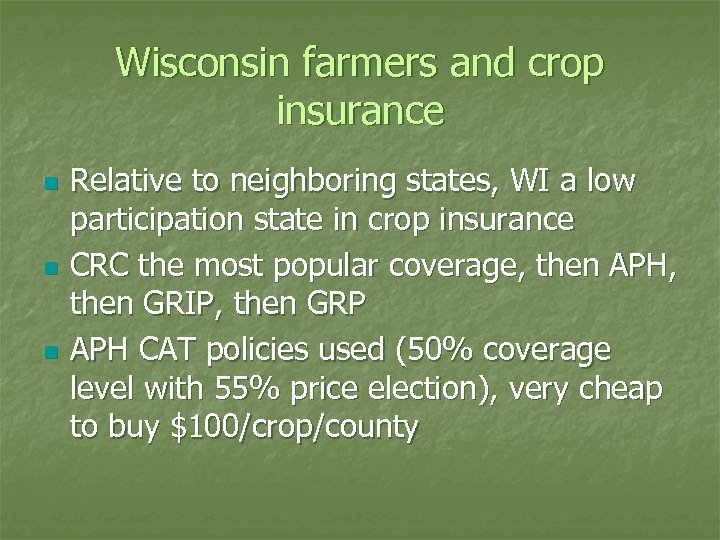 Wisconsin farmers and crop insurance n n n Relative to neighboring states, WI a low participation state in crop insurance CRC the most popular coverage, then APH, then GRIP, then GRP APH CAT policies used (50% coverage level with 55% price election), very cheap to buy $100/crop/county
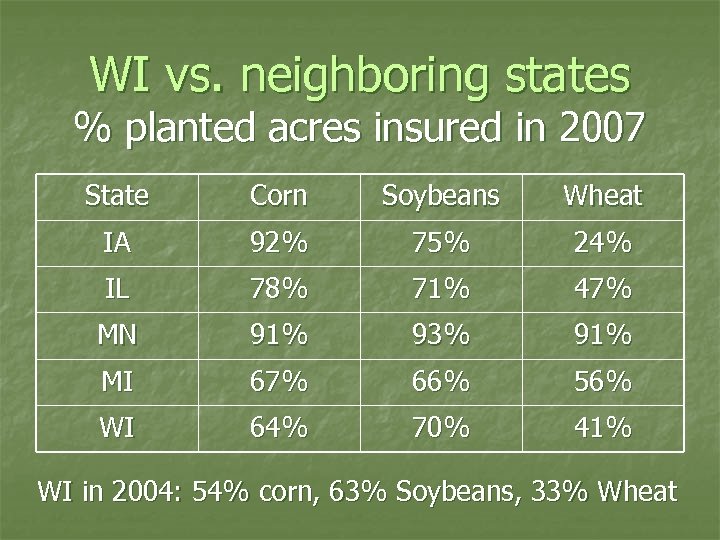 WI vs. neighboring states % planted acres insured in 2007 State Corn Soybeans Wheat IA 92% 75% 24% IL 78% 71% 47% MN 91% 93% 91% MI 67% 66% 56% WI 64% 70% 41% WI in 2004: 54% corn, 63% Soybeans, 33% Wheat
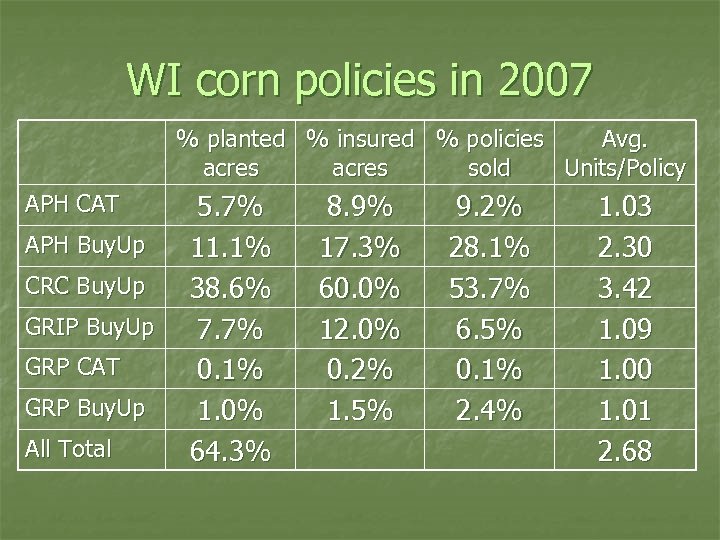 WI corn policies in 2007 % planted % insured % policies Avg. acres sold Units/Policy APH CAT APH Buy. Up CRC Buy. Up GRIP Buy. Up GRP CAT GRP Buy. Up All Total 5. 7% 11. 1% 38. 6% 7. 7% 0. 1% 1. 0% 64. 3% 8. 9% 17. 3% 60. 0% 12. 0% 0. 2% 1. 5% 9. 2% 28. 1% 53. 7% 6. 5% 0. 1% 2. 4% 1. 03 2. 30 3. 42 1. 09 1. 00 1. 01 2. 68
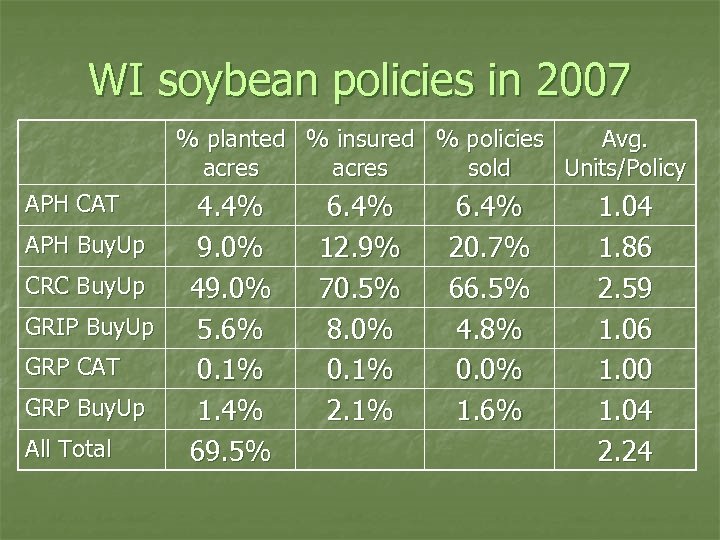 WI soybean policies in 2007 % planted % insured % policies Avg. acres sold Units/Policy APH CAT APH Buy. Up CRC Buy. Up GRIP Buy. Up GRP CAT GRP Buy. Up All Total 4. 4% 9. 0% 49. 0% 5. 6% 0. 1% 1. 4% 69. 5% 6. 4% 12. 9% 70. 5% 8. 0% 0. 1% 2. 1% 6. 4% 20. 7% 66. 5% 4. 8% 0. 0% 1. 6% 1. 04 1. 86 2. 59 1. 06 1. 00 1. 04 2. 24
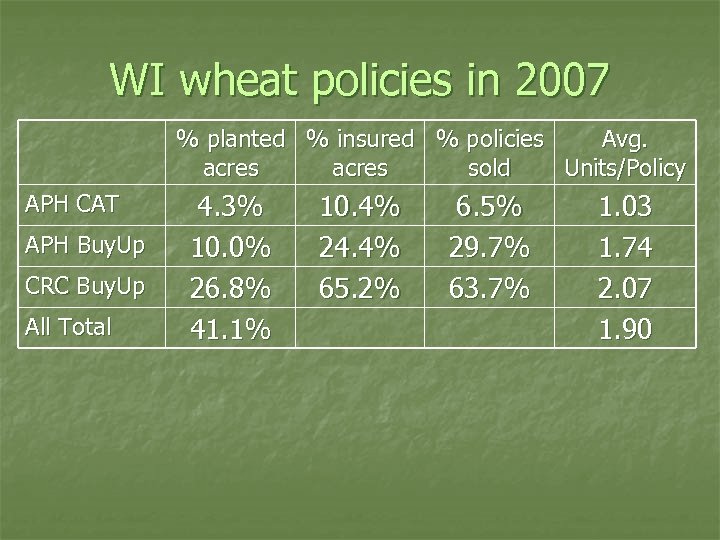 WI wheat policies in 2007 % planted % insured % policies Avg. acres sold Units/Policy APH CAT APH Buy. Up CRC Buy. Up All Total 4. 3% 10. 0% 26. 8% 41. 1% 10. 4% 24. 4% 65. 2% 6. 5% 29. 7% 63. 7% 1. 03 1. 74 2. 07 1. 90
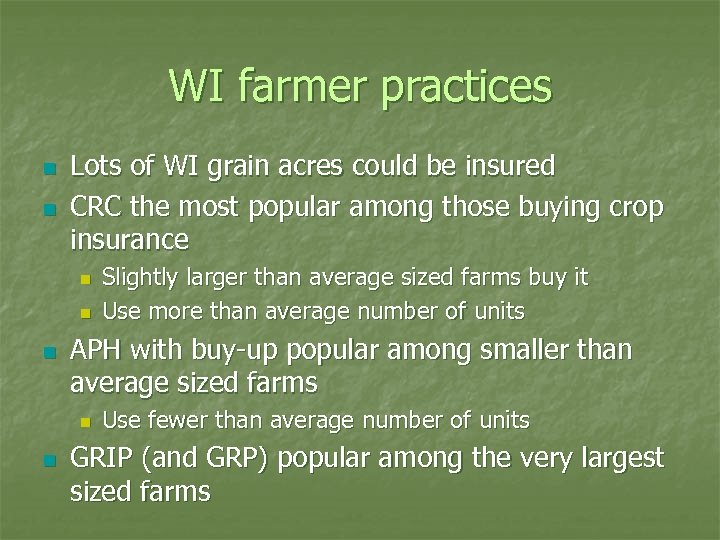 WI farmer practices n n Lots of WI grain acres could be insured CRC the most popular among those buying crop insurance n n n APH with buy-up popular among smaller than average sized farms n n Slightly larger than average sized farms buy it Use more than average number of units Use fewer than average number of units GRIP (and GRP) popular among the very largest sized farms
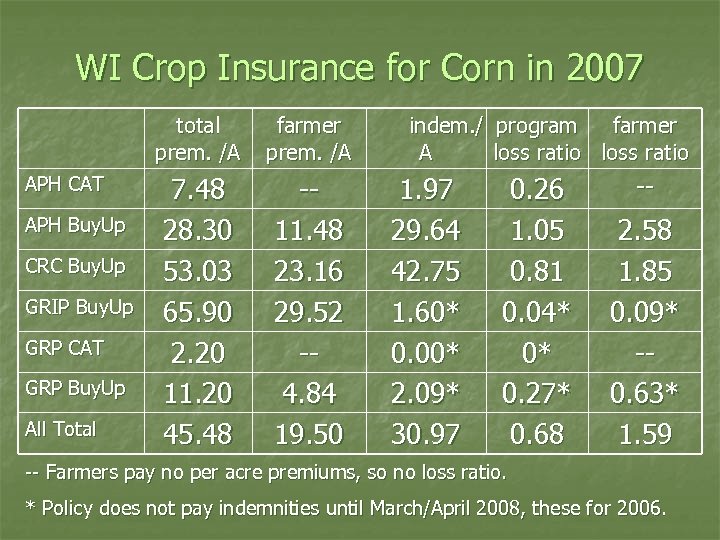 WI Crop Insurance for Corn in 2007 total prem. /A APH CAT APH Buy. Up CRC Buy. Up GRIP Buy. Up GRP CAT GRP Buy. Up All Total farmer prem. /A 7. 48 28. 30 53. 03 65. 90 2. 20 11. 20 45. 48 -11. 48 23. 16 29. 52 -4. 84 19. 50 indem. / program farmer A loss ratio 1. 97 29. 64 42. 75 1. 60* 0. 00* 2. 09* 30. 97 0. 26 1. 05 0. 81 0. 04* 0* 0. 27* 0. 68 -- 2. 58 1. 85 0. 09* -0. 63* 1. 59 -- Farmers pay no per acre premiums, so no loss ratio. * Policy does not pay indemnities until March/April 2008, these for 2006.
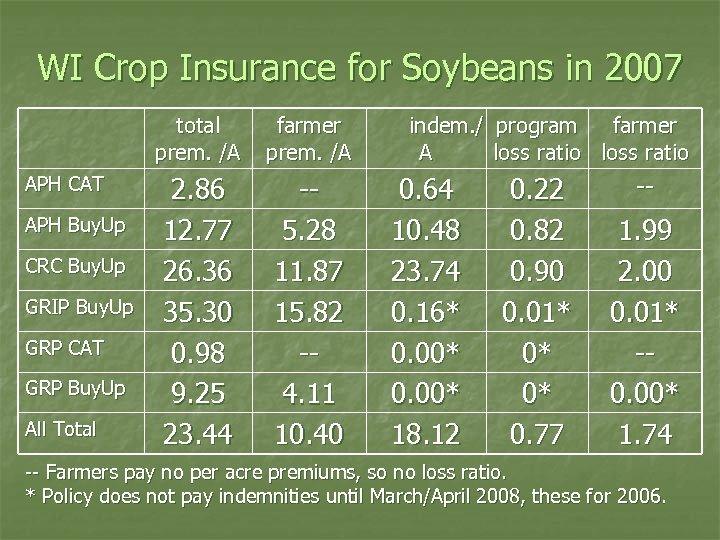 WI Crop Insurance for Soybeans in 2007 total prem. /A APH CAT APH Buy. Up CRC Buy. Up GRIP Buy. Up GRP CAT GRP Buy. Up All Total farmer prem. /A 2. 86 12. 77 26. 36 35. 30 0. 98 9. 25 23. 44 -5. 28 11. 87 15. 82 -4. 11 10. 40 indem. / program farmer A loss ratio 0. 64 10. 48 23. 74 0. 16* 0. 00* 18. 12 0. 22 0. 82 0. 90 0. 01* 0* 0* 0. 77 -- 1. 99 2. 00 0. 01* -0. 00* 1. 74 -- Farmers pay no per acre premiums, so no loss ratio. * Policy does not pay indemnities until March/April 2008, these for 2006.
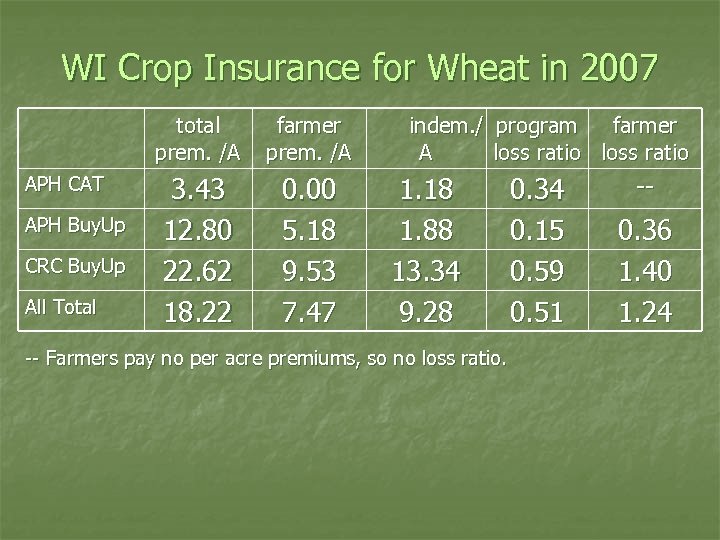 WI Crop Insurance for Wheat in 2007 total prem. /A APH CAT APH Buy. Up CRC Buy. Up All Total farmer prem. /A 3. 43 12. 80 22. 62 18. 22 0. 00 5. 18 9. 53 7. 47 indem. / program farmer A loss ratio 1. 18 1. 88 13. 34 9. 28 -- Farmers pay no per acre premiums, so no loss ratio. 0. 34 0. 15 0. 59 0. 51 -- 0. 36 1. 40 1. 24
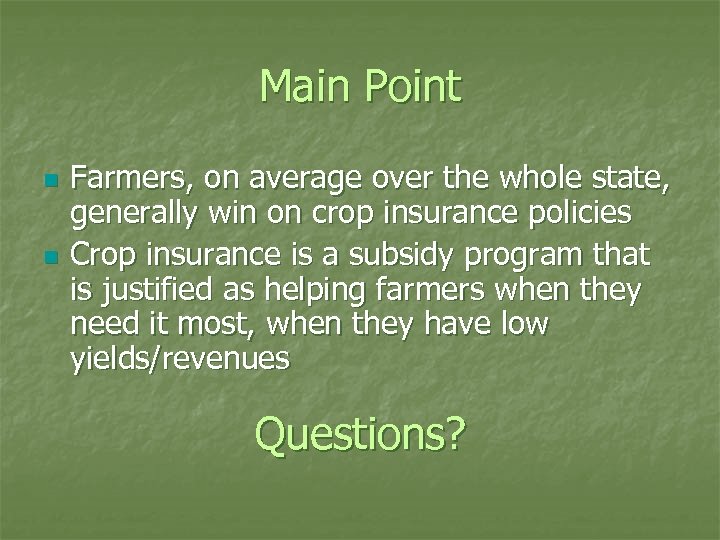 Main Point n n Farmers, on average over the whole state, generally win on crop insurance policies Crop insurance is a subsidy program that is justified as helping farmers when they need it most, when they have low yields/revenues Questions?
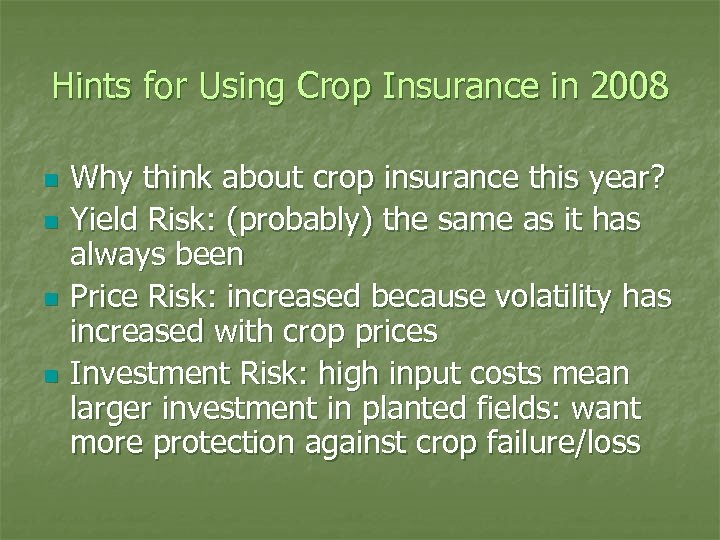 Hints for Using Crop Insurance in 2008 n n Why think about crop insurance this year? Yield Risk: (probably) the same as it has always been Price Risk: increased because volatility has increased with crop prices Investment Risk: high input costs mean larger investment in planted fields: want more protection against crop failure/loss
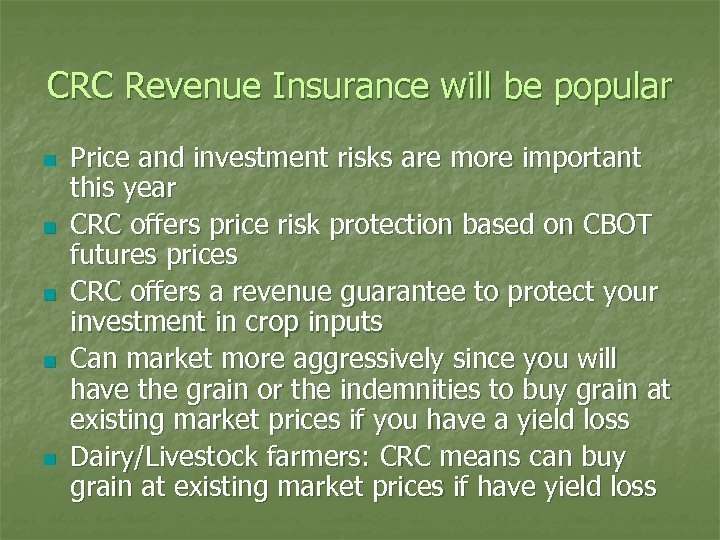 CRC Revenue Insurance will be popular n n n Price and investment risks are more important this year CRC offers price risk protection based on CBOT futures prices CRC offers a revenue guarantee to protect your investment in crop inputs Can market more aggressively since you will have the grain or the indemnities to buy grain at existing market prices if you have a yield loss Dairy/Livestock farmers: CRC means can buy grain at existing market prices if have yield loss
 Crop Insurance Hints for 2008 n Coverage Level for APH and CRC 70 -75% most popular and typically maximizes expected returns (or pretty close) n Sometimes 65% or 80% are better, but often not by much in terms of expected returns n 80% and 85% CRC often quite expensive and don’t increase expected returns that much n n Price Election for APH: take 100% Most poplar, maximizes expected returns n If have a loss, want largest payment possible n
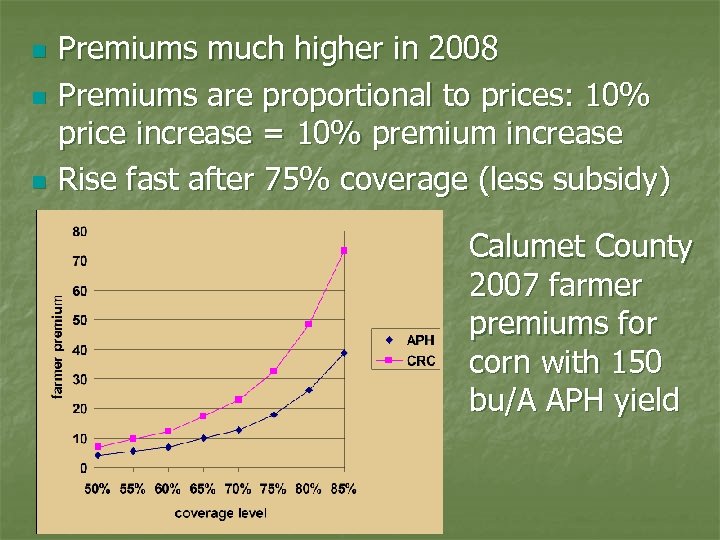 n n n Premiums much higher in 2008 Premiums are proportional to prices: 10% price increase = 10% premium increase Rise fast after 75% coverage (less subsidy) Calumet County 2007 farmer premiums for corn with 150 bu/A APH yield
 Unit Structure n n n All coverage is at the unit level: if total yield for a unit falls below its guarantee, triggers indemnity payments Units: Optional, Basic, and Enterprise Units Get as many Optional Units as you can More likely trigger a payment if have a loss n Worth slightly larger cost for optional units n WI data: larger farms, CRC with many units n
 GRP/GRIP n n Yield Basis: Value of GRP/GRIP depends on how your yield moves with county yield Potentially useful for irrigated farmers or those with short (or no) yield histories Offset irrigation costs in dry years n Use while build yield history n Combine GRP/GRIP with crop hail n GRIP: cheap way to get price protection n n Larger/low risk farms use it as well
 GRP/GRIP for Corn in Wisconsin n Important issue for Corn: Which county yield do you choose to insure, yield per planted acre or yield per harvested acre? Only in Wisconsin is there a choice Because of dairy, in years with marginal corn yields, poorer corn chopped for silage n n Yield per harvested acre can remain high, even though it’s a bad year Which is better? Depends on the county!
 Is GRP a good deal for my Corn and Soybeans? n n n Bulletins posted on my webpage (soybeans soon) Analyze county yield data and estimate the expected return to GRP in bu/ac for each Wisconsin county that has GRP Expected return = long run average net return to GRP if everything constant over many years If GRP is valuable for a county, GRIP will be valuable too, as it adds price protection If GRP is not valuable for a county, GRIP can still make sense, to get the price protection
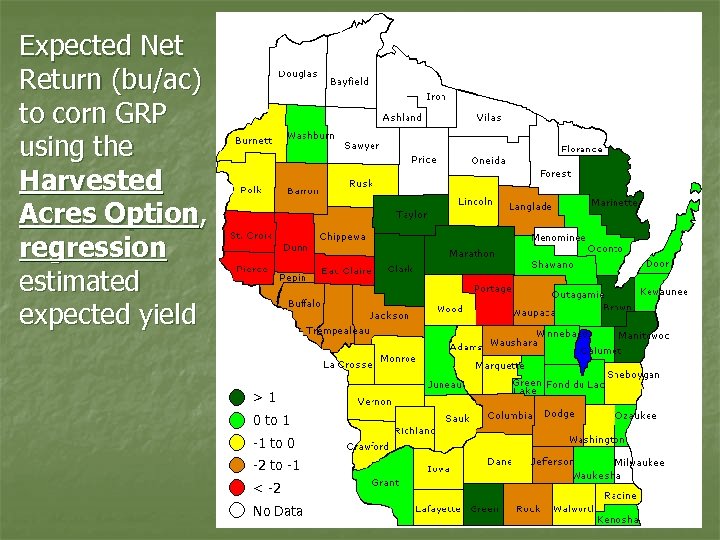 Expected Net Return (bu/ac) to corn GRP using the Harvested Acres Option, regression estimated expected yield >1 0 to 1 -1 to 0 -2 to -1 < -2 No Data
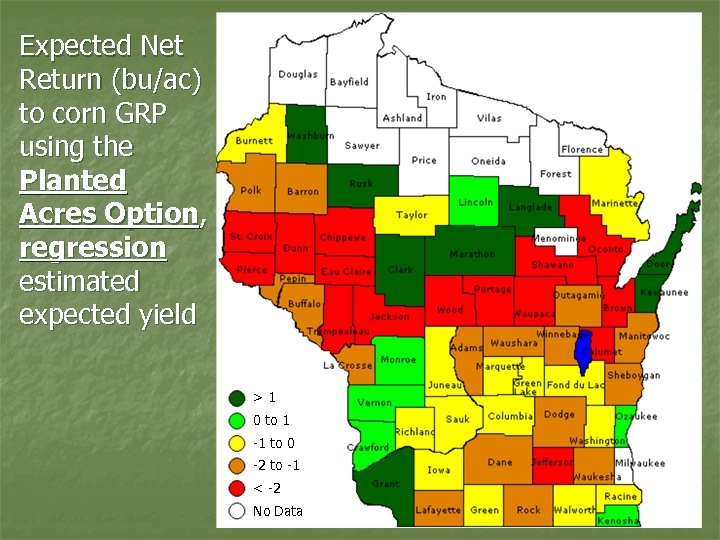 Expected Net Return (bu/ac) to corn GRP using the Planted Acres Option, regression estimated expected yield >1 0 to 1 -1 to 0 -2 to -1 < -2 No Data
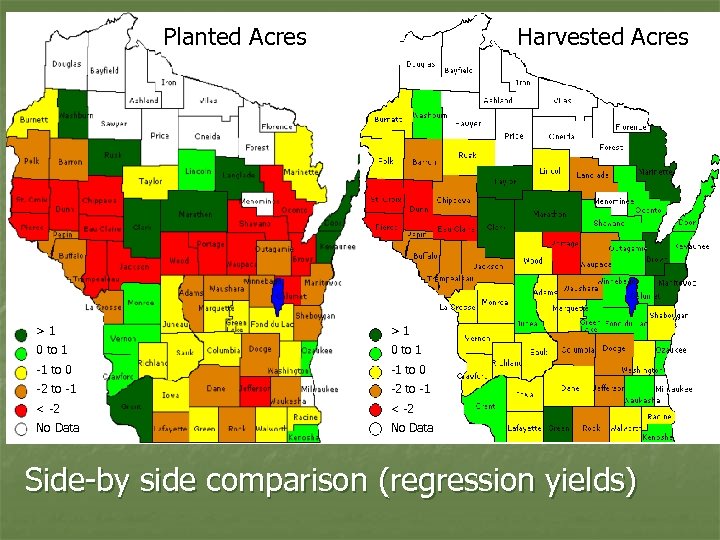 Planted Acres Harvested Acres >1 >1 0 to 1 -1 to 0 -2 to -1 < -2 No Data Side-by side comparison (regression yields)
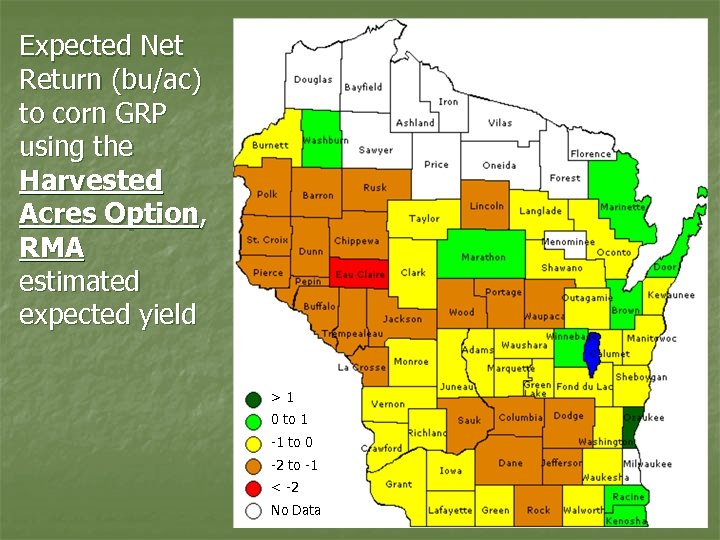 Expected Net Return (bu/ac) to corn GRP using the Harvested Acres Option, RMA estimated expected yield >1 0 to 1 -1 to 0 -2 to -1 < -2 No Data
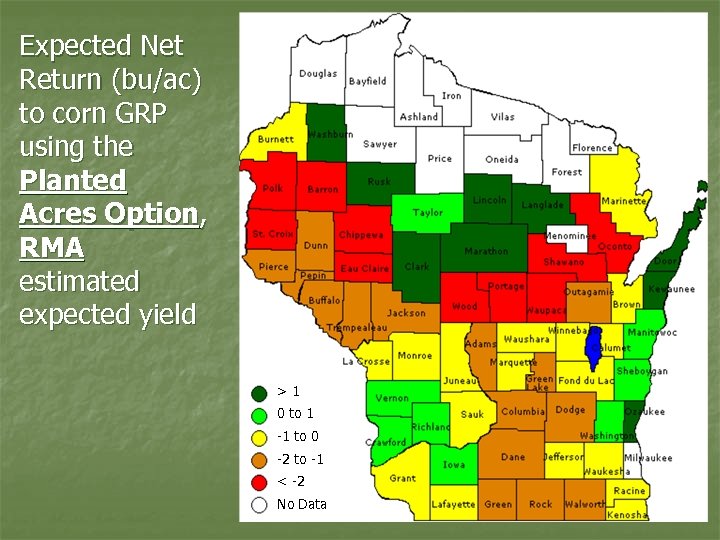 Expected Net Return (bu/ac) to corn GRP using the Planted Acres Option, RMA estimated expected yield >1 0 to 1 -1 to 0 -2 to -1 < -2 No Data
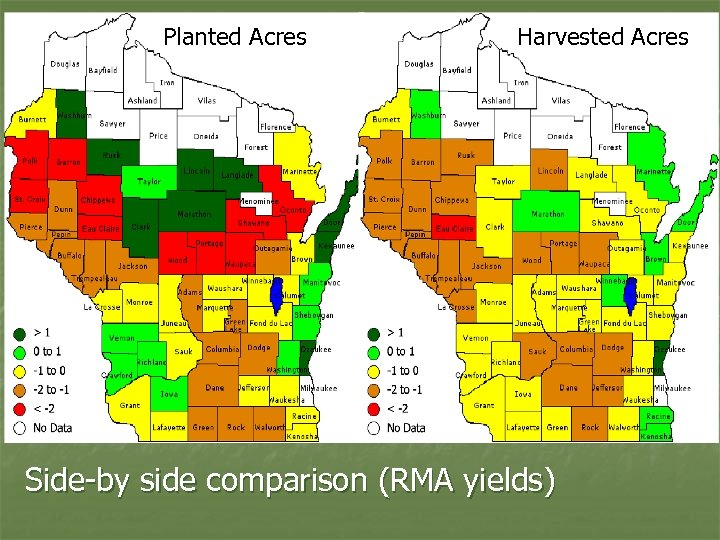 Planted Acres Harvested Acres Side-by side comparison (RMA yields)
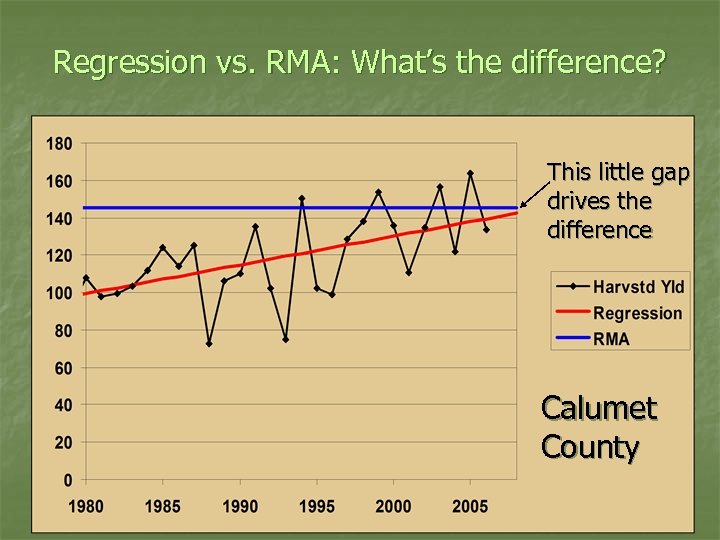 Regression vs. RMA: What’s the difference? This little gap drives the difference Calumet County
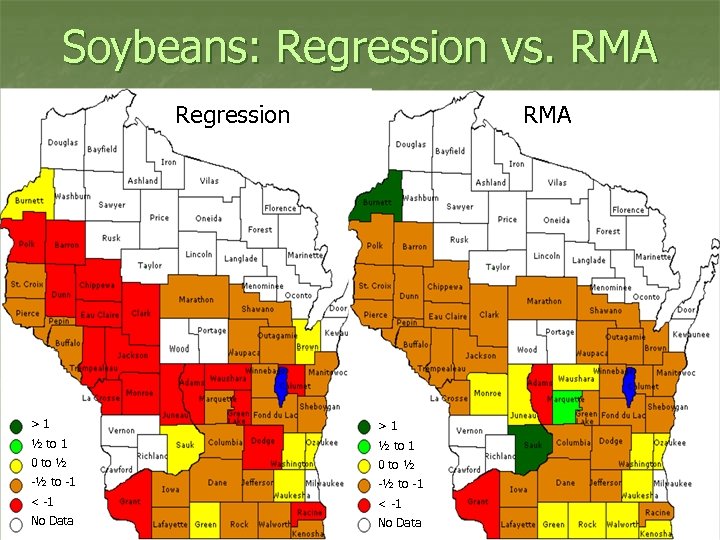 Soybeans: Regression vs. RMA Regression RMA >1 >1 ½ to 1 0 to ½ -½ to -1 < -1 No Data
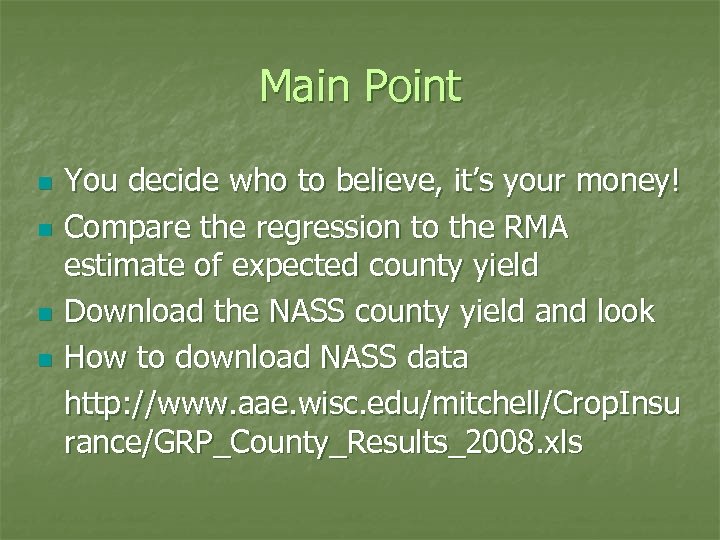 Main Point n n You decide who to believe, it’s your money! Compare the regression to the RMA estimate of expected county yield Download the NASS county yield and look How to download NASS data http: //www. aae. wisc. edu/mitchell/Crop. Insu rance/GRP_County_Results_2008. xls
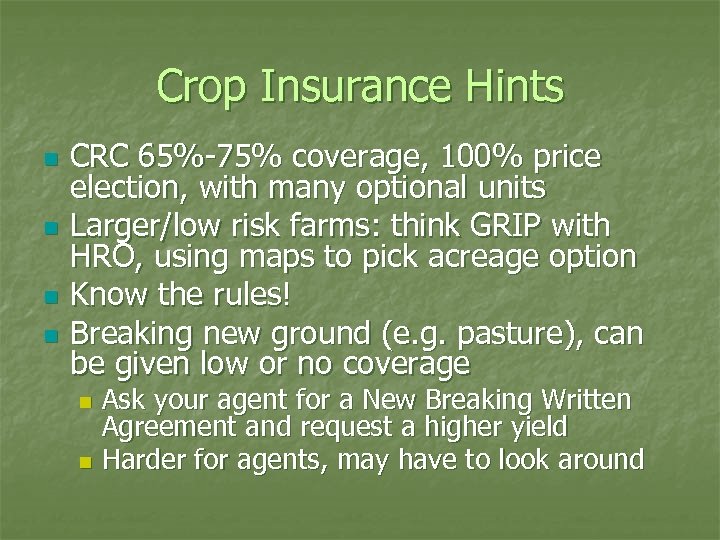 Crop Insurance Hints n n CRC 65%-75% coverage, 100% price election, with many optional units Larger/low risk farms: think GRIP with HRO, using maps to pick acreage option Know the rules! Breaking new ground (e. g. pasture), can be given low or no coverage Ask your agent for a New Breaking Written Agreement and request a higher yield n Harder for agents, may have to look around n
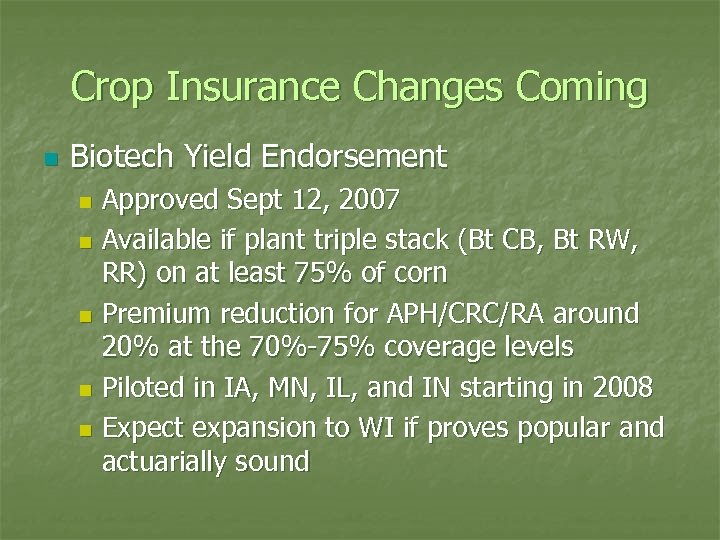 Crop Insurance Changes Coming n Biotech Yield Endorsement Approved Sept 12, 2007 n Available if plant triple stack (Bt CB, Bt RW, RR) on at least 75% of corn n Premium reduction for APH/CRC/RA around 20% at the 70%-75% coverage levels n Piloted in IA, MN, IL, and IN starting in 2008 n Expect expansion to WI if proves popular and actuarially sound n
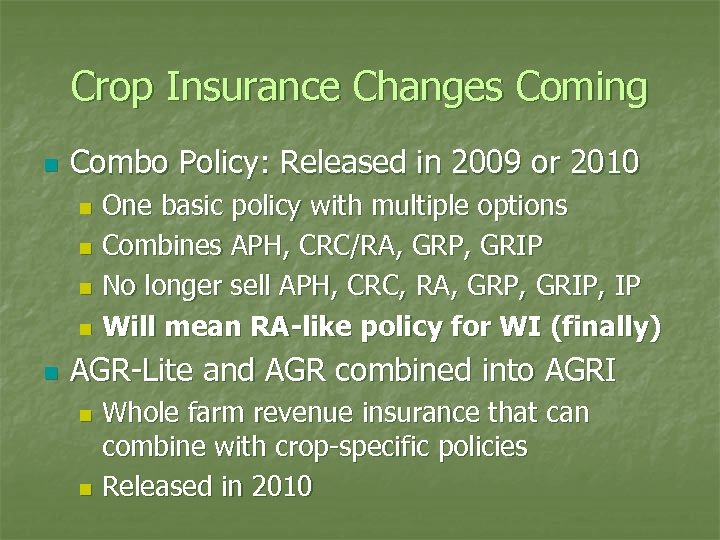 Crop Insurance Changes Coming n Combo Policy: Released in 2009 or 2010 One basic policy with multiple options n Combines APH, CRC/RA, GRP, GRIP n No longer sell APH, CRC, RA, GRP, GRIP, IP n Will mean RA-like policy for WI (finally) n n AGR-Lite and AGR combined into AGRI Whole farm revenue insurance that can combine with crop-specific policies n Released in 2010 n
 Questions? Paul D. Mitchell UW-Madison Ag & Applied Economics Office: (608) 265 -6514 Cell: (608) 320 -1162 Email: pdmitchell@wisc. edu Extension Web Page: www. aae. wisc. edu/mitchell/extension. htm