 Скачать презентацию CRONUS Web Calculators formerly Stone Age Important
02b215ce93f10be9e680c51680f1a8af.ppt
- Количество слайдов: 6



CRONUS Web Calculators (formerly ‘Stone Age’) • Important need at present: – Rate of publication of exposure-dating papers is big. – most present applications by nonspecialists are exposure ages and erosion rates. – these lack a common basis for the calculations: results in proliferation of inconsistent results. – many users aren’t familiar with the basic calculation tools. • Rapid and useful deliverable to user community
Initial goals: • 1. Compute P(z) for Al-26, Be-10, Cl-36, (and He-3) • 2. Compute simple exposure ages and/or steadystate erosion rates therefrom. • Summary: provide basic functions to satisfy majority of straightforward applications. Make framework that can be expanded to include improvements in future years.
Design - • Running on MATLAB web server – – Easy language to learn Ingests and regurgitates basic HTML Eliminates unpleasant CGI/Java/whatever coding Already in use by most CRONUS folks • Modular design -- – All functions replaceable with improved versions – Anyone can contribute a function with specified I/O • Well-documented • Emphasis on organization, documentation, clarity, separability rather than computational speed
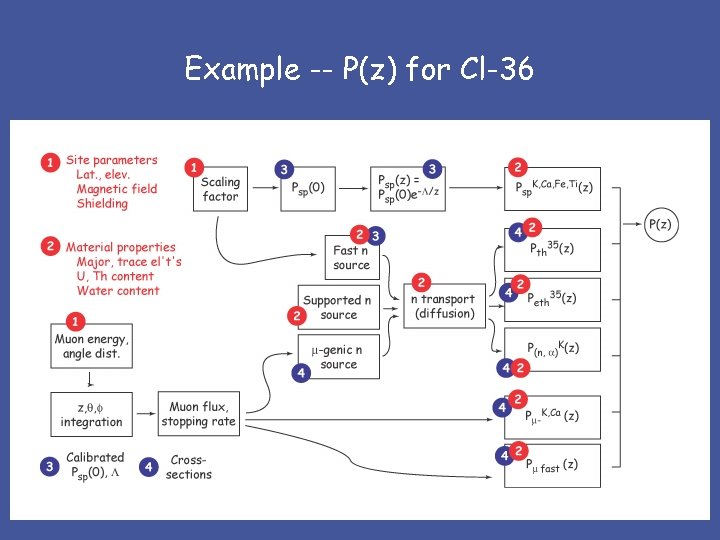
Example -- P(z) for Cl-36
Plan - • Buy LINUX server -- housed/maintained at UW • Implement basic Be-10, Al-26, Cl-36 production rate, exposure age, and steady erosion rate calculators – Mainly relies on pre-existing code at UW; contributions solicited – Target spring/summer 2005 • Circulate internally – CRONUS folks to test; discussion of model/parameter choices • Notify public via publication (in online journal), and open web site to users. Release all MATLAB functions to public. – Target summer/fall 2005…
Issues…. • Data reporting and referencing in published work. – Suggestion: Calculations receive unique number when requested, at which point the data and calculation parameters are archived on the web site, and can be referenced in the publication/retrieved by readers. – Archived data/parameters can be recalculated later to reflect improvements. How to handle this? • Basin-averaged production rates. – High demand. Much bigger challenge to centralise. Maybe just offer MATLAB/ARC/GMT/whatever code to do this offline. • Where does the calculation start? – 10/9 ratio or atoms/g Be-10? • (problem: correlated [Cl], [Cl-36] errors…) – Coordination with PRIME/LLNL reporting schemes?
Скачать презентацию CRONUS Web Calculators formerly Stone Age Important
02b215ce93f10be9e680c51680f1a8af.ppt