


 Скачать презентацию CRMtex Updates Achille Felicetti Francesca Murano Università
f9829d79c6f7e1c67facf4934d121cc1.ppt
- Количество слайдов: 24
 CRMtex Updates Achille Felicetti – Francesca Murano Università degli Studi di Firenze, Italy
 CRMtex updates • First draft available on CIDOC CRM website (Proposal for approval) • Scope notes for classes and properties • Application examples • http: //www. cidoc-crm. org/crmtex/ • Previous publications: • A. Felicetti, F. Murano, P. Ronzino, F. Niccolucci: CIDOC CRM and Epigraphy: a Hermeneutic Challenge, EMF-CRM@ TPDL, 2015, http: //ceurws. org/Vol-1656/paper 5. pdf • A. Felicetti, F. Murano, Scripta manent: a CIDOC CRM semiotic reading of ancient texts, Int. Journal of Digital Libraries, 2017 https: //doi. org/10. 1007/s 00799 -016 -0189 -z • Revision and harmonisation with other models (FRBRoo/LRMoo)
 Background: a quick overview • An “Ancient Text” • Is a “document” bearing a text (!!) • Is the product of manual work rather than a mechanised process (as in modern printing) • Special relationship between the text and its support • Uniqueness of the text Even in case of texts written by same person on identical media and with an identical technique the resulting copies are never identical • Mechanised process in antiquity: coins, medal stamps, seals • Close relation between text and support still important
 The meaning of “ancient text” • Physical manifestation • A set of physical features on a given support, produced through the use of specific techniques • Scribbled with ink, painted, engraved etc. • Abstract dimension • Set of concepts represented by the same physical features • “Writing” • A sophisticated human technology allowing the encoding of a text in a specific language through series (or sequences) of signs specifically selected for this purpose
 Texts and interpretation • We consider a text as a “semiotic feature”, a number of signs physically traced on a support and intended to encode a linguistic expression • The intentionality is fundamental to define a text • Only in this case we speak of written communication
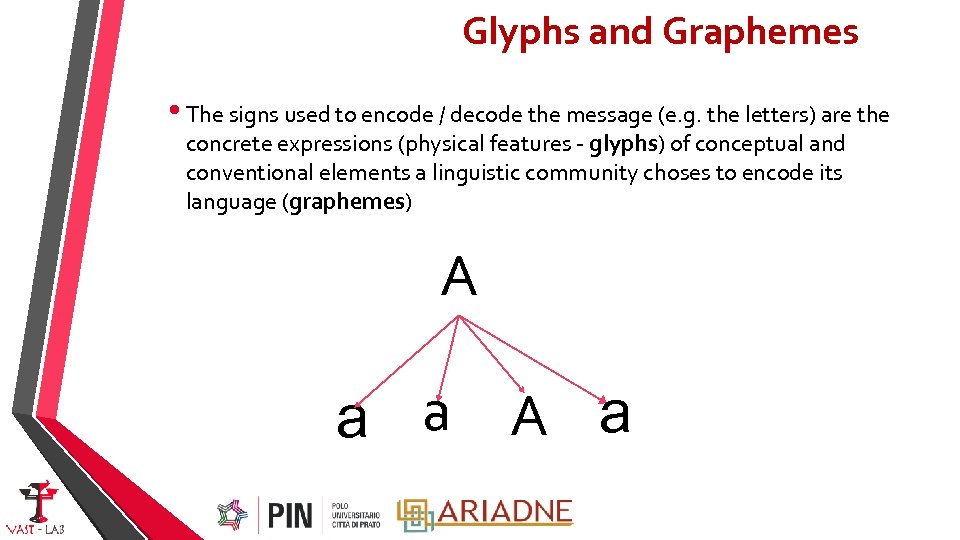 Glyphs and Graphemes • The signs used to encode / decode the message (e. g. the letters) are the concrete expressions (physical features - glyphs) of conceptual and conventional elements a linguistic community choses to encode its language (graphemes) A a a A a
 Written Text and Writing Event • TX 1 Written Text. Subclass of E 25 Man-Made Feature intended to describe a particular feature (i. e. , ‘set of glyphs’) created (i. e. , written) on various kinds of support, having semiotic significance and the declared purpose of conveying a specific message towards a given recipient or group of recipients • TX 2 Writing. Subclass of E 12 Production indicating the activity of creating textual entities using various techniques (painting, sculpture, etc. ) and by means of specific tools on a given physical carrier in a non-mechanical way
 Writing Systems • TX 3 Writing System. Subclass of E 29 Design or Procedure, refers to a conventional system (e. g. , the Greek alphabet) consisting of a set of characters (graphemes, E 90 ) used to codify a natural language. A writing system can be used to notate different natural languages, by means of specific rules in the combination and phonological value assignment of the chosen graphemes. It is used to produce a TX 1 Written Text through a TX 2 Writing event
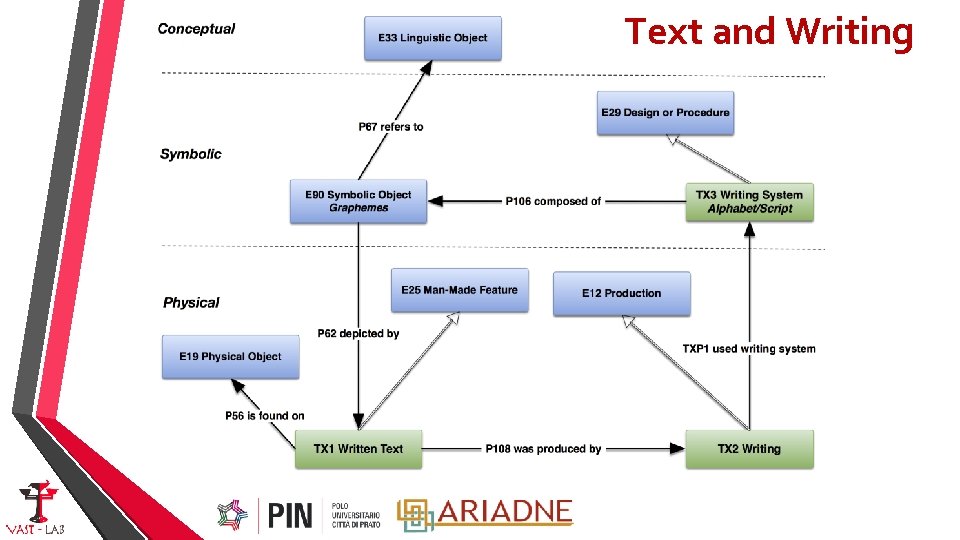 Text and Writing
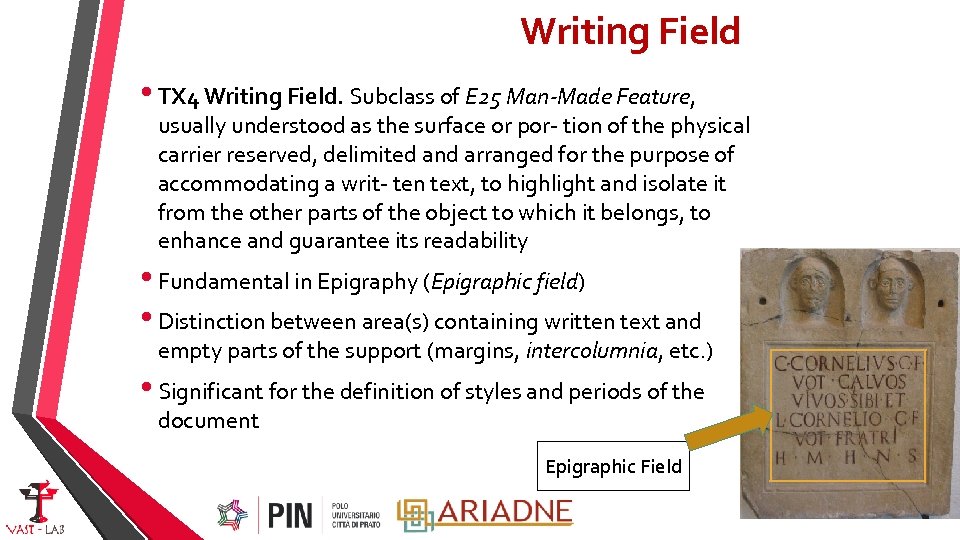 Writing Field • TX 4 Writing Field. Subclass of E 25 Man-Made Feature, usually understood as the surface or por- tion of the physical carrier reserved, delimited and arranged for the purpose of accommodating a writ- ten text, to highlight and isolate it from the other parts of the object to which it belongs, to enhance and guarantee its readability • Fundamental in Epigraphy (Epigraphic field) • Distinction between area(s) containing written text and empty parts of the support (margins, intercolumnia, etc. ) • Significant for the definition of styles and periods of the document Epigraphic Field
 Reading Event • TX 5 Reading. Subclass of the CRMsci S 4 Observation class, referring to the scientific autoptic examination of the document and constituting the first action required in preparation for its study. It consists of an accurate analysis of the surface and the signs and prescribes the use of specific tools and procedures, to establishing as faithfully as possible the exact value of each sign drawn on the physical feature
 Transcription Event • TX 6 Transcription. Subclass of E 7 Activity, referring to the activity of re-writing the text conducted by an editor. This operation, in some cases, involves a writing system (TX 3 ) different from that of the original text (e. g. , Latin characters to render a Coptic text); this results in a re-encoding of the text itself and, from a linguistic point of view, it is indicated more properly as a ‘transliteration’, because it implies a 1 : 1 relation between the signs of the two writing systems
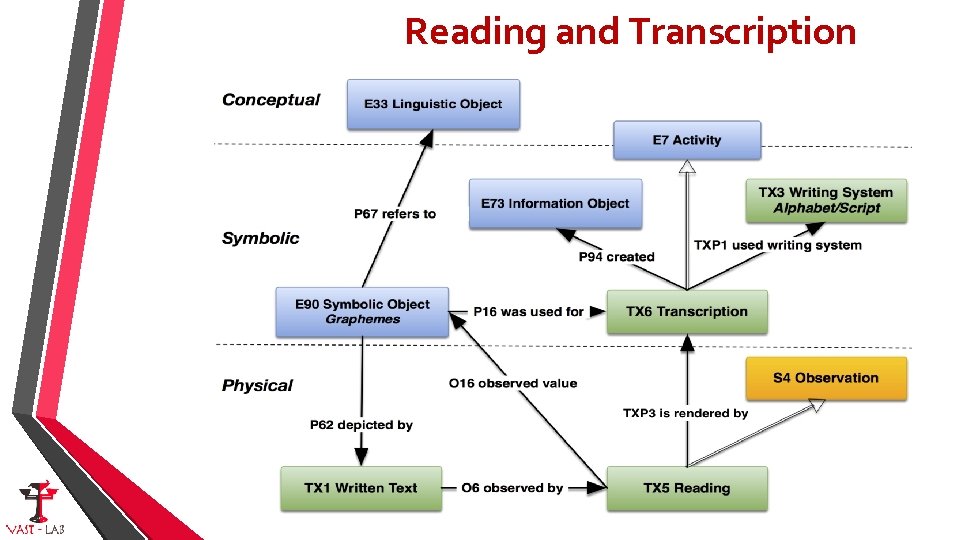 Reading and Transcription
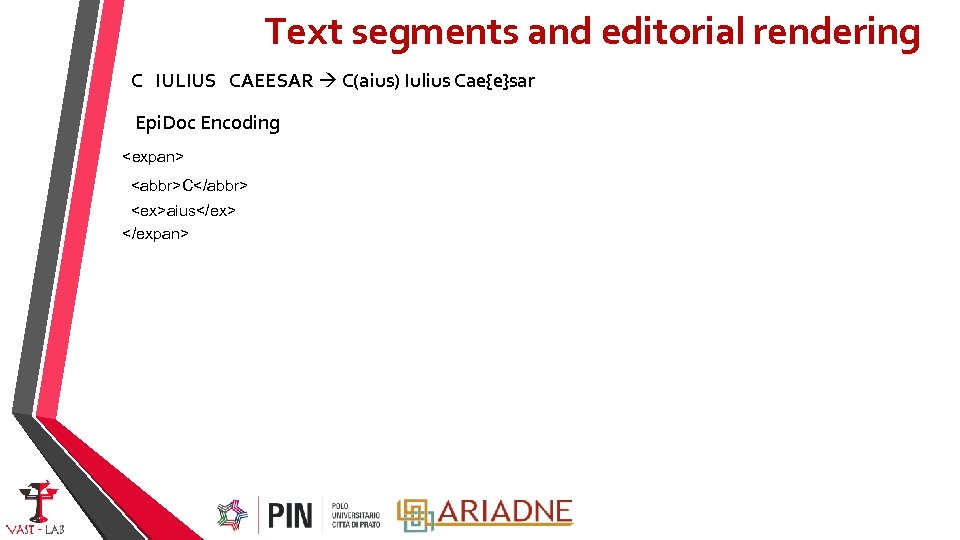
 Text and Text Segments • Segmentation of the text has various purposes: • 1. To describe the layout of the text (columns, pages, etc. ) • Decided by the writer during a TX 2 Writing event for communication • 2. To describe the material condition of a part of the text • Operated by scholars during a TX 5 Reading event for study • Related to the physical feature scholars observe ( TX 1 Written Text) • 3. To analyse the content of the text • Operated by scholars during a TX 5 Reading event for study • Related to the meaning, i. e. the E 33 Linguistic Object, • Editorial interventions on the text • E. g. : C IULIUS CAEESAR C(aius) Iulius Cae{e}sar
 Text and Text Segments • TX 7 Written Text Segment. Subclass of TX 1 Written Text, can be used to highlight specific portions of text on which the study focuses, specific phenomena appear or from which it is possible to derive special meanings. • Segmentation of ancient texts performed according with various typological/functional criteria and specific needs of the disciplines • columns, sections, chapters, lines, words, fragments …
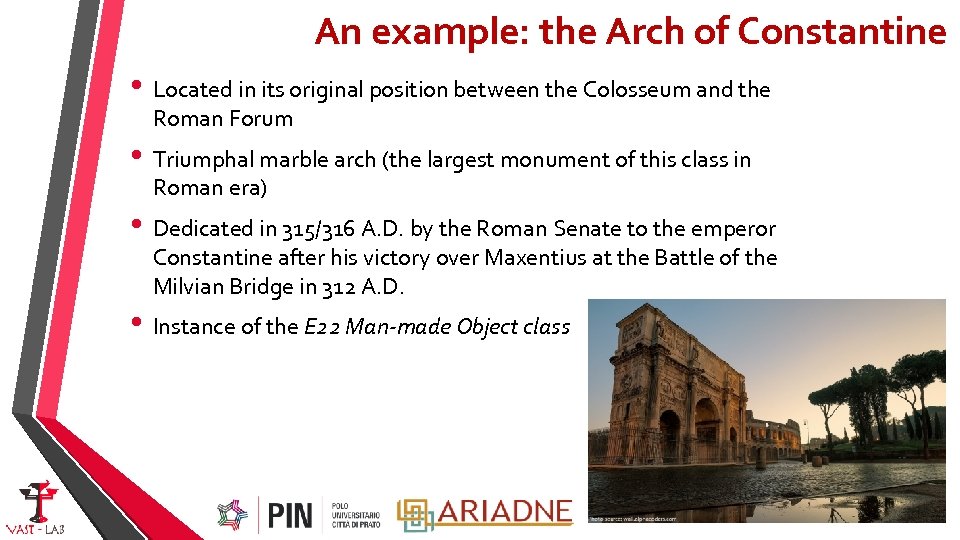 An example: the Arch of Constantine • Located in its original position between the Colosseum and the Roman Forum • Triumphal marble arch (the largest monument of this class in Roman era) • Dedicated in 315/316 A. D. by the Roman Senate to the emperor Constantine after his victory over Maxentius at the Battle of the Milvian Bridge in 312 A. D. • Instance of the E 22 Man-made Object class
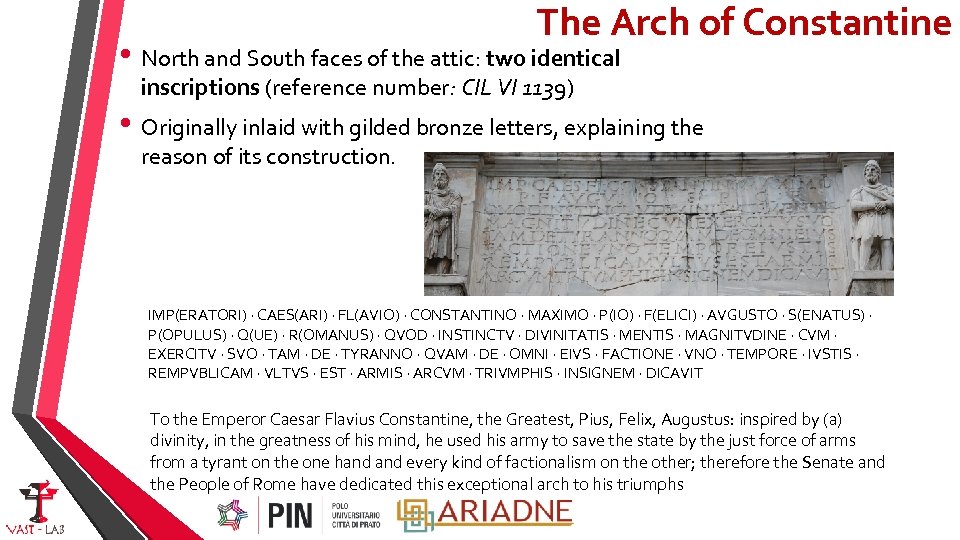 The Arch of Constantine • North and South faces of the attic: two identical inscriptions (reference number: CIL VI 1139) • Originally inlaid with gilded bronze letters, explaining the reason of its construction. IMP(ERATORI) · CAES(ARI) · FL(AVIO) · CONSTANTINO · MAXIMO · P(IO) · F(ELICI) · AVGUSTO · S(ENATUS) · P(OPULUS) · Q(UE) · R(OMANUS) · QVOD · INSTINCTV · DIVINITATIS · MENTIS · MAGNITVDINE · CVM · EXERCITV · SVO · TAM · DE · TYRANNO · QVAM · DE · OMNI · EIVS · FACTIONE · VNO · TEMPORE · IVSTIS · REMPVBLICAM · VLTVS · EST · ARMIS · ARCVM · TRIVMPHIS · INSIGNEM · DICAVIT To the Emperor Caesar Flavius Constantine, the Greatest, Pius, Felix, Augustus: inspired by (a) divinity, in the greatness of his mind, he used his army to save the state by the just force of arms from a tyrant on the one hand every kind of factionalism on the other; therefore the Senate and the People of Rome have dedicated this exceptional arch to his triumphs
 The Arch of Constantine: Investigations • Thousands of investigations during the centuries • • Description of the monument as archaeological object Transcription and comment of the texts • Reading and transcription by Bormann and Henzen in 1876 of the text(s) published in Corpus Inscriptionum Latinarum (CIL VI 1139) • Analysis and transcription carried out by Rodolfo Lanciani in 1892 (1) • The “INSTINCTV DIVINITATIS” text portion of the inscription(s) commented by Rodolfo Lanciani (1) Lanciani, R. : The significance of the inscription on the Arch of Constantine, in Pagan and Christian Rome, Houghton, Mifflin and Company, Boston and New York, 1892.
 Arch of Constantine: CRMtex Representation
 CRMtex and TEI/Epi. Doc • TX 7 Written Text Fragment: enhances mappings to TEI/Epi. Doc • TEI/Epi. Doc: no semiotic distinction in analysing a text segment: • Characters erased in the past and are illegible (physical condition)
 • Characters restored by modern editor (interpretation/rendering)
 Text segments and physical conditions
 Text segments and editorial rendering C IULIUS CAEESAR C(aius) Iulius Cae{e}sar Epi. Doc Encoding
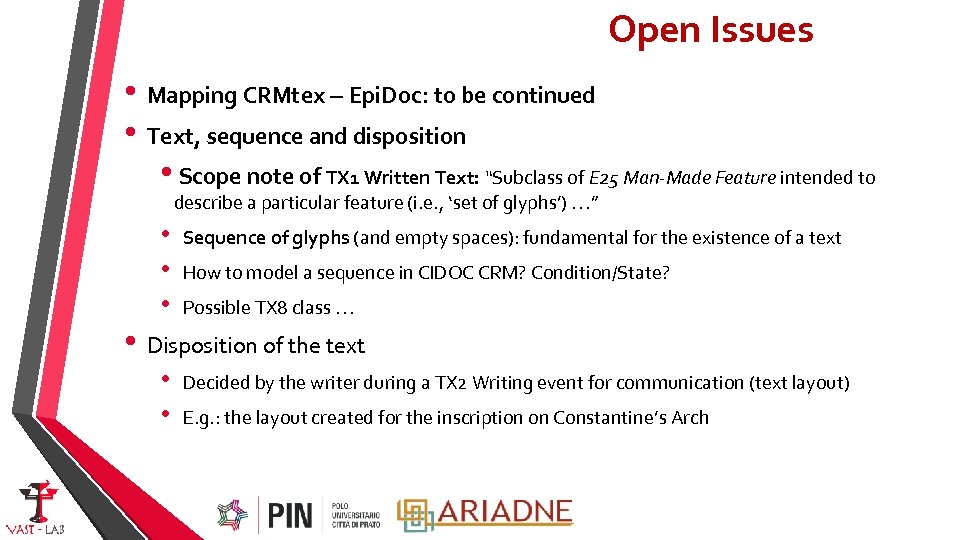 Open Issues • Mapping CRMtex – Epi. Doc: to be continued • Text, sequence and disposition • Scope note of TX 1 Written Text: “Subclass of E 25 Man-Made Feature intended to describe a particular feature (i. e. , ‘set of glyphs’) …” • • • Sequence of glyphs (and empty spaces): fundamental for the existence of a text How to model a sequence in CIDOC CRM? Condition/State? Possible TX 8 class … • Disposition of the text • • Decided by the writer during a TX 2 Writing event for communication (text layout) E. g. : the layout created for the inscription on Constantine’s Arch
 Thank you • Achille Felicetti • PIN, Università degli Studi di Firenze, Italy • achille. felicetti@pin. unifi. it