


 Скачать презентацию CRJ s Technology Infrastructure Evaluation Recommendations April 20
582ecc4298cdd5ce892789ac874c63b0.ppt
- Количество слайдов: 41
 CRJ's Technology Infrastructure: Evaluation & Recommendations April 20, 2010
 Goals for Today's Session My Role Provide framework for evaluating IT operations at CRJ Share Common Impact's analysis of CRJ's IT environment Answer your questions to clarify our analysis Your Role Think about root causes of the issues raised in this presentation – Potential root causes: human behavior, communication, process, technology itself Ask questions to clarify root causes and how CRJ could address them Begin thinking about how you would prioritize these issues – in preparation for our third meeting where the TAC suggests priorities to CFO and Director of TS Common Impact http: //www. commonimpact. org/
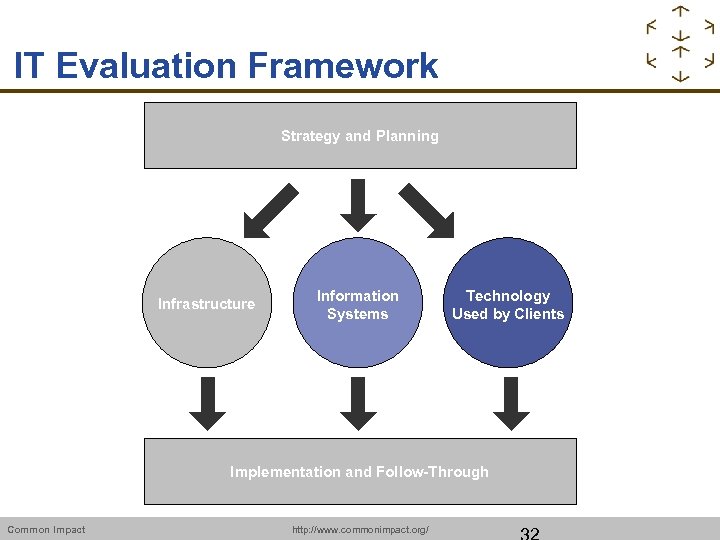
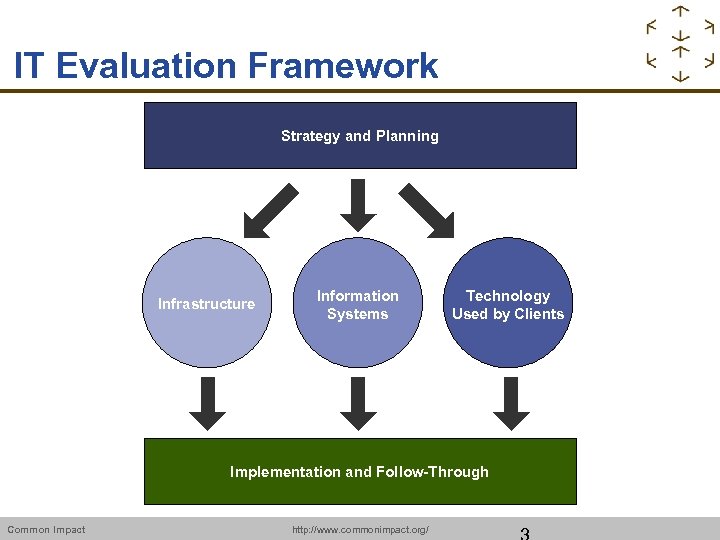 IT Evaluation Framework Strategy and Planning Infrastructure Information Systems Technology Used by Clients Implementation and Follow-Through Common Impact http: //www. commonimpact. org/
 Responsibilities: Strategy and Planning provides the framework for technology operations at CRJ, leading to proactive decision-making that advances the overall mission. Determining Philosophical Approach to IT (eg: build vs. buy, open source vs. commercial products, etc. ) Technology Planning & Budgeting Determining How IT Interfaces with Business Units, So They Can Proactively Identify and Solve Users' Needs Determining Staffing Structure of IT Department Creating Clear Performance Metrics for Each IT Employee Policy Creation and Enforcement Common Impact http: //www. commonimpact. org/
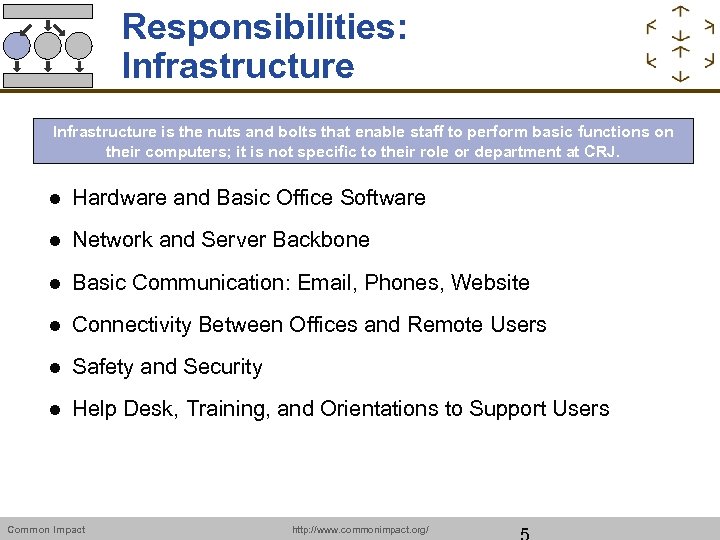 Responsibilities: Infrastructure is the nuts and bolts that enable staff to perform basic functions on their computers; it is not specific to their role or department at CRJ. Hardware and Basic Office Software Network and Server Backbone Basic Communication: Email, Phones, Website Connectivity Between Offices and Remote Users Safety and Security Help Desk, Training, and Orientations to Support Users Common Impact http: //www. commonimpact. org/
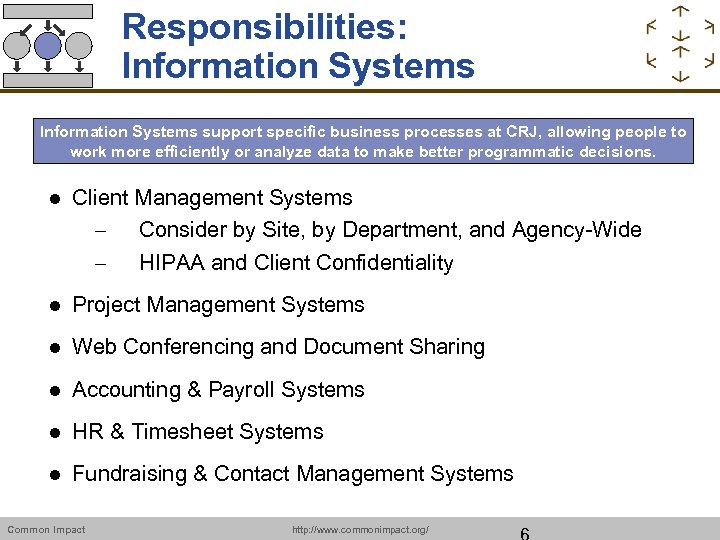 Responsibilities: Information Systems support specific business processes at CRJ, allowing people to work more efficiently or analyze data to make better programmatic decisions. Client Management Systems – Consider by Site, by Department, and Agency-Wide – HIPAA and Client Confidentiality Project Management Systems Web Conferencing and Document Sharing Accounting & Payroll Systems HR & Timesheet Systems Fundraising & Contact Management Systems Common Impact http: //www. commonimpact. org/
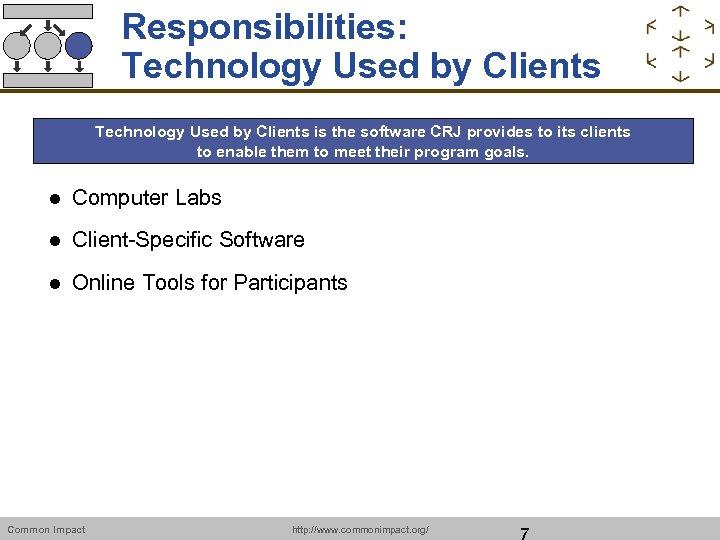 Responsibilities: Technology Used by Clients is the software CRJ provides to its clients to enable them to meet their program goals. Computer Labs Client-Specific Software Online Tools for Participants Common Impact http: //www. commonimpact. org/
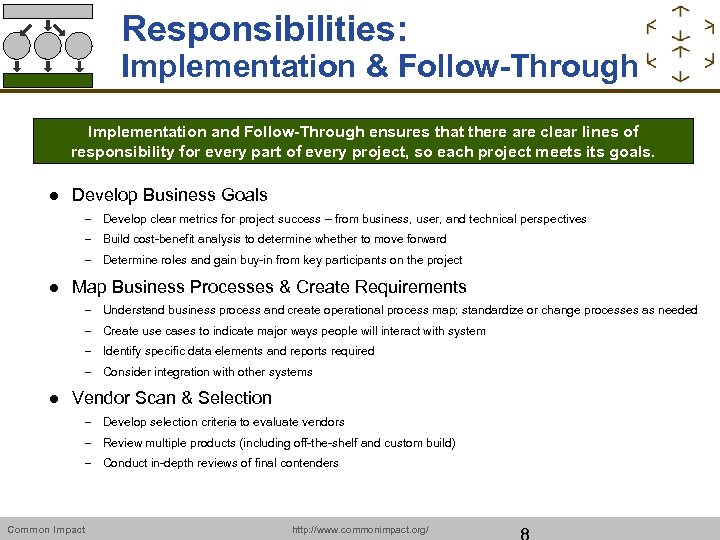 Responsibilities: Implementation & Follow-Through Implementation and Follow-Through ensures that there are clear lines of responsibility for every part of every project, so each project meets its goals. Develop Business Goals – Develop clear metrics for project success – from business, user, and technical perspectives – Build cost-benefit analysis to determine whether to move forward – Determine roles and gain buy-in from key participants on the project Map Business Processes & Create Requirements – Understand business process and create operational process map; standardize or change processes as needed – Create use cases to indicate major ways people will interact with system – Identify specific data elements and reports required – Consider integration with other systems Vendor Scan & Selection – Develop selection criteria to evaluate vendors – Review multiple products (including off-the-shelf and custom build) – Conduct in-depth reviews of final contenders Common Impact http: //www. commonimpact. org/
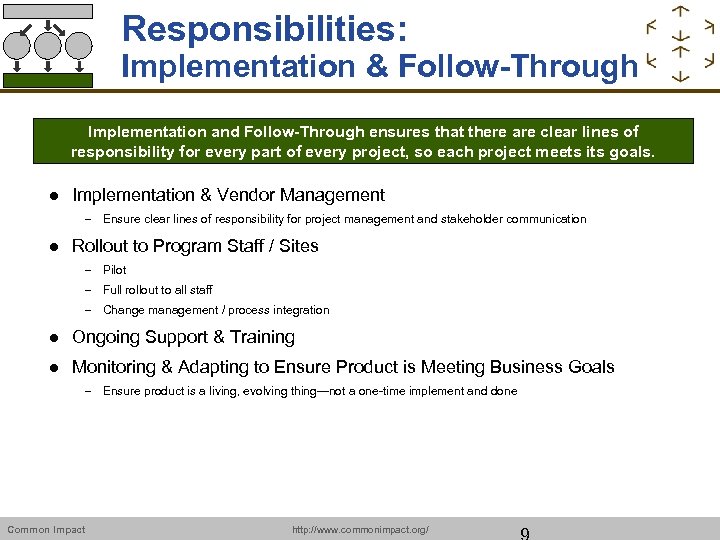 Responsibilities: Implementation & Follow-Through Implementation and Follow-Through ensures that there are clear lines of responsibility for every part of every project, so each project meets its goals. Implementation & Vendor Management – Ensure clear lines of responsibility for project management and stakeholder communication Rollout to Program Staff / Sites – Pilot – Full rollout to all staff – Change management / process integration Ongoing Support & Training Monitoring & Adapting to Ensure Product is Meeting Business Goals – Ensure product is a living, evolving thing—not a one-time implement and done Common Impact http: //www. commonimpact. org/
 Common Impact's Evaluation Common Impact http: //www. commonimpact. org/
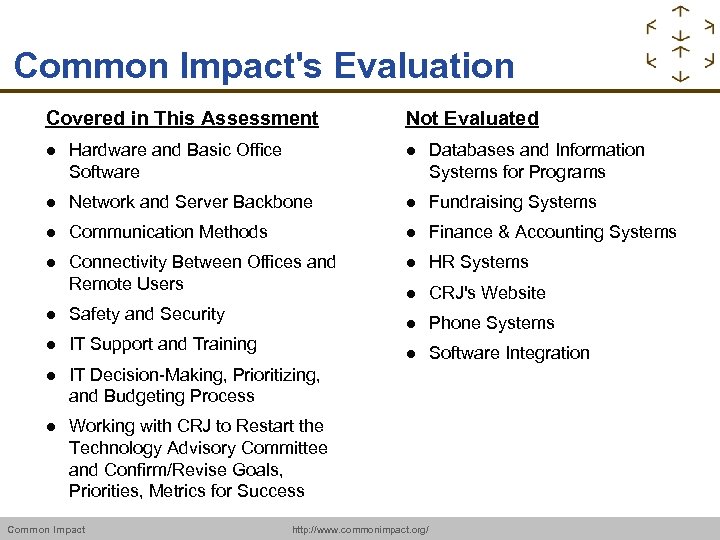 Common Impact's Evaluation Covered in This Assessment Not Evaluated Hardware and Basic Office Software Databases and Information Systems for Programs Network and Server Backbone Fundraising Systems Communication Methods Finance & Accounting Systems Connectivity Between Offices and Remote Users HR Systems CRJ's Website Phone Systems Software Integration Safety and Security IT Support and Training IT Decision-Making, Prioritizing, and Budgeting Process Working with CRJ to Restart the Technology Advisory Committee and Confirm/Revise Goals, Priorities, Metrics for Success Common Impact http: //www. commonimpact. org/
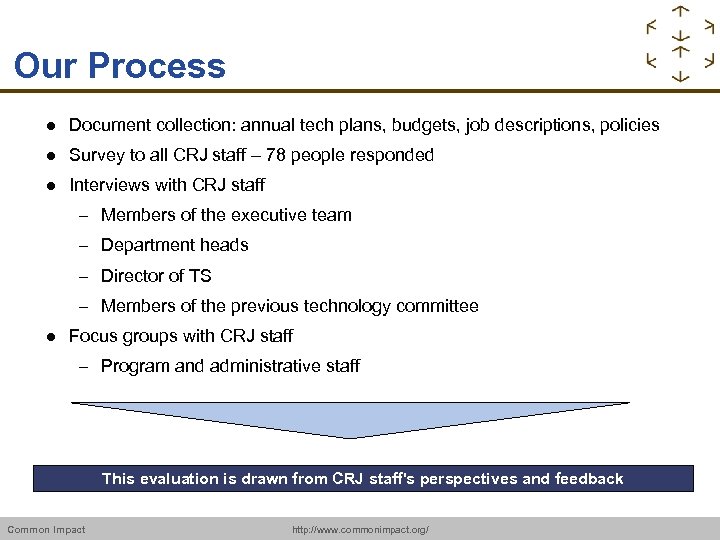 Our Process Document collection: annual tech plans, budgets, job descriptions, policies Survey to all CRJ staff – 78 people responded Interviews with CRJ staff – Members of the executive team – Department heads – Director of TS – Members of the previous technology committee Focus groups with CRJ staff – Program and administrative staff This evaluation is drawn from CRJ staff's perspectives and feedback Common Impact http: //www. commonimpact. org/
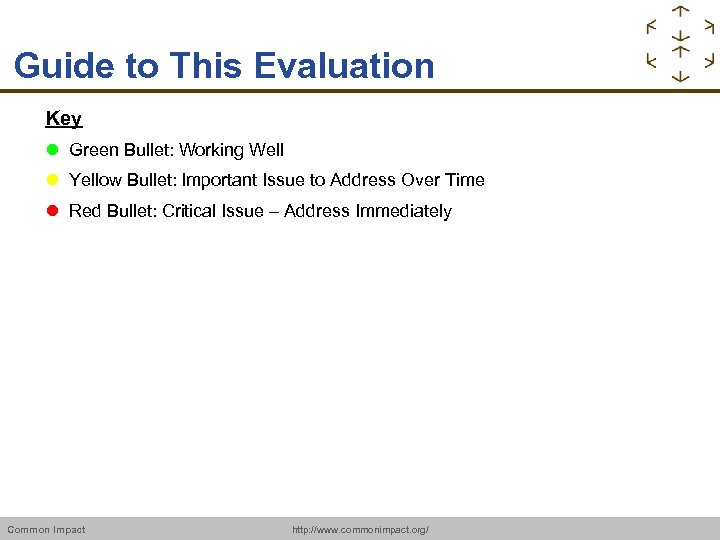 Guide to This Evaluation Key Green Bullet: Working Well Yellow Bullet: Important Issue to Address Over Time Red Bullet: Critical Issue – Address Immediately Common Impact http: //www. commonimpact. org/
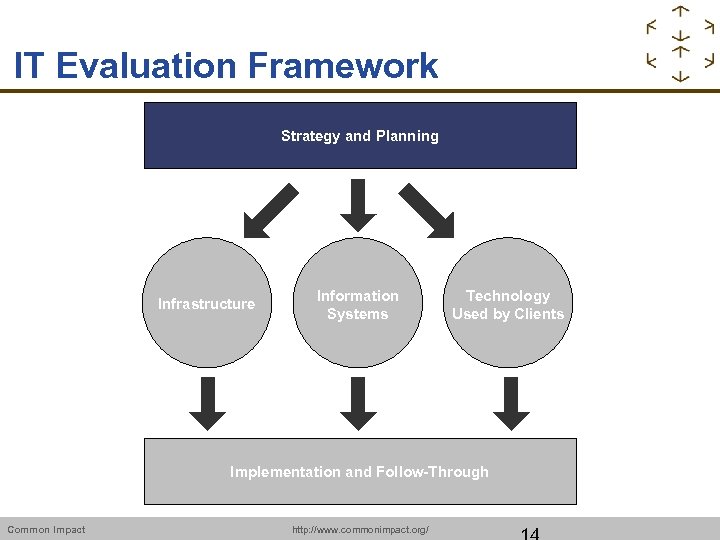 IT Evaluation Framework Strategy and Planning Infrastructure Information Systems Technology Used by Clients Implementation and Follow-Through Common Impact http: //www. commonimpact. org/
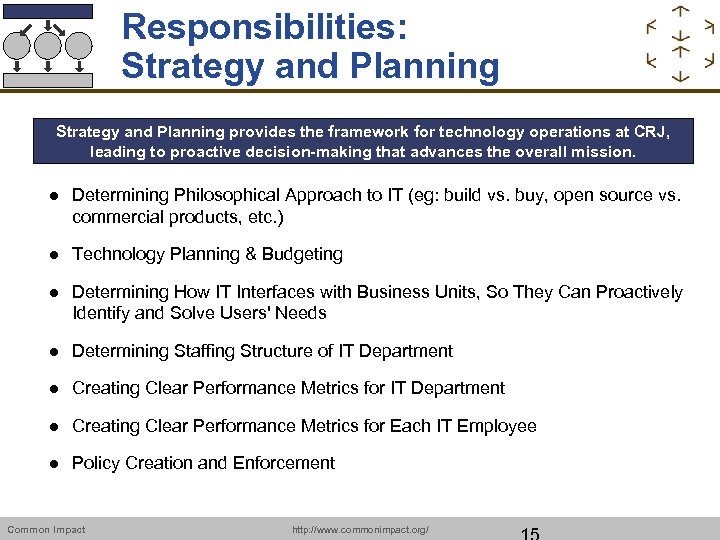 Responsibilities: Strategy and Planning provides the framework for technology operations at CRJ, leading to proactive decision-making that advances the overall mission. Determining Philosophical Approach to IT (eg: build vs. buy, open source vs. commercial products, etc. ) Technology Planning & Budgeting Determining How IT Interfaces with Business Units, So They Can Proactively Identify and Solve Users' Needs Determining Staffing Structure of IT Department Creating Clear Performance Metrics for Each IT Employee Policy Creation and Enforcement Common Impact http: //www. commonimpact. org/
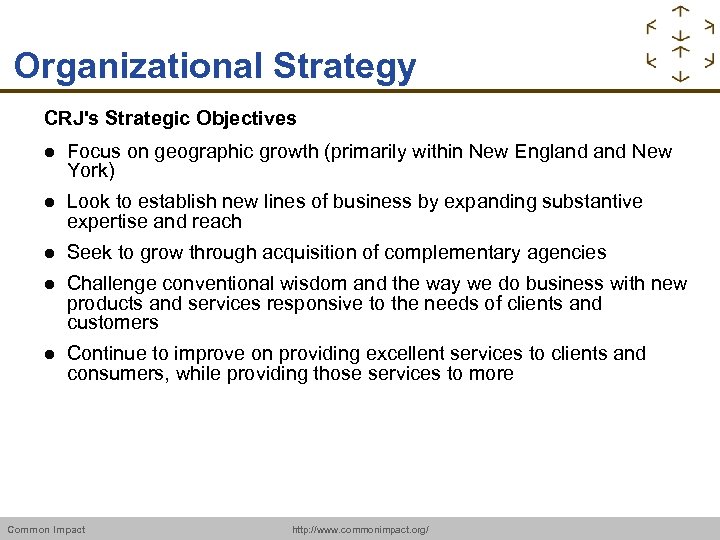 Organizational Strategy CRJ's Strategic Objectives Focus on geographic growth (primarily within New England New York) Look to establish new lines of business by expanding substantive expertise and reach Seek to grow through acquisition of complementary agencies Challenge conventional wisdom and the way we do business with new products and services responsive to the needs of clients and customers Continue to improve on providing excellent services to clients and consumers, while providing those services to more Common Impact http: //www. commonimpact. org/
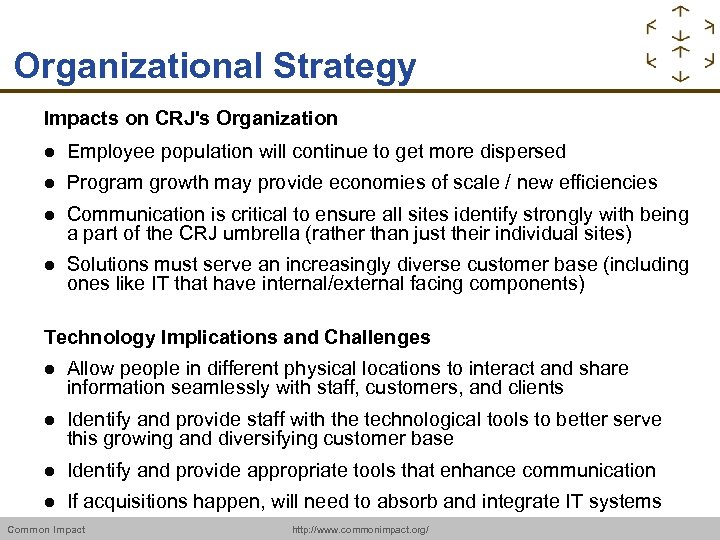 Organizational Strategy Impacts on CRJ's Organization Employee population will continue to get more dispersed Program growth may provide economies of scale / new efficiencies Communication is critical to ensure all sites identify strongly with being a part of the CRJ umbrella (rather than just their individual sites) Solutions must serve an increasingly diverse customer base (including ones like IT that have internal/external facing components) Technology Implications and Challenges Allow people in different physical locations to interact and share information seamlessly with staff, customers, and clients Identify and provide staff with the technological tools to better serve this growing and diversifying customer base Identify and provide appropriate tools that enhance communication If acquisitions happen, will need to absorb and integrate IT systems Common Impact http: //www. commonimpact. org/
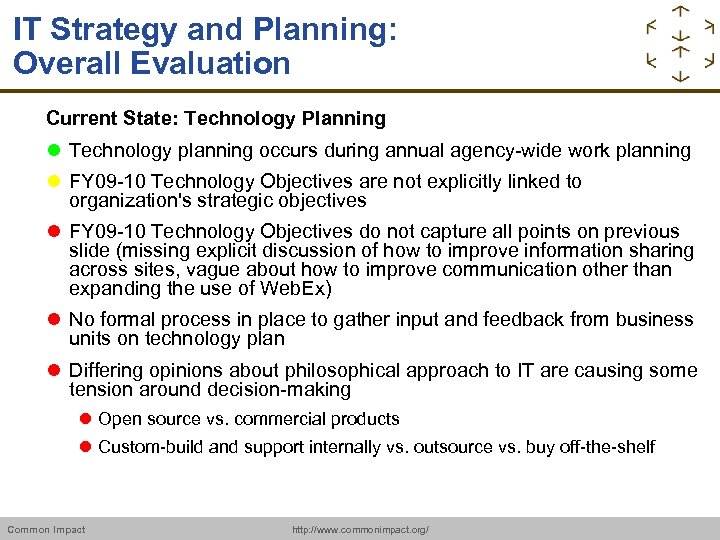 IT Strategy and Planning: Overall Evaluation Current State: Technology Planning Technology planning occurs during annual agency-wide work planning FY 09 -10 Technology Objectives are not explicitly linked to organization's strategic objectives FY 09 -10 Technology Objectives do not capture all points on previous slide (missing explicit discussion of how to improve information sharing across sites, vague about how to improve communication other than expanding the use of Web. Ex) No formal process in place to gather input and feedback from business units on technology plan Differing opinions about philosophical approach to IT are causing some tension around decision-making Open source vs. commercial products Custom-build and support internally vs. outsource vs. buy off-the-shelf Common Impact http: //www. commonimpact. org/
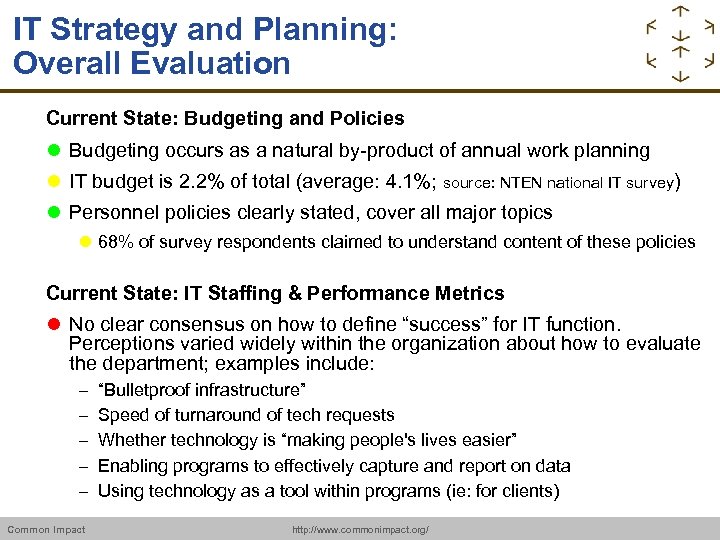 IT Strategy and Planning: Overall Evaluation Current State: Budgeting and Policies Budgeting occurs as a natural by-product of annual work planning IT budget is 2. 2% of total (average: 4. 1%; source: NTEN national IT survey) Personnel policies clearly stated, cover all major topics 68% of survey respondents claimed to understand content of these policies Current State: IT Staffing & Performance Metrics No clear consensus on how to define “success” for IT function. Perceptions varied widely within the organization about how to evaluate the department; examples include: – – – Common Impact “Bulletproof infrastructure” Speed of turnaround of tech requests Whether technology is “making people's lives easier” Enabling programs to effectively capture and report on data Using technology as a tool within programs (ie: for clients) http: //www. commonimpact. org/
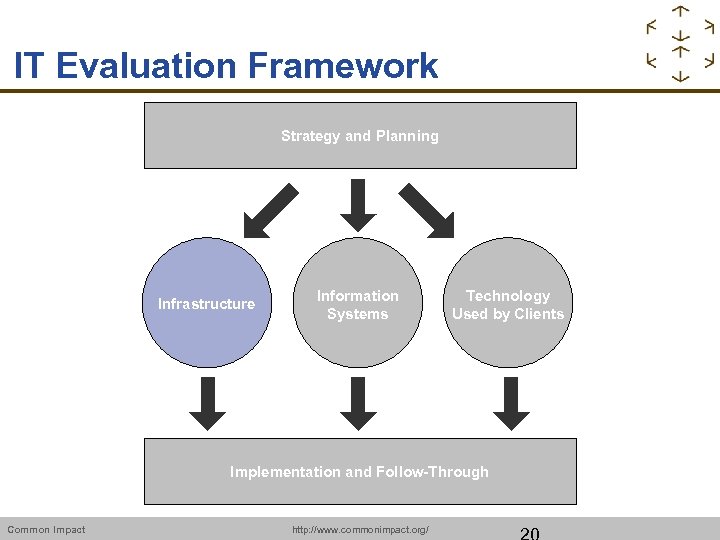 IT Evaluation Framework Strategy and Planning Infrastructure Information Systems Technology Used by Clients Implementation and Follow-Through Common Impact http: //www. commonimpact. org/
 Responsibilities: Infrastructure is the nuts and bolts that enable staff to perform basic functions on their computers; it is not specific to their role or department at CRJ. Hardware and Basic Office Software Network and Server Backbone Basic Communication: Email, Phones, Website Connectivity Between Offices and Remote Users Safety and Security Help Desk, Training, and Orientations to Support Users Common Impact http: //www. commonimpact. org/
 Infrastructure: Hardware and Basic Office Software Current State: Desktop and Laptop Computers for each full-time employee who needs them Most computers meet CI's minimum hardware requirements A few people commented that their computers are slow; 6 out of 20 of sampled computers have less than 1 GB of memory Computers are phased out every 4 -5 years Computers purchased with three-year service agreements Current State: Software All computers use business class operating systems All computers have office productivity software Different versions of Microsoft Office causing some compatibility issues Users can install their own software; 2 of 20 sampled computers had games/file sharing software Common Impact http: //www. commonimpact. org/
 Infrastructure: Network and Server Backbone Current State: Internet Most programs have high speed internet services Cable and Satellite in Western MA, Cable or DSL in Boston Current State: Servers and Shared Drives Local Area Networks at all major locations, either server or peer-to-peer No unified corporate network: employees at one site cannot access files from other sites Common Impact http: //www. commonimpact. org/
 Infrastructure: Basic Communication Current State: Email System All key staff have email addresses Most employees find email system cumbersome Minimal synchronization between Outlook, webmail, and Blackberry No system-wide address book Inability to set Out of Office auto-reply Limitation of attachment size 36% of survey respondents cited problems with spam (both volume of spam in inbox and good messages getting sent to spam folder) Current State: Website and Phones Not evaluated by Common Impact http: //www. commonimpact. org/
 Infrastructure: Connectivity Between Offices Current State: Document Sharing & Project Spaces 30% of survey respondents say they use shared drive to store files Main reasons why people said they didn't use it: - They don't know how to find it or don't feel trained to use it - They have security concerns / don't know how to protect files - They don't think there is enough space to store their files - They think shared files are hard to find (disorganized) Document management system (Open. Doc. Man) built to better organize files, but usage has been minimal Cited reasons: Disorganized, hard to use, unclear naming conventions to understand different versions of files, “no one manages it” Intranet for corporate forms described as easy to use, well organized Site for maintenance requests, training manuals, forms for HR, fiscal and administration Common Impact http: //www. commonimpact. org/
 Infrastructure: Connectivity Between Offices Current State: Laptops, Black. Berries, and Remote Login Increasing numbers of staff are using laptops and Black. Berries Policy is unclear to mid-level managers about who gets Black. Berry Black. Berries do not sync well with corporate email IT department uses Log. Me. In to remotely administer computers, staff generally feel fine using this support method Not enough licenses of Log. Me. In for other staff to access files remotely Current State: Usage of Home Computers Some people use home computers to access email, send documents to themselves for editing, or to convert between Office file formats Common Impact IT department has no control over security of home computers Potential security issue if client information is taken off corporate network http: //www. commonimpact. org/
 Infrastructure: Connectivity Between Offices Current State: Virtual Communication Tools for virtual communication are typically originated within CJI and sometimes adopted by other business units CJI uses Google Chat for regular communication, appears to work well; no other business units discussed need for chat or instant messaging As discussed on previous slides, there is no seamless, universally adopted method for users to share documents across sites Infrastructure to support virtual meetings or trainings does not yet exist; Web. Ex virtual conferencing system has been purchased but there is a general perception that it is not used effectively Needs discussed: CSNH meetings between people on the road; CJI conference calls; virtual trainings for people at remote sites instead of having them come to main office Common Impact http: //www. commonimpact. org/
 Infrastructure: Safety and Security Current State: Backups Policy requires individuals to backup their own files, but only 40% do so Half of people who do backup files only do it monthly Policies state “CRJ’s back-up protocols are subject to failure and human error, and should not be relied upon as a substitute for proper long-term filing procedures. ” Current State: Passwords and User Roles Users are required to log into their computers with a password Users are not required to change passwords No requirements exist around the complexity of passwords File locations on server are segmented by department Staff do not know how to create confidential folders on the server Managers, staff, and clients sometimes use same login to computer Common Impact http: //www. commonimpact. org/
 Infrastructure: Safety and Security Current State: Malware Prevention 20 of 20 sampled computers up to date with Windows Updates 6 of 20 sampled computers missing Office Updates 20 of 20 sampled computers up to date with Anti-Virus and Anti. Spyware software Current State: Network Security Wireless router protected by password Hardware and software firewalls exist to protect networks Common Impact http: //www. commonimpact. org/
 Infrastructure: Help Desk, Training, and IT Support Current State: Availability of IT Support 89% of survey respondents say IT staff are readily available when they need help Locations without an IT person perceived getting less timely service Current State: Communication around IT Support 82% of survey respondents felt that IT communicates in a way that is easy for them to understand With specialized software, staff were sometimes confused about who is responsible for supporting the application Current State: Redundancy No external consultants in use to provide backup when IT staff is out sick or on vacation (with addition of third IT person, may be less critical) Common Impact did not review custom-built software applications, but these should be checked to ensure multiple people understand design Common Impact http: //www. commonimpact. org/
 Infrastructure: Help Desk, Training, and IT Support Current State: Training & Orientation Conflicting perceptions about the need for training vs. actual effort to make them happen 65% of survey respondents said they could use more training—from basic network use to office productivity software to more advanced applications 14% of survey respondents said they had done IT training in the last year When IT department offered trainings, few took advantage of them 93% of survey respondents said they met CI's essential computer skills 67% of survey respondents said they met CI's intermediate skills No clear guidelines on what technology skills program staff should have No IT orientation provided to new staff Common Impact http: //www. commonimpact. org/
 IT Evaluation Framework Strategy and Planning Infrastructure Information Systems Technology Used by Clients Implementation and Follow-Through Common Impact http: //www. commonimpact. org/
 Information Systems & Technology Used by Clients Out of Scope These topics were not evaluated by Common Impact CRJ's Technology Advisory Committee should still pursue an evaluation of what is working well and what needs to be improved in these areas We did hear one common theme that CRJ staff were unclear about who should be building these systems. Key questions: – Should business unit staff know more about technology so they can identify their own needs? – Should the IT department know more about how business units operate so they can help advance each unit's business goals? – Who is responsible for proactively advancing the agenda of technology use in programs—both for internal data systems and for the technology used by CRJ's client population? Common Impact http: //www. commonimpact. org/
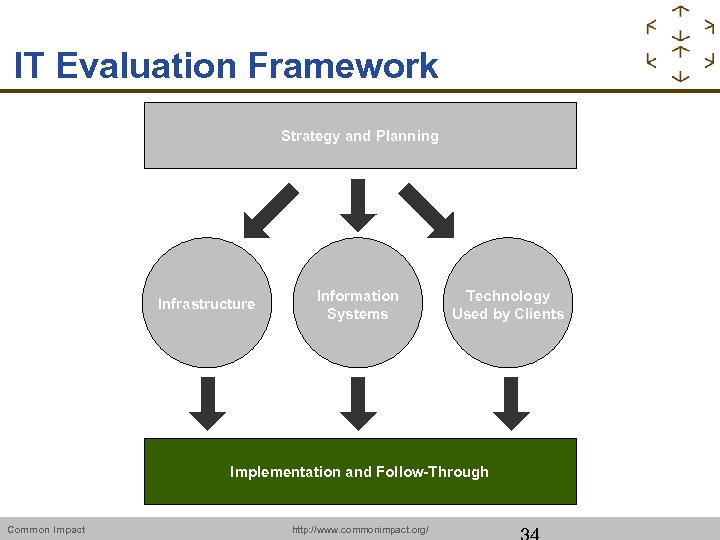 IT Evaluation Framework Strategy and Planning Infrastructure Information Systems Technology Used by Clients Implementation and Follow-Through Common Impact http: //www. commonimpact. org/
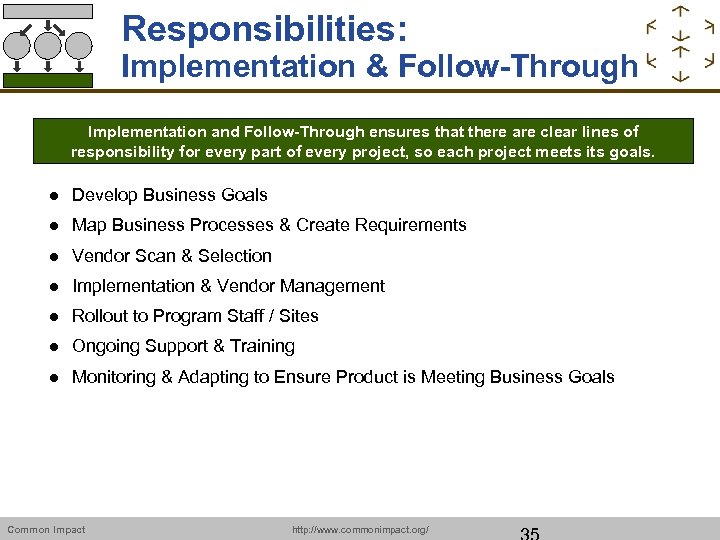 Responsibilities: Implementation & Follow-Through Implementation and Follow-Through ensures that there are clear lines of responsibility for every part of every project, so each project meets its goals. Develop Business Goals Map Business Processes & Create Requirements Vendor Scan & Selection Implementation & Vendor Management Rollout to Program Staff / Sites Ongoing Support & Training Monitoring & Adapting to Ensure Product is Meeting Business Goals Common Impact http: //www. commonimpact. org/
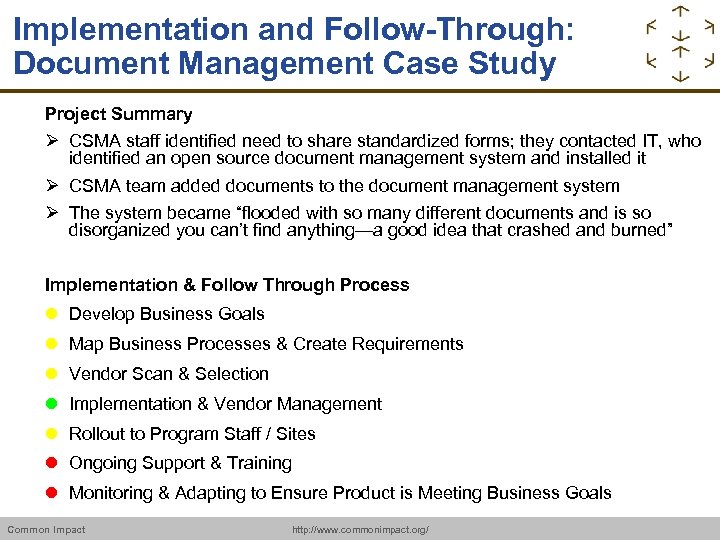 Implementation and Follow-Through: Document Management Case Study Project Summary CSMA staff identified need to share standardized forms; they contacted IT, who identified an open source document management system and installed it CSMA team added documents to the document management system The system became “flooded with so many different documents and is so disorganized you can’t find anything—a good idea that crashed and burned” Implementation & Follow Through Process Develop Business Goals Map Business Processes & Create Requirements Vendor Scan & Selection Implementation & Vendor Management Rollout to Program Staff / Sites Ongoing Support & Training Monitoring & Adapting to Ensure Product is Meeting Business Goals Common Impact http: //www. commonimpact. org/
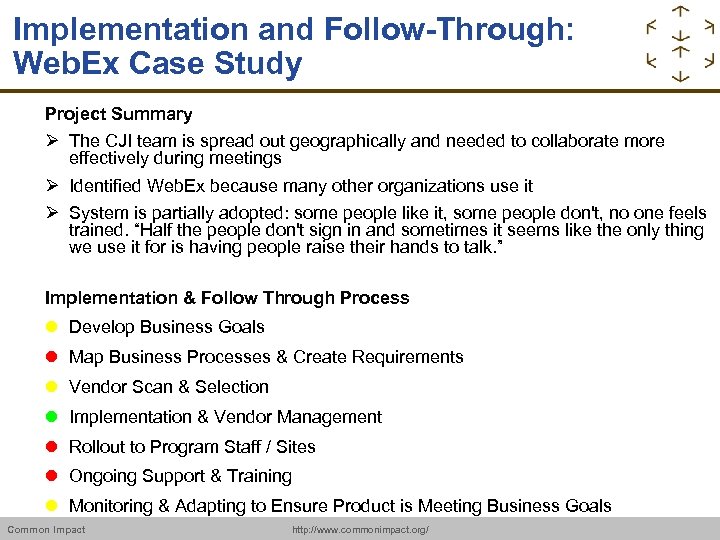 Implementation and Follow-Through: Web. Ex Case Study Project Summary The CJI team is spread out geographically and needed to collaborate more effectively during meetings Identified Web. Ex because many other organizations use it System is partially adopted: some people like it, some people don't, no one feels trained. “Half the people don't sign in and sometimes it seems like the only thing we use it for is having people raise their hands to talk. ” Implementation & Follow Through Process Develop Business Goals Map Business Processes & Create Requirements Vendor Scan & Selection Implementation & Vendor Management Rollout to Program Staff / Sites Ongoing Support & Training Monitoring & Adapting to Ensure Product is Meeting Business Goals Common Impact http: //www. commonimpact. org/
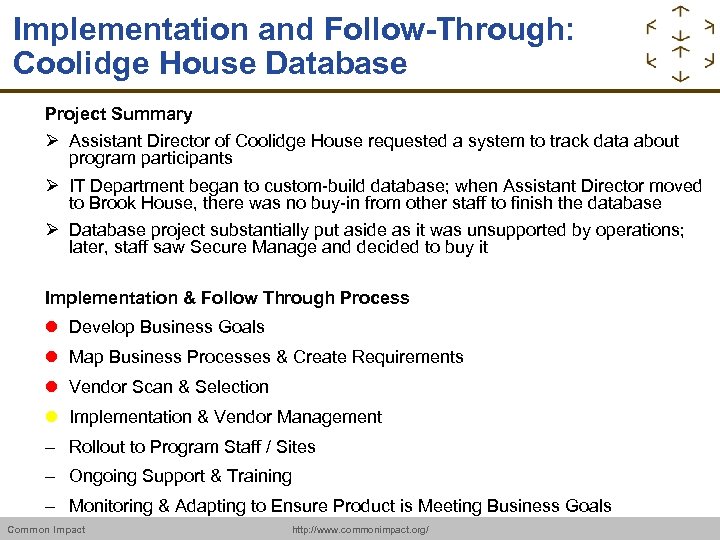 Implementation and Follow-Through: Coolidge House Database Project Summary Assistant Director of Coolidge House requested a system to track data about program participants IT Department began to custom-build database; when Assistant Director moved to Brook House, there was no buy-in from other staff to finish the database Database project substantially put aside as it was unsupported by operations; later, staff saw Secure Manage and decided to buy it Implementation & Follow Through Process Develop Business Goals Map Business Processes & Create Requirements Vendor Scan & Selection Implementation & Vendor Management ‒ Rollout to Program Staff / Sites ‒ Ongoing Support & Training ‒ Monitoring & Adapting to Ensure Product is Meeting Business Goals Common Impact http: //www. commonimpact. org/
 Summary of IT Evaluation Common Impact http: //www. commonimpact. org/
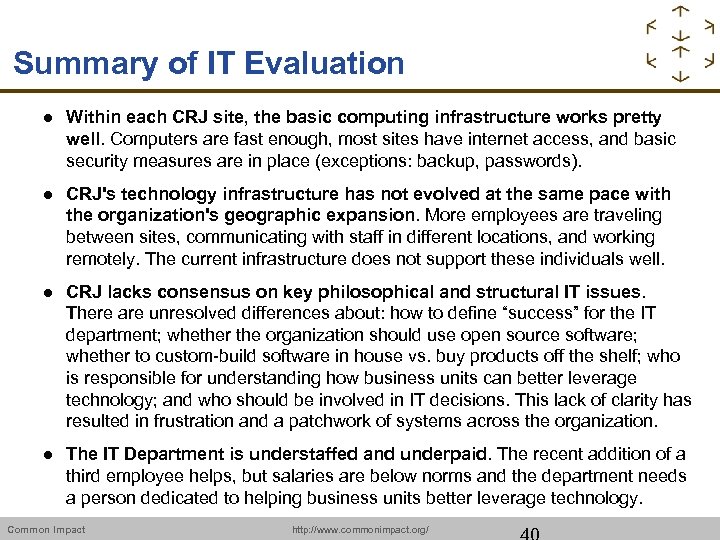 Summary of IT Evaluation Within each CRJ site, the basic computing infrastructure works pretty well. Computers are fast enough, most sites have internet access, and basic security measures are in place (exceptions: backup, passwords). CRJ's technology infrastructure has not evolved at the same pace with the organization's geographic expansion. More employees are traveling between sites, communicating with staff in different locations, and working remotely. The current infrastructure does not support these individuals well. CRJ lacks consensus on key philosophical and structural IT issues. There are unresolved differences about: how to define “success” for the IT department; whether the organization should use open source software; whether to custom-build software in house vs. buy products off the shelf; who is responsible for understanding how business units can better leverage technology; and who should be involved in IT decisions. This lack of clarity has resulted in frustration and a patchwork of systems across the organization. The IT Department is understaffed and underpaid. The recent addition of a third employee helps, but salaries are below norms and the department needs a person dedicated to helping business units better leverage technology. Common Impact http: //www. commonimpact. org/
 Summary of IT Evaluation The decision-making for IT projects lacks consistency and structure. CRJ has taken an informal approach to major IT initiatives. As a result, some projects have failed because there were unclear business goals and success metrics, the project lacked buy-in, the software was built/purchased without examining competitors, there was no plan to address cultural and operational implications of the new software, and/or there was a lack of training and postimplementation support. Overall, an IT crisis is emerging. As CRJ's technology challenges have shifted from establishing a basic infrastructure to supporting each department's operational processes, business units are feeling less supported. If future IT initiatives are to be successful, the department must understand how they can better meet all users' needs, and proactively communicate how they are addressing everyone's concerns. Common Impact http: //www. commonimpact. org/