


 Скачать презентацию Critical Mission Support Through Energy Security Susan Van
499d532bece5a90ed9506aaafea6beb1.ppt
- Количество слайдов: 11
 Critical Mission Support Through Energy Security Susan Van Scoyoc Concurrent Technologies Corporation 16 August 2012 Energy Huntsville Meeting Huntsville, AL 1
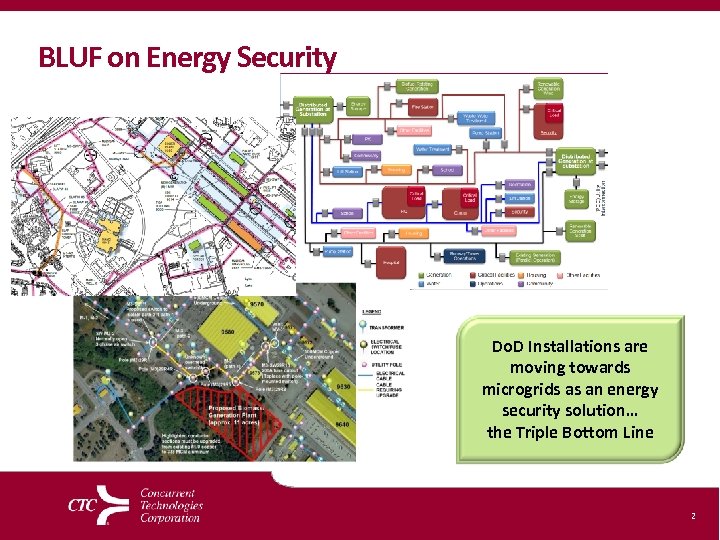 BLUF on Energy Security Do. D Installations are moving towards microgrids as an energy security solution… the Triple Bottom Line 2
 What is the State of your Energy Security? • Are the critical missions and corresponding critical facilities identified? • Are all the mission critical equipment connected to the auxiliary generators? • Are your auxiliary generators capable of long-term continuous operation? • Can the generation be grid connected and operate in parallel? • Do you have large prime power generators on site? Are they connected to the distribution system? • Can the installation distribution system be operated independently from the commercial electric utility supply? 3
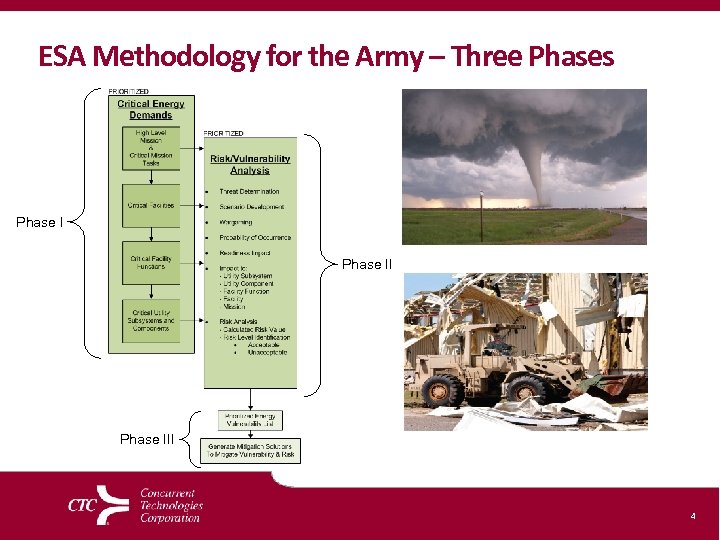 ESA Methodology for the Army – Three Phases Phase III 4
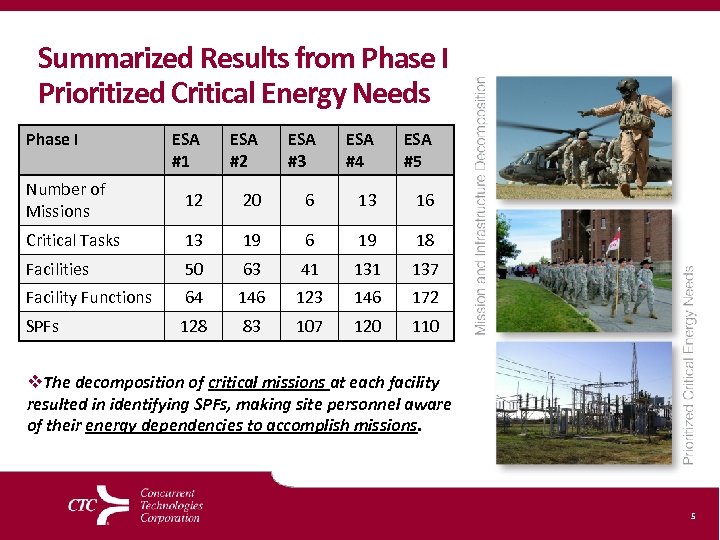 Summarized Results from Phase I Prioritized Critical Energy Needs Phase I ESA #1 ESA #2 ESA #3 ESA #4 ESA #5 Number of Missions 12 20 6 13 16 Critical Tasks 13 19 6 19 18 Facilities 50 63 41 137 Facility Functions 64 146 123 146 172 SPFs 128 83 107 120 110 v. The decomposition of critical missions at each facility resulted in identifying SPFs, making site personnel aware of their energy dependencies to accomplish missions. 5
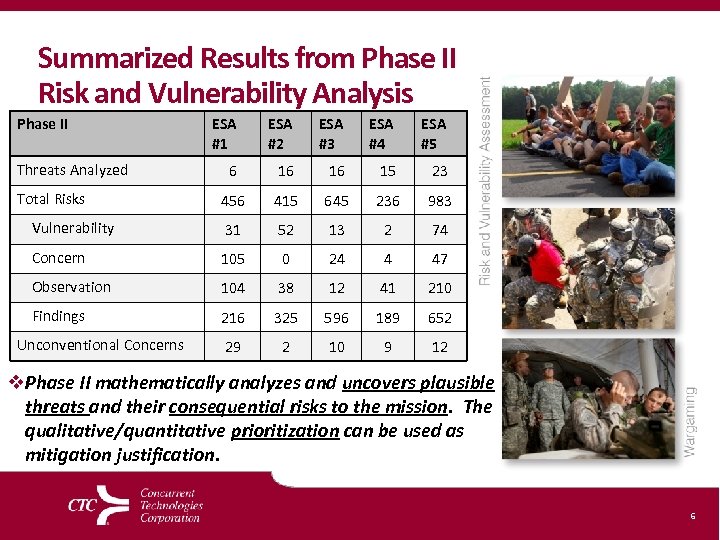 Summarized Results from Phase II Risk and Vulnerability Analysis Phase II ESA #1 ESA #2 ESA #3 ESA #4 ESA #5 6 16 16 15 23 456 415 645 236 983 Vulnerability 31 52 13 2 74 Concern 105 0 24 4 47 Observation 104 38 12 41 210 Findings 216 325 596 189 652 29 2 10 9 12 Threats Analyzed Total Risks Unconventional Concerns v. Phase II mathematically analyzes and uncovers plausible threats and their consequential risks to the mission. The qualitative/quantitative prioritization can be used as mitigation justification. 6
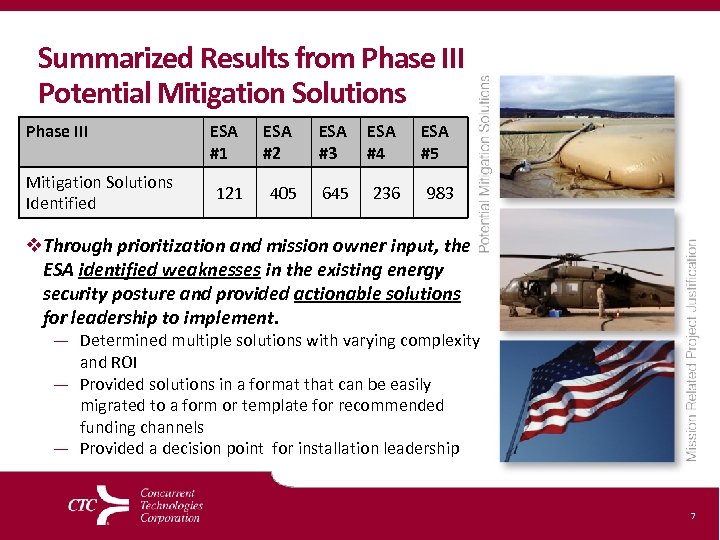 Summarized Results from Phase III Potential Mitigation Solutions Phase III Mitigation Solutions Identified ESA #1 121 ESA #2 405 ESA #3 ESA #4 645 236 ESA #5 983 v. Through prioritization and mission owner input, the ESA identified weaknesses in the existing energy security posture and provided actionable solutions for leadership to implement. — Determined multiple solutions with varying complexity and ROI — Provided solutions in a format that can be easily migrated to a form or template for recommended funding channels — Provided a decision point for installation leadership 7
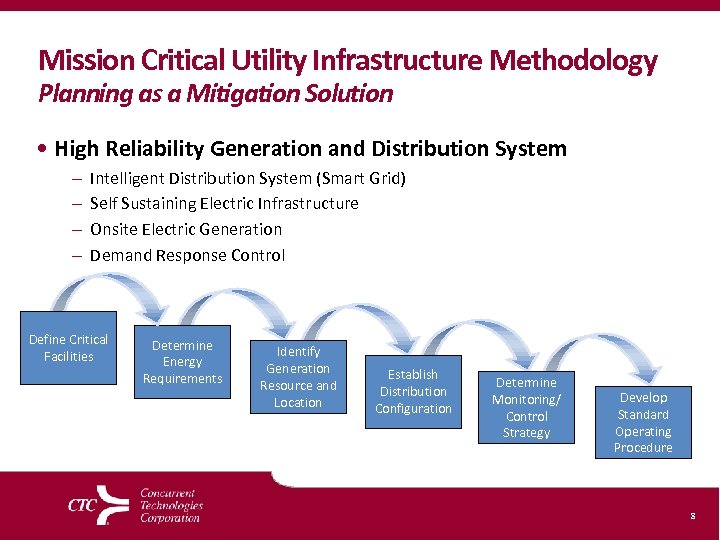 Mission Critical Utility Infrastructure Methodology Planning as a Mitigation Solution • High Reliability Generation and Distribution System – – Intelligent Distribution System (Smart Grid) Self Sustaining Electric Infrastructure Onsite Electric Generation Demand Response Control Define Critical Facilities Determine Energy Requirements Identify Generation Resource and Location Establish Distribution Configuration Determine Monitoring/ Control Strategy Develop Standard Operating Procedure 8
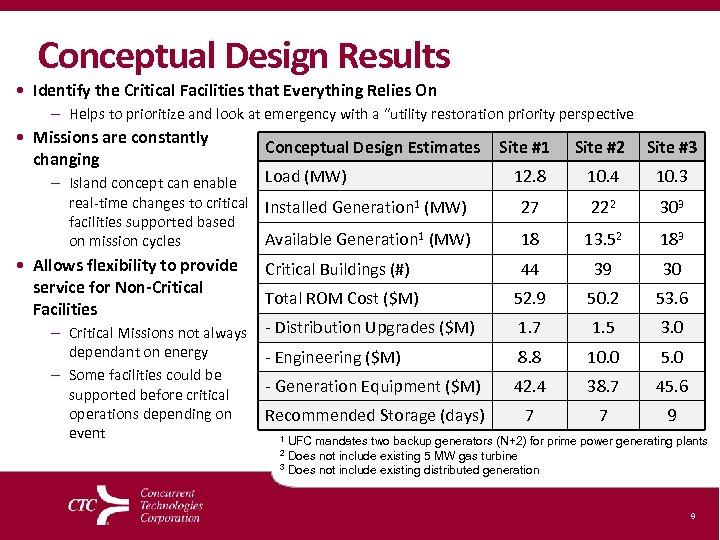 Conceptual Design Results • Identify the Critical Facilities that Everything Relies On – Helps to prioritize and look at emergency with a “utility restoration priority perspective • Missions are constantly changing Conceptual Design Estimates Site #1 Site #2 Site #3 12. 8 10. 4 10. 3 27 222 303 18 13. 52 183 Critical Buildings (#) 44 39 30 Total ROM Cost ($M) 52. 9 50. 2 53. 6 - Distribution Upgrades ($M) 1. 7 1. 5 3. 0 - Engineering ($M) 8. 8 10. 0 5. 0 - Generation Equipment ($M) 42. 4 38. 7 45. 6 Recommended Storage (days) 7 7 9 Load (MW) – Island concept can enable real-time changes to critical Installed Generation 1 (MW) facilities supported based Available Generation 1 (MW) on mission cycles • Allows flexibility to provide service for Non-Critical Facilities – Critical Missions not always dependant on energy – Some facilities could be supported before critical operations depending on event UFC mandates two backup generators (N+2) for prime power generating plants Does not include existing 5 MW gas turbine 3 Does not include existing distributed generation 1 2 9
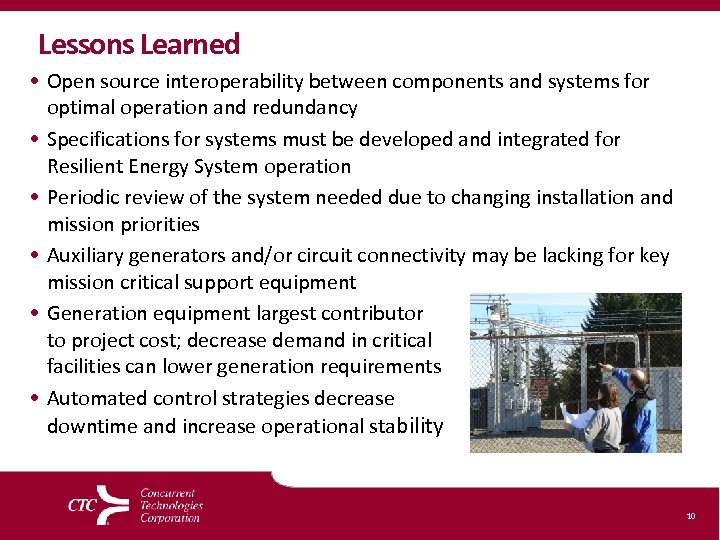 Lessons Learned • Open source interoperability between components and systems for optimal operation and redundancy • Specifications for systems must be developed and integrated for Resilient Energy System operation • Periodic review of the system needed due to changing installation and mission priorities • Auxiliary generators and/or circuit connectivity may be lacking for key mission critical support equipment • Generation equipment largest contributor to project cost; decrease demand in critical facilities can lower generation requirements • Automated control strategies decrease downtime and increase operational stability 10
 Technology Gaps • Standard communication structure for both monitoring and command/control of distributed resources being implemented outside of a utility infrastructure • User-accessible, documented power interface design approach - how to choose components such as inductors/capacitors for solid application • Multimode inverters that can operate grid connected and switch to grid independent – Bi-directional DC to DC – Bi-directional AC to DC and DC to AC • Cyber security standards/protocols to mitigate threats • Small scale nuclear plants for military installations 11