


 Скачать презентацию Critical Issues EDA 590 Dr Rich Hawkins drrjh optonline
d61a212cf3c3a09ee877cd04567a2adf.ppt
- Количество слайдов: 101
 Critical Issues EDA 590 Dr. Rich Hawkins drrjh@optonline. net
 Pertinent Data n Name n Home Address n Home Tel. # n Work Address n Work Tel # n Grade/Discipline Taught n Email 1 n Administrative Aspiration n Email 2
 Thoughts about Leadership “Leaders are visionaries with a poorly developed sense of fear and no concept of the odds against them. ” – Robert Jarvik n “If you do not have time to read, you do not have time to lead. ” – Phil Schlechty n “Readers are plentiful; thinkers are rare. ” – Harriet Marineau n “People don’t leave companies, they leave leaders. ” – Richard Leider n
 Thoughts about Leadership n n "Never doubt that a small group of thoughtful, committed citizens can change the world. Indeed, it is the only thing that ever has. " – Margaret Mead “The future belongs to the leader who can juggle a dozen conundrums at once. ” – Tom Peters The very essence of leadership is that you have to have vision. You can’t blow an uncertain trumpet. - Theodore M. Hesburgh A rising tide raises all boats – J. F. Kennedy
 Thoughts about Leadership n You do not lead by hitting people over the head- that’s assault, not leadership. - Dwight D. Eisenhower n What you always do before you make a decision is consult. The best public policy is made when you are listening to people who are going to be impacted. Then, once policy is determined, you call on them to help you sell it. - Elizabeth Dole n Most important, leaders can conceive and articulate goals that lift people out of their petty preoccupations and unite them in pursuit of objectives worthy of their best efforts. John Gardner
 Thoughts about Leadership n “Look at any leader who’s made a big change. The key is servanthood. You can’t lead without making sacrifices. ” – Randy Hopper, US Military Academy n “If people are too intimidated or too reluctant to help their leaders lead, their leaders will fail. ” – Michael Useem n “If you think I can run this place effectively all by myself, you’re nuts!” – RJH n The manager accepts the status quo; the leader challenges it. - Warren Bennis
 Thoughts about Leadership n The first responsibility of a leader is to define reality. The last is to say thank you. In between, the leader is a servant. - Max De. Pree n Leadership is not magnetic personality that can just as well be a glib tongue. It is not "making friends and influencing people“; that is flattery. Leadership is lifting a person's vision to higher sights, the raising of a person's performance to a higher standard, the building of a personality beyond its normal limitations. - Peter F. Drucker n Time given to thought is the greatest timesaver of all. Norman Cousins n The lowest performing teacher in your building sets your standard for what is acceptable – Rich Hawkins
 Thoughts about Leadership n There's nothing more demoralizing than a leader who can't clearly articulate why we're doing what we're doing. -James Kouzes and Barry Posner n When dealing with people, remember you are not dealing with creatures of logic, but creatures of emotion. - Dale Carnegie n A leader's role is to raise people's aspirations for what they can become and to release their energies so they will try to get there. - David Gergen
 Thoughts about Leadership n A leader takes people where they want to go. A great leader takes people where they don't necessarily want to go but ought to be. -Rosalynn Carter n You cannot be a leader, and ask other people to follow you, unless you know how to follow. - Sam Rayburn n You can't force commitment, what you can do. . . You nudge a little here, inspire a little there, and provide a role model. Your primary influence is the environment you create. - Peter Senge n Standardization, the great ally of mediocrity, wins out over imagination. – T. Sergiovanni
 Thoughts about Leadership “Look at any leader who’s made a big change. The key is servanthood. You can’t lead without making sacrifices. ” – Randy Hopper, US Military Academy n “If people are too intimidated or too reluctant to help their leaders lead, their leaders will fail. ” – Michael Useem n “If you think I can run this place effectively all by myself, you’re nuts!” - RJH n
 Margaret Mead said, “We are now at a point where we must educate our children in what no one knew yesterday, and prepare our schools for what no one knows yet. ” Vision anyone?
 Rules for a Learning Conversation n n n Speak from the Heart Listen carefully to yourself and others Be aware of your own Mental Models Hold space for different opinions Suspend certainty (a mind, like a parachute, only works while open). Stay in inquiry; limit advocacy SLOW DOWN the inquiry. Sometimes you need to go slow to go fast
 Check-In What it is and what it’s not n How do we do it n Adult Learning Theory n The Rules: n “I’m in” ¨ “I’m out” ¨
 Check-In Who are you? n Where do you work? n What is your current assignment/role? n Why are you here and what do you want to get from this class? n
 Some Additional Thoughts… No “…but” n “I would like to build on that…. ” n Substitute “and/both” for “either/or” n “I’m wondering…” n
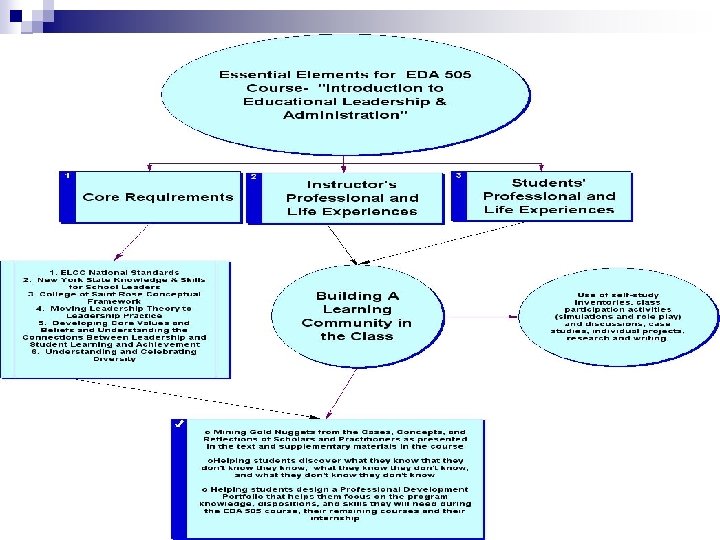
 Expectations Review Course Outline n Review Student Obligations n ¨ Be present in all ways and at all times ¨ Be prepared for each day ¨ Participate fully n Review Instructor Obligations ¨ Be present in all ways and at all times ¨ Be prepared for each day ¨ Answer all questions to the best of my ability
 Expectations Let’s Review the Course Outline
 Class Format n We will follow and model the following protocols: ¨Facilitation ¨Lecture ¨Reflection (Individual and Group) ¨Generation (Collective Wisdom)
 Outcomes To begin thinking like a leader n To understand the principles and practices of effective leadership n ¨ Leading through Inquiry ¨ Servant Leadership ¨ Leading with Vision n To increase or deepen your understanding of the conceptual and practical applications
 Outcomes To increase your understanding of the Five Disciplines of a Learning Organization (Senge, 1990) n To understand the disciplines and how they affect change n To increase or deepen your understanding of the conceptual and practical applications of Learning Communities n
 Outcomes continued… To increase your capacity to use the skills imbedded in the disciplines for the betterment of your organization and its’ personnel n To increase or deepen your knowledge and capacity to engage in skillful discussions and, hopefully, dialogue n
 Outcomes continued… n To give me feedback throughout the week on content, format, and delivery
 Setting the Stage for Understanding Organizational Culture Clarify Purpose n Group inquiry n Artifacts n Espoused Values n ¨ Organization’s rationale-Why do they do things this way? n Cultural Assumptions ¨ Sources of Meaning and Contradiction The Dance of Change, ( 1999) Senge et. al. , pp. 334 -341
 Describe the culture of your present organization n What is your organization’s genetic code? ¨ What aspects stay constant amid the flux of people, info, and work? What values, ways of acting, or habitual beliefs reinforce your identity as “us”? n Who belongs? ¨ Which people truly belong? Do they know they belong? Have they chosen to belong? n What is the purpose? ¨ What wants to happen in your organization? Is it a desirable future? Is there a “shared vision” among all stakeholders? The Dance of Change, ( 1999) Senge et. al. , pp. 334 -341
 Describe the culture of your present organization n How aware is your organization of itself and its environment? n Use artifacts/rituals of your culture to justify all of your observations. The Dance of Change, ( 1999) Senge et. al. , pp. 334 -341
 Narrowing the path to espoused vs. actual culture How does your culture define truth? n What does your culture believe about human capability? n What does your culture believe about human nature? n What does your culture believe about social organization? n The Dance of Change, ( 1999) Senge et. al. , pp. 334 -341
 Setting the Stage for Understanding Organizational Culture Narrowing Down The Cultural Diagnosis n Formal Intervention: Initiating Cultural Change n ¨ What results and new ways of working do we want to create? ¨ Which cultural characteristics are most likely to hinder the change? Which will be helpful? ¨ How would aba’s of all constituents shift? What would their concept of place in an organization shift? The Dance of Change, ( 1999) Senge et. al. , pp. 334 -341
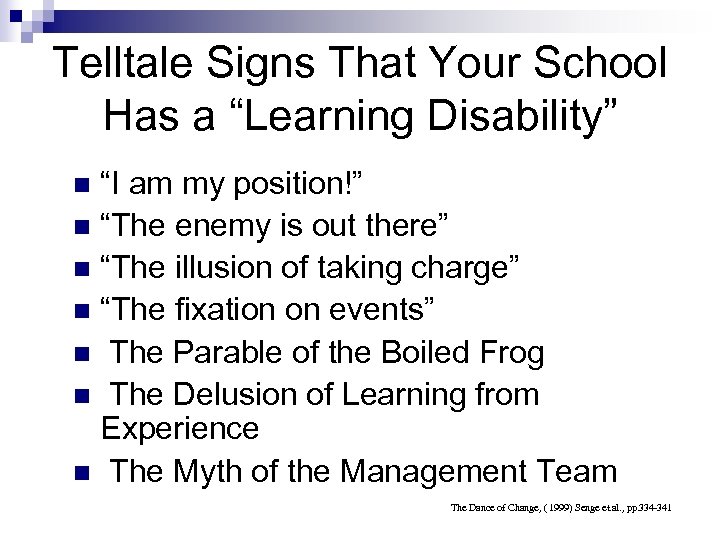 Telltale Signs That Your School Has a “Learning Disability” “I am my position!” n “The enemy is out there” n “The illusion of taking charge” n “The fixation on events” n The Parable of the Boiled Frog n The Delusion of Learning from Experience n The Myth of the Management Team n The Dance of Change, ( 1999) Senge et. al. , pp. 334 -341

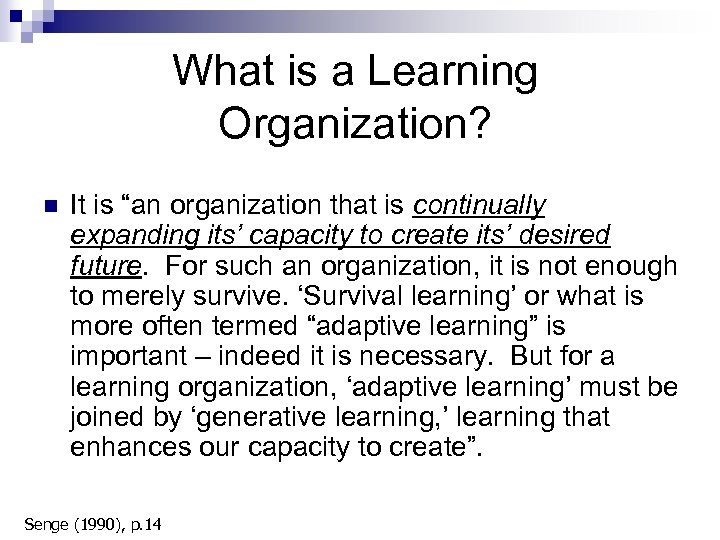 What is a Learning Organization? n It is “an organization that is continually expanding its’ capacity to create its’ desired future. For such an organization, it is not enough to merely survive. ‘Survival learning’ or what is more often termed “adaptive learning” is important – indeed it is necessary. But for a learning organization, ‘adaptive learning’ must be joined by ‘generative learning, ’ learning that enhances our capacity to create”. Senge (1990), p. 14
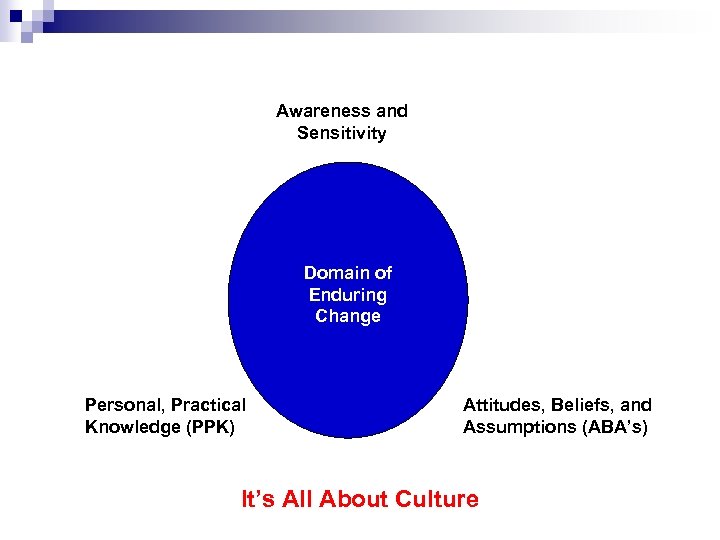 Awareness and Sensitivity Domain of Enduring Change Personal, Practical Knowledge (PPK) Attitudes, Beliefs, and Assumptions (ABA’s) It’s All About Culture
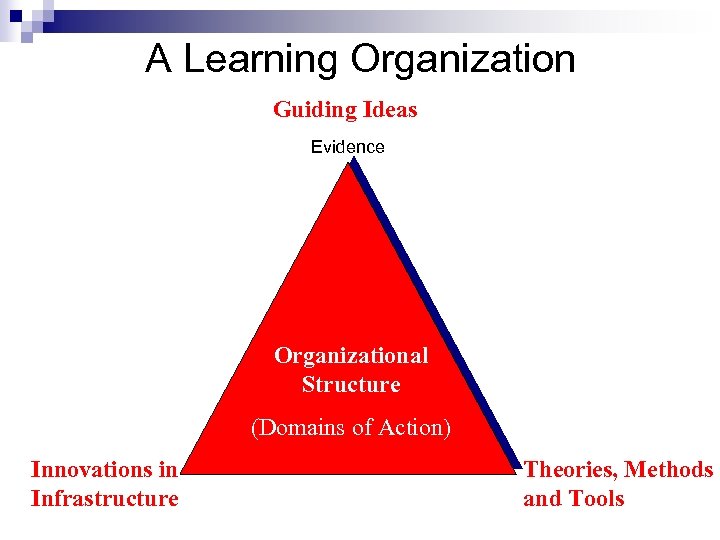 A Learning Organization Guiding Ideas Evidence Organizational Structure (Domains of Action) Innovations in Infrastructure Theories, Methods and Tools
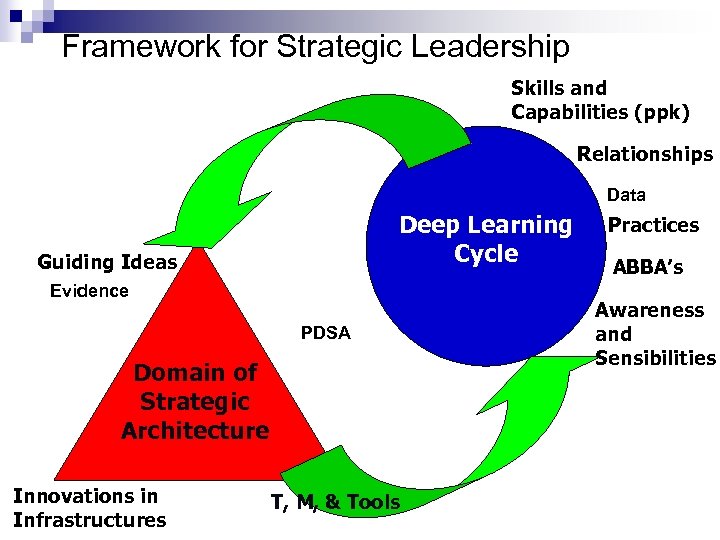 Framework for Strategic Leadership Skills and Capabilities (ppk) Relationships Data Deep Learning Cycle Guiding Ideas Evidence PDSA Domain of Strategic Architecture Innovations in Infrastructures T, M, & Tools Practices ABBA’s Awareness and Sensibilities
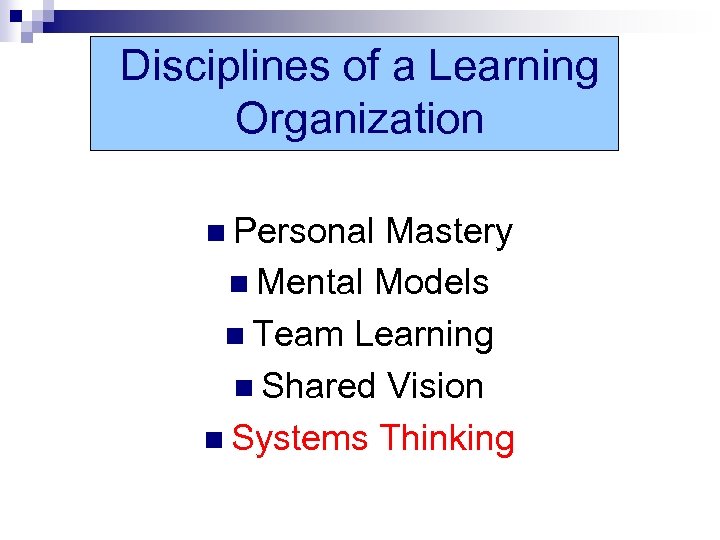 Disciplines of a Learning Organization n Personal Mastery n Mental Models n Team Learning n Shared Vision n Systems Thinking
 Caution!!!! STOP The five disciplines are inextricably linked and interdependent n Each discipline can aid every organization, however, all disciplines must to be practiced simultaneously to maximize organizational effectiveness and efficacy. n
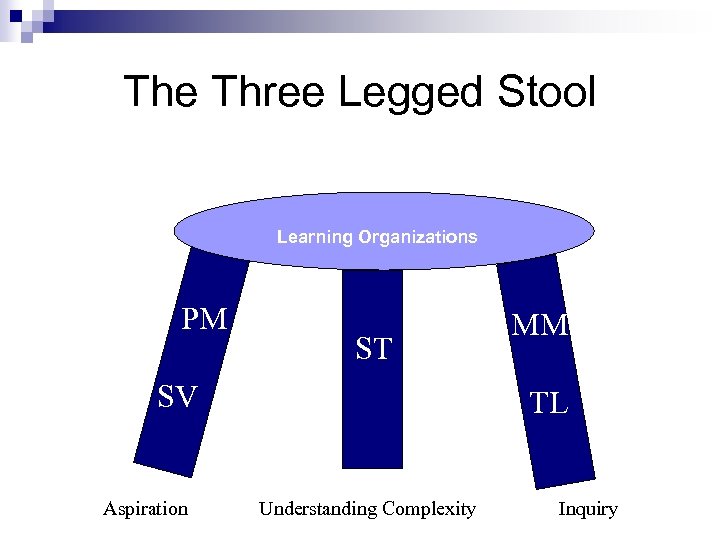 The Three Legged Stool Learning Organizations PM ST SV Aspiration MM TL Understanding Complexity Inquiry
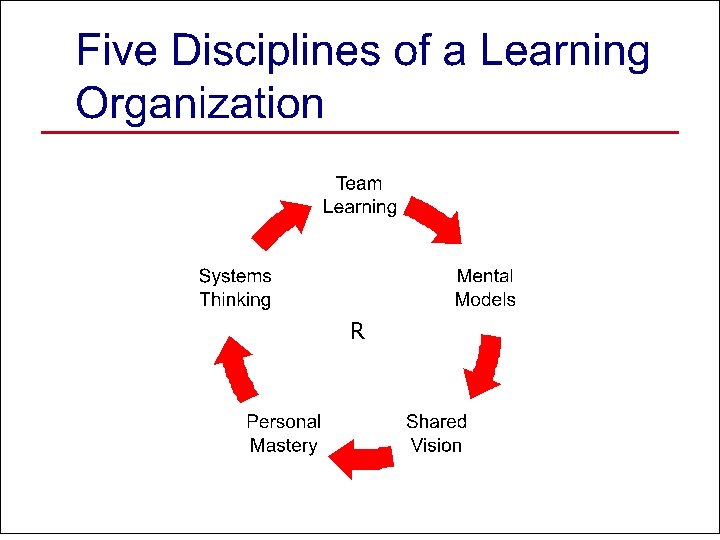 R
R
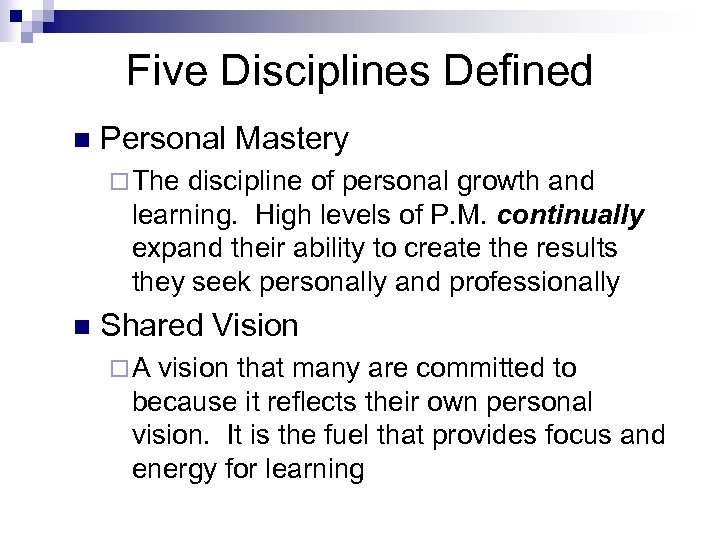 Five Disciplines Defined n Personal Mastery ¨ The discipline of personal growth and learning. High levels of P. M. continually expand their ability to create the results they seek personally and professionally n Shared Vision ¨A vision that many are committed to because it reflects their own personal vision. It is the fuel that provides focus and energy for learning
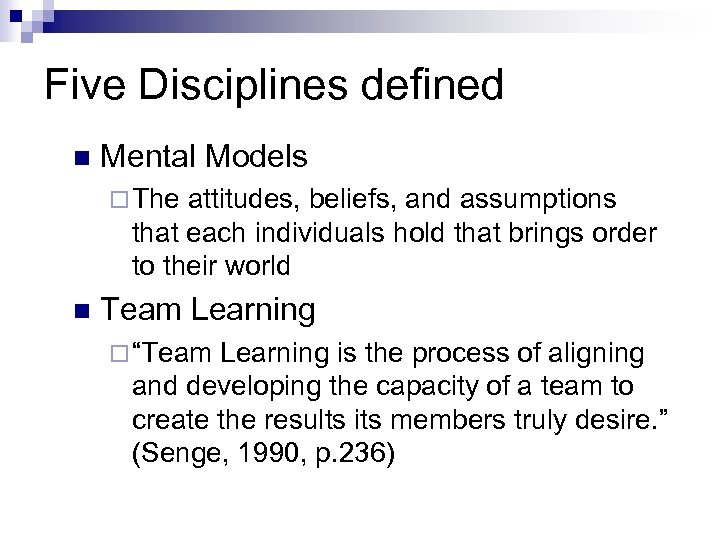 Five Disciplines defined n Mental Models ¨ The attitudes, beliefs, and assumptions that each individuals hold that brings order to their world n Team Learning ¨ “Team Learning is the process of aligning and developing the capacity of a team to create the results its members truly desire. ” (Senge, 1990, p. 236)
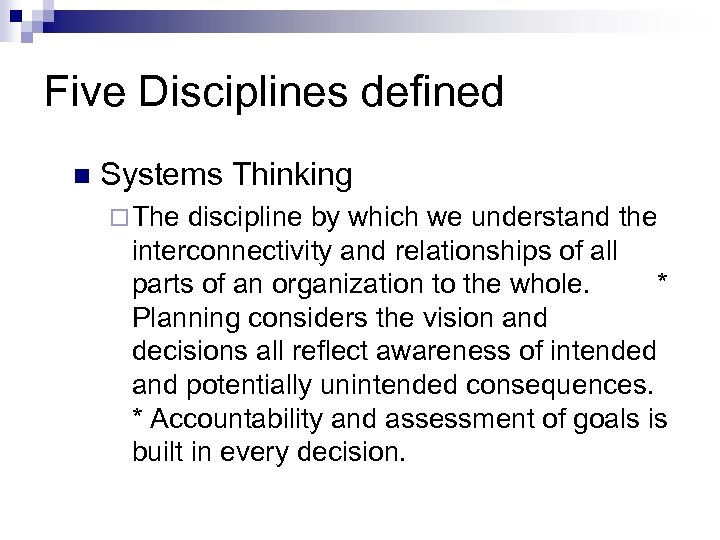 Five Disciplines defined n Systems Thinking ¨ The discipline by which we understand the interconnectivity and relationships of all parts of an organization to the whole. * Planning considers the vision and decisions all reflect awareness of intended and potentially unintended consequences. * Accountability and assessment of goals is built in every decision.
 Personal Mastery Your capacity to improve yourself and your organization
 Personal Mastery n Describe a person and a situation that you observed that required high levels of personal mastery ¨ What was the situation? ¨ Who was the person? ¨ What were the skills you observed? ¨ Why were they necessary to resolve the problem?
 Shared Vision Not, “Here’s my vision. Let me share it with you. ”
 Abraham Lincoln once said, “You can’t escape the responsibility of tomorrow by evading it today. ”
 You must give birth to your images. They are the future waiting to be born. Fear not the strangeness you feel. The future must enter you long before it happens. Just wait for the birth, For the hour of new clarity. Rainer Maria Rilke
 Link the Leg of Aspiration PM/SV The story of the Philharmonic
 Mental Models “You are what you think”
 Within you right now is the power to do things you never dreamed possible. This power becomes available to you just as soon as you can change your beliefs. Maxwell Maltz
 Mental Models are: Inherently neither good nor bad. n Inherently neither right or wrong. n The sum of every life experience you’ve ever had. n Structural barriers we must suspend to enable growth and to see and accomplish things that conventional wisdom deems impossible. n
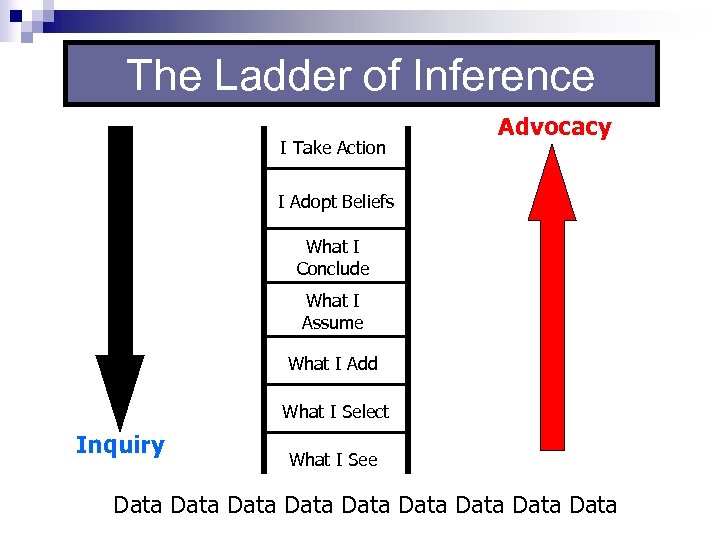 The Ladder of Inference I Take Action Advocacy I Adopt Beliefs What I Conclude What I Assume What I Add What I Select Inquiry What I See Data Data Data
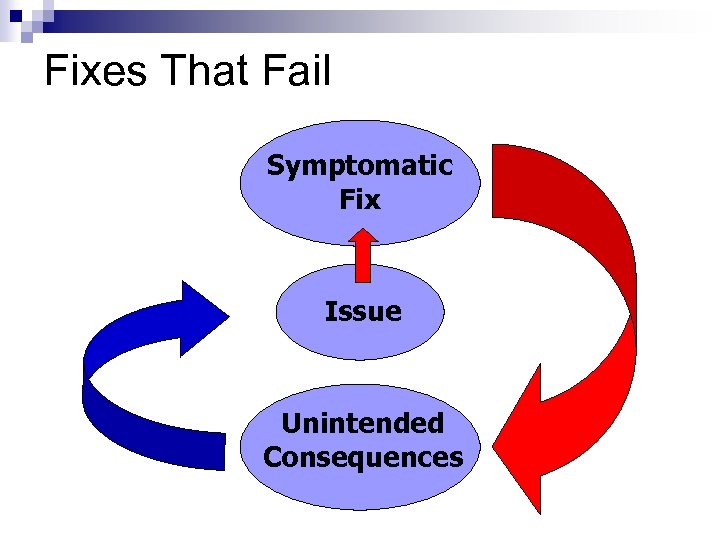
 How Do “Mental Models” Impact Organizational Learning? They don’t, if they are not recognized, suspended, and modified through new learning! n If MM’s are not recognized and suspended, then: n ¨ The notion of “team” cannot exist. ¨ Learning cannot take place ¨ Conversations are filled with blame and lose-lose solutions ¨ The organization is destined to create “Fixes That Fail. ”
 How Often Have You Been Up The Ladder? Describe a scenario when your data was wrong because you rushed to judgment
 Team Learning “Team Learning is the process of aligning and developing the capacity of a team to create the results its members truly desire. ”
 Teams are characterized by openness, “both the norm of speaking openly and honestly about important issues and the capacity to continually challenge one’s own thinking. The first might be called participative openness, the second reflective openness. ” (Senge, 1990, p. 274)
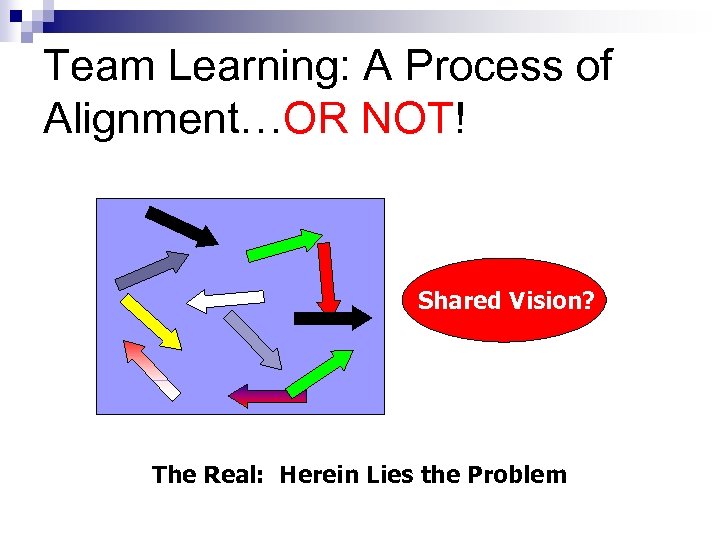 Team Learning: A Process of Alignment…OR NOT! Shared Vision? The Real: Herein Lies the Problem
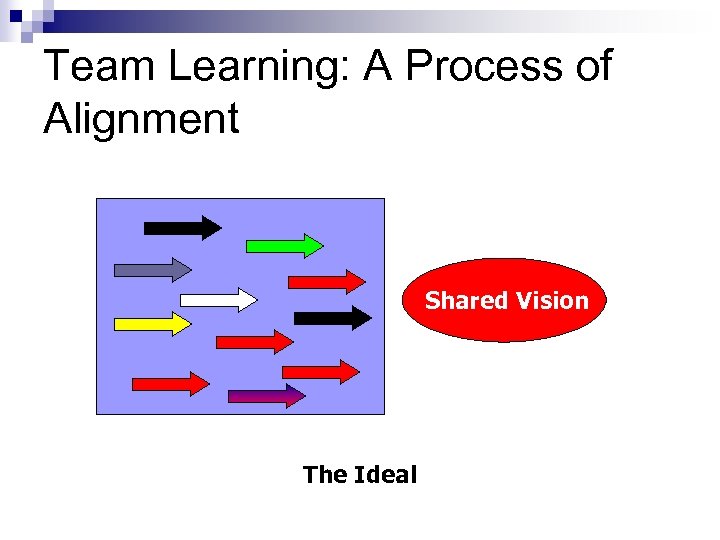 Team Learning: A Process of Alignment Shared Vision The Ideal
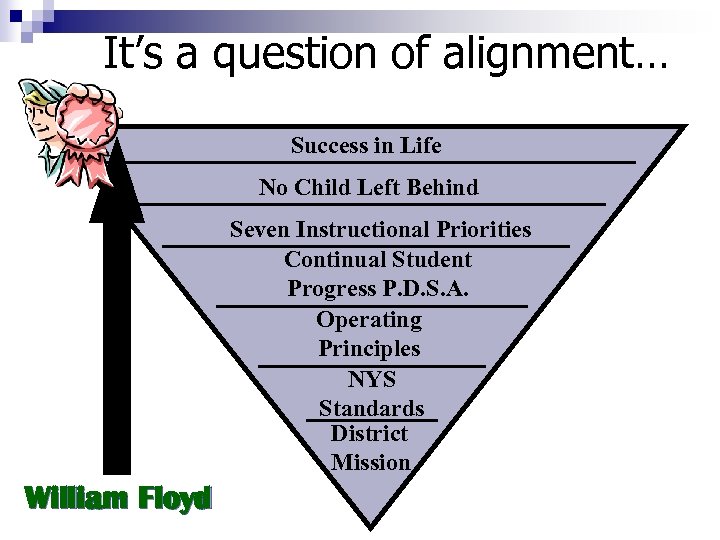 It’s a question of alignment… Success in Life No Child Left Behind Seven Instructional Priorities Continual Student Progress P. D. S. A. Operating Principles NYS Standards District Mission William Floyd
 The Power of Teams n Have you ever experienced a moment in time where you were in total sync with another person or groups of people? Have you ever experienced a time when everything felt like slow motion and others could read your mind without a word spoken? ¨ Think about a successful sports team you were on. ¨ Think about a successful musical performance in which you sang or performed. ¨ Think about a conversation or situation you experienced with someone wherein you both deeply connected.
 The difference between groups and teams
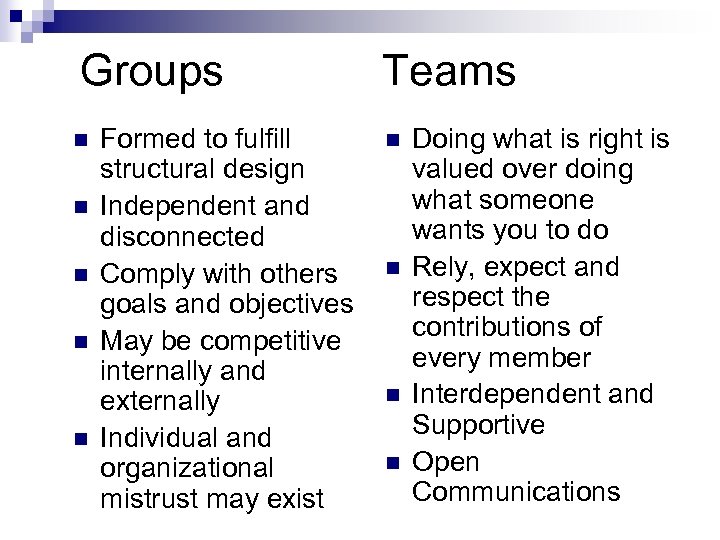 Groups n n n Formed to fulfill structural design Independent and disconnected Comply with others goals and objectives May be competitive internally and externally Individual and organizational mistrust may exist Teams n n Doing what is right is valued over doing what someone wants you to do Rely, expect and respect the contributions of every member Interdependent and Supportive Open Communications
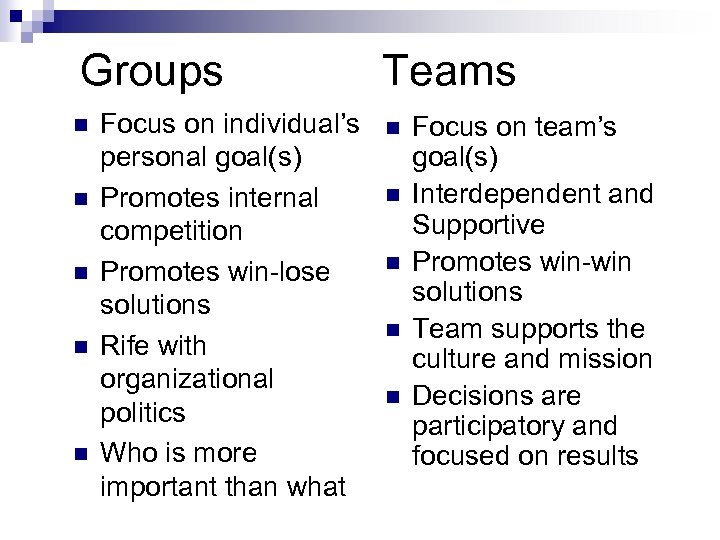 Groups n n n Focus on individual’s personal goal(s) Promotes internal competition Promotes win-lose solutions Rife with organizational politics Who is more important than what Teams n n n Focus on team’s goal(s) Interdependent and Supportive Promotes win-win solutions Team supports the culture and mission Decisions are participatory and focused on results
 Systems Thinking It’s all connected and interdependent
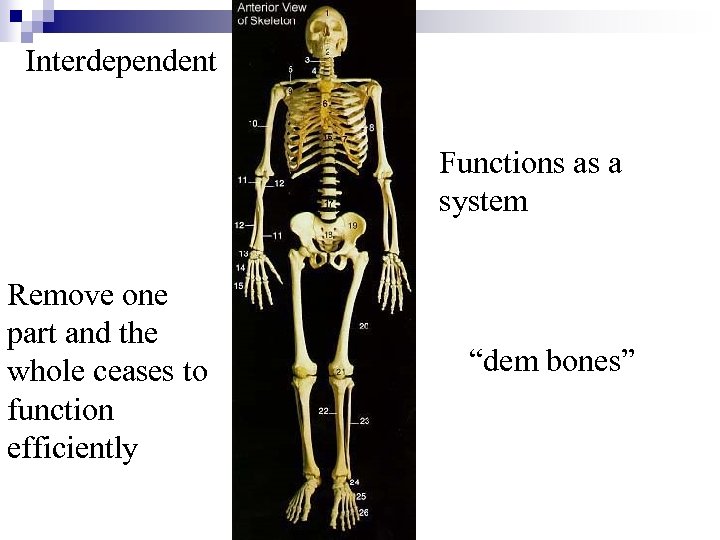 Interdependent Remove one part and the whole ceases to function efficiently Functions as a system “dem bones”
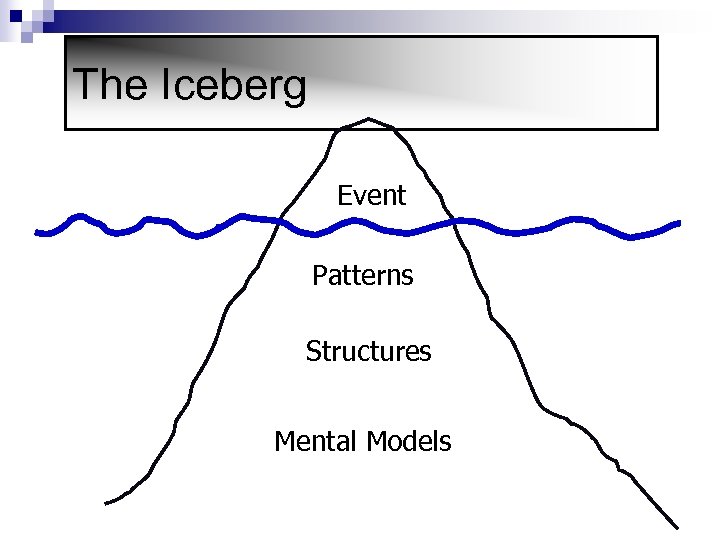 The Iceberg Event Patterns Structures Mental Models
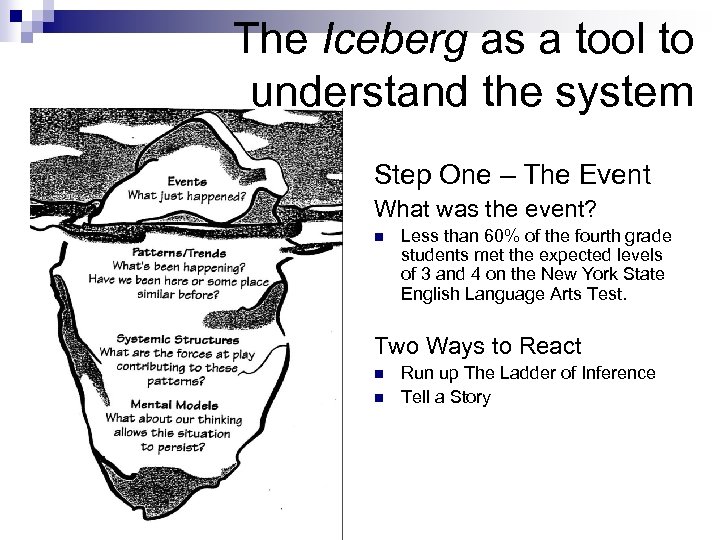 The Iceberg as a tool to understand the system Step One – The Event What was the event? n Less than 60% of the fourth grade students met the expected levels of 3 and 4 on the New York State English Language Arts Test. Two Ways to React n n Run up The Ladder of Inference Tell a Story
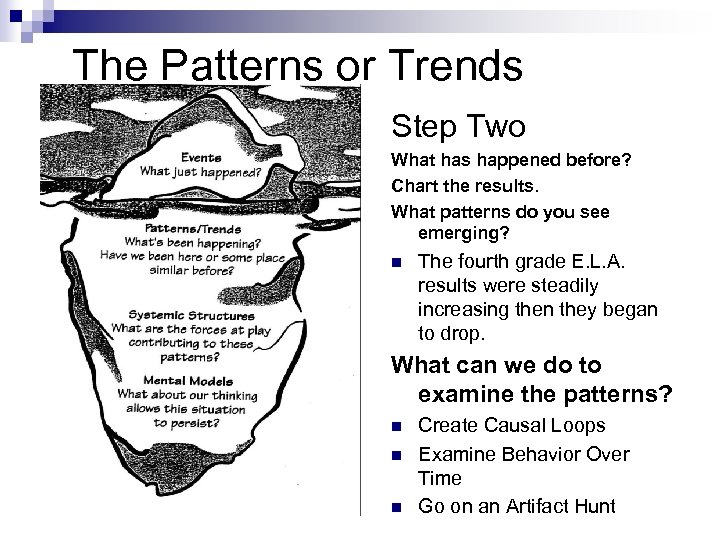 The Patterns or Trends Step Two What has happened before? Chart the results. What patterns do you see emerging? n The fourth grade E. L. A. results were steadily increasing then they began to drop. What can we do to examine the patterns? n n n Create Causal Loops Examine Behavior Over Time Go on an Artifact Hunt
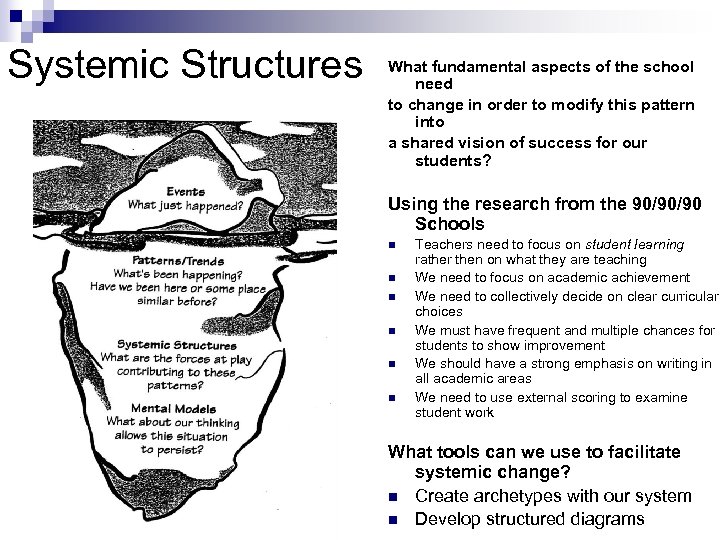 Systemic Structures What fundamental aspects of the school need to change in order to modify this pattern into a shared vision of success for our students? Using the research from the 90/90/90 Schools n n n Teachers need to focus on student learning rather then on what they are teaching We need to focus on academic achievement We need to collectively decide on clear curricular choices We must have frequent and multiple chances for students to show improvement We should have a strong emphasis on writing in all academic areas We need to use external scoring to examine student work What tools can we use to facilitate systemic change? n Create archetypes with our system n Develop structured diagrams
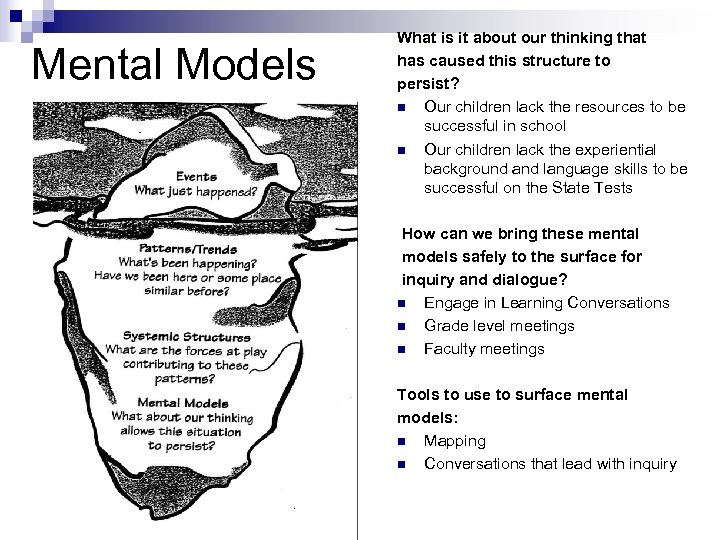 Mental Models What is it about our thinking that has caused this structure to persist? n Our children lack the resources to be successful in school n Our children lack the experiential background and language skills to be successful on the State Tests How can we bring these mental models safely to the surface for inquiry and dialogue? n Engage in Learning Conversations n Grade level meetings n Faculty meetings Tools to use to surface mental models: n Mapping n Conversations that lead with inquiry
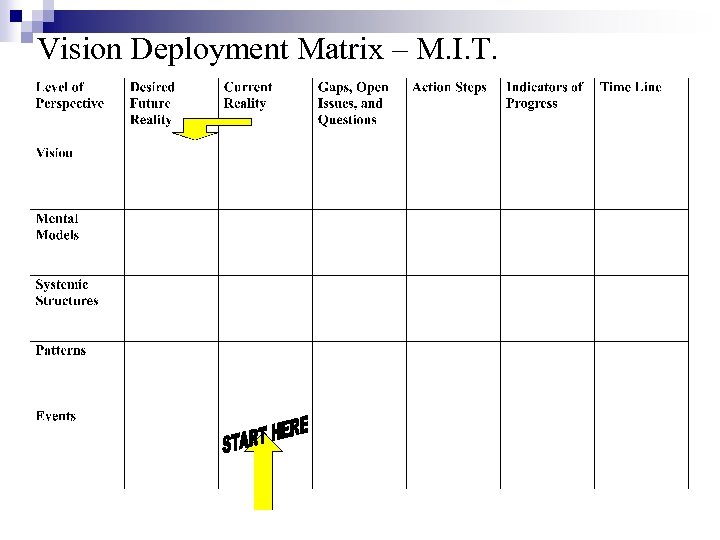 Vision Deployment Matrix – M. I. T.
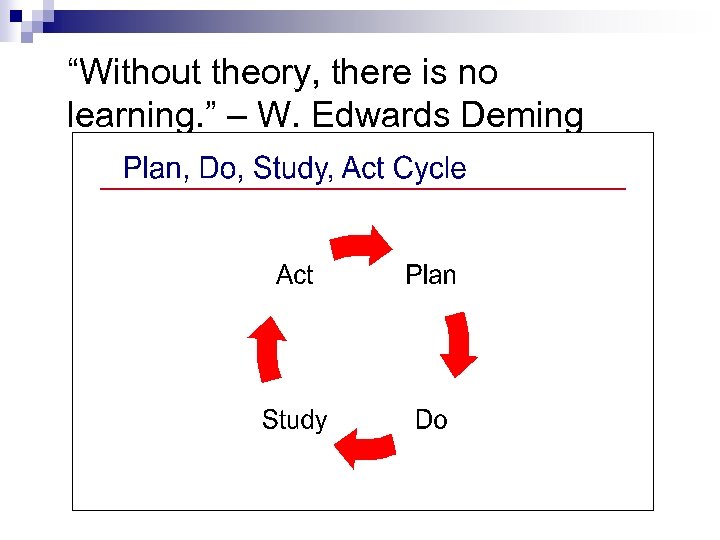 “Without theory, there is no learning. ” – W. Edwards Deming
 Guiding Ideas n Operating Assumptions n Operating Principles n Operating Rules
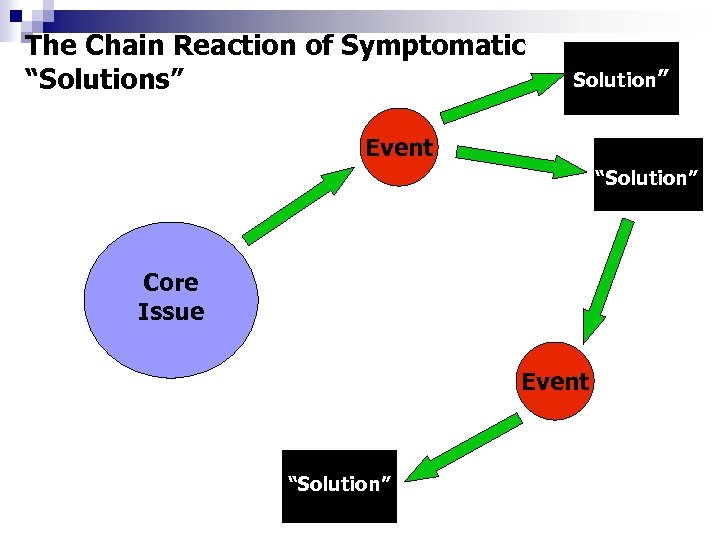
 Systems Archetypes Systems are knowable and predictable
 Fixes That Fail Symptomatic Fix Issue Unintended Consequences
 The Chain Reaction of Symptomatic “Solutions” Solution” Event “Solution” Core Issue Event “Solution”
 Why have educational reforms failed? We typically play here Emotional Tension Current Reality Problems, Issues
 Why have educational reforms failed? Shared Vision Problems, Issues Creative Tension Current Reality We typically play here Problems, Issues
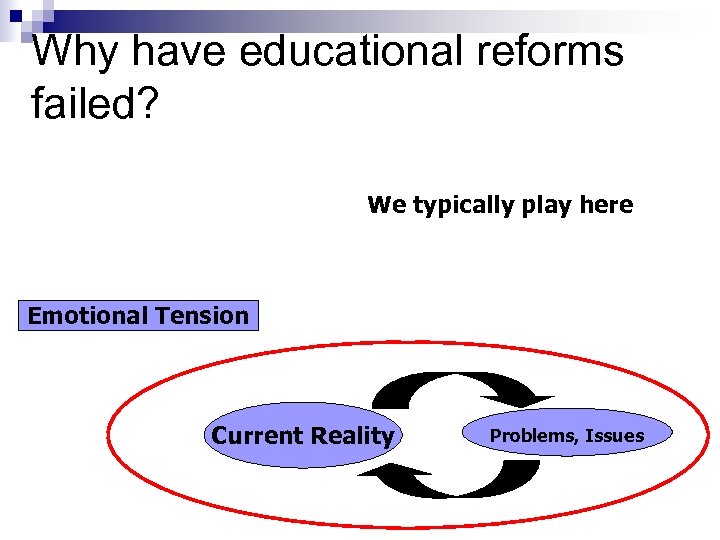
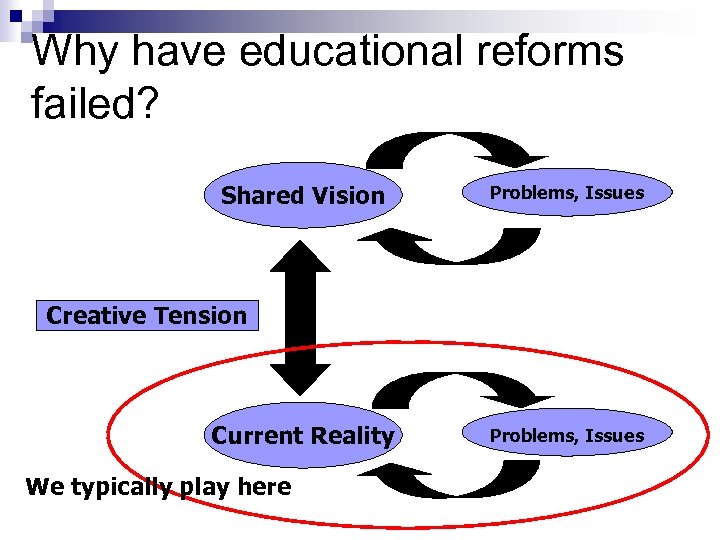
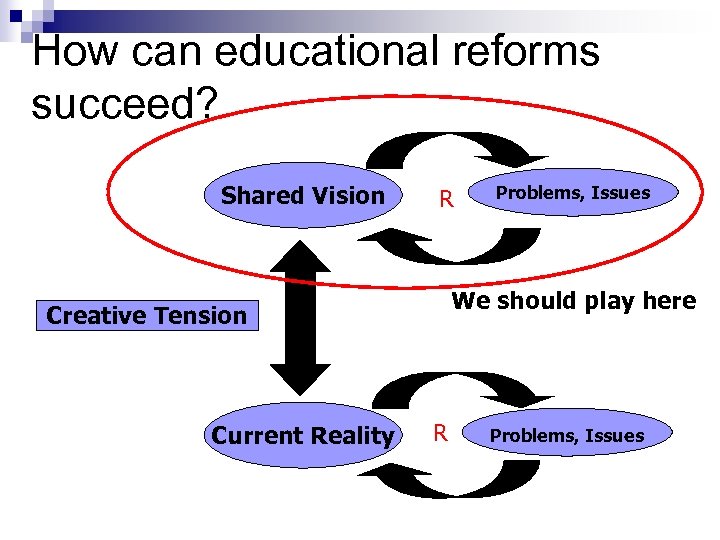 How can educational reforms succeed? Shared Vision R We should play here Creative Tension Current Reality Problems, Issues R Problems, Issues
 Reflection and Generation A New Idea?
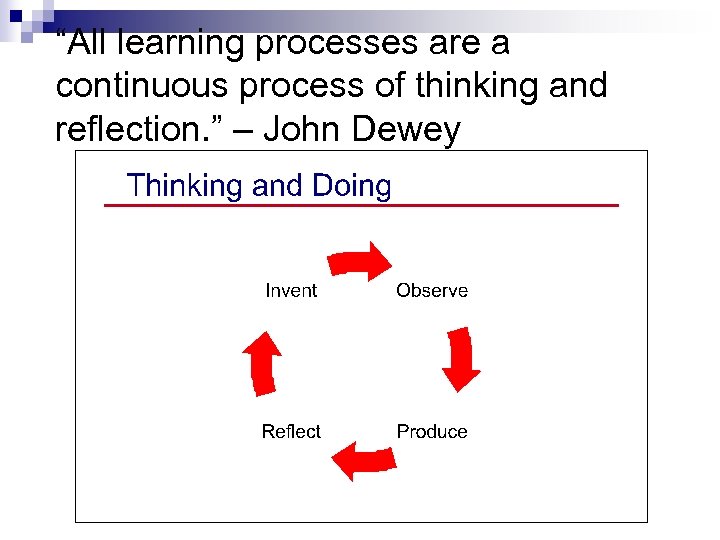 “All learning processes are a continuous process of thinking and reflection. ” – John Dewey
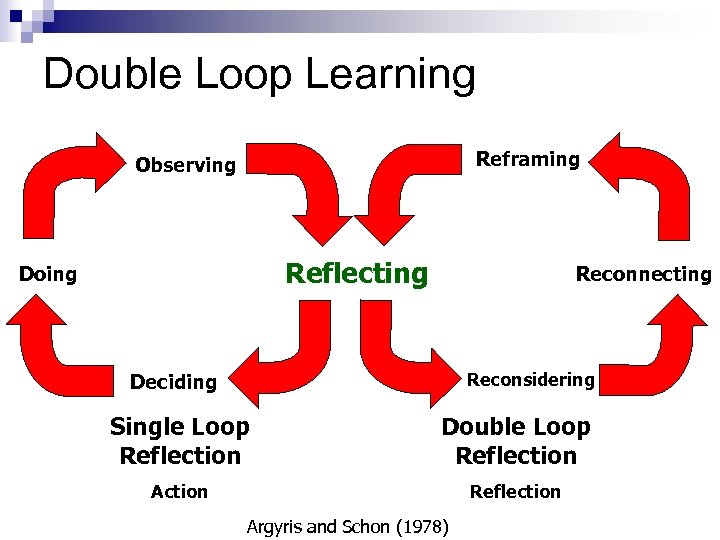 Double Loop Learning Reframing Observing Reflecting Doing Reconnecting Reconsidering Deciding Single Loop Reflection Double Loop Reflection Action Reflection Argyris and Schon (1978)
 Dialogue A very, very short course on how and where to begin
 Rules for a Learning Conversation n n n Speak from the Heart Listen carefully to yourself and others Be aware of your own Mental Models Hold space for different opinions Suspend certainty (a mind, like a parachute, only works while open). Stay in inquiry; limit advocacy SLOW DOWN the inquiry. Sometimes you need to go slow to go fast
 Skillful Discussion and Dialogue Issacs (1999) described our typical conversations as a process of “loading” and “reloading. ” Very little listening occurs. A friend once told him, “People don’t listen. They reload. ” n Skillful discussion and Dialogue require discipline, practice and, at least at the outset, a coach or facilitator to foster a deep, communicative environment n
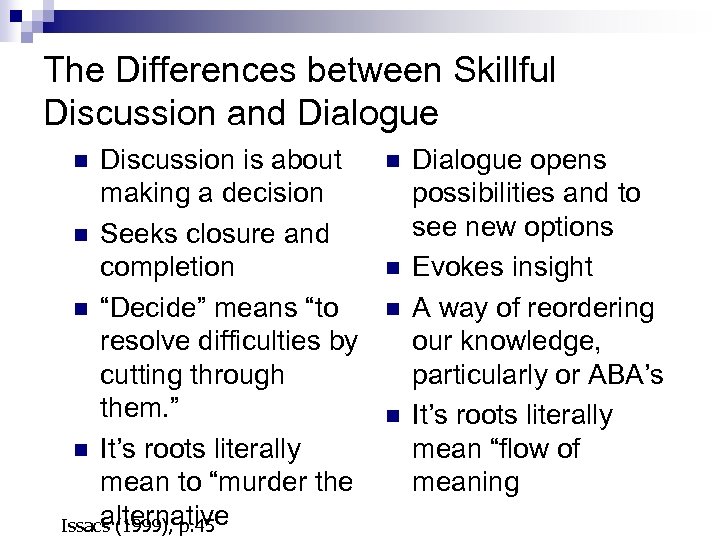 The Differences between Skillful Discussion and Dialogue Discussion is about making a decision n Seeks closure and completion n “Decide” means “to resolve difficulties by cutting through them. ” n It’s roots literally mean to “murder the alternative Issacs (1999), p. 45 n n n Dialogue opens possibilities and to see new options Evokes insight A way of reordering our knowledge, particularly or ABA’s It’s roots literally mean “flow of meaning
 Dialogue n Is a process of building collective wisdom and deeper understanding of an issue, a situation, or a vision. n Encourages and values all participants and their contributions n Follows a few basic guidelines to maximize learning n Encourages participants to notice what they are feeling
 Dialogue Is a process that focuses on inquiry, not advocacy n Discourages the use of the phrases, “yes, but…”, “yes, I agree, but…” and “or”. Encourages “…and”. n Encourages wondering phrases like, “I wonder why you see things like that? ” or “I wonder if you could help me understand what you are saying? ” or “I wonder why you are feeling that way? n
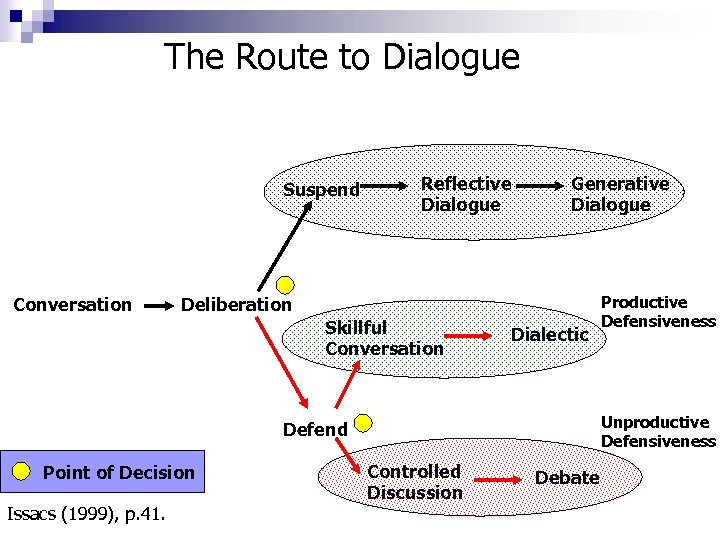 The Route to Dialogue Suspend Conversation Reflective Dialogue Generative Dialogue Deliberation Skillful Conversation Dialectic Unproductive Defensiveness Defend Point of Decision Issacs (1999), p. 41. Productive Defensiveness Controlled Discussion Debate
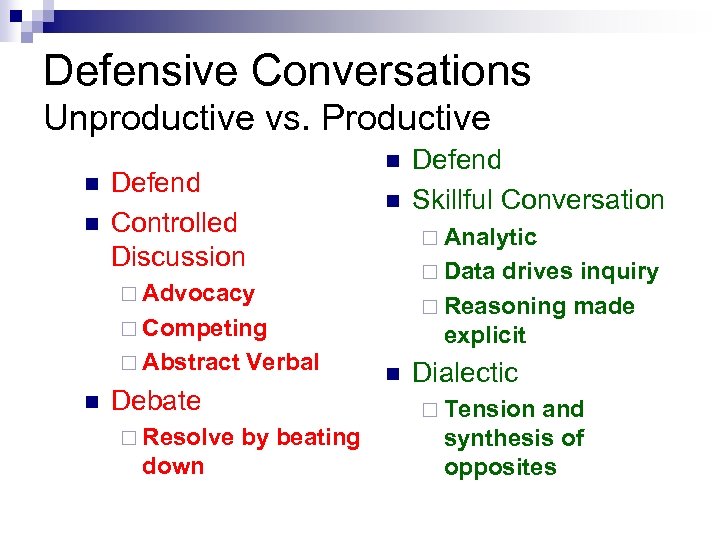 Defensive Conversations Unproductive vs. Productive n n n Defend Controlled Discussion n ¨ Analytic ¨ Data drives inquiry ¨ Reasoning made explicit ¨ Advocacy ¨ Competing ¨ Abstract n Verbal Debate ¨ Resolve down Defend Skillful Conversation n Dialectic ¨ Tension by beating and synthesis of opposites
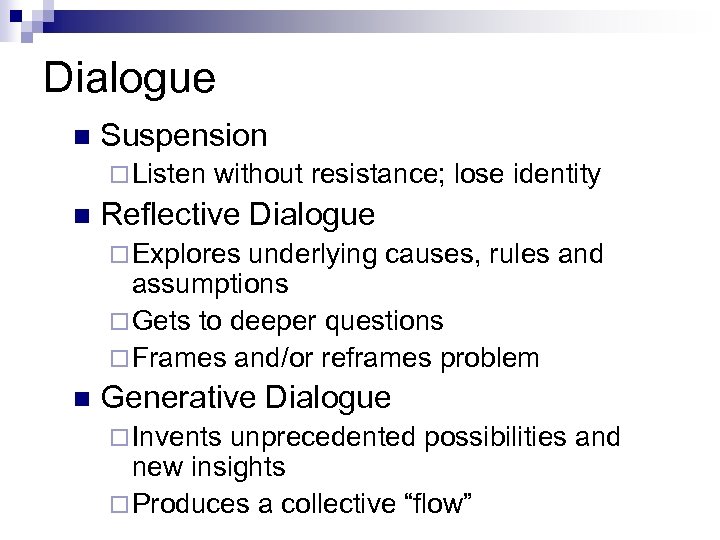 Dialogue n Suspension ¨ Listen n without resistance; lose identity Reflective Dialogue ¨ Explores underlying causes, rules and assumptions ¨ Gets to deeper questions ¨ Frames and/or reframes problem n Generative Dialogue ¨ Invents unprecedented possibilities and new insights ¨ Produces a collective “flow”
 Setting the Stage for Dialogue n Clarify Your Intentions ¨ Recognize your own mental models ¨ Are you willing to be challenged? n Entry is Everything ¨ Set the tone carefully…it will determine the flow of the conversation n Join Each Person Differently ¨ Everyone brings their own lens and language ¨ Respect and try to acknowledge their individuality
 Setting the Stage for Dialogue n Create the Container ¨ Set the stage using the guidelines. ¨ Encourage participants to: Evoke the Ideal n Support Dreaming Out Loud n Deepen the listening n Make It Safe For Opposition n Dare People to Suspend n Isaacs (1999), p. 292 -293
 How vs. Yes Questions Unfortunately “how” questions are typically asked first. This prevents deeper inquiry because “how” questions connote action n Deeper understanding (Yes Q’s) must be understood prior to action. n “Yes” questions spread the responsibility to the group n
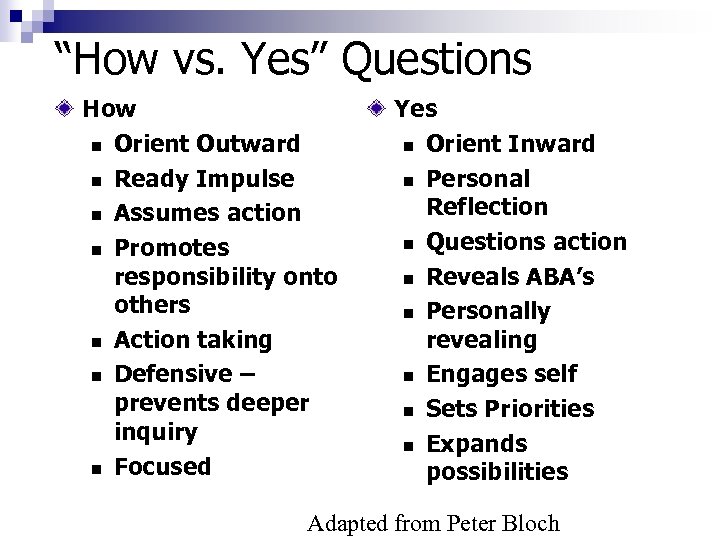 “How vs. Yes” Questions How n Orient Outward n Ready Impulse n Assumes action n Promotes responsibility onto others n Action taking n Defensive – prevents deeper inquiry n Focused Yes n Orient Inward n Personal Reflection n Questions action n Reveals ABA’s n Personally revealing n Engages self n Sets Priorities n Expands possibilities Adapted from Peter Bloch
 Reflections A Personal Journey
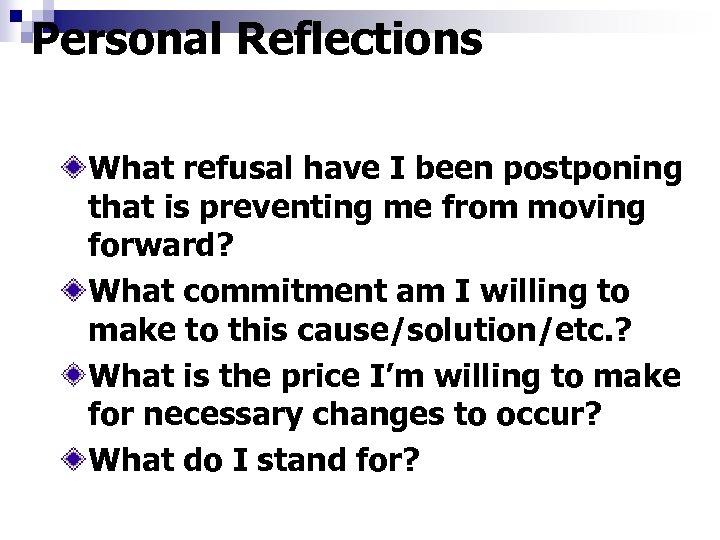 Personal Reflections What refusal have I been postponing that is preventing me from moving forward? What commitment am I willing to make to this cause/solution/etc. ? What is the price I’m willing to make for necessary changes to occur? What do I stand for?
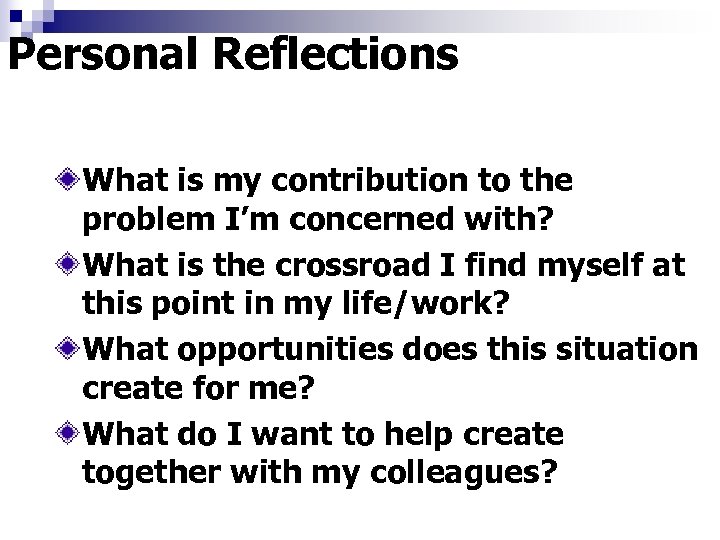 Personal Reflections What is my contribution to the problem I’m concerned with? What is the crossroad I find myself at this point in my life/work? What opportunities does this situation create for me? What do I want to help create together with my colleagues?
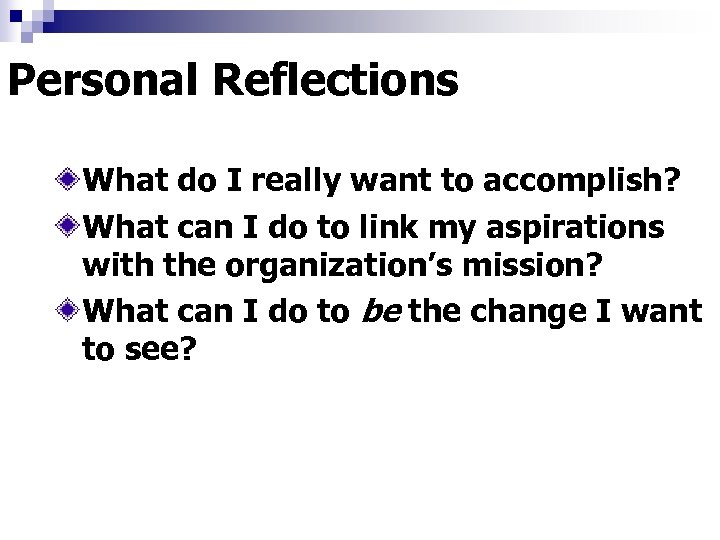 Personal Reflections What do I really want to accomplish? What can I do to link my aspirations with the organization’s mission? What can I do to be the change I want to see?
 The Journey Mary Oliver
 The Journey by Mary Oliver One day you finally knew what you had to do, and began, Though the voices around you kept shouting their bad advise. Though the whole house began to tremble and you felt the tug at your ankle “Mend my life!” each voice cried. But you didn’t stop. You knew what you had to do, though the wind pried with stiff fingers at the very foundations, though their melancholy was terrible.
 It was already late enough, and a wild night, and the road full of fallen branches and stones. But little by little, as you left their voices behind, the stars began to burn through the sheets of clouds, And there was a new voice, which you slowly recognized as your own, that kept you company as you strode deeper and deeper into the world, determined to do the only thing you could dodetermined to save the only life you could save.