 Скачать презентацию Critical Evaluation of Waterbody Assessment Processes Lindsay Martin
bb3c3f6562584be4726df0329d12cb1a.ppt
- Количество слайдов: 16



Critical Evaluation of Waterbody Assessment Processes Lindsay Martin Griffith Brown and Caldwell - Golden, Colorado lgriffith@brwncald. com
Project Background • WERF Sponsored Research Project • Critical Evaluation of Assessment Methodologies for States Integrated Reports • Final Report - September, 2006
Project Objectives • Gather info on current assessment methodologies • Identify approaches that optimize data and best characterize waterbody conditions • Provide recommendations to serve as guidance to states on how to: – Integrate monitoring design with analysis methods – Use robust methods that adequately characterize water quality – Determine with greater confidence waters that are impaired
Research Tasks • • • Lit Review of State Integrated Reports Lit Review of Assessment Guidance Telcoms with State Personnel Development of Critical Evaluation Matrix Development of Recommendations
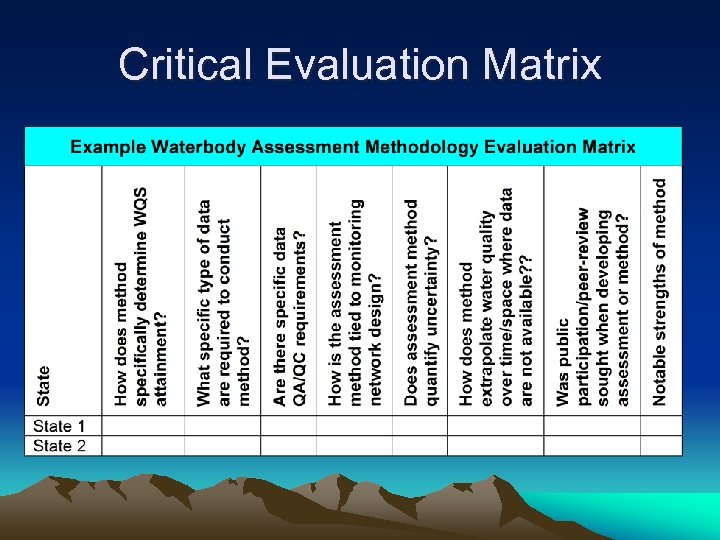
Critical Evaluation Matrix
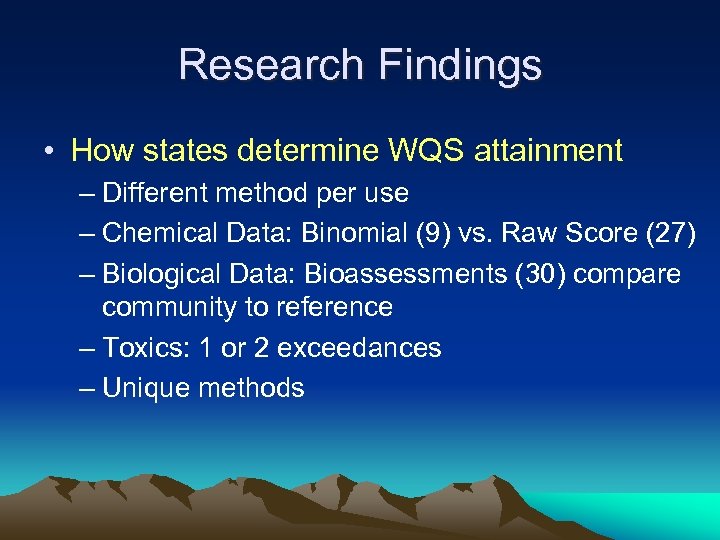
Research Findings • How states determine WQS attainment – Different method per use – Chemical Data: Binomial (9) vs. Raw Score (27) – Biological Data: Bioassessments (30) compare community to reference – Toxics: 1 or 2 exceedances – Unique methods
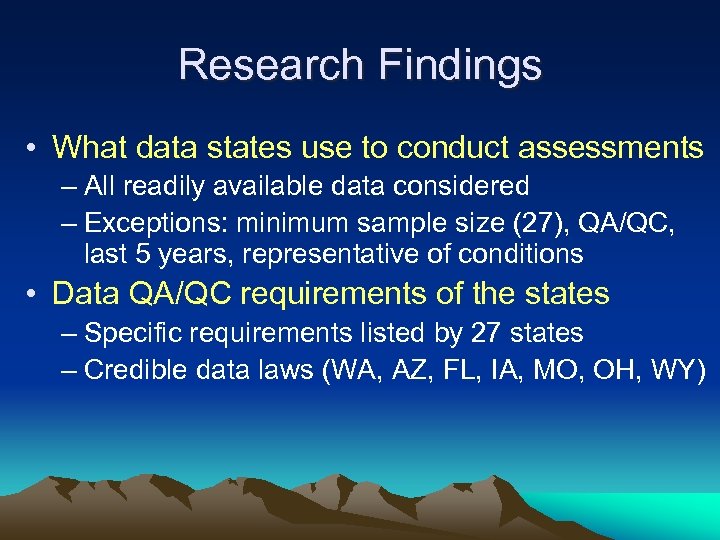
Research Findings • What data states use to conduct assessments – All readily available data considered – Exceptions: minimum sample size (27), QA/QC, last 5 years, representative of conditions • Data QA/QC requirements of the states – Specific requirements listed by 27 states – Credible data laws (WA, AZ, FL, IA, MO, OH, WY)
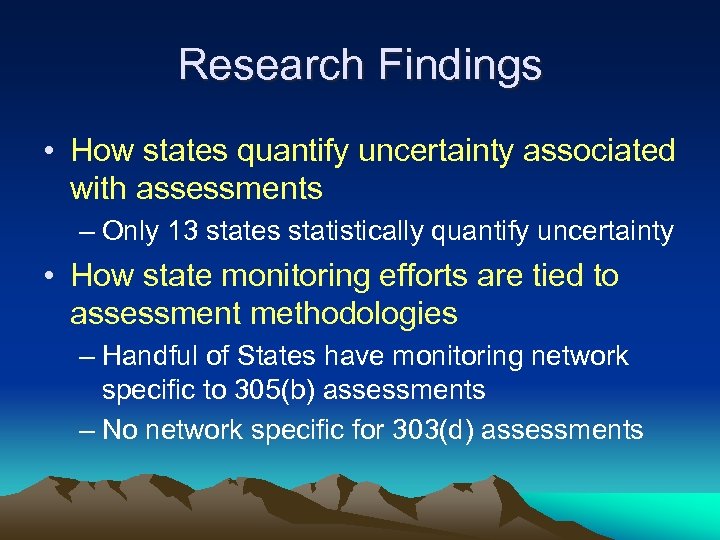
Research Findings • How states quantify uncertainty associated with assessments – Only 13 states statistically quantify uncertainty • How state monitoring efforts are tied to assessment methodologies – Handful of States have monitoring network specific to 305(b) assessments – No network specific for 303(d) assessments
Research Findings • How states extrapolate assessments to nonmonitored waters – Define “assessment units” – Probability-based monitoring networks (9) used for 305(b) assessments • Public involvement in assessments and methodology development – Data solicited from public – Public Review of 303(d) list – 12 states published draft methodology for public comment
Preliminary Recommendations • WQS Attainment Assessment Methodologies – Must be tied to standards – Better Integrate 305(b) with 303(d) – Allow for weight-of-evidence for both attainment and non-attainment – Statistical basis to reduce uncertainty – Develop site-specific biocriteria to draw more defensible conclusions from bioassessments – Transparent and auditable – Develop de-listing methodologies
Preliminary Recommendations • Data used in Waterbody Assessments – Develop data quality requirements, including minimum temporal/spatial coverage – Address how to deal with non-detects and outliers – Specifically state how to address waterbodies that do not meet DQRs
Preliminary Recommendations • Integration of Monitoring Design – Need better integration of “statewide” 305(b) monitoring with 303(d) assessments – Focus on monitoring for biocriteria development
Preliminary Recommendations • Waterbody Assessment Extrapolation – Standardize definition of AUs – Georeference AUs and sampling sites
Preliminary Recommendations • Public Involvement – Need technical discussion with public during development of methodology and AUs – Need EPA buy-in prior to performing assessments
Preliminary Recommendations • Bayesian Approach – analyze data for (1) probability of sample being representative, and then (2) probability of exceedance – Use translators developed by the user to “update” analysis of probability of exceedance – Translators include WQ criteria, additonal constraints, etc. .
Summary • Critical evaluation of current waterbody assessment methodologies • Each states program has strengths and weaknesses • Recommendations to serve as guidance for developing more robust methods that will help states characterize water quality with greater consistency and confidence
Скачать презентацию Critical Evaluation of Waterbody Assessment Processes Lindsay Martin
bb3c3f6562584be4726df0329d12cb1a.ppt