


 Скачать презентацию Crime and Punishment Prosecution of Juveniles as Adults
609a5a099925626cdf37a0596b1212e2.ppt
- Количество слайдов: 31
 Crime and Punishment: Prosecution of Juveniles as Adults Throughout Time
 History n n n Juveniles have been punished as adults for centuries. Prior to the 17 th Century, children were seen as being different from adults only in their size. It was not until the 17 th century that European church and community leaders successfully advanced the notion that children were weak and innocent, and in need of guidance , protection, and socialization of adults.
 n n By the 18 th century, English common law characterized those under the age of seven being incapable of forming criminal intent. For the act to be considered criminal, there must be actus reus (the criminal act itself). n Mens rea (the intent to commit the criminal act). n Corpus delecti (the interaction between the act and the intent to commit it).
 n n Between the ages of seven and fourteen, children were presumed to be without criminal intent unless it could be proven that they knew the difference between right and wrong. At age fourteen, they legally were considered adults, capable of forming criminal intent and therefore justly sentenced to serve time in jail and prison alongside other adults.
 n n By the early 1800’s there was the belief that juvenile and adult offenders should be incarcerated separately. Special correctional institutions for youthful offenders were established in the U. S. It was not until 1899, that the first juvenile court was established. Instead of deciding guilt or innocence, the court would determine whether youths were in need of treatment.
 n n n The court would seek long-term behavioral change by providing the guidance youths lacked. Sentences were to be customized to meet the needs of each juvenile to optimize the rehabilitative effects of court intervention. Violent juvenile crime has increased by nearly 70% since 1986.
 For and Against n n Some people believe prosecuting teens as adults is justified because they’re committing more extreme crimes at a younger age. People believe teens shouldn’t be “let off the leash” just because they are younger.
 n n Others believe teens are being punished too harshly for committing nonviolent crimes. Juvenile advocates say the child’s mental and emotional problems would get addressed in the juvenile system, but not in the adult system.
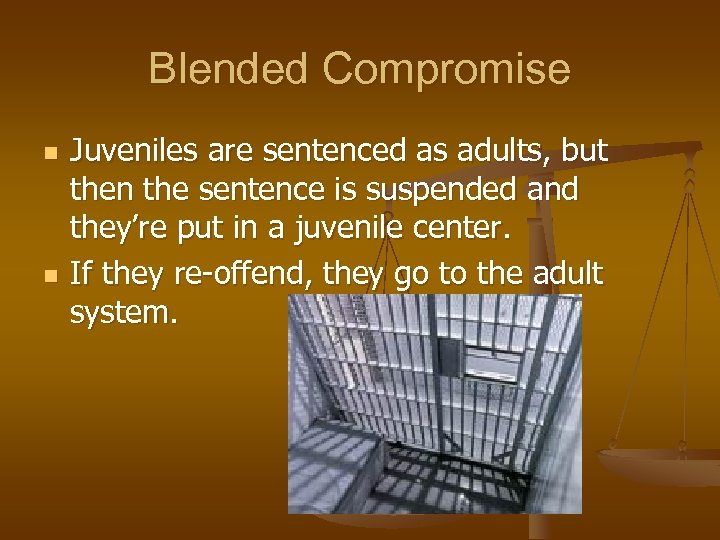 Blended Compromise n n Juveniles are sentenced as adults, but then the sentence is suspended and they’re put in a juvenile center. If they re-offend, they go to the adult system.
 Case One n n n 16 -year-old Adam Bollenbach, stole a sixpack of beer from an open garage. Months earlier he was charged as an adult for stealing a bag of potato chips from his school lunchroom. The charges were dropped, but once a teen is charged as an adult, he can’t be charged as a juvenile. Therefore, Adam was charged as an adult for stealing a six-pack.
 Judge Howard n n n Ignored state recommendations of less than 4 years and sentenced Adam to 10 years in prison. He wanted to use Adam as an example for other misbehaving teens. “You’re well on your way to a lifetime in prison and I don’t want to see that happen. This sentence is going to break your spirit right now. ”
 Case Two n n n 17 -year-old Scott Dyleski broke into Pamela Vitale’s house ( a wife and mother of two) one Saturday morning and stabbed her 26 times in the head and stomach. Autopsies showed broken fingers, dislodged teeth, and bruises all over her body. Adam had also carved his signature artwork into her back.
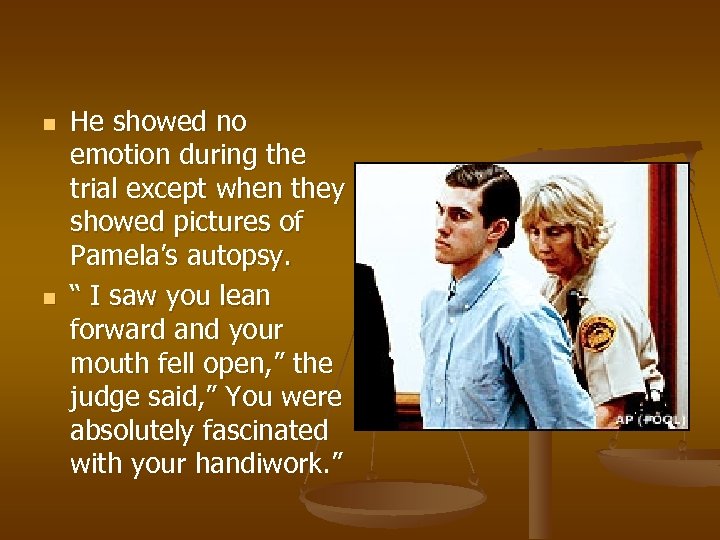 n n He showed no emotion during the trial except when they showed pictures of Pamela’s autopsy. “ I saw you lean forward and your mouth fell open, ” the judge said, ” You were absolutely fascinated with your handiwork. ”
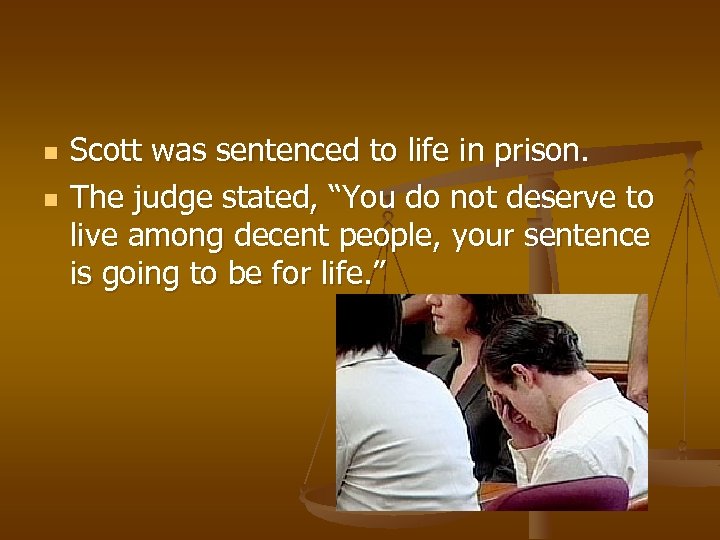 n n Scott was sentenced to life in prison. The judge stated, “You do not deserve to live among decent people, your sentence is going to be for life. ”
 A Timeline of School Shootings n n n n n Feb. 2, 1996, Moses Lake, Washington: 2 students and one teacher killed, one other wounded when 14 year old Barry Loukaitis opened fire on his algebra class. Dec. 1, 1997, West Paducah, Kentucky: Three students killed, five wounded by Michael Carneal, 14, as they participated in a prayer circle at Heath High School. March 24, 1998, Jonesboro, Arkansas: 4 students and 1 teacher killed, 10 others wounded outside as Westside Middle School emptied during a false fire alarm. Mitchell Johnson, 13, and Andrew Golden, 11, shot at their classmates and teachers from the woods April 28, 1999, Taber, Alberta, Canada: 1 student killed, 1 wounded at W. R. Meyers High School in first fatal high school shooting in Canada in 20 years. The suspect, a 14 year old boy, had dropped out of high school after he was severely ostracized by his classmates. March 2000, Branneburg, Germany: 1 teacher killed by a 15 year old student, who then shot himself. The shooter has been in a coma ever since. Sept. 24, 2003, Cold Spring, Minnesota: 2 students were killed at Rocori High School by John Jason Mc. Laughlin, 15. March 21, 2005, Red Lake, Minnesota: Jeff Weis, 16, killed grandfather and companion, the arrived at school where he killed a teacher, a security guard, 5 students, and finally himself, leaving a total of 10 dead. Nov. 8, 2005, Jacksboro, Tennessee: A 15 year old shot and killed an assistant principal at Campbell County High School and seriously wounded two other administrators. Sept. 29, 2006, Nickel Mines, Pennsylvania: A 15 year old student shot and killed Weston School principal John Klang.
 Nathaniel Abraham n. Youngest n 12 person to be prosecuted in the U. S. on first degree murder charges years old and in 6 th grade, he was only 11 when he committed the crime n. Mother was a single working women raising 4 children and they grew u p in conditions of poverty n. He began to show psychological problems at an early age, tests revealed that he was emotionally damaged and functioning at 3 or 4 years below his actual age n. He was expelled from three different schools within 2 years because of fights and other behavioral problems n. In n. He 1997 he became angry and went after his sister and aunt, firing a BB gun at them blames most of his problems on the conditions he lived in, claiming the way he acted was not his fault.
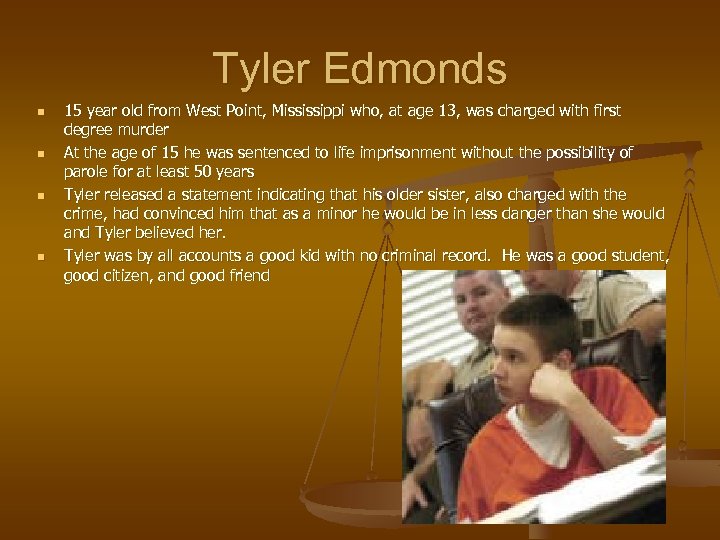 Tyler Edmonds n n 15 year old from West Point, Mississippi who, at age 13, was charged with first degree murder At the age of 15 he was sentenced to life imprisonment without the possibility of parole for at least 50 years Tyler released a statement indicating that his older sister, also charged with the crime, had convinced him that as a minor he would be in less danger than she would and Tyler believed her. Tyler was by all accounts a good kid with no criminal record. He was a good student, good citizen, and good friend
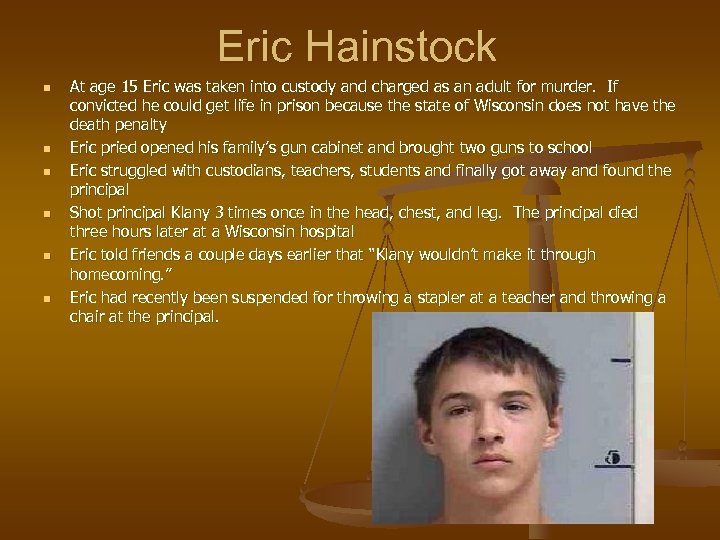 Eric Hainstock n n n At age 15 Eric was taken into custody and charged as an adult for murder. If convicted he could get life in prison because the state of Wisconsin does not have the death penalty Eric pried opened his family’s gun cabinet and brought two guns to school Eric struggled with custodians, teachers, students and finally got away and found the principal Shot principal Klany 3 times once in the head, chest, and leg. The principal died three hours later at a Wisconsin hospital Eric told friends a couple days earlier that “Klany wouldn’t make it through homecoming. ” Eric had recently been suspended for throwing a stapler at a teacher and throwing a chair at the principal.
 The Pro’s and Con’s Facts to Know Con’s Many feel if not old enough to vote, serve the country, they are not at the proper mind set. Not mature enough to handle the consequents of their actions Juvenile facilities tend to offer a better education more of a chance at a normal life Once you are put in the mind set of an adult always feel like an adult which can have harsh consequences Many young children are not competent enough to stand trial they have no clue as to what is happening around them Children have rights They are still children they need to be protected Pro’s Once you commit the crime you should do the time The family member of the victims deserve to see justice for the lose of their loved one Its naïve to think that these violent children are going to stop if sent to a juvenile facility for help Some need more then just a slap on the wrist Facts Since 1992 every state but Nebraska has made it easier to try juvenile as adults Many states have legalized harsher sentences In some states its up to the judges discretion as to the juveniles fate Its estimated that roughly 200, 000 juveniles are criminally charged as adults every year The justice department statistics, 12%of the juveniles charged as adults in 1996 were younger then 16 23 states and the District of Columbia set no minimum age which juveniles can be tried as adults, 27 set a minimum age for at least some crimes of 15 and younger
 n n n The campaign to criminalize youth goes back to Victorian England when poor and mentallydisturbed children were put in workhouses, terrorized and beaten. More than 100 years ago, the social reformers who championed the setting up of a separate juvenile justice system recognized that children did not have the same physical and mental faculties as adults. As part of their abandonment of any social reformist conceptions, both political parties in America have rejected such conceptions and have moved to dismantle the juvenile justice system.
 Violent Youth Predator Act of 1997 n n n A bill pushed by Congressional Republicans but whose key provisions enjoy the support of President Clinton. One version of the bill, which has already been passed by the House and is being discussed in the Senate, would mandate adult prosecution of children as young as 13, encourages states to hold parents criminally responsible for their children’s actions, open up juvenile arrest records to the public, and, for the first time, allow children to be housed with adult prisoners. It would also allow the execution of those who committed crimes when they were as young as 16. Over the last decade, the large number of youth through government electrocution and lethal injections, has doubled.
 Transfer Laws n n n Set up to enhance community protection by deterring juveniles from committing serious crimes and by providing greater certainty of an incarceration period of adequate length through trial and sentencing in the criminal court Most transferred juveniles are 17 -year old African American males who have committed offenses against persons. Almost every state has set the minimum age for transfer at 14 Many states now require transfer for juveniles who commit violent felonies such as murder, rape, or armed robbery Legislative changes in transfer laws have included n n Lowering the minimum age for transfer Expanding the list of crimes for which transfer is an option Vesting greater discretion in prosecutors Eliminating some of the factors judges must consider before transferring youth
 Different rules in different states n n n 10 states including Michigan, prosecutors now have the authority to move a juvenile case into criminal court. Most states require that the child be at least 14, but in Michigan and Nebraska there is no minimum age. In 36 states and the District of Columbia, the state legislatures have passed laws to exclude all 17 -year olds and in some cases all 16 -year olds from the juvenile courts. Three states, Indiana, Vermont, and South Dakota, allow 10 -year-olds to be prosecuted as adults. In other states the legislatures have passed “three strikes and you’re an adult” statutes, automatically sending juveniles with records to the adult criminal justice system.
 Minnesota n n Discretionary Waiver On motion of the prosecutor in the case of a child of at least 14 accused of a felony, the juvenile court may, after a hearing, certify the proceeding for adult criminal prosecution if it finds: n n Probable cause to believe that the child committed the offense alleged That the prosecutor has shown by clear and convincing evidence that the public safety would not be served by retaining the proceeding in juvenile court.
 Presumptive Waiver n If a child of at least 16 is accused of n n n An offense that would result in a presumptive commitment to prison under applicable laws and sentencing guidelines A felony committed with a firearm, there is a presumption that certification for a trial as an adult is appropriate Then the court has to find probable cause to believe that the child the offense alleged, and the child has the burden of showing by clear and convincing evidence that the public safety would be served by retaining the case in juvenile court.
 Statutory Exclusion n The term “delinquent child” does not include a child of at least 16 who is accused of first degree murder n Once n an Adult, Always The juvenile court must order certification for trial as an adult in any case in which the prosecutor shows that a child accused of a felony was n n Previously certified Thereafter convicted, either of the offense for which he was certified or of a lesser included offense that itself constituted a felony
 States with once an adult/always and adult provisions n Arizona, California, Delaware, District of Columbia, Florida, Hawaii, Idaho, Indiana, Iowa, Kansas, Maine, Michigan, Minnesota, Mississippi, Missouri, Nevada, New Hampshire, North Dakota, Ohio, Oklahoma, Oregon, Pennsylvania, Rhode Island, South Dakota
 Juvenile Death Penalties… The Ultimate Consequence n n n Since 1973, 17 men have been executed in the US for crimes committed as juveniles. 74 other offenders are on death row for crimes committed before they turned 18. Of the 38 states that have the death penalty, 23 permit the execution of offenders who committed crimes before turning 18.
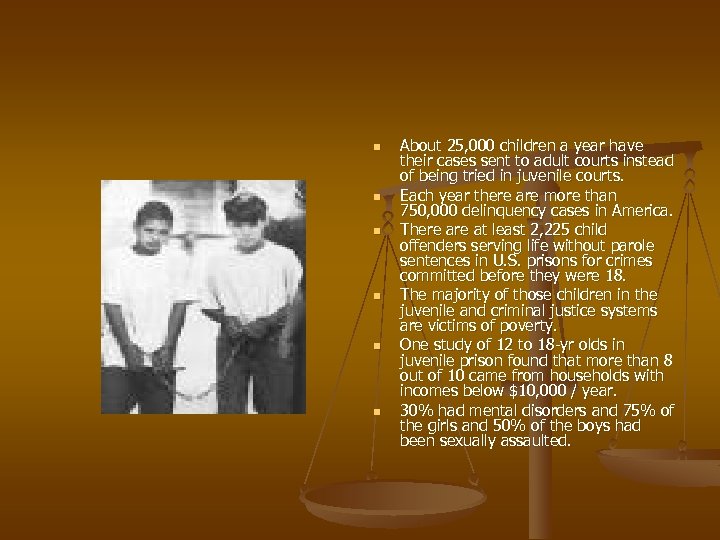 n n n About 25, 000 children a year have their cases sent to adult courts instead of being tried in juvenile courts. Each year there are more than 750, 000 delinquency cases in America. There at least 2, 225 child offenders serving life without parole sentences in U. S. prisons for crimes committed before they were 18. The majority of those children in the juvenile and criminal justice systems are victims of poverty. One study of 12 to 18 -yr olds in juvenile prison found that more than 8 out of 10 came from households with incomes below $10, 000 / year. 30% had mental disorders and 75% of the girls and 50% of the boys had been sexually assaulted.
 Social Workers needed? ? n Due to an increase in juvenile delinquency, the profession of social work is on the rise and they are needed to help educate, prevent and guide these troubled youth.
 Social Welfare…at risk? ? Some questions to think about. n n n Should juveniles that are too young to vote, or drink, or watch certain movies be able to be tried as adults in court and possibly spend their lives in prison without parole or face execution? Why is America incarcerating and executing its youth, and expanding spending on prison systems while spending on elementary and secondary education is declining? Can public safety be protected without subjecting juveniles to these harsh prison sentences?