 Скачать презентацию Çrémad-Bhägavata Vidyäpéöham The Sanskrit School of the Bhaktivedanta
Citra Kavitvani .ppt
- Количество слайдов: 66



Çrémad-Bhägavata Vidyäpéöham The Sanskrit School of the Bhaktivedanta Book Trust is pleased to present
Citra Kavitvani May Çré Rüpa, the mighty king of poets, duñkaräëi kavitväni yaù karoti mahäbalaù | who composes poetical me sa deyät extremely difficult to çré-rüpaù kavi-bhü-poverses that arebuddhi-sampadam || compose,
What is Citra-kavitväni? • Kavitväni means “poetic verses”. • Citra can mean “wonderful” or “picture”. • Çréla Rüpa Gosvämé’s 12 wonderful picture verses appear in the Stava-mälä. • This English translation of Citra-kavitväni follows Çréla Baladeva Vidyäbhüñaëa’s Sanskrit commentary.
fd two-Consonant Verses be u CONSONANTS R, S
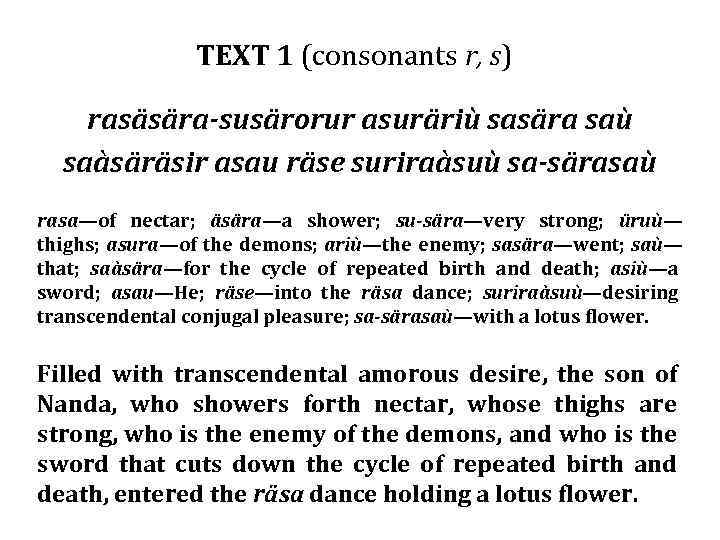
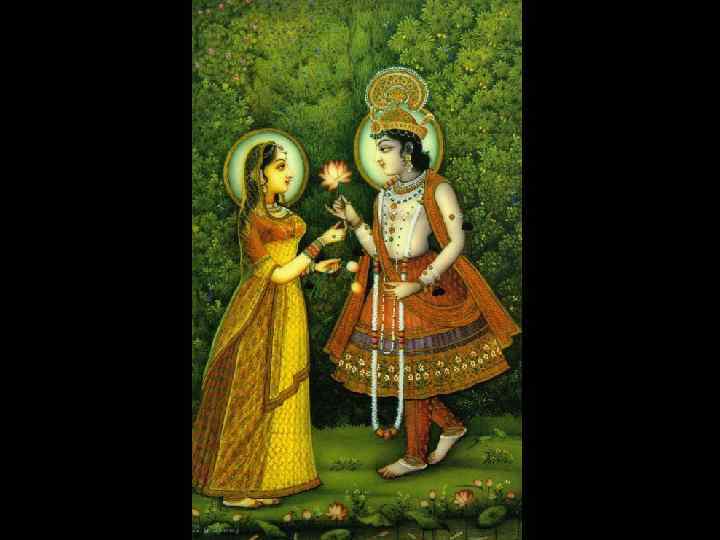
TEXT 1 (consonants r, s) rasäsära-susärorur asuräriù sasära saù saàsäräsir asau räse suriraàsuù sa-särasaù rasa—of nectar; äsära—a shower; su-sära—very strong; üruù— thighs; asura—of the demons; ariù—the enemy; sasära—went; saù— that; saàsära—for the cycle of repeated birth and death; asiù—a sword; asau—He; räse—into the räsa dance; suriraàsuù—desiring transcendental conjugal pleasure; sa-särasaù—with a lotus flower. Filled with transcendental amorous desire, the son of Nanda, who showers forth nectar, whose thighs are strong, who is the enemy of the demons, and who is the sword that cuts down the cycle of repeated birth and death, entered the räsa dance holding a lotus flower.
fd two-Consonant Verses be v CONSONANTS C, R
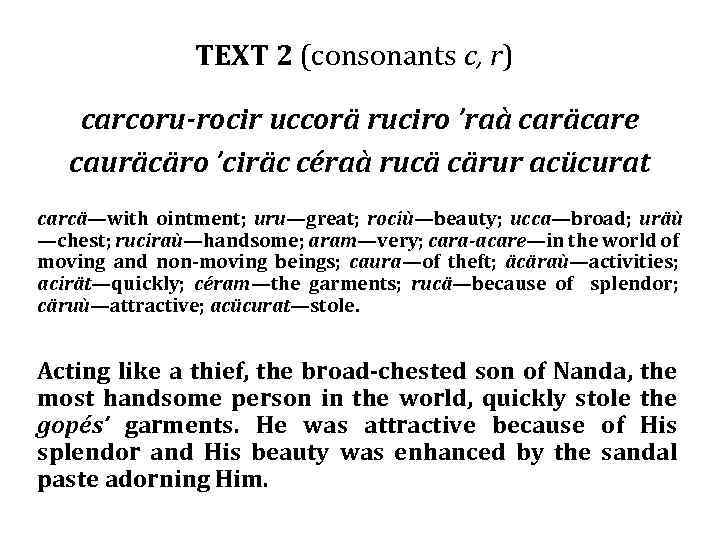
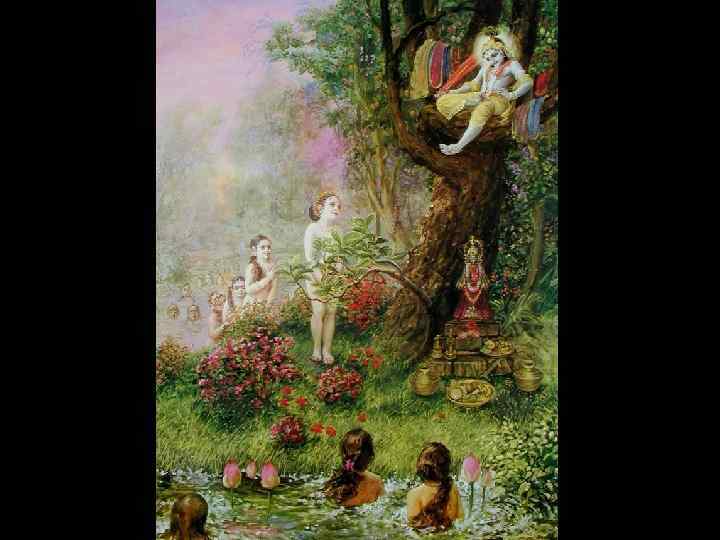
TEXT 2 (consonants c, r) carcoru-rocir uccorä ruciro ’raà caräcare cauräcäro ’ciräc céraà rucä cärur acücurat carcä—with ointment; uru—great; rociù—beauty; ucca—broad; uräù —chest; ruciraù—handsome; aram—very; cara-acare—in the world of moving and non-moving beings; caura—of theft; äcäraù—activities; acirät—quickly; céram—the garments; rucä—because of splendor; cäruù—attractive; acücurat—stole. Acting like a thief, the broad-chested son of Nanda, the most handsome person in the world, quickly stole the gopés’ garments. He was attractive because of His splendor and His beauty was enhanced by the sandal paste adorning Him.
fd two-Consonant Verses be w CONSONANTS DH, R
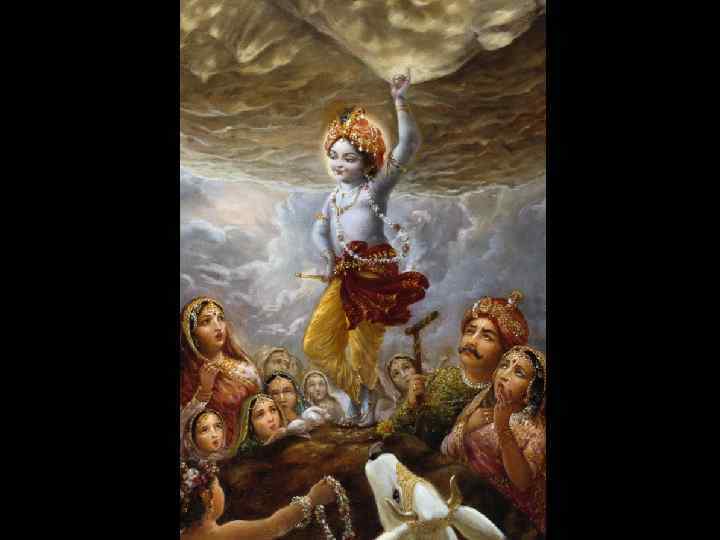
TEXT 3 (consonants dh, r) dhare dharädhara-dharaà dhärädhara-dhur-ärudhi dhéra-dhér ärarädhädhi-rodhaà rädhä dhuraàdharam dhare—at the hill; dharä-dhara—of the hill (the earth is called dharä because it supports all the living entities, and hills and mountains are called dharä-dharas because they support (dhara) the earth (dharä)); dharam—the holder; dhärä-dhara—of the clouds (clouds are called dhärä-dharas because they bear (dhara) a shower (dhärä)); dhur—the burden; ärudhi—blocking; dhéra—steady; dhéù—mind; ärarädha— worshiped; ädhi—distress; rodham—removing; rädhä—Rädhä; dhuraàdharam—the Supreme Lord. Beneath Govardhana hill, which was blocking the forceful attack of the devastating clouds, steady-minded Rädhä worshiped the Supreme Lord, who held up the hill and removed the anguish of His devotees.
fd one-Consonant Verse! be x
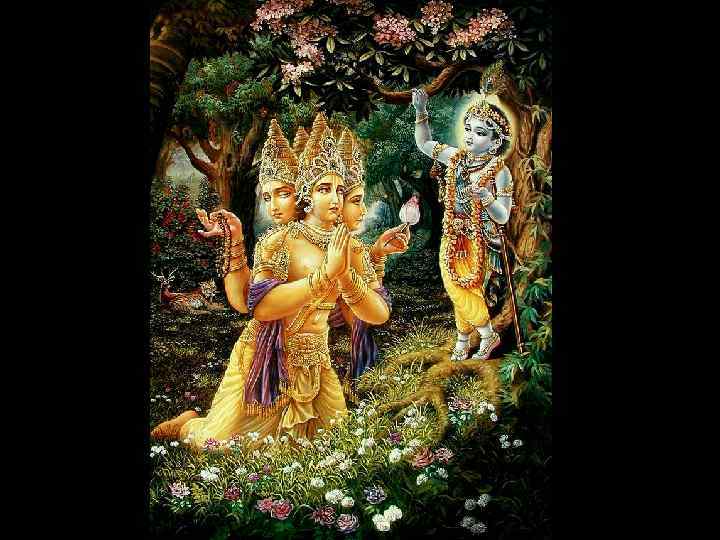
TEXT 4 ninunnäno ’nanaà nünaà nänünonnänano ’nunéù nänenänäà ninunanaù—of the cart demon; ananam—the nanu nenaà nänaun nänänano life; ninunna—driven away; nünam—certainly; na—not; anüna—completely; unna—wet with tears; änanaù—face; anunéù—trying to pacify; nänä—various; inänäm —of the demigods; ninut—who is the impeller; na—not; inam—to the Lord; na—not; anaut—offered prayers; nänä-änanaù—the manyheaded Lord Brahmä; nanu—O disputant. Did not the many-headed Lord Brahmä, who impels the various demigods, offer prayers, with tears streaming down his face, trying to pacify Lord Kåñëa, the killer of Çakaöäsura?

cakra-bandhaù w. Heel Formation y
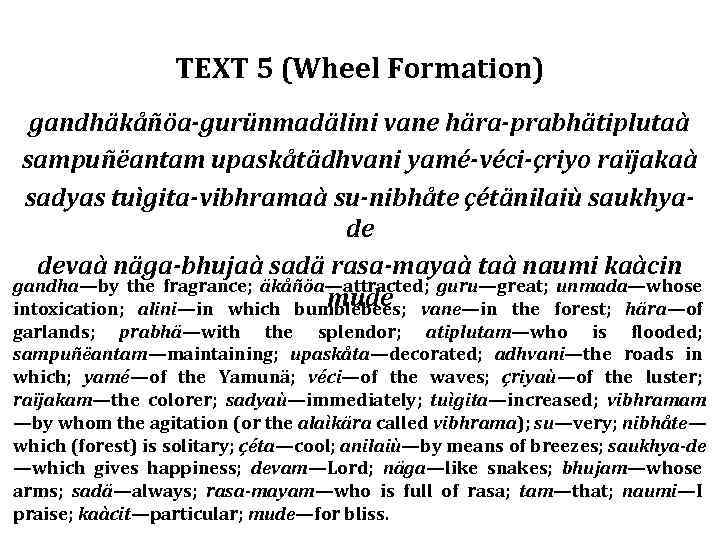
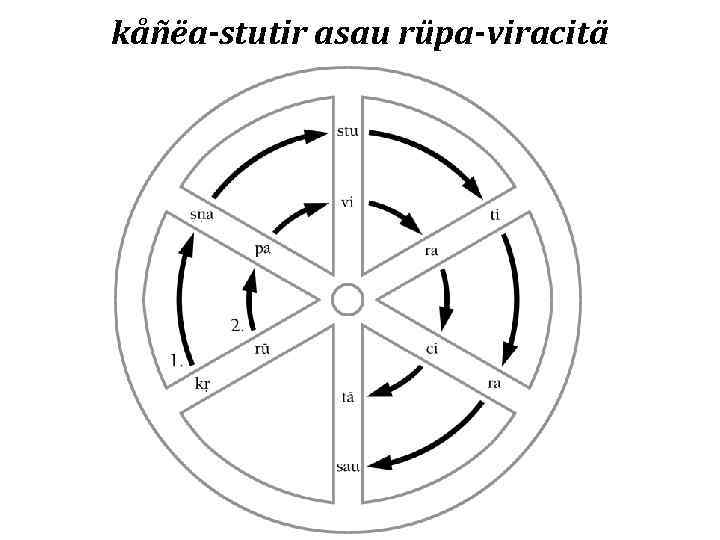
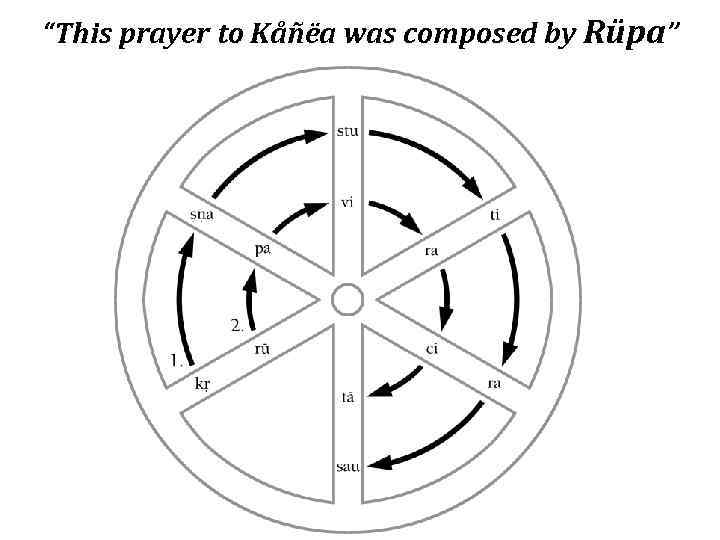
TEXT 5 (Wheel Formation) gandhäkåñöa-gurünmadälini vane hära-prabhätiplutaà sampuñëantam upaskåtädhvani yamé-véci-çriyo raïjakaà sadyas tuìgita-vibhramaà su-nibhåte çétänilaiù saukhyade devaà näga-bhujaà sadä rasa-mayaà taà naumi kaàcin gandha—by the fragrance; äkåñöa—attracted; guru—great; unmada—whose mude intoxication; alini—in which bumblebees; vane—in the forest; hära—of garlands; prabhä—with the splendor; atiplutam—who is flooded; sampuñëantam—maintaining; upaskåta—decorated; adhvani—the roads in which; yamé—of the Yamunä; véci—of the waves; çriyaù—of the luster; raïjakam—the colorer; sadyaù—immediately; tuìgita—increased; vibhramam —by whom the agitation (or the alaìkära called vibhrama); su—very; nibhåte— which (forest) is solitary; çéta—cool; anilaiù—by means of breezes; saukhya-de —which gives happiness; devam—Lord; näga—like snakes; bhujam—whose arms; sadä—always; rasa-mayam—who is full of rasa; tam—that; naumi—I praise; kaàcit—particular; mude—for bliss.
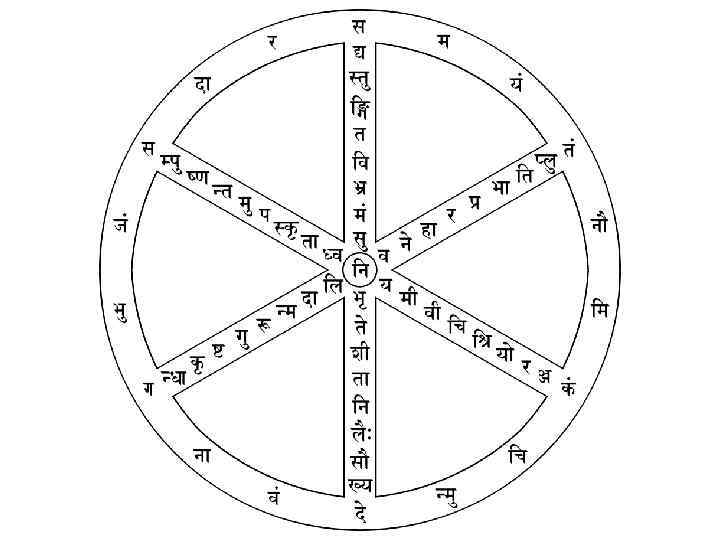
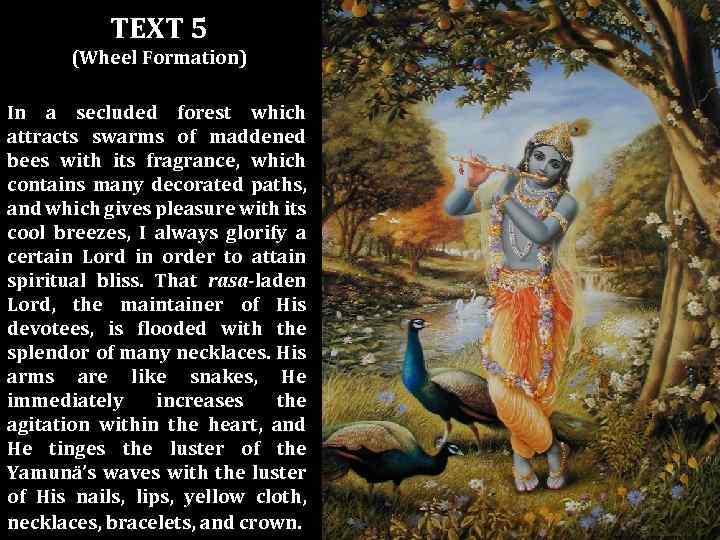
TEXT 5 (Wheel Formation) In a secluded forest which attracts swarms of maddened bees with its fragrance, which contains many decorated paths, and which gives pleasure with its cool breezes, I always glorify a certain Lord in order to attain spiritual bliss. That rasa-laden Lord, the maintainer of His devotees, is flooded with the splendor of many necklaces. His arms are like snakes, He immediately increases the agitation within the heart, and He tinges the luster of the Yamunä’s waves with the luster of His nails, lips, yellow cloth, necklaces, bracelets, and crown.
An extra specialty of this verse is that Rüpa Gosvämé has ingeniously placed a hidden signature inside the spokes of the wheel. The signature is not apparent in the verse. It becomes visible only when the verse is drawn in the wheel formation.
kåñëa-stutir asau rüpa-viracitä
“This prayer to Kåñëa was composed by Rüpa”

sarpa-bandhaù snake Formation z
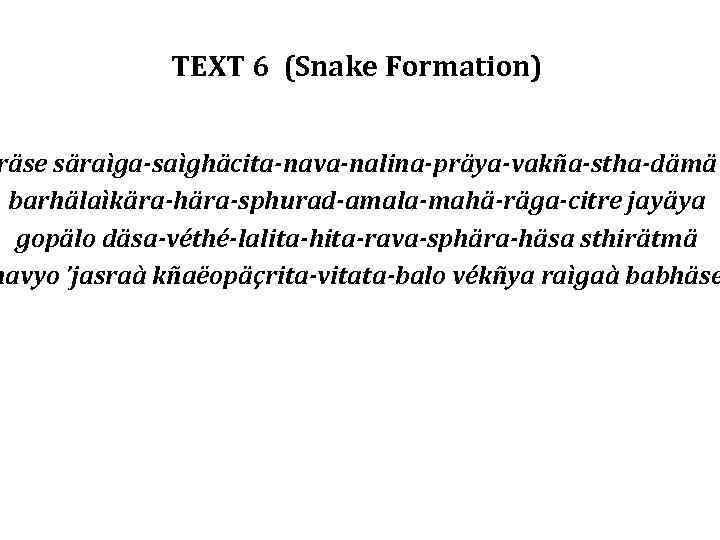
TEXT 6 (Snake Formation) räse säraìga-saìghäcita-nava-nalina-präya-vakña-stha-dämä barhälaìkära-hära-sphurad-amala-mahä-räga-citre jayäya gopälo däsa-véthé-lalita-hita-rava-sphära-häsa sthirätmä navyo ’jasraà kñaëopäçrita-vitata-balo vékñya raìgaà babhäse
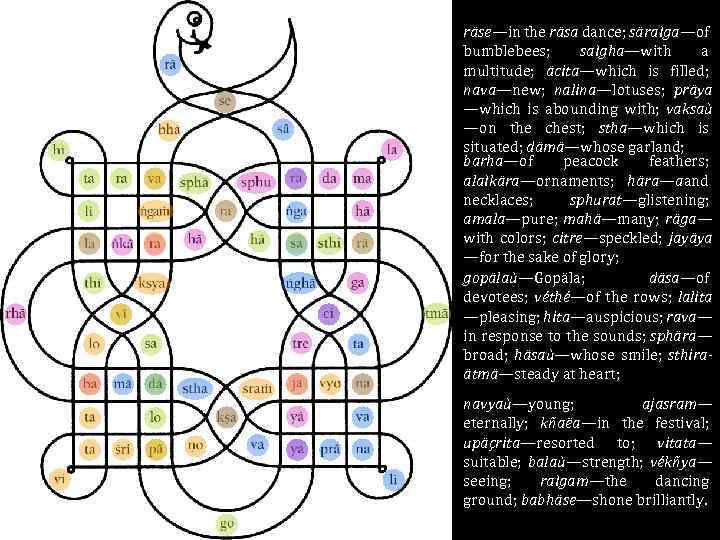
räse—in the räsa dance; säraìga—of bumblebees; saìgha—with a multitude; äcita—which is filled; nava—new; nalina—lotuses; präya —which is abounding with; vaksaù —on the chest; stha—which is situated; dämä—whose garland; barha—of peacock feathers; alaìkära—ornaments; hära—aand necklaces; sphurat—glistening; amala—pure; mahä—many; räga— with colors; citre—speckled; jayäya —for the sake of glory; gopälaù—Gopäla; däsa—of devotees; véthé—of the rows; lalita —pleasing; hita—auspicious; rava— in response to the sounds; sphära— broad; häsaù—whose smile; sthiraätmä—steady at heart; navyaù—young; ajasram— eternally; kñaëa—in the festival; upäçrita—resorted to; vitata— suitable; balaù—strength; vékñya— seeing; raìgam—the dancing ground; babhäse—shone brilliantly.
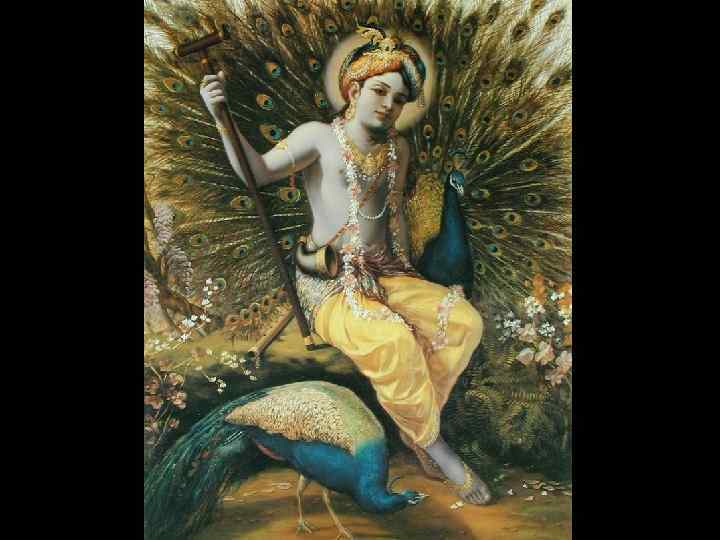
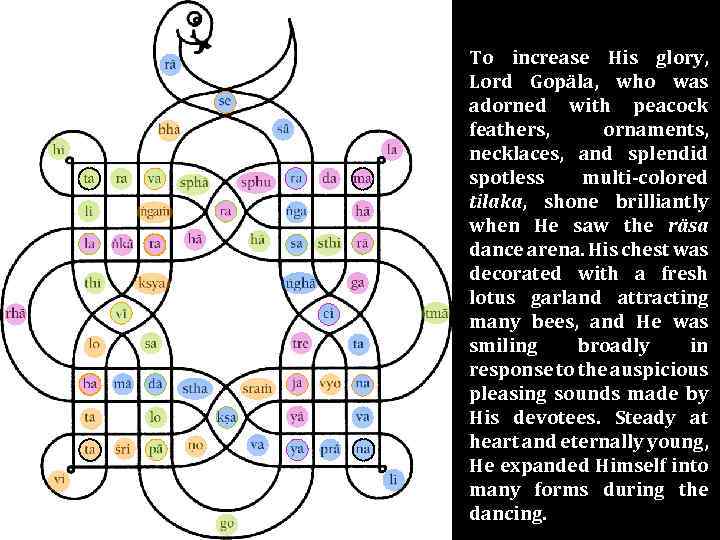
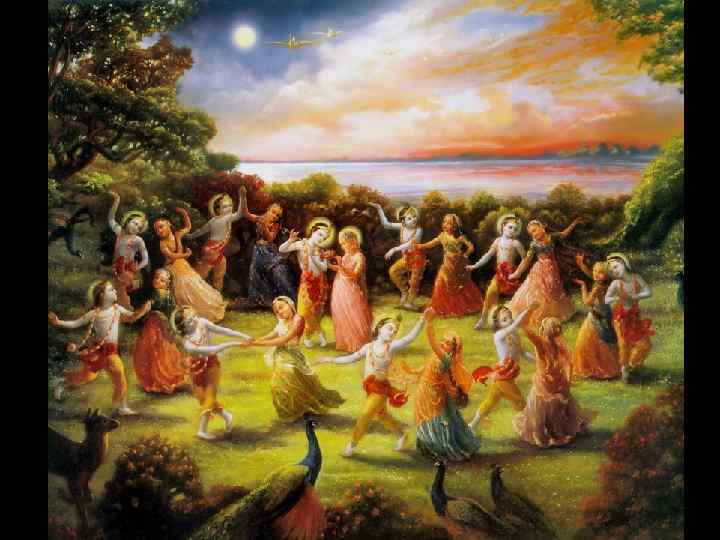
To increase His glory, Lord Gopäla, who was adorned with peacock feathers, ornaments, necklaces, and splendid spotless multi-colored tilaka, shone brilliantly when He saw the räsa dance arena. His chest was decorated with a fresh lotus garland attracting many bees, and He was smiling broadly in response to the auspicious pleasing sounds made by His devotees. Steady at heart and eternally young, He expanded Himself into many forms during the dancing.
padma-bandhaù lot. Us Formation {
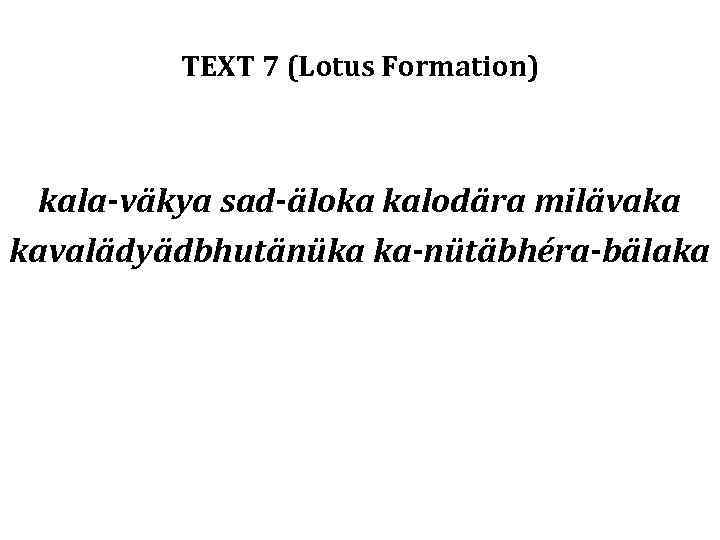
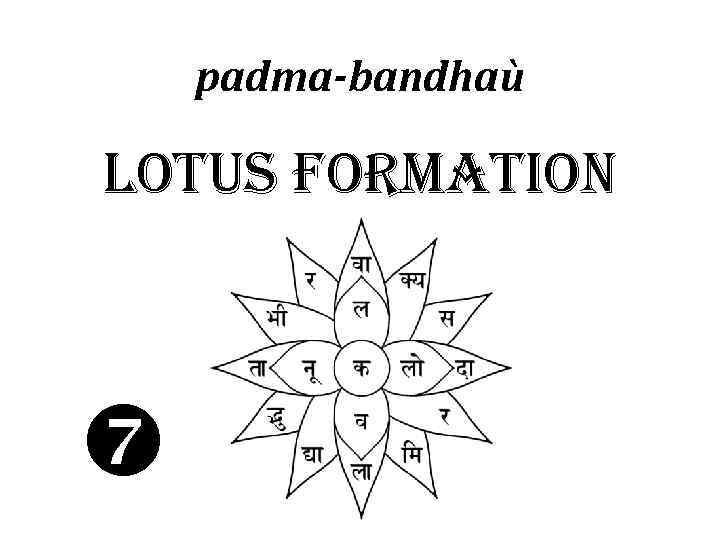
TEXT 7 (Lotus Formation) kala-väkya sad-äloka kalodära milävaka kavalädyädbhutänüka ka-nütäbhéra-bälaka
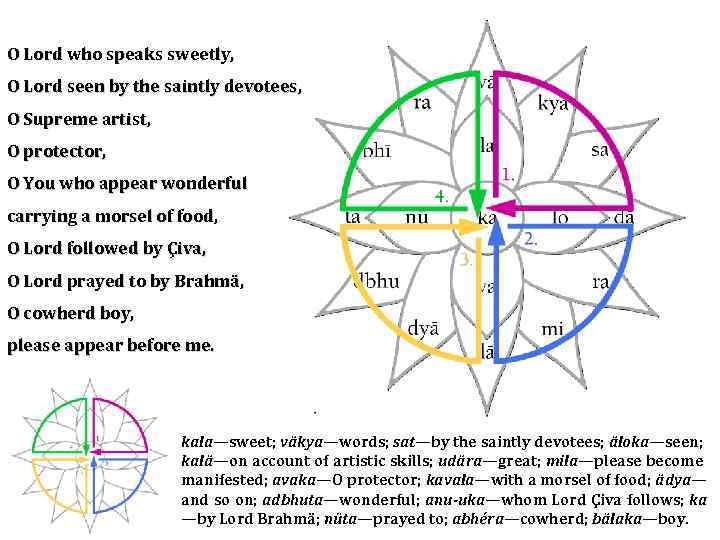
O Lord who speaks sweetly, O Lord seen by the saintly devotees, O Supreme artist, O protector, O You who appear wonderful carrying a morsel of food, O Lord followed by Çiva, O Lord prayed to by Brahmä, O cowherd boy, please appear before me. kala—sweet; väkya—words; sat—by the saintly devotees; äloka—seen; kalä—on account of artistic skills; udära—great; mila—please become manifested; avaka—O protector; kavala—with a morsel of food; ädya— and so on; adbhuta—wonderful; anu-uka—whom Lord Çiva follows; ka —by Lord Brahmä; nüta—prayed to; abhéra—cowherd; bälaka—boy.
prätilomyänulomya-samam “reading the same forwards and backwards” |
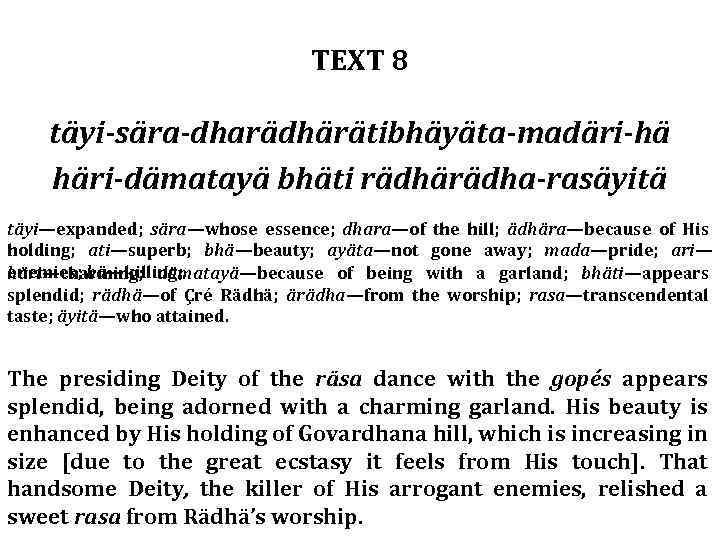
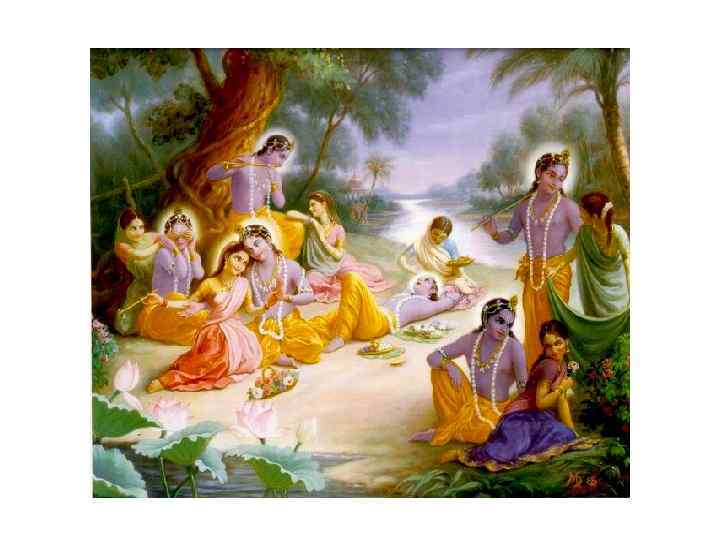
TEXT 8 täyi-sära-dharädhärätibhäyäta-madäri-hä häri-dämatayä bhäti rädhärädha-rasäyitä täyi—expanded; sära—whose essence; dhara—of the hill; ädhära—because of His holding; ati—superb; bhä—beauty; ayäta—not gone away; mada—pride; ari— enemies; hä—killing; häri—charming; dämatayä—because of being with a garland; bhäti—appears splendid; rädhä—of Çré Rädhä; ärädha—from the worship; rasa—transcendental taste; äyitä—who attained. The presiding Deity of the räsa dance with the gopés appears splendid, being adorned with a charming garland. His beauty is enhanced by His holding of Govardhana hill, which is increasing in size [due to the great ecstasy it feels from His touch]. That handsome Deity, the killer of His arrogant enemies, relished a sweet rasa from Rädhä’s worship.
gomütrikä-bandhaù } Go-mütrikä literally means “similar to the course of a cow’s urine”, i. e. , going alternately to one side and then to the other (zigzagging).
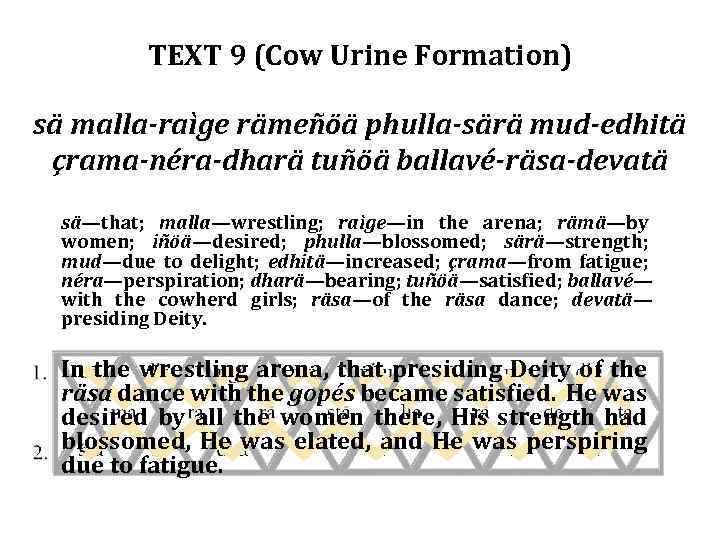
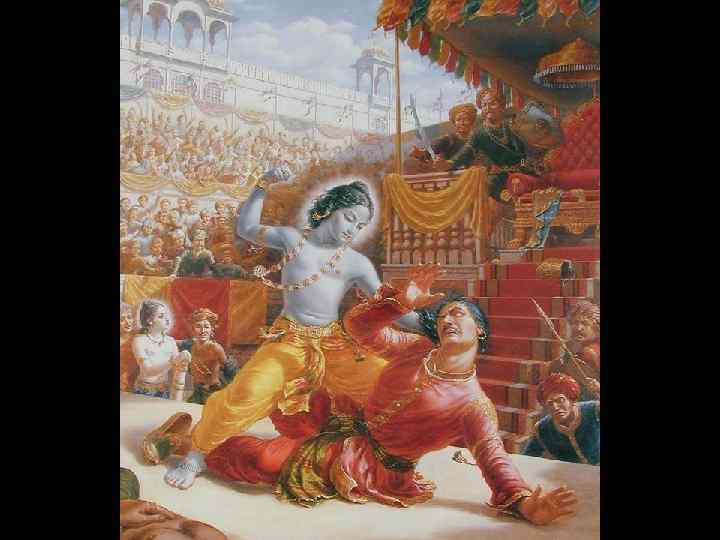
TEXT 9 (Cow Urine Formation) sä malla-raìge rämeñöä phulla-särä mud-edhitä çrama-néra-dharä tuñöä ballavé-räsa-devatä sä—that; malla—wrestling; raìge—in the arena; rämä—by women; iñöä—desired; phulla—blossomed; särä—strength; mud—due to delight; edhitä—increased; çrama—from fatigue; néra—perspiration; dharä—bearing; tuñöä—satisfied; ballavé— with the cowherd girls; räsa—of the räsa dance; devatä— presiding Deity. In the wrestling arena, that presiding Deity of the räsa dance with the gopés became satisfied. He was desired by all the women there, His strength had blossomed, He was elated, and He was perspiring due to fatigue.
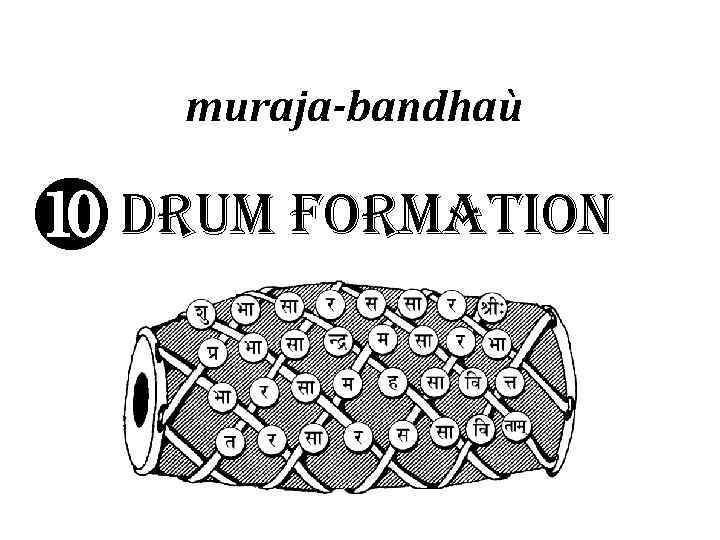
muraja-bandhaù ~ Dr. Um Formation
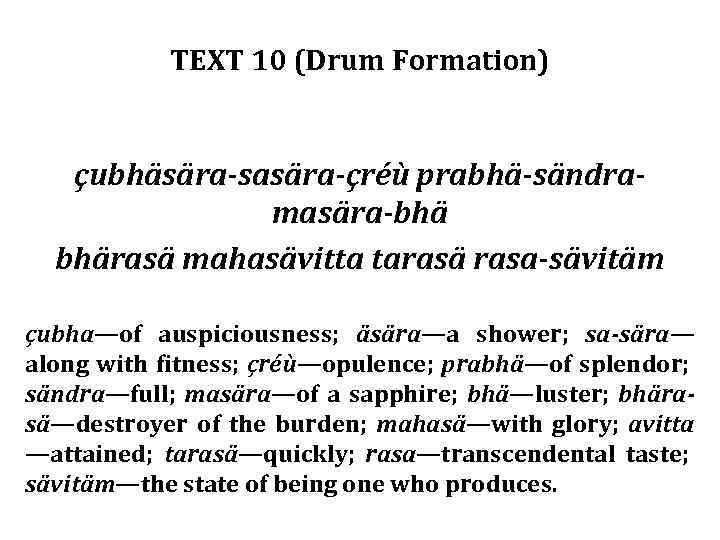
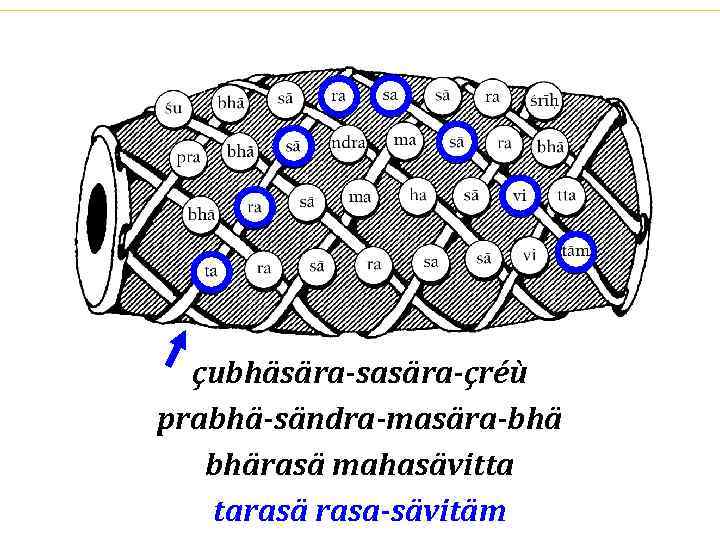
TEXT 10 (Drum Formation) çubhäsära-sasära-çréù prabhä-sändramasära-bhä bhärasä mahasävitta tarasä rasa-sävitäm çubha—of auspiciousness; äsära—a shower; sa-sära— along with fitness; çréù—opulence; prabhä—of splendor; sändra—full; masära—of a sapphire; bhä—luster; bhärasä—destroyer of the burden; mahasä—with glory; avitta —attained; tarasä—quickly; rasa—transcendental taste; sävitäm—the state of being one who produces.
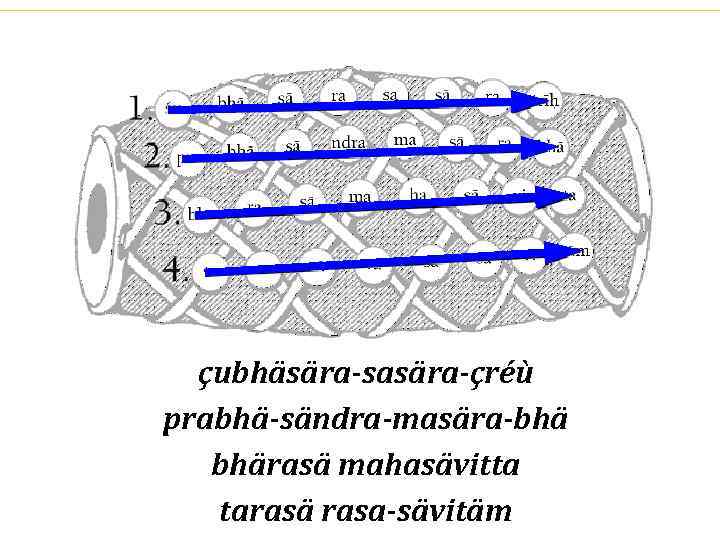
çubhäsära-sasära-çréù prabhä-sändra-masära-bhä bhärasä mahasävitta tarasä rasa-sävitäm
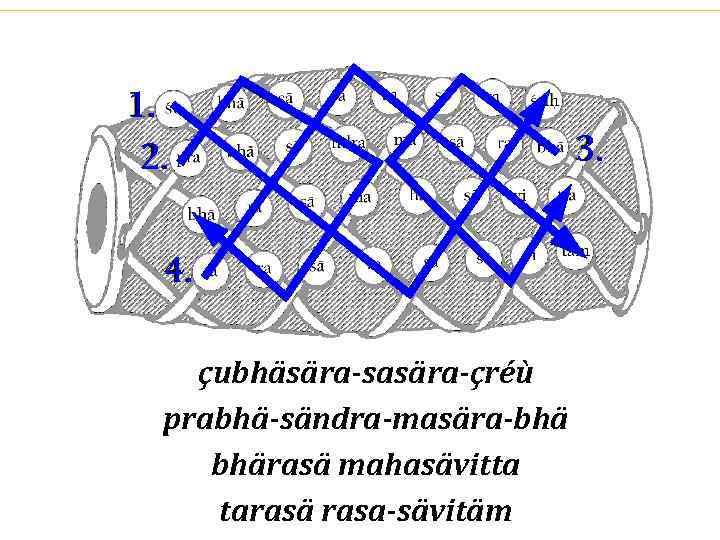
1. 2. 4. çubhäsära-sasära-çréù prabhä-sändra-masära-bhä bhärasä mahasävitta tarasä rasa-sävitäm 3.
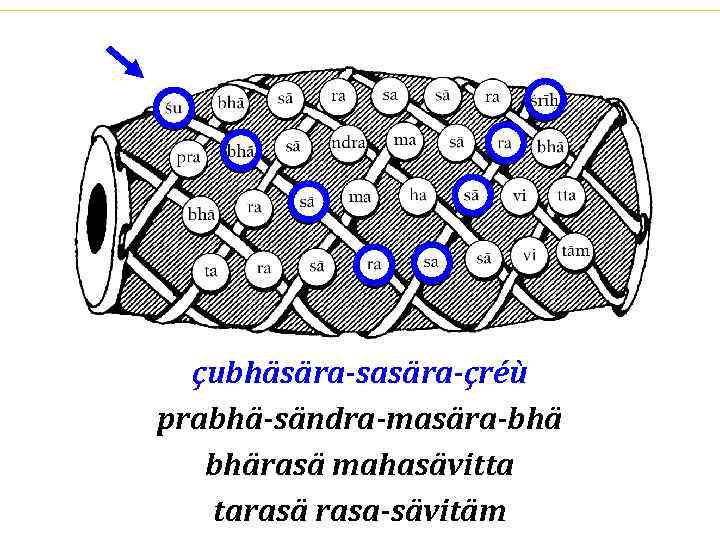
çubhäsära-sasära-çréù prabhä-sändra-masära-bhä bhärasä mahasävitta tarasä rasa-sävitäm
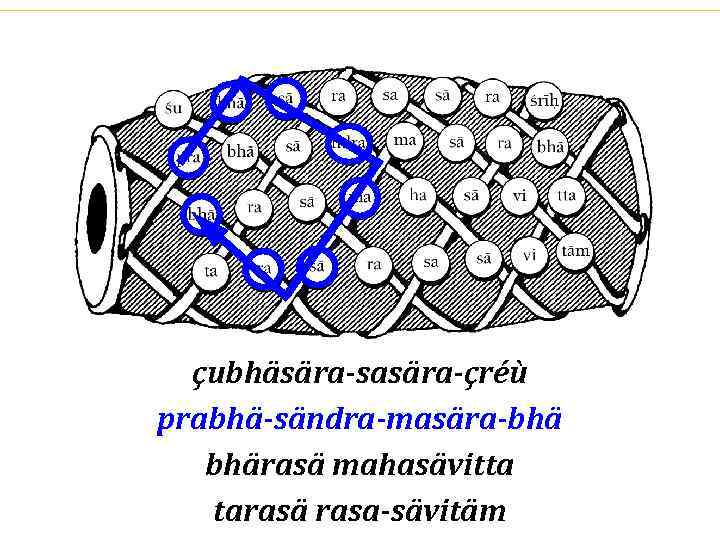
çubhäsära-sasära-çréù prabhä-sändra-masära-bhä bhärasä mahasävitta tarasä rasa-sävitäm
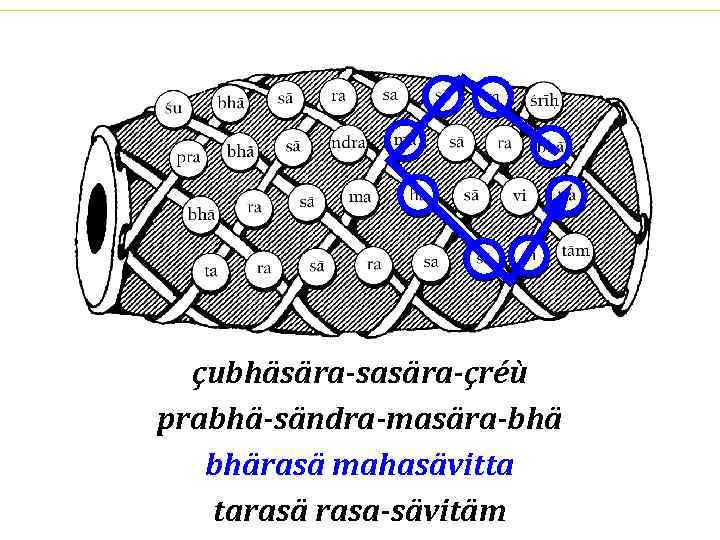
çubhäsära-sasära-çréù prabhä-sändra-masära-bhä bhärasä mahasävitta tarasä rasa-sävitäm
çubhäsära-sasära-çréù prabhä-sändra-masära-bhä bhärasä mahasävitta tarasä rasa-sävitäm
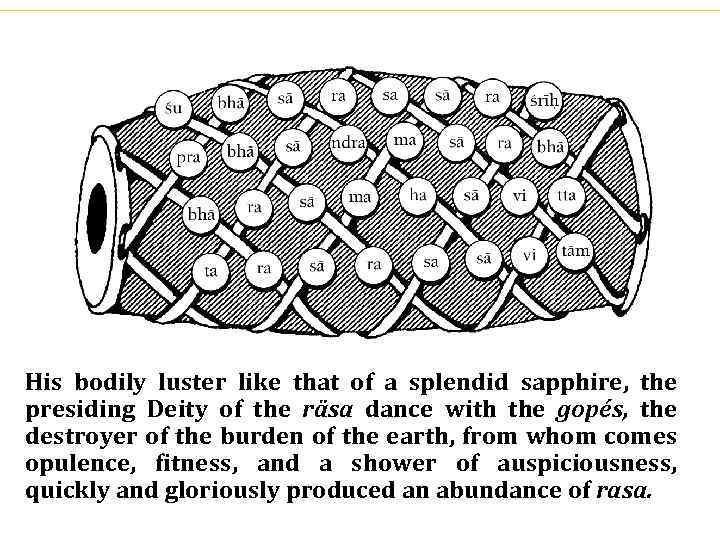
His bodily luster like that of a splendid sapphire, the presiding Deity of the räsa dance with the gopés, the destroyer of the burden of the earth, from whom comes opulence, fitness, and a shower of auspiciousness, quickly and gloriously produced an abundance of rasa.
sarvato-bhadraù (“good on every side”) The following verse reads the same backwards and forwards as well as upwards and downwards. uu
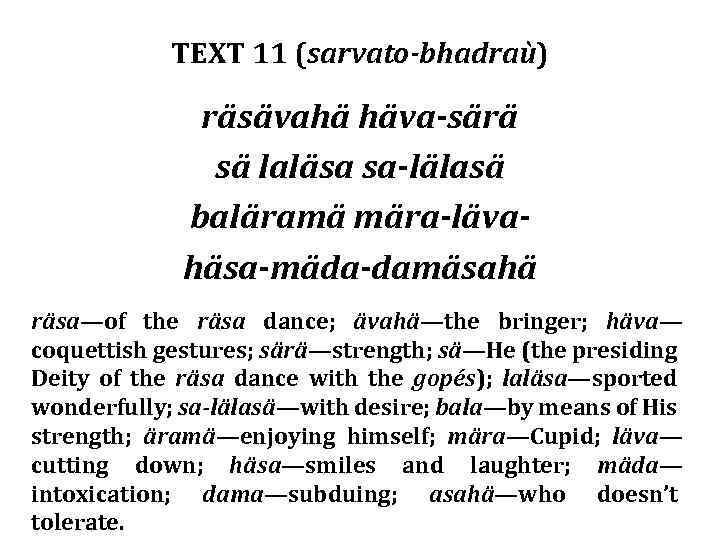
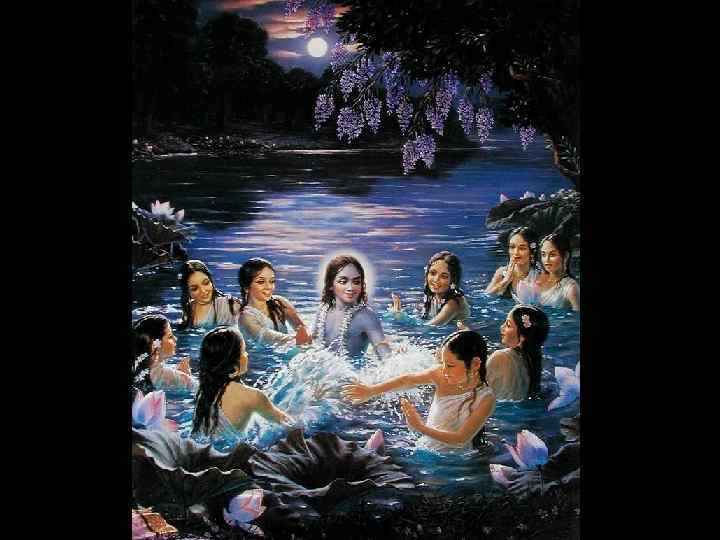
TEXT 11 (sarvato-bhadraù) räsävahä häva-särä sä laläsa sa-lälasä baläramä mära-lävahäsa-mäda-damäsahä räsa—of the räsa dance; ävahä—the bringer; häva— coquettish gestures; särä—strength; sä—He (the presiding Deity of the räsa dance with the gopés); laläsa—sported wonderfully; sa-lälasä—with desire; bala—by means of His strength; äramä—enjoying himself; mära—Cupid; läva— cutting down; häsa—smiles and laughter; mäda— intoxication; dama—subduing; asahä—who doesn’t tolerate.
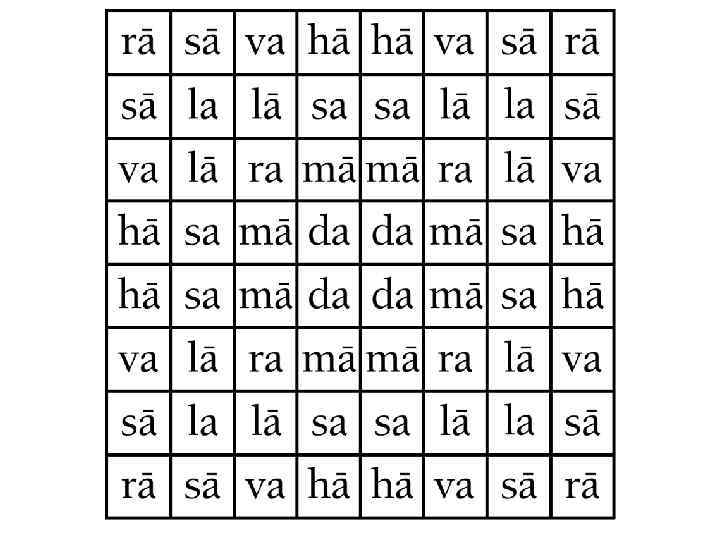
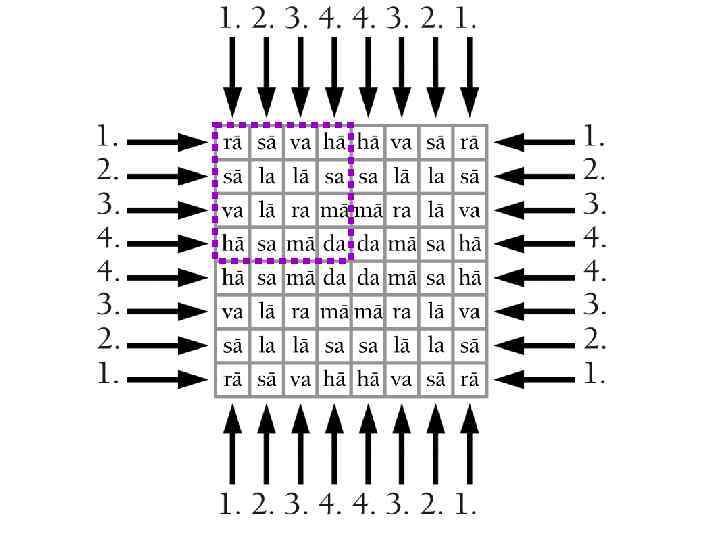
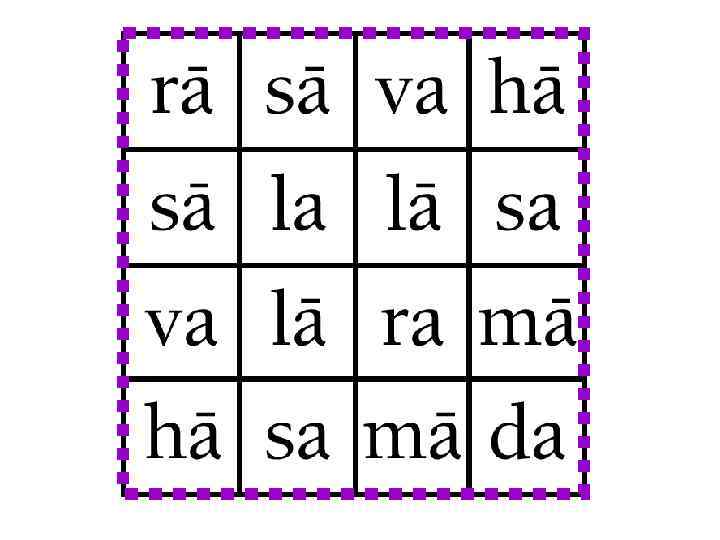
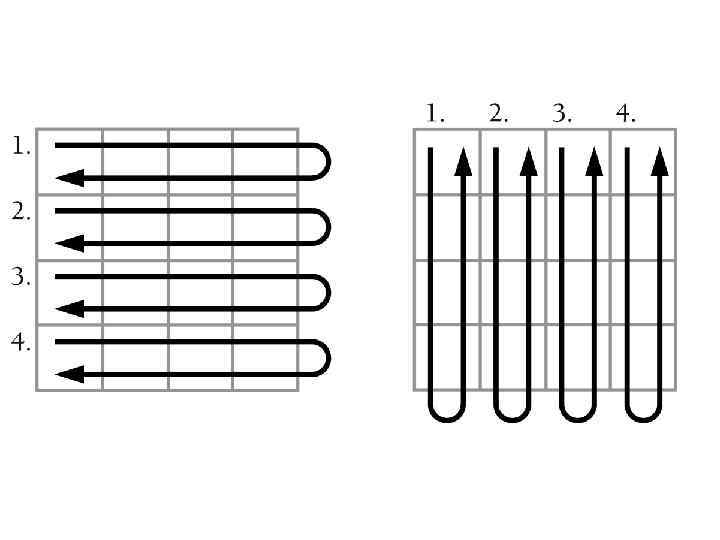
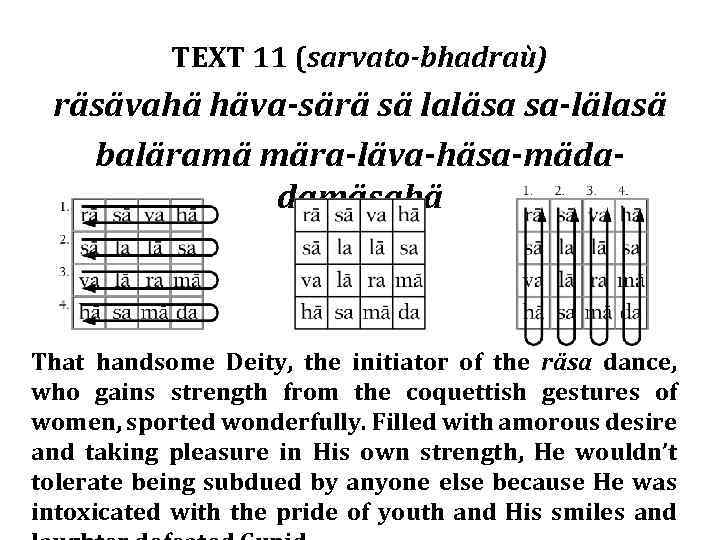
TEXT 11 (sarvato-bhadraù) räsävahä häva-särä sä laläsa sa-lälasä baläramä mära-läva-häsa-mädadamäsahä That handsome Deity, the initiator of the räsa dance, who gains strength from the coquettish gestures of women, sported wonderfully. Filled with amorous desire and taking pleasure in His own strength, He wouldn’t tolerate being subdued by anyone else because He was intoxicated with the pride of youth and His smiles and
båhat-padma-bandhaù Bi. G lot. Us Formation uv
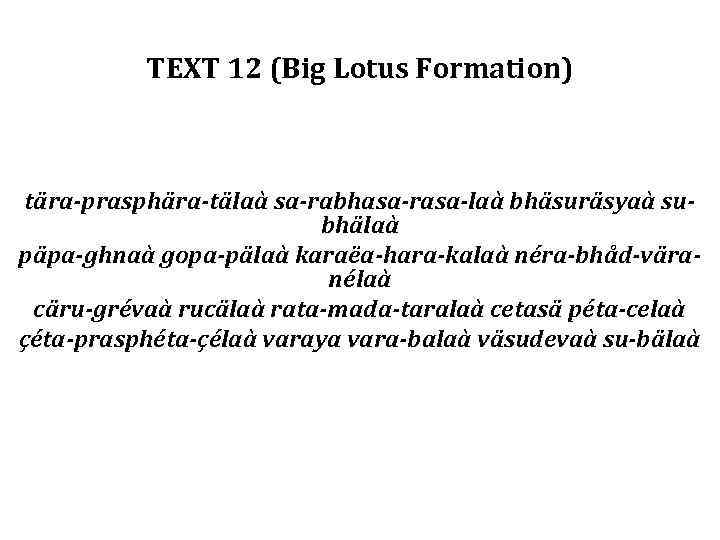
TEXT 12 (Big Lotus Formation) tära-prasphära-tälaà sa-rabhasa-rasa-laà bhäsuräsyaà subhälaà päpa-ghnaà gopa-pälaà karaëa-hara-kalaà néra-bhåd-väranélaà cäru-grévaà rucälaà rata-mada-taralaà cetasä péta-celaà çéta-prasphéta-çélaà varaya vara-balaà väsudevaà su-bälaà
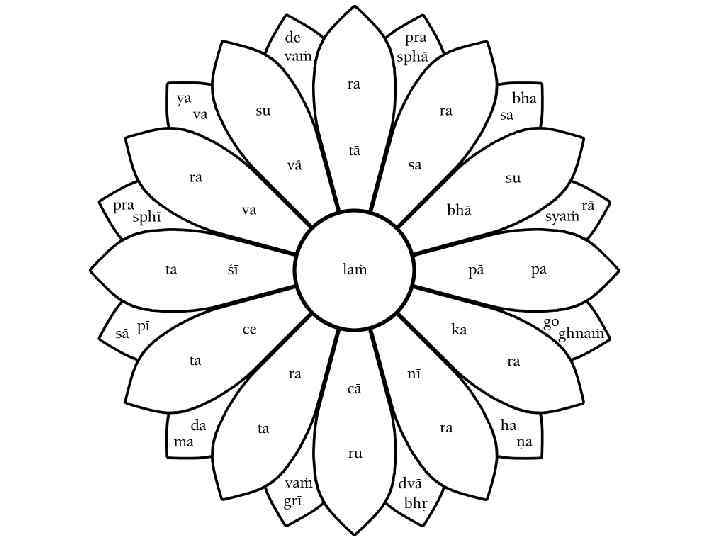
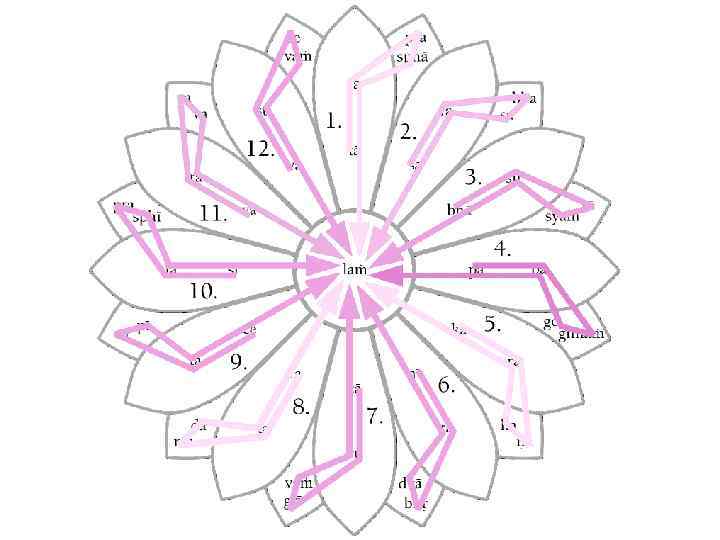
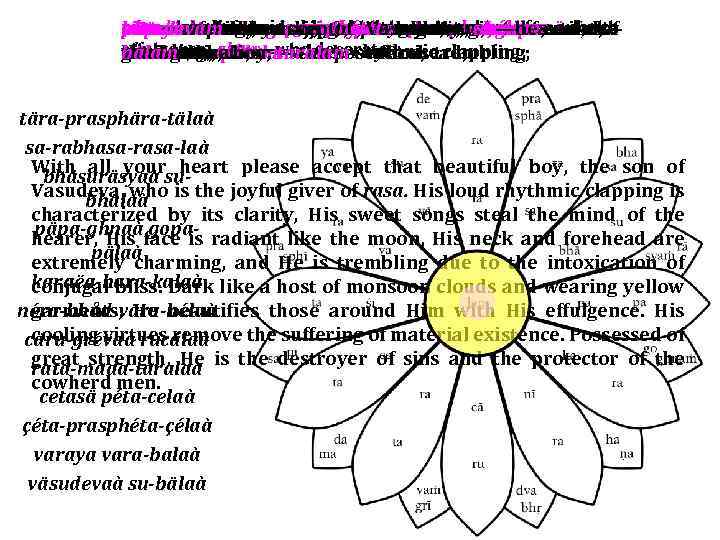
cäru—handsome; conjugalvara—great; kalam—whose néra-bhåt—of yourprasphéta—great; mada—because grévam—whose rucä—with çéta—cooling; tära—characterized by hara—charm; çélam—whose väsudevam—the heart; pleasure; neck; nélam—dark; varaya—please cetasä—with senses; of péta—yellow; celam—whose rata—caused by accept; clarity; prasphära—far karaëa—the clouds; vära—like a multitude; gopa—of su— päpa—of sins; ghnam—the destroyer; balam—whose bhäsura—radiant; son äsyam—whose su—beautiful; of sa-rabhasa—joyful; rasa-lam—giver of rasa; the Vasudeva; face; effulgence; alam—who decorates; is trembling; virtues; sounding; tälam—whose rhythmic clapping; bälam—the strength; garments; boy. the intoxication; sweet sounds; taralam—who cowherds; bhälam—whose forehead; handsome; pälam—the protector; tära-prasphära-tälaà sa-rabhasa-rasa-laà With all yoursubhäsuräsyaà heart please accept that beautiful boy, the son of Vasudeva, who is the joyful giver of rasa. His loud rhythmic clapping is bhälaà characterized by its clarity, His sweet songs steal the mind of the päpa-ghnaà gopahearer, His face is radiant like the moon, His neck and forehead are pälaà extremely charming, and He is trembling due to the intoxication of karaëa-hara-kalaà conjugal bliss. Dark like a host of monsoon clouds and wearing yellow garments, He beautifies those around Him with His effulgence. His néra-bhåd-vära-nélaà cooling virtues remove the suffering of material existence. Possessed of cäru-grévaà rucälaà great strength, He rata-mada-taralaà is the destroyer of sins and the protector of the cowherd men. cetasä péta-celaà çéta-prasphéta-çélaà varaya vara-balaà väsudevaà su-bälaà
çré-caitanya-mano-’bhéñöaà sthäpitaà yena bhü-tale svayaà rüpaù kadä mahyaà dadäti sva-padäntikam When will Çréla Rüpa Gosvämé Prabhupäda, who has established within this material world the mission to fulfill the desire of Lord Caitanya, give me shelter under his lotus feet?
Çréla Rüpa Gosvämé’s Citra Kavitväni Translation Graphics Pictures Design Matsya-avatära Däsa Bh. Erik BBT, B. G. Sharma Dämodara Gopäla Däsa & Bh. Re’em
Скачать презентацию Çrémad-Bhägavata Vidyäpéöham The Sanskrit School of the Bhaktivedanta
Citra Kavitvani .ppt