 Скачать презентацию Credit Spreads on Sovereign Debt An Explanatory Regression
aedb23534e568239ba45d32b03758334.ppt
- Количество слайдов: 59



Credit Spreads on Sovereign Debt An Explanatory Regression Model & Trading Strategy Submitted by Vaswar Mitra, Vinaya Jain Independent Study Project under Prof. Campbell Harvey, Term 4 2006 May 5 th, 2006
Agenda l l l Summary Findings The Origins & Evolution of Sovereign Debt Factors that influence sovereign credit spreads Overview of Methodologies Overview of Regression Analysis Model 1: WB Annual l Regression Model & Trading Strategy Model 2: WB Monthly l Regression Model & Trading Strategies Model 3: ICRG Monthly l Regression Model & Trading Strategies Model 4: Lagged Spreads l Regression Model & Trading Strategy Momentum Trading Strategy Issues to be Explored Further Bibliography 2
Summary Findings l l l WB Data annual and monthly (Annual independent variables replicated to give monthly data) data gave us high R-Squares in the 85% range The ICRG monthly data gave us R-Squares in the 63% range, lower than what we got using WB data. An explanatory model using lagged spreads gave us extremely high R-Squares over 96% even though the residuals were not distributed normally Long-Only trading strategies using 1 -year lags gave us good results, both with WB data and ICRG data. The Long-Short strategy did not work similarly well Given the high R-Squares using lagged spreads, we felt that a momentum strategy should work well. Our strategy yielded a percent accuracy of only 49% and cannot be used in its current form 3
The Origins of Sovereign Debt l The first public bonds originated in 17 th century European city-states – lifetime/redeemable annuities that paid interest to bondholders. l The UK “Consol” (1751) is the earliest example of a government bond used to supplement revenues from taxation l l Alexander Hamilton (1789) created “Hamilton 6 s” to refinance existing US debt – the first US federal bonds based on the Consols l l l Liquid, perpetual (redeemable at par) and highly credible. Backed by sinking funds, Consol’s formed 96% of Britain’s total debt from 1801 -1914 The Bank of England (1694) was mandated to manage government debt, issue currency and provide liquidity between bonds and cash Consols quickly became a “byword for financial security” and a benchmark for other risky assets Created the first US central bank, modeled on the Bank of England The British system of public debt was widely adopted worldwide – Holland (1814), Italy (1893), Japan (1880’s) Post World War 1 – the British Treasury developed more maturities of debt to supplement Consols l The first “gilt edged government securities” were introduced 4
The Evolution of Sovereign Debt The magnitude of government budget deficits and consequently, the outstanding volume of sovereign debt has fluctuated significantly over the years l l France, Russia and Italy averaged high deficits in the 18 th and 19 th century. The UK had the best record for balanced budget Between the years of 1816 – 1899: l l l UK – Only 4 years with a deficit >1% of GNP. Average budget surplus of 4. 6% France – Only 7 years with a budget surplus during this period. Italy – Ran a deficit every year from 1862 – 1899 USA – Average deficit of 1% of GNP Deficits were vastly larger during the World Wars particularly in combatant nations l l l World War 1 Average Deficit : UK - 30% of GNP, Germany 40%, Italy 22% World War 2: Soviet Union – 19% of GNP, Germany 36%. Axis countries relied heavily on short term borrowings, while the US and UK had more balanced maturity structures of sovereign debt “Wars of credit” - between 1776 and 1783, bonds financed 40% of the UK’s war expenditure Short term debt (Bills) gained in popularity, as the attractiveness of long dated war bonds declined 5
The Evolution of Sovereign Debt Contd. . . Early European kingdoms were notoriously prone to defaulting on sovereign debt. Defaults could be declared in many ways – the most common types were: l Outright Default – Suspension of principal or interest payments l Moratoria/ Rescheduling - Institutionalized processes to make creditors agree to new terms on the debt l Conversions – the exchange of one class of bond for another, usually with a lower coupon or higher maturity. In the UK, conversions were always negotiated, while in other countries they could be imposed upon creditors. Some well known examples of sovereign defaults: l Spain & France defaulted on all or part of their debt, over 10 times in the 16 th and 17 th centuries l The UK declared a moratorium on interest payments in the 1680’s and converted some debt l Turkey defaulted in 1875, and after World War I l Latin American countries like Brazil, Mexico and Colombia were “perennial defaulters” in the late 19 th and 20 th centuries 6
Factors Influencing Sovereign Debt Spreads l The credit spread or ”yield” is the main determinant of the borrowing cost for a country. According to traditional economic theory, spreads are determined by: l l l Expectations of real growth prospects, nominal interest rates and inflation for the country in question (Fisher Effect, Gibson’s Paradox) They are thought to be linked to measures of “monetary growth” , “fiscal stability”, and the overall term structure of interest rates The credit spread is viewed as a premium for default risk and other risks specific to the issuing country Political and other types of idiosyncratic risks The “Feel good” factor – psychology and economics l l l Economic policy and its effect on the morale of the public “It’s the economy stupid” – Bill Clinton The eternal Fiscal Policy question - do higher debts lead to higher interest rates? l l Regression analysis of UK data from 1727 shows a very low relationship between yields and the debt/GNP and deficit/GNP Ratio However in the late 1970’s and 1980’s there is evidence of strong positive correlation between debt/GNP ratios and rising real interest rates. 7
Overview of Methodologies To develop an explanatory model for sovereign debt spreads we created three methodologies: 1. Using World Bank (WB) annual data after correcting for missing data 2. Using World Bank (WB) annual data but transforming it to monthly by replicating the annual data (independent variables) 12 times but using actual monthly spreads (dependent variable) 3. Using ICRG monthly data Next we tested for viable trading strategies: 1. For each of the explanatory models developed above, we developed a predictive model using in sample data and tested the model on out of sample data 2. Tested for a momentum trading strategy 8
Overview of Regression Analysis l l l Stata used for regression analysis Assumed that there would be fixed time effects. Eliminated these effects by using time dummies for each year Used cluster standard errors Ensured that independent variable correlations and multicollinearity were within reasonable levels Generated partial regression plots and checked for any unusual or influential points Finally, tested that the regression residuals for normality 9
Model 1: WB Annual World Bank Annual Data 10
WB Annual: Regression Variables l Dependent Variable: l l Independent Variable: l l Ln(Spread) GDP Per Capita, Reserves Per Capita, External Debt as a Percent of GDP We expect spreads to be: l l l Lower for higher GDP Per Capita Lower for higher Reserves per Capita numbers Higher for higher External Debt as a Percent of GDP This was consistent with our regression results 11
WB Annual: Modifications to Data l l l Lack of data for certain years for certain variables presented a problem In general we excluded the years or countries for which data was missing In one case we modified the data. Data for the independent variable “External Debt as a percent of GDP” was sometimes missing for certain years or for a specific country altogether. To handle this situation, we made the following modifications: l Where the data was missing for a specific year but the country had data for previous years, we simply used the country data from previous years l Where data was completely missing for the country, we used the average across all countries for the particular year 12
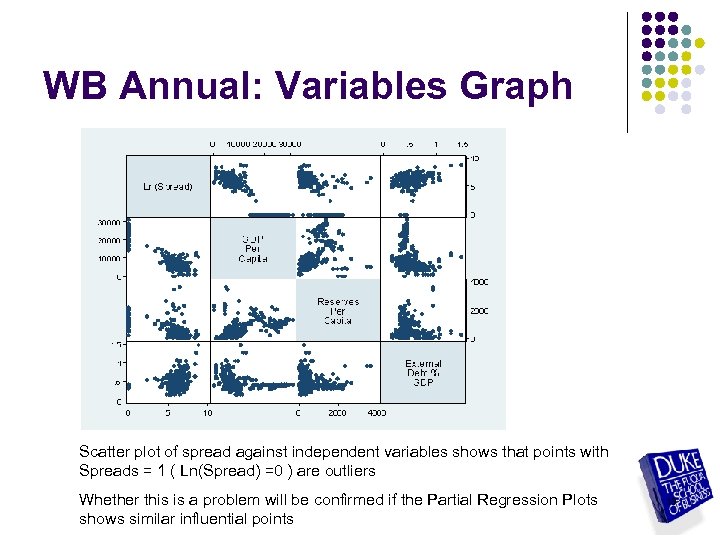
WB Annual: Variables Graph Scatter plot of spread against independent variables shows that points with Spreads = 1 ( Ln(Spread) =0 ) are outliers Whether this is a problem will be confirmed if the Partial Regression Plots shows similar influential points 13
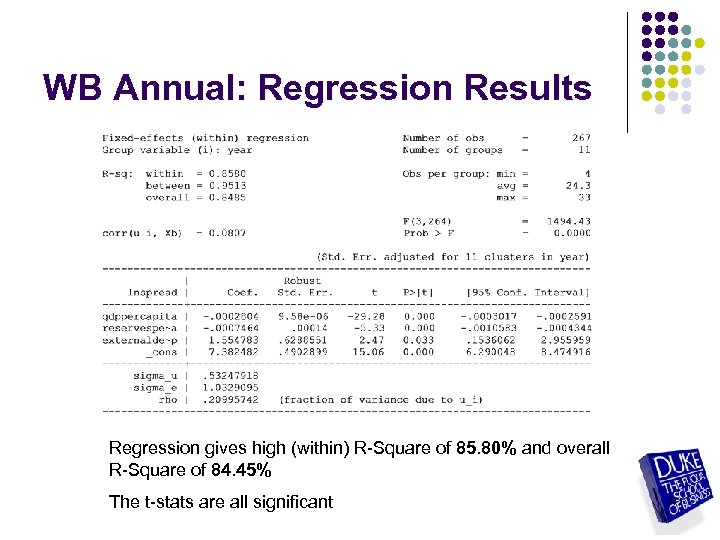
WB Annual: Regression Results Regression gives high (within) R-Square of 85. 80% and overall R-Square of 84. 45% The t-stats are all significant 14
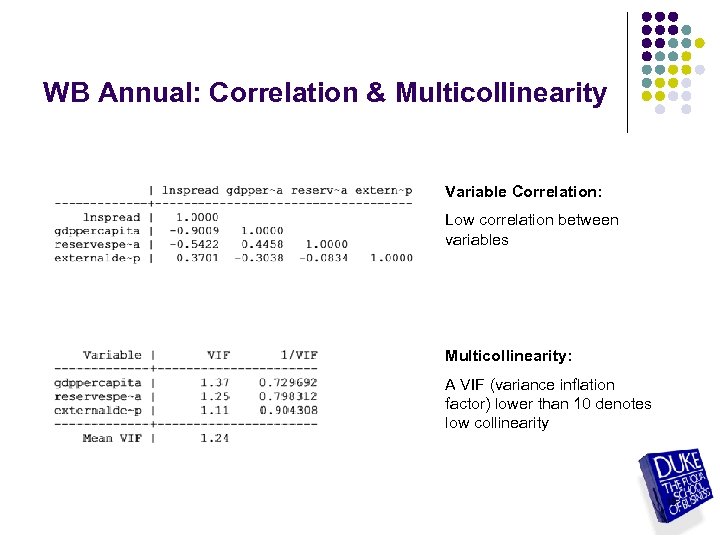
WB Annual: Correlation & Multicollinearity Variable Correlation: Low correlation between variables Multicollinearity: A VIF (variance inflation factor) lower than 10 denotes low collinearity 15
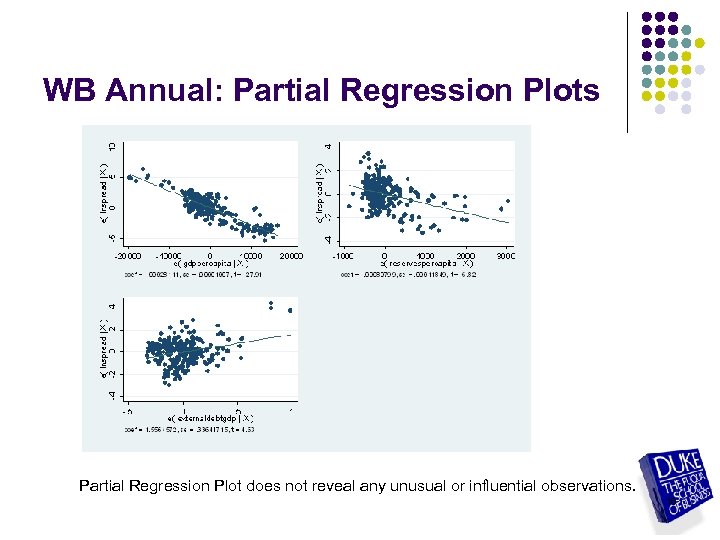
WB Annual: Partial Regression Plots Partial Regression Plot does not reveal any unusual or influential observations. 16
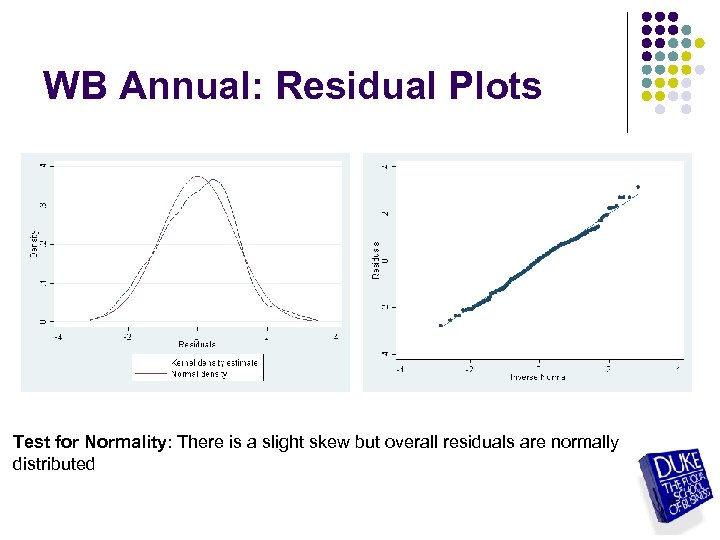
WB Annual: Residual Plots Test for Normality: There is a slight skew but overall residuals are normally distributed 17
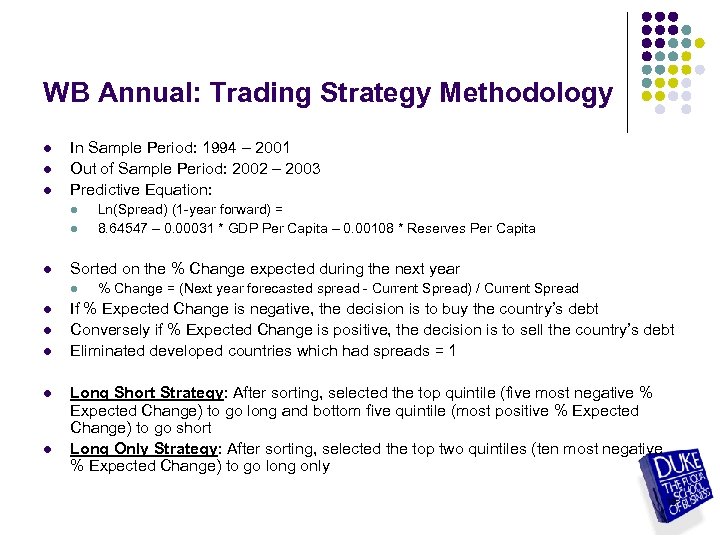
WB Annual: Trading Strategy Methodology l l l In Sample Period: 1994 – 2001 Out of Sample Period: 2002 – 2003 Predictive Equation: l l l Sorted on the % Change expected during the next year l l l Ln(Spread) (1 -year forward) = 8. 64547 – 0. 00031 * GDP Per Capita – 0. 00108 * Reserves Per Capita % Change = (Next year forecasted spread - Current Spread) / Current Spread If % Expected Change is negative, the decision is to buy the country’s debt Conversely if % Expected Change is positive, the decision is to sell the country’s debt Eliminated developed countries which had spreads = 1 Long Short Strategy: After sorting, selected the top quintile (five most negative % Expected Change) to go long and bottom five quintile (most positive % Expected Change) to go short Long Only Strategy: After sorting, selected the top two quintiles (ten most negative % Expected Change) to go long only 18
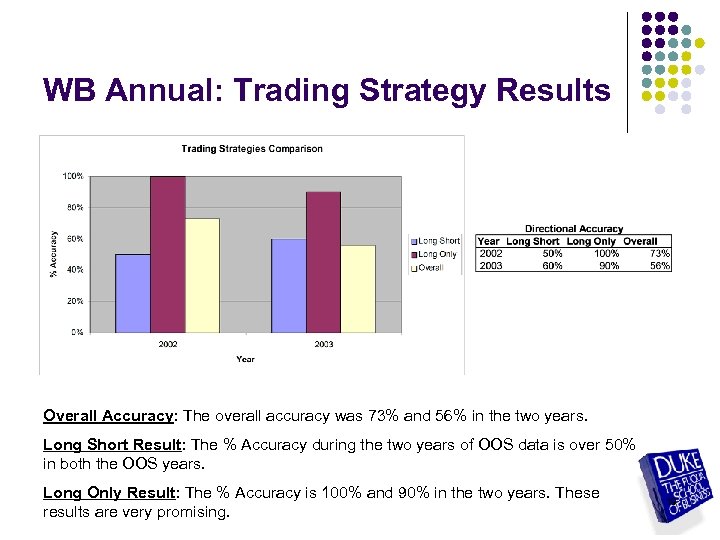
WB Annual: Trading Strategy Results Overall Accuracy: The overall accuracy was 73% and 56% in the two years. Long Short Result: The % Accuracy during the two years of OOS data is over 50% in both the OOS years. Long Only Result: The % Accuracy is 100% and 90% in the two years. These results are very promising. 19
WB Annual: Conclusions l Strong explanatory power of World Bank annual data. Gives us R-Sq in the 85% range l Long only Trading Strategy shows a lot of promise l Need to explore reasons why the short side of the strategy does not yield as good results 20
Model 2: WB Monthly World Bank Annual Data converted to Monthly 21
WB Monthly: Regression Variables l Dependent Variable: l l Independent Variable: l l Ln(Spread) GDP Per Capita, Reserves Per Capita, External Debt as a Percent of GDP We expect spreads to be: l l l Lower for higher GDP Per Capita Lower for higher Reserves per Capita numbers Higher for higher External Debt as a Percent of GDP This was consistent with our regression results 22
WB Monthly: Modifications to Data l Starting with the WB annual data used in Model 1, we made the following modifications: 1. We replicated the annual data (independent variables) 12 times, once for each month of the year 2. used the actual monthly spreads (dependent variable) 3. Ran our regressions and our trading strategy as if we had monthly data 23
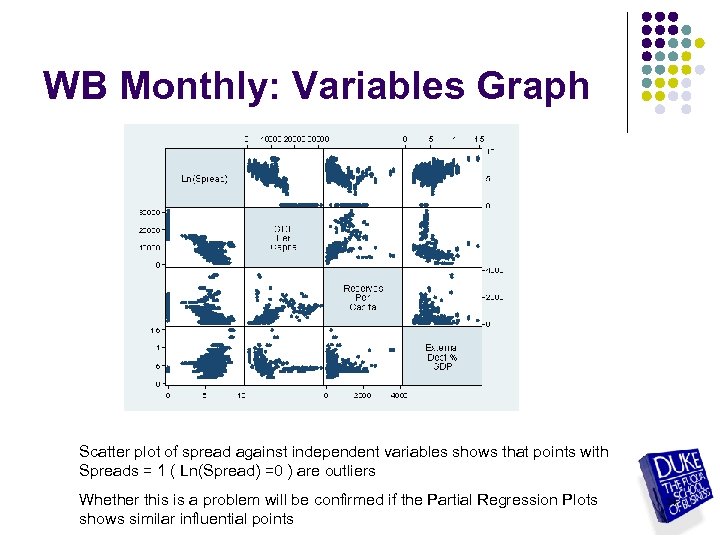
WB Monthly: Variables Graph Scatter plot of spread against independent variables shows that points with Spreads = 1 ( Ln(Spread) =0 ) are outliers Whether this is a problem will be confirmed if the Partial Regression Plots shows similar influential points 24
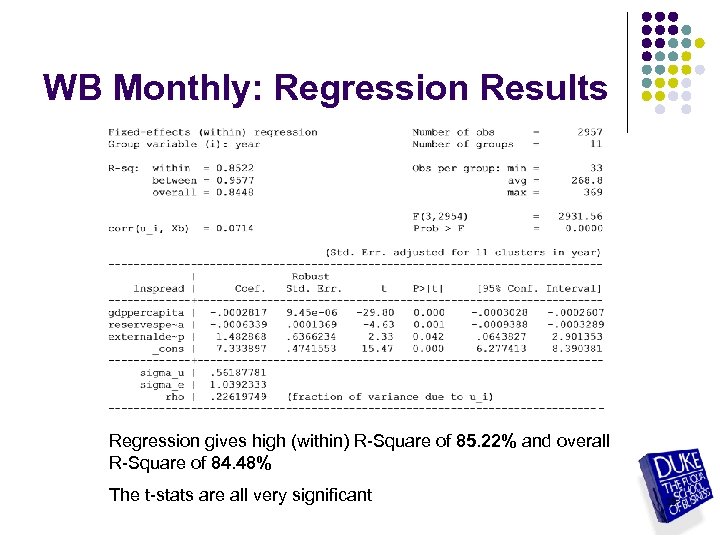
WB Monthly: Regression Results Regression gives high (within) R-Square of 85. 22% and overall R-Square of 84. 48% The t-stats are all very significant 25
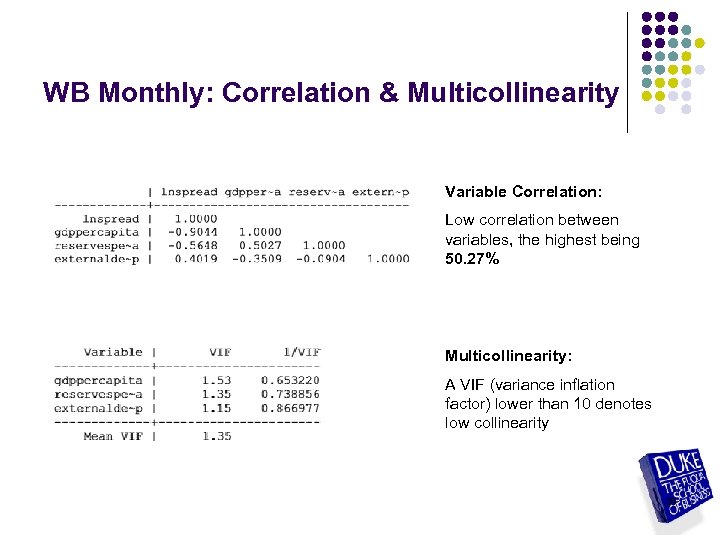
WB Monthly: Correlation & Multicollinearity Variable Correlation: Low correlation between variables, the highest being 50. 27% Multicollinearity: A VIF (variance inflation factor) lower than 10 denotes low collinearity 26
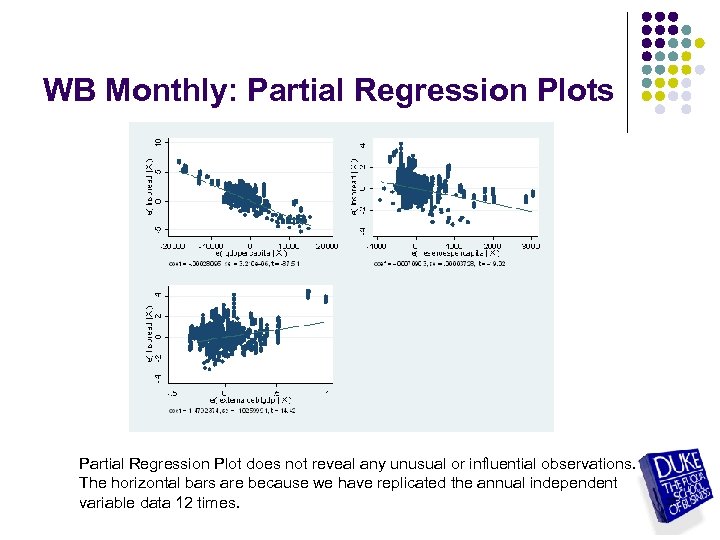
WB Monthly: Partial Regression Plots Partial Regression Plot does not reveal any unusual or influential observations. The horizontal bars are because we have replicated the annual independent variable data 12 times. 27
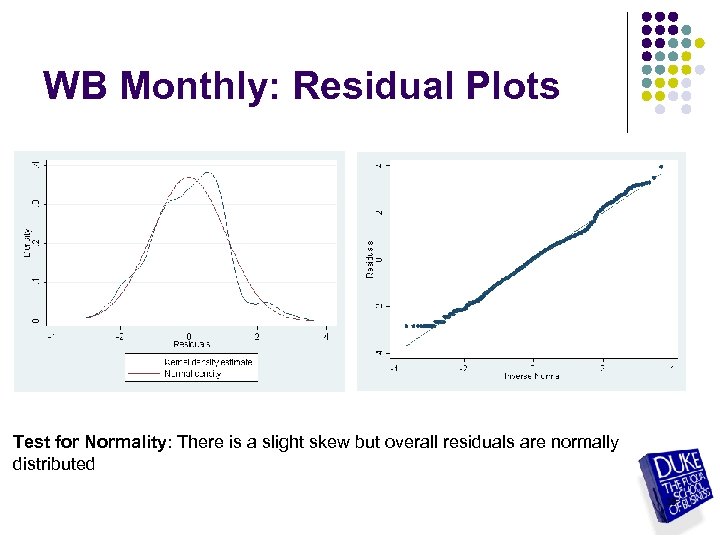
WB Monthly: Residual Plots Test for Normality: There is a slight skew but overall residuals are normally distributed 28
WB Monthly: Trading Strategy Methodology- 1 Methodology – 1 uses 1 -month predictive model l In Sample Period: 1994 Jan – 2002 Dec Out of Sample Period: 2003 Jan – 2004 Nov Predictive Equation: l l l Sorted on the % Change expected during the next month l l l Ln(Spread) (1 -month forward) = 8. 090379 – 0. 00029 * GDP Per Capita – 0. 001111 * Reserves Per Capita + 0. 580377 * External Debt as a % of GDP % Change = (Next month forecasted spread - Current Spread) / Current Spread If % Expected Change is negative, the decision is to buy the country’s debt Conversely if % Expected Change is positive, the decision is to sell the country’s debt Long Short Strategy: After sorting, selected the top quintile (five most negative % Expected Change) to go long and bottom five quintile (most positive % Expected Change) to go short Long Only Strategy: After sorting, selected the top two quintiles (ten most negative % Expected Change) to go long only 29
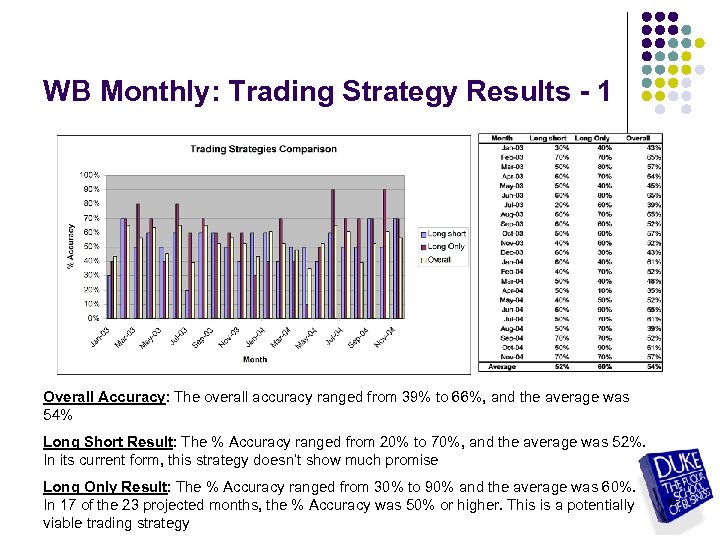
WB Monthly: Trading Strategy Results - 1 Overall Accuracy: The overall accuracy ranged from 39% to 66%, and the average was 54% Long Short Result: The % Accuracy ranged from 20% to 70%, and the average was 52%. In its current form, this strategy doesn’t show much promise Long Only Result: The % Accuracy ranged from 30% to 90% and the average was 60%. In 17 of the 23 projected months, the % Accuracy was 50% or higher. This is a potentially viable trading strategy 30
WB Monthly: Trading Strategy Methodology- 2 Methodology – 2 uses 1 -year predictive model l In Sample Period: 1994 Jan – 2001 Dec Out of Sample Period: 2002 Jan – 2003 Dec Predictive Equation: l l l Sorted on the % Change expected during the next year l l l Ln(Spread) (1 -year forward) = 8. 491300 – 0. 000295 * GDP Per Capita – 0. 001160 * Reserves Per Capita % Change = (Next year forecasted spread - Current Spread) / Current Spread If % Expected Change is negative, the decision is to buy the country’s debt Conversely if % Expected Change is positive, the decision is to sell the country’s debt Long Short Strategy: After sorting, selected the top quintile (five most negative % Expected Change) to go long and bottom five quintile (most positive % Expected Change) to go short Long Only Strategy: After sorting, selected the top two quintiles (ten most negative % Expected Change) to go long only 31
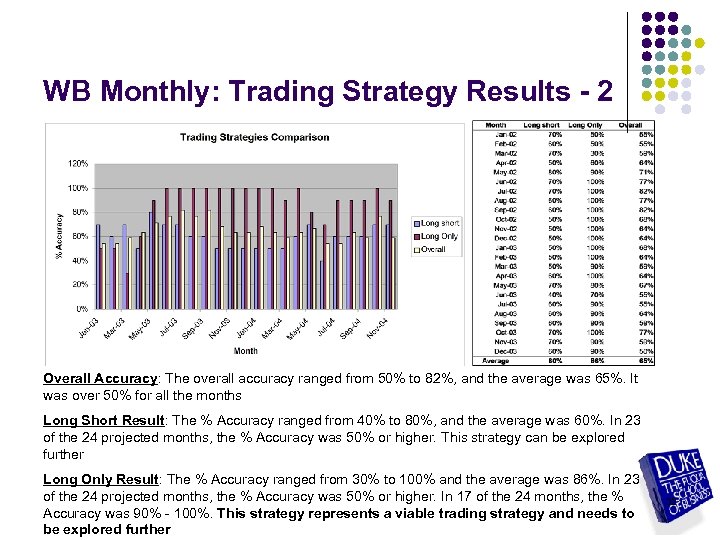
WB Monthly: Trading Strategy Results - 2 Overall Accuracy: The overall accuracy ranged from 50% to 82%, and the average was 65%. It was over 50% for all the months Long Short Result: The % Accuracy ranged from 40% to 80%, and the average was 60%. In 23 of the 24 projected months, the % Accuracy was 50% or higher. This strategy can be explored further Long Only Result: The % Accuracy ranged from 30% to 100% and the average was 86%. In 23 of the 24 projected months, the % Accuracy was 50% or higher. In 17 of the 24 months, the % Accuracy was 90% - 100%. This strategy represents a viable trading strategy and needs to be explored further 32
WB Monthly: Conclusions l l Strong explanatory power of World Bank monthly data. Gives us R-Sq in the 85% range Trading strategy using 1 -Year lag holds the most promise l l Long Short Trading Strategy shows some promise Long only Trading Strategy represents a viable trading strategy and needs to be explored further l Need to explore reasons why the short side of the strategy does not yield good results 33
Model 3: ICRG Monthly Data 34
ICRG Country Ratings Overview l The International Country Risk Guide (ICRG) methodology l Developed in 1980, by the editors of the newsletter International Reports l Considers 22 total variables under 3 categories of risks – Economic, Financial and Political with separate indices for each category l Economic (50 Points) § GDP/ Head, Real GDP growth, Inflation, Fiscal & Current Account Deficit l Financial (50 Points) § % of Foreign Debt, Exchange Rate stability, Debt Service, Current Account % of Exports l Political (100 Points – Scale from 1 -12) § Government Stability, Socioeconomic Conditions, Corruption, Law & Order l These 3 indices are used to produce a composite score out of 100 l 80 – 100: Very Low Risk Countries l 0 – 49. 5: Very High Risk Countries l The ICRG team generates current, 1 year and 5 year forecasts for each risk category as well as for the 3 separate indices 35
ICRG Monthly: Regression Variables l Dependent Variable: l l Independent Variable: l l Ln(Spread) GDP Per Head Annual Inflation Rate Foreign Debt as a Percent of GDP We expect spreads to be: l l l Lower for higher GDP Per Head Higher for higher Annual Inflation rates Higher for higher Foreign Debt as a Percent of GDP This was consistent with our regression results 36
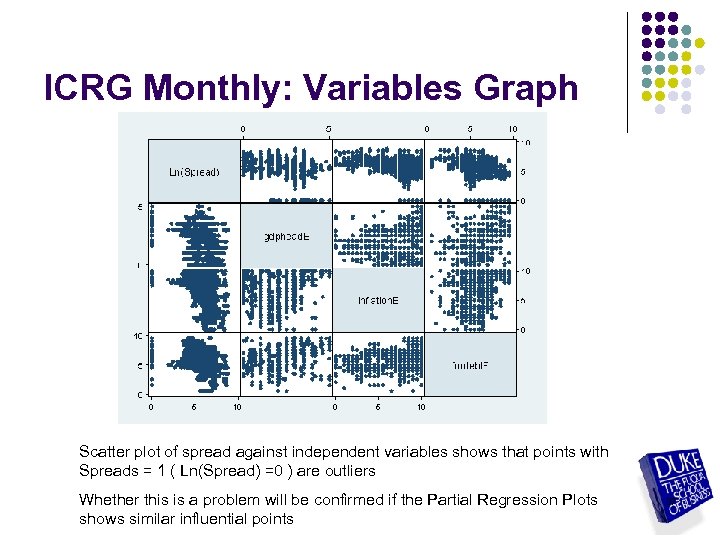
ICRG Monthly: Variables Graph Scatter plot of spread against independent variables shows that points with Spreads = 1 ( Ln(Spread) =0 ) are outliers Whether this is a problem will be confirmed if the Partial Regression Plots shows similar influential points 37
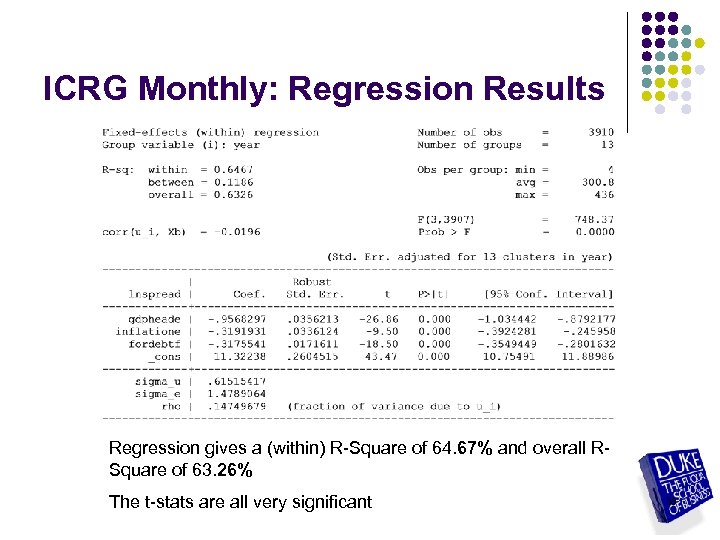
ICRG Monthly: Regression Results Regression gives a (within) R-Square of 64. 67% and overall RSquare of 63. 26% The t-stats are all very significant 38
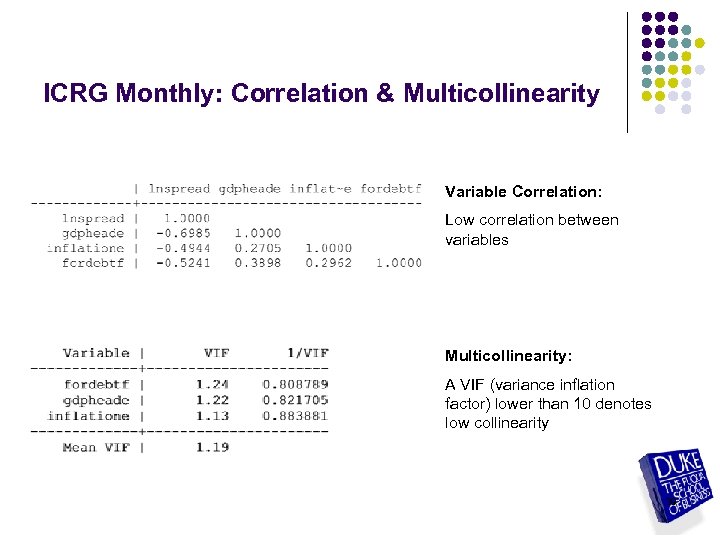
ICRG Monthly: Correlation & Multicollinearity Variable Correlation: Low correlation between variables Multicollinearity: A VIF (variance inflation factor) lower than 10 denotes low collinearity 39
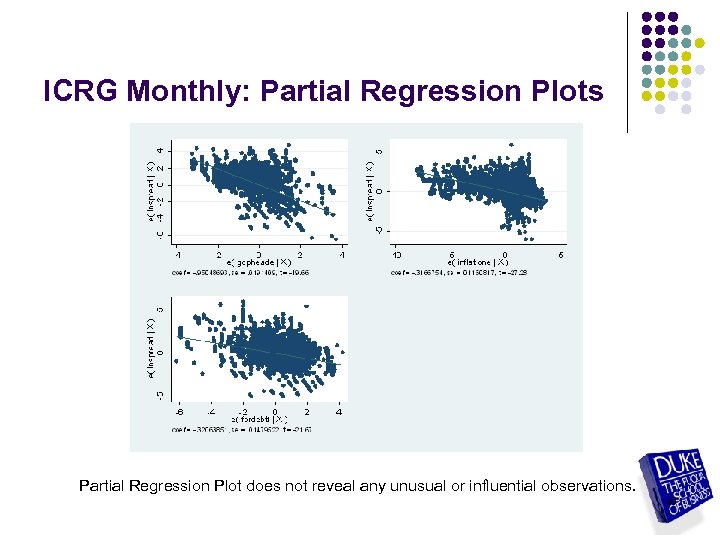
ICRG Monthly: Partial Regression Plots Partial Regression Plot does not reveal any unusual or influential observations. 40
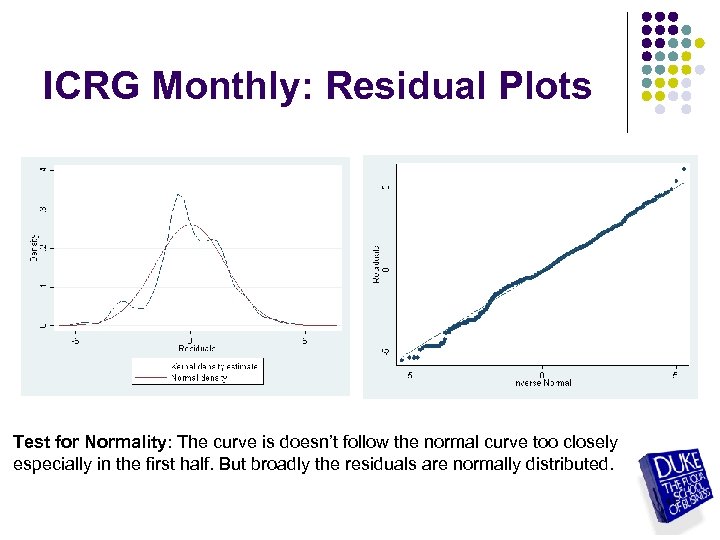
ICRG Monthly: Residual Plots Test for Normality: The curve is doesn’t follow the normal curve too closely especially in the first half. But broadly the residuals are normally distributed. 41
ICRG Monthly: Trading Strategy Methodology- 1 Methodology – 1 uses 1 -month predictive model l In Sample Period: 1993 Dec – 2003 Dec Out of Sample Period: 2004 Jan – 2005 Nov Predictive Equation: l l l Sorted on the % Change expected during the next month l l l Ln(Spread) (1 -month forward) = 11. 05438 – 0. 94991 * GDP Per Head Rating – 0. 33263 * Annual Inflation Rate Rating - 0. 30559 * Foreign Debt as a % of GDP Rating % Change = (Next month forecasted spread - Current Spread) / Current Spread If % Expected Change is negative, the decision is to buy the country’s debt Conversely if % Expected Change is positive, the decision is to sell the country’s debt Long Short Strategy: After sorting, selected the top quintile (five most negative % Expected Change) to go long and bottom five quintile (most positive % Expected Change) to go short Long Only Strategy: After sorting, selected the top two quintiles (ten most negative % Expected Change) to go long only 42
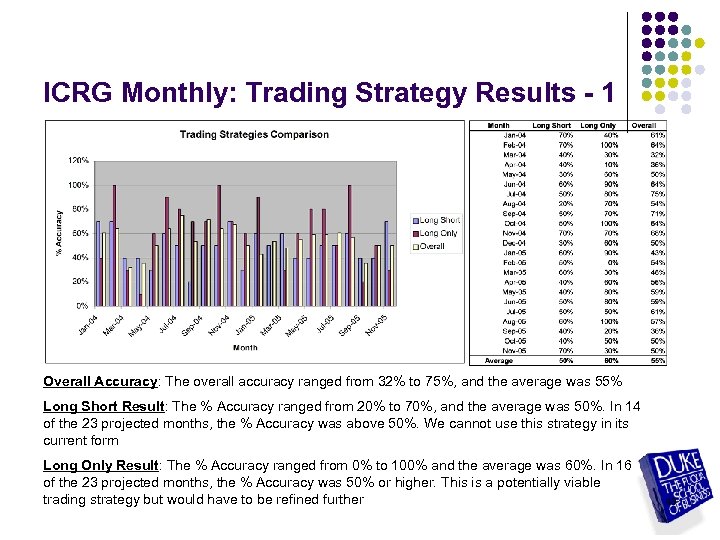
ICRG Monthly: Trading Strategy Results - 1 Overall Accuracy: The overall accuracy ranged from 32% to 75%, and the average was 55% Long Short Result: The % Accuracy ranged from 20% to 70%, and the average was 50%. In 14 of the 23 projected months, the % Accuracy was above 50%. We cannot use this strategy in its current form Long Only Result: The % Accuracy ranged from 0% to 100% and the average was 60%. In 16 of the 23 projected months, the % Accuracy was 50% or higher. This is a potentially viable trading strategy but would have to be refined further 43
ICRG Monthly: Trading Strategy Methodology- 2 Methodology – 2 uses 1 -year predictive model l In Sample Period: 1993 Dec – 2002 Dec Out of Sample Period: 2003 Jan – 2004 Dec Predictive Equation: l l l Sorted on the % Change expected during the next year l l l Ln(Spread) (1 -year forward) = 11. 10612 – 0. 97069 * GDP Per Head Rating – 0. 28848 * Annual Inflation Rate Rating - 0. 31489 * Foreign Debt as a % of GDP Rating % Change = (Next year forecasted spread - Current Spread) / Current Spread If % Expected Change is negative, the decision is to buy the country’s debt Conversely if % Expected Change is positive, the decision is to sell the country’s debt Long Short Strategy: After sorting, selected the top quintile (five most negative % Expected Change) to go long and bottom five quintile (most positive % Expected Change) to go short Long Only Strategy: After sorting, selected the top two quintiles (ten most negative % Expected Change) to go long only 44
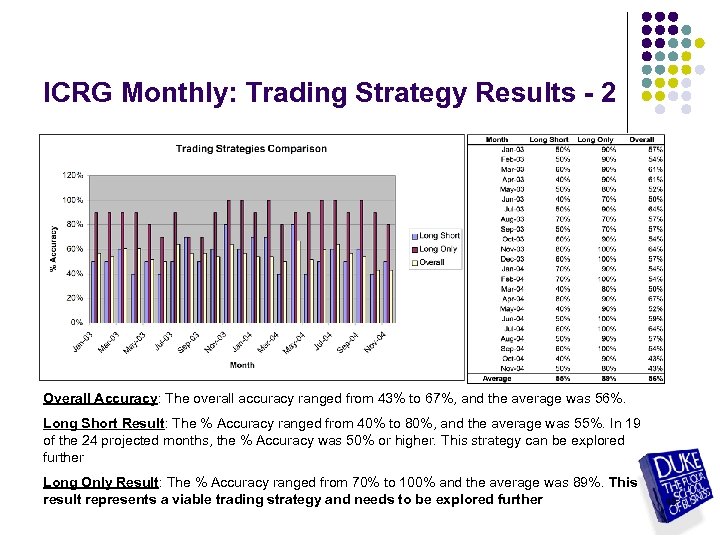
ICRG Monthly: Trading Strategy Results - 2 Overall Accuracy: The overall accuracy ranged from 43% to 67%, and the average was 56%. Long Short Result: The % Accuracy ranged from 40% to 80%, and the average was 55%. In 19 of the 24 projected months, the % Accuracy was 50% or higher. This strategy can be explored further Long Only Result: The % Accuracy ranged from 70% to 100% and the average was 89%. This result represents a viable trading strategy and needs to be explored further 45
ICRG Monthly: Conclusions l l Explanatory power of ICRG data was surprising below that of the World Bank monthly data. This gave us R-Sq in the 63% range compared to 85% range for WB data Trading strategy using 1 -Year lag holds the most promise l l Long Short Trading Strategy shows some promise with 19 of the 24 months having over 50% accuracy Long only Trading Strategy represents a viable trading strategy but needs to be explored further l Need to explore reasons why the short side of the strategy does not yield good results 46
Model 4: Lagged Spreads Monthly Spreads Regressed on 1 -Month Lagged Spreads 47
Lagged Spreads: Regression Variables l l l Dependent Variable: l Ln(Spread) Independent Variable: l Ln(Spread) 1 -Month Lag l Foreign Debt Service as a Percent of Exports of Goods and Services We expect spreads to be: l Higher if the previous month spread was high due to a momentum effect. l Higher for higher Foreign Debt Service ratio. A high ratio shows that a country may default in the near future. This was consistent with our regression results 48
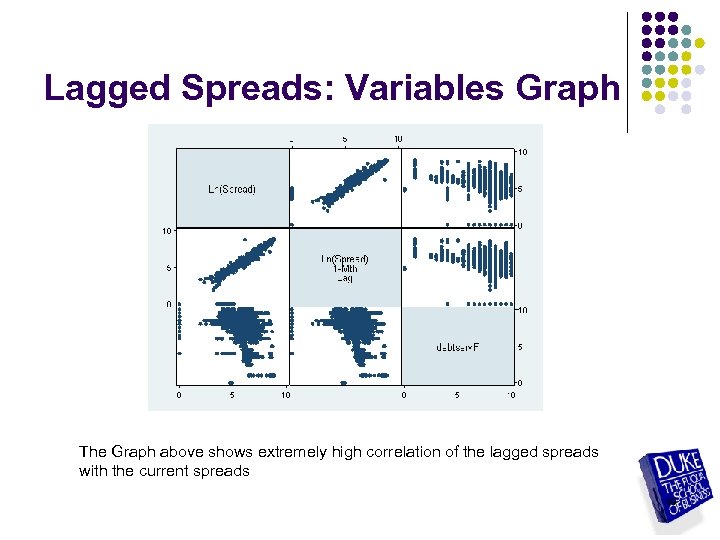
Lagged Spreads: Variables Graph The Graph above shows extremely high correlation of the lagged spreads with the current spreads 49
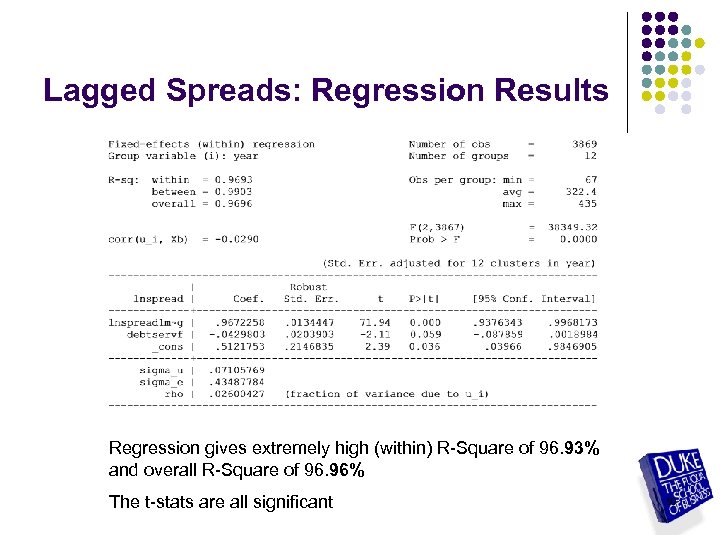
Lagged Spreads: Regression Results Regression gives extremely high (within) R-Square of 96. 93% and overall R-Square of 96. 96% The t-stats are all significant 50
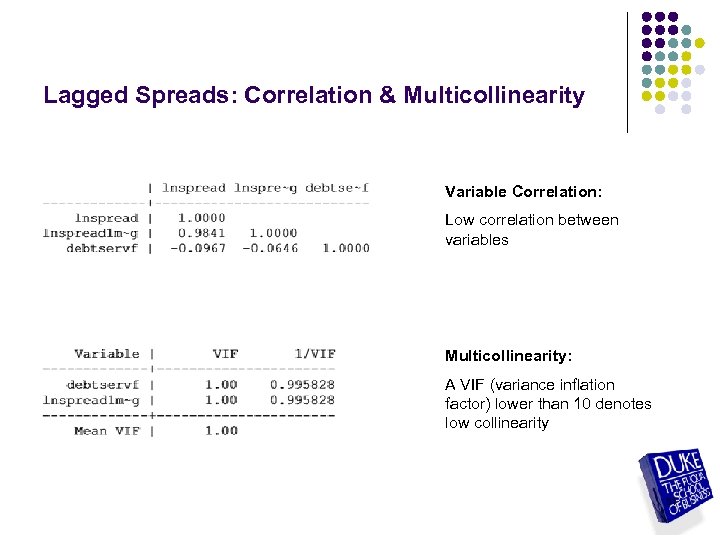
Lagged Spreads: Correlation & Multicollinearity Variable Correlation: Low correlation between variables Multicollinearity: A VIF (variance inflation factor) lower than 10 denotes low collinearity 51
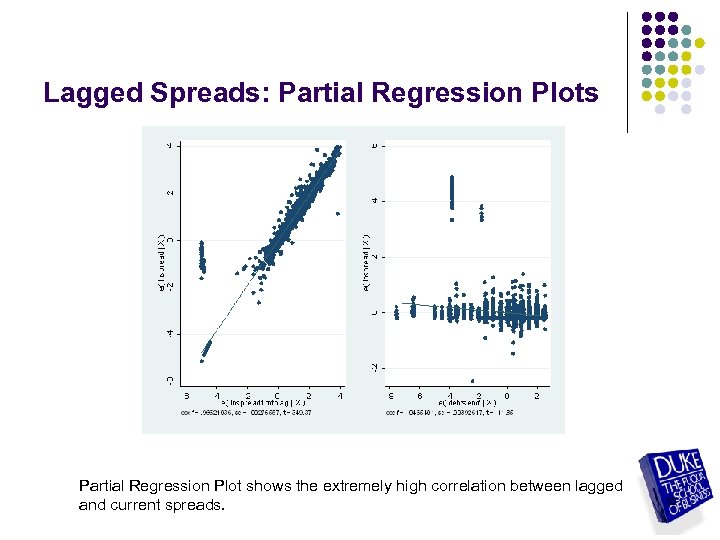
Lagged Spreads: Partial Regression Plots Partial Regression Plot shows the extremely high correlation between lagged and current spreads. 52
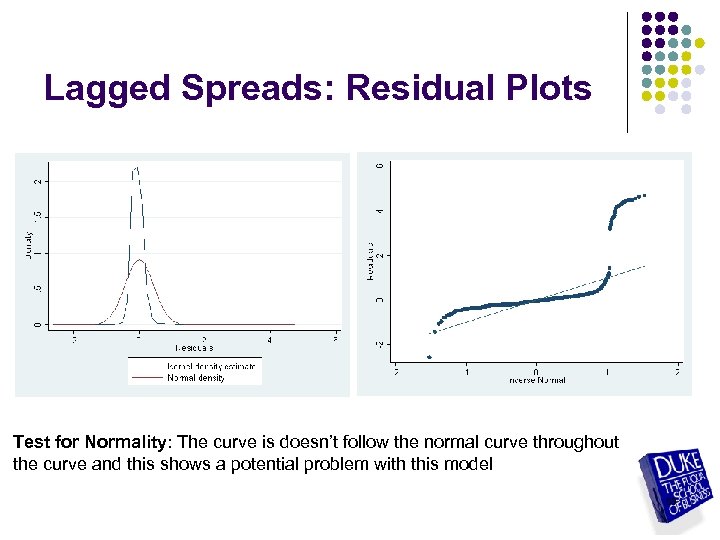
Lagged Spreads: Residual Plots Test for Normality: The curve is doesn’t follow the normal curve throughout the curve and this shows a potential problem with this model 53
Lagged Spreads: Trading Strategy Methodology l l l In Sample Period: 1993 Dec – 2003 Dec Out of Sample Period: 2004 Jan – 2005 Nov Predictive Equation: l Ln(Spread) (1 -month forward) = l -0. 40302 + 1. 00144 * Ln(Spread) + 0. 04623 * Debt Service Ratio Rating (The positive sign for the Debt Service Ratio coefficient on the in sample regression came as a surprise especially because the sign was negative in the explanatory model. This despite the low variable correlation and high t-stats. We reasoned that if a country has a high Debt Service ratio today, it might be making efforts to reduce its debt which would lead to fall in future spreads) l l l Sorted on the % Change expected during the next month l % Change = (Next month forecasted spread - Current Spread) / Current Spread If % Expected Change is negative, the decision is to buy the country’s debt Conversely if % Expected Change is positive, the decision is to sell the country’s debt Long Short Strategy: After sorting, selected the top quintile (five most negative % Expected Change) to go long and bottom five quintile (most positive % Expected Change) to go short Long Only Strategy: After sorting, selected the top two quintiles (ten most negative % Expected Change) to go long only 54
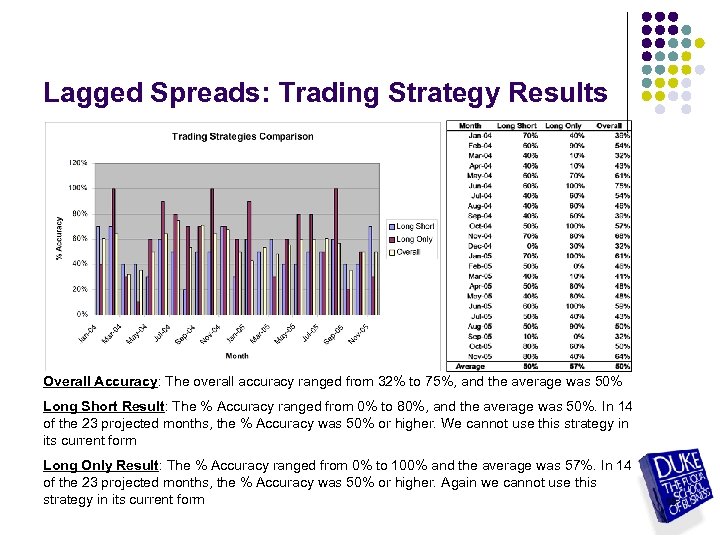
Lagged Spreads: Trading Strategy Results Overall Accuracy: The overall accuracy ranged from 32% to 75%, and the average was 50% Long Short Result: The % Accuracy ranged from 0% to 80%, and the average was 50%. In 14 of the 23 projected months, the % Accuracy was 50% or higher. We cannot use this strategy in its current form Long Only Result: The % Accuracy ranged from 0% to 100% and the average was 57%. In 14 of the 23 projected months, the % Accuracy was 50% or higher. Again we cannot use this strategy in its current form 55
Lagged Spreads: Conclusions l l l Explanatory power of ICRG data was surprisingly high with R-Sq over 96% much higher than all other models However the residuals did not show a normal distribution – there might be potential problems with the model Trading strategy using 1 -month lag did not show much promise. The results lacked any consistency 56
Momentum Strategy l l l Given the high correlation of lagged monthly spread with current spread, we felt that a momentum strategy should work well We calculated the monthly change in spread (CAGR) for last 6 months, 3 months and 1 month If the current month CAGRs are higher than previous month CAGRs in at least two of the above three calculations, then the decision is to sell, else buy l Result: The percent accuracy of this strategy (after ignoring all the records with spreads = 1) was 49%. This was well below what we would have liked in a good trading strategy l Conclusion: There is promise in this strategy but it needs to be explored further 57
Issues to be Explored Further l l Despite attempting several trading strategies it was difficult to come up with a convincing one The short side of the Long-short strategy was especially poor and would need to be explore Our OOS was typically for periods in 2003 and 2004 when the economy was coming out of a recession. The results may be skewed because of this effect. We should test the strategy in more “normal” periods Finally, the momentum strategy seems to hold promise and needs be explored 58

Bibliography l l l Ferguson, Niall. “The Cash Nexus – Money and Power in the Modern World 1700 -2000. Penguin Books. Chapters 4 – 8 Ferguson, Niall. “Paper & Iron – Hamburg business and German politics in the era of inflation, 1897 – 1927” The International Country Risk Guide, http: //www. icrgonline. com/page. aspx? page=icrgmethods#Background_of_t he_ICRG_Rating_System The University of California, Los Angeles. “Resources to help you learn and use Stata” http: //www. ats. ucla. edu/stata/ The World Bank, International Monetary Fund and World Markets Research Center websites. 59
Скачать презентацию Credit Spreads on Sovereign Debt An Explanatory Regression
aedb23534e568239ba45d32b03758334.ppt