 Скачать презентацию CREDIT SEMINAR PHARMACOLOGY of SEABUCKTHORN Hippophae rhamnoides PRESENTED
655090915ef204c1439c285b50c93235.ppt
- Количество слайдов: 29



CREDIT SEMINAR PHARMACOLOGY of SEABUCKTHORN (Hippophae rhamnoides) PRESENTED BY DR. MILINDMITRA K. LONARE (V-2002 -30 -13) DEPARTMENT OF PHARMACOLOGY & TOXICOLOGY COVAS, CSKHPKV, PALAMPUR-176062 (INDIA) DATE: 29 -01 -2003

♪ Grows naturally in cold countries on river sides, hill top & sun facing mountains ♪ India- found in dry temporate Himalayas ♪ Himachal pradesh-found in Chamba, Kinnaur, Kullu& Lahaul-Spiti ♪ It is quality fuel wood and fodder ♪ Potential health food
Historical Background ♪ First report - China (8 th century), In Yue Wang You Zhen medicinal classic ♪ Second report – Tibetan & Mongolia (18 th century), in Sibu Yidian (Tibetan classic) ♪ India – used locally since time immemorial ♪ officially listed by Chinese Pharmacopoeias by ministry of public health (1977)
Composition & Functions l Fruit juice: 60 -80 %, 190 kinds of bioactive substances 1. Organic acids (malic/oxalic/unidentified acids) - Terminating toxicity - Protection from teratogenesis & X-ray damage - Prevention from side-effects of O 2 therapy 2. Betaines (methylation of glycine) - prevents & cures arteriosclerosis - anti-inflammatory
3. Triterpene (ursolic acid) - adrenocorticotropic mimetic - controls action of Na+ & Cl- anti-inflammatory activity 4. Flavonoids (flavonol, catechin, lukocyanidin & flavone) - prevents vit-C oxidation - lowers cholesterol levels - anti-microbial & anti-inflammatory - anti-allergic & anti-tumorogenic
5. 5–HT (5 - hydroxytryptamine) - regulates B. P. and temperature - influences sleep, intestinal motility, hormonal level & emotions - promote coagulation 6. β- amyrinoleylalcohol acid - dilates cardiac & cerebral vessels - facilitates blood circulation 7. Coumarins - strengthen capillary function - anti-tumorogenic, anti-numbness and anti-pyretic
8. Triterpene (ursolic acid) - adrenocorticotropic mimetic - controls action of Na+ & Cl- anti-inflammatory activity 9. Amino acids & Minerals 10. Flavoxanthin, cryptoxanthin and violaxanthin
11. Progestin 12. Vitamins - β-carotenes (250 mg/100 gm) - Vit. -C, K, E Steroides (ergosterols, stigma sterols, lanosterols & amyrins ) 13. 14. Tannic acid 15. Fatty acids
l Seed oil: 8 -18 %, 106 bioactive substances 1. 22 kinds of fatty acids (saturated-13. 7% & unsaturated-86. 3%) - linolenic acid (omega-3 & 6) - oleic acid- control cholesterol level - anti-diabetics, obesity & cancer - essential for fat soluble vitamins
2. 6 knds of fat soluble vitamins - vit. A; carotene-249 mg/100 g - vit. E-203 mg/100 g - vit. K-150 mg/100 g 3. 36 kinds of flavonoids and phenols - anti-oxidation, anti-radiation - enhancement of cachettin & quassium functions
4. 42 kinds of phospholipids - strengthen the membrane mitochondria - participation in electron migration - oxidative phosphorylation & cellular metabolism l Fruit residue: - 20 % of total wt. - rich in proteins, amino acids, carotene, vitamin C (426 -503 mg/100 g), microelements
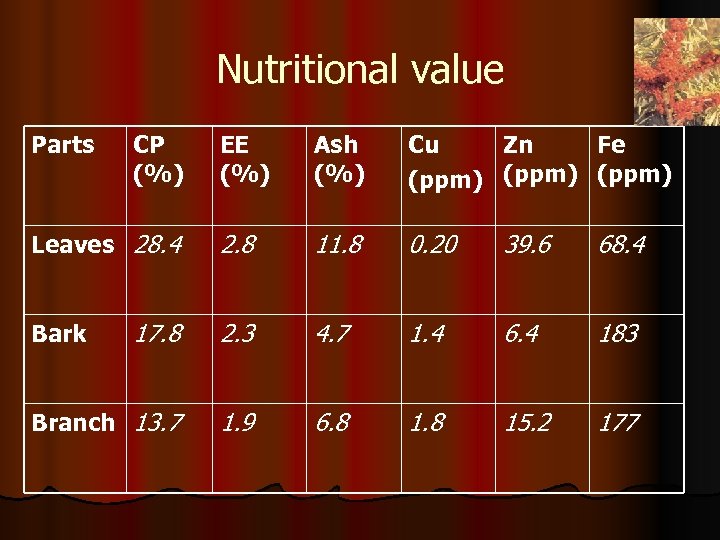
Nutritional value Parts EE (%) Ash (%) Cu Zn Fe (ppm) Leaves 28. 4 2. 8 11. 8 0. 20 39. 6 68. 4 17. 8 2. 3 4. 7 1. 4 6. 4 183 Branch 13. 7 1. 9 6. 8 15. 2 177 Bark CP (%)
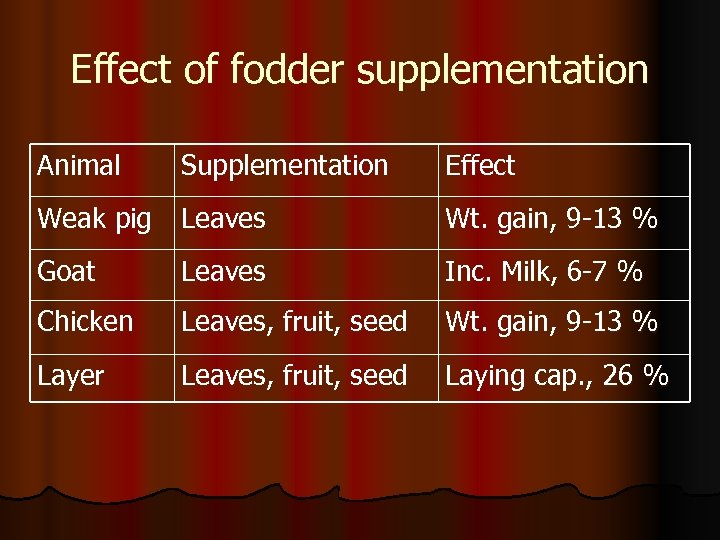
Effect of fodder supplementation Animal Supplementation Effect Weak pig Leaves Wt. gain, 9 -13 % Goat Leaves Inc. Milk, 6 -7 % Chicken Leaves, fruit, seed Wt. gain, 9 -13 % Layer Leaves, fruit, seed Laying cap. , 26 %
Healing potential l Plays role in ulcer, wound and skin burn l Causes regeneration of tissues l Granulation of tissue formation (8 days) Antimicrobial activity l Purified tannin from SBT having play role l Having broad spectrum activity
Cytoproctective & Anti-oxidant activity l CEH having capacity of anti-oxidant l Increases elimination of free radical l Decreases glutathione peroxidase and glutathione level l Decreases cytotoxicity and apoptosis l Restore the phagocytic activity
Role in age related memory disorder l Prevent neurological, endocrine & metabolic effects l Alter the level of amines l Prevent Ach level loss
Nerophysiological adaptation (Cold stress) l Prevent cardiovascular response to cold stress l Reduces epinephrine and norepinephrine level l Reduces plasma cortisol level
Cardiovascular diseases l Omega-3 fatty acid decreases risk l Decreases total and LDL cholesterol, triglyceroides & lipoproteins l Alter the platelet aggregation factor l Strengthen the myocardial contraction
Immune mechanism l Prevent membrane phosphorylatio l Prod. of Eicosanoids & cytokines l Increases serum lysosomes & Alexin level l Increases natural killer cell level l Enhances T-lymphocyte proliferation & IL-2 secretion
Anti-inflammatory activity l Carotene, Vit. E & PUFA play role l Counter checks senilism by controlling proteometabolism and metabolism of nucleic acid l Prevent damage due to radiation l Facilitate the exudation & hematopedesis l Enhances cellular infiltration & metabolism
Anti-tumorigenesis l Direct act through general immunity l Inhibits the growth of gastric carcinoma & lymphatic leukemia l Blocks the synthesis of N-nitrosomolane l Increases superoxide dismutase activity
Other activities l Protects from pain in stomach, liver, chest & lumbar region l Prevents hepatic damage - CCl 4, alcohol & paracetamol l Used in gynecological ailments l Used for treatment of cough & cleaning lung l Used as cosmetic
Toxicity l Acute & chronic toxicity l Toxic dose: l Oil: 20 -30 % in diet l l Effects- other than vegetative & CNS Fruit: 40 % in diet Increases bilirubin l Decreases TLC l l Fruits: 100 % feeding l Fatal to all animals
l Store-house of many bioactive substances l Possesses diverse pharmacological activities l Useful for prevention of diseases l Has great nutritional value l As a alternative remedy for treatment of diseases

THANKS
Скачать презентацию CREDIT SEMINAR PHARMACOLOGY of SEABUCKTHORN Hippophae rhamnoides PRESENTED
655090915ef204c1439c285b50c93235.ppt