 Скачать презентацию CREDIT AND SALES PARTNERSHIP FOR PROFIT BEST PRACTICES
d20e616f077c0f91a65109801ac97ac1.ppt
- Количество слайдов: 21



CREDIT AND SALES: PARTNERSHIP FOR PROFIT (BEST PRACTICES AND LEGAL CONSIDERATIONS) Robert Shultz, Managing Partner Amber Tallmadge, Corporate Credit Manager Scott Blakeley, Esq. , Founding Partner 1
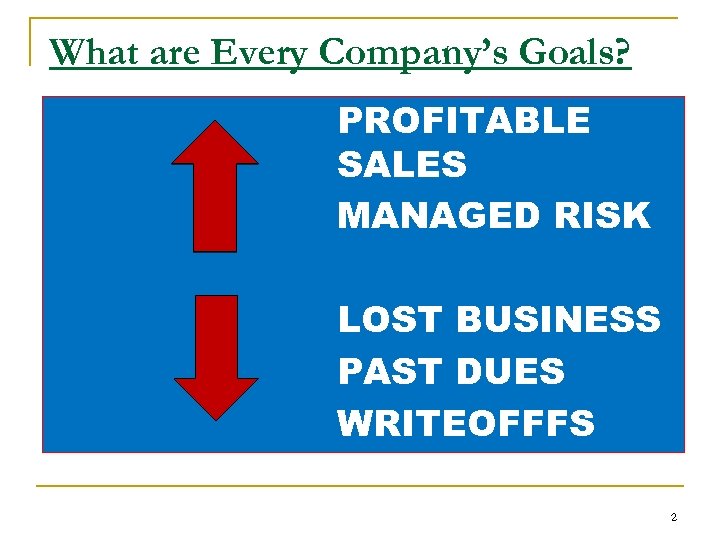
What are Every Company’s Goals? PROFITABLE SALES MANAGED RISK LOST BUSINESS PAST DUES WRITEOFFFS 2
Today’s Focus n Understand the relationship between Credit and Sales n Know the respective functions and goals of Credit and Sales n Streamlining the relationship: suggestions to eliminate discord between Credit and Sales n Get the Message Across - Communicate…. Sell YOUR Value n Strengthening and Capitalizing on the Relationship n Educate Sales on the Fiduciary and Legal Responsibilities of both Departments n Do you view your customers, Internal and External, as transactions or relationships? 3
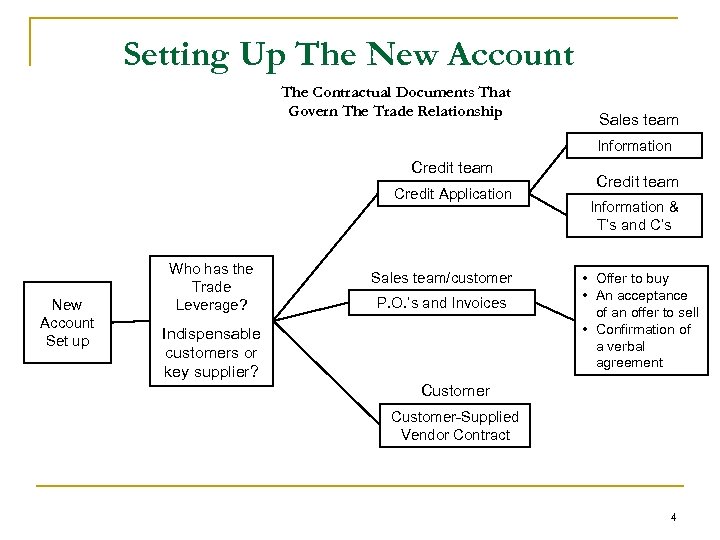
Setting Up The New Account The Contractual Documents That Govern The Trade Relationship Sales team Information Credit team Credit Application New Account Set up Who has the Trade Leverage? Sales team/customer P. O. ’s and Invoices Indispensable customers or key supplier? Credit team Information & T’s and C’s • Offer to buy • An acceptance of an offer to sell • Confirmation of a verbal agreement Customer-Supplied Vendor Contract 4
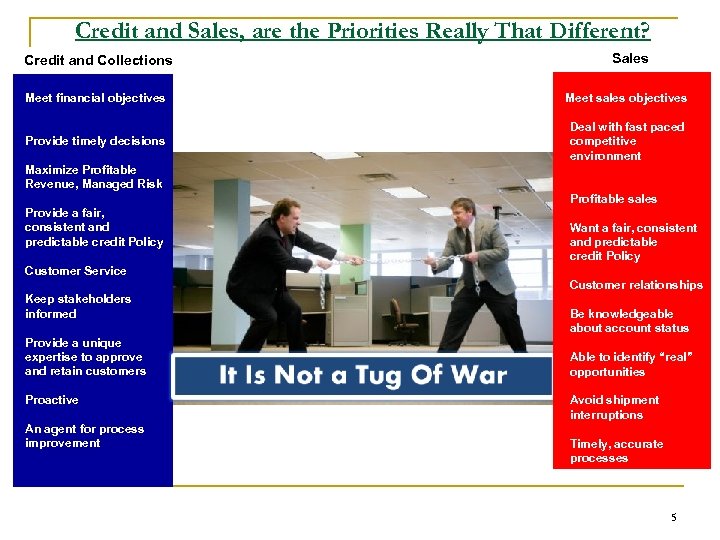
Credit and Sales, are the Priorities Really That Different? Credit and Collections Sales Meet financial objectives Meet sales objectives Provide timely decisions Deal with fast paced competitive environment Maximize Profitable Revenue, Managed Risk Profitable sales Provide a fair, consistent and predictable credit Policy Want a fair, consistent and predictable credit Policy Customer Service Customer relationships Keep stakeholders informed Provide a unique expertise to approve and retain customers Proactive An agent for process improvement Be knowledgeable about account status Able to identify “real” opportunities Avoid shipment interruptions Timely, accurate processes 5
Understand the Relationship Between Credit and Sales Know the respective functions and goals of Credit and Sales Encourage a mutually beneficial relationship: n q It starts with “Organizational Buy-in” at the top q Define shared goals q Understand your company’s business and the competitive context q Understand your potential to drive revenue and good “business decisions” q Understand what motivates a Sales Representative, a Sales Manager, a General Manager q Be part of the “Sales Forecasting” process 6
Understand the Relationship Between Credit and Sales Know the respective functions and goals of Credit and Sales n What a credit professional has to offer: q Professional knowledge q Understanding of your company’s processes and procedures q Credit/Collection Information and trends q Early visibility to risks and opportunities q Help educate customers on ways to manage cash, accounts receivable q Internal control, process and regulatory compliance issues q Best practices and benchmarks q Creative credit policies q A key factor in customer service 7
Understand the Relationship Between Credit and Sales Know the respective functions and goals of Credit and Sales n What Sales has to offer: q Generates revenue with a personal stake in the result q Understands the competitive marketplace q First to know about potential business opportunities q First to know about struggling customers q Sees the customer first-hand – can warn Credit about important employees leaving, competitors opening nearby, owners discussing selling the business q Maintains the customer relationship and potential leverage q Can assist in resolving disputes q Can assist in collections of past due accounts 8
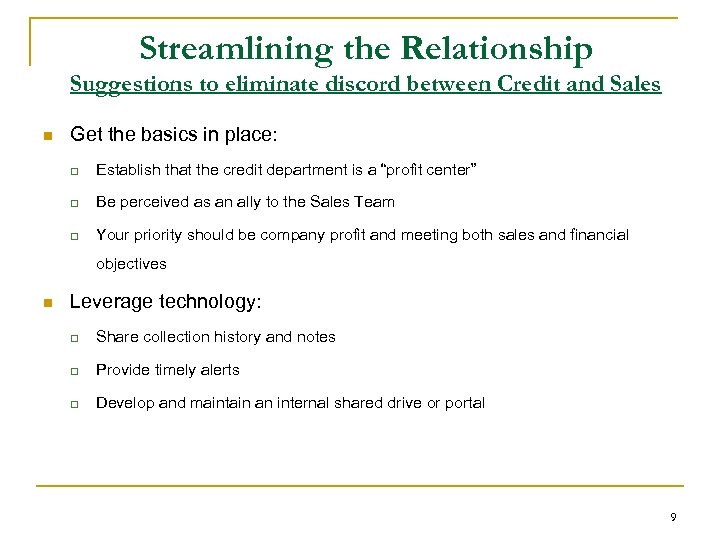
Streamlining the Relationship Suggestions to eliminate discord between Credit and Sales n Get the basics in place: q Establish that the credit department is a “profit center” q Be perceived as an ally to the Sales Team q Your priority should be company profit and meeting both sales and financial objectives n Leverage technology: q Share collection history and notes q Provide timely alerts q Develop and maintain an internal shared drive or portal 9
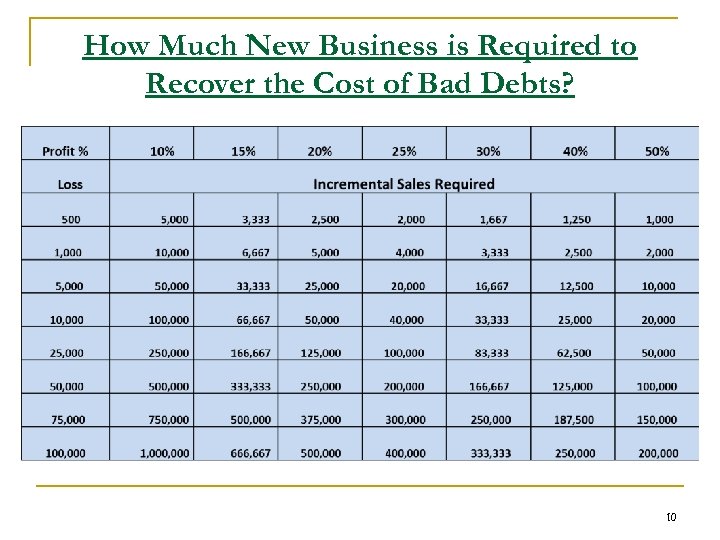
How Much New Business is Required to Recover the Cost of Bad Debts? 10
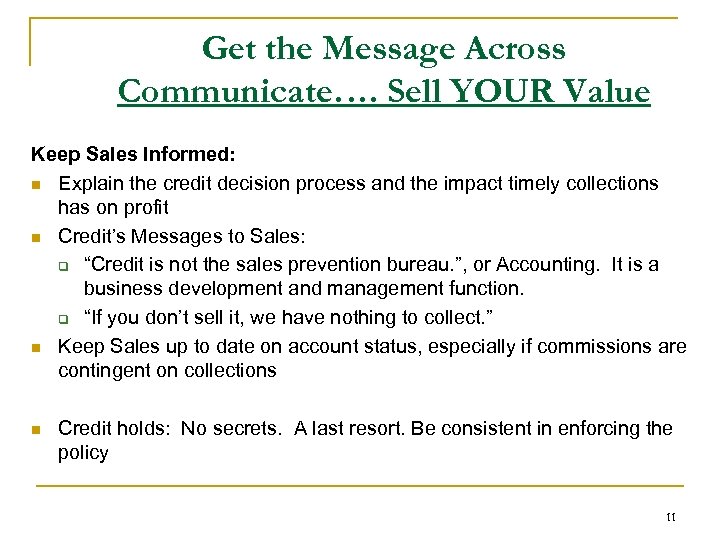
Get the Message Across Communicate…. Sell YOUR Value Keep Sales Informed: n Explain the credit decision process and the impact timely collections has on profit n Credit’s Messages to Sales: q “Credit is not the sales prevention bureau. ”, or Accounting. It is a business development and management function. q “If you don’t sell it, we have nothing to collect. ” n Keep Sales up to date on account status, especially if commissions are contingent on collections n Credit holds: No secrets. A last resort. Be consistent in enforcing the policy 11
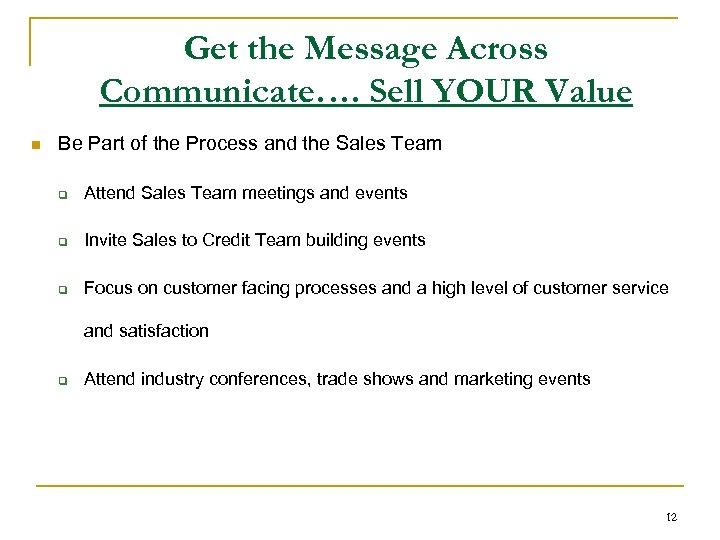
Get the Message Across Communicate…. Sell YOUR Value n Be Part of the Process and the Sales Team q Attend Sales Team meetings and events q Invite Sales to Credit Team building events q Focus on customer facing processes and a high level of customer service and satisfaction q Attend industry conferences, trade shows and marketing events 12
Practices Credit and Collections Need to Avoid n Holding orders unnecessarily n Passing customers with complaints from person-to-person and department-to-department n Taking a long time to resolve disputes, discrepancies, and deductions n Rejecting unusually large orders or unusual requests simply to avoid possible increases in past dues or DSO. Credit has to be willing to take educated, reasonable risks. Don’t make decisions to protect your numbers! If your past dues and DSO are dropping and so are sales, you may be part of the problem and not the solution 13
Strengthening and Capitalizing on the Relationship Information and role-sharing to bridge the gap between Credit and Sales n Develop working relationships: n With individual Sales Reps, Sales Managers and Marketing Reps n With customer’s AP, Vendor Compliance, Purchasing, owners. n Relevant and timely decisions q Be there at the beginning: No surprises for Sales q Involve the sales people in the difficult credit decisions – ask them: “What would they do in your shoes? ” q Provide choices q Allow discretion q Be prepared for exceptions 14
Strengthening and Capitalizing on the Relationship Information and role-sharing to bridge the gap between Credit and Sales n n n n Travel with your sales people – Get to know your customers Pay attention to the issues Salespeople encounter from customers Prepare for customer visits by examining the customer’s buying patterns as well as their payment patterns Visit customers who pay well to thank them for their payments and their purchases. Help Sales increase volume with good paying customers Reexamine credit lines in advance of visits so that you are ready to support increased purchases-update credit files with reports from NACM and other sources Know your customer base. If different types of customers have different major influences (seasonality, etc. ) be aware of those factors Ask your customer: “How are we doing? How do we compare as a supplier? ” “Is there anything more we can do for you? ” Tell Sales what you learn 15
Strengthening and Capitalizing on the Relationship Information and role-sharing to bridge the gap between Credit and Sales n Establish your value as a go to person q q n Be open to collaboration in both directions. Never say no. Say yes, but how? Educate Sales on options to unsecured open terms Be professionally prepared q Keep up with professional education q Participate in NACM Industry Credit Groups q Network q Understand your industry benchmarks q Understand available resources q Be an agent of change and improvement 16
Strengthening and Capitalizing on the Relationship Information and role-sharing to bridge the gap between Credit and Sales n Provide actionable and timely information: q q It is not always bad news: Keep Sales informed of opportunities to sell more q n On risks and potential credit holds Reports of trends and performance of customer payments Compare Sales Team and Sales Rep results q Are the Goals of both functions in alignment? q Work toward goals of mutual benefit q Make sure Management hasn’t placed each group in a position to oppose the other. 17
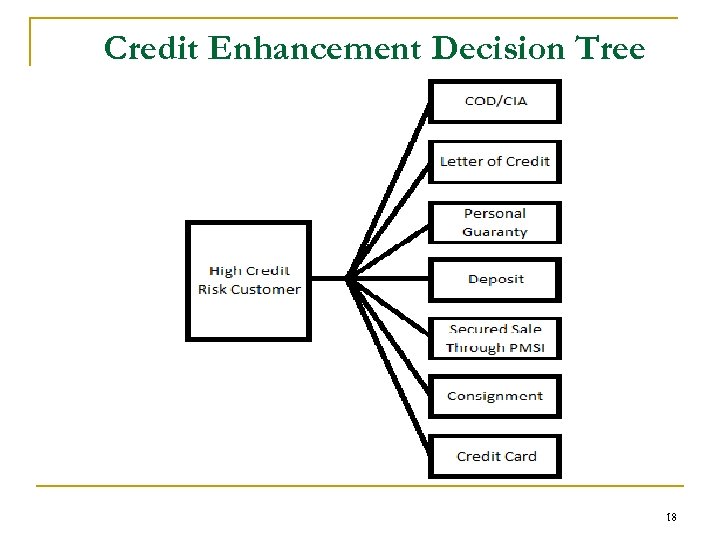
Credit Enhancement Decision Tree 18
Terms Pushback Strategy (TPS) n For many customers, extending payables has become a best practice n Small and medium sized customers find bank financing difficult, forcing vendors to be last source of financing n Big businesses sitting on record cash holding but increase the days to pay vendors 19
Educate Sales on the Fiduciary and Legal Responsibilities of Both Departments n Complying with the antitrust laws q q New account set up and gathering customer information q Customer credit terms pushback q n Sharing industry group information Working with the delinquent account The Sarbanes-Oxley Act and the sales team's pledge of no ancillary agreements with customers n Credit, Sales Cooperation when a customer exerts a payment terms pushback strategy n The importance of cooperation if a bankruptcy is looming 20
Contact Information Robert S. Shultz Managing Partner Cutting Edge Business Resources & Solutions (CEBRS) 4212 East Los Angeles Ave. No. 3872 Simi Valley, CA 93065 (805) 520 -7880 (Office and Fax) rshultz@cebrs. com Amber Tallmadge Corporate Credit Manger Central States Manufacturing, Inc. 302 Jane Place Lowell, AR 72745 (479) 770 -0188 (Office) atallmadge@centralstatesmfg. com Scott Blakeley, Esq. Founding Partner, Blakeley LLP 18500 Von Karman Ave, Suite 530 Irvine, CA 92612 (949) 260 -0612 seb@blakeleyllp. com 21
Скачать презентацию CREDIT AND SALES PARTNERSHIP FOR PROFIT BEST PRACTICES
d20e616f077c0f91a65109801ac97ac1.ppt