


 Скачать презентацию Creating the Future Changing Aging Services AHCA Convention
4a3a0c70dcc42e941e0f40eafdd47a26.ppt
- Количество слайдов: 30
 Creating the Future: Changing Aging Services AHCA Convention October 8, 2007 Steve Chies, SVP, LTC Operations, Benedictine Health Services Jeff Wilson, CEO, Liberty Healthcare LTC Group, North Carolina Loren Coleman, Asst. Commissioner, Dept. of Human Services, MN Nancy Rehkamp, Principal. Larson. Allen John Richter, CPA, National Health Care Principal, Larson. Allen.
 Today’s Discussion • Overview of key changes that will impact the demand for aging services • Discussion of one state’s approach - Minnesota • Strategic repositioning case examples – Benedictine Health System, headquartered Minnesota – Liberty Healthcare Long Term Care Group, headquartered North Carolina • Discussion of key strategic questions providers are facing
 Reasons for Future Changes in SNF Utilization 1. Changing demographics • • 2. 3. 4. Hospital discharges to skilled Swing bed utilization Long term care alternatives • • 5. Aging population Growth in numbers living alone Caregiver availability Declining economic position of future elders Home & Community Based Services Other housing options – assisted living, housing with services Age of admission to SNF Length of stay decline State and Federal policies and program initiatives • • PACE Managed care for dual eligible individuals Medicare acute care changes Medicare post-acute care changes
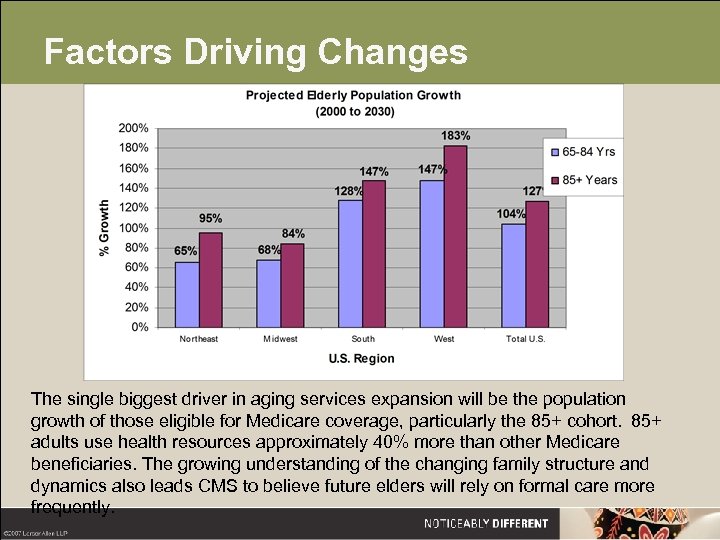 Factors Driving Changes The single biggest driver in aging services expansion will be the population growth of those eligible for Medicare coverage, particularly the 85+ cohort. 85+ adults use health resources approximately 40% more than other Medicare beneficiaries. The growing understanding of the changing family structure and dynamics also leads CMS to believe future elders will rely on formal care more frequently.
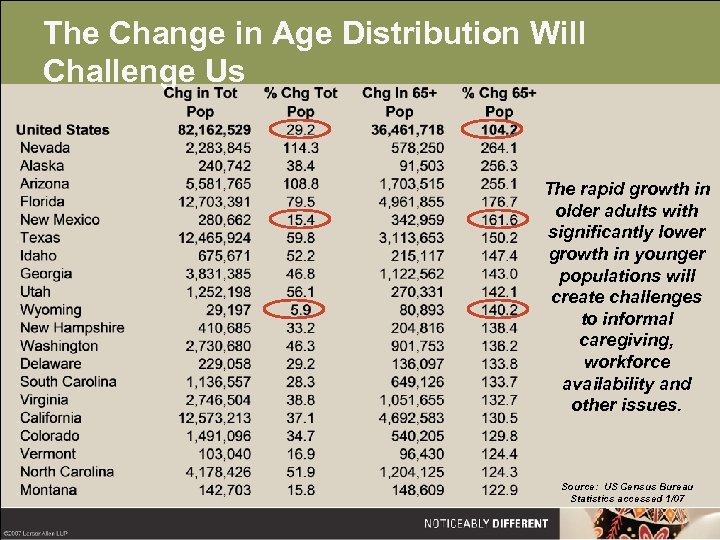 The Change in Age Distribution Will Challenge Us The rapid growth in older adults with significantly lower growth in younger populations will create challenges to informal caregiving, workforce availability and other issues. Source: US Census Bureau Statistics accessed 1/07
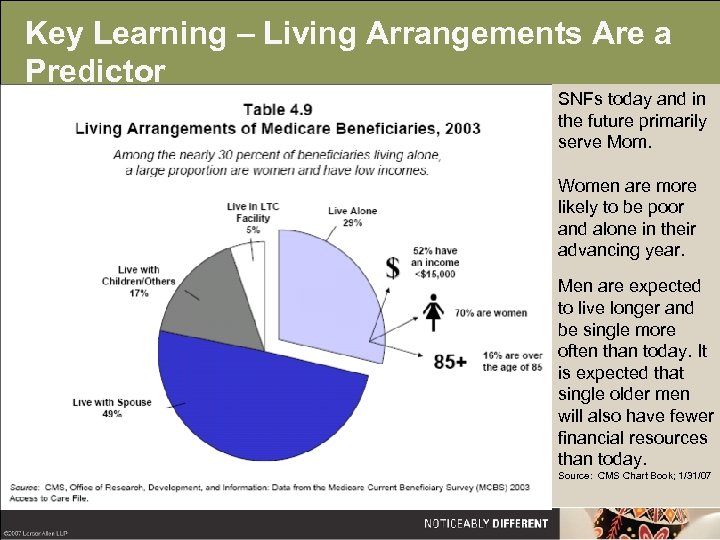 Key Learning – Living Arrangements Are a Predictor SNFs today and in the future primarily serve Mom. Women are more likely to be poor and alone in their advancing year. Men are expected to live longer and be single more often than today. It is expected that single older men will also have fewer financial resources than today. Source: CMS Chart Book; 1/31/07
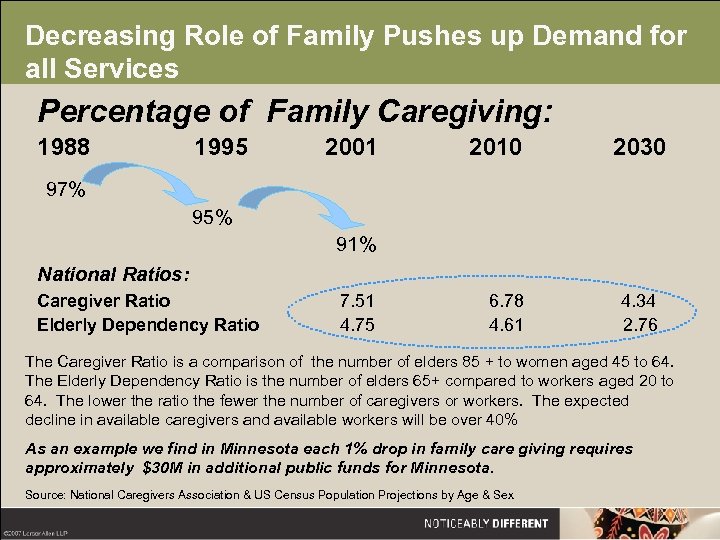 Decreasing Role of Family Pushes up Demand for all Services Percentage of Family Caregiving: 1988 1995 2001 2010 2030 97% 95% 91% National Ratios: Caregiver Ratio Elderly Dependency Ratio 7. 51 4. 75 6. 78 4. 61 4. 34 2. 76 The Caregiver Ratio is a comparison of the number of elders 85 + to women aged 45 to 64. The Elderly Dependency Ratio is the number of elders 65+ compared to workers aged 20 to 64. The lower the ratio the fewer the number of caregivers or workers. The expected decline in available caregivers and available workers will be over 40% As an example we find in Minnesota each 1% drop in family care giving requires approximately $30 M in additional public funds for Minnesota. Source: National Caregivers Association & US Census Population Projections by Age & Sex
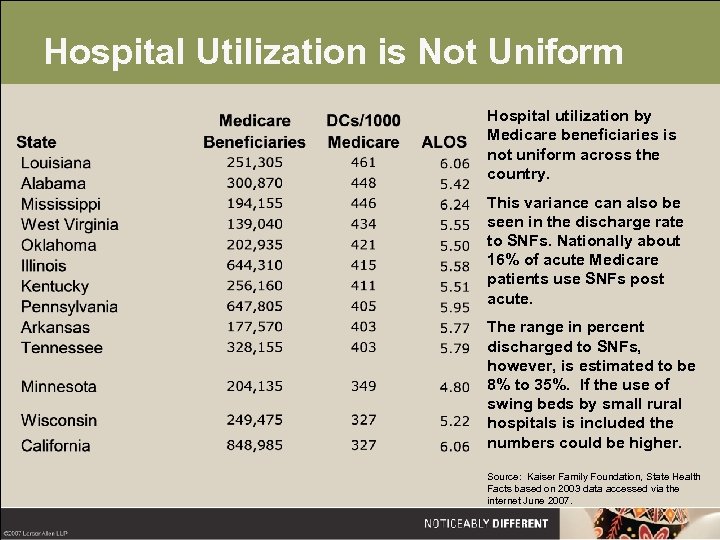 Hospital Utilization is Not Uniform Hospital utilization by Medicare beneficiaries is not uniform across the country. This variance can also be seen in the discharge rate to SNFs. Nationally about 16% of acute Medicare patients use SNFs post acute. The range in percent discharged to SNFs, however, is estimated to be 8% to 35%. If the use of swing beds by small rural hospitals is included the numbers could be higher. Source: Kaiser Family Foundation, State Health Facts based on 2003 data accessed via the internet June 2007.
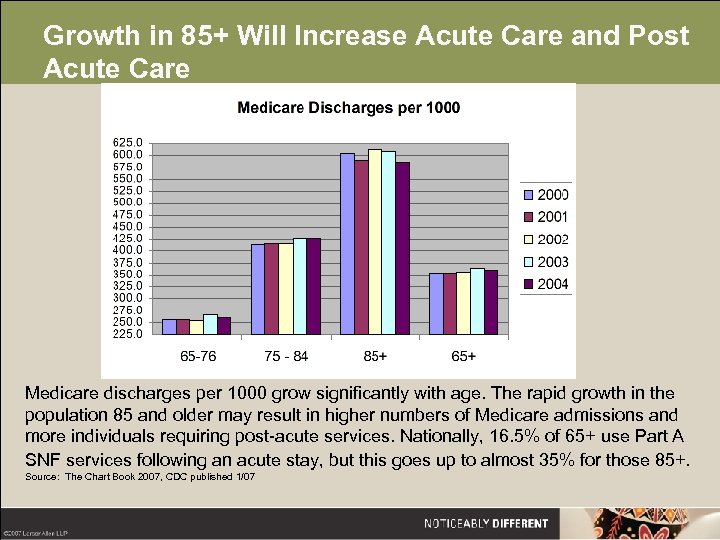 Growth in 85+ Will Increase Acute Care and Post Acute Care Medicare discharges per 1000 grow significantly with age. The rapid growth in the population 85 and older may result in higher numbers of Medicare admissions and more individuals requiring post-acute services. Nationally, 16. 5% of 65+ use Part A SNF services following an acute stay, but this goes up to almost 35% for those 85+. Source: The Chart Book 2007, CDC published 1/07
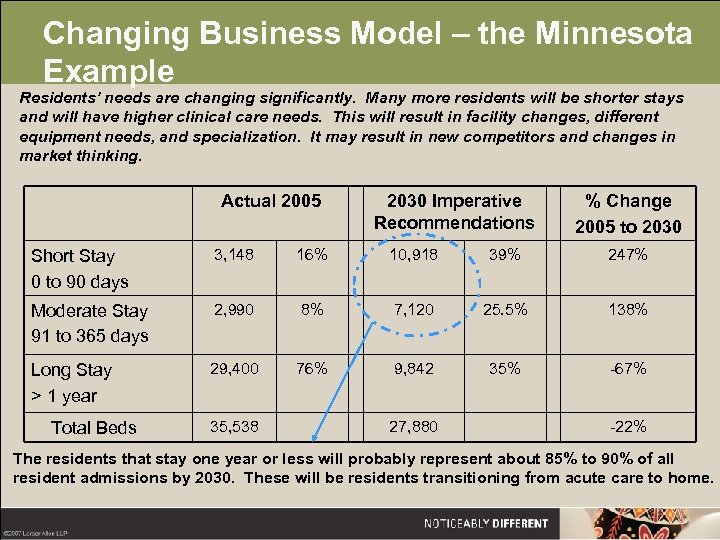 Changing Business Model – the Minnesota Example Residents’ needs are changing significantly. Many more residents will be shorter stays and will have higher clinical care needs. This will result in facility changes, different equipment needs, and specialization. It may result in new competitors and changes in market thinking. Actual 2005 2030 Imperative Recommendations % Change 2005 to 2030 Short Stay 0 to 90 days 3, 148 16% 10, 918 39% 247% Moderate Stay 91 to 365 days 2, 990 8% 7, 120 25. 5% 138% Long Stay > 1 year 29, 400 76% 9, 842 35% -67% Total Beds 35, 538 27, 880 -22% The residents that stay one year or less will probably represent about 85% to 90% of all resident admissions by 2030. These will be residents transitioning from acute care to home.
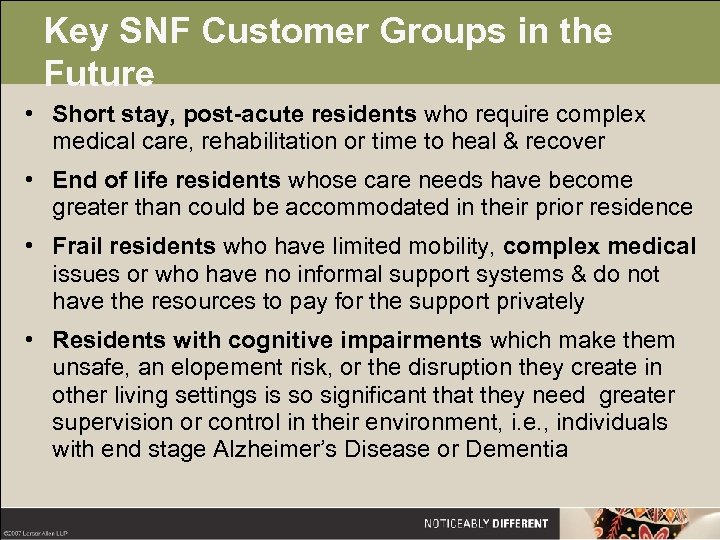 Key SNF Customer Groups in the Future • Short stay, post-acute residents who require complex medical care, rehabilitation or time to heal & recover • End of life residents whose care needs have become greater than could be accommodated in their prior residence • Frail residents who have limited mobility, complex medical issues or who have no informal support systems & do not have the resources to pay for the support privately • Residents with cognitive impairments which make them unsafe, an elopement risk, or the disruption they create in other living settings is so significant that they need greater supervision or control in their environment, i. e. , individuals with end stage Alzheimer’s Disease or Dementia
 Benedictine Health System Strategically Using the Imperative Demand Model
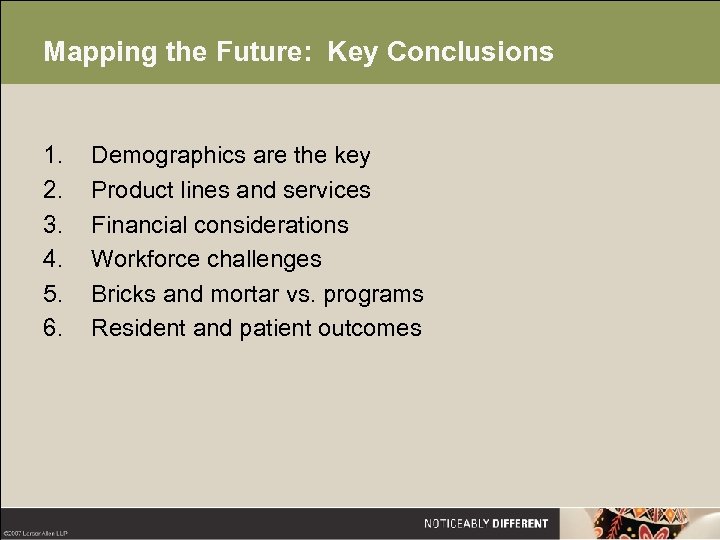 Mapping the Future: Key Conclusions 1. 2. 3. 4. 5. 6. Demographics are the key Product lines and services Financial considerations Workforce challenges Bricks and mortar vs. programs Resident and patient outcomes
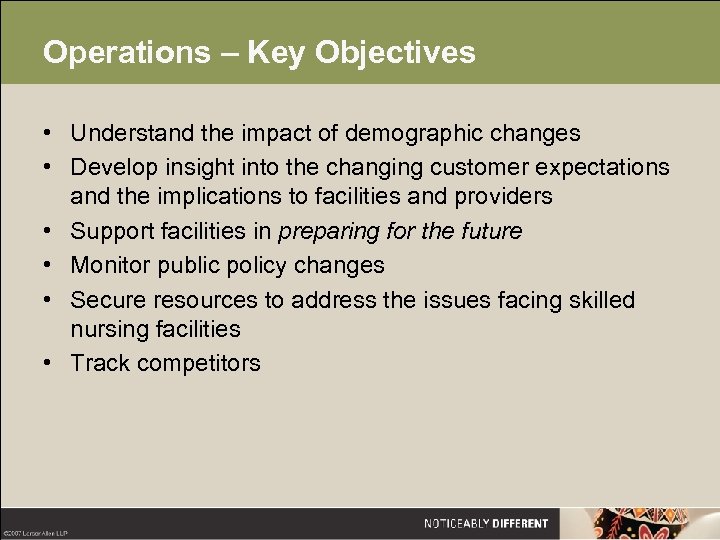 Operations – Key Objectives • Understand the impact of demographic changes • Develop insight into the changing customer expectations and the implications to facilities and providers • Support facilities in preparing for the future • Monitor public policy changes • Secure resources to address the issues facing skilled nursing facilities • Track competitors
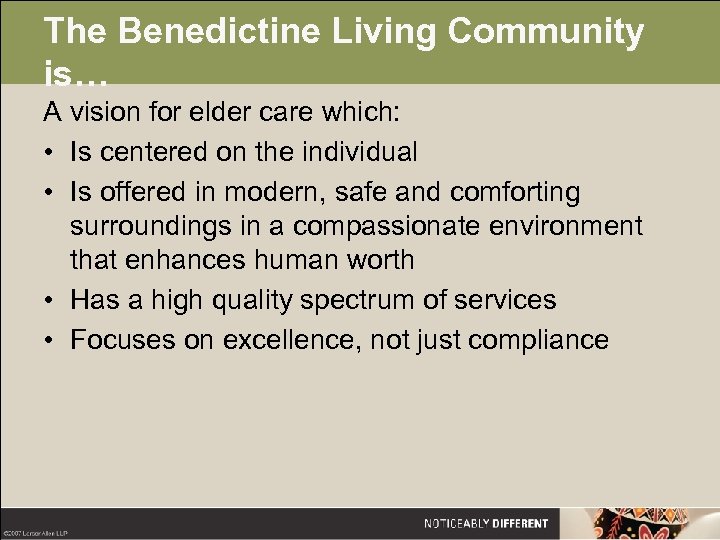 The Benedictine Living Community is… A vision for elder care which: • Is centered on the individual • Is offered in modern, safe and comforting surroundings in a compassionate environment that enhances human worth • Has a high quality spectrum of services • Focuses on excellence, not just compliance
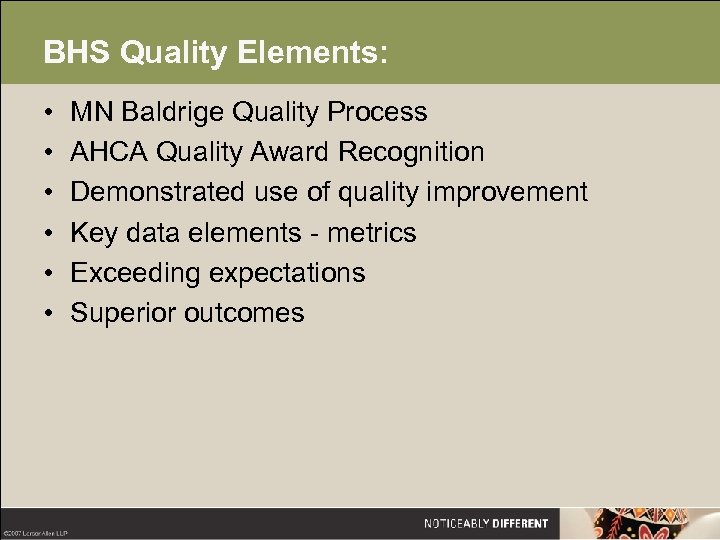 BHS Quality Elements: • • • MN Baldrige Quality Process AHCA Quality Award Recognition Demonstrated use of quality improvement Key data elements - metrics Exceeding expectations Superior outcomes
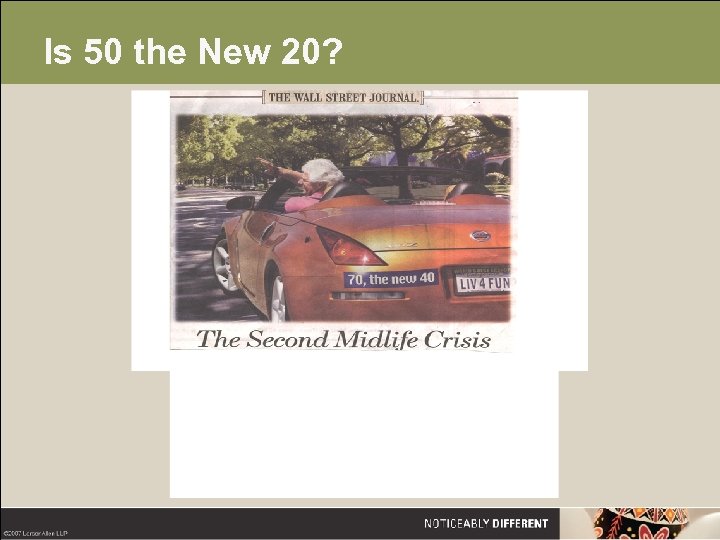 Is 50 the New 20?
 Resident and Family Expectations: • • A sense of being in control. A sense of belonging. Trust in You! OHANA
 Physical Plant Elements: • • Compliance with codes and standards Private rooms Performance on inspections and surveys Safe environment Comfortable and home like Interior design Preventative maintenance program
 Closing Thoughts “The problems that exist in the world today cannot be solved by the level of thinking that created them. ” Albert Einstein
 LIBERTY HEALTHCARE: Creating and Changing Aging Services
 Liberty Healthcare is…… • Small Regional Company based in Wilmington, NC • Liberty offers a continuum of services to the communities we serve through several different divisions. • Long Term Care Management Services operates 17 SNF’s with 2013 beds all in NC • Liberty Home Care and Hospice has 25 Home Care Offices and 27 Hospice Sites in NC, SC, and VA • Liberty Assisted Living Division operates 4 Assisted Living Facilities, and 2 Independent Living Apartment Sites. • Liberty also operates several ancillary service companies: LTC Pharmacy, DME Company, and a Therapy Company.
 Preparing for Demographic Changes • • • Offer services across the continuum of care Physical Plant Changes Staffing Technology Marketing
 Offer Services Across Continuum of Care Diversify the services offered to meet the changing needs and demands by the communities served. § Home Care § Hospice § Assisted Living § DME § Outpatient Therapy § Dialysis § Obesity treatment § Secure Dementia Care Units
 Physical Plant Changes Renovate or replace older buildings. – – Increase percentage of private rooms. Increase number private showers in each room. Provide flat screen televisions and telephone service. Implement neighborhood concept with smaller dining and activity spaces. – Less emphasis on nurses station. – Create secure dementia care units Barriers – Capital for renovation or replacement – Certificate of Need – Reimbursement systems providing a return on investment
 Staffing Recruitment and Retention – – Recruitment and retention committee Supervisor Training On-going staff education Creating a culture of Customer Service – Hospitality Model Foreign Worker Recruitment – Program in place for four years – Recruited 18 RN’s, with 40 in process and have retained 100% to date. – Recruited 54 Physical Therapists and have retained 52.
 Technology Electronic Medical Records – Each CNA documents direct care on a PDA at the bed side, allowing more time for direct patient care. – Nursing Documentation and Medication Administration is done electronically, reducing errors, and making staff more efficient. Management Tools – Digital Dashboard with real time financial and clinical information available to managers to respond quickly to changes. Resident Tools – Wireless Internet available – Computer stations for resident use including games, websites, customized to each resident’s areas of interest.
 Marketing Culture Change – Traditional Medicaid facilities have approached marketing from more of an order taker mentality. – Nursing Centers need to transition to more of a sales driven model to tell their story, make consumers aware of array of services that are available, and capture a share of the growing short term stay market. – Create and foster relationships with key decision makers for services in each community.
 Creating the Future – The Driving Questions • Why do states or regions vary so significantly in the use of SNF services? • What is our “rightsizing” goal for nursing-facility based care? • Assuming reduced future demand, how can we ensure that skilled nursing beds are in the right locations? • How can we make the best use of replacement and renovation dollars to address new technologies, new clinical practices, and consumer preference in the care centers of tomorrow? • How can we reposition our aging facilities to meet the customer demands within the current economics of SNF reimbursement? • How do I evaluate when to get out of or reduce SNF services? • The reduction in skilled beds will require other facilities and services. What services will substitute for skilled and how many units, visits or other services will be required?
 Creating the Future – The Driving Questions • How do we transition our facilities to care for larger numbers of short stay residents? • What programs do the local hospitals offer that could be extended into skilled care, i. e. , orthopedic, congestive heart failure, low back pain management and rehab, post-surgery de-conditioning? • What will be the economic investments required by state and federal funding sources to develop the aging continuum? • What are some of the regulatory changes that will be required to retain care delivery flexibility and allow resident choice? • Why are skilled care providers better positioned to provide a greater array of aging services? • What are the strategic opportunities for new services, innovations, etc. that might develop from the evolving continuum of aging services? • What are the changing workforce needs to serve the growing and changing older population?