 Скачать презентацию Creating the Enterprise Database Administrator Role Moving from
17cd5a9800137792527d7b5c2f907209.ppt
- Количество слайдов: 27



Creating the Enterprise Database Administrator Role: Moving from Vision to Effective Practices Deanna Mc. Murray, Enterprise Database Administrator Marina Arseniev, Director of Enterprise Architecture, Security, and Data Management Services Copyright © 2008 The Regents of the University of California All Rights Reserved. Permission is granted for this material to be shared for noncommercial, educational purposes, provided that this copyright statement appears on the reproduced materials.
A Common Problem: Silo Specific DBA Groups • Most IT organizations have silo specific database administration groups based on database platforms – – Oracle Sybase DB 2 Microsoft SQL Server Database administration is rarely considered part of the overall Enterprise Architecture strategy for cross-platform database development and operations.
The Missing Role: An Enterprise DBA • The absence of Enterprise-level coordination of product/ platform or application silo specific database administration groups = redundant and inconsistent database management • This missing role of an Enterprise-level cross-DBA control point that is part of an Enterprise Architecture team results in a number of problems in the IT organization
Common Problems from this Missing Role: • • Inconsistent procedures across project team silos Security oversights Insufficient disaster recovery preparedness Redundant data Inadequate documentation Lack of education in data management best practices Highly trained DBAs not being optimally utilized across the department since they report into silos • Experts are dedicated to single projects—problem!
Solution: Create an Enterprise DBA Role! Benefits of an Enterprise-level DBA role: • Shared common resource of competency • Provides guidance to ensure consistent procedures are implemented cross database platforms and projects • Reduces risks and costs • Implements data management best practices in the IT organization
All Databases have a Common Set of Functions—Be Consistent! Common Functions: • • • Data Quality Management Data Security Management Database Management Data Governance Data Architecture, Analysis and Design It is the job of the Enterprise DBA role to set up an Enterprise-wide consistent blueprint for database development and management
Implementing an Enterprise DBA Role: Step 1—Become Educated in Data Management Best Practices • I. T. Architects in Academia www. itana. org is currently focusing on Data Management — developing metrics to measure maturity of Data Management in an organization – ITANA is a Peer Group for I. T. Architects in Higher Education sponsored by Educause and Internet 2 – Meeting later today at Educause • Data Governance Institute www. datagovernance. com • Attend DAMA Data Management and Metadata Conference
Who is DAMA? • DAMA -- Data Management Association International • Not-for-profit, vendor-independent dedicated to advancing the concepts and practices of data resource management (DRM) • Purpose -- to promote the understanding, development and practice of managing information and data as a key enterprise asset
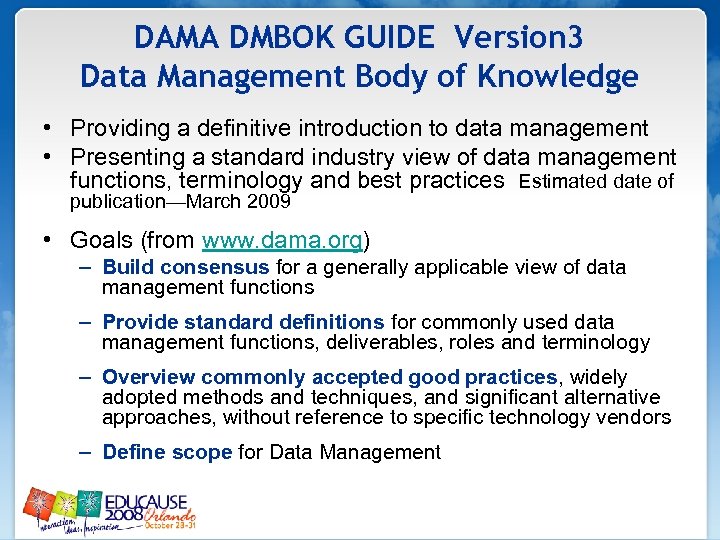
DAMA DMBOK GUIDE Version 3 Data Management Body of Knowledge • Providing a definitive introduction to data management • Presenting a standard industry view of data management functions, terminology and best practices Estimated date of publication—March 2009 • Goals (from www. dama. org) – Build consensus for a generally applicable view of data management functions – Provide standard definitions for commonly used data management functions, deliverables, roles and terminology – Overview commonly accepted good practices, widely adopted methods and techniques, and significant alternative approaches, without reference to specific technology vendors – Define scope for Data Management
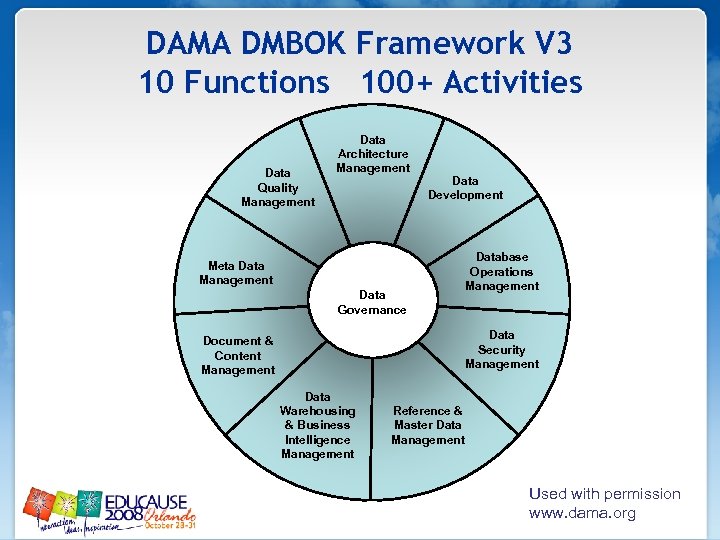
DAMA DMBOK Framework V 3 10 Functions 100+ Activities Data Quality Management Data Architecture Management Data Development Meta Data Management Data Governance Database Operations Management Data Security Management Document & Content Management Data Warehousing & Business Intelligence Management Reference & Master Data Management Used with permission www. dama. org
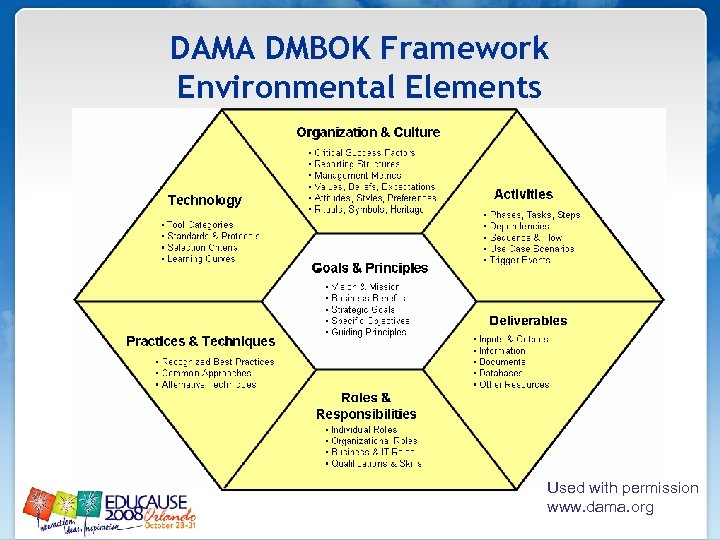
DAMA DMBOK Framework Environmental Elements Used with permission www. dama. org
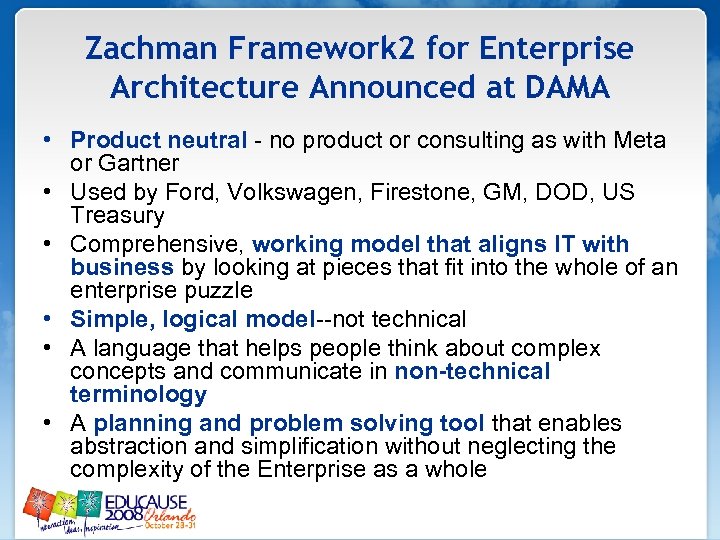
Zachman Framework 2 for Enterprise Architecture Announced at DAMA • Product neutral - no product or consulting as with Meta or Gartner • Used by Ford, Volkswagen, Firestone, GM, DOD, US Treasury • Comprehensive, working model that aligns IT with business by looking at pieces that fit into the whole of an enterprise puzzle • Simple, logical model--not technical • A language that helps people think about complex concepts and communicate in non-technical terminology • A planning and problem solving tool that enables abstraction and simplification without neglecting the complexity of the Enterprise as a whole
Research Data Governance Best Practices • Data Governance Institute, www. datagovernance. com, offers in depth vendor-neutral information • Techniques, models, and best practices for data governance • Data Governance and Stewardship “Community of Practice” to share information – nominal fee for membership, some information available at no cost
Step 2: Incorporate Data Management Best Practices into your Strategic Plan • Educate your DBAs and Managers about the DAMA Framework Functions – Address all functions during strategic plan development • Use ITANA Data Management Metrics — measure Data Management maturity – Think about: What areas of Data Management does your organization need to improve in? • Use the Zachman Framework 2 as one of your guides for Enterprise Architecture
Step 3: Set up your Matrix Managed DBA Team • One useful way -- implement your Enterprise DBA function using a matrix management style • Important to oversee the consistency of procedures: – Security (protection of Personal Identity Data, PCI and HIPAA data) – Disaster Recovery – Documentation – Service Level Agreements
Justify Creating an Enterprise DBA Role in your Organization • Show the many organizational benefits! • Keep metrics to demonstrate improvements • Write “executive reports” showing the impact of your new Enterprise DBA role to high-level managers in your organization
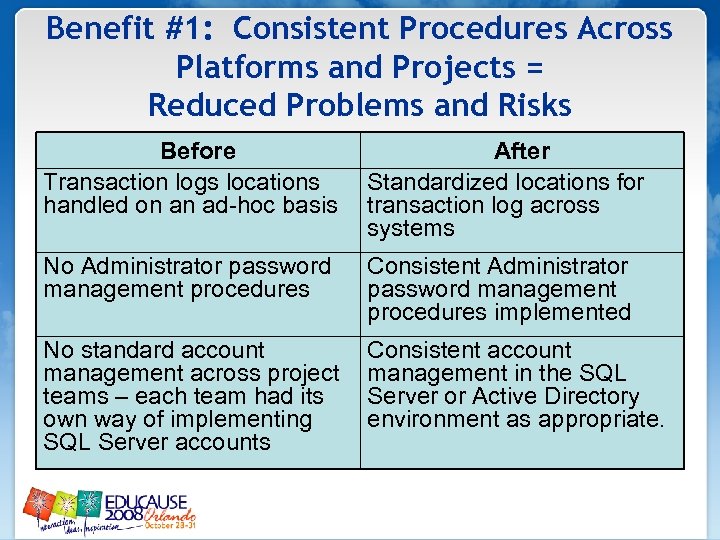
Benefit #1: Consistent Procedures Across Platforms and Projects = Reduced Problems and Risks Before Transaction logs locations handled on an ad-hoc basis After Standardized locations for transaction log across systems No Administrator password management procedures Consistent Administrator password management procedures implemented No standard account management across project teams – each team had its own way of implementing SQL Server accounts Consistent account management in the SQL Server or Active Directory environment as appropriate.
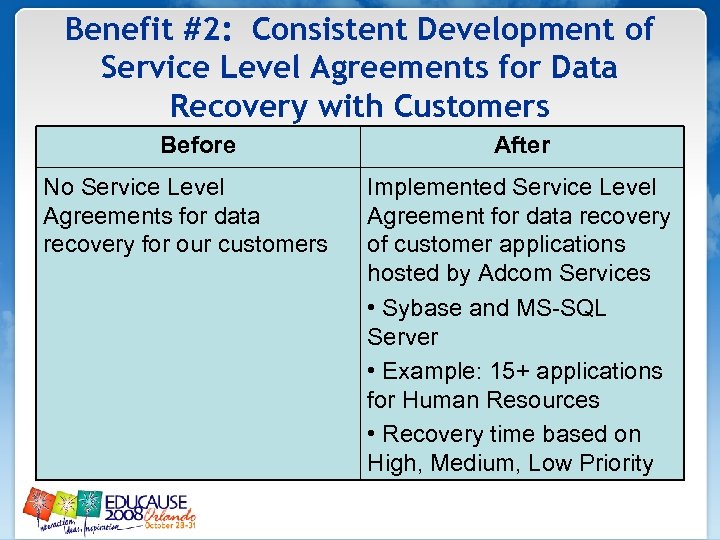
Benefit #2: Consistent Development of Service Level Agreements for Data Recovery with Customers Before No Service Level Agreements for data recovery for our customers After Implemented Service Level Agreement for data recovery of customer applications hosted by Adcom Services • Sybase and MS-SQL Server • Example: 15+ applications for Human Resources • Recovery time based on High, Medium, Low Priority
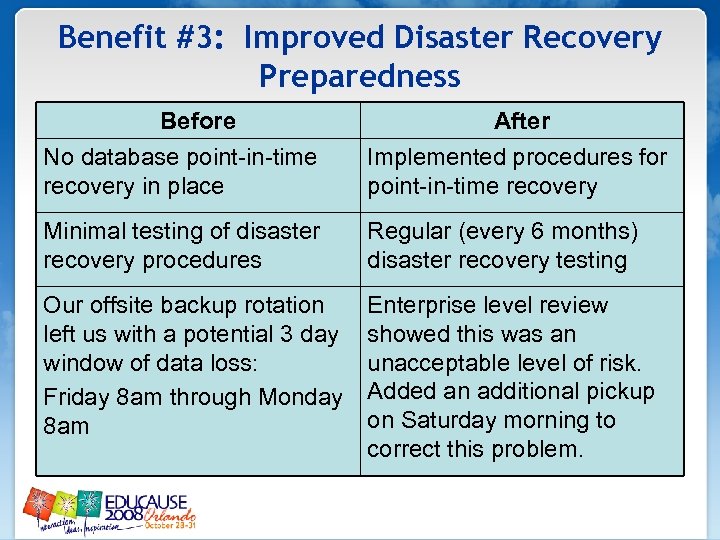
Benefit #3: Improved Disaster Recovery Preparedness Before No database point-in-time recovery in place After Implemented procedures for point-in-time recovery Minimal testing of disaster recovery procedures Regular (every 6 months) disaster recovery testing Our offsite backup rotation left us with a potential 3 day window of data loss: Friday 8 am through Monday 8 am Enterprise level review showed this was an unacceptable level of risk. Added an additional pickup on Saturday morning to correct this problem.
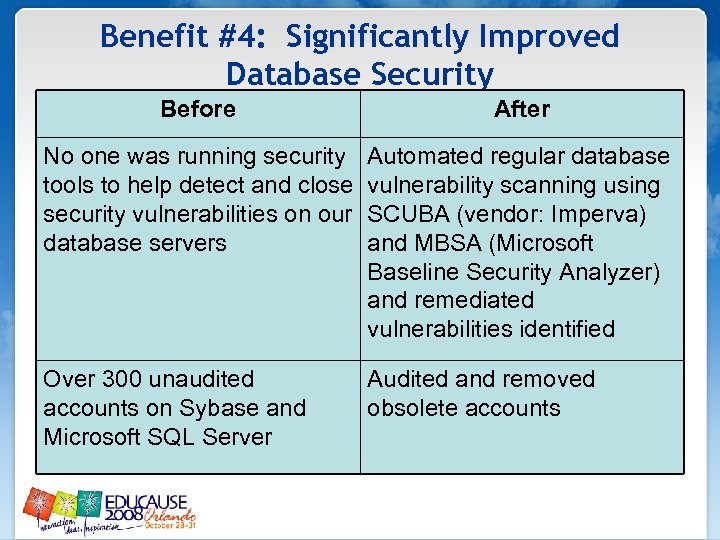
Benefit #4: Significantly Improved Database Security Before After No one was running security tools to help detect and close security vulnerabilities on our database servers Automated regular database vulnerability scanning using SCUBA (vendor: Imperva) and MBSA (Microsoft Baseline Security Analyzer) and remediated vulnerabilities identified Over 300 unaudited accounts on Sybase and Microsoft SQL Server Audited and removed obsolete accounts
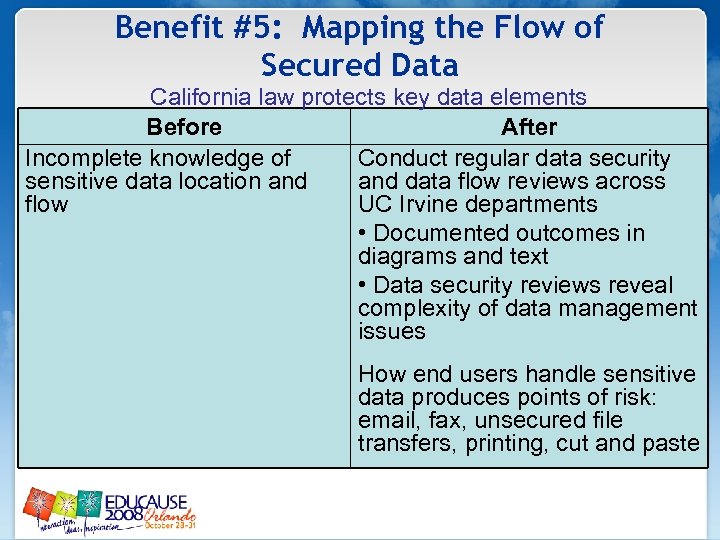
Benefit #5: Mapping the Flow of Secured Data California law protects key data elements Before After Incomplete knowledge of Conduct regular data security sensitive data location and data flow reviews across flow UC Irvine departments • Documented outcomes in diagrams and text • Data security reviews reveal complexity of data management issues How end users handle sensitive data produces points of risk: email, fax, unsecured file transfers, printing, cut and paste
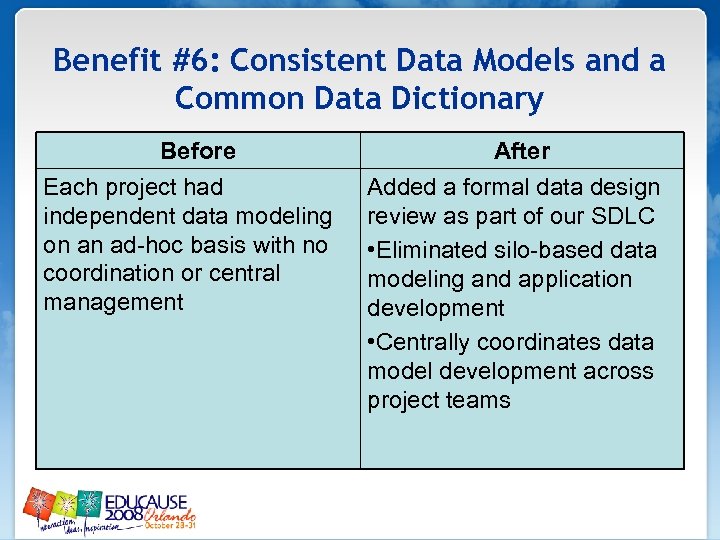
Benefit #6: Consistent Data Models and a Common Data Dictionary Before Each project had independent data modeling on an ad-hoc basis with no coordination or central management After Added a formal data design review as part of our SDLC • Eliminated silo-based data modeling and application development • Centrally coordinates data model development across project teams
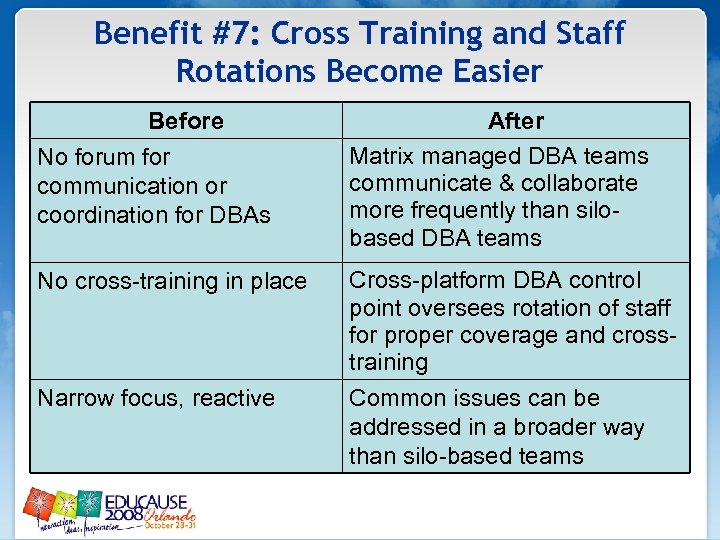
Benefit #7: Cross Training and Staff Rotations Become Easier Before No forum for communication or coordination for DBAs After Matrix managed DBA teams communicate & collaborate more frequently than silobased DBA teams No cross-training in place Cross-platform DBA control point oversees rotation of staff for proper coverage and crosstraining Common issues can be addressed in a broader way than silo-based teams Narrow focus, reactive
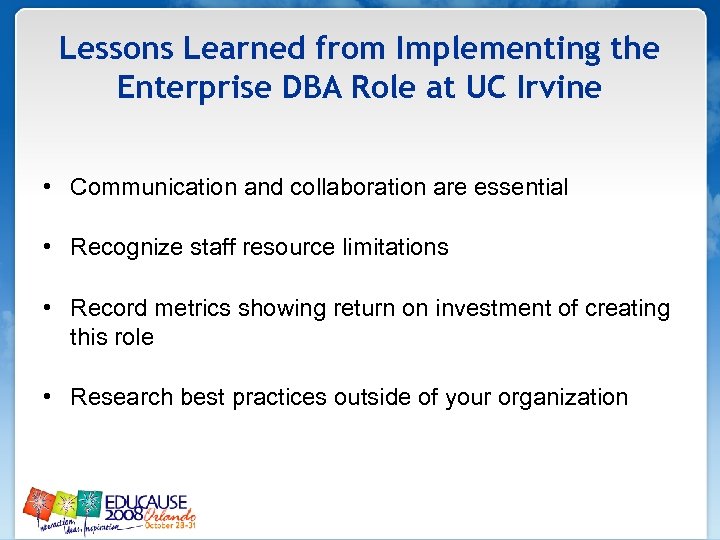
Lessons Learned from Implementing the Enterprise DBA Role at UC Irvine • Communication and collaboration are essential • Recognize staff resource limitations • Record metrics showing return on investment of creating this role • Research best practices outside of your organization
Future Plans: Focus on Data Quality in 2009 • Example of challenges: Student Billing System contains data that originates from many different sources • Problem: How do you improve the quality of the data when you are not the originator of the data? • Plan: Identify the Master of Record if you have conflicting values for your data elements
Five Year Picture: A Perfect World • Reduce platforms/complexity –- 2 database platforms • Uniformity of all servers • Highly trained staff—shared • Databases are secured • Increased dialog with business owner and better alignment of resources to reduce risks • Know location of your data – Which data is regulated? – Know what we have!
For More Information… • DAMA www. dama. org • ITANA www. itana. org • Zachman Framework 2 for Enterprise Architecture www. zachmaninternational. com • Data Governance Institute www. datagovernance. com
Скачать презентацию Creating the Enterprise Database Administrator Role Moving from
17cd5a9800137792527d7b5c2f907209.ppt