


 Скачать презентацию Creating New Markets Prof Markus Christen INSEAD Singapore
53afc00cd32990e471947a76560e838c.ppt
- Количество слайдов: 15
 Creating New Markets Prof. Markus Christen INSEAD Singapore May/June 2007
 Case: Digital Video Recorders § Why have sales of DVRs in general and of Ti. Vo in particular been well below forecasts in spite of the general excitement among industry experts and the raving reviews from users? 2 Market Driving Strategies - May/June 2007 © Prof. Markus Christen
 Change Process: Diffusion of Innovations § Adoption • Buying or using the innovative product/service (e. g. , a portable land-line telephone) for the first time. § Diffusion • Spread of adoption throughout market to a “ceiling” level (saturation), a market limit. • Sales = diffusion (first purchases), followed by replacement sales (upgrades, downgrades) and multiple purchases. 3 Market Driving Strategies - May/June 2007 © Prof. Markus Christen
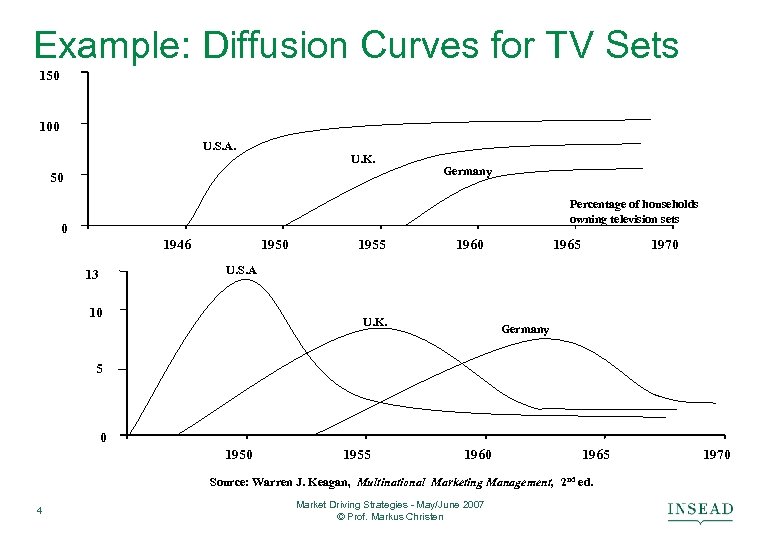 Example: Diffusion Curves for TV Sets 150 100 U. S. A. U. K. 50 Germany Percentage of households owning television sets 0 1946 1950 1955 1960 1965 1970 U. S. A 13 10 U. K. Germany 5 0 1955 1960 1965 Source: Warren J. Keagan, Multinational Marketing Management, 2 nd ed. 4 Market Driving Strategies - May/June 2007 © Prof. Markus Christen 1970
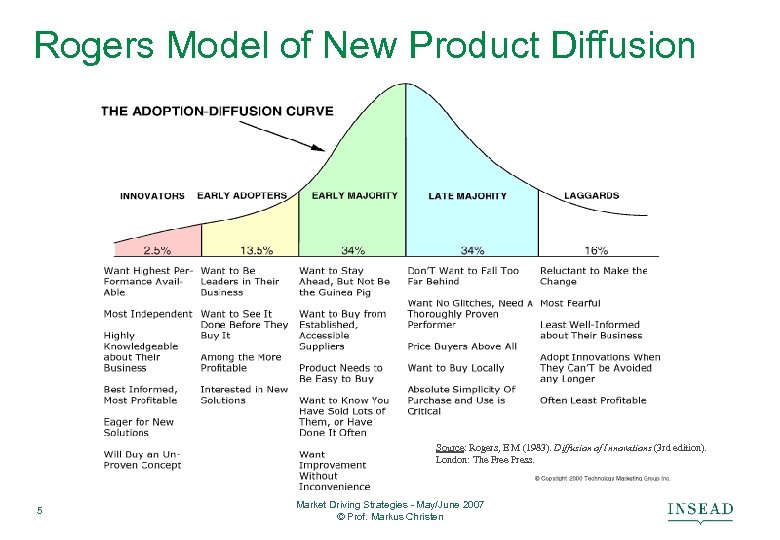 Rogers Model of New Product Diffusion Source: Rogers, E M (1983). Diffusion of Innovations (3 rd edition). London: The Free Press. 5 Market Driving Strategies - May/June 2007 © Prof. Markus Christen
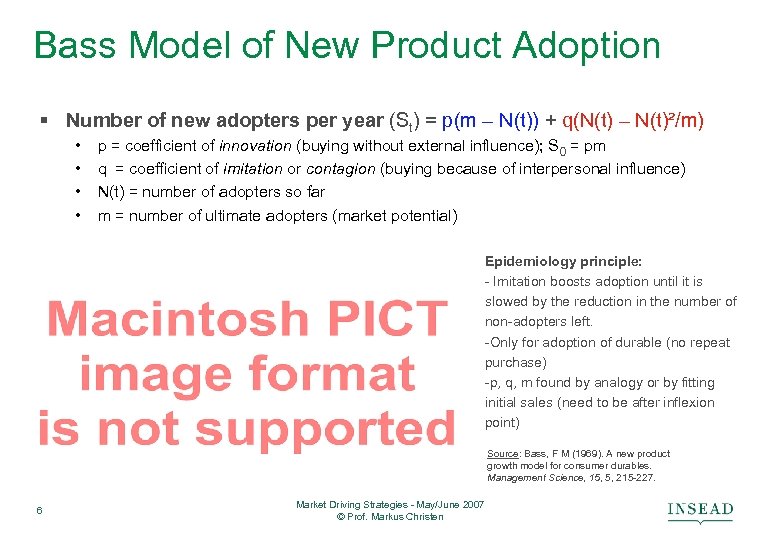 Bass Model of New Product Adoption § Number of new adopters per year (St) = p(m – N(t)) + q(N(t) – N(t)²/m) • • p = coefficient of innovation (buying without external influence); S 0 = pm q = coefficient of imitation or contagion (buying because of interpersonal influence) N(t) = number of adopters so far m = number of ultimate adopters (market potential) Epidemiology principle: - Imitation boosts adoption until it is slowed by the reduction in the number of non-adopters left. -Only for adoption of durable (no repeat purchase) -p, q, m found by analogy or by fitting initial sales (need to be after inflexion point) Source: Bass, F M (1969). A new product growth model for consumer durables. Management Science, 15, 5, 215 -227. 6 Market Driving Strategies - May/June 2007 © Prof. Markus Christen
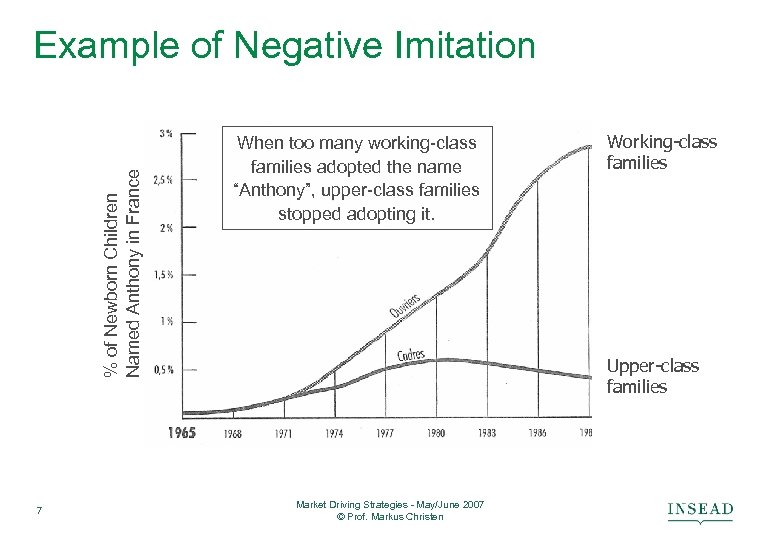 % of Newborn Children Named Anthony in France Example of Negative Imitation 7 When too many working-class families adopted the name “Anthony”, upper-class families stopped adopting it. Working-class families Upper-class families Market Driving Strategies - May/June 2007 © Prof. Markus Christen
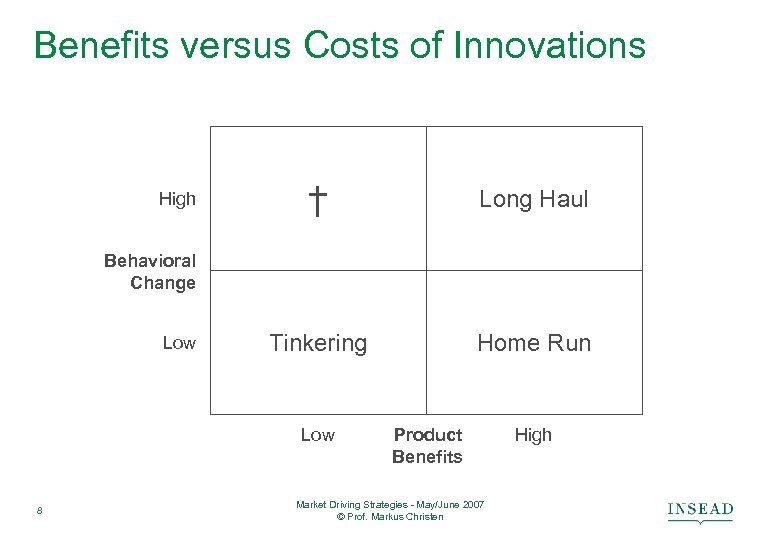 Benefits versus Costs of Innovations High † Long Haul Tinkering Home Run Behavioral Change Low 8 Product Benefits Market Driving Strategies - May/June 2007 © Prof. Markus Christen High
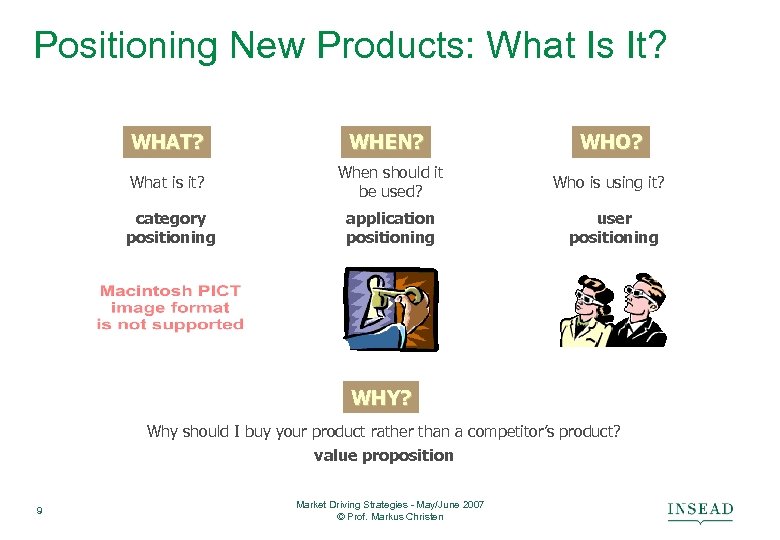 Positioning New Products: What Is It? WHAT? WHEN? WHO? What is it? When should it be used? Who is using it? category positioning application positioning user positioning WHY? Why should I buy your product rather than a competitor’s product? value proposition 9 Market Driving Strategies - May/June 2007 © Prof. Markus Christen
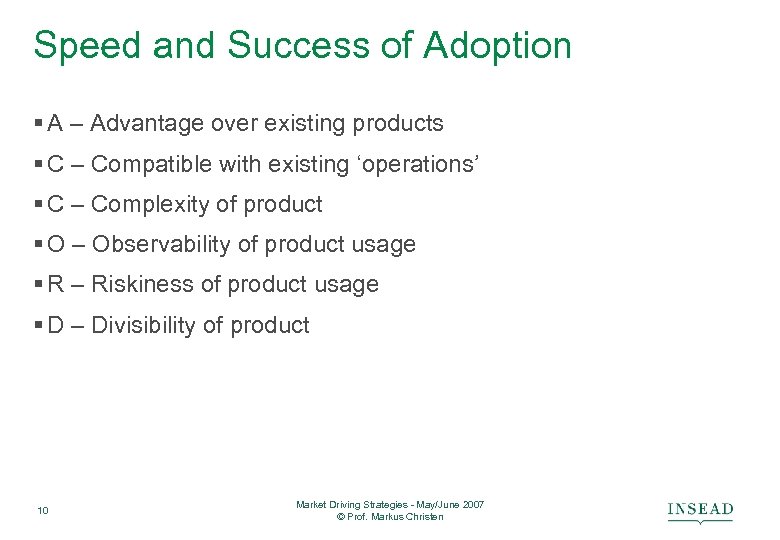 Speed and Success of Adoption § A – Advantage over existing products § C – Compatible with existing ‘operations’ § C – Complexity of product § O – Observability of product usage § R – Riskiness of product usage § D – Divisibility of product 10 Market Driving Strategies - May/June 2007 © Prof. Markus Christen
 What Can Go Wrong? § Nobody believes in innovation • “Heavier-than-air flying machines are impossible. ” (Lord Kelvin, 1895) • “Everything that can be invented has been invented. ” (Charles H. Duell, US Office of Patents, 1899) 11 Market Driving Strategies - May/June 2007 © Prof. Markus Christen
 What Can Go Wrong? § Firms do not see the market potential • “The wireless music box has no imaginable commercial value. Who would pay for a message sent to nobody in particular? ” (David Sarnoff’s associates, in response to his urgings for investment in the radio in the 1920’s) • “I think there is a world market for maybe five computers. ” (Tom Watson, IBM, 1943) • “There is no reason for any individuals to have a computer in their home. ” (Ken Olsen, Digital, 1977) 12 Market Driving Strategies - May/June 2007 © Prof. Markus Christen
 What Can Go Wrong? § Customers don’t understand the benefits • “Airplanes are interesting toys but of no military value. ” (Marshal Foch) • “This ‘telephone’ has too many shortcomings to be seriously considered as a means of communication. The device is inherently of no value to us. ” (Western Union, Internal Memo, 1876) 13 Market Driving Strategies - May/June 2007 © Prof. Markus Christen
 What Can Go Wrong? § Companies don’t understand what it takes to create a new market • • Does the product have the right attributes and does it address a real need? Can people easily understand what the product is and how it creates value? Is the marketing effort targeted at the right people? Who are the people for whom the product creates the most value and who can readily understand the value? • Are the benefits big enough to compensate for the cost of change? • Can you benefit from your effort to create a new market? 14 Market Driving Strategies - May/June 2007 © Prof. Markus Christen
 Rule 14: Market Creation Successful market creation requires finding or creating innovators. 15 Market Driving Strategies - May/June 2007 © Prof. Markus Christen