


 Скачать презентацию Creating Math Moments in Preschool Greg Gierhart Murray
566e898b405d2458879162f69c21bd76.ppt
- Количество слайдов: 48
 Creating Math Moments in Preschool Greg Gierhart Murray State University Dr. Nancy Lovett Regional Training Center-Calloway County This presentation is dedicated to bringing out the inner child within you!
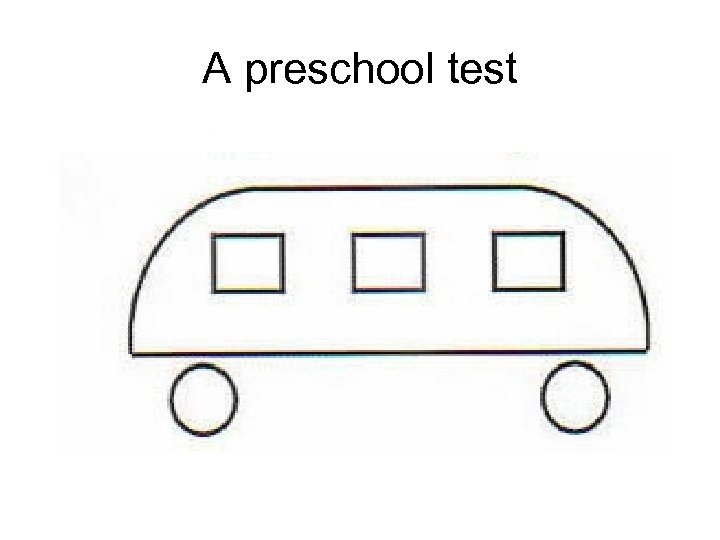 A preschool test
 Principles for a Developmental Curriculum • Each child is an individual and should be treated and respected as such • The early years are a period of development in their own right, and education of young children should be seen as special with its own valid criteria of appropriate practice. • The role of the educator of young children is to engage actively with what most concerns the child, and to support learning through these preoccupations
 Principles for a Developmental Curriculum • The educator has a responsibility to foster positive attitudes in children to both self and others, and to counter negative message with children may have received • Each child’s cultural and linguistic endowment is seen as the fundamental medium of learning • An anti-discriminatory approach is the basis for all respect-worthy education, and is essential as a criterion for a developmentally appropriate curriculum (DAC)
 Principles for a Developmental Curriculum • All children should be offered equal opportunities to progress and develop and should have equal access to good quality provision. The concepts of multiculturalism and tolerance are intrinsic to this whole educational approach • Partnership with parents should be given priority as the most effective means of ensuring coherence and continuity in children’s experiences, and in the curriculum offered to them • A democratic perspective permeates education of good quality and is the basis of transactions between people
 Math Wars • Camp #1 -Behavioralists-Math is for knowing – Memorize – Know the basic facts • Camp #2 -Constructivists-math is for understanding -conceptualize (scaffold learning) -deeper understanding of mathematics
 A Famous Problem The Horse Problem! • A man buys a horse for 50 dollars. Decides he wants to sell his horse later and gets 60 dollars. He then decides to buy it back again and paid 70 dollars. However, he could no longer keep it and he sold it for 80 dollars. • Did he make money? lose money? or break even? Explain why.
 Substantial changes in Pre. K-12 math education are occurring nationwide due to • New beliefs about how children learn. • Massive changes in technologywidespread availability of calculators and computers. • Changing demands on workers made by business and industry
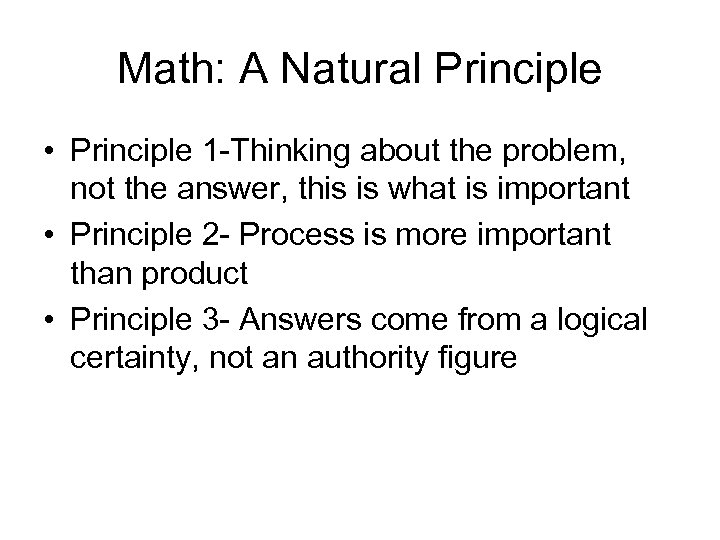 Math: A Natural Principle • Principle 1 -Thinking about the problem, not the answer, this is what is important • Principle 2 - Process is more important than product • Principle 3 - Answers come from a logical certainty, not an authority figure
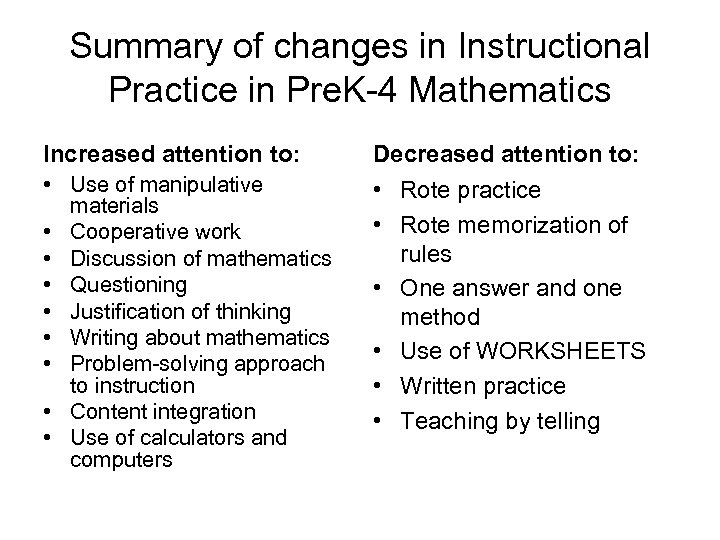 Summary of changes in Instructional Practice in Pre. K-4 Mathematics Increased attention to: Decreased attention to: • Use of manipulative materials • Cooperative work • Discussion of mathematics • Questioning • Justification of thinking • Writing about mathematics • Problem-solving approach to instruction • Content integration • Use of calculators and computers • Rote practice • Rote memorization of rules • One answer and one method • Use of WORKSHEETS • Written practice • Teaching by telling
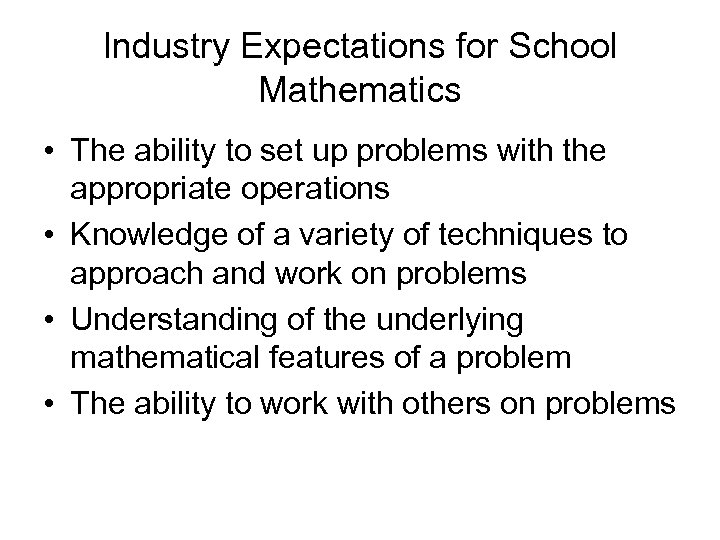 Industry Expectations for School Mathematics • The ability to set up problems with the appropriate operations • Knowledge of a variety of techniques to approach and work on problems • Understanding of the underlying mathematical features of a problem • The ability to work with others on problems
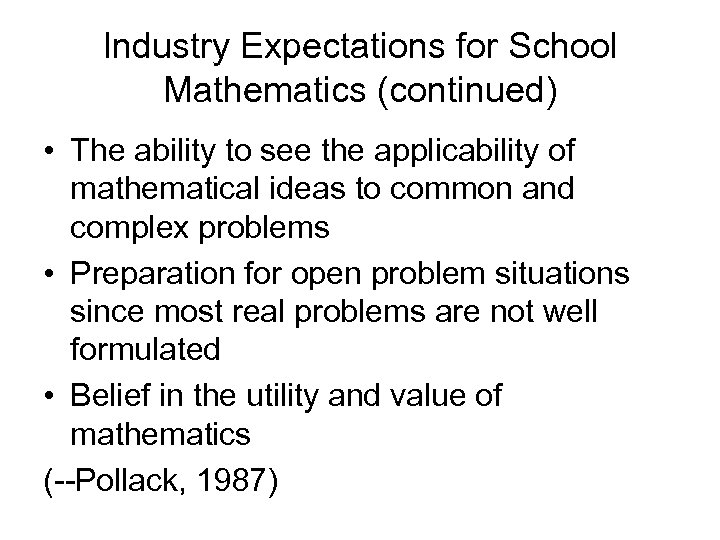 Industry Expectations for School Mathematics (continued) • The ability to see the applicability of mathematical ideas to common and complex problems • Preparation for open problem situations since most real problems are not well formulated • Belief in the utility and value of mathematics (--Pollack, 1987)
 Social and Emotional Preschoolers with social and emotional problems will need to have those needs addressed before they can successfully develop their mathematical skills (Sousa)
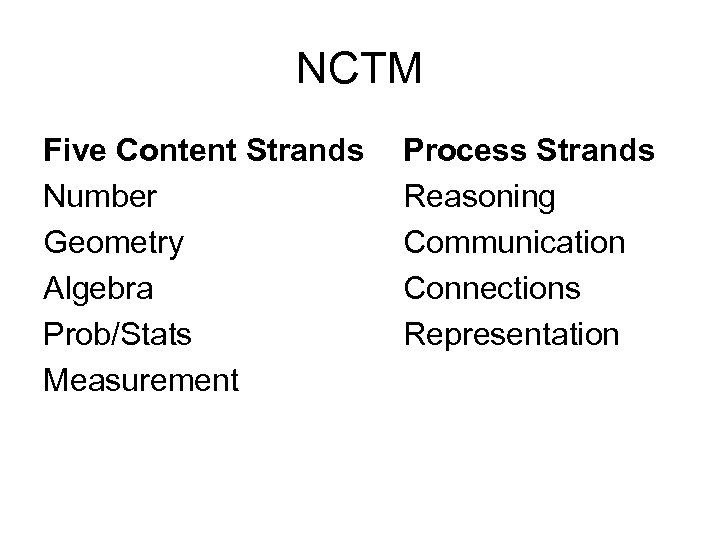 NCTM Five Content Strands Number Geometry Algebra Prob/Stats Measurement Process Strands Reasoning Communication Connections Representation
 Kentucky Early Childhood Standards and Benchmarks • NCTM Principles and Standards • NCTM Curriculum Focal Points • Standards and Benchmarks
 NCTM PRINCIPLES • • • Equity Curriculum Teaching Learning Assessment Technology
 Goals and Objectives of Mathematics Learning • Guiding learning • Poster session: creating mathematics-rich physical environment – – – – – Arrival Large group time Choice time Small group time Snack/meal time Transitions Outdoor time Rest time Dismissal
 Emergent Mathematicians • Naturally acquire some mathematical concepts without direct teaching • Follow a generally standard sequence of gradual mathematical development • Construct mathematical concepts from a very early age
 Intentional Teacher • Understand child development • Understand each individual needs and interests • Use this understanding to develop the best curriculum for children • Take an active role in the development of the curriculum • Use resources • Understands that planning involves the
 Intentional Teacher (Continued) • Consider student interest • Consider your standards/benchmarks, objectives, goals, and assessment (not activities) • Do not rely on pre-made lessons or worksheets (or canned activities) • Knows the standards/benchmarks of the state
 Bridging in Mathematics: How Does a Preschool Teacher Do It? Observer Validator Participant/Converser Extender Problem Initiator Role Model Instructor Manager
 How Does a Mathematician Solve Problems? • Work for a small amount of time on a problem and will return to it later • Collaborate with others and study the problem together • Prove that the solution is correct • Solve complex problems • Take pride in their accomplishments and use the problem solving process • Never Give Up
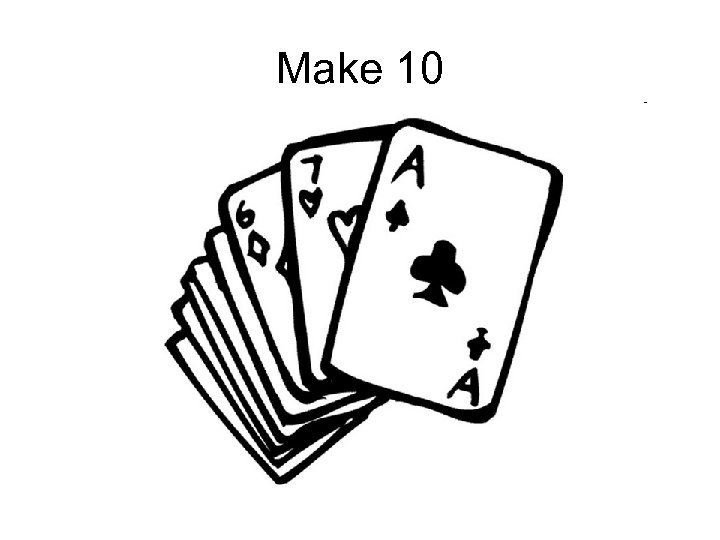 Make 10
 THE NCTM STANDARDS How and What to teach How What • Mathematics as Problem Solving • Mathematics as Communication • Mathematics as reasoning • Mathematical Connections • Estimation • Number sense and numeration • Whole number • Geometry and Spatial Sense (play and proximity) • Measurement (play) • Statistics and Probability (Graphs) • Patterns and Relationships (patterns)
 Planning Learning Experiences • • Child initiated learning Teacher guided instruction Large groups Small groups
 What is the best center? Learning v Interest Learn concepts, skills and facts independently or in small groups Planned according to developmental needs Planned according to the interest of children Planned to use all of the senses
 Dramatic Play • Prop Boxes http: //www. angelfire. com/dc/childsplay/Prop_Box_Ideas. htm EXAMPLE: RESTAURANT Tablecloth dishes menus (made w/ food pictures) Sign for restaurant hats trays napkins Tablewear order pads/pencils aprons Cash register play food
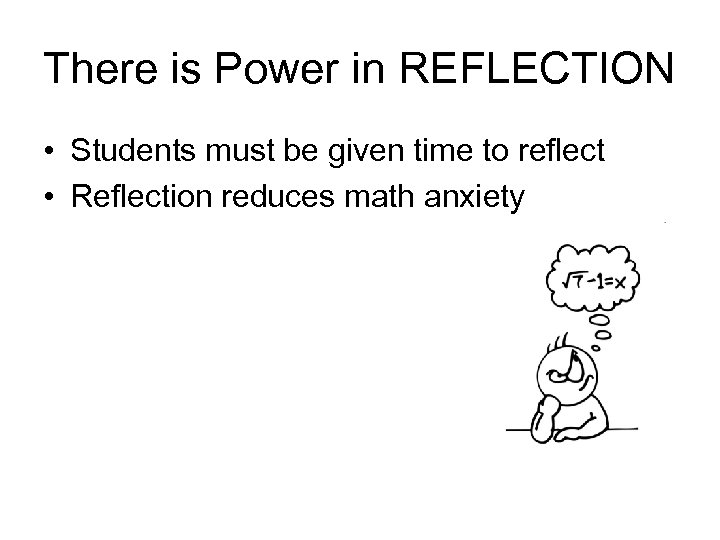 There is Power in REFLECTION • Students must be given time to reflect • Reflection reduces math anxiety
 How to Best Learn Mathematics? • • Behaviorist Approach Montessori Method A Visual Approach The Constructivist Approach
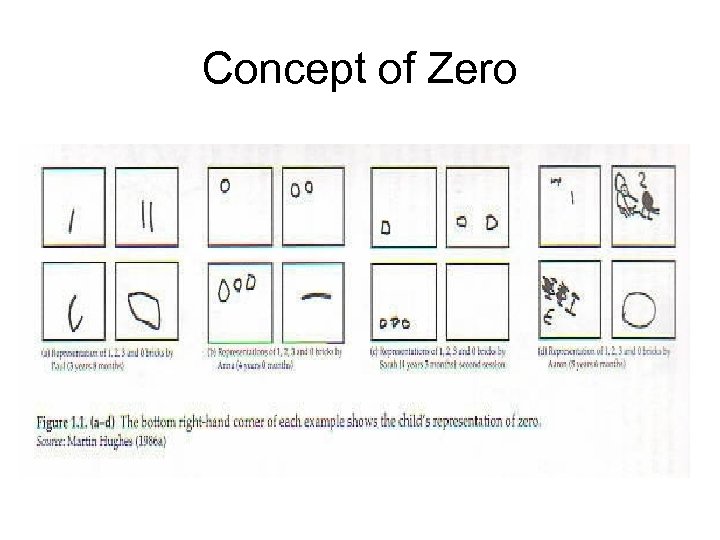 Concept of Zero
 Is Play and Work Important? Every person has a developmental need to experience creativity and self-expression People skilled at play have more power, influence, and capacity to create meaningful lives-builds problemsolving, persistence, and collaboration Play allows a conduit to new experiences, content, and meaning Play is integral to curriculum, to allow for engaging for hands-on problem solving and inspiring projects Through play, we learn to accept differences of opinion and how to resolve conflict
 Project Approach • Katz and Helm • Studies (p. 95 -99) • Introduces children to experiences of mathematics inquiry and explorations at an earlier age (researchers-validation) • The child’s prior knowledge should be assessed before teachers provide new experiences
 Math Backpacks This provides a link between home and school and the parents get to see what their child is learning. You will need: 1 backpack, materials required for extension activity, instructions for the parents, and a scribbler for comments. I provide the scribbler so that parents and students may share their thoughts about the activities. I send the backpack home every night with a different student. If by chance they forget the pack, it is not sent home with another student until it returns. When the pack is returned we read and share the comments with the class. Once all of the children have had a chance to take home the pack, I refill it with another activity and we start over again. The children are so eager to take the pack home and share the learning with their parents.
 Math Tubs • Math Tubs are simply plastic tubs containing games and hands on manipulatives for students to use that focus on a particular math concept. The tubs can be used as a directed center, one on one skill practice, or for additional reinforcement during free choice time once introduced. While working with the materials in each tub, students are practicing and developing one to one correspondence, numeral recognition, sorting skills, patterning skills, set recognition, etc. • The math area also contains manipulatives such as size bears, unifix cubes, pattern blocks, plastic chain links, tiles, colored cubes, plastic animals, tangrams, etc. These are for students to use in conjunction with some of the math tub activities, but also for whole class lessons and free exploration.
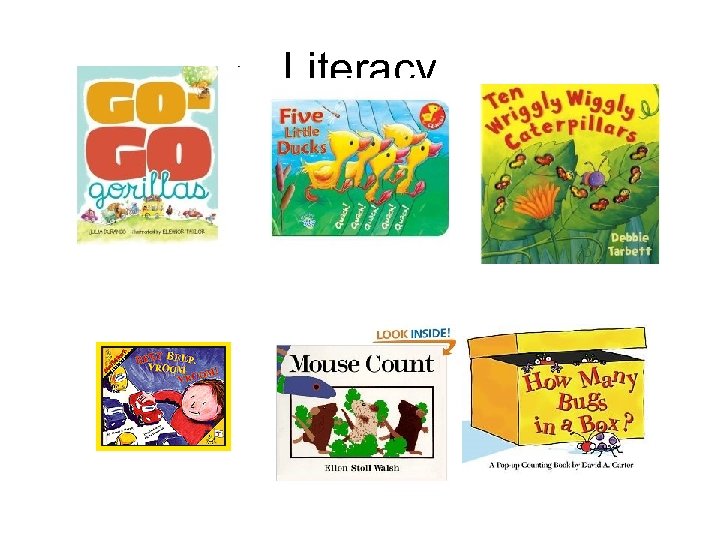 Literacy
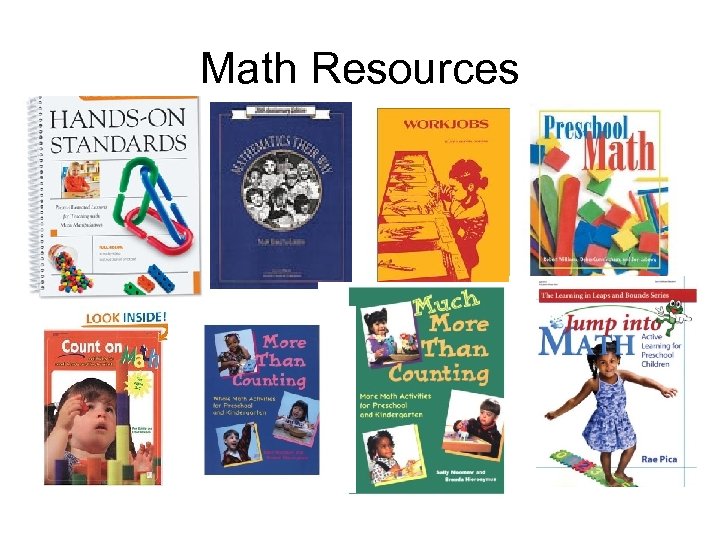 Math Resources
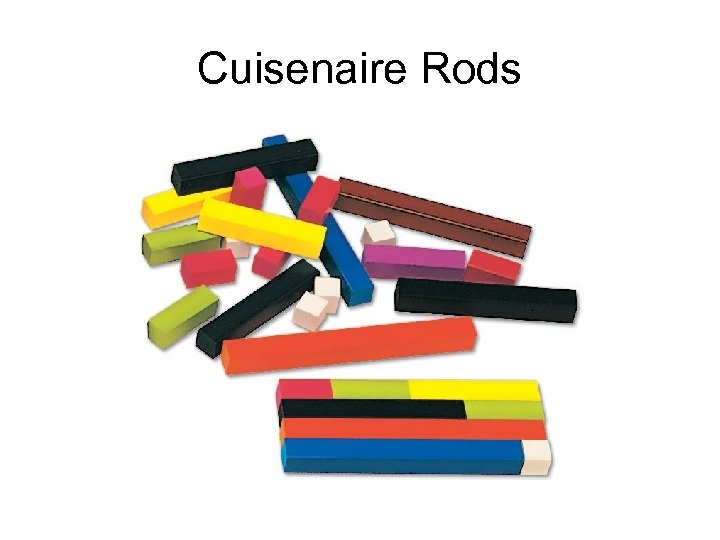 Cuisenaire Rods
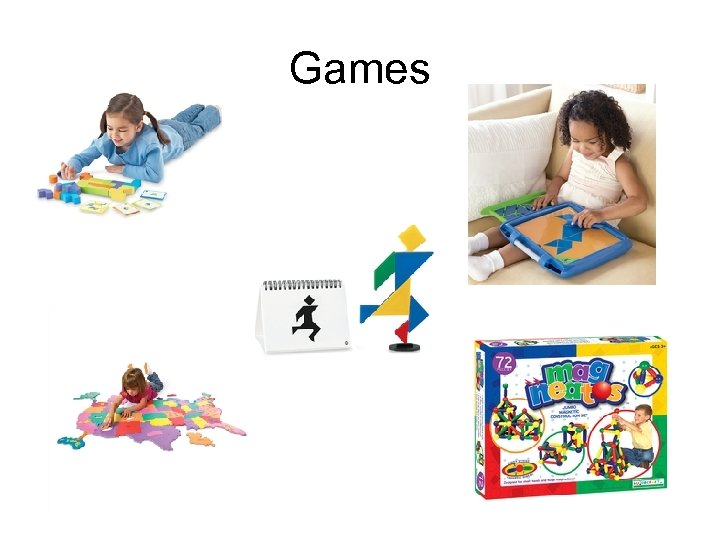 Games
Games
 Mathematics HOT TOPICS • Standards, objectives, assessments, and activities • Learning trajectories • Brain Research and Mathematics • Technology (SMARTBOARDS—HD digital video)
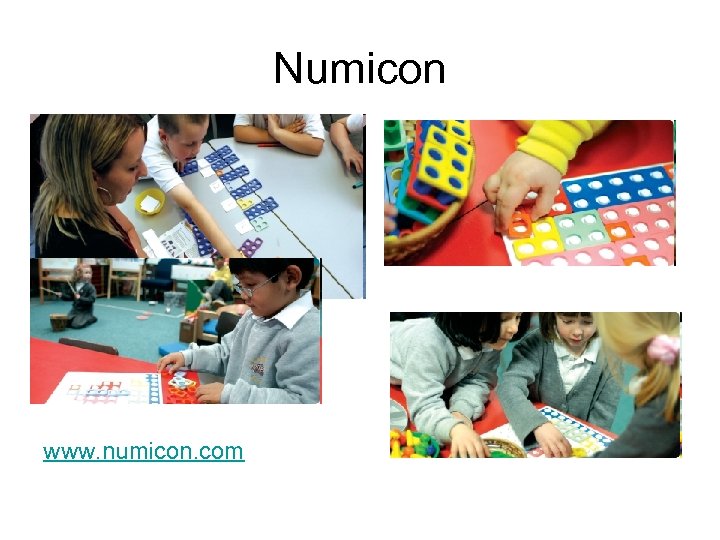 Numicon www. numicon. com
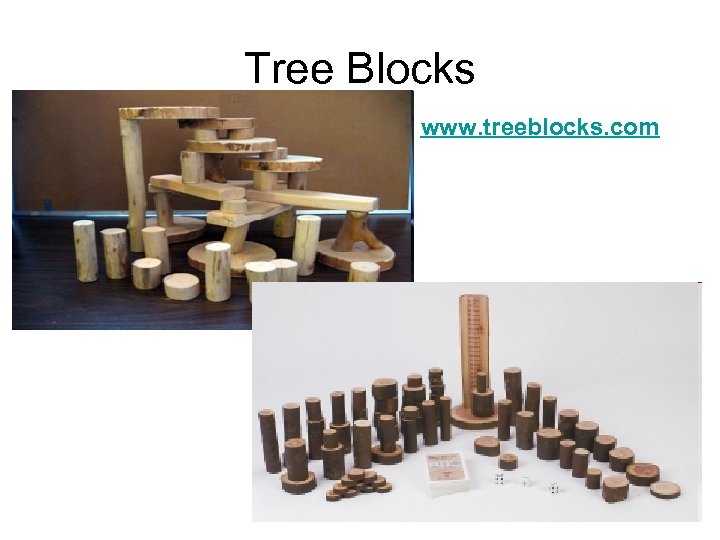 Tree Blocks www. treeblocks. com
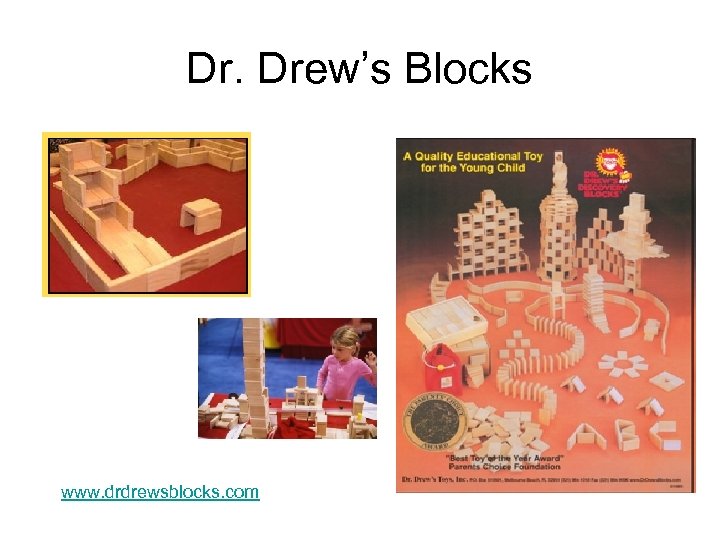 Dr. Drew’s Blocks www. drdrewsblocks. com
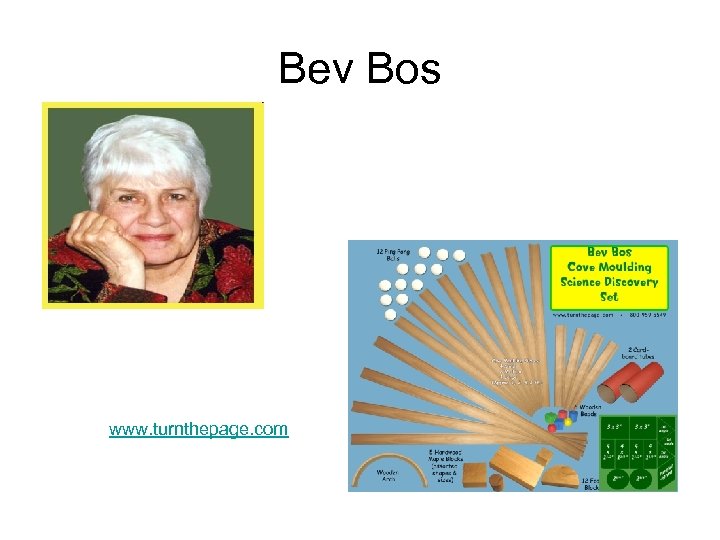 Bev Bos www. turnthepage. com
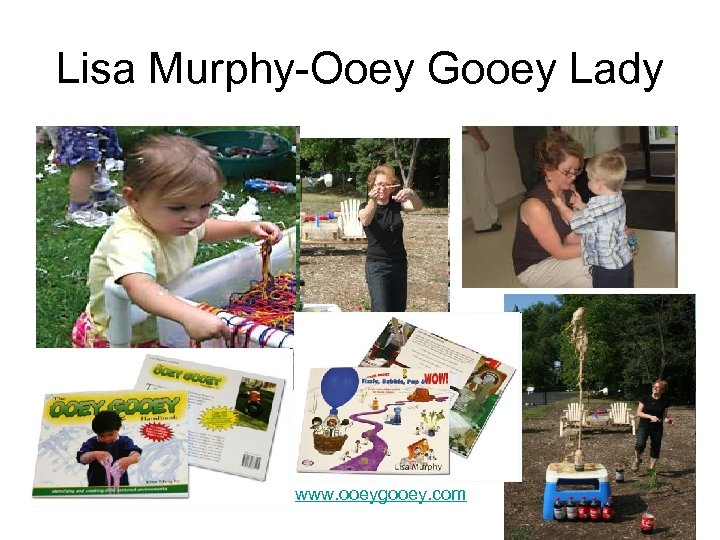 Lisa Murphy-Ooey Gooey Lady www. ooeygooey. com
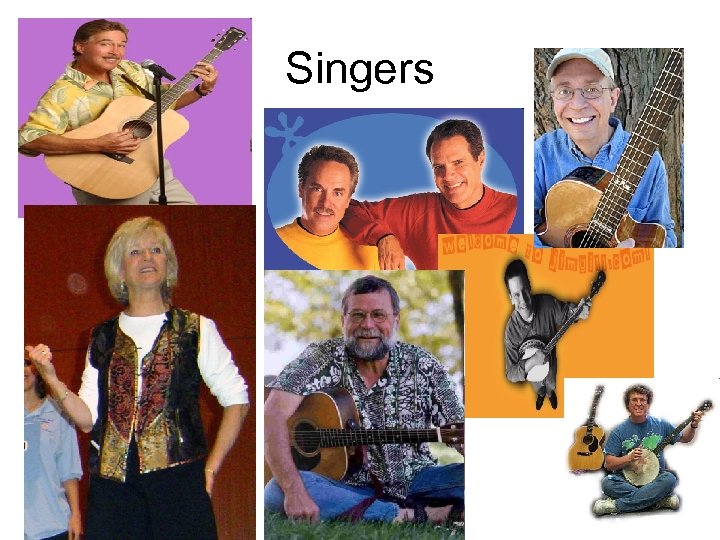 Singers
 Websites of interest Bev Bos: www. turnthepage. com Lisa Murphy: www. ooeygooey. com Steve Spangler: www. stevespanglerscience. com Jim Gill: http: //www. jimgill. com/ Greg and Steve: http: //www. gregandsteve. com/index. php Jack Hartmann: http: //www. jackhartmann. com/ Hugh Hanley: http: //www. hughhanley. com/ Tom Hunter: http: //www. tomhunter. com/ Paul “Vincent” Nunes: http: //www. lighthouserecords. com/ Math manipulatives: http: //nlvm. usu. edu/en/nav/vlibrary. html KY math center: http: //kentuckymathematics. org/ Math playground: http: //www. mathplayground. com/ Math and standards: http: //www. mathwire. com/ Math resources: http: //www. internet 4 classrooms. com/early_childhood/math_pre-k. htm
 More Websites • • • Nick Jr. Activities: http: //www. nickjr. com/ Illuminations: http: //illuminations. nctm. org/ Games: http: //www. prongo. com/games/ages 3 -6. html Games galore: http: //www. cut-the-knot. org/games. shtml Math concepts: http: //www. internet 4 classrooms. com/skills-kmathbuilders. htm Workjobs: http: //www. preschoolfun. com/pages/teacch%20 work%20 jobs. htm More Workjobs: http: //www. blaine. k 12. wa. us/bes/class/Klemmt/html%20 file/workjobs. html Math tubs: http: //www. marcias-lesson-links. com/Math. Tubs. html More math tubs: http: //www. hubbardscupboard. org/math_tubs. html More math tubs: http: //www. vickymoore 2. com/for. cfm? subpage=633403 Math backpack: http: //www 2. hcpss. org/res/mathbp/kindergarten. html Literacy and Mathematics: http: //www. indiana. edu/~reading/ieo/bibs/childmat. html
 We thank you!