


 Скачать презентацию Creating Independence An Innovative Way to Educate Vermont s
cc2a50f4293181e2eb33c088277b9432.ppt
- Количество слайдов: 17
 Creating Independence: An Innovative Way to Educate Vermont’s Children? By Daren M. Houck Headmaster, Lyndon Institute Former Headmaster, The Mountain School at Winhall Former Trustee, The Village School of North Bennington President, Green Mountain Educational Consulting Tuesday, August 18, 2015
![Those who really desire to attain an independence, have only [to] set their minds](https://present5.com/presentation/cc2a50f4293181e2eb33c088277b9432/image-2.jpg "Those who really desire to attain an independence, have only [to] set their minds") Those who really desire to attain an independence, have only [to] set their minds upon it, and adopt the proper means, as they do in regard to any other object which they wish to accomplish, and the thing is easily done. " --P. T. Barnum, American showman and businessman
Those who really desire to attain an independence, have only [to] set their minds upon it, and adopt the proper means, as they do in regard to any other object which they wish to accomplish, and the thing is easily done. " --P. T. Barnum, American showman and businessman
 Who is This Guy? • Educational leader, teacher, and coach for over 20 years • M. Ed. in Educational Leadership, B. A. in Education • Worked in PK-12 public and independent schools of 70 students to 1, 400 students in three states • Graduate of K-12 public system, public and private university system • Educational Consultant and writer
 Conundrums we are facing… • Shrinking Enrollment – As of 2015, Vermont “lead” the nation in student decline (annual increase of 13% nationally, decline of 10%-12% in Vermont)(VHA, USDOE) – Birthrates supposed to begin increasing slightly in 2018, but never to previous levels – Economic climate still a factor • Public education v. publicly funded education – What is our obligation to our children? – How can we ensure equity and excellence? • High Property Taxes – Are we at a breaking point? – How much education can we “afford”? • Consolidation – Is there a place for the smaller community school? – What will we learn – or not – from Maine?
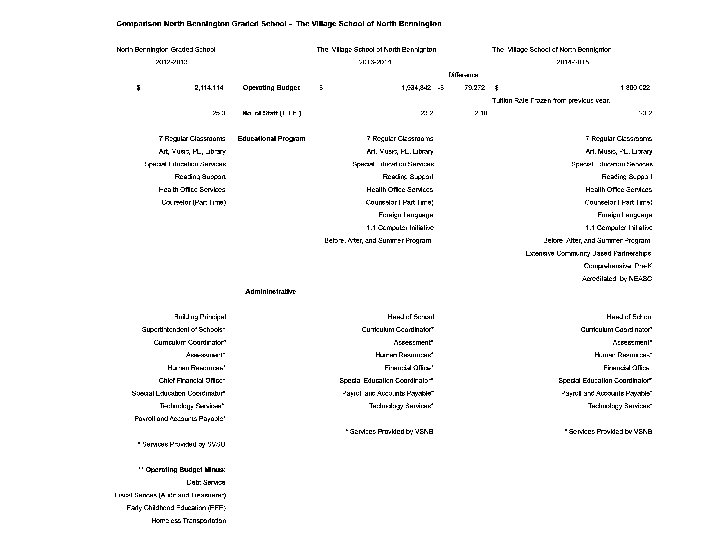
 A Tale of Two Schools The Mountain School… The Village School • 1997 -1998, Winhall Elementary was the costliest school in VT and one of the lowestperforming • Community wanted to ensure an equitable and excellent program in a fiscally responsible manner • Looked at the neighbor down the street (BBA)… • NB Graded School was considered a highperforming school, costeffective in the SU • Community wanted to retain community control of a highly-regarded school and program that would not succumb to consolidation, closure • Looked at their predecessor, MSW…
 What is a “Town Academy? ” • • • Dates back to 1700’s “Private School, Public Mission” - towns contracted with established local private schools to educate their respective communities’ children Used to be hundreds…now only 22 Washington and Fryeburg (ME) oldest operating TA’s (founded early 1790’s) VT Academies: Thetford (oldest, 1817), Burr & Burton Academy, St. Johnsbury, Lyndon Institute; MSW, VSNB (only elementary Academies ever in existence)
 How Does a TA Operate? • Core Values: – Independence (operates like an independent school) – Equity (serves all students) – Excellence (focus on quality as defined by the school) – Choice (parents choose you, are more committed) • Governance: – Typically private, selfperpetuating Board of Trustees – Board’s role is strategic • Funding: – TA’s receive funding from two main sources: tuition and fundraising – Some grants, other sources (Title monies, etc. ) • Tuition: – Set by the Board – “Approved” by the sending town(s)* – Never covers cost of education – CTE exception • Sending Towns – “Tuition for admission” – TA’s work with surrounding towns to admit the town’s children the school is able to serve (SU involvement) – Choice = partnership with the parents • Designation – Towns can vote to designate HIGH SCHOOL, school can refuse
 Public, Private, or Independent? • • • Private v. Independent …just semantics? Vermont recognizes public and indepndent Not all “private” schools are “independent, ” but all “independent” schools are “private” 10% of Pre-K-12 students in U. S. attend private schools (same as Vermont)(www. capenet. org) Private schools make up 24% of all schools (much smaller size) Only 1% of American students (10% of all private school students) attend a “true” independent school (NAIS) – Independent schools have the freedom to… • • Define their own mission Admit/retain students the mission states the school should serve Hire/retain faculty based on the school’s own criteria for excellence Articulate a curriculum and program as the school/mission deems fit – Other private schools are: • Financed and controlled by the state (i. e. charter schools) • Financed and controlled by a religious organization (i. e. parochial schools)
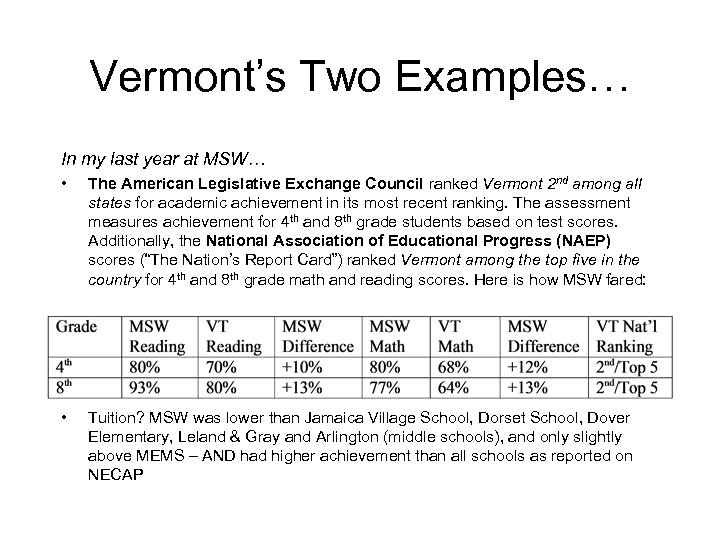 Vermont’s Two Examples… In my last year at MSW… • The American Legislative Exchange Council ranked Vermont 2 nd among all states for academic achievement in its most recent ranking. The assessment measures achievement for 4 th and 8 th grade students based on test scores. Additionally, the National Association of Educational Progress (NAEP) scores (“The Nation’s Report Card”) ranked Vermont among the top five in the country for 4 th and 8 th grade math and reading scores. Here is how MSW fared: • Tuition? MSW was lower than Jamaica Village School, Dorset School, Dover Elementary, Leland & Gray and Arlington (middle schools), and only slightly above MEMS – AND had higher achievement than all schools as reported on NECAP
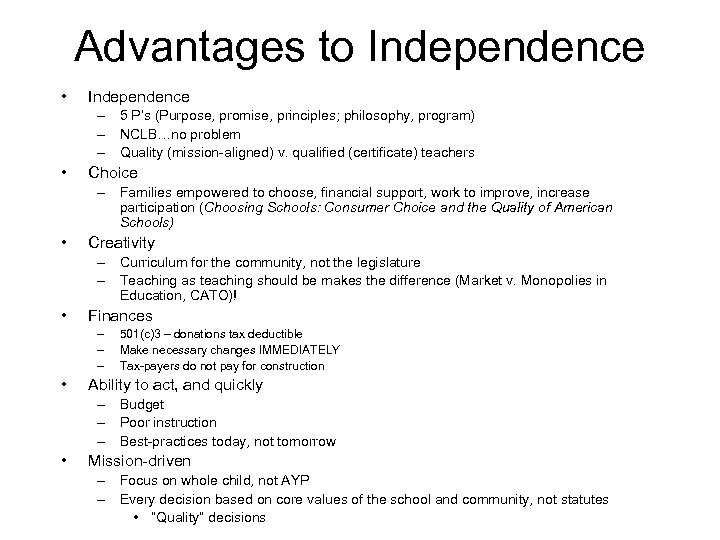 Advantages to Independence • Independence – 5 P’s (Purpose, promise, principles; philosophy, program) – NCLB…no problem – Quality (mission-aligned) v. qualified (certificate) teachers • Choice – Families empowered to choose, financial support, work to improve, increase participation (Choosing Schools: Consumer Choice and the Quality of American Schools) • Creativity – Curriculum for the community, not the legislature – Teaching as teaching should be makes the difference (Market v. Monopolies in Education, CATO)! • Finances – – – • 501(c)3 – donations tax deductible Make necessary changes IMMEDIATELY Tax-payers do not pay for construction Ability to act, and quickly – Budget – Poor instruction – Best-practices today, not tomorrow • Mission-driven – Focus on whole child, not AYP – Every decision based on core values of the school and community, not statutes • “Quality” decisions
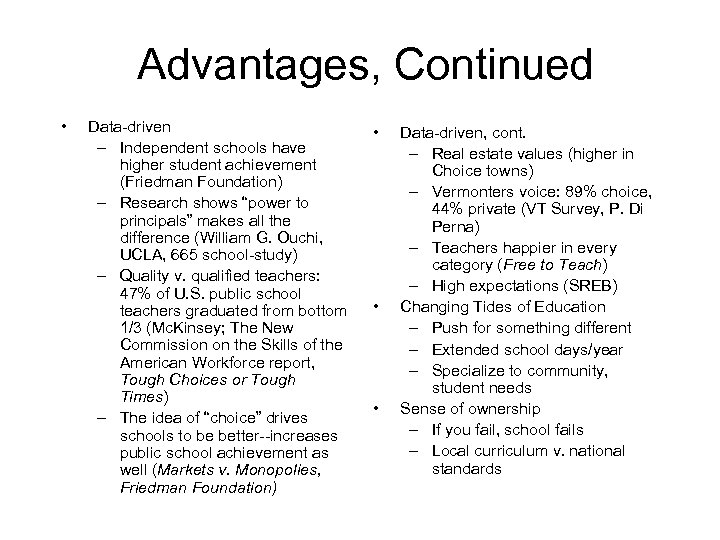 Advantages, Continued • Data-driven – Independent schools have higher student achievement (Friedman Foundation) – Research shows “power to principals” makes all the difference (William G. Ouchi, UCLA, 665 school-study) – Quality v. qualified teachers: 47% of U. S. public school teachers graduated from bottom 1/3 (Mc. Kinsey; The New Commission on the Skills of the American Workforce report, Tough Choices or Tough Times) – The idea of “choice” drives schools to be better--increases public school achievement as well (Markets v. Monopolies, Friedman Foundation) • • • Data-driven, cont. – Real estate values (higher in Choice towns) – Vermonters voice: 89% choice, 44% private (VT Survey, P. Di Perna) – Teachers happier in every category (Free to Teach) – High expectations (SREB) Changing Tides of Education – Push for something different – Extended school days/year – Specialize to community, student needs Sense of ownership – If you fail, school fails – Local curriculum v. national standards
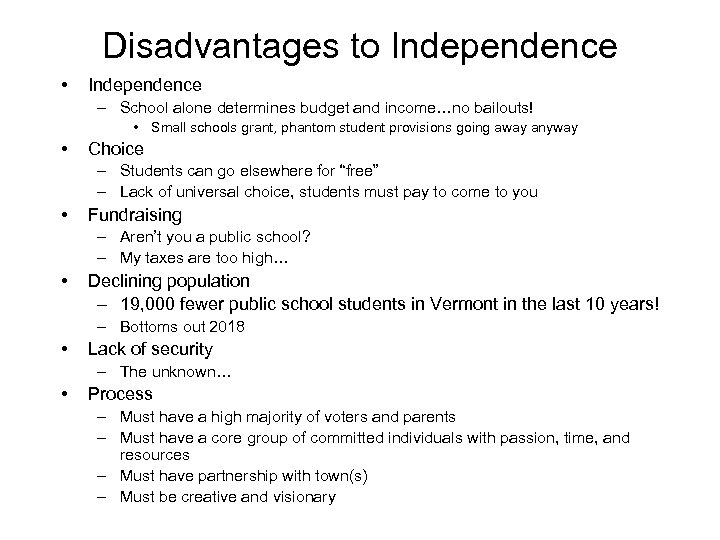 Disadvantages to Independence • Independence – School alone determines budget and income…no bailouts! • Small schools grant, phantom student provisions going away anyway • Choice – Students can go elsewhere for “free” – Lack of universal choice, students must pay to come to you • Fundraising – Aren’t you a public school? – My taxes are too high… • Declining population – 19, 000 fewer public school students in Vermont in the last 10 years! – Bottoms out 2018 • Lack of security – The unknown… • Process – Must have a high majority of voters and parents – Must have a core group of committed individuals with passion, time, and resources – Must have partnership with town(s) – Must be creative and visionary
 Specific MSW Challenges • Clarity… – Philosophy v. Practice • “Accept every child…” – Strategic Planning • Founded out of a crisis • Lack of leadership - 6 heads in 6 years, 5 board chairs in 7 years • No strategic plan – Identity • Know yourself! • Culture… – “Public school was good enough for me, good enough for my kid” (lost students) – “Didn’t know I had a ‘choice’” (retained students, lost commitment) – Culture of choice (2 nd homes, limited by state choice) • Community… – SPED • No one cares for your children like you do…
 Keys to Moving Forward • Strong Leadership – Board, Head, and Community • Strategic Vision – Foundational – Long-term • Clearly Defined Mission – Child and learning-centered – Rigor and creativity – Guides every decision • Commitment – Founders, school, community • The Right Reasons – Don’t do it for the money… • The Hard Decisions – Staffing: Who stays? What’s needed? What’s in our mission? • SPED – Must take control of all aspects of your school • Clarity of Change – Avoid MSW’s identity crisis
 Commonly Asked Questions • When I was at MSW… – How has the school itself changed? – How about the facility? – What about choice? Have families moved to Winhall for MSW? What about real estate? – What happened to the staff? – How has community support changed? – What has happened to tuition costs? – Is your curriculum really that good? – Aren’t you too small? – Can we create a RED? – What agencies/people helped start MSW? – What about “local control”? Do towns really even have “local control” with a public school? – How can you fundraise? – What about SPED? – Does the SU “lose” money by a school going independent? – Does the town save money on the SU? – Why is the public school against choice/independent schools? – What is the difference of public education and publicly funded education?
 Other Resources • • • www. themountainschool. org www. vermontersforbettereducat ion. com “The Maine View” (Maine Policy Heritage Center) “They Spend What? The Real Cost of Public Schools” (CATO) Vermont Spending Data (VTDOE) Private/Public School Achievement (Friedman Foundation) Survey (Strategic Vision) “Markets v. Monopolies” (CATO) MSW, VSNB History