 Скачать презентацию Created by Mr Steve Hauprich for acceleration and
fbad02cdb98fc5e20af24f9a36330449.ppt
- Количество слайдов: 60



Created by Mr. Steve Hauprich for acceleration and remediation of US History students The United States Constitution (2 nd attempt by the 13 United States of America) New and Improved !!! • Written in 1787 • Ratified in 1789 • Amended in 1791
The Articles of Confederation was the 1 st US Constitution Preamble Article I - Style Article II - States Rights Article III - Mutual defense Article IV - Laws of other states to be abided; extradition Article V - The Legislature Article VI - Rights denied the States Article VII - Appointment of military officers Article VIII - United States to pay for defense; taxes Article IX - Rights granted the Federal Government Article X - Committee of States Article XI - Canada may join the United States Article XII - Assumption of debt Article XIII - Articles are Supreme Law, amendment Conclusion Signatories
The US Constitution would be the 2 nd US Constitution Preamble Article I - The Legislative Branch Section 1 - The Legislature Section 2 - The House Section 3 - The Senate Section 4 - Elections, Meetings Section 5 - Membership, Rules, Journals, Adjournment Section 6 - Compensation Section 7 - Revenue Bills, Legislative Process, Presidential Veto Section 8 - Powers of Congress Section 9 - Limits on Congress Section 10 - Powers prohibited of States Article II - The Executive Branch Section 1 - The President Section 2 - Civilian Power over Military, Cabinet, Pardon Power, Appointments Section 3 - State of the Union, Convening Congress Section 4 - Disqualification Article III - The Judicial Branch Section 1 - Judicial Powers Section 2 - Trial by Jury, Original Jurisdiction, Jury Trials Section 3 - Treason Article IV - The States Section 1 - Each State to Honor all others Section 2 - State citizens, Extradition Section 3 - New States Section 4 - Republican government Article V - Amendment Article VI - The United States Article VII - Ratification Signatories
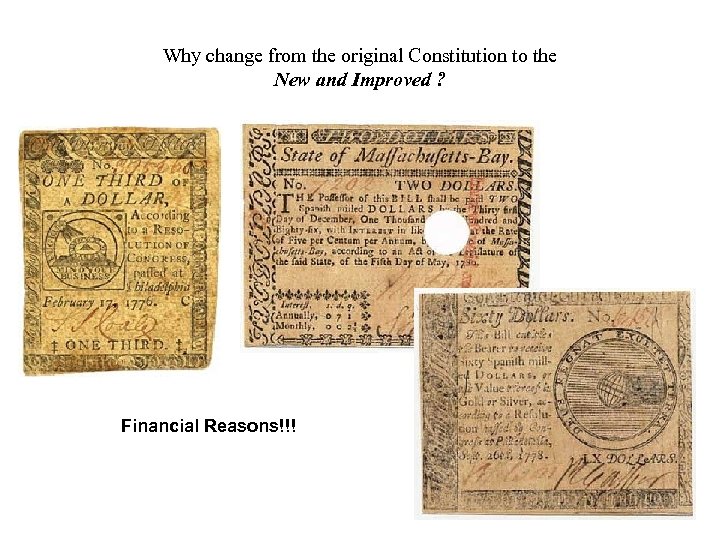
Why change from the original Constitution to the New and Improved ? Financial Reasons!!!
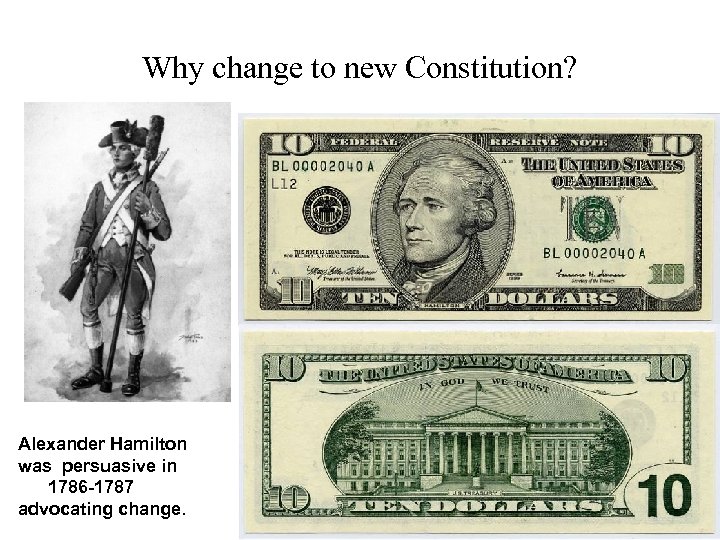
Why change to new Constitution? Alexander Hamilton was persuasive in 1786 -1787 advocating change.
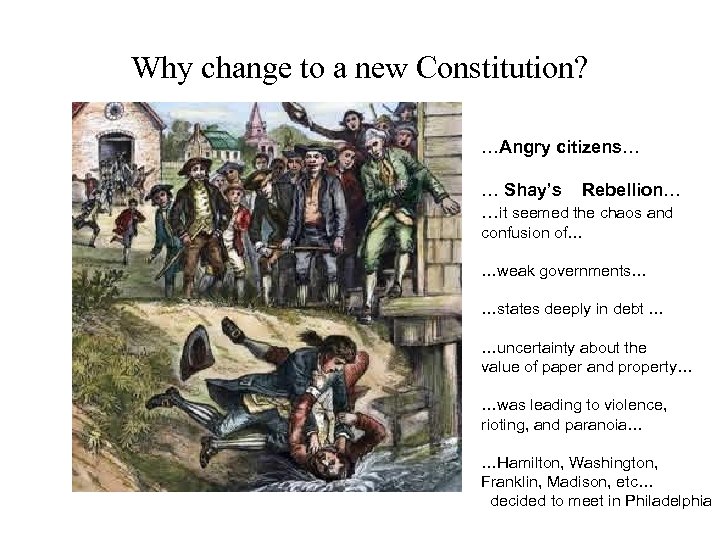
Why change to a new Constitution? …Angry citizens… … Shay’s Rebellion… …it seemed the chaos and confusion of… …weak governments… …states deeply in debt … …uncertainty about the value of paper and property… …was leading to violence, rioting, and paranoia… …Hamilton, Washington, Franklin, Madison, etc… decided to meet in Philadelphia
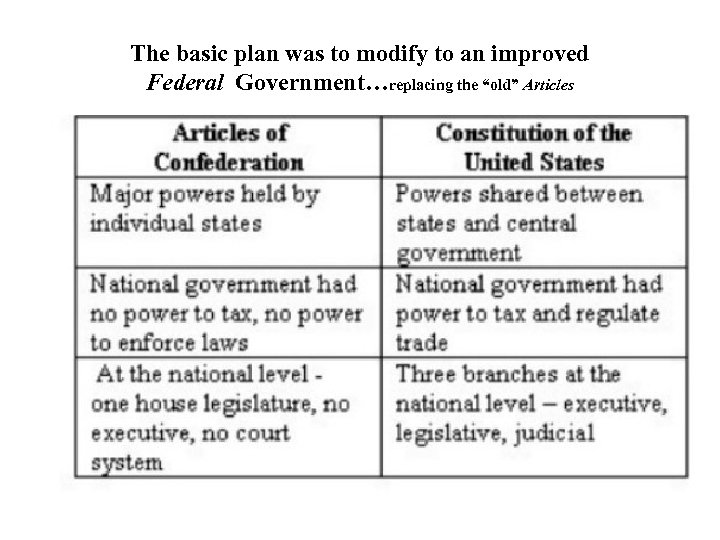
The basic plan was to modify to an improved Federal Government…replacing the “old” Articles
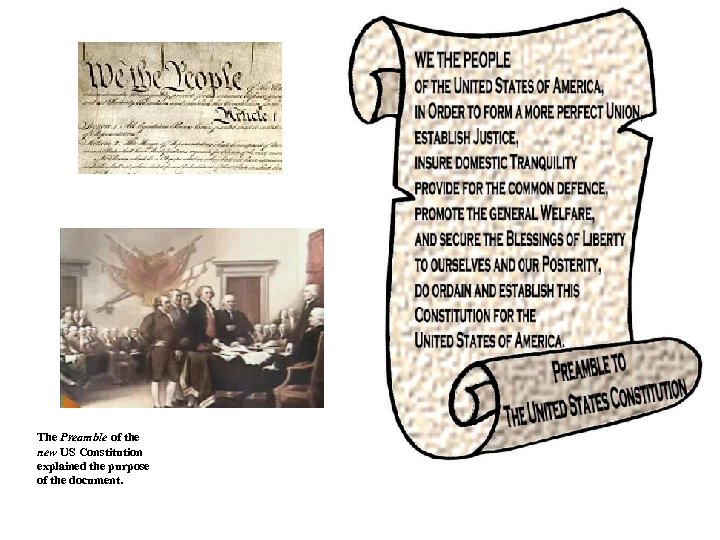
The Preamble of the new US Constitution explained the purpose of the document.
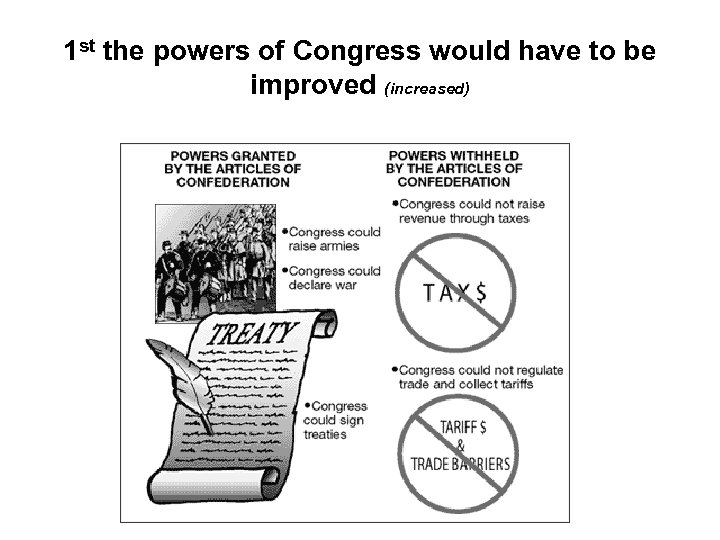
1 st the powers of Congress would have to be improved (increased)
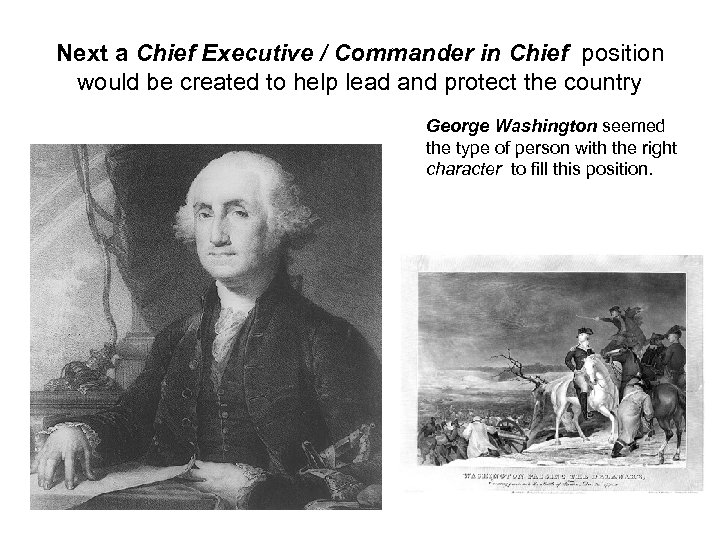
Next a Chief Executive / Commander in Chief position would be created to help lead and protect the country George Washington seemed the type of person with the right character to fill this position.
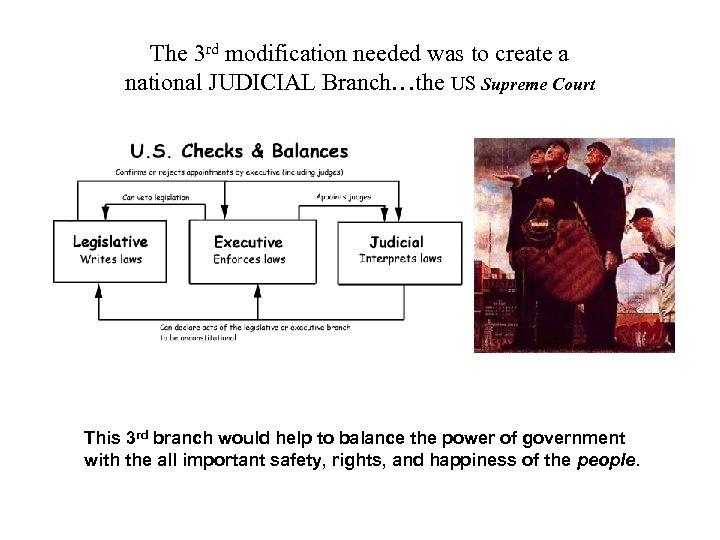
The 3 rd modification needed was to create a national JUDICIAL Branch…the US Supreme Court This 3 rd branch would help to balance the power of government with the all important safety, rights, and happiness of the people.
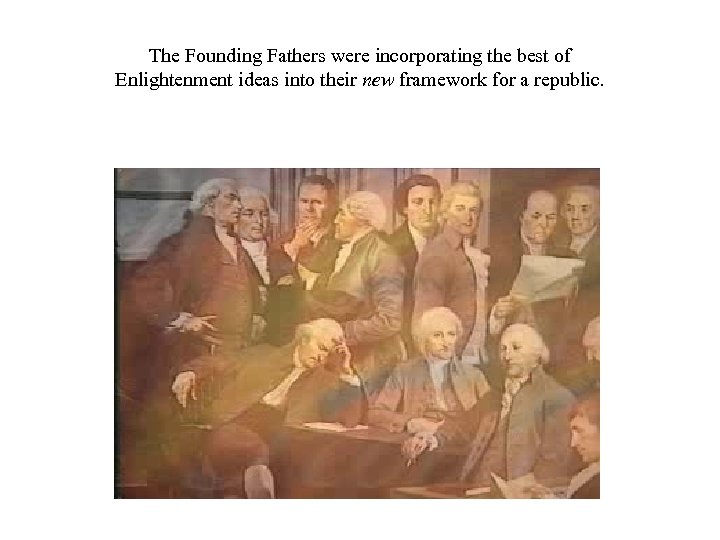
The Founding Fathers were incorporating the best of Enlightenment ideas into their new framework for a republic.
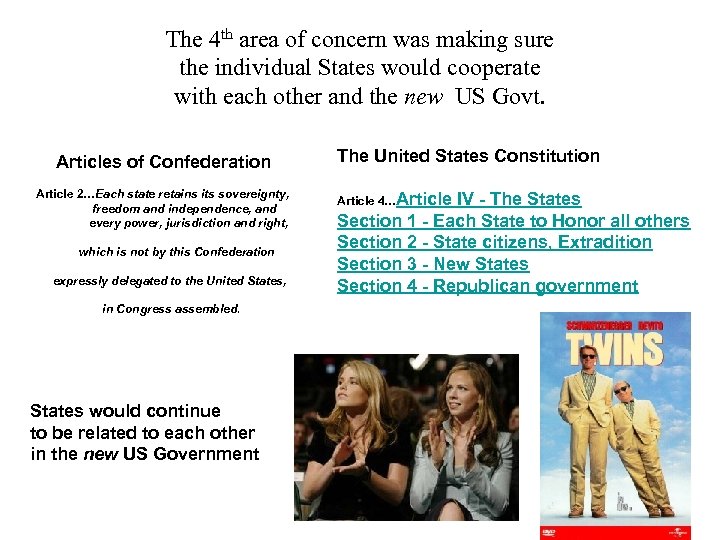
The 4 th area of concern was making sure the individual States would cooperate with each other and the new US Govt. Articles of Confederation The United States Constitution Article 2…Each state retains its sovereignty, freedom and independence, and every power, jurisdiction and right, Article 4…Article IV - The States which is not by this Confederation expressly delegated to the United States, in Congress assembled. States would continue to be related to each other in the new US Government Section 1 - Each State to Honor all others Section 2 - State citizens, Extradition Section 3 - New States Section 4 - Republican government
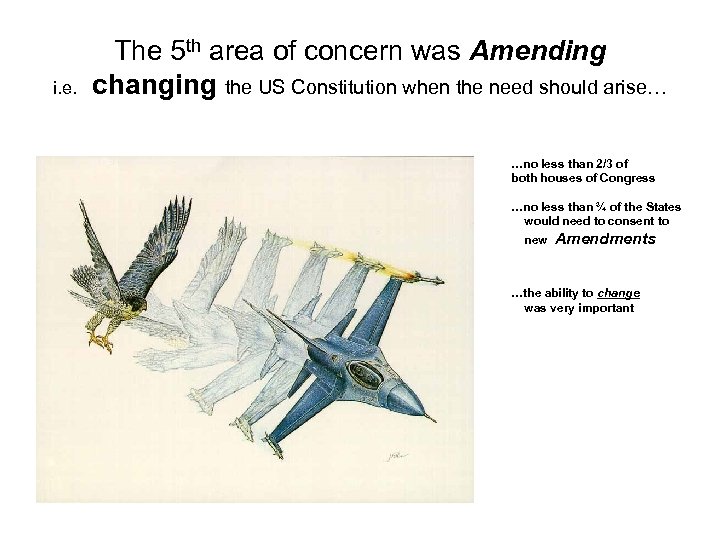
The 5 th area of concern was Amending i. e. changing the US Constitution when the need should arise… …no less than 2/3 of both houses of Congress …no less than ¾ of the States would need to consent to new Amendments …the ability to change was very important
The 6 th Article would declare the US Constitution …the Supreme Law of the Land… The 7 th Article declared 9 of the 13 states were needed to ratify the new Constitution North Carolina and Rhode Island were the last two states to ratify… Rhode Island didn’t even attend the Constitutional Convention in 1787
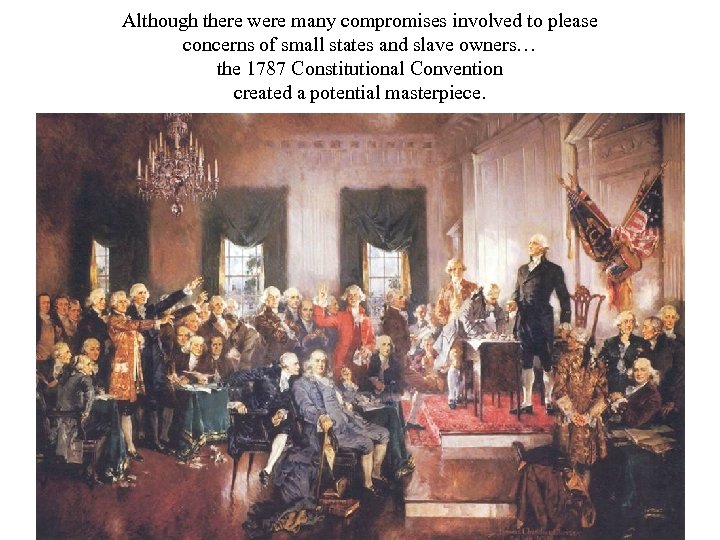
Although there were many compromises involved to please concerns of small states and slave owners… the 1787 Constitutional Convention created a potential masterpiece.
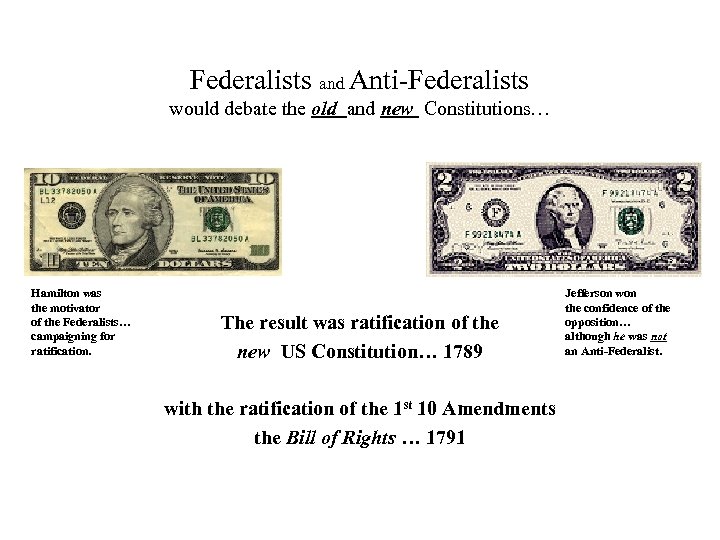
Federalists and Anti-Federalists would debate the old and new Constitutions… Hamilton was the motivator of the Federalists… campaigning for ratification. The result was ratification of the new US Constitution… 1789 with the ratification of the 1 st 10 Amendments the Bill of Rights … 1791 Jefferson won the confidence of the opposition… although he was not an Anti-Federalist.
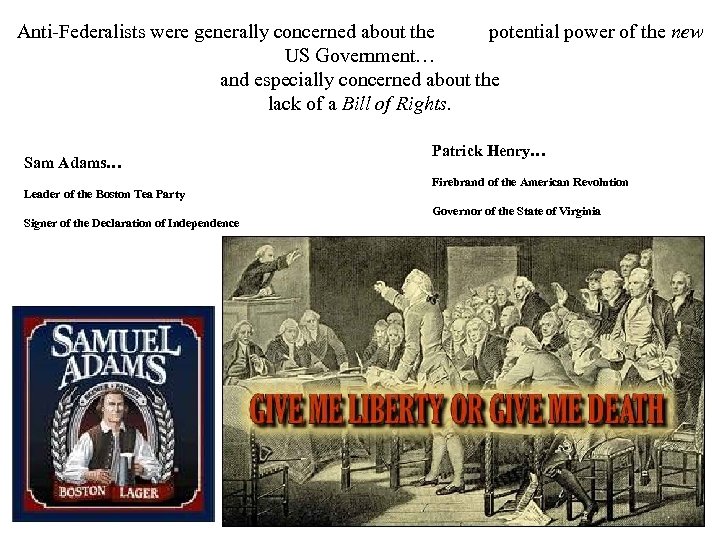
Anti-Federalists were generally concerned about the potential power of the new US Government… and especially concerned about the lack of a Bill of Rights. Sam Adams… Leader of the Boston Tea Party Signer of the Declaration of Independence Patrick Henry… Firebrand of the American Revolution Governor of the State of Virginia
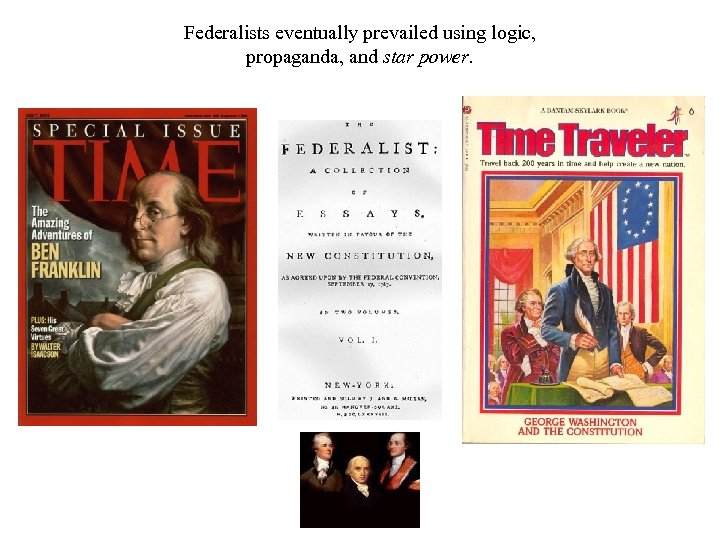
Federalists eventually prevailed using logic, propaganda, and star power.
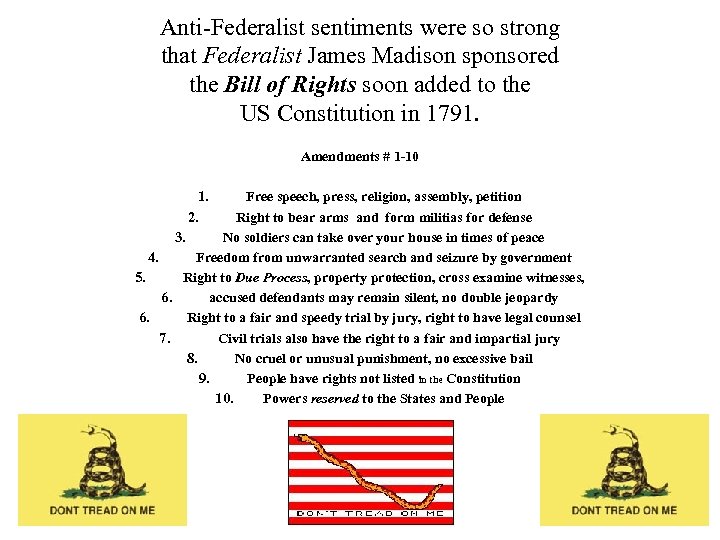
Anti-Federalist sentiments were so strong that Federalist James Madison sponsored the Bill of Rights soon added to the US Constitution in 1791. Amendments # 1 -10 1. 2. Free speech, press, religion, assembly, petition Right to bear arms and form militias for defense 3. No soldiers can take over your house in times of peace 4. Freedom from unwarranted search and seizure by government 5. Right to Due Process, property protection, cross examine witnesses, 6. accused defendants may remain silent, no double jeopardy 6. Right to a fair and speedy trial by jury, right to have legal counsel 7. Civil trials also have the right to a fair and impartial jury 8. No cruel or unusual punishment, no excessive bail 9. People have rights not listed in the Constitution 10. Powers reserved to the States and People
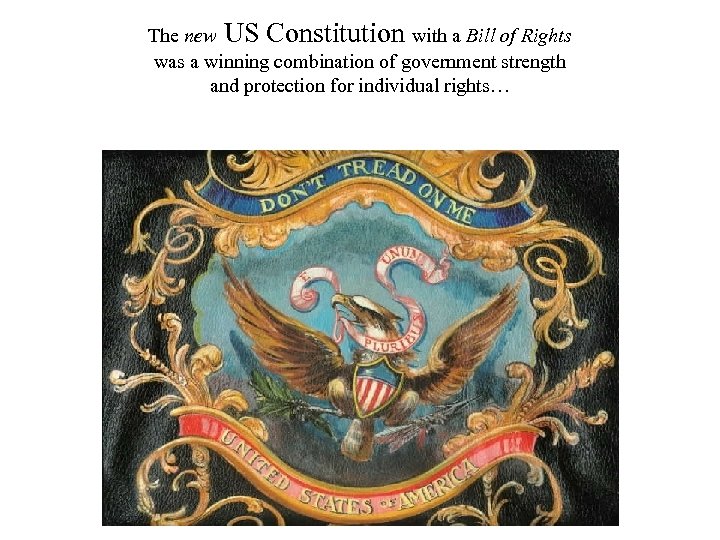
The new US Constitution with a Bill of Rights was a winning combination of government strength and protection for individual rights…
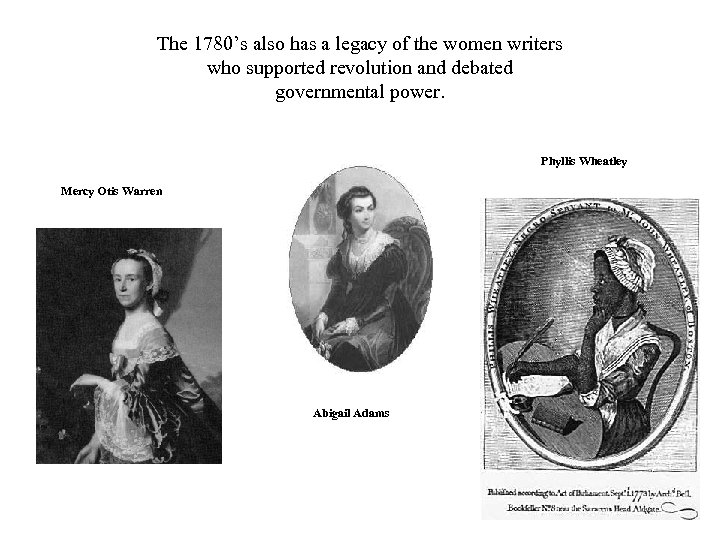
The 1780’s also has a legacy of the women writers who supported revolution and debated governmental power. Phyllis Wheatley Mercy Otis Warren Abigail Adams
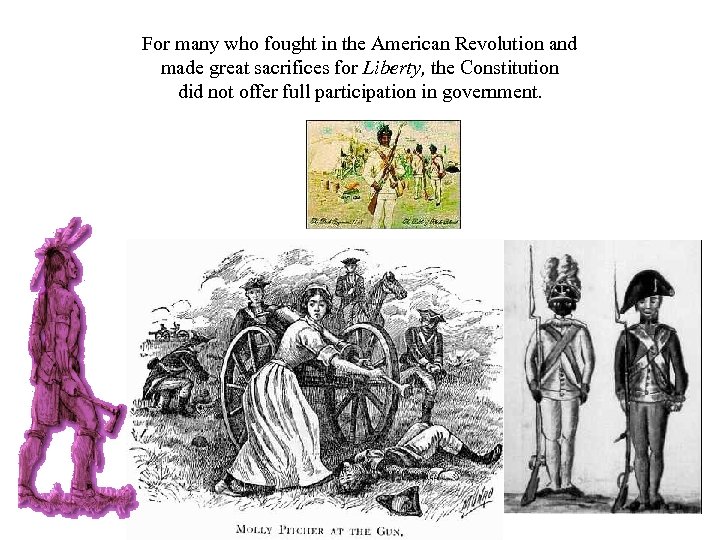
For many who fought in the American Revolution and made great sacrifices for Liberty, the Constitution did not offer full participation in government.
The 1780’s were turbulent years that resulted in the establishment of a stronger Central Government uniting STATES and PEOPLE …E Pluribus Unum… …protecting rights of minorities… …promoting free speech… …encouraging enterprise… …fostering positive change…

The possibilities for change and a better world still are guided by the US Constitution.
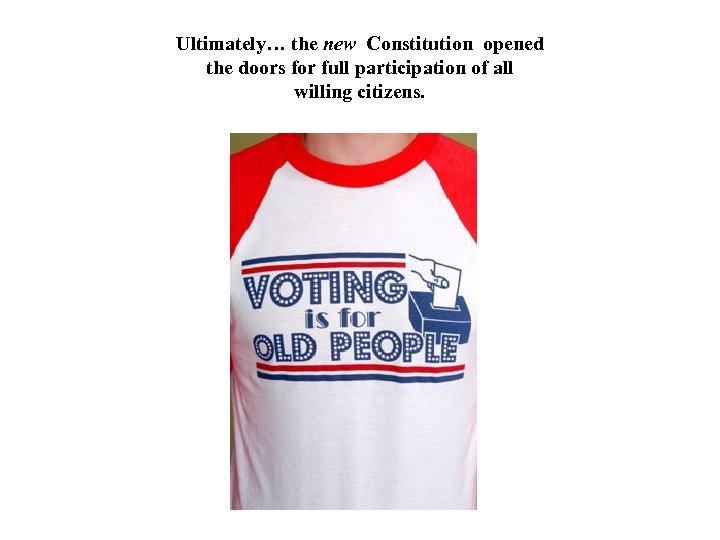
Ultimately… the new Constitution opened the doors for full participation of all willing citizens.
Field Trip
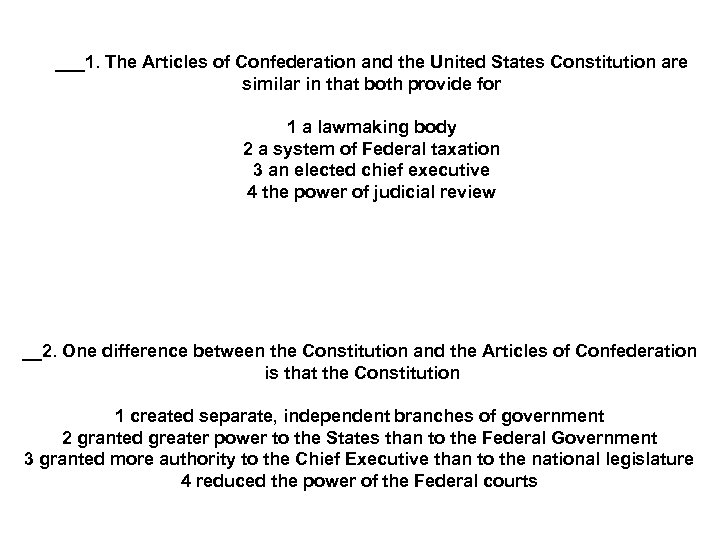
___1. The Articles of Confederation and the United States Constitution are similar in that both provide for 1 a lawmaking body 2 a system of Federal taxation 3 an elected chief executive 4 the power of judicial review __2. One difference between the Constitution and the Articles of Confederation is that the Constitution 1 created separate, independent branches of government 2 granted greater power to the States than to the Federal Government 3 granted more authority to the Chief Executive than to the national legislature 4 reduced the power of the Federal courts
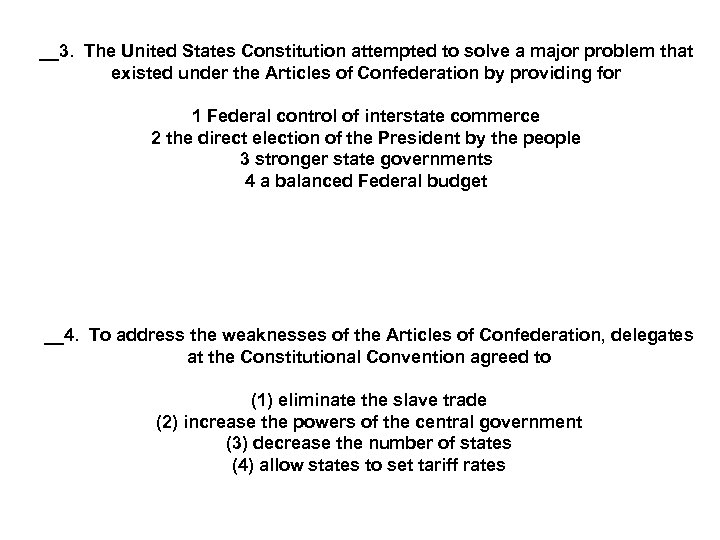
__3. The United States Constitution attempted to solve a major problem that existed under the Articles of Confederation by providing for 1 Federal control of interstate commerce 2 the direct election of the President by the people 3 stronger state governments 4 a balanced Federal budget __4. To address the weaknesses of the Articles of Confederation, delegates at the Constitutional Convention agreed to (1) eliminate the slave trade (2) increase the powers of the central government (3) decrease the number of states (4) allow states to set tariff rates
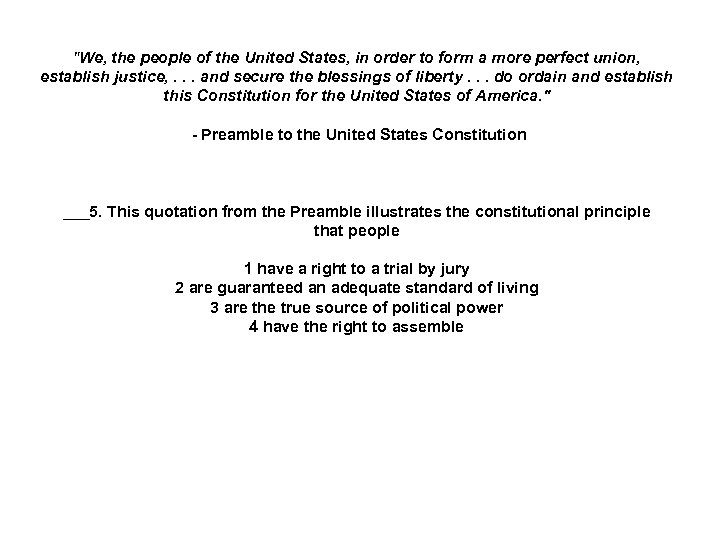
"We, the people of the United States, in order to form a more perfect union, establish justice, . . . and secure the blessings of liberty. . . do ordain and establish this Constitution for the United States of America. " - Preamble to the United States Constitution ___5. This quotation from the Preamble illustrates the constitutional principle that people 1 have a right to a trial by jury 2 are guaranteed an adequate standard of living 3 are the true source of political power 4 have the right to assemble
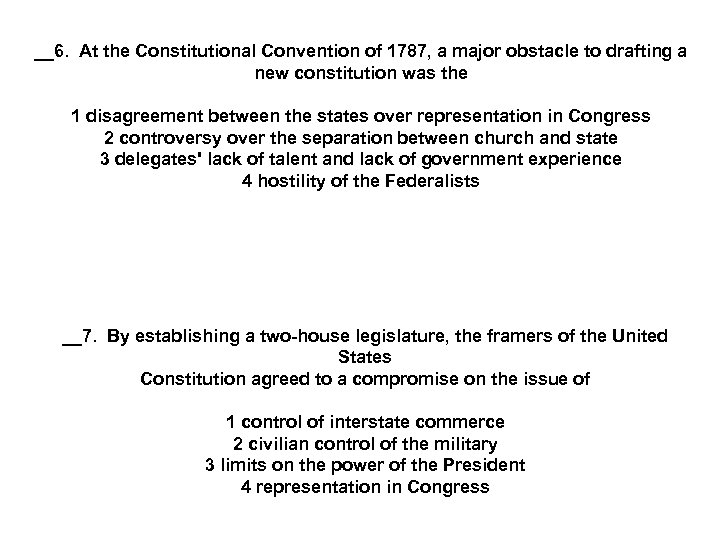
__6. At the Constitutional Convention of 1787, a major obstacle to drafting a new constitution was the 1 disagreement between the states over representation in Congress 2 controversy over the separation between church and state 3 delegates' lack of talent and lack of government experience 4 hostility of the Federalists __7. By establishing a two-house legislature, the framers of the United States Constitution agreed to a compromise on the issue of 1 control of interstate commerce 2 civilian control of the military 3 limits on the power of the President 4 representation in Congress
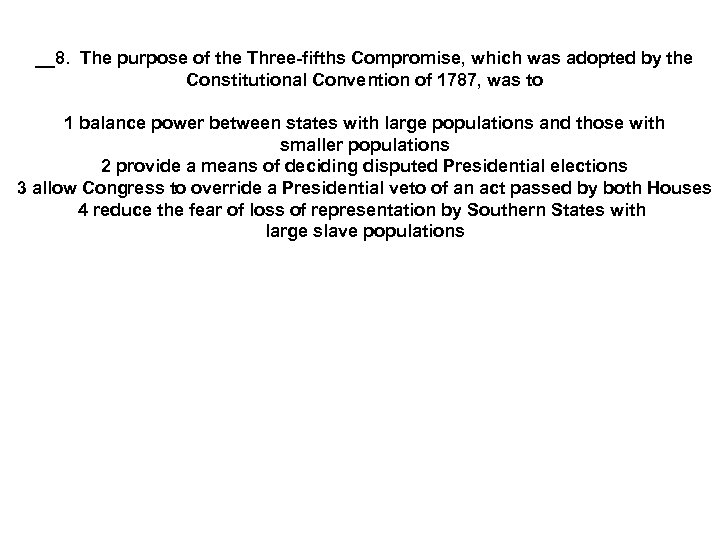
__8. The purpose of the Three-fifths Compromise, which was adopted by the Constitutional Convention of 1787, was to 1 balance power between states with large populations and those with smaller populations 2 provide a means of deciding disputed Presidential elections 3 allow Congress to override a Presidential veto of an act passed by both Houses 4 reduce the fear of loss of representation by Southern States with large slave populations
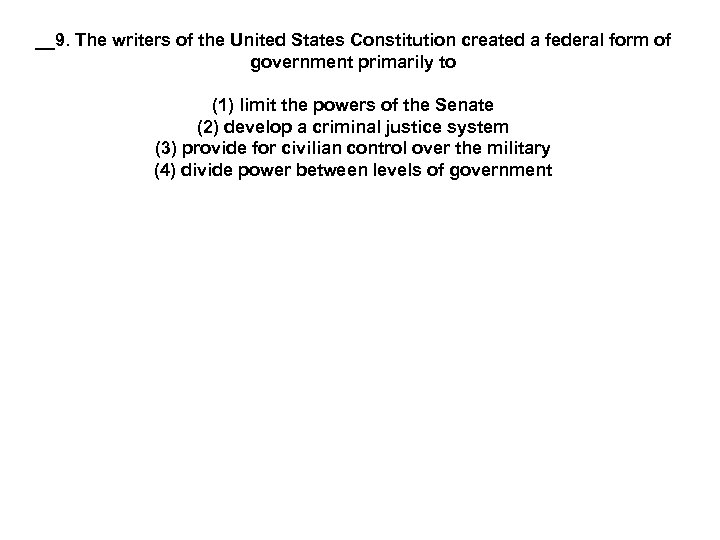
__9. The writers of the United States Constitution created a federal form of government primarily to (1) limit the powers of the Senate (2) develop a criminal justice system (3) provide for civilian control over the military (4) divide power between levels of government
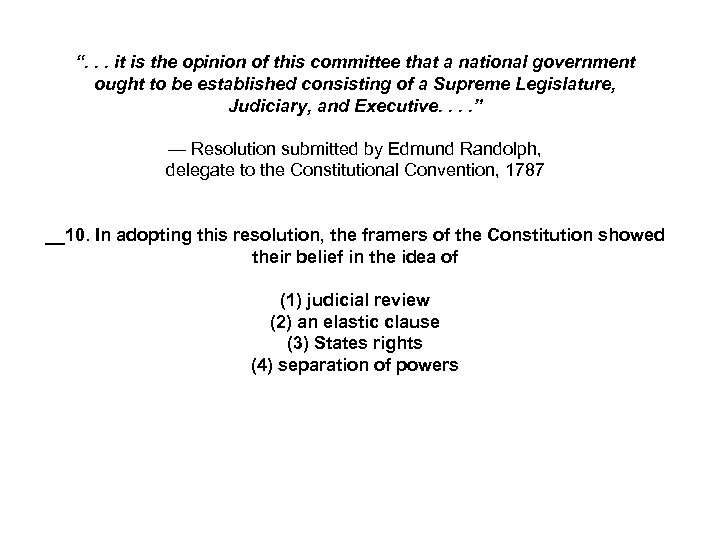
“. . . it is the opinion of this committee that a national government ought to be established consisting of a Supreme Legislature, Judiciary, and Executive. . ” — Resolution submitted by Edmund Randolph, delegate to the Constitutional Convention, 1787 __10. In adopting this resolution, the framers of the Constitution showed their belief in the idea of (1) judicial review (2) an elastic clause (3) States rights (4) separation of powers
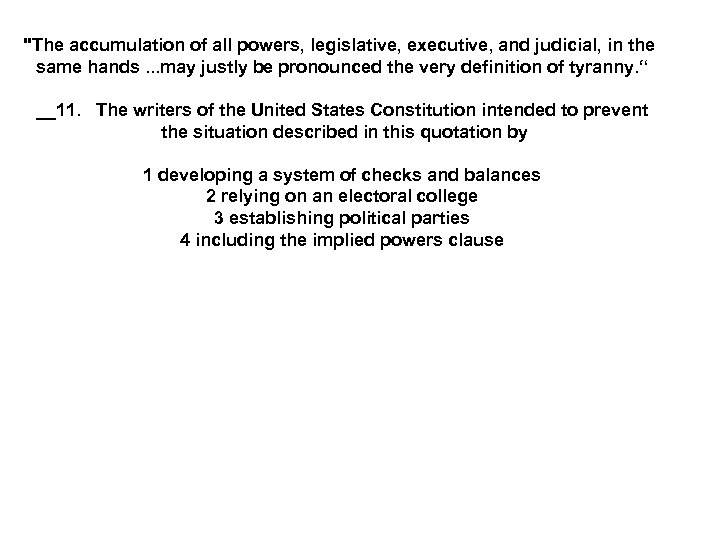
"The accumulation of all powers, legislative, executive, and judicial, in the same hands. . . may justly be pronounced the very definition of tyranny. “ __11. The writers of the United States Constitution intended to prevent the situation described in this quotation by 1 developing a system of checks and balances 2 relying on an electoral college 3 establishing political parties 4 including the implied powers clause
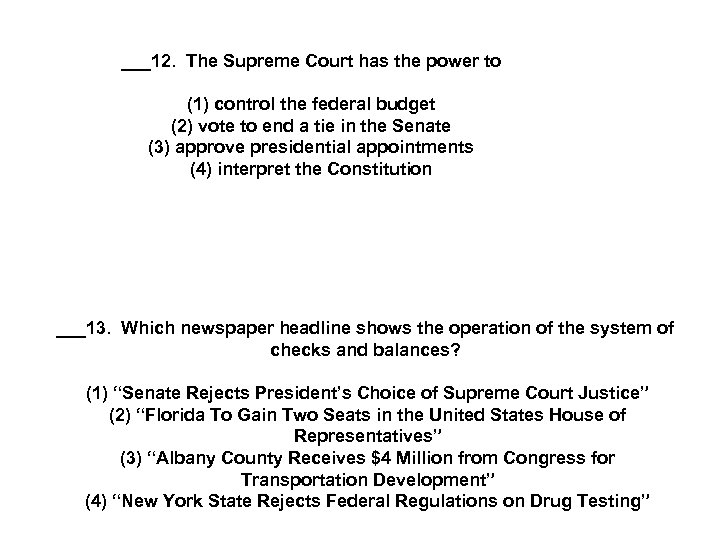
___12. The Supreme Court has the power to (1) control the federal budget (2) vote to end a tie in the Senate (3) approve presidential appointments (4) interpret the Constitution ___13. Which newspaper headline shows the operation of the system of checks and balances? (1) “Senate Rejects President’s Choice of Supreme Court Justice” (2) “Florida To Gain Two Seats in the United States House of Representatives” (3) “Albany County Receives $4 Million from Congress for Transportation Development” (4) “New York State Rejects Federal Regulations on Drug Testing”
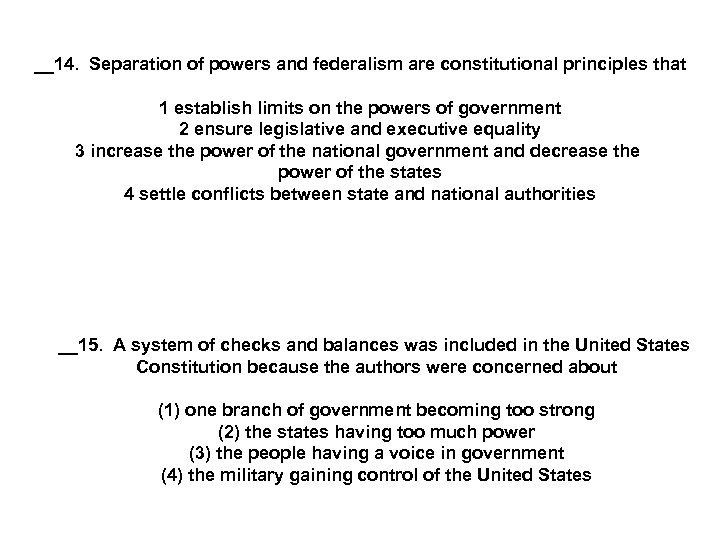
__14. Separation of powers and federalism are constitutional principles that 1 establish limits on the powers of government 2 ensure legislative and executive equality 3 increase the power of the national government and decrease the power of the states 4 settle conflicts between state and national authorities __15. A system of checks and balances was included in the United States Constitution because the authors were concerned about (1) one branch of government becoming too strong (2) the states having too much power (3) the people having a voice in government (4) the military gaining control of the United States
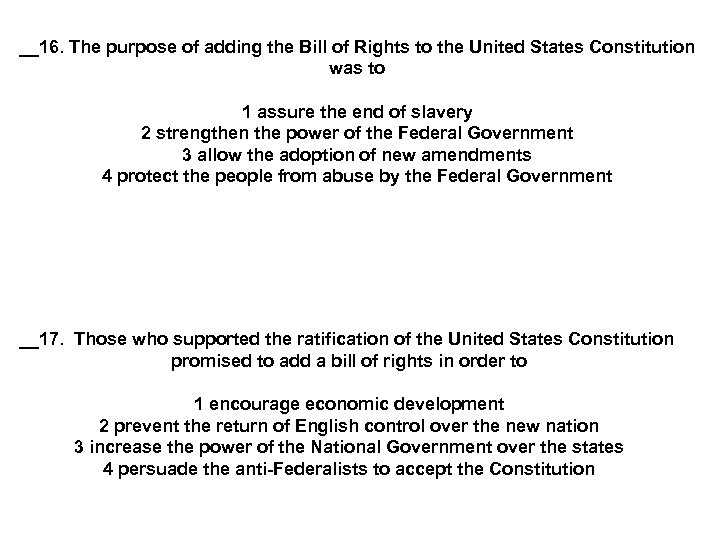
__16. The purpose of adding the Bill of Rights to the United States Constitution was to 1 assure the end of slavery 2 strengthen the power of the Federal Government 3 allow the adoption of new amendments 4 protect the people from abuse by the Federal Government __17. Those who supported the ratification of the United States Constitution promised to add a bill of rights in order to 1 encourage economic development 2 prevent the return of English control over the new nation 3 increase the power of the National Government over the states 4 persuade the anti-Federalists to accept the Constitution
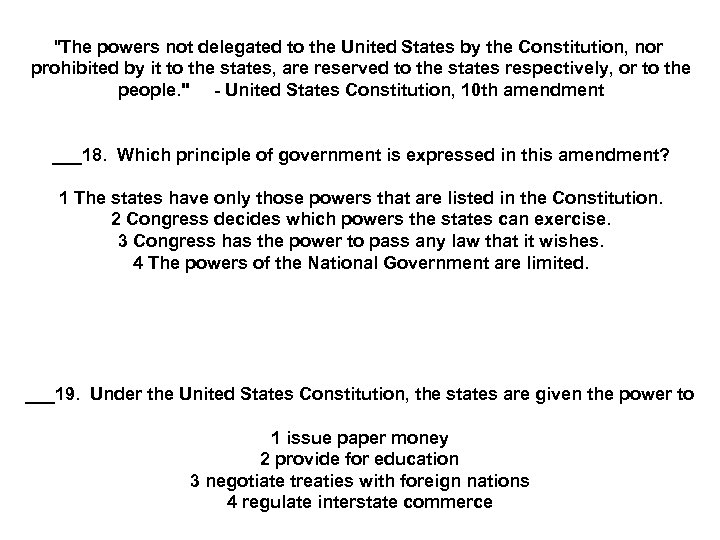
"The powers not delegated to the United States by the Constitution, nor prohibited by it to the states, are reserved to the states respectively, or to the people. " - United States Constitution, 10 th amendment ___18. Which principle of government is expressed in this amendment? 1 The states have only those powers that are listed in the Constitution. 2 Congress decides which powers the states can exercise. 3 Congress has the power to pass any law that it wishes. 4 The powers of the National Government are limited. ___19. Under the United States Constitution, the states are given the power to 1 issue paper money 2 provide for education 3 negotiate treaties with foreign nations 4 regulate interstate commerce
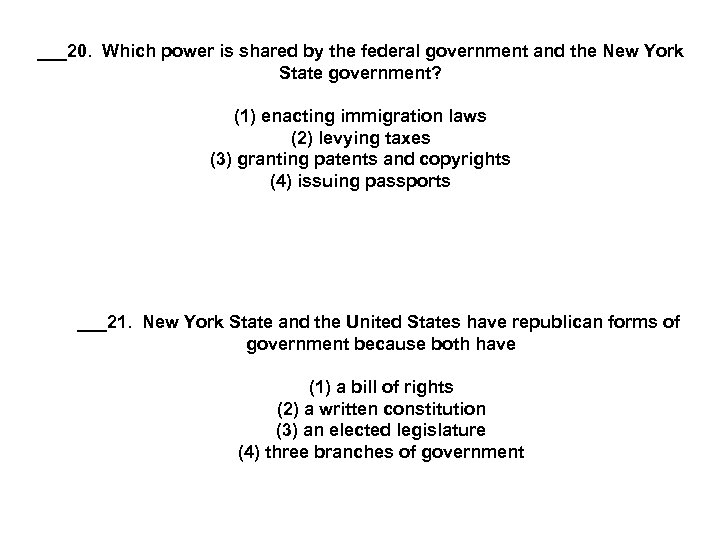
___20. Which power is shared by the federal government and the New York State government? (1) enacting immigration laws (2) levying taxes (3) granting patents and copyrights (4) issuing passports ___21. New York State and the United States have republican forms of government because both have (1) a bill of rights (2) a written constitution (3) an elected legislature (4) three branches of government
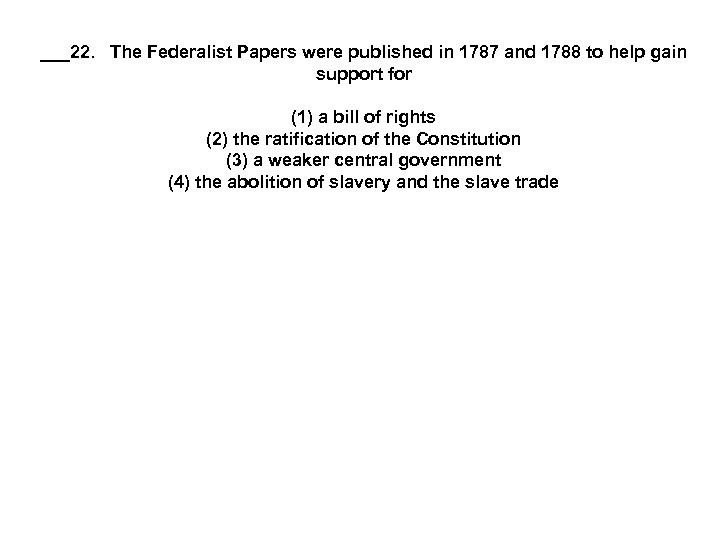
___22. The Federalist Papers were published in 1787 and 1788 to help gain support for (1) a bill of rights (2) the ratification of the Constitution (3) a weaker central government (4) the abolition of slavery and the slave trade
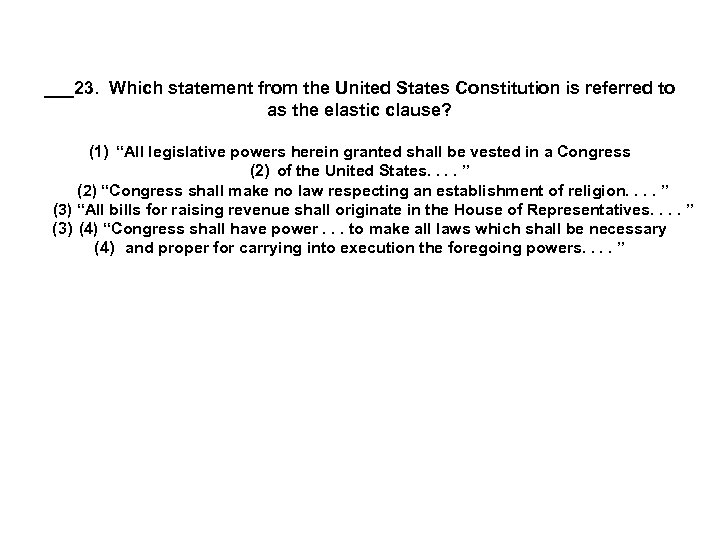
___23. Which statement from the United States Constitution is referred to as the elastic clause? (1) “All legislative powers herein granted shall be vested in a Congress (2) of the United States. . ” (2) “Congress shall make no law respecting an establishment of religion. . ” (3) “All bills for raising revenue shall originate in the House of Representatives. . ” (3) (4) “Congress shall have power. . . to make all laws which shall be necessary (4) and proper for carrying into execution the foregoing powers. . ”
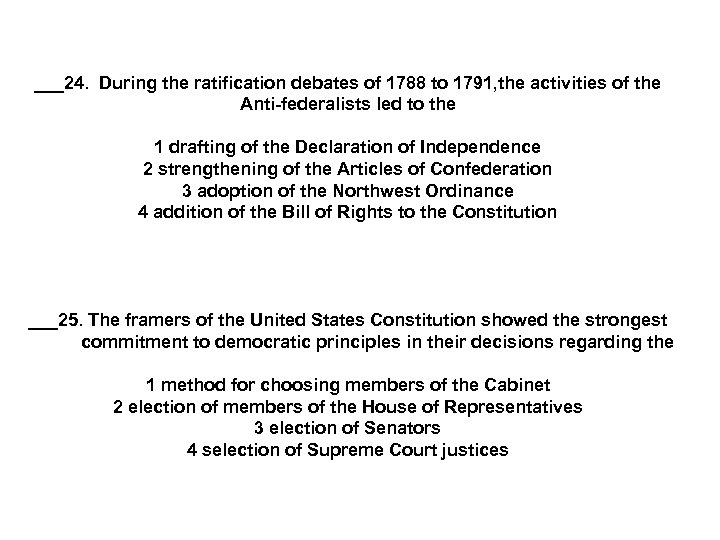
___24. During the ratification debates of 1788 to 1791, the activities of the Anti-federalists led to the 1 drafting of the Declaration of Independence 2 strengthening of the Articles of Confederation 3 adoption of the Northwest Ordinance 4 addition of the Bill of Rights to the Constitution ___25. The framers of the United States Constitution showed the strongest commitment to democratic principles in their decisions regarding the 1 method for choosing members of the Cabinet 2 election of members of the House of Representatives 3 election of Senators 4 selection of Supreme Court justices
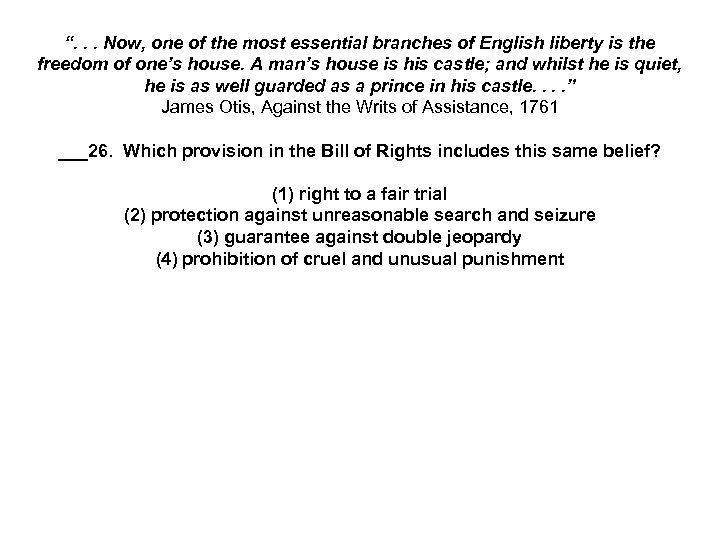
“. . . Now, one of the most essential branches of English liberty is the freedom of one’s house. A man’s house is his castle; and whilst he is quiet, he is as well guarded as a prince in his castle. . ” James Otis, Against the Writs of Assistance, 1761 ___26. Which provision in the Bill of Rights includes this same belief? (1) right to a fair trial (2) protection against unreasonable search and seizure (3) guarantee against double jeopardy (4) prohibition of cruel and unusual punishment
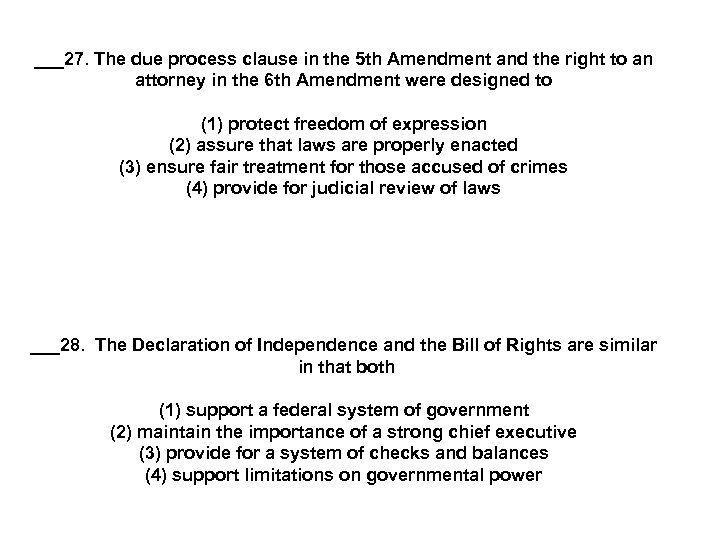
___27. The due process clause in the 5 th Amendment and the right to an attorney in the 6 th Amendment were designed to (1) protect freedom of expression (2) assure that laws are properly enacted (3) ensure fair treatment for those accused of crimes (4) provide for judicial review of laws ___28. The Declaration of Independence and the Bill of Rights are similar in that both (1) support a federal system of government (2) maintain the importance of a strong chief executive (3) provide for a system of checks and balances (4) support limitations on governmental power
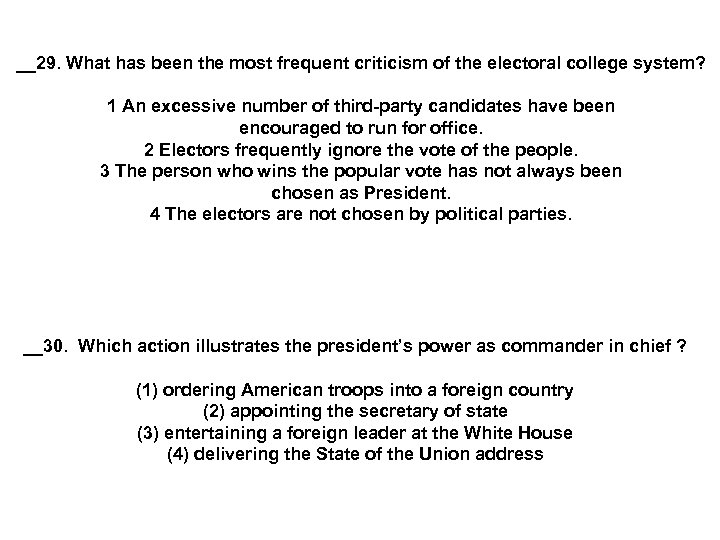
__29. What has been the most frequent criticism of the electoral college system? 1 An excessive number of third-party candidates have been encouraged to run for office. 2 Electors frequently ignore the vote of the people. 3 The person who wins the popular vote has not always been chosen as President. 4 The electors are not chosen by political parties. __30. Which action illustrates the president’s power as commander in chief ? (1) ordering American troops into a foreign country (2) appointing the secretary of state (3) entertaining a foreign leader at the White House (4) delivering the State of the Union address
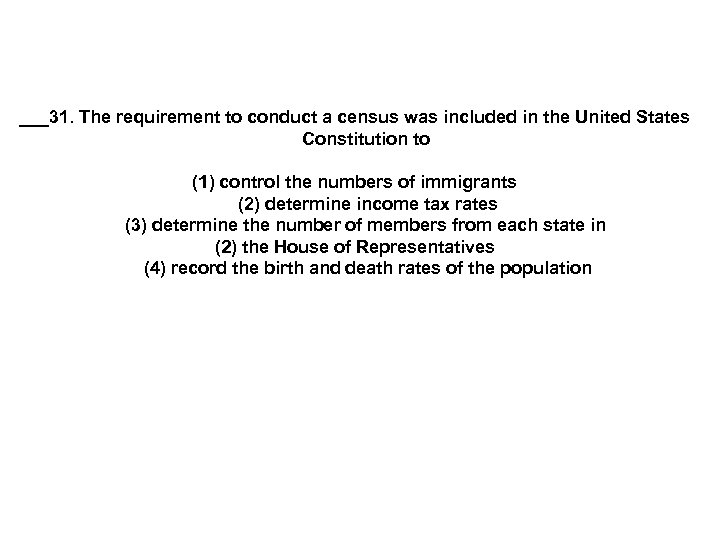
___31. The requirement to conduct a census was included in the United States Constitution to (1) control the numbers of immigrants (2) determine income tax rates (3) determine the number of members from each state in (2) the House of Representatives (4) record the birth and death rates of the population
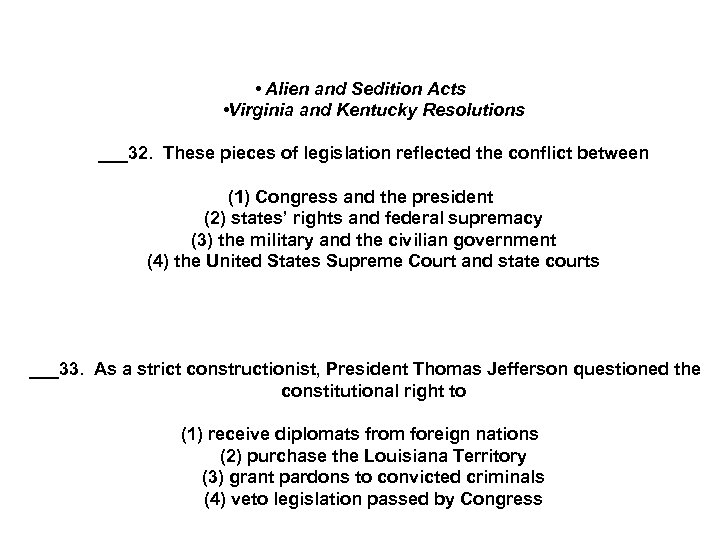
• Alien and Sedition Acts • Virginia and Kentucky Resolutions ___32. These pieces of legislation reflected the conflict between (1) Congress and the president (2) states’ rights and federal supremacy (3) the military and the civilian government (4) the United States Supreme Court and state courts ___33. As a strict constructionist, President Thomas Jefferson questioned the constitutional right to (1) receive diplomats from foreign nations (2) purchase the Louisiana Territory (3) grant pardons to convicted criminals (4) veto legislation passed by Congress
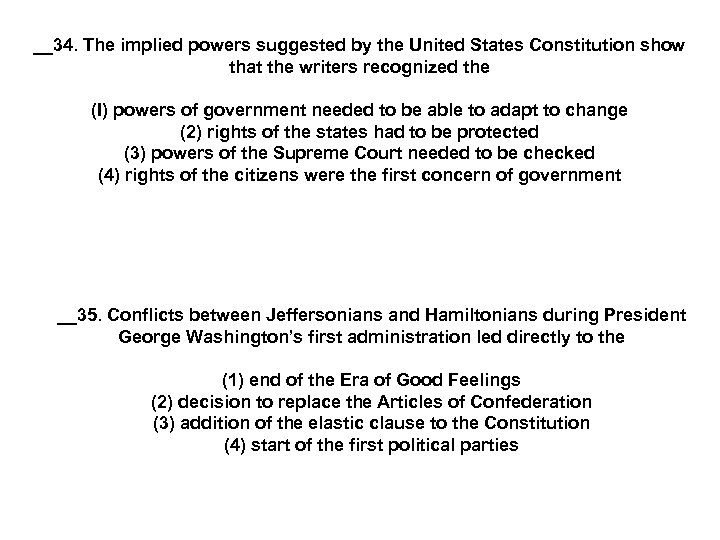
__34. The implied powers suggested by the United States Constitution show that the writers recognized the (I) powers of government needed to be able to adapt to change (2) rights of the states had to be protected (3) powers of the Supreme Court needed to be checked (4) rights of the citizens were the first concern of government __35. Conflicts between Jeffersonians and Hamiltonians during President George Washington’s first administration led directly to the (1) end of the Era of Good Feelings (2) decision to replace the Articles of Confederation (3) addition of the elastic clause to the Constitution (4) start of the first political parties
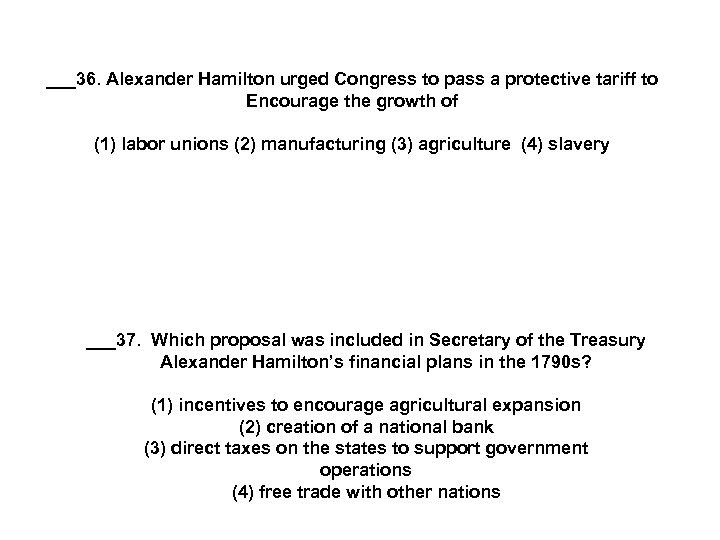
___36. Alexander Hamilton urged Congress to pass a protective tariff to Encourage the growth of (1) labor unions (2) manufacturing (3) agriculture (4) slavery ___37. Which proposal was included in Secretary of the Treasury Alexander Hamilton’s financial plans in the 1790 s? (1) incentives to encourage agricultural expansion (2) creation of a national bank (3) direct taxes on the states to support government operations (4) free trade with other nations
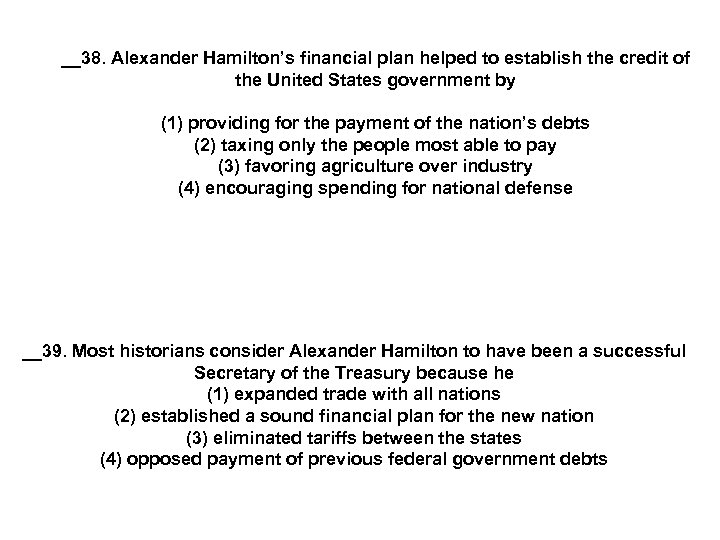
__38. Alexander Hamilton’s financial plan helped to establish the credit of the United States government by (1) providing for the payment of the nation’s debts (2) taxing only the people most able to pay (3) favoring agriculture over industry (4) encouraging spending for national defense __39. Most historians consider Alexander Hamilton to have been a successful Secretary of the Treasury because he (1) expanded trade with all nations (2) established a sound financial plan for the new nation (3) eliminated tariffs between the states (4) opposed payment of previous federal government debts
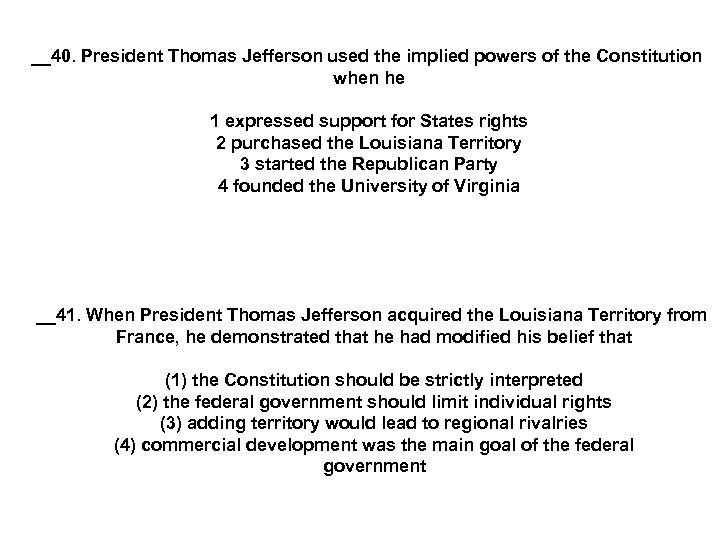
__40. President Thomas Jefferson used the implied powers of the Constitution when he 1 expressed support for States rights 2 purchased the Louisiana Territory 3 started the Republican Party 4 founded the University of Virginia __41. When President Thomas Jefferson acquired the Louisiana Territory from France, he demonstrated that he had modified his belief that (1) the Constitution should be strictly interpreted (2) the federal government should limit individual rights (3) adding territory would lead to regional rivalries (4) commercial development was the main goal of the federal government
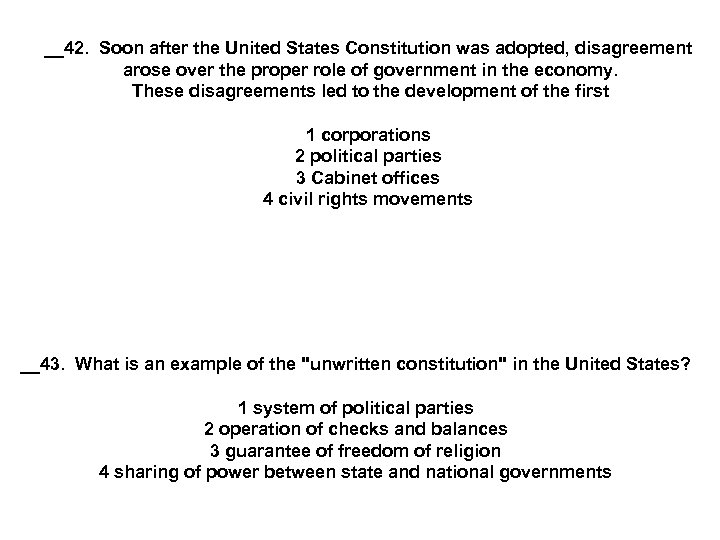
__42. Soon after the United States Constitution was adopted, disagreement arose over the proper role of government in the economy. These disagreements led to the development of the first 1 corporations 2 political parties 3 Cabinet offices 4 civil rights movements __43. What is an example of the "unwritten constitution" in the United States? 1 system of political parties 2 operation of checks and balances 3 guarantee of freedom of religion 4 sharing of power between state and national governments
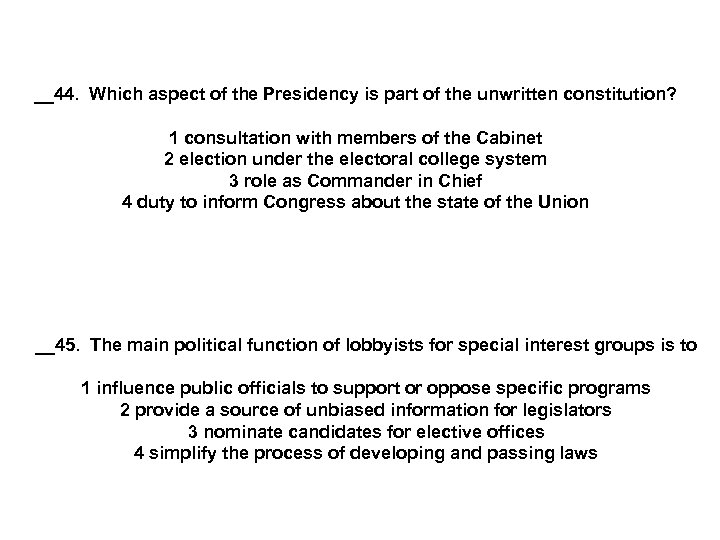
__44. Which aspect of the Presidency is part of the unwritten constitution? 1 consultation with members of the Cabinet 2 election under the electoral college system 3 role as Commander in Chief 4 duty to inform Congress about the state of the Union __45. The main political function of lobbyists for special interest groups is to 1 influence public officials to support or oppose specific programs 2 provide a source of unbiased information for legislators 3 nominate candidates for elective offices 4 simplify the process of developing and passing laws
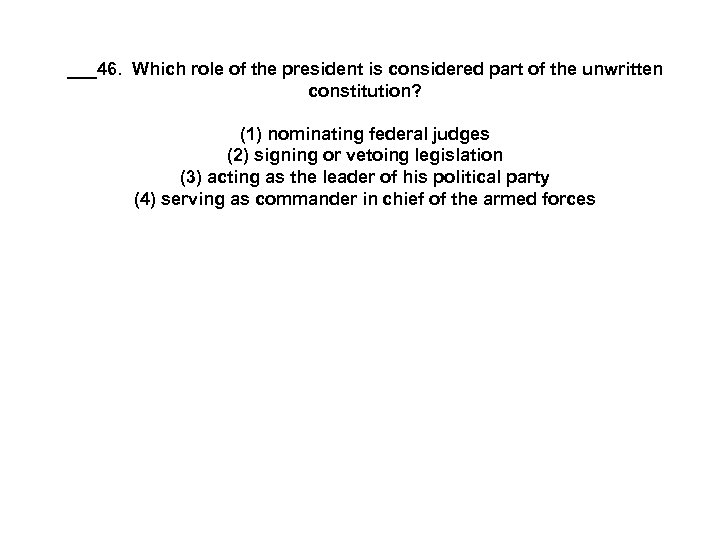
___46. Which role of the president is considered part of the unwritten constitution? (1) nominating federal judges (2) signing or vetoing legislation (3) acting as the leader of his political party (4) serving as commander in chief of the armed forces
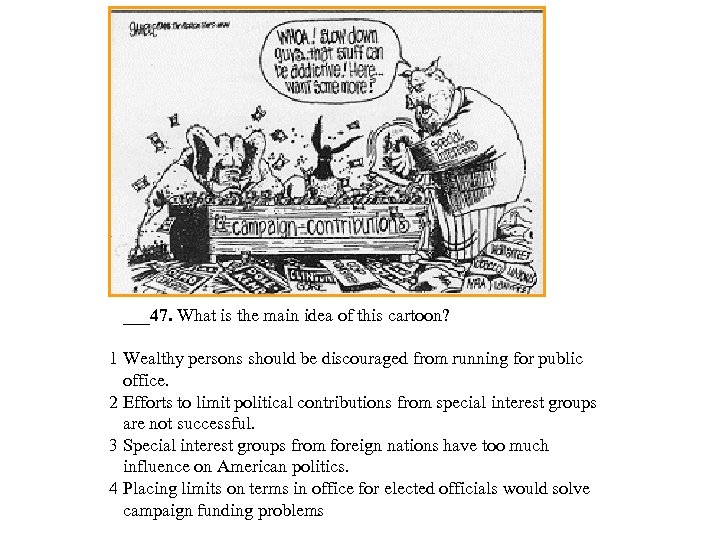
___47. What is the main idea of this cartoon? 1 Wealthy persons should be discouraged from running for public office. 2 Efforts to limit political contributions from special interest groups are not successful. 3 Special interest groups from foreign nations have too much influence on American politics. 4 Placing limits on terms in office for elected officials would solve campaign funding problems
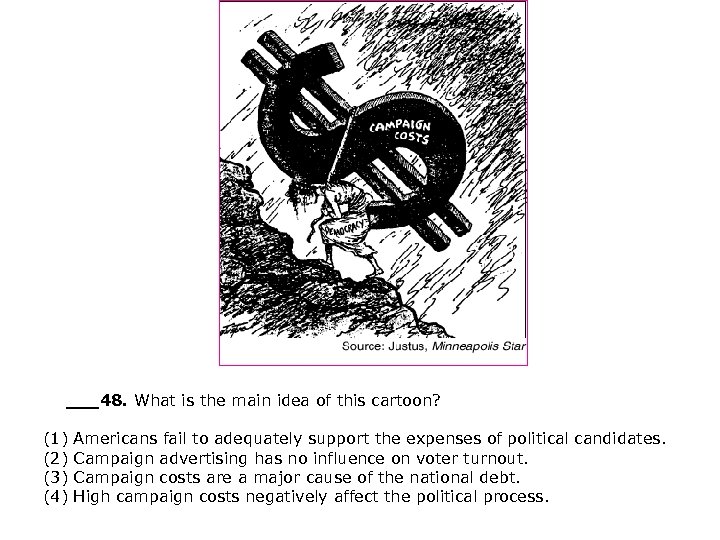
___48. What is the main idea of this cartoon? (1) (2) (3) (4) Americans fail to adequately support the expenses of political candidates. Campaign advertising has no influence on voter turnout. Campaign costs are a major cause of the national debt. High campaign costs negatively affect the political process.
__49. The amendment process was included in the United States Constitution in order to (1) remove government officials from political office (2) check the power of the Supreme Court (3) allow government to meet the changing needs of society (4) preserve the federal system of government __50. Which action would be necessary to place a legal limit on the number of terms served by members of Congress? 1 an amendment to the Federal Constitution 2 a United States Supreme Court ruling 3 an agreement between political parties 4 a Presidential order
__51. The change to the direct election of senators, the lowering of the voting age to eighteen, and the establishment of a two-term limit for presidents are all examples of the use of (1) judicial review (2) checks and balances (3) executive privilege (4) the amendment process ___52. One reason the United States Constitution is considered a flexible document is that it (1) can be rewritten every ten years (2) allows for the creation of a multiparty political system (3) gives the states the power to change federal laws (4) includes the elastic clause
"The Constitution is as the Supreme Court interprets it. " - President Dwight D. Eisenhower ___53. Which constitutional principle does this quotation best describe? 1 judicial review 3 federalism 2 reserved powers 4 concurrent powers __54. The Supreme Court has ruled that burning the United States flag is a form of protest protected by the first amendment. Which action would be necessary to overturn this ruling? 1 issue of an Executive order by the President 2 passage of a law by Congress 3 ratification of an amendment to the Constitution 4 adoption of a formal resolution by each state's legislature
Скачать презентацию Created by Mr Steve Hauprich for acceleration and
fbad02cdb98fc5e20af24f9a36330449.ppt