


 Скачать презентацию Create the Product Chapter Eight 2012 Pearson
1882738dc0544f02ad296ce6161fab59.ppt
- Количество слайдов: 28
 Create the Product Chapter Eight © 2012 Pearson Education, Inc. publishing as Prentice-Hall.
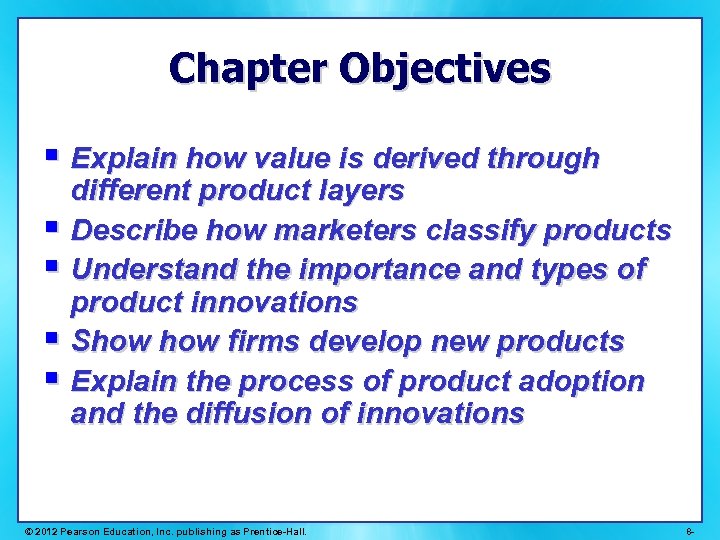 Chapter Objectives § Explain how value is derived through different product layers § Describe how marketers classify products § Understand the importance and types of product innovations § Show firms develop new products § Explain the process of product adoption and the diffusion of innovations © 2012 Pearson Education, Inc. publishing as Prentice-Hall. 8 -
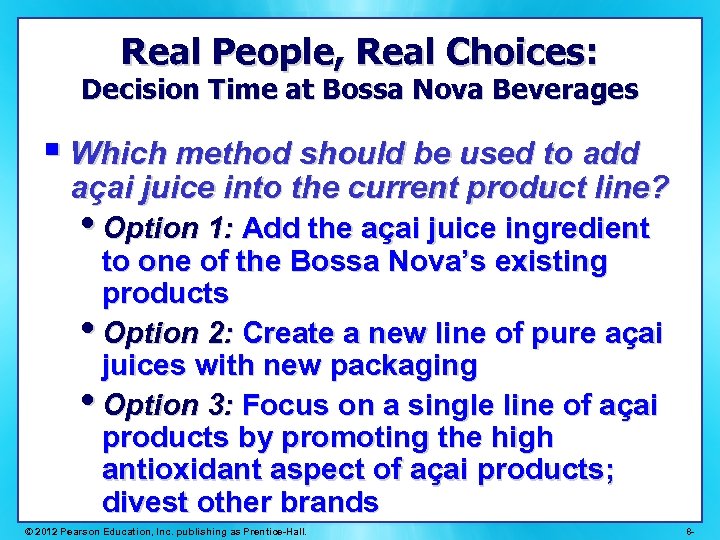 Real People, Real Choices: Decision Time at Bossa Nova Beverages § Which method should be used to add açai juice into the current product line? • Option 1: Add the açai juice ingredient to one of the Bossa Nova’s existing products • Option 2: Create a new line of pure açai juices with new packaging • Option 3: Focus on a single line of açai products by promoting the high antioxidant aspect of açai products; divest other brands © 2012 Pearson Education, Inc. publishing as Prentice-Hall. 8 -
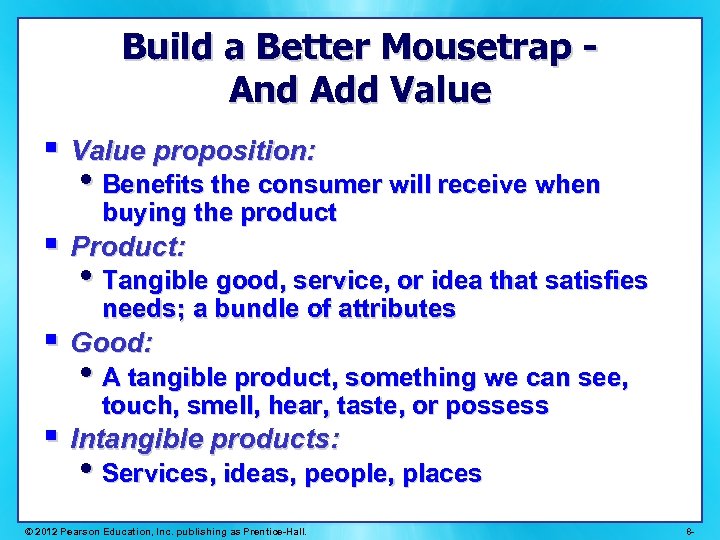 Build a Better Mousetrap And Add Value § Value proposition: • Benefits the consumer will receive when buying the product § Product: • Tangible good, service, or idea that satisfies needs; a bundle of attributes § Good: • A tangible product, something we can see, touch, smell, hear, taste, or possess § Intangible products: • Services, ideas, people, places © 2012 Pearson Education, Inc. publishing as Prentice-Hall. 8 -
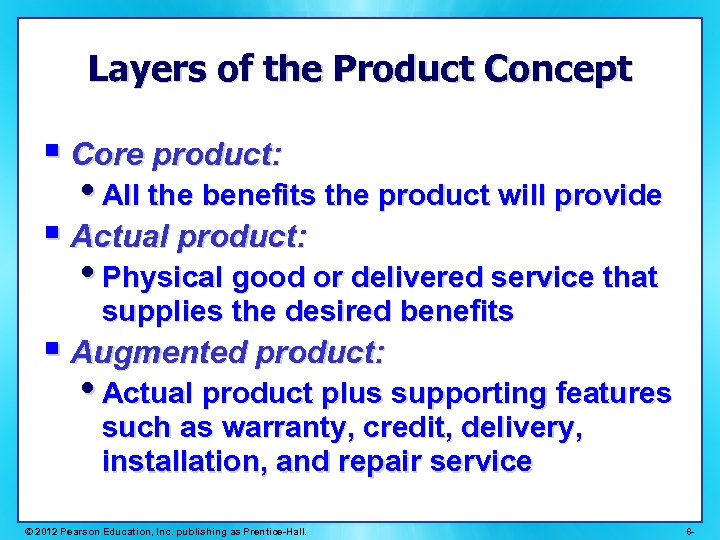 Layers of the Product Concept § Core product: • All the benefits the product will provide § Actual product: • Physical good or delivered service that supplies the desired benefits § Augmented product: • Actual product plus supporting features such as warranty, credit, delivery, installation, and repair service © 2012 Pearson Education, Inc. publishing as Prentice-Hall. 8 -
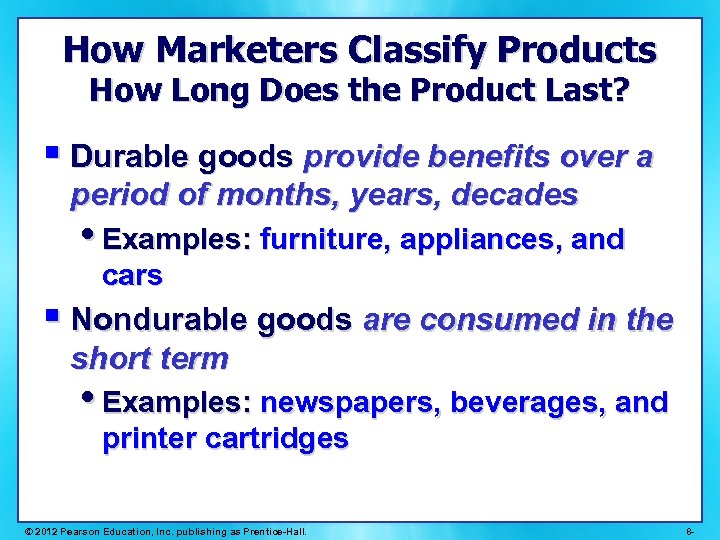 How Marketers Classify Products How Long Does the Product Last? § Durable goods provide benefits over a period of months, years, decades • Examples: furniture, appliances, and cars § Nondurable goods are consumed in the short term • Examples: newspapers, beverages, and printer cartridges © 2012 Pearson Education, Inc. publishing as Prentice-Hall. 8 -
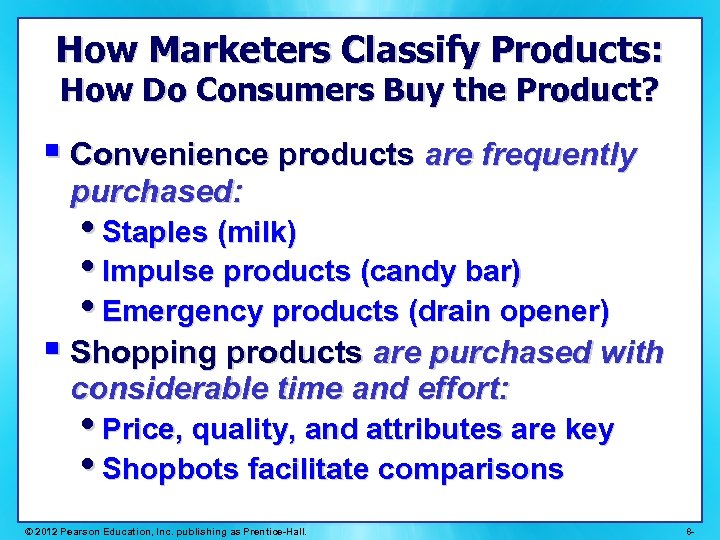 How Marketers Classify Products: How Do Consumers Buy the Product? § Convenience products are frequently purchased: • Staples (milk) • Impulse products (candy bar) • Emergency products (drain opener) § Shopping products are purchased with considerable time and effort: • Price, quality, and attributes are key • Shopbots facilitate comparisons © 2012 Pearson Education, Inc. publishing as Prentice-Hall. 8 -
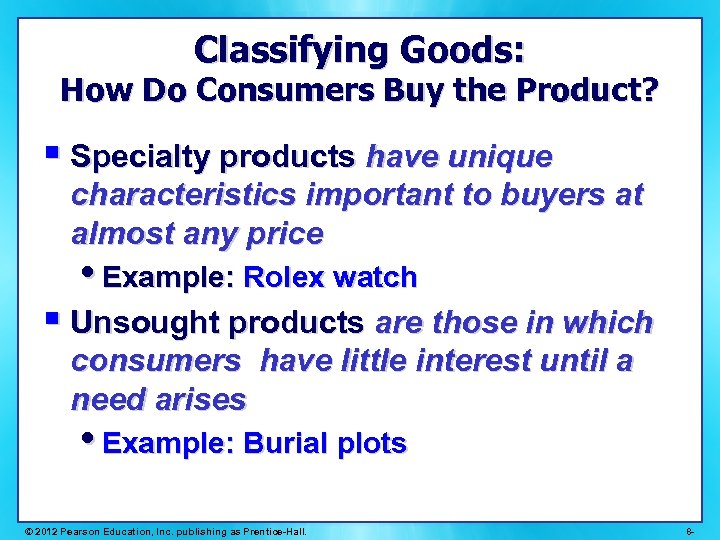 Classifying Goods: How Do Consumers Buy the Product? § Specialty products have unique characteristics important to buyers at almost any price • Example: Rolex watch § Unsought products are those in which consumers have little interest until a need arises • Example: Burial plots © 2012 Pearson Education, Inc. publishing as Prentice-Hall. 8 -
 Business-to-Business Products § B 2 B products are classified by how organizational customers use them: • Equipment is used in daily operations • Maintenance, repair, and operating (MRO) goods are consumed relatively quickly • Raw materials are products of fishing, lumber, agricultural, and mining industries that are used in the manufacture of finished goods © 2012 Pearson Education, Inc. publishing as Prentice-Hall. 8 -
 Business-to-Business Products § B 2 B products are classified by how organizational customers use them: • Processed materials are created when raw materials are transformed from their original state • Specialized services are purchased from outside suppliers; equipment or non-equipment based • Component parts are manufactured goods or subassemblies of finished goods © 2012 Pearson Education, Inc. publishing as Prentice-Hall. 8 -
 “New and Improved” The Process of Innovation § Innovation: A product that customers perceive to be new and different from existing products § The Federal Trade Commission says: • A product must be entirely new or changed significantly to be called “new”, and • A product may be called “new” for only six months © 2012 Pearson Education, Inc. publishing as Prentice-Hall. 8 -
 Types of Innovations § Innovations: • differ in their degree of newness • can be classified along a continuum in terms of the amount of disruption/ change they bring to people’s lives § Types of innovation: • Continuous innovations • Dynamically continuous innovations • Discontinuous innovations © 2012 Pearson Education, Inc. publishing as Prentice-Hall. 8 -
 Continuous Innovations § Continuous innovations: A modification to an existing product • Sets a brand apart from the competition • Consumers don’t need to learn anything new; change is minimal v. Examples: brand extensions, line extensions • Knockoffs copy (with slight changes) the design of an original product © 2012 Pearson Education, Inc. publishing as Prentice-Hall. 8 -
 Dynamically Continuous Innovation § Dynamically continuous innovation: A pronounced modification to an existing product • Requires a modest amount of learning or behavior change • Convergence: The coming together of two or more technologies to create a new system with greater benefit than its parts © 2012 Pearson Education, Inc. publishing as Prentice-Hall. 8 -
 Discontinuous Innovations § Discontinuous innovation: A totally new product • Creates major changes in the way we live • Consumers must engage in a great deal of new learning v. Examples: microwave ovens when first introduced as an alternative to traditional ovens © 2012 Pearson Education, Inc. publishing as Prentice-Hall. 8 -
 How Do We Measure Innovation? § Measuring innovation is complicated. § Innovation should be measured with respect to: • Firm strategy • Firm culture • Outcomes of innovation © 2012 Pearson Education, Inc. publishing as Prentice-Hall. 8 -
 Developing New Products § New-product development (NPD) The phases by which firms develop new products including idea generation, product concept development and screening, marketing strategy development, business analysis, technical development, test marketing, and commercialization © 2012 Pearson Education, Inc. publishing as Prentice-Hall. 8 -
 New-Product Development § Phase 1: Idea generation • Brainstorming product ideas that provide customer benefits and which are compatible with the firm’s mission § Phase 2: Product-concept development and screening • Product ideas are tested for technical and commercial success § Phase 3: Marketing strategy development • Developing a strategy to introduce the product to the marketplace © 2012 Pearson Education, Inc. publishing as Prentice-Hall. 8 -
 New-Product Development § Phase 4: Business analysis • The product’s commercial viability is assessed § Phase 5: Technical development • Firm engineers refine and perfect the new product • Prototypes or test versions of the proposed product are developed (in R&D department) • The firm may need to apply for a patent © 2012 Pearson Education, Inc. publishing as Prentice-Hall. 8 -
 New-Product Development § Phase 6: Test marketing: • The complete marketing plan is tested in a small geographic area similar to the larger market § Phase 7: Commercialization: • The new product is launched into the market • Begin full-scale production, distribution, advertising, and sales promotion © 2012 Pearson Education, Inc. publishing as Prentice-Hall. 8 -
 Adoption and Diffusion of New Products § Product adoption: • Process by which a consumer or business customer begins to buy and use a new good, service, or idea § Diffusion: • Process by which the use of a product spreads throughout a population v. The point where a product’s sales spike from a slow climb to a new level is called the tipping point © 2012 Pearson Education, Inc. publishing as Prentice-Hall. 8 -
 Stages in Consumers’ Adoption of a New Product § Awareness: • Massive advertising is used § Interest: • Prospective adopters see how the new product might satisfy a need • Teaser advertising may be used to stimulate interest § Evaluation: • Consumers weigh the costs/benefits • Impulse purchases are typically made with little evaluation © 2012 Pearson Education, Inc. publishing as Prentice-Hall. 8 -
 Stages in Consumers’ Adoption of a New Product § Trial: • Potential adopters experience or use the product • Sales promotions and product demos are critical § Adoption: • The prospect buys the product § Confirmation: • The consumer weighs the expected vs. actual benefits and costs • Marketers can reinforce the consumer’s choice via marketing communications © 2012 Pearson Education, Inc. publishing as Prentice-Hall. 8 -
 Innovator Categories § Diffusion of innovation adopter categories include: • Innovators • Early adopters • Early majority • Late majority • Laggards © 2012 Pearson Education, Inc. publishing as Prentice-Hall. 8 -
 Product Factors That Affect the Rate of Adoption § Each characteristics affects the speed of innovation diffusion: • Relative advantage • Compatibility • Complexity • Trialability • Observability © 2012 Pearson Education, Inc. publishing as Prentice-Hall. 8 -
 Real People, Real Choices: Decision Made at Bossa Nova § Palo clung to options 1 and 2 for several months but in the end chose option 3 • Why do you think Palo eventually decided to create Bossa Nova Açai juice in Mango, Passion Fruit, and Original flavors? © 2012 Pearson Education, Inc. publishing as Prentice-Hall. 8 -
 Keeping It Real: Fast-Forward to Next Class Decision Time at General Mills § Meet David Clark, VP, Big G Adult Cereals at General Mills § Increased consumer interest in fiber food products created growth potential for fiber cereals § The decision to be made: How should the core Fiber One brand be positioned? © 2012 Pearson Education, Inc. publishing as Prentice-Hall. 8 -
 All rights reserved. No part of this publication may be reproduced, stored in a retrieval system, or transmitted, in any form or by any means, electronic, mechanical, photocopying, recording, or otherwise, without the prior written permission of the publisher. Printed in the United States of America © 2012 Pearson Education, Inc. publishing as Prentice-Hall. 8 -