 Скачать презентацию Creando Nuestra Salud Breaking down internal barriers
90f63bf651f23caa75eb058b3fe9ba72.ppt
- Количество слайдов: 21



Creando Nuestra Salud : Breaking down internal barriers to breast health among Spanish-speaking, Hispanic women in Florida and Kentucky Myrtha Barbara Forges, MD, MPH Robin Lewy, M. A. and Fran Ricardo, B. A. Rural Women’s Health Project, Gainesville, Florida APHA 135 th Annual Meeting and Expo November 3 -7, 2007 Washington, D. C.
Learning Objectives n Articulate five key perceptions and concerns of Hispanic women about breast cancer n Compare the perspectives related to breast cancer of rural Hispanic women 12 -40 years of age with those over the age of 40 n Recognize the role of Community Health Workers (CHWs) in community -based research n Understand how the project developed and incorporated the fotonovela materials to examine breast cancer as a strategic tool to address early detection in the target community
Breast Cancer Facts and Hispanic Women Breast cancer: n is the most commonly diagnosed cancer among Hispanic women n is more aggressive in Hispanics than non-Hispanic whites because of late detection n is the leading cause of cancer deaths among Hispanic women n is less likely to be diagnosed at an early stage in Hispanic women when compared to non-Hispanic women
Project Objectives 1. Assess knowledge, views and concerns of Hispanic women on breast cancer issues 2. Identify internal barriers to early detection for Hispanic women 3. Involve CHWs and other Hispanic women in finding answers to their health challenges
Project Objectives (cont. ) 4. Create testimonial-style education materials that will inform and motivate Hispanic women to engage in actions to improve their breast health 5. Compare attitudes of young Hispanic women to Hispanic women aged 40 and over on breast cancer
Methodology n RWHP selected four organizations (one in Kentucky and three in Florida) to participate n Each of the four organizations has an active CHW program n Surveys were facilitated by CHWs trained by RWHP staff n Community Exchange Sessions (CES): three were carried out, only in our Florida sites, averaging from one to three hours, each with approximately 10 participants
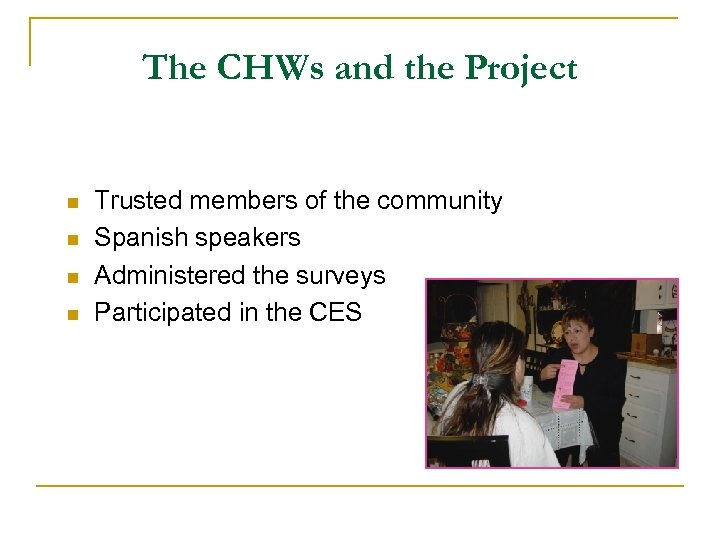
The CHWs and the Project n n Trusted members of the community Spanish speakers Administered the surveys Participated in the CES
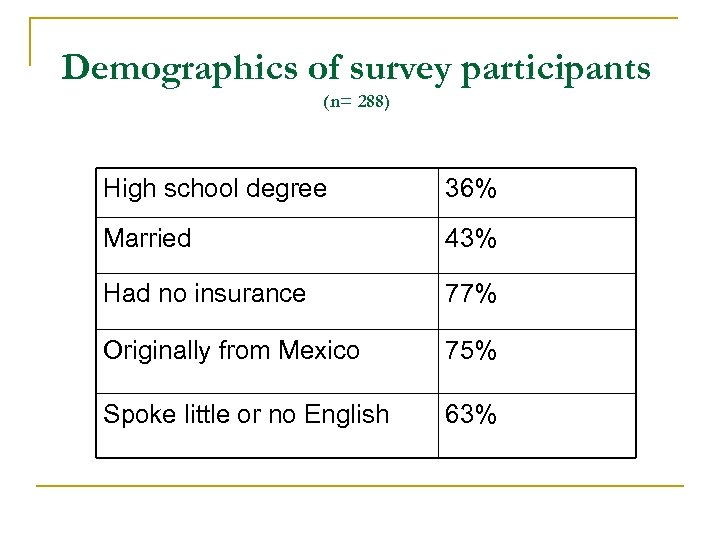
Demographics of survey participants (n= 288) High school degree 36% Married 43% Had no insurance 77% Originally from Mexico 75% Spoke little or no English 63%
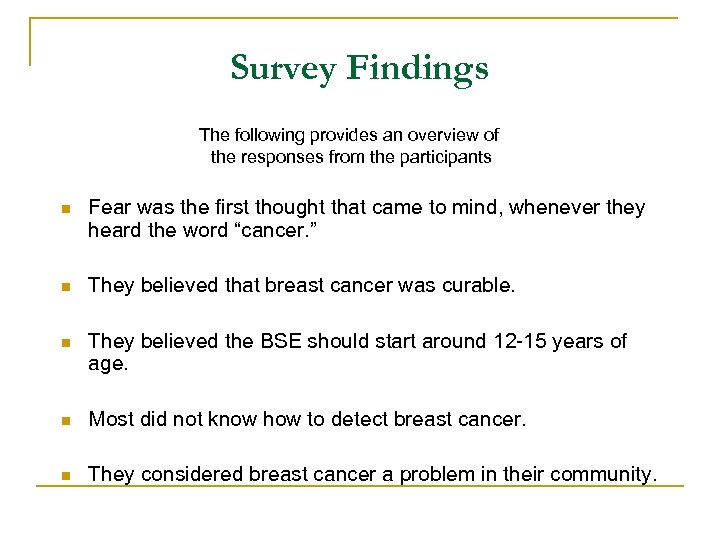
Survey Findings The following provides an overview of the responses from the participants n Fear was the first thought that came to mind, whenever they heard the word “cancer. ” n They believed that breast cancer was curable. n They believed the BSE should start around 12 -15 years of age. n Most did not know how to detect breast cancer. n They considered breast cancer a problem in their community.
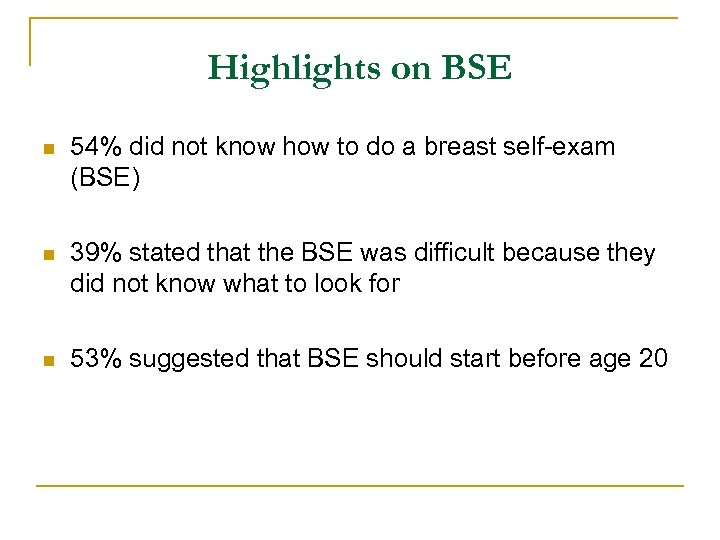
Highlights on BSE n 54% did not know how to do a breast self-exam (BSE) n 39% stated that the BSE was difficult because they did not know what to look for n 53% suggested that BSE should start before age 20
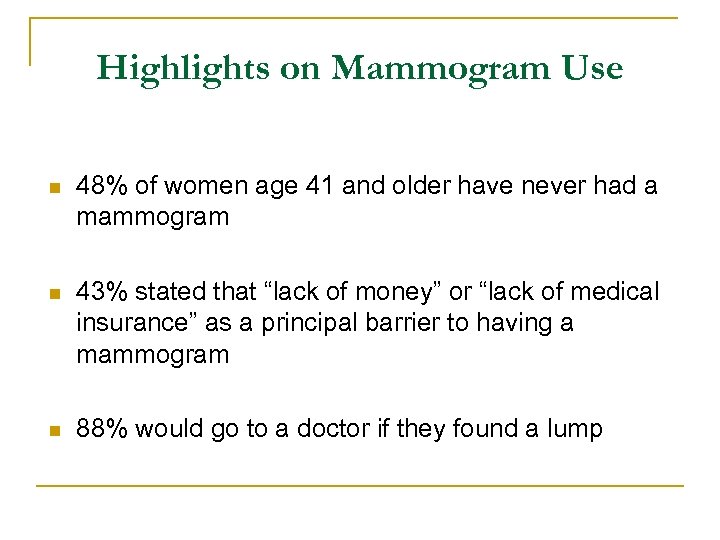
Highlights on Mammogram Use n 48% of women age 41 and older have never had a mammogram n 43% stated that “lack of money” or “lack of medical insurance” as a principal barrier to having a mammogram n 88% would go to a doctor if they found a lump
Findings Summary n n n Breast cancer was a problem in their community. Expressed an interest in learning about breast cancer and early detection The BSE should start with puberty. The church would serve as a place where they would like to learn about breast cancer. Respondents stated “friends” as key resources for health information.
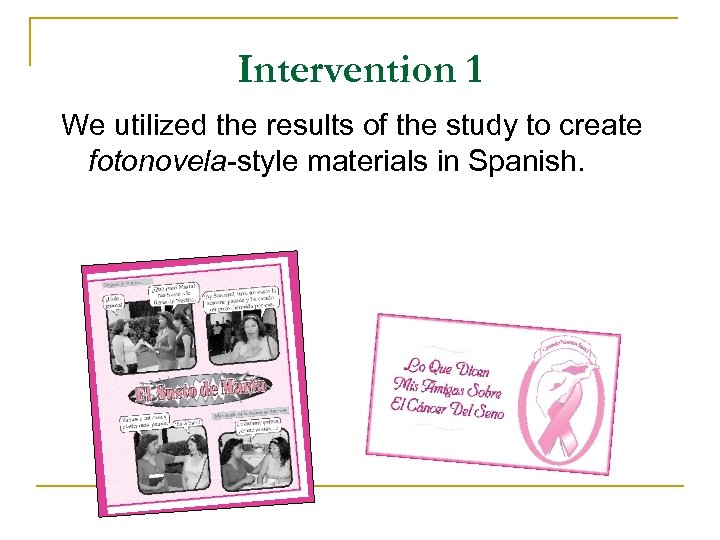
Intervention 1 We utilized the results of the study to create fotonovela-style materials in Spanish.
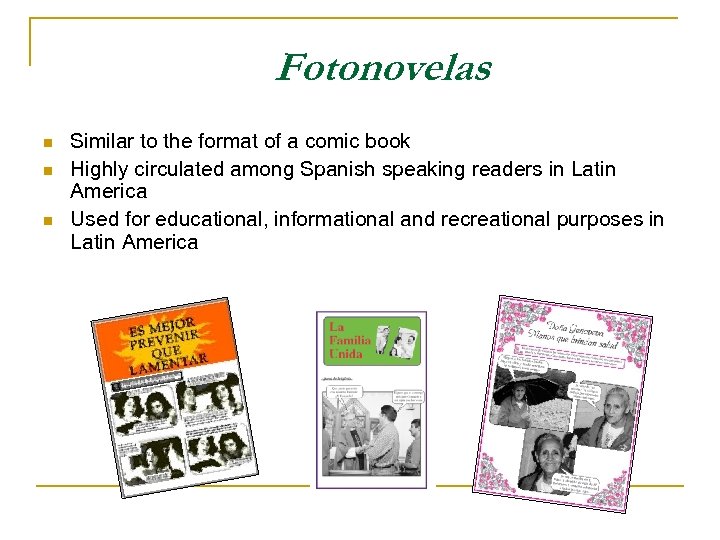
Fotonovelas n n n Similar to the format of a comic book Highly circulated among Spanish speaking readers in Latin America Used for educational, informational and recreational purposes in Latin America
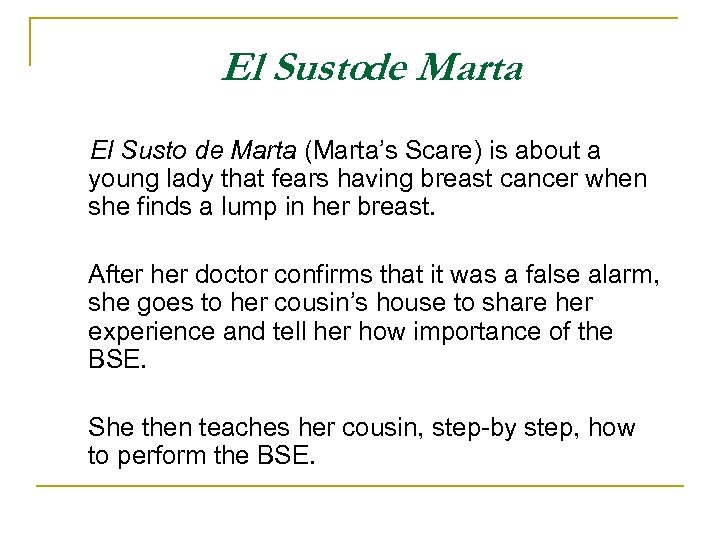
El Sustode Marta El Susto de Marta (Marta’s Scare) is about a young lady that fears having breast cancer when she finds a lump in her breast. After her doctor confirms that it was a false alarm, she goes to her cousin’s house to share her experience and tell her how importance of the BSE. She then teaches her cousin, step-by step, how to perform the BSE.
Lo quedicen amigas mis sobre cáncerdelseno el Lo que dicen mis amigas sobre el cáncer del s. Eno (What My Friends Say About Breast Cancer) Is an advice novela which responds to many women’s fear, misconceptions and beliefs The novela teaches, in a simple way, basic information about breast cancer
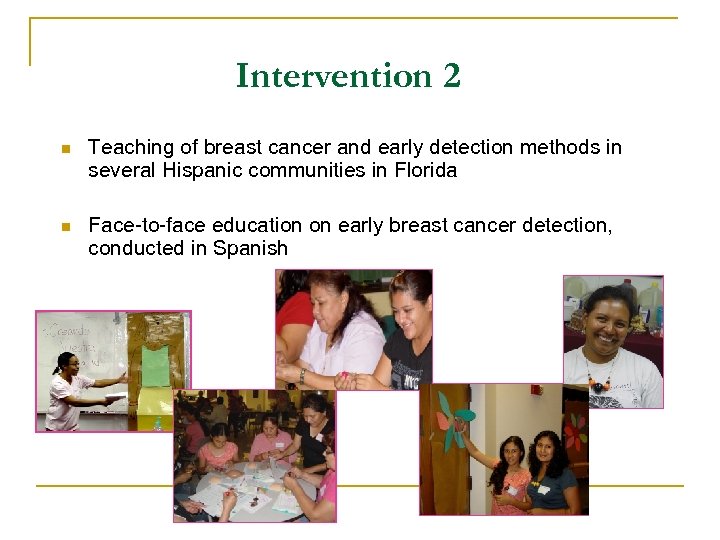
Intervention 2 n Teaching of breast cancer and early detection methods in several Hispanic communities in Florida n Face-to-face education on early breast cancer detection, conducted in Spanish
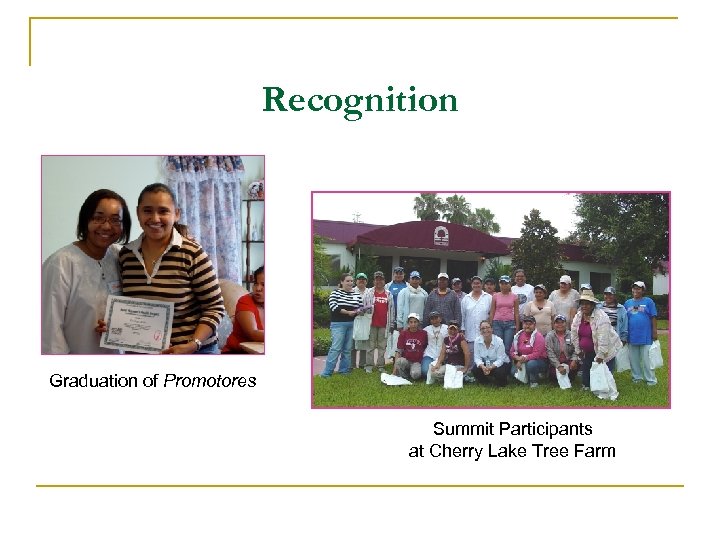
Recognition Graduation of Promotores Summit Participants at Cherry Lake Tree Farm
Acknowledgements: n n n n Florida Breast Cancer Coalition Research Foundation AMA - Alianza de Mujeres Activas (Active Women Alliance) Pierson, Florida Healthy Start of Manatee County, Bradenton, Florida Project Claridad, Putnam and Palm Beach counties, Florida North Central Kentucky AHEC, Lexington, Kentucky American Cancer Society - Florida Division Ellen Lopez, Ph. D, University of Florida- College of Public Health and Health Professions, Gainesville, Florida
¡Grac ías! For more information about our project, contact: Rural Women’s Health Project (RWHP) P. O. Box 12016, Gainesville, Florida 32604 Phone: (352) 372 -1095 Fax: (352) 338 -8211 Email: rwhp@cafl. com Visit our website: www. rwhp. org
Скачать презентацию Creando Nuestra Salud Breaking down internal barriers
90f63bf651f23caa75eb058b3fe9ba72.ppt