


 Скачать презентацию Cranes 1 VHA Center for Engineering Occupational
83706aabf29947d462cbaa8ed4a0a8fb.ppt
- Количество слайдов: 42
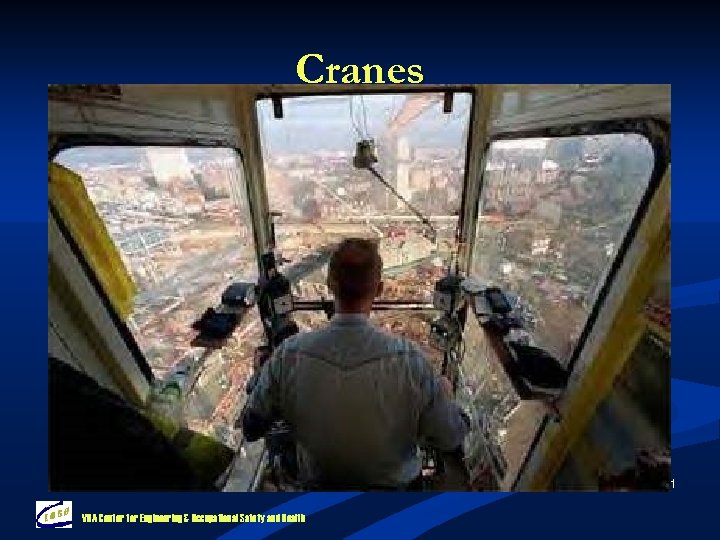 Cranes 1 VHA Center for Engineering & Occupational Safety and Health
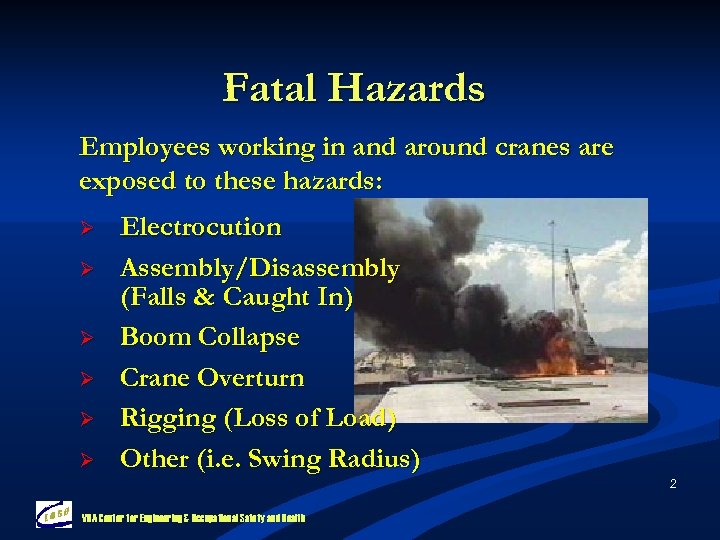 Fatal Hazards Employees working in and around cranes are exposed to these hazards: Ø Ø Ø Electrocution Assembly/Disassembly (Falls & Caught In) Boom Collapse Crane Overturn Rigging (Loss of Load) Other (i. e. Swing Radius) 2 VHA Center for Engineering & Occupational Safety and Health
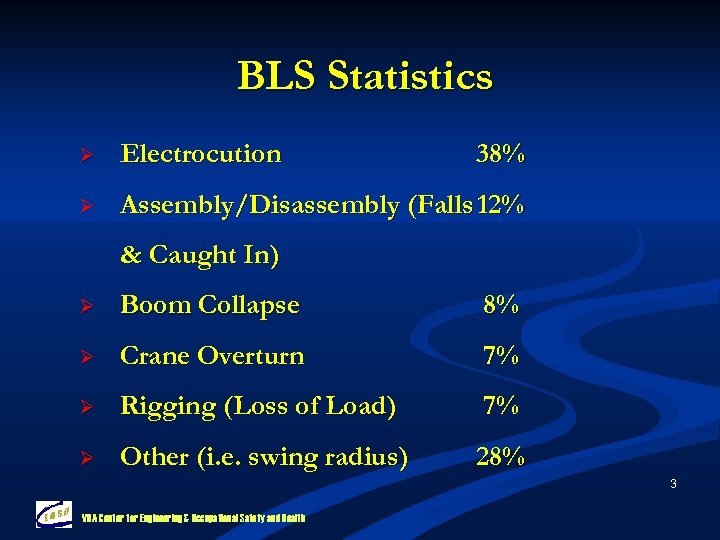 BLS Statistics Ø Electrocution 38% Ø Assembly/Disassembly (Falls 12% & Caught In) Ø Boom Collapse 8% Ø Crane Overturn 7% Ø Rigging (Loss of Load) 7% Ø Other (i. e. swing radius) 28% 3 VHA Center for Engineering & Occupational Safety and Health
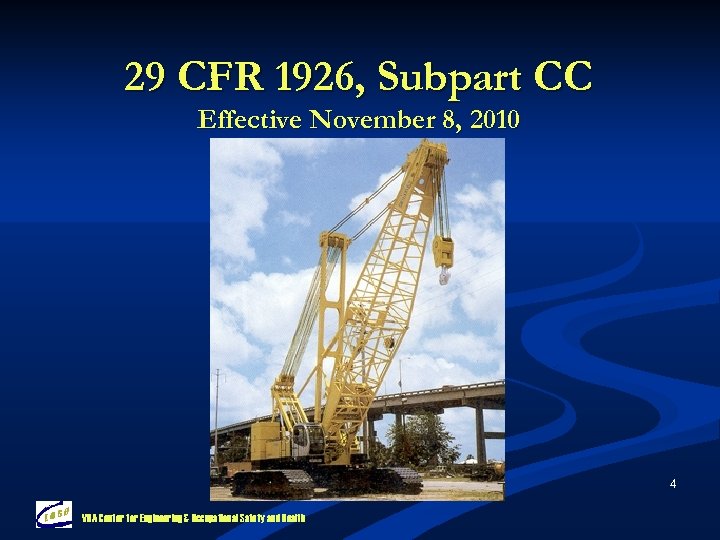 29 CFR 1926, Subpart CC Effective November 8, 2010 4 VHA Center for Engineering & Occupational Safety and Health
 Highlights • Scope • Definitions • Ground Conditions • Assembly/ Disassembly (New Role A/D Director) • Power Line Safety • Inspections • Wire Rope • Safety Devices • Operational Aids • Operation VHA Center for Engineering & Occupational Safety and Health • Authority to Stop Operation • Signals • Fall Protection • Work Area Control • Keeping Clear of the Load (Qualified Rigger) • Free Fall & Controlled Load Lowering • Operator Qualification & Certification • Signal Person Qualifications 5
 Highlights • Qualifications of Maintenance and Repair Workers (Qualified Person) • Training • Hoisting Personnel • Multiple Crane/Derrick Lifts • Design, Construction and Testing • Equipment Modifications • • Tower Cranes Derricks Floating Cranes & Land Cranes on Barges Overhead and Gantry Cranes Dedicated Pile Drivers Sideboom Cranes Requirements for equipment w/ capacity of 2000 lbs and less 6 VHA Center for Engineering & Occupational Safety and Health
 What Is A Crane? Ø Ø Ø Defined within the scope of the standard: Can hoist, lower and horizontally move a suspended load. Fairly substantial change. Put a hook on a rough terrain forklift and you have a crane! 7 VHA Center for Engineering & Occupational Safety and Health
 Ø Ø Ø Exempt Power shovels, excavators, wheel loaders, backhoes, loader backhoes, track loaders Machinery originally designed as vehiclemounted aerial devices (for lifting personnel) and self-propelled elevating work platforms Forklift without winch or hook Tree trimming and tree removal work Material Delivery - Articulating/knuckle-boom truck cranes that deliver material to a construction site 8 VHA Center for Engineering & Occupational Safety and Health
 Training The training must include (No cost to EE): Ø Overhead Power Lines (All) Ø Ø Crush/pinch points Maint. Tag Out & Restart Procedures Operator: During the 4 -year phase-in period for operator cert. or qual. , ERs must train each operator who has not yet been certified or qualified CP & Qual. Persons: Requirements of this crane standard to their respective roles 9 VHA Center for Engineering & Occupational Safety and Health
 Competent & Qualified Person Ø CP - capable of identifying and authority to correct hazards (i. e. Lead Person) Ø QP - by possession of a recognized degree, certificate, or professional standing, or who by extensive knowledge, training and experience, successfully demonstrated the ability to solve/resolve problems relating to the subject matter, the work, or the project 10 VHA Center for Engineering & Occupational Safety and Health
 Crane CPs & QPs? A/D Director (New Defined Role) Ø CP & QP Crane Operator Ø CP and often a QP. However, may not feel knowledgeable for certain QP duties Signal Person, Rigger, & Maintenance & Repair Workers Ø QP for signaling 11 VHA Center for Engineering & Occupational Safety and Health
 Required CP & QP Roles? A/D Director (New Defined Role) Ø If assembly required Crane Operator & Rigger Ø Always, couldn’t see as one person Signal Person Ø Anytime view obstructed or as determined necessary due to site safety concerns Maintenance & Repair Workers Ø As necessary 12 VHA Center for Engineering & Occupational Safety and Health
 Training Documentation? A/D Director (New Defined Role) Ø Documentation not specified, but no cost to EE gives indication of formal training Crane Operator Ø During 4 year phase-in on certification requirements no documentation specified Rigger Ø Documentation not specified, but no cost to EE gives indication of formal training 13 VHA Center for Engineering & Occupational Safety and Health
 Training Documentation? Signal Person Ø Documentation specified and required to indicate what type (hand signals, radio signals, etc. . ). Test verbal or written 7 practical examination. Maintenance & Repair Workers Ø Documentation not specified, but no cost to EE gives indication of formal training 14 VHA Center for Engineering & Occupational Safety and Health
 Competent & Qualified Person Ø Master Specs: All EEs of contractors shall have other relevant competency training. Ø Submit training records of all such employees for approval before work starts. Ø OSHA 30 Hour Course participation would most likely not have provided adequate crane safety training! Additionally, lots of brand new requirements on Nov 8, 2010! Maybe on light rigging work – rigger training. Ø Write in specific documentation reqs. ? VHA Center for Engineering & Occupational Safety and Health 15
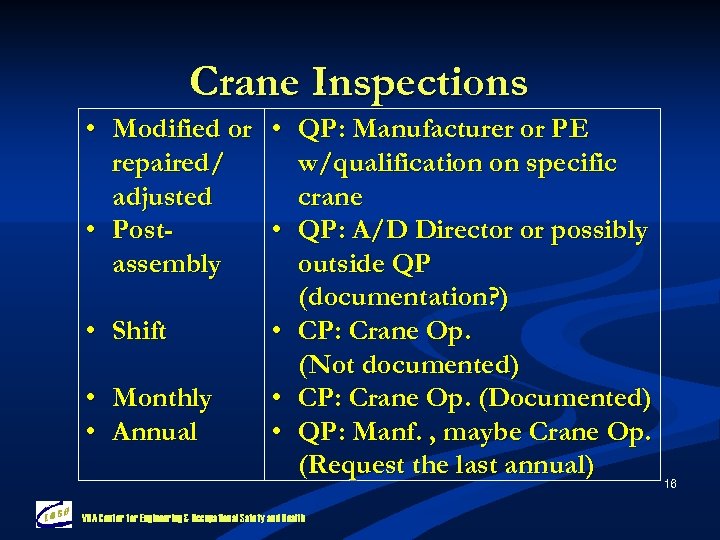 Crane Inspections • Modified or • QP: Manufacturer or PE repaired/ w/qualification on specific adjusted crane • Post • QP: A/D Director or possibly assembly outside QP (documentation? ) • Shift • CP: Crane Op. (Not documented) • Monthly • CP: Crane Op. (Documented) • Annual • QP: Manf. , maybe Crane Op. (Request the last annual) VHA Center for Engineering & Occupational Safety and Health 16
 Wire Rope Inspections • Shift • Monthly • Annual • CP: Crane Op. (Not documented) • CP: Crane Op. (Documented) • QP: Manf. , maybe Crane Op. (Request the last annual) • Routinely request to review monthly crane and wire rope inspections 17 VHA Center for Engineering & Occupational Safety and Health
 Assembly/Disassembly Two options: Ø Manufacturer procedures or Ø Employer procedures (criteria requirements) Ø Qualified Person develops Ø Meets all of Crane Standards reqs. Ø Still have to follow any manufacturer’s prohibitions 18 VHA Center for Engineering & Occupational Safety and Health
 Turnover & Boom Collapse Ø As with buildings a crane’s foundation is highly important Ø Going beyond the crane’s capacity Ø Knowing the weight of the load Ø Ability to read load charts and follow Ø Secondary: Properly functioning load weighing or moment indicators (Moment = Force (load) x Distance from tipping axles) Hey just like a see saw! 19 VHA Center for Engineering & Occupational Safety and Health
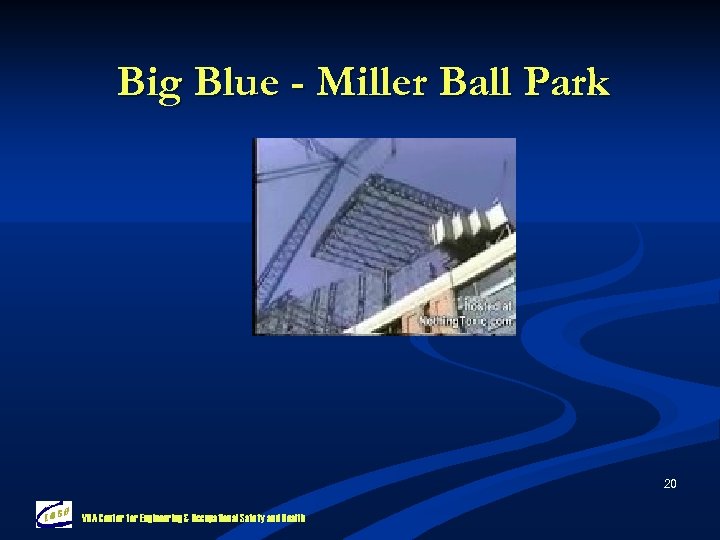 Big Blue - Miller Ball Park 20 VHA Center for Engineering & Occupational Safety and Health
 Accident factors Ø Ø Ø Failure to factor wind into the crane loading Failure to follow the manufacturer's limitations on the crane Lifting loads in excess of the crane's rated capacity Failure to properly calibrate the load indicator Improper ground loading conditions 21 VHA Center for Engineering & Occupational Safety and Health
 Safety Pays? Ø 3 workers killed Ø Ball Park opened one year late Ø 100 million repair cost Ø 27 million punitive damages (3 killed) Ø Total expect costs after lawsuits are finished will approach 1 billion 22 VHA Center for Engineering & Occupational Safety and Health
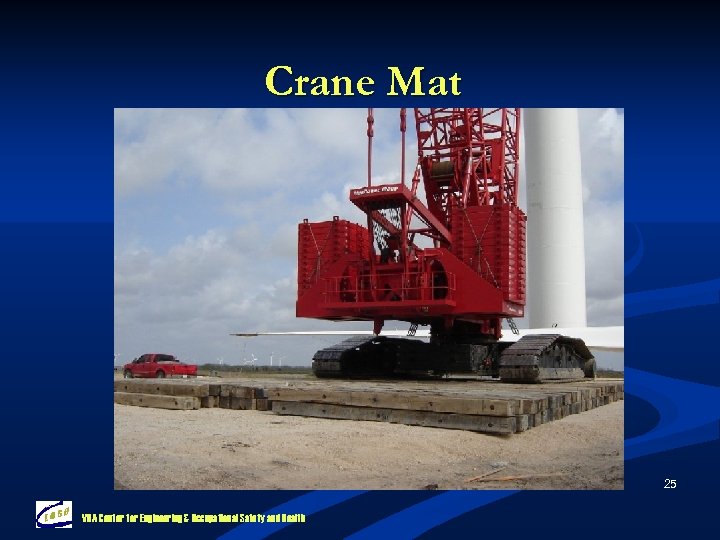
 Ground Conditions Controlling entity must: Ø Contractor: Adequately support and provide degree of level needed for the crane (provide any necessary supporting material such as mats, cribbing, etc…) Ø VA: Provide documents that contain information on the location of hazards (voids, tanks, tunnels, utilities) below the set -up area Ø VA: Hazards below the set-up area that are known, but are not documented VHA Center for Engineering & Occupational Safety and Health 23
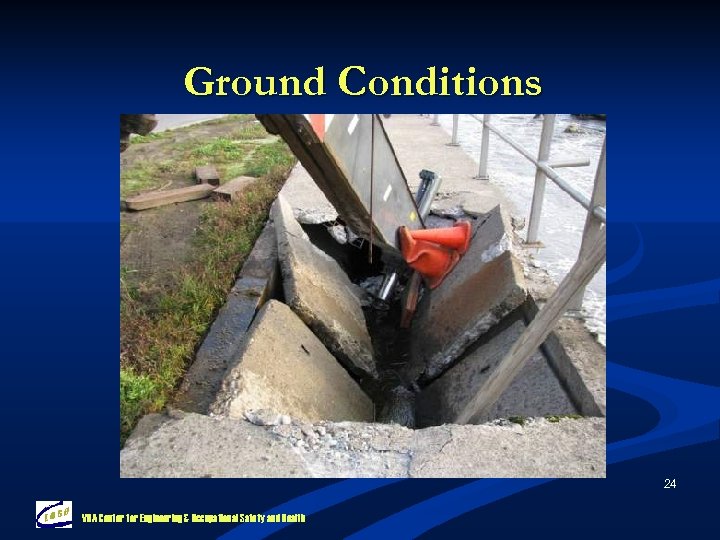 Ground Conditions 24 VHA Center for Engineering & Occupational Safety and Health
 Crane Mat 25 VHA Center for Engineering & Occupational Safety and Health
 Operation Ø Unavailable operation procedures Ø Employer must develop Ø Procedures for the operational controls must be developed by a qualified person Ø Procedures related to the capacity of the equipment must be developed and signed by a registered professional engineer familiar with the equipment 26 VHA Center for Engineering & Occupational Safety and Health
 Operation Ø Ø Must determine the weight of the load! Highly important in not overloading If using a operational aid to determine the weight and it indicates that during the lift the crane will exceed 75% of capacity, the load weight must be determined by one of the following: Ø Load’s Manufacturer Ø Calculation (i. e. length x weight per foot) Ø Equally reliable method 27 VHA Center for Engineering & Occupational Safety and Health
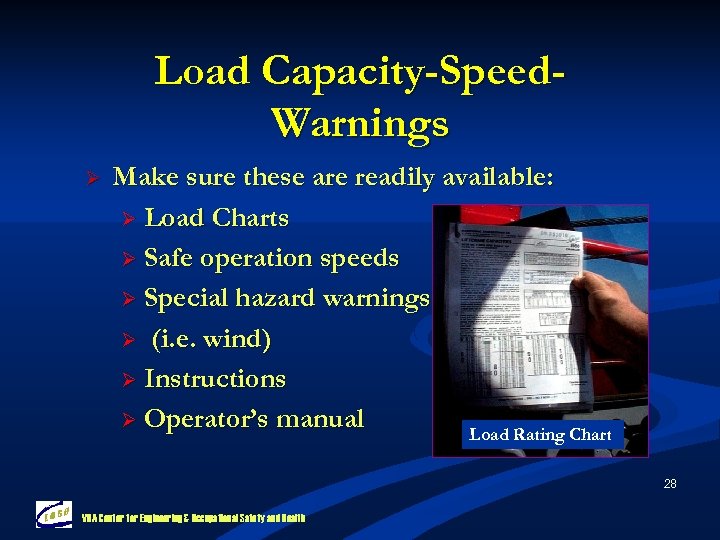 Load Capacity-Speed. Warnings Ø Make sure these are readily available: Ø Load Charts Ø Safe operation speeds Ø Special hazard warnings Ø (i. e. wind) Ø Instructions Ø Operator’s manual Load Rating Chart 28 VHA Center for Engineering & Occupational Safety and Health
 Safety Devices Safety devices are required and must be operational at all times Include: Ø Crane Level indicator Ø Boom/Jib stops (except derricks) Ø Integral holding device/check valve for outrigger and stabilizer jacks Ø 29 VHA Center for Engineering & Occupational Safety and Health
 Operational Aids Cat I: Boom hoist limiting device, luffing jib limiting device, and anti two-blocking device Ø Have to be repaired within 7 days of discovery Cat II: Boom angle or radius indicator, boom length indicator, load weighing or moment devices, jib angle indicator, outrigger/stabilizer position sensor/monitor, and hoist drum rotation indicator Ø Have to be repaired within 30 days of discovery. Except ordered part – 7 days of receipt 30 VHA Center for Engineering & Occupational Safety and Health
 Keeping Clear of Loads Ø Ø Ø Identify the Fall Zone. Fall zone means the area (including but not limited to the area directly beneath the load) in which it is reasonably foreseeable that partially or completely suspended materials could fall in the event of an accident Only EES rigging, guiding, and receiving the load are allowed in the fall zone. Avoid being under the loads if possible. 31 VHA Center for Engineering & Occupational Safety and Health
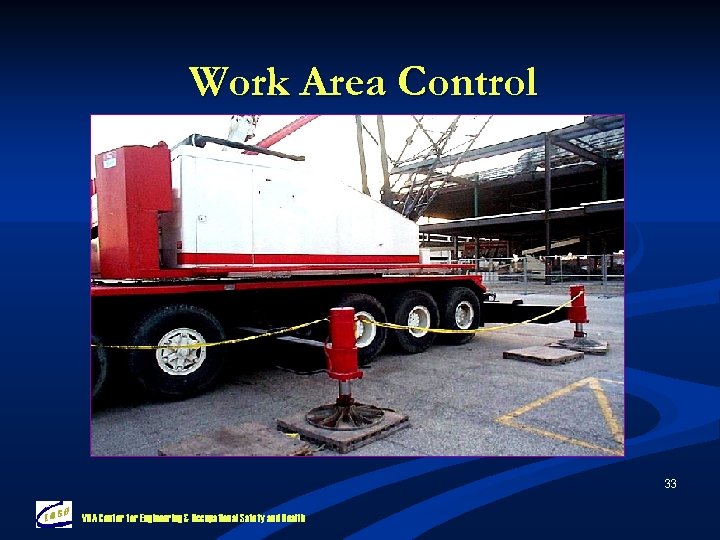
 Work Area Control Ø Ø Swing Radius Hazard Employer must: Ø Train to recognize struck-by and pinch/crush hazard areas posed by the rotating superstructure Ø Control line, warning line, railing, or similar Ø Demonstrated that it is infeasible: Clearly mark area, warning signs, and train (have not see an infeasible)case 32 VHA Center for Engineering & Occupational Safety and Health
 Work Area Control 33 VHA Center for Engineering & Occupational Safety and Health
 Power Lines 34 VHA Center for Engineering & Occupational Safety and Health
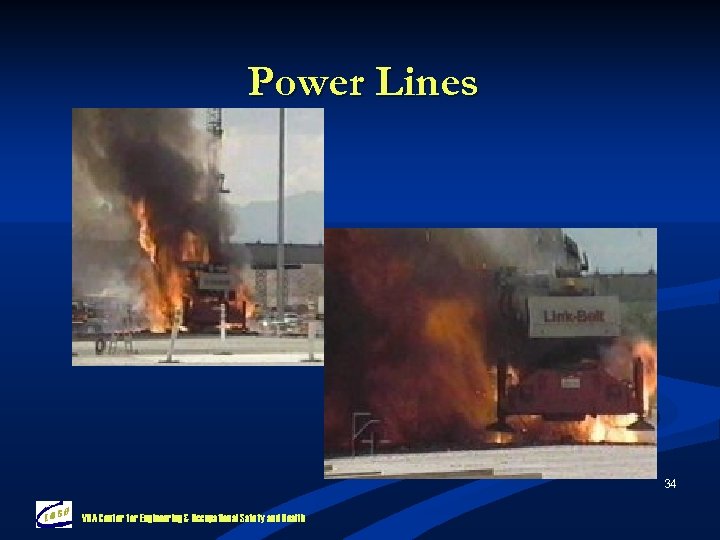
 Power Lines Ø Identify Work Zone (New) Ø Demarcating boundaries (such as with flags, or a device such as a range limit device or range control warning device) Ø Defining the work zone as full boom length and 360 degrees around Ø Determine if any part of the equipment could get closer than 20 feet to a power line 35 VHA Center for Engineering & Occupational Safety and Health
 Can get within 20 Ft? Ø Option 1: De-energize and ground Ø Option 2: Maintain 20 foot clearance and additional measures Ø Option 3: Use Table A in standards and additional measures 36 VHA Center for Engineering & Occupational Safety and Health
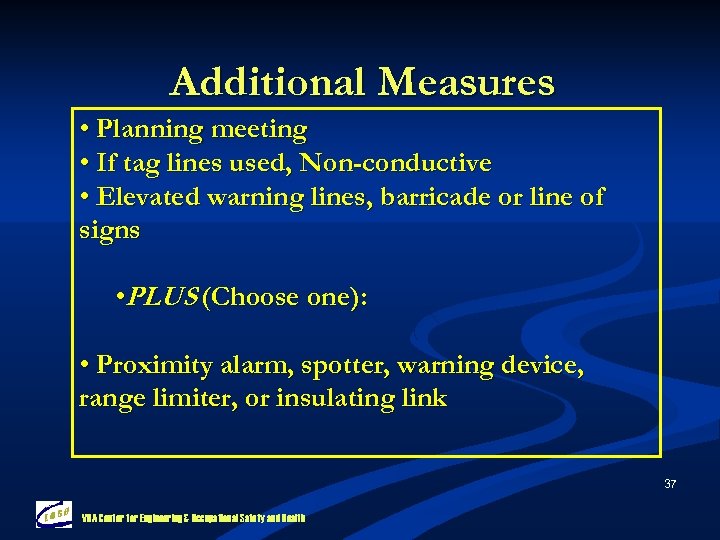 Additional Measures • Planning meeting • If tag lines used, Non-conductive • Elevated warning lines, barricade or line of signs • PLUS (Choose one): • Proximity alarm, spotter, warning device, range limiter, or insulating link 37 VHA Center for Engineering & Occupational Safety and Health
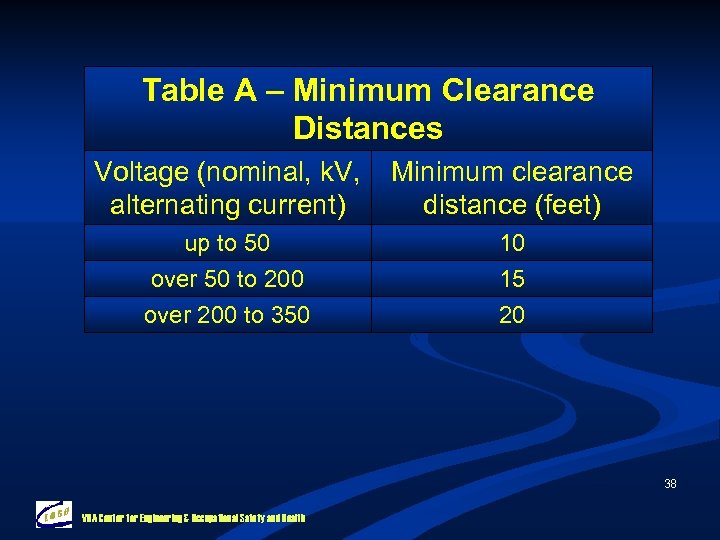 Table A – Minimum Clearance Distances Voltage (nominal, k. V, alternating current) Minimum clearance distance (feet) up to 50 over 50 to 200 over 200 to 350 10 15 20 38 VHA Center for Engineering & Occupational Safety and Health
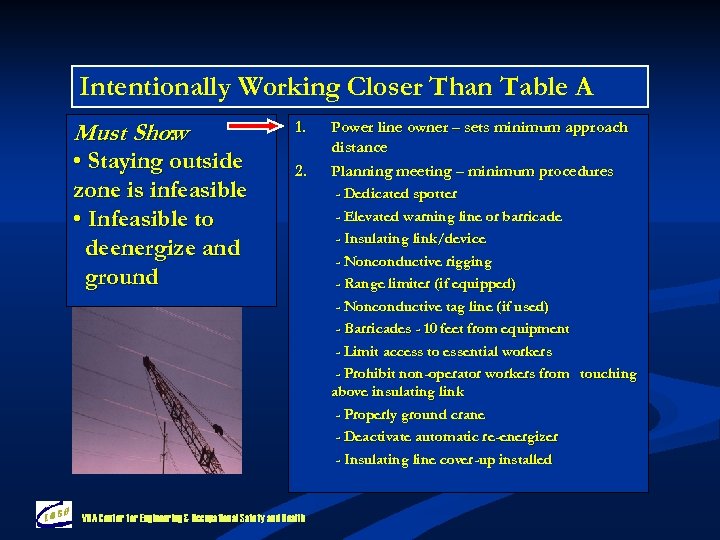 Intentionally Working Closer Than Table A Must Show : • Staying outside zone is infeasible • Infeasible to deenergize and ground 1. 2. VHA Center for Engineering & Occupational Safety and Health Power line owner – sets minimum approach distance Planning meeting – minimum procedures - Dedicated spotter - Elevated warning line or barricade - Insulating link/device - Nonconductive rigging - Range limiter (if equipped) - Nonconductive tag line (if used) - Barricades - 10 feet from equipment - Limit access to essential workers - Prohibit non-operator workers from touching above insulating link - Properly ground crane - Deactivate automatic re-energizer - Insulating line cover-up installed
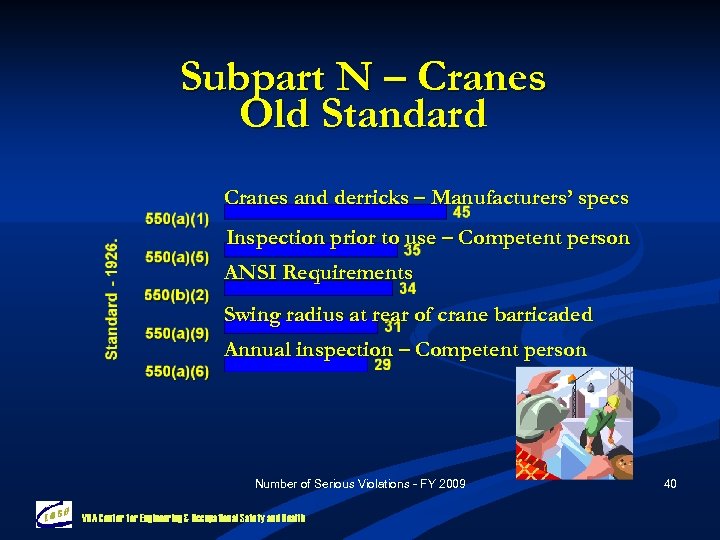 Subpart N – Cranes Old Standard Cranes and derricks – Manufacturers’ specs Inspection prior to use – Competent person ANSI Requirements Swing radius at rear of crane barricaded Annual inspection – Competent person Number of Serious Violations - FY 2009 VHA Center for Engineering & Occupational Safety and Health 40
 Summary Ø Training – All Roles Ø Signal Person – Documentation of training Ø Crane Operators do not have documentation of training requirement during the 4 year phase-in period Ø Ground Conditions – controlling entity must prep. to adequately support and provide degree of level, provide docs. of known hazards, and communicate other know hazards. 41 VHA Center for Engineering & Occupational Safety and Health
 Summary Ø Operation – Weight of load and load chart highly important Ø Swing Radius (Work area control) – Train & erect barriers Ø Generally – Maintaining 20 feet from power lines is required. Ø Fall Zone – Only EES rigging, guiding, and receiving the load are allowed 42 VHA Center for Engineering & Occupational Safety and Health