 Скачать презентацию CPT-S 415 Big Data Yinghui Wu EME B
9c208f2620f3cc408aa2c4cdc808aa91.ppt
- Количество слайдов: 65



CPT-S 415 Big Data Yinghui Wu EME B 45 1 1
CPT-S 483 05 Big Data Beyond Relational Data Graphs and RDF data ü Graph data basics ü Introduction to RDF – RDF data model and syntax – RDF schemas – RDF inferencing 2
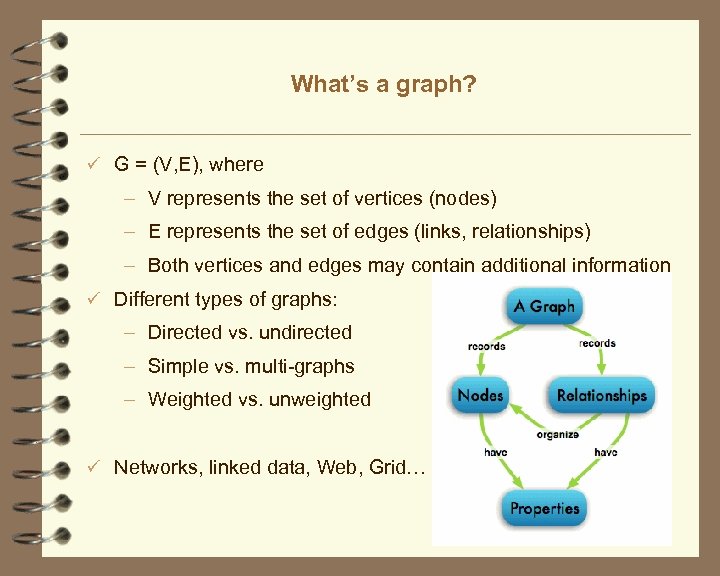
What’s a graph? ü G = (V, E), where – V represents the set of vertices (nodes) – E represents the set of edges (links, relationships) – Both vertices and edges may contain additional information ü Different types of graphs: – Directed vs. undirected – Simple vs. multi-graphs – Weighted vs. unweighted ü Networks, linked data, Web, Grid…
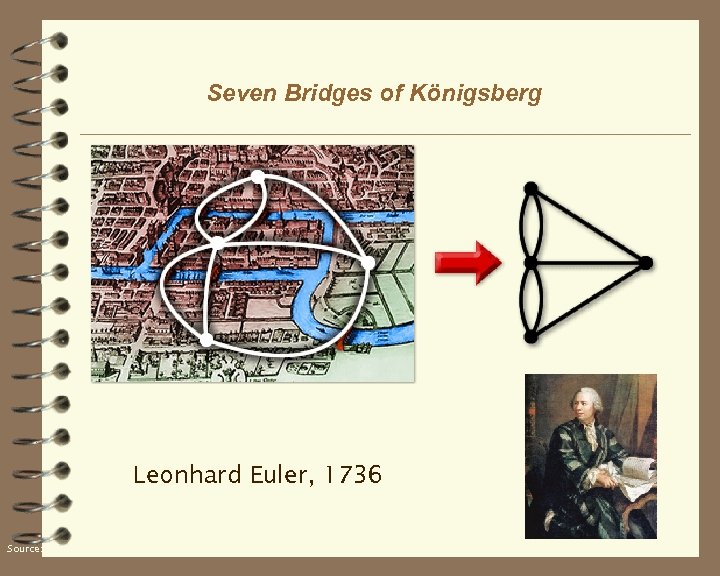
Seven Bridges of Königsberg Leonhard Euler, 1736 Source: Wikipedia (Königsberg)
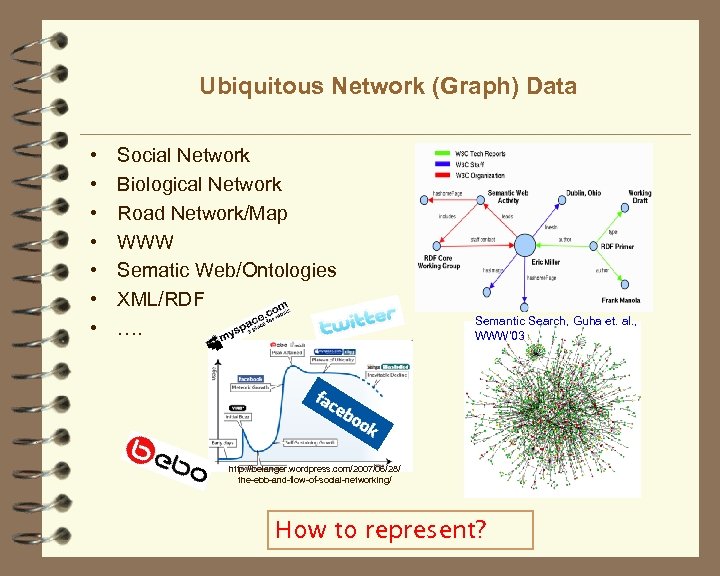
Ubiquitous Network (Graph) Data • • Social Network Biological Network Road Network/Map WWW Sematic Web/Ontologies XML/RDF …. Semantic Search, Guha et. al. , WWW’ 03 http: //belanger. wordpress. com/2007/06/28/ the-ebb-and-flow-of-social-networking/ How to represent? 5
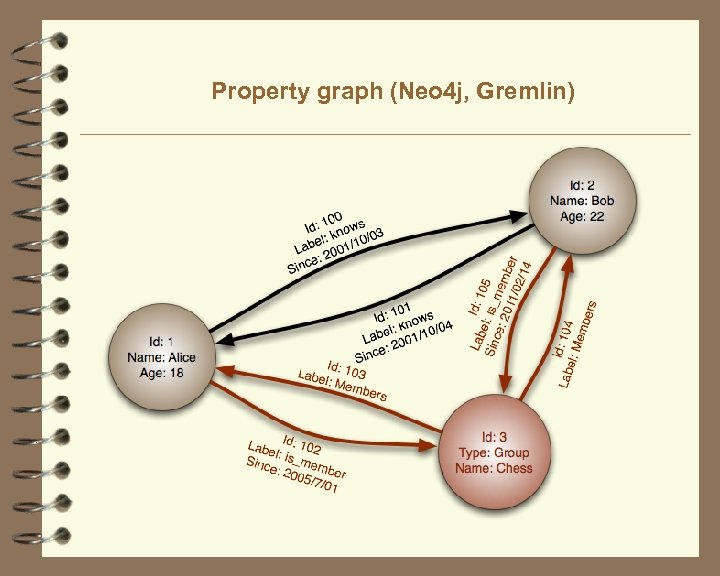
Property graph (Neo 4 j, Gremlin)
Can we use XML? ü XML is a universal metalanguage for defining markup ü It provides a uniform framework for interchange of data and metadata between applications ü However, XML does not provide any means of talking about the semantics (meaning) of data ü E. g. , there is no intended meaning associated with the nesting of tags – It is up to each application to interpret the nesting. 7
What is RDF? ü Resource Description Framework: Developed by the World Wide Web Consortium (W 3 C) to provide a standard for defining an architecture for supporting the vast amount of web metadata. ü Human and machine readable – Machine-readable: it maintains the structure of the data. ü Short history: – Metadata: begins in 1995 – Platform for Internet Content Selection (PICS) • Mechanism for communicating ratings of web pages from server to clients. – Interned resource description based on PICS architecture – PICS-NG working group -> RDF, 2004 8
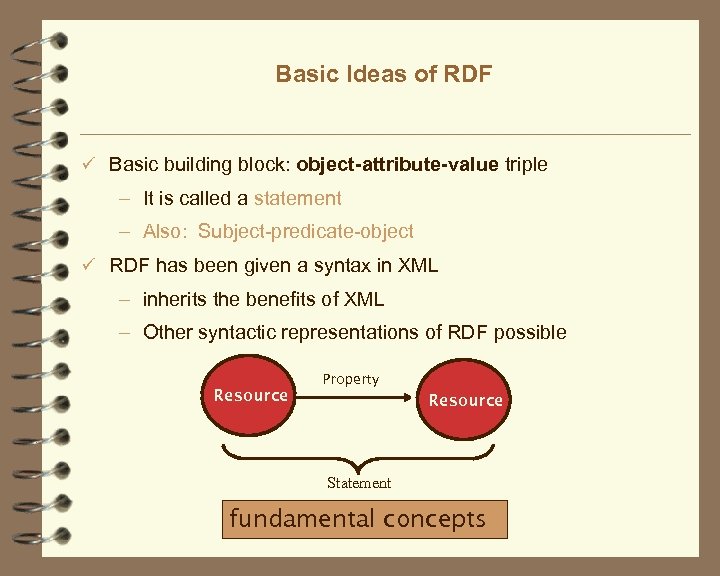
Basic Ideas of RDF ü Basic building block: object-attribute-value triple – It is called a statement – Also: Subject-predicate-object ü RDF has been given a syntax in XML – inherits the benefits of XML – Other syntactic representations of RDF possible Resource Property Value Resource Statement fundamental concepts
Resources ü We can think of a resource as an object – E. g. authors, books, publishers, places, people, hotels ü Every resource has a URI, a Universal Resource Identifier ü A URI can be – a URL (Web address) or – some other kind of unique identifier (e. g. , URN; ISBN) 10
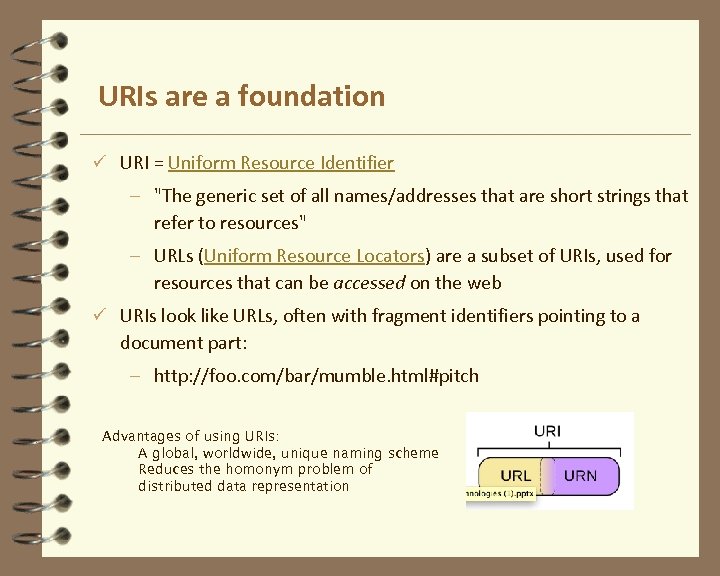
URIs are a foundation ü URI = Uniform Resource Identifier – "The generic set of all names/addresses that are short strings that refer to resources" – URLs (Uniform Resource Locators) are a subset of URIs, used for resources that can be accessed on the web ü URIs look like URLs, often with fragment identifiers pointing to a document part: – http: //foo. com/bar/mumble. html#pitch Advantages of using URIs: Α global, worldwide, unique naming scheme Reduces the homonym problem of distributed data representation
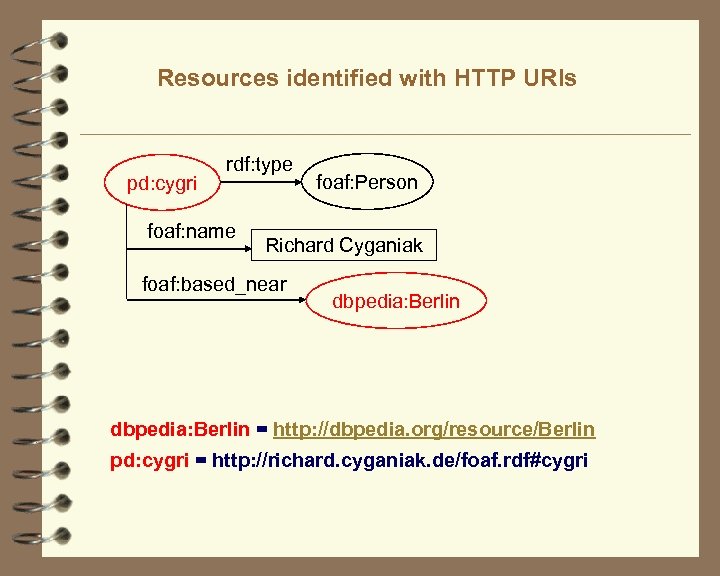
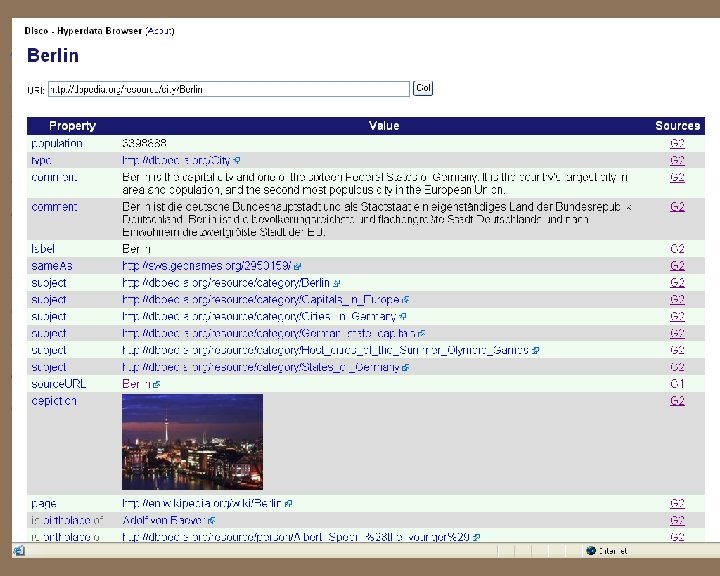
Resources identified with HTTP URIs pd: cygri rdf: type foaf: name foaf: Person Richard Cyganiak foaf: based_near dbpedia: Berlin = http: //dbpedia. org/resource/Berlin pd: cygri = http: //richard. cyganiak. de/foaf. rdf#cygri
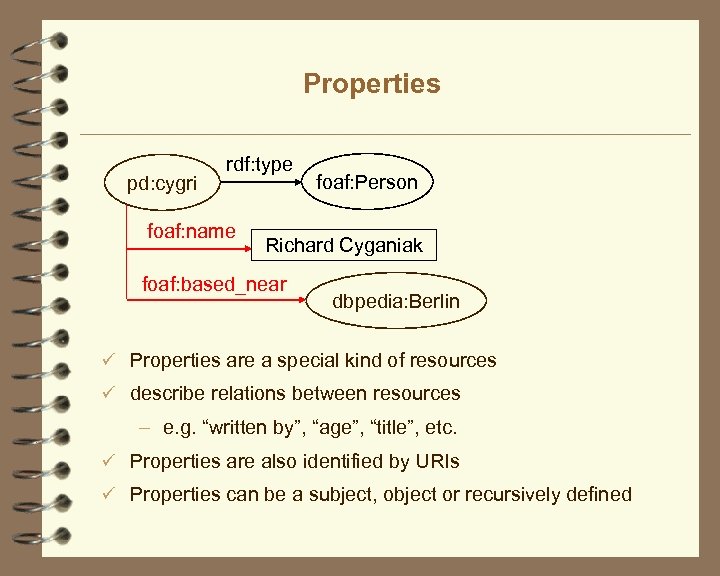
Properties pd: cygri rdf: type foaf: name foaf: Person Richard Cyganiak foaf: based_near dbpedia: Berlin ü Properties are a special kind of resources ü describe relations between resources – e. g. “written by”, “age”, “title”, etc. ü Properties are also identified by URIs ü Properties can be a subject, object or recursively defined 13
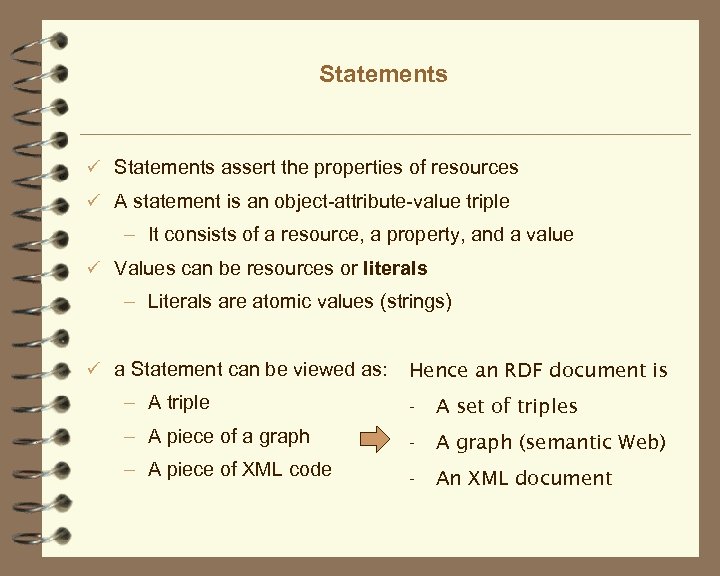
Statements ü Statements assert the properties of resources ü A statement is an object-attribute-value triple – It consists of a resource, a property, and a value ü Values can be resources or literals – Literals are atomic values (strings) ü a Statement can be viewed as: Hence an RDF document is – A triple - A set of triples – A piece of a graph - A graph (semantic Web) – A piece of XML code - An XML document 14
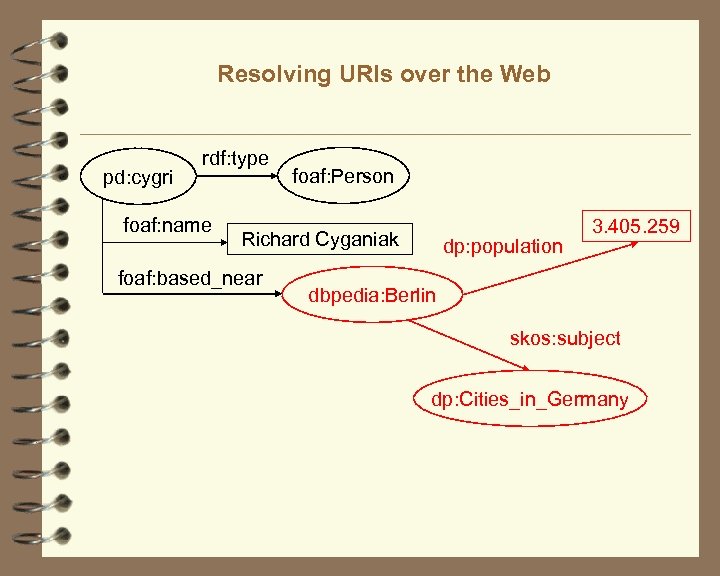
Resolving URIs over the Web pd: cygri rdf: type foaf: name foaf: Person Richard Cyganiak foaf: based_near dp: population 3. 405. 259 dbpedia: Berlin skos: subject dp: Cities_in_Germany
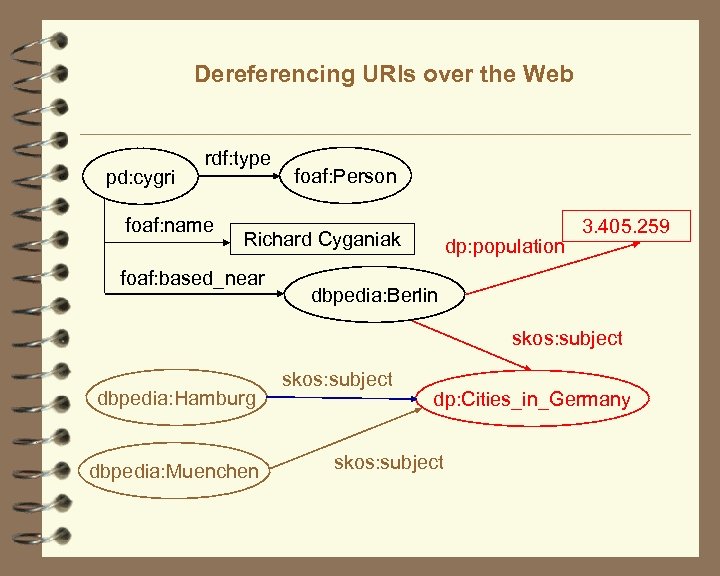
Dereferencing URIs over the Web pd: cygri rdf: type foaf: name foaf: Person Richard Cyganiak foaf: based_near dp: population 3. 405. 259 dbpedia: Berlin skos: subject dbpedia: Hamburg dbpedia: Muenchen skos: subject dp: Cities_in_Germany skos: subject
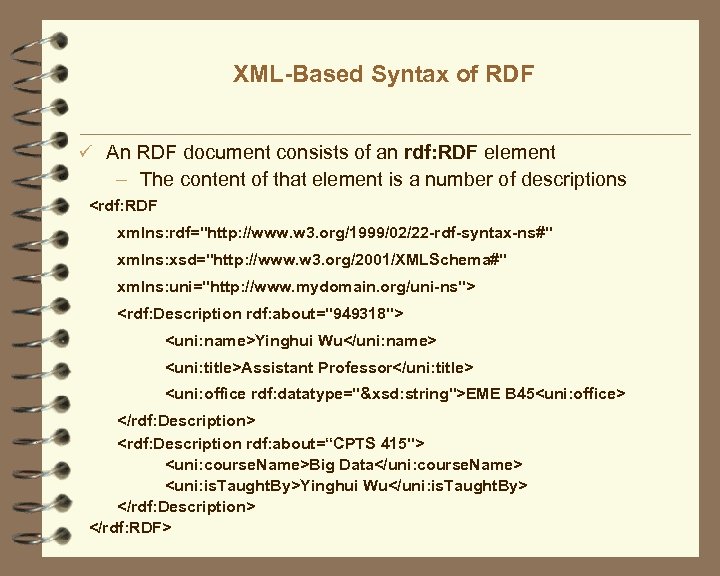
XML-Based Syntax of RDF ü An RDF document consists of an rdf: RDF element – The content of that element is a number of descriptions <rdf: RDF xmlns: rdf="http: //www. w 3. org/1999/02/22 -rdf-syntax-ns#" xmlns: xsd="http: //www. w 3. org/2001/XMLSchema#" xmlns: uni="http: //www. mydomain. org/uni-ns"> <rdf: Description rdf: about="949318"> <uni: name>Yinghui Wu</uni: name> <uni: title>Assistant Professor</uni: title> <uni: office rdf: datatype="&xsd: string">EME B 45<uni: office> </rdf: Description> <rdf: Description rdf: about=“CPTS 415"> <uni: course. Name>Big Data</uni: course. Name> <uni: is. Taught. By>Yinghui Wu</uni: is. Taught. By> </rdf: Description> </rdf: RDF> 18
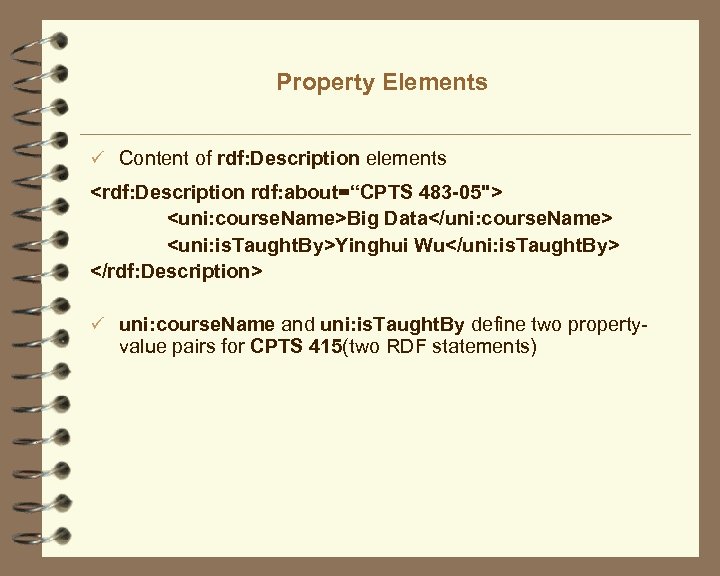
Property Elements ü Content of rdf: Description elements <rdf: Description rdf: about=“CPTS 483 -05"> <uni: course. Name>Big Data</uni: course. Name> <uni: is. Taught. By>Yinghui Wu</uni: is. Taught. By> </rdf: Description> ü uni: course. Name and uni: is. Taught. By define two property- value pairs for CPTS 415(two RDF statements) 19
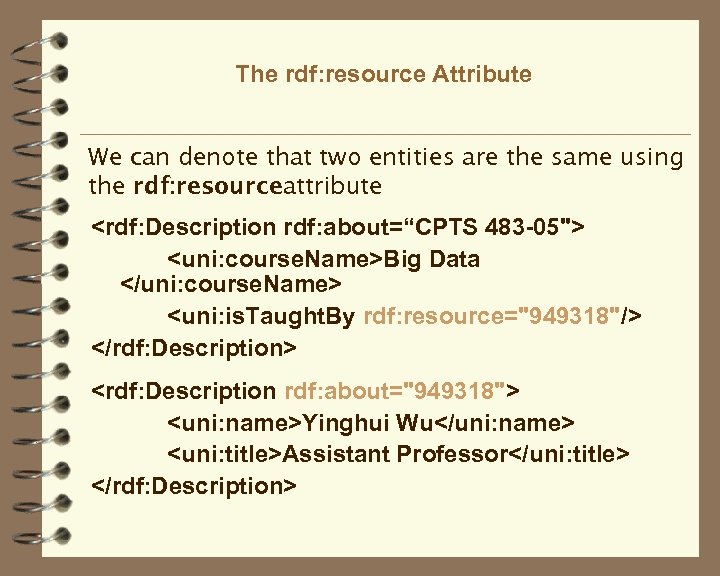
The rdf: resource Attribute We can denote that two entities are the same using the rdf: resourceattribute <rdf: Description rdf: about=“CPTS 483 -05"> <uni: course. Name>Big Data </uni: course. Name> <uni: is. Taught. By rdf: resource="949318"/> </rdf: Description> <rdf: Description rdf: about="949318"> <uni: name>Yinghui Wu</uni: name> <uni: title>Assistant Professor</uni: title> </rdf: Description> 20
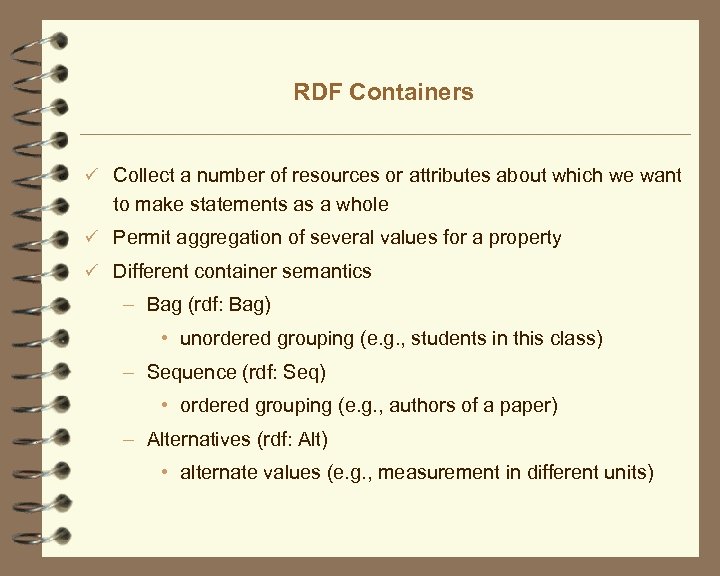
RDF Containers ü Collect a number of resources or attributes about which we want to make statements as a whole ü Permit aggregation of several values for a property ü Different container semantics – Bag (rdf: Bag) • unordered grouping (e. g. , students in this class) – Sequence (rdf: Seq) • ordered grouping (e. g. , authors of a paper) – Alternatives (rdf: Alt) • alternate values (e. g. , measurement in different units)
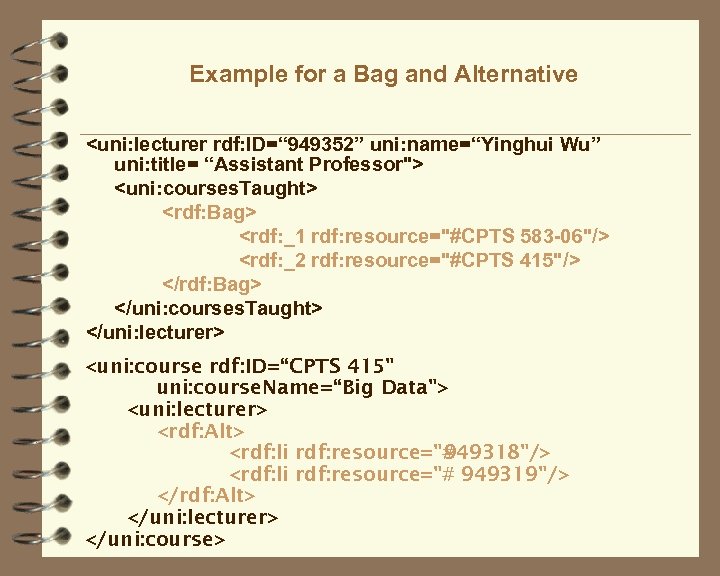
Example for a Bag and Alternative <uni: lecturer rdf: ID=“ 949352” uni: name=“Yinghui Wu” uni: title= “Assistant Professor"> <uni: courses. Taught> <rdf: Bag> <rdf: _1 rdf: resource="#CPTS 583 -06"/> <rdf: _2 rdf: resource="#CPTS 415"/> </rdf: Bag> </uni: courses. Taught> </uni: lecturer> <uni: course rdf: ID=“CPTS 415" uni: course. Name=“Big Data"> <uni: lecturer> <rdf: Alt> <rdf: li rdf: resource="# 49318"/> 9 <rdf: li rdf: resource="# 949319"/> </rdf: Alt> </uni: lecturer> </uni: course> 22
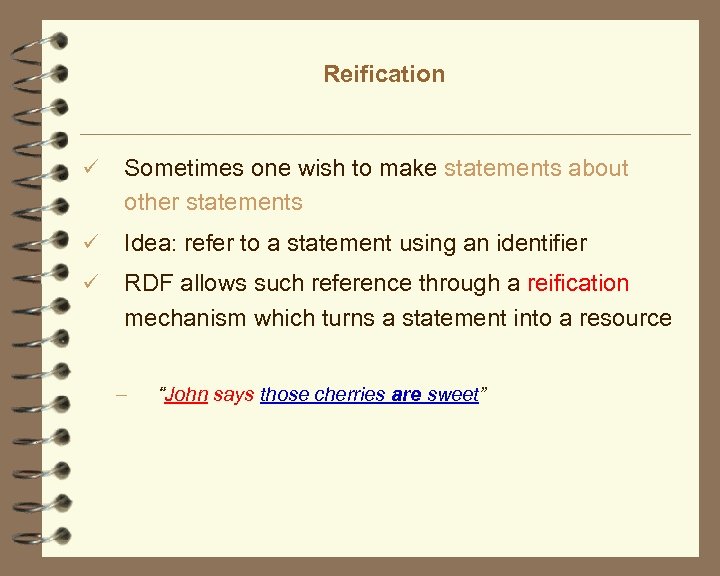
Reification ü Sometimes one wish to make statements about other statements ü Idea: refer to a statement using an identifier ü RDF allows such reference through a reification mechanism which turns a statement into a resource – “John says those cherries are sweet” 23
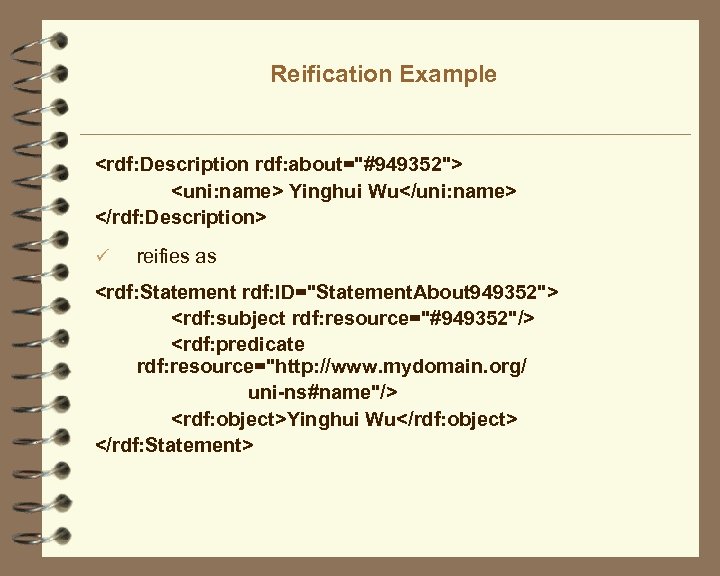
Reification Example <rdf: Description rdf: about="#949352"> <uni: name> Yinghui Wu</uni: name> </rdf: Description> ü reifies as <rdf: Statement rdf: ID="Statement. About 949352"> <rdf: subject rdf: resource="#949352"/> <rdf: predicate rdf: resource="http: //www. mydomain. org/ uni-ns#name"/> <rdf: object>Yinghui Wu</rdf: object> </rdf: Statement> 24
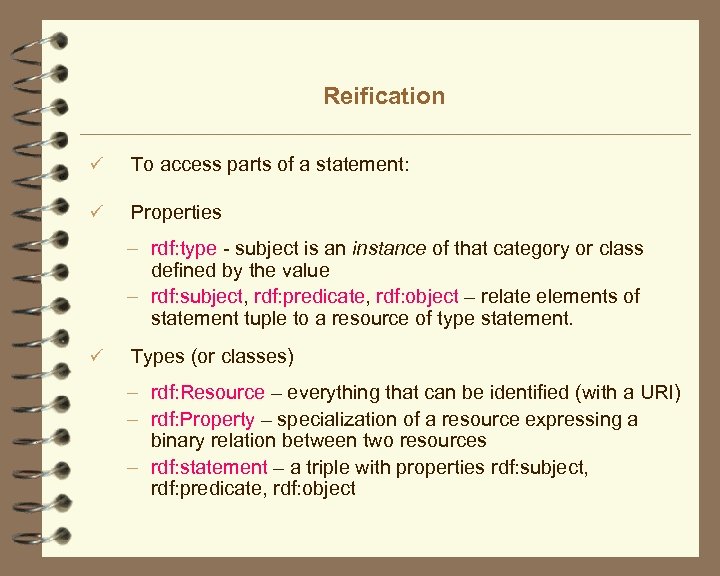
Reification ü To access parts of a statement: ü Properties – rdf: type - subject is an instance of that category or class defined by the value – rdf: subject, rdf: predicate, rdf: object – relate elements of statement tuple to a resource of type statement. ü Types (or classes) – rdf: Resource – everything that can be identified (with a URI) – rdf: Property – specialization of a resource expressing a binary relation between two resources – rdf: statement – a triple with properties rdf: subject, rdf: predicate, rdf: object
RDF Schema 26
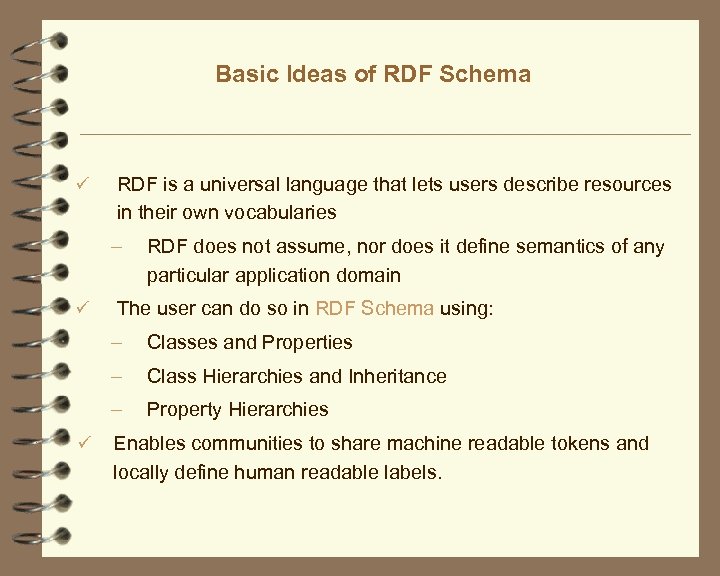
Basic Ideas of RDF Schema ü RDF is a universal language that lets users describe resources in their own vocabularies – ü RDF does not assume, nor does it define semantics of any particular application domain The user can do so in RDF Schema using: – – Class Hierarchies and Inheritance – ü Classes and Properties Property Hierarchies Enables communities to share machine readable tokens and locally define human readable labels. 27
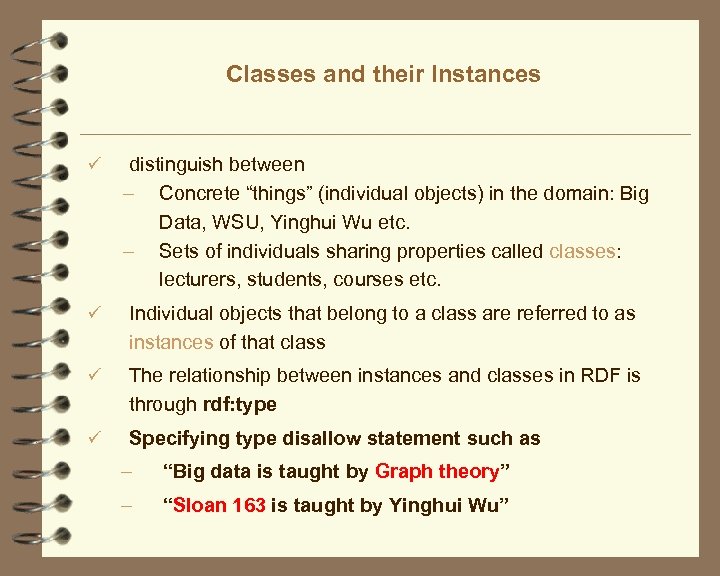
Classes and their Instances ü distinguish between – Concrete “things” (individual objects) in the domain: Big Data, WSU, Yinghui Wu etc. – Sets of individuals sharing properties called classes: lecturers, students, courses etc. ü Individual objects that belong to a class are referred to as instances of that class ü The relationship between instances and classes in RDF is through rdf: type ü Specifying type disallow statement such as – “Big data is taught by Graph theory” – “Sloan 163 is taught by Yinghui Wu” 28
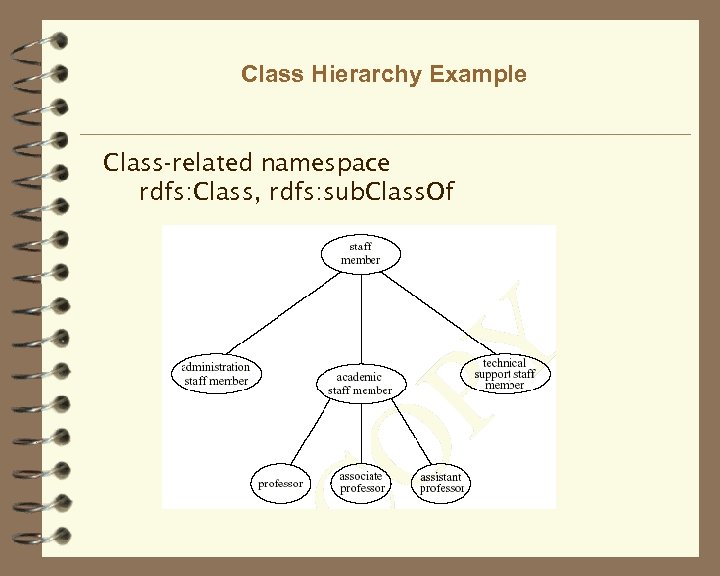
Class Hierarchy Example Class-related namespace rdfs: Class, rdfs: sub. Class. Of 29
Property Hierarchies ü Property-related namespace – rdfs: sub. Property. Of, rdfs: domain, rdfs: range ü Hierarchical relationships for properties – – ü E. g. , “is taught by” is a subproperty of “involves” If a course C is taught by an academic staff member A, then C also involves Α The converse is not necessarily true – ü a tutor who marks student homework but does not teach C P is a subproperty of Q, if Q(x, y) is true whenever P(x, y) is true 30
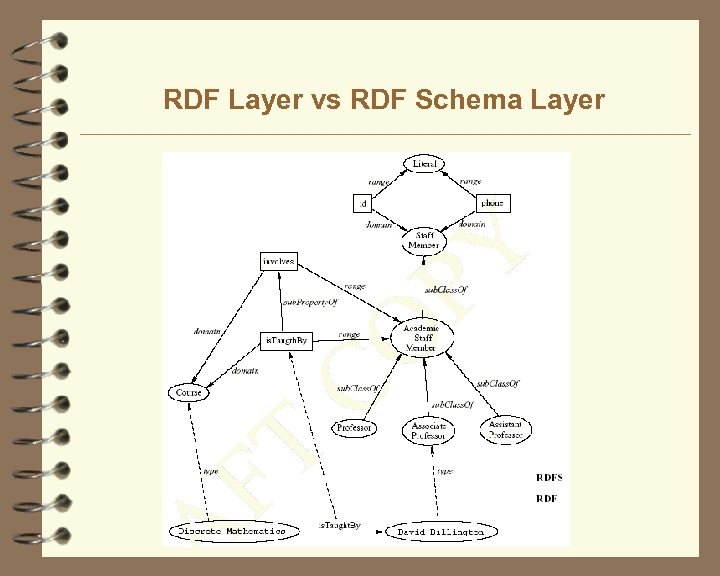
RDF Layer vs RDF Schema Layer 31
RDF Schema in RDF ü The modeling primitives of RDF Schema are defined using resources and properties (an RDF!) ü To declare that “lecturer” is a subclass of “academic staff member” – – define property sub. Class. Of – ü Define resources lecturer, academic. Staff. Member, and sub. Class. Of Write triple (lecturer, sub. Class. Of, academic. Staff. Member) XML-based syntax of RDF 32
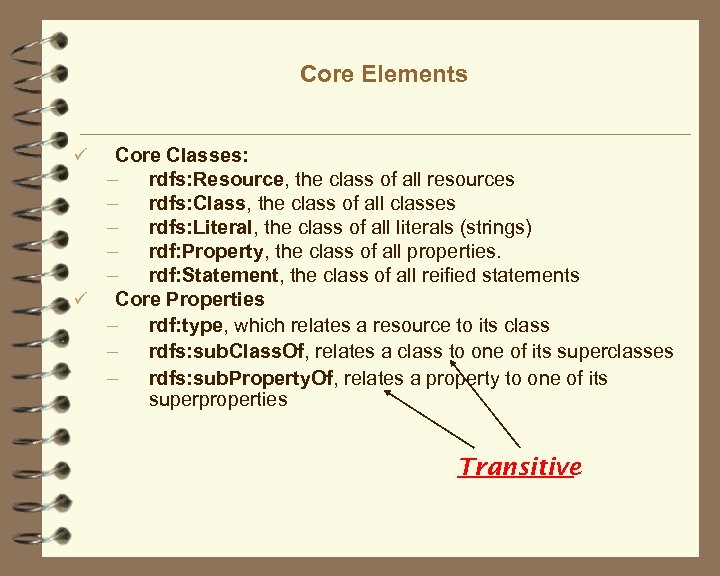
Core Elements Core Classes: – rdfs: Resource, the class of all resources – rdfs: Class, the class of all classes – rdfs: Literal, the class of all literals (strings) – rdf: Property, the class of all properties. – rdf: Statement, the class of all reified statements ü Core Properties – rdf: type, which relates a resource to its class – rdfs: sub. Class. Of, relates a class to one of its superclasses – rdfs: sub. Property. Of, relates a property to one of its superproperties ü Transitive 33
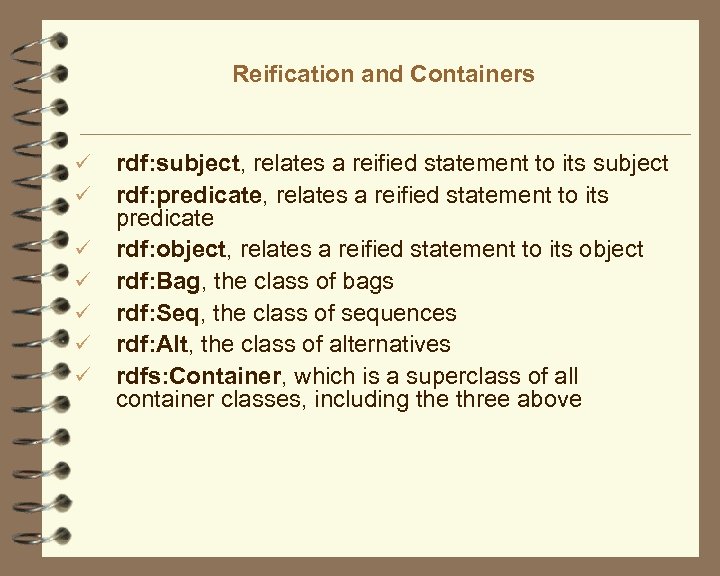
Reification and Containers ü ü ü ü rdf: subject, relates a reified statement to its subject rdf: predicate, relates a reified statement to its predicate rdf: object, relates a reified statement to its object rdf: Bag, the class of bags rdf: Seq, the class of sequences rdf: Alt, the class of alternatives rdfs: Container, which is a superclass of all container classes, including the three above 34
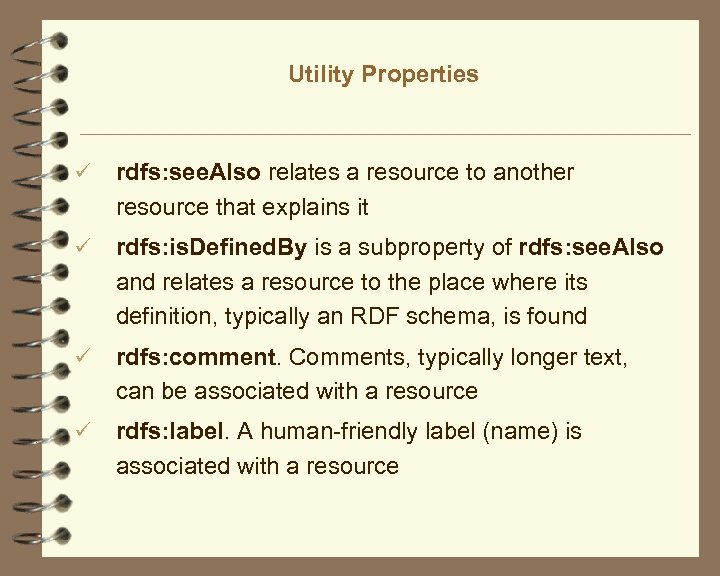
Utility Properties ü rdfs: see. Also relates a resource to another resource that explains it ü rdfs: is. Defined. By is a subproperty of rdfs: see. Also and relates a resource to the place where its definition, typically an RDF schema, is found ü rdfs: comment. Comments, typically longer text, can be associated with a resource ü rdfs: label. A human-friendly label (name) is associated with a resource 35
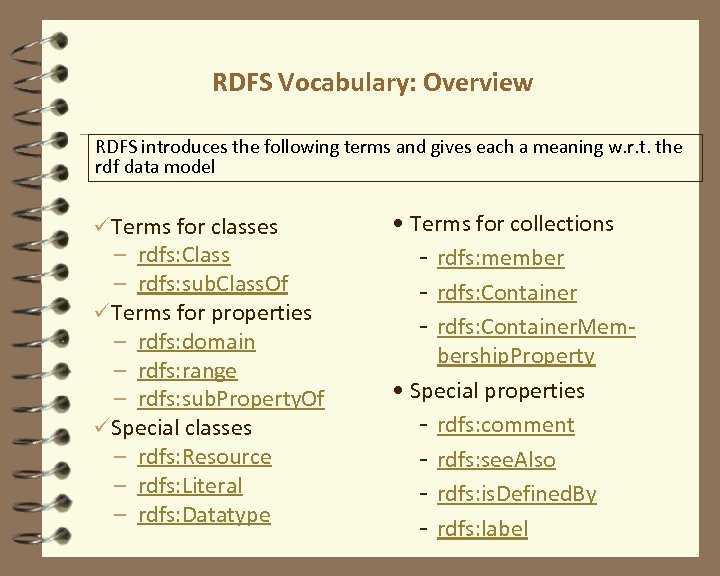
RDFS Vocabulary: Overview RDFS introduces the following terms and gives each a meaning w. r. t. the rdf data model ü Terms for classes – rdfs: Class – rdfs: sub. Class. Of ü Terms for properties – rdfs: domain – rdfs: range – rdfs: sub. Property. Of ü Special classes – rdfs: Resource – rdfs: Literal – rdfs: Datatype • Terms for collections - rdfs: member - rdfs: Container. Membership. Property • Special properties - rdfs: comment - rdfs: see. Also - rdfs: is. Defined. By - rdfs: label
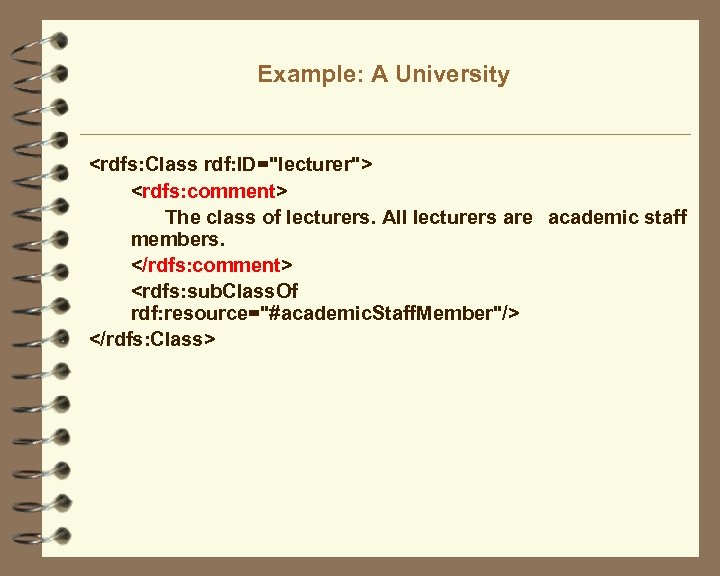
Example: A University <rdfs: Class rdf: ID="lecturer"> <rdfs: comment> The class of lecturers. All lecturers are academic staff members. </rdfs: comment> <rdfs: sub. Class. Of rdf: resource="#academic. Staff. Member"/> </rdfs: Class> 37
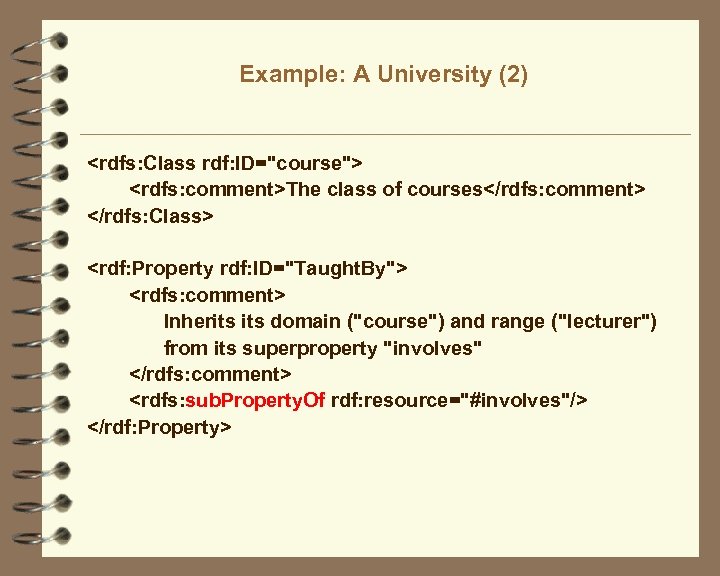
Example: A University (2) <rdfs: Class rdf: ID="course"> <rdfs: comment>The class of courses</rdfs: comment> </rdfs: Class> <rdf: Property rdf: ID="Taught. By"> <rdfs: comment> Inherits domain ("course") and range ("lecturer") from its superproperty "involves" </rdfs: comment> <rdfs: sub. Property. Of rdf: resource="#involves"/> </rdf: Property> 38
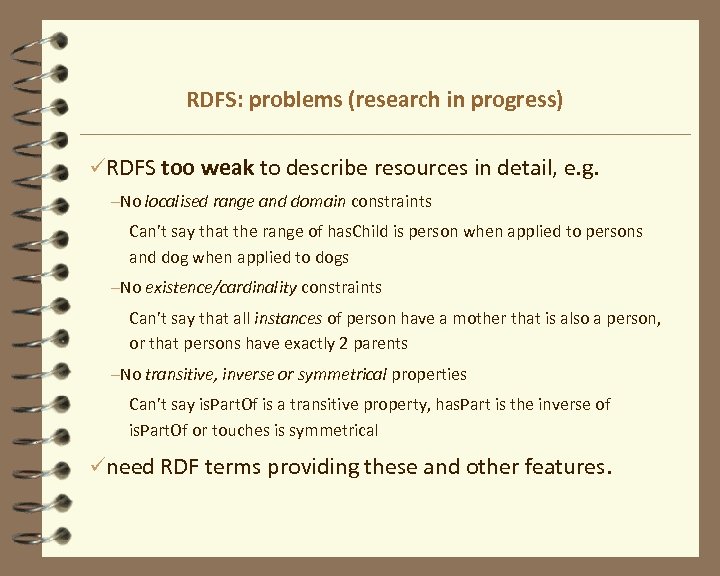
RDFS: problems (research in progress) üRDFS too weak to describe resources in detail, e. g. –No localised range and domain constraints Can’t say that the range of has. Child is person when applied to persons and dog when applied to dogs –No existence/cardinality constraints Can’t say that all instances of person have a mother that is also a person, or that persons have exactly 2 parents –No transitive, inverse or symmetrical properties Can’t say is. Part. Of is a transitive property, has. Part is the inverse of is. Part. Of or touches is symmetrical üneed RDF terms providing these and other features.
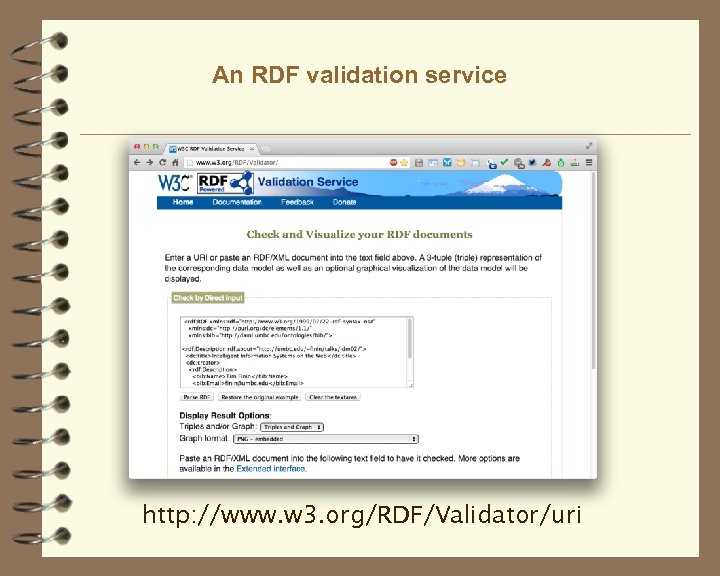
An RDF validation service http: //www. w 3. org/RDF/Validator/uri
RDF Semantics Inferencing 41
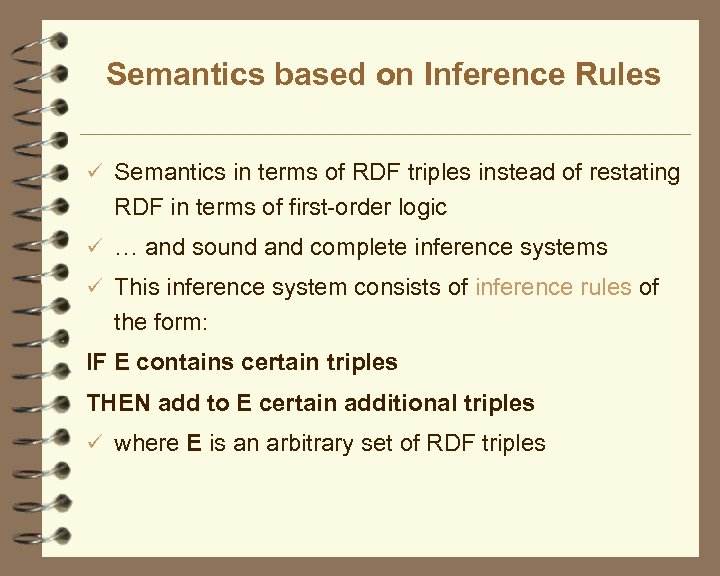
Semantics based on Inference Rules ü Semantics in terms of RDF triples instead of restating RDF in terms of first-order logic ü … and sound and complete inference systems ü This inference system consists of inference rules of the form: IF E contains certain triples THEN add to E certain additional triples ü where E is an arbitrary set of RDF triples 42
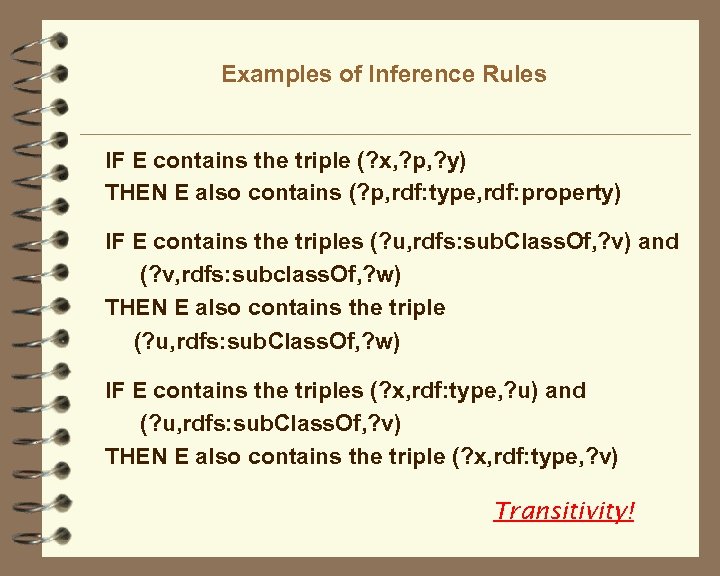
Examples of Inference Rules IF E contains the triple (? x, ? p, ? y) THEN E also contains (? p, rdf: type, rdf: property) IF E contains the triples (? u, rdfs: sub. Class. Of, ? v) and (? v, rdfs: subclass. Of, ? w) THEN E also contains the triple (? u, rdfs: sub. Class. Of, ? w) IF E contains the triples (? x, rdf: type, ? u) and (? u, rdfs: sub. Class. Of, ? v) THEN E also contains the triple (? x, rdf: type, ? v) Transitivity! 43
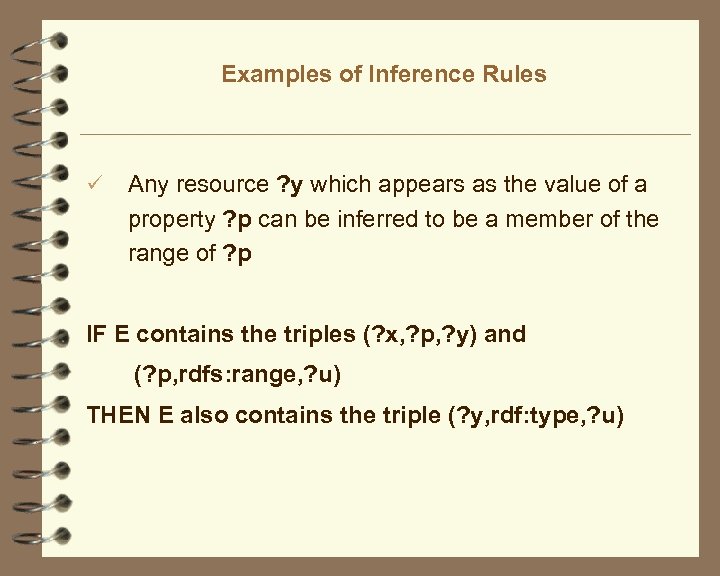
Examples of Inference Rules ü Any resource ? y which appears as the value of a property ? p can be inferred to be a member of the range of ? p IF E contains the triples (? x, ? p, ? y) and (? p, rdfs: range, ? u) THEN E also contains the triple (? y, rdf: type, ? u) 44
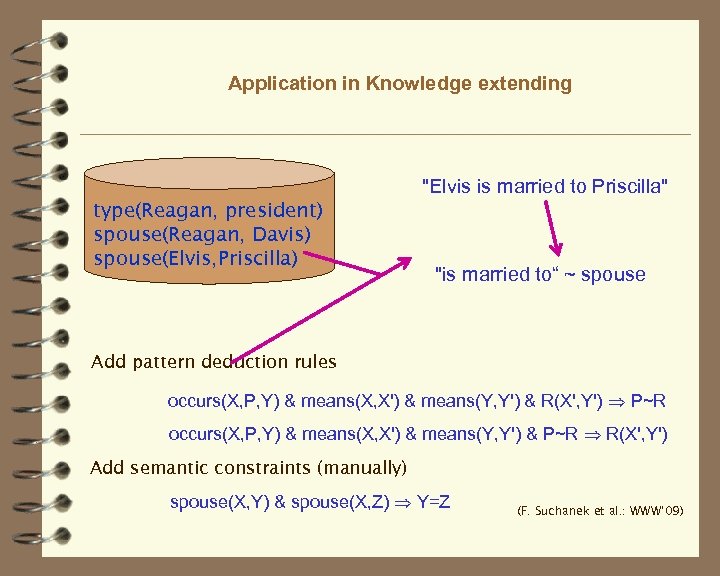
Application in Knowledge extending "Elvis is married to Priscilla" type(Reagan, president) spouse(Reagan, Davis) spouse(Elvis, Priscilla) "is married to“ ~ spouse Add pattern deduction rules occurs(X, P, Y) & means(X, X') & means(Y, Y') & R(X', Y') P~R occurs(X, P, Y) & means(X, X') & means(Y, Y') & P~R R(X', Y') Add semantic constraints (manually) spouse(X, Y) & spouse(X, Z) Y=Z (F. Suchanek et al. : WWW‘ 09)
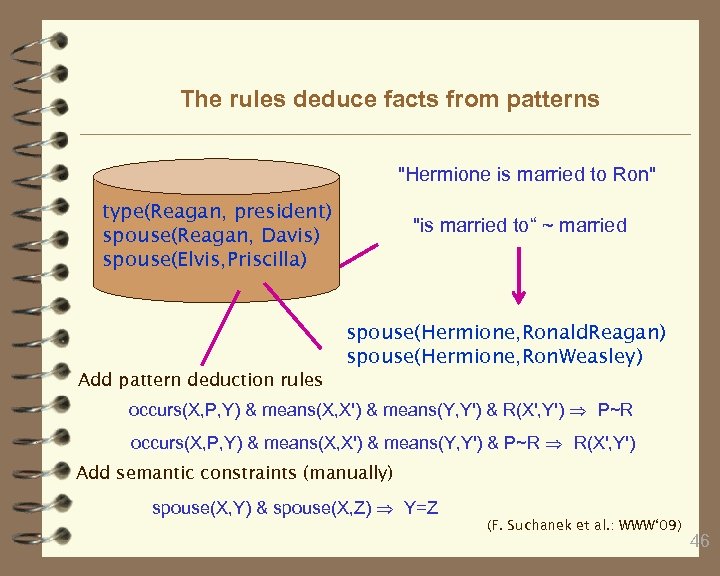
The rules deduce facts from patterns "Hermione is married to Ron" type(Reagan, president) spouse(Reagan, Davis) spouse(Elvis, Priscilla) "is married to“ ~ married spouse(Hermione, Ronald. Reagan) spouse(Hermione, Ron. Weasley) Add pattern deduction rules occurs(X, P, Y) & means(X, X') & means(Y, Y') & R(X', Y') P~R occurs(X, P, Y) & means(X, X') & means(Y, Y') & P~R R(X', Y') Add semantic constraints (manually) spouse(X, Y) & spouse(X, Z) Y=Z (F. Suchanek et al. : WWW‘ 09) 46
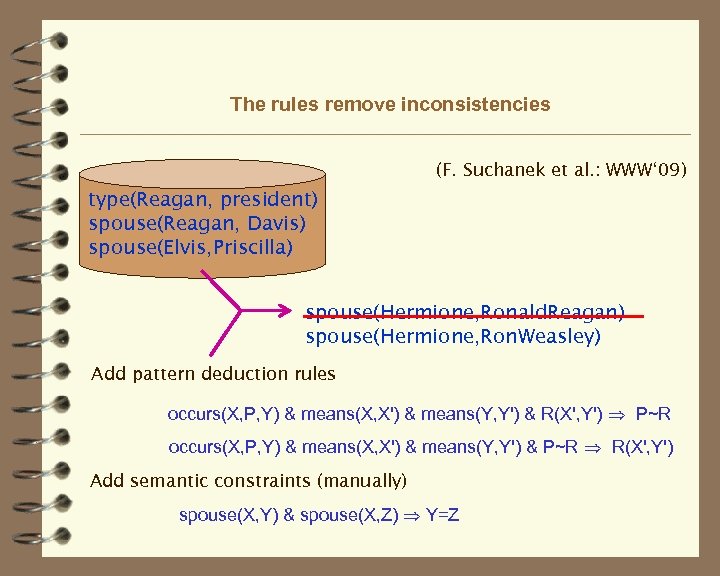
The rules remove inconsistencies (F. Suchanek et al. : WWW‘ 09) type(Reagan, president) spouse(Reagan, Davis) spouse(Elvis, Priscilla) spouse(Hermione, Ronald. Reagan) spouse(Hermione, Ron. Weasley) Add pattern deduction rules occurs(X, P, Y) & means(X, X') & means(Y, Y') & R(X', Y') P~R occurs(X, P, Y) & means(X, X') & means(Y, Y') & P~R R(X', Y') Add semantic constraints (manually) spouse(X, Y) & spouse(X, Z) Y=Z
RDF and Linked data 48
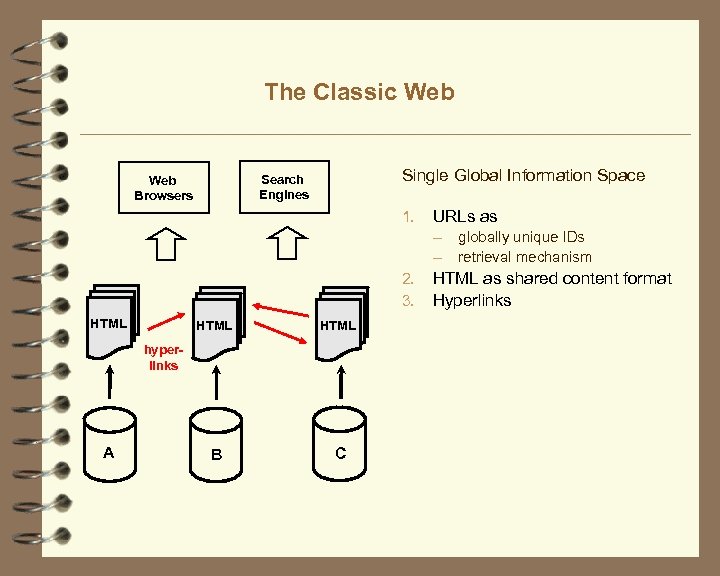
The Classic Web Single Global Information Space Search Engines Web Browsers 1. URLs as – – 2. 3. HTML B C hyperlinks A globally unique IDs retrieval mechanism HTML as shared content format Hyperlinks
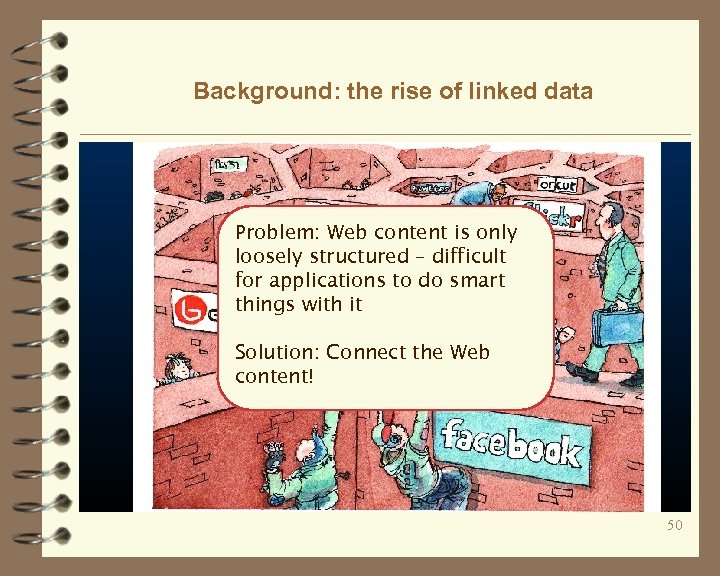
Background: the rise of linked data Problem: Web content is only loosely structured – difficult for applications to do smart things with it Solution: Connect the Web content! 50
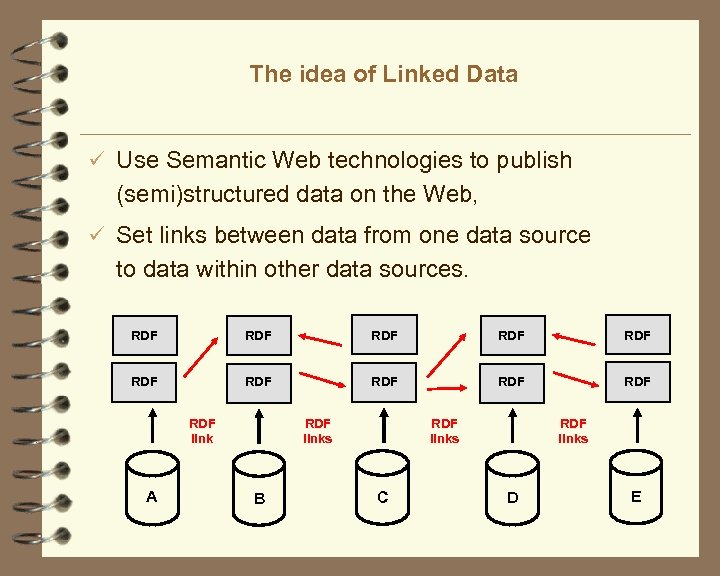
The idea of Linked Data ü Use Semantic Web technologies to publish (semi)structured data on the Web, ü Set links between data from one data source to data within other data sources. RDF RDF RDF link A RDF links B RDF links C RDF links D E
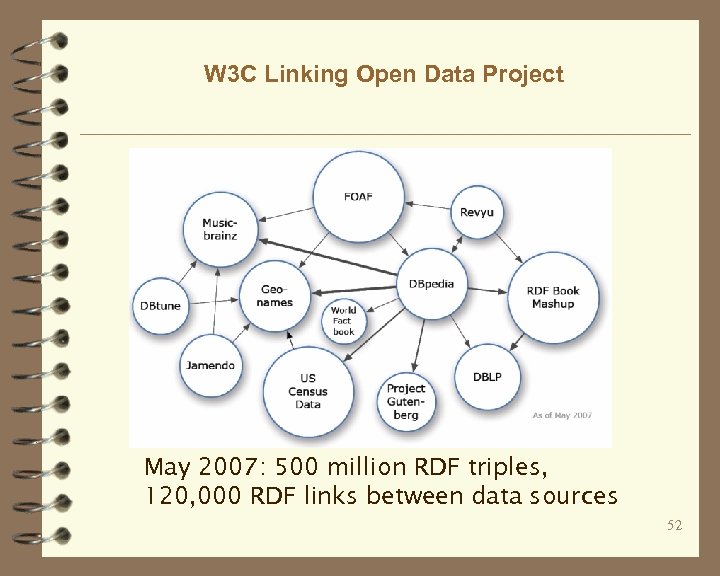
W 3 C Linking Open Data Project May 2007: 500 million RDF triples, 120, 000 RDF links between data sources 52
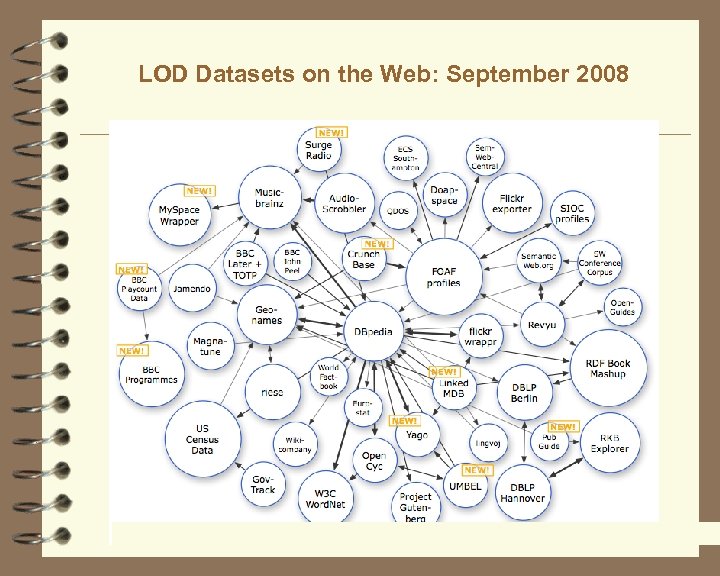
LOD Datasets on the Web: September 2008
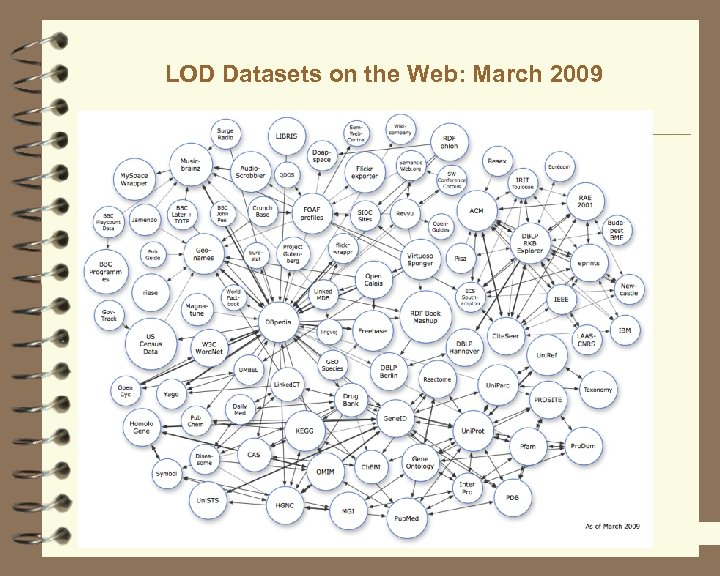
LOD Datasets on the Web: March 2009
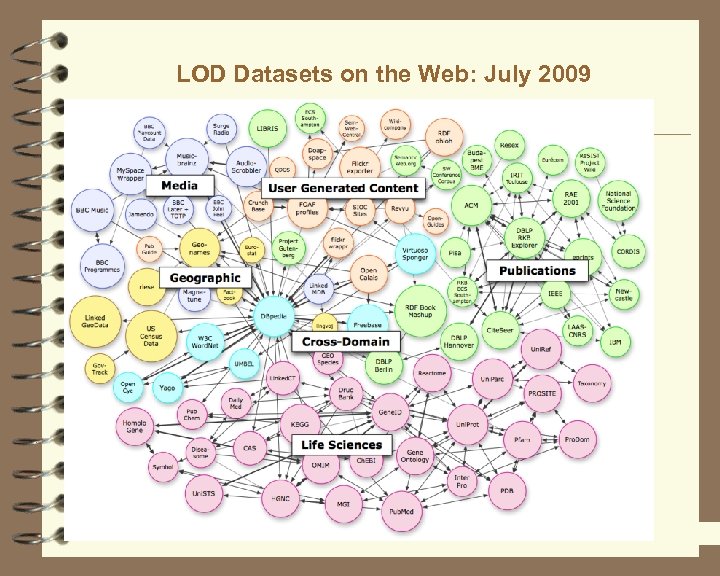
LOD Datasets on the Web: July 2009
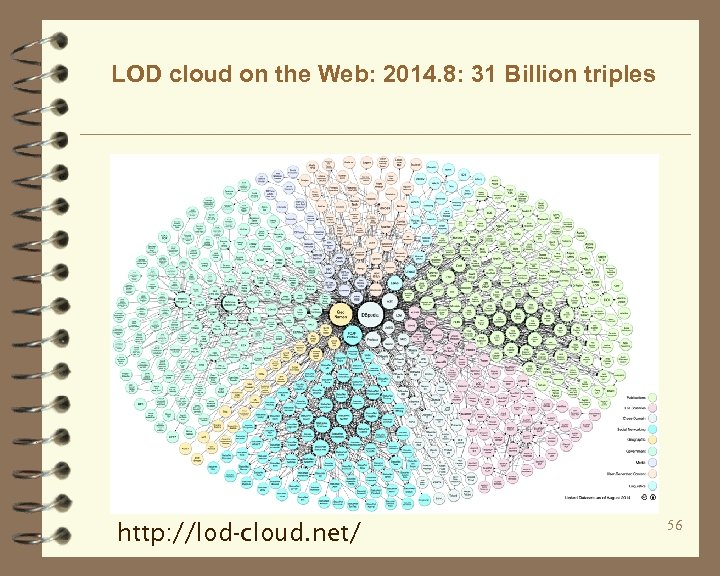
LOD cloud on the Web: 2014. 8: 31 Billion triples http: //lod-cloud. net/ 56
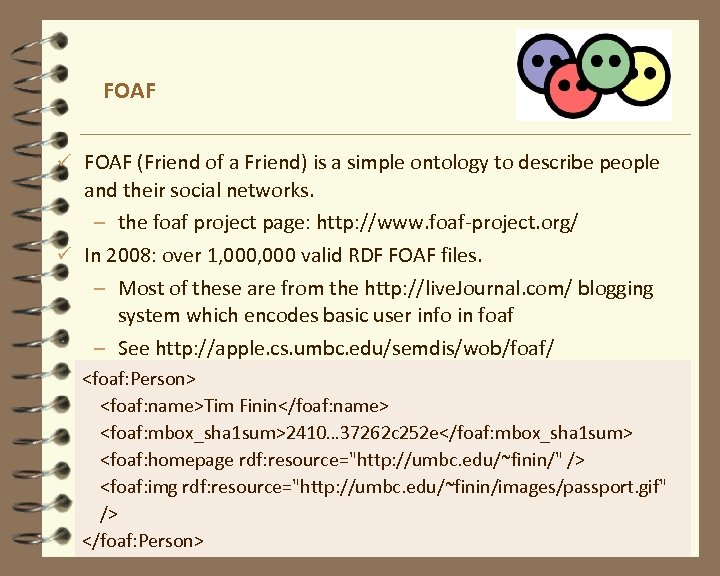
FOAF ü FOAF (Friend of a Friend) is a simple ontology to describe people and their social networks. – the foaf project page: http: //www. foaf-project. org/ ü In 2008: over 1, 000 valid RDF FOAF files. – Most of these are from the http: //live. Journal. com/ blogging system which encodes basic user info in foaf – See http: //apple. cs. umbc. edu/semdis/wob/foaf/ <foaf: Person> <foaf: name>Tim Finin</foaf: name> <foaf: mbox_sha 1 sum>2410… 37262 c 252 e</foaf: mbox_sha 1 sum> <foaf: homepage rdf: resource="http: //umbc. edu/~finin/" /> <foaf: img rdf: resource="http: //umbc. edu/~finin/images/passport. gif" /> </foaf: Person>
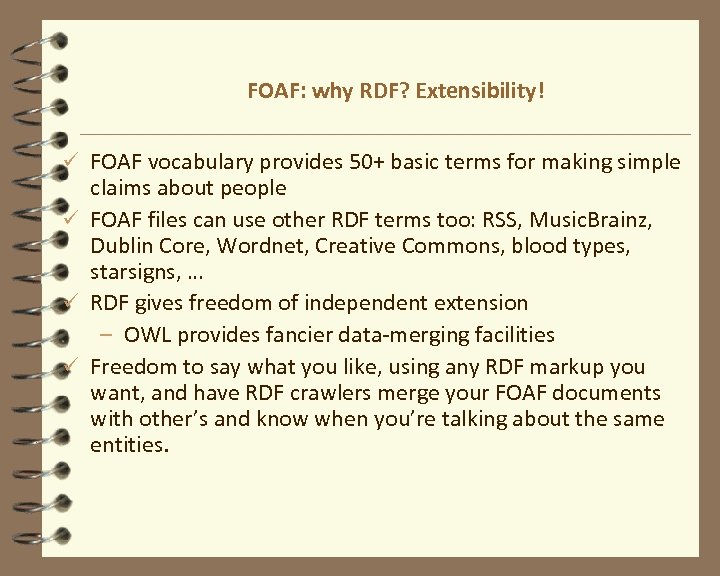
FOAF: why RDF? Extensibility! ü FOAF vocabulary provides 50+ basic terms for making simple claims about people ü FOAF files can use other RDF terms too: RSS, Music. Brainz, Dublin Core, Wordnet, Creative Commons, blood types, starsigns, … ü RDF gives freedom of independent extension – OWL provides fancier data-merging facilities ü Freedom to say what you like, using any RDF markup you want, and have RDF crawlers merge your FOAF documents with other’s and know when you’re talking about the same entities.
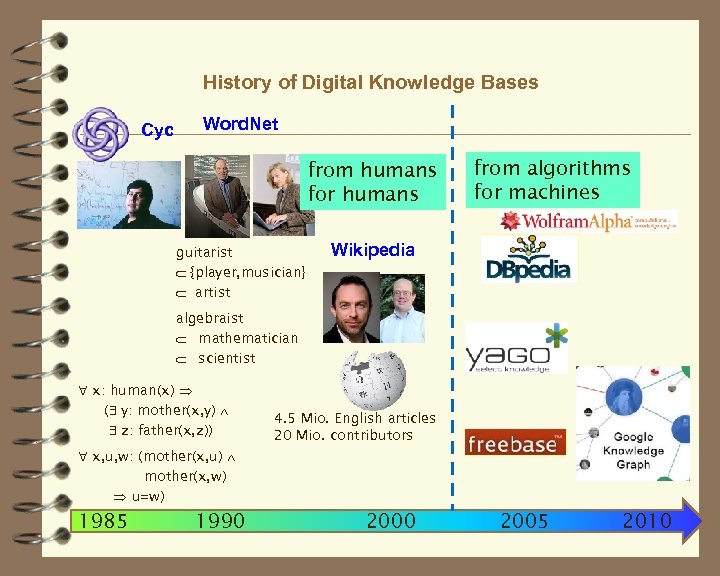
History of Digital Knowledge Bases Cyc Word. Net from humans for humans guitarist {player, musician} artist from algorithms for machines Wikipedia algebraist mathematician scientist x: human(x) ( y: mother(x, y) z: father(x, z)) 4. 5 Mio. English articles 20 Mio. contributors x, u, w: (mother(x, u) mother(x, w) u=w) 1985 1990 2005 2010
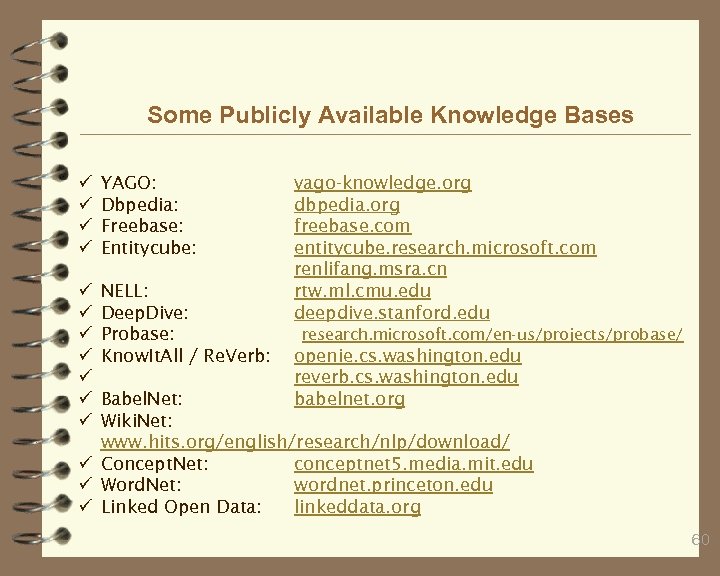
Some Publicly Available Knowledge Bases ü ü YAGO: Dbpedia: Freebase: Entitycube: ü ü ü ü NELL: Deep. Dive: Probase: Know. It. All / Re. Verb: yago-knowledge. org dbpedia. org freebase. com entitycube. research. microsoft. com renlifang. msra. cn rtw. ml. cmu. edu deepdive. stanford. edu research. microsoft. com/en-us/projects/probase/ openie. cs. washington. edu reverb. cs. washington. edu babelnet. org Babel. Net: Wiki. Net: www. hits. org/english/research/nlp/download/ ü Concept. Net: conceptnet 5. media. mit. edu ü Word. Net: wordnet. princeton. edu ü Linked Open Data: linkeddata. org 60
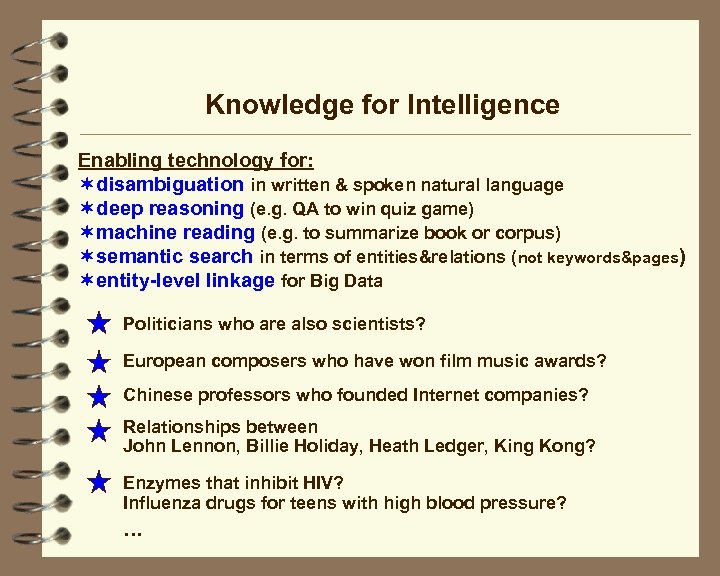
Knowledge for Intelligence Enabling technology for: disambiguation in written & spoken natural language deep reasoning (e. g. QA to win quiz game) machine reading (e. g. to summarize book or corpus) semantic search in terms of entities&relations (not keywords&pages) entity-level linkage for Big Data Politicians who are also scientists? European composers who have won film music awards? Chinese professors who founded Internet companies? Relationships between John Lennon, Billie Holiday, Heath Ledger, King Kong? Enzymes that inhibit HIV? Influenza drugs for teens with high blood pressure? . . .
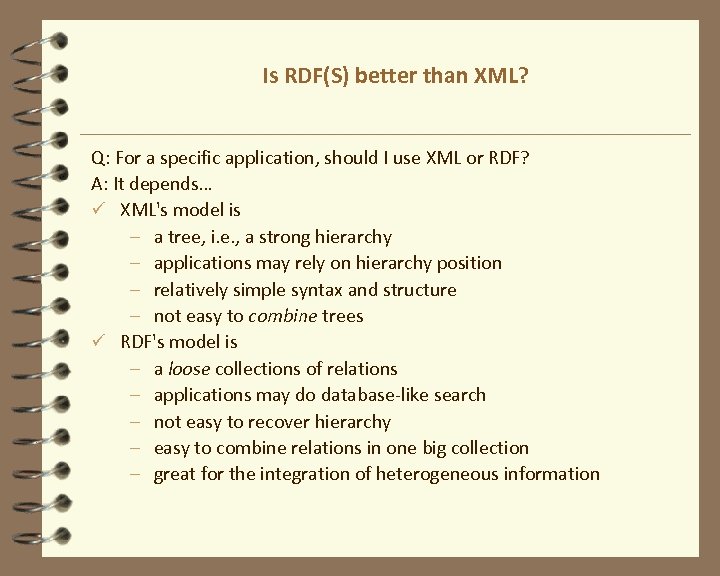
Is RDF(S) better than XML? Q: For a specific application, should I use XML or RDF? A: It depends… ü XML's model is – a tree, i. e. , a strong hierarchy – applications may rely on hierarchy position – relatively simple syntax and structure – not easy to combine trees ü RDF's model is – a loose collections of relations – applications may do database-like search – not easy to recover hierarchy – easy to combine relations in one big collection – great for the integration of heterogeneous information
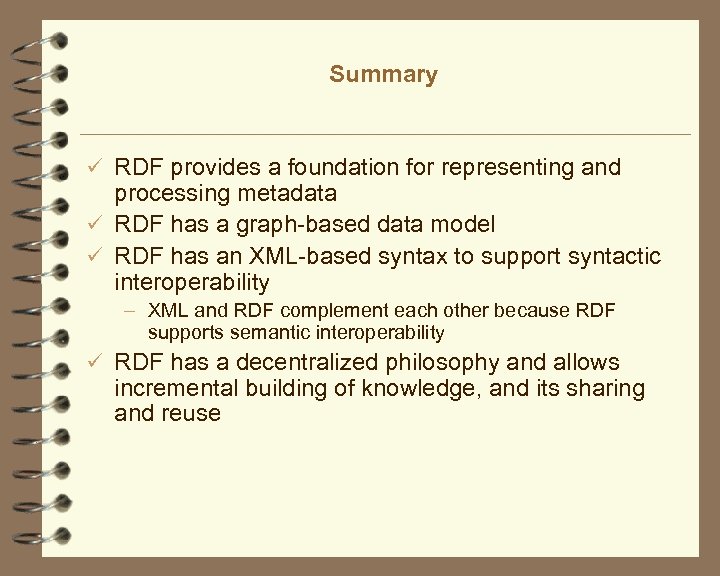
Summary ü RDF provides a foundation for representing and processing metadata ü RDF has a graph-based data model ü RDF has an XML-based syntax to support syntactic interoperability – XML and RDF complement each other because RDF supports semantic interoperability ü RDF has a decentralized philosophy and allows incremental building of knowledge, and its sharing and reuse 63
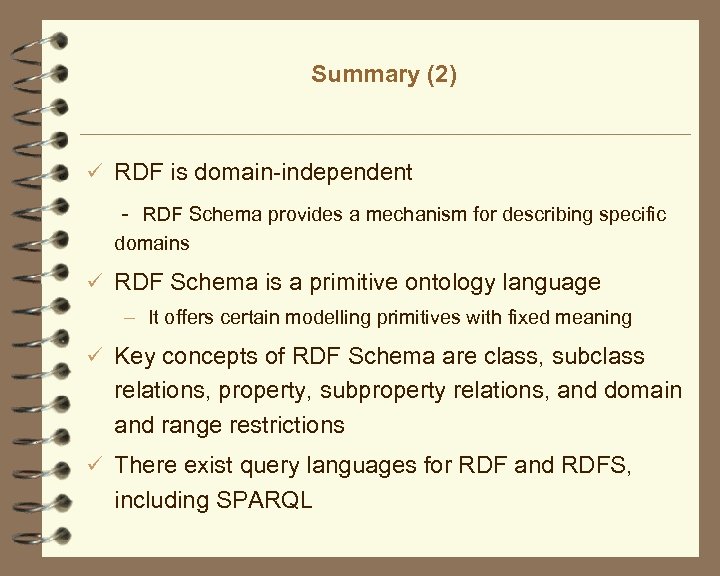
Summary (2) ü RDF is domain-independent - RDF Schema provides a mechanism for describing specific domains ü RDF Schema is a primitive ontology language – It offers certain modelling primitives with fixed meaning ü Key concepts of RDF Schema are class, subclass relations, property, subproperty relations, and domain and range restrictions ü There exist query languages for RDF and RDFS, including SPARQL 64
Reading list 2 (see course website) ü Next lecture: no. SQL systems ü For the following up two weeks, read: – “professional no. SQL”, chap 1 (page 1 -20) http: //eecs. wsu. edu/~yinghui/mat/courses/fall%202016/resources/p rofessional_nosql. pdf – “no. SQL databases”, chap 1 & 2 http: //eecs. wsu. edu/~yinghui/mat/courses/fall%202016/resources/n osqldbs. pdf – Scalable SQL and no. SQL data stores, Rick Cattell http: //dl. acm. org/citation. cfm? id=1978919 65
Скачать презентацию CPT-S 415 Big Data Yinghui Wu EME B
9c208f2620f3cc408aa2c4cdc808aa91.ppt