 Скачать презентацию CPSC 231 Classes and Objects You will learn
49046d68a40151fba6305b486d6096f3.ppt
- Количество слайдов: 42



CPSC 231: Classes and Objects You will learn how to define new types of variables that can have custom attributes and capabilities slide 1
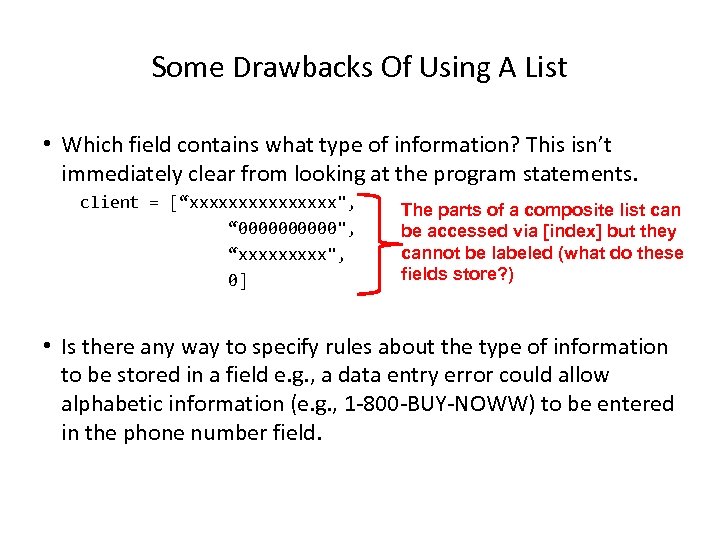
Some Drawbacks Of Using A List • Which field contains what type of information? This isn’t immediately clear from looking at the program statements. client = [“xxxxxxxx", “ 00000", “xxxxx", 0] The parts of a composite list can be accessed via [index] but they cannot be labeled (what do these fields store? ) • Is there any way to specify rules about the type of information to be stored in a field e. g. , a data entry error could allow alphabetic information (e. g. , 1 -800 -BUY-NOWW) to be entered in the phone number field.
Classes • Can be used to define a generic template for a new nonhomogeneous composite type. • It can label and define more complex entities than a list. • This template defines what an instance (example) of this new composite type would consist of but it doesn’t create an instance. Copyright information unknown James Tam
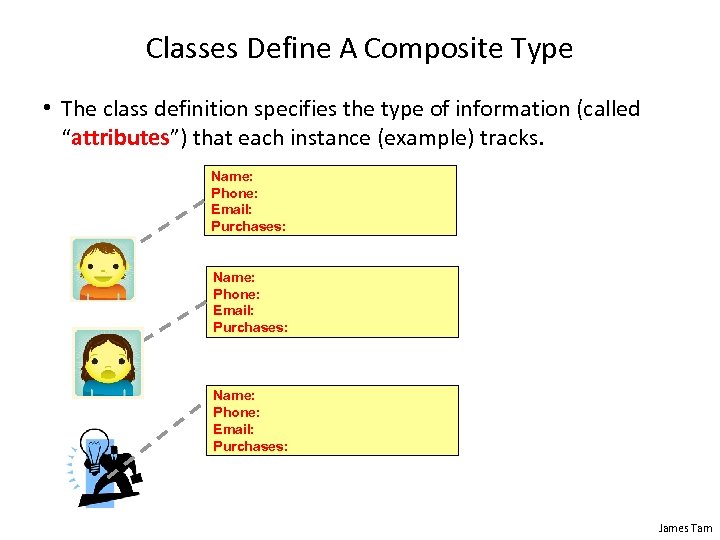
Classes Define A Composite Type • The class definition specifies the type of information (called “attributes”) that each instance (example) tracks. Name: Phone: Email: Purchases: James Tam
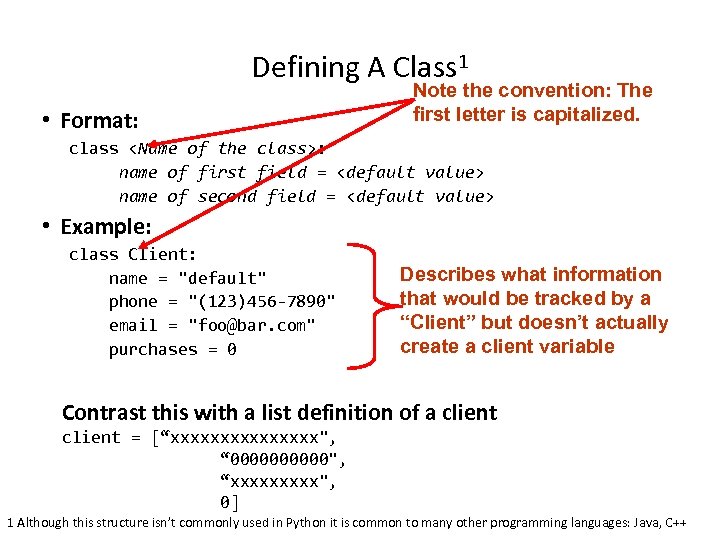
Defining A Class 1 • Format: Note the convention: The first letter is capitalized. class <Name of the class>: name of first field = <default value> name of second field = <default value> • Example: class Client: name = "default" phone = "(123)456 -7890" email = "foo@bar. com" purchases = 0 Describes what information that would be tracked by a “Client” but doesn’t actually create a client variable Contrast this with a list definition of a client = [“xxxxxxxx", “ 00000", “xxxxx", 0] 1 Although this structure isn’t commonly used in Python it is common to many other programming languages: Java, C++
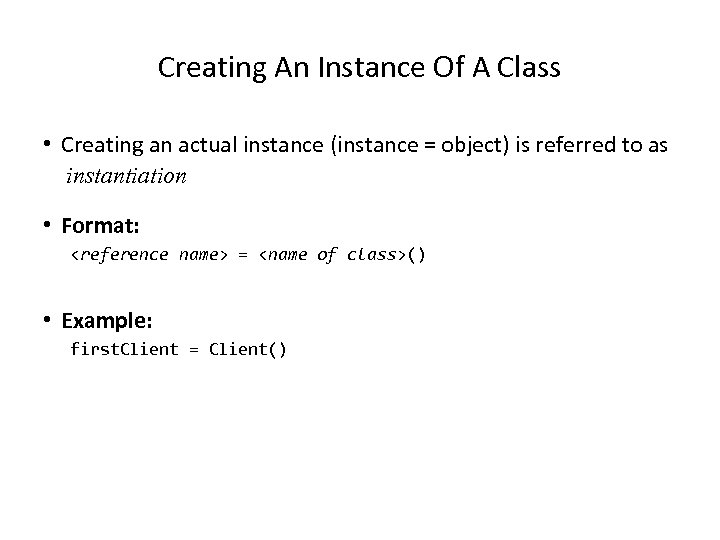
Creating An Instance Of A Class • Creating an actual instance (instance = object) is referred to as instantiation • Format: <reference name> = <name of class>() • Example: first. Client = Client()
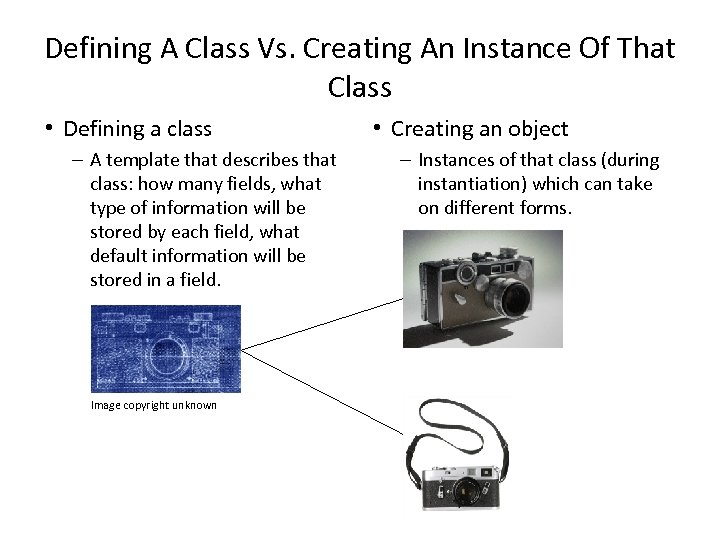
Defining A Class Vs. Creating An Instance Of That Class • Defining a class – A template that describes that class: how many fields, what type of information will be stored by each field, what default information will be stored in a field. Image copyright unknown • Creating an object – Instances of that class (during instantiation) which can take on different forms.
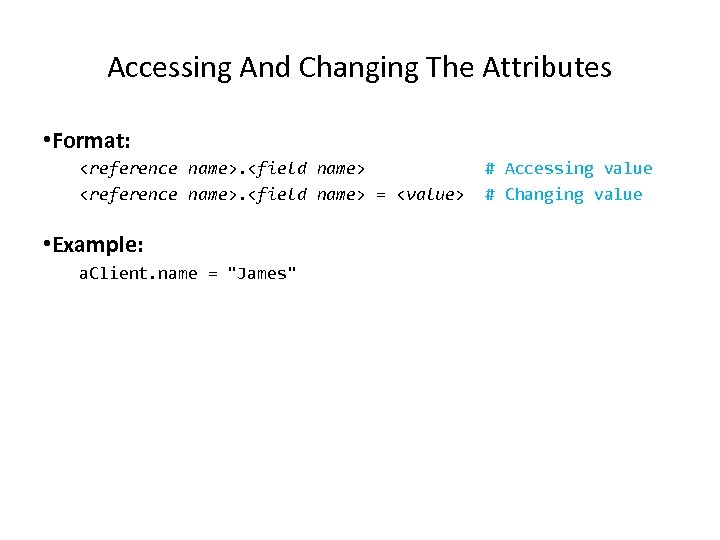
Accessing And Changing The Attributes • Format: <reference name>. <field name> = <value> • Example: a. Client. name = "James" # Accessing value # Changing value
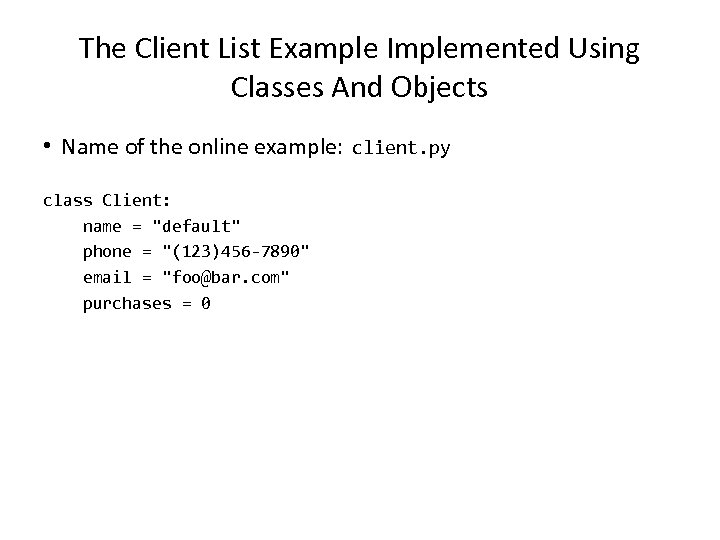
The Client List Example Implemented Using Classes And Objects • Name of the online example: client. py class Client: name = "default" phone = "(123)456 -7890" email = "foo@bar. com" purchases = 0
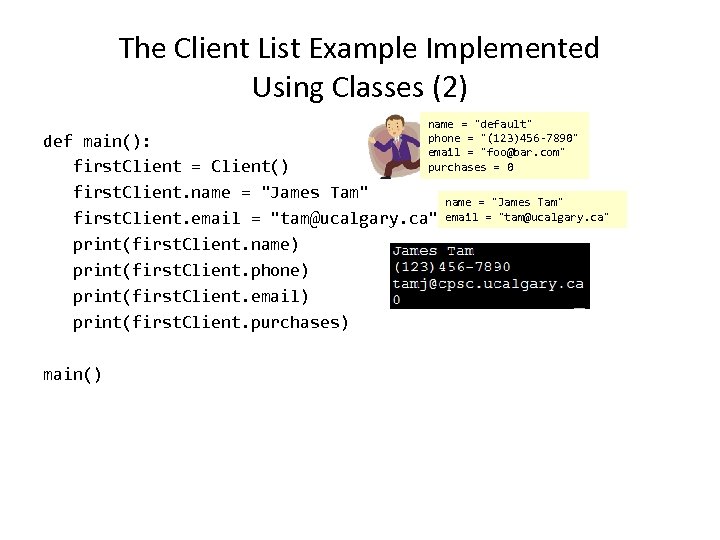
The Client List Example Implemented Using Classes (2) name = "default" phone = "(123)456 -7890" email = "foo@bar. com" purchases = 0 def main(): first. Client = Client() first. Client. name = "James Tam" first. Client. email = "tam@ucalgary. ca" print(first. Client. name) print(first. Client. phone) print(first. Client. email) print(first. Client. purchases) main() name = "James Tam" email = "tam@ucalgary. ca"
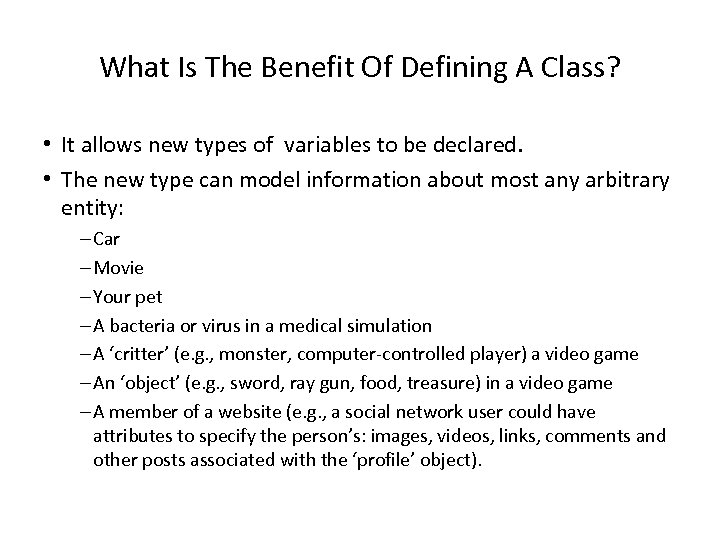
What Is The Benefit Of Defining A Class? • It allows new types of variables to be declared. • The new type can model information about most any arbitrary entity: – Car – Movie – Your pet – A bacteria or virus in a medical simulation – A ‘critter’ (e. g. , monster, computer-controlled player) a video game – An ‘object’ (e. g. , sword, ray gun, food, treasure) in a video game – A member of a website (e. g. , a social network user could have attributes to specify the person’s: images, videos, links, comments and other posts associated with the ‘profile’ object).
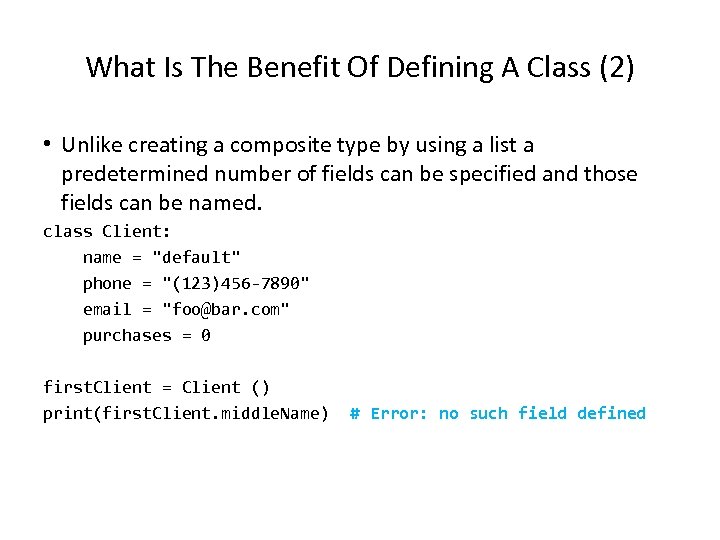
What Is The Benefit Of Defining A Class (2) • Unlike creating a composite type by using a list a predetermined number of fields can be specified and those fields can be named. class Client: name = "default" phone = "(123)456 -7890" email = "foo@bar. com" purchases = 0 first. Client = Client () print(first. Client. middle. Name) # Error: no such field defined
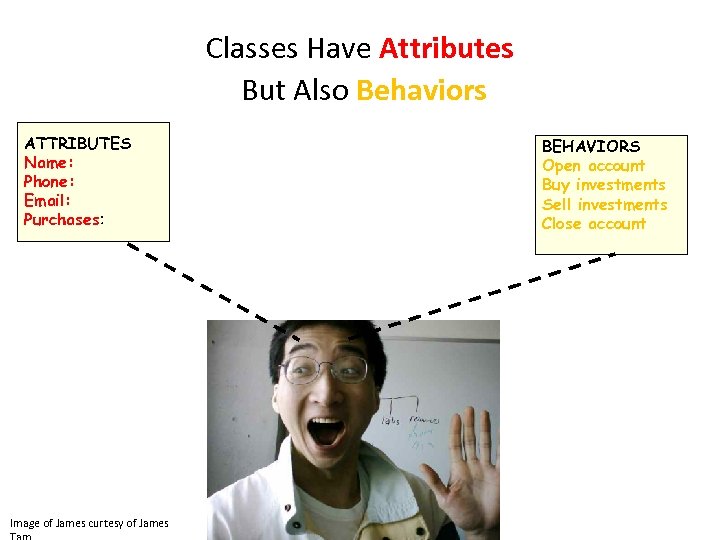
Classes Have Attributes But Also Behaviors ATTRIBUTES Name: Phone: Email: Purchases: Image of James curtesy of James BEHAVIORS Open account Buy investments Sell investments Close account
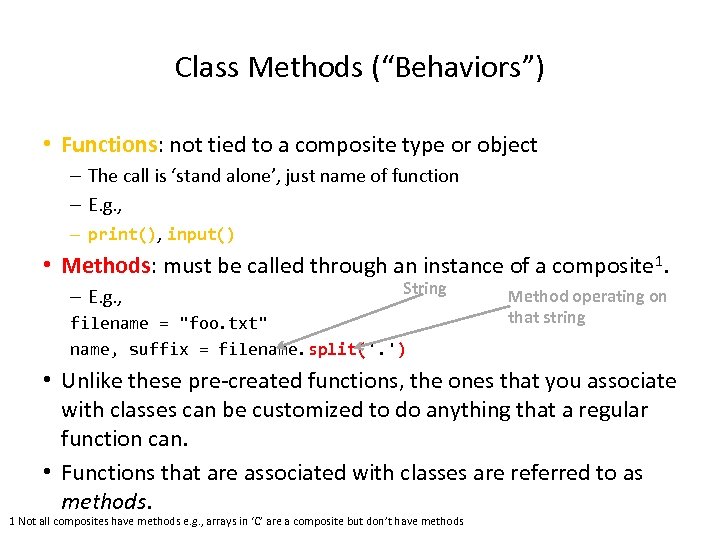
Class Methods (“Behaviors”) • Functions: not tied to a composite type or object – The call is ‘stand alone’, just name of function – E. g. , – print(), input() • Methods: must be called through an instance of a composite 1. – E. g. , String filename = "foo. txt" name, suffix = filename. split('. ') Method operating on that string • Unlike these pre-created functions, the ones that you associate with classes can be customized to do anything that a regular function can. • Functions that are associated with classes are referred to as methods. 1 Not all composites have methods e. g. , arrays in ‘C’ are a composite but don’t have methods
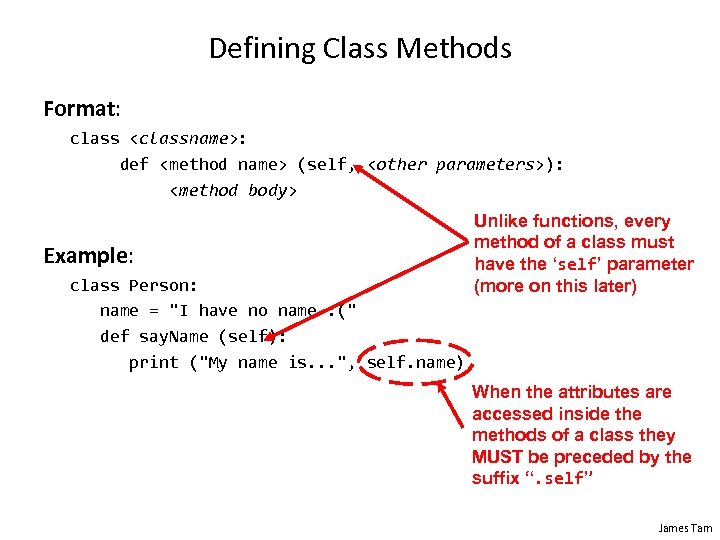
Defining Class Methods Format: class <classname>: def <method name> (self, <other parameters>): <method body> Example: class Person: name = "I have no name : (" def say. Name (self): print ("My name is. . . ", self. name) Unlike functions, every method of a class must have the ‘self’ parameter (more on this later) When the attributes are accessed inside the methods of a class they MUST be preceded by the suffix “. self” James Tam
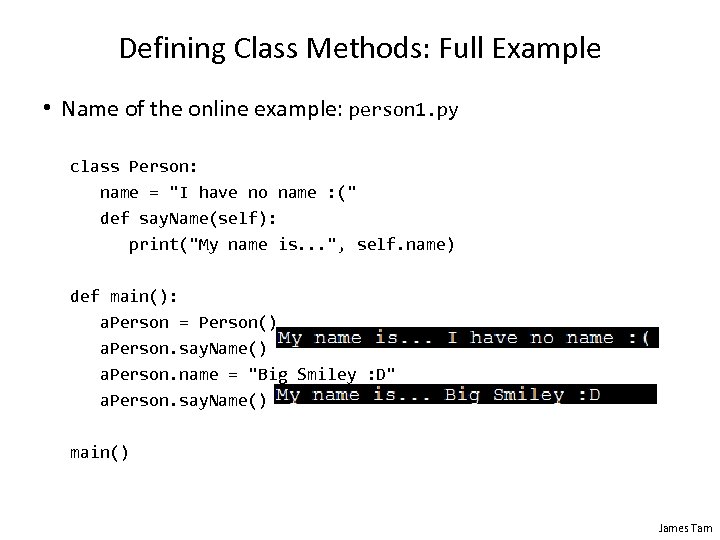
Defining Class Methods: Full Example • Name of the online example: person 1. py class Person: name = "I have no name : (" def say. Name(self): print("My name is. . . ", self. name) def main(): a. Person = Person() a. Person. say. Name() a. Person. name = "Big Smiley : D" a. Person. say. Name() main() James Tam
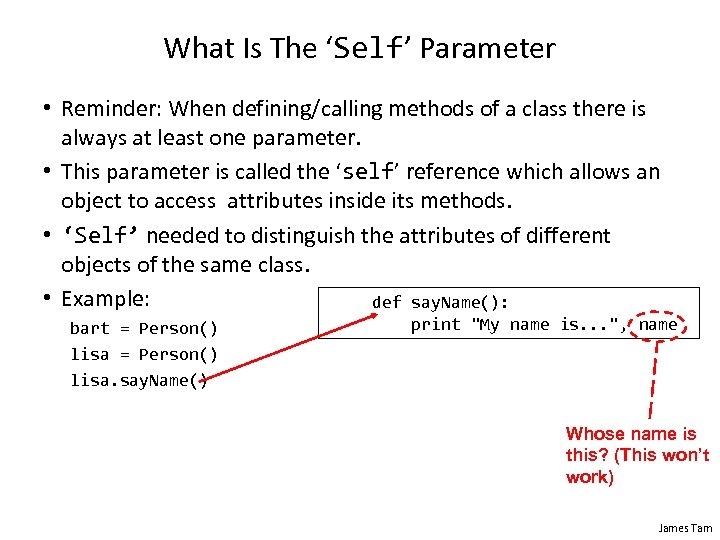
What Is The ‘Self’ Parameter • Reminder: When defining/calling methods of a class there is always at least one parameter. • This parameter is called the ‘self’ reference which allows an object to access attributes inside its methods. • ‘Self’ needed to distinguish the attributes of different objects of the same class. • Example: def say. Name(): bart = Person() lisa. say. Name() print "My name is. . . ", name Whose name is this? (This won’t work) James Tam
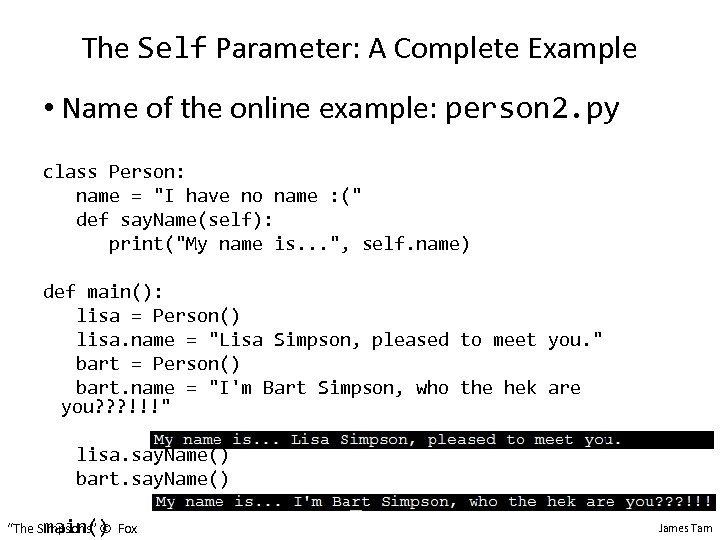
The Self Parameter: A Complete Example • Name of the online example: person 2. py class Person: name = "I have no name : (" def say. Name(self): print("My name is. . . ", self. name) def main(): lisa = Person() lisa. name = "Lisa Simpson, pleased to meet you. " bart = Person() bart. name = "I'm Bart Simpson, who the hek are you? ? ? !!!" lisa. say. Name() bart. say. Name() “The Simpsons” Fox main() James Tam
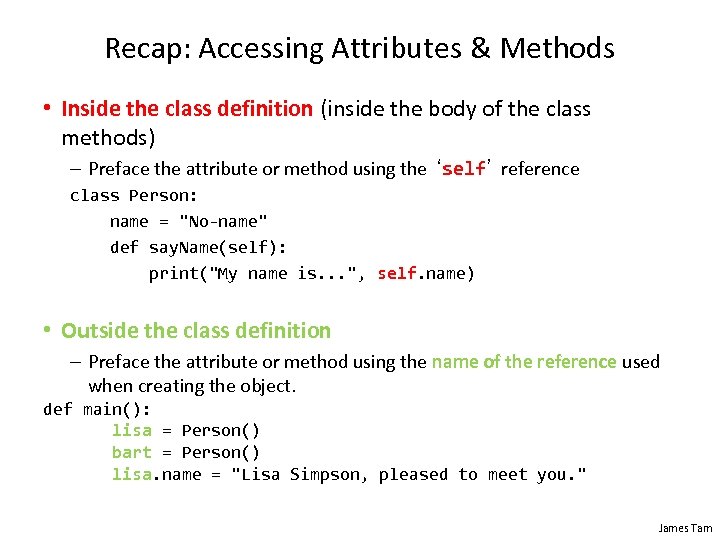
Recap: Accessing Attributes & Methods • Inside the class definition (inside the body of the class methods) – Preface the attribute or method using the ‘self’ reference class Person: name = "No-name" def say. Name(self): print("My name is. . . ", self. name) • Outside the class definition – Preface the attribute or method using the name of the reference used when creating the object. def main(): lisa = Person() bart = Person() lisa. name = "Lisa Simpson, pleased to meet you. " James Tam
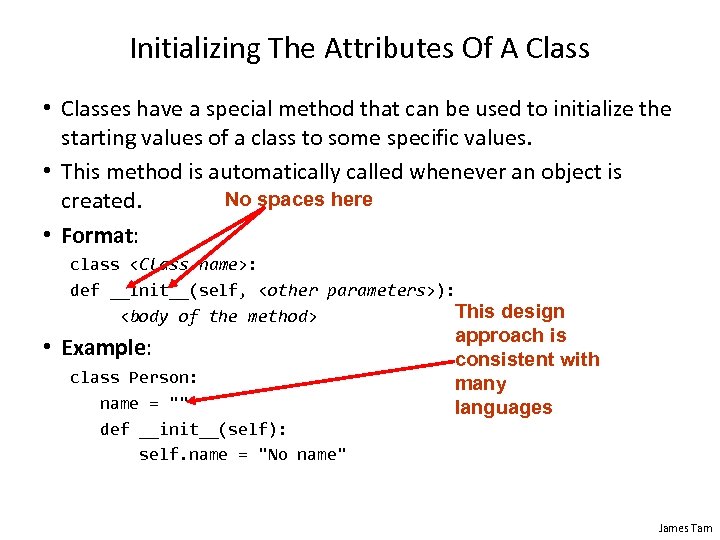
Initializing The Attributes Of A Class • Classes have a special method that can be used to initialize the starting values of a class to some specific values. • This method is automatically called whenever an object is No spaces here created. • Format: class <Class name>: def __init__(self, <other parameters>): This design <body of the method> • Example: class Person: name = "" def __init__(self): self. name = "No name" approach is consistent with many languages James Tam
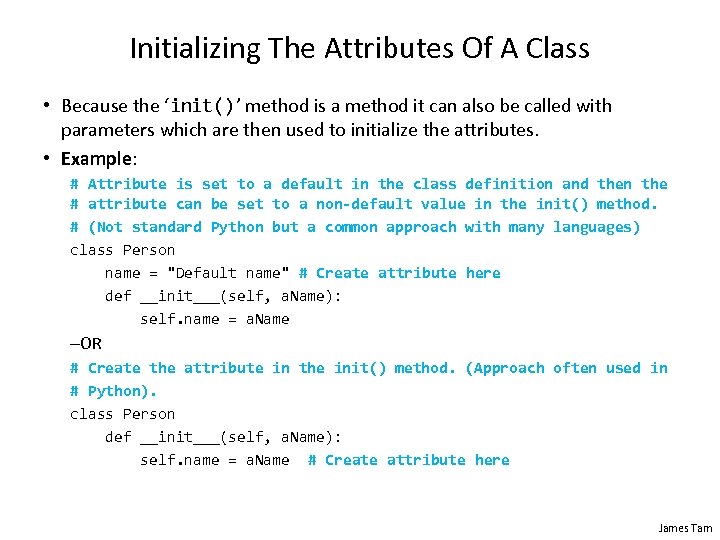
Initializing The Attributes Of A Class • Because the ‘init()’ method is a method it can also be called with parameters which are then used to initialize the attributes. • Example: # Attribute is set to a default in the class definition and then the # attribute can be set to a non-default value in the init() method. # (Not standard Python but a common approach with many languages) class Person name = "Default name" # Create attribute here def __init___(self, a. Name): self. name = a. Name –OR # Create the attribute in the init() method. (Approach often used in # Python). class Person def __init___(self, a. Name): self. name = a. Name # Create attribute here James Tam
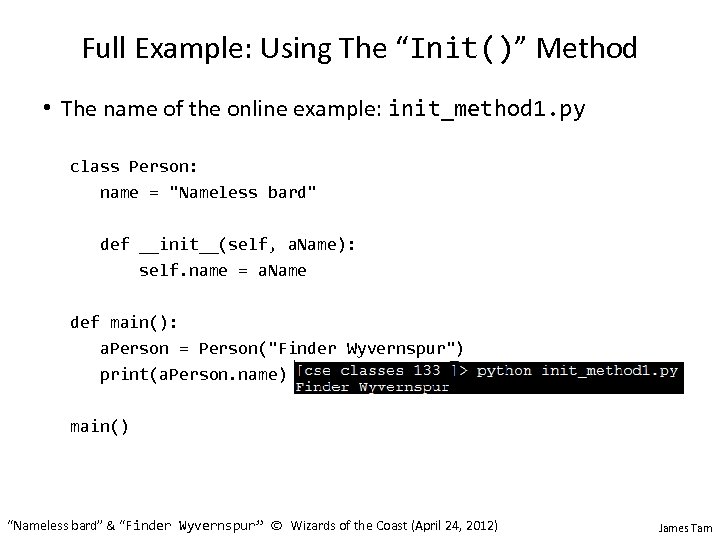
Full Example: Using The “Init()” Method • The name of the online example: init_method 1. py class Person: name = "Nameless bard" def __init__(self, a. Name): self. name = a. Name def main(): a. Person = Person("Finder Wyvernspur") print(a. Person. name) main() “Nameless bard” & “Finder Wyvernspur” Wizards of the Coast (April 24, 2012) James Tam
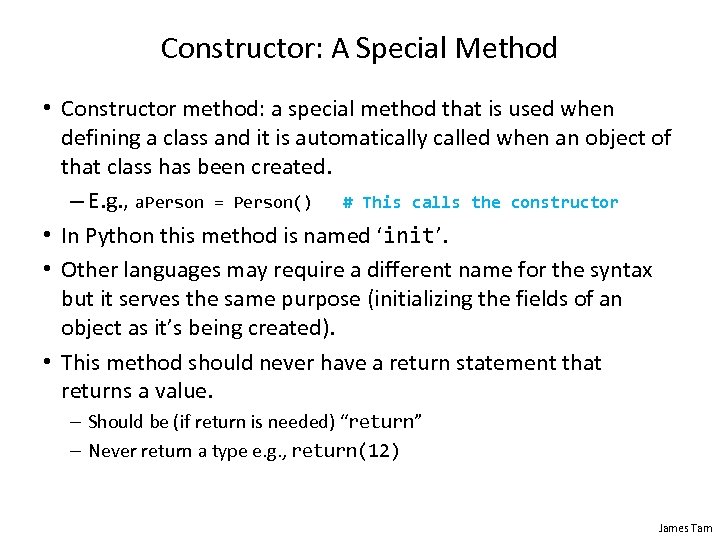
Constructor: A Special Method • Constructor method: a special method that is used when defining a class and it is automatically called when an object of that class has been created. – E. g. , a. Person = Person() # This calls the constructor • In Python this method is named ‘init’. • Other languages may require a different name for the syntax but it serves the same purpose (initializing the fields of an object as it’s being created). • This method should never have a return statement that returns a value. – Should be (if return is needed) “return” – Never return a type e. g. , return(12) James Tam
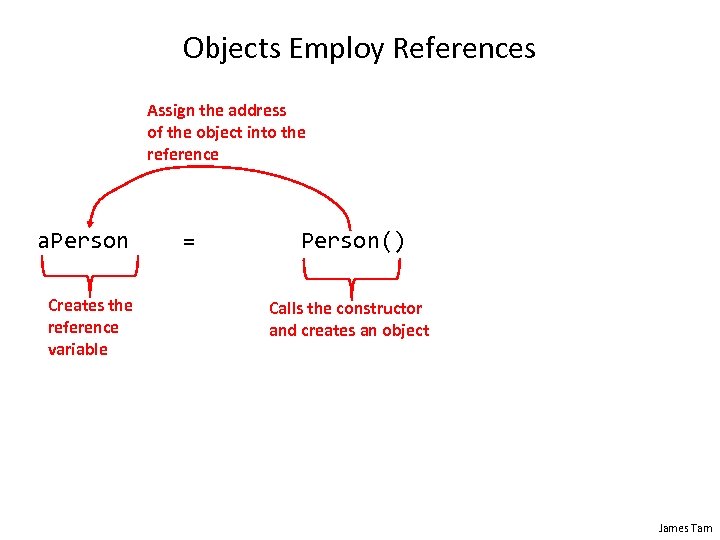
Objects Employ References Assign the address of the object into the reference a. Person Creates the reference variable = Person() Calls the constructor and creates an object James Tam
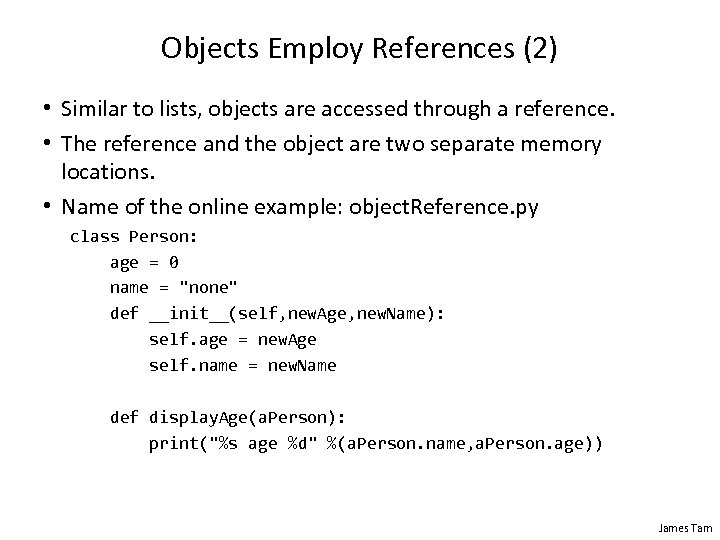
Objects Employ References (2) • Similar to lists, objects are accessed through a reference. • The reference and the object are two separate memory locations. • Name of the online example: object. Reference. py class Person: age = 0 name = "none" def __init__(self, new. Age, new. Name): self. age = new. Age self. name = new. Name def display. Age(a. Person): print("%s age %d" %(a. Person. name, a. Person. age)) James Tam
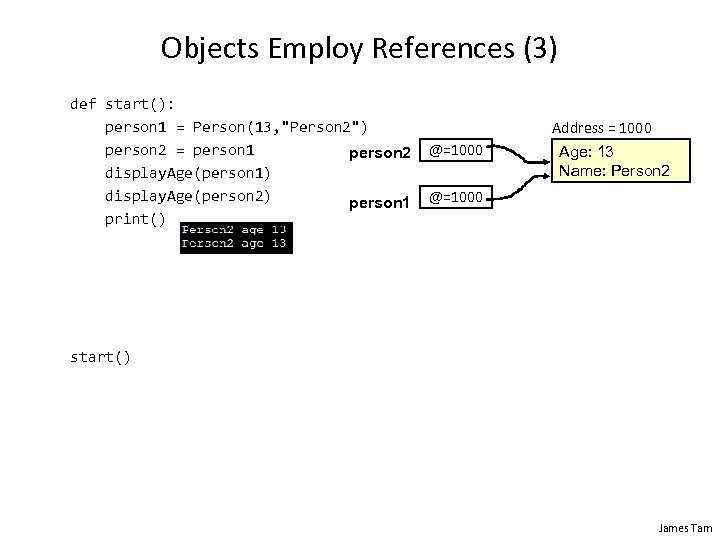
Objects Employ References (3) def start(): person 1 = Person(13, "Person 2") person 2 = person 1 person 2 display. Age(person 1) display. Age(person 2) person 1 print() Address = 1000 @=1000 Age: 13 Name: Person 2 @=1000 start() James Tam
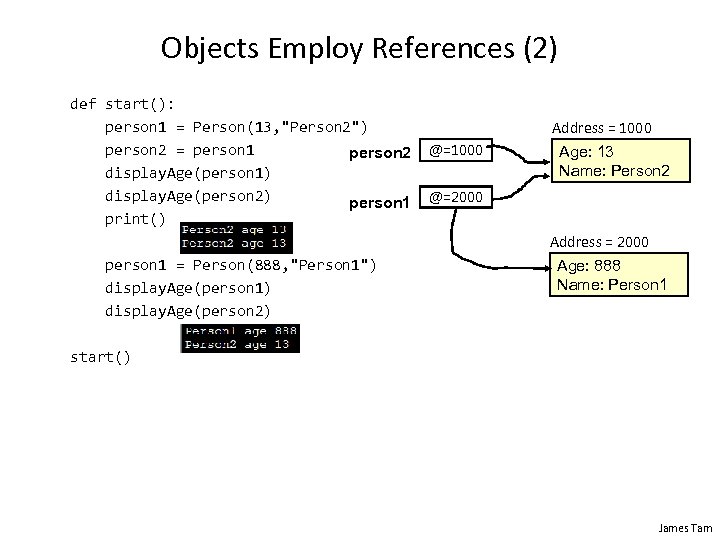
Objects Employ References (2) def start(): person 1 = Person(13, "Person 2") person 2 = person 1 person 2 display. Age(person 1) display. Age(person 2) person 1 print() Address = 1000 @=1000 Age: 13 Name: Person 2 @=1000 @=2000 Address = 2000 person 1 = Person(888, "Person 1") display. Age(person 1) display. Age(person 2) Age: 888 Name: Person 1 start() James Tam
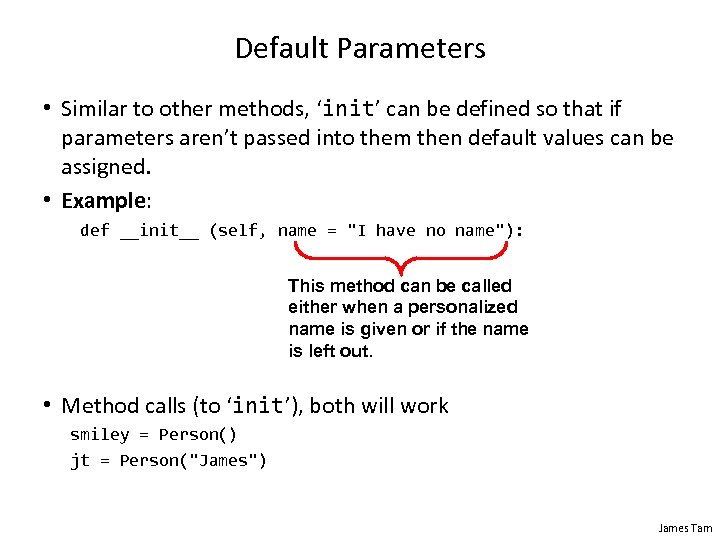
Default Parameters • Similar to other methods, ‘init’ can be defined so that if parameters aren’t passed into them then default values can be assigned. • Example: def __init__ (self, name = "I have no name"): This method can be called either when a personalized name is given or if the name is left out. • Method calls (to ‘init’), both will work smiley = Person() jt = Person("James") James Tam
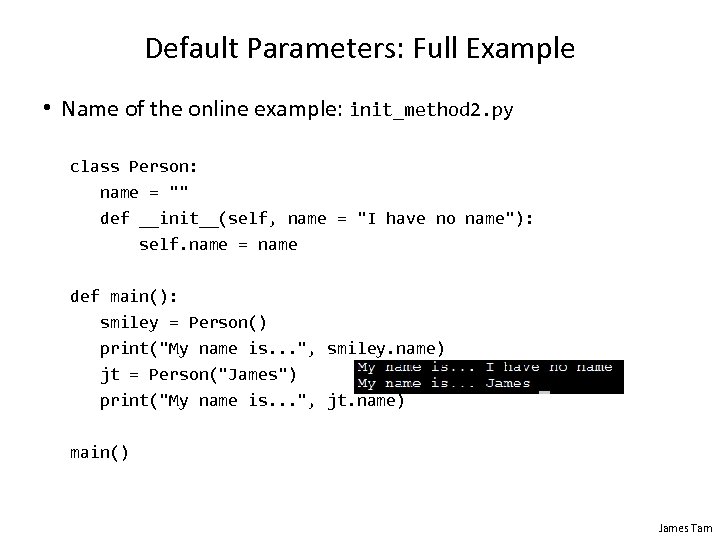
Default Parameters: Full Example • Name of the online example: init_method 2. py class Person: name = "" def __init__(self, name = "I have no name"): self. name = name def main(): smiley = Person() print("My name is. . . ", smiley. name) jt = Person("James") print("My name is. . . ", jt. name) main() James Tam
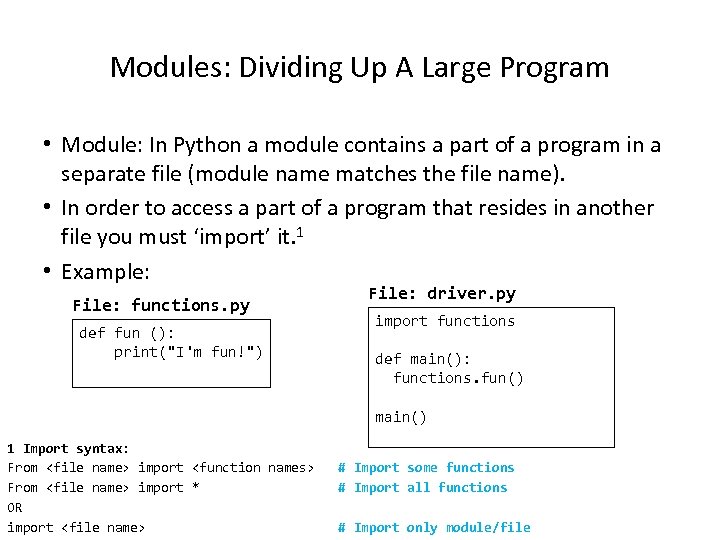
Modules: Dividing Up A Large Program • Module: In Python a module contains a part of a program in a separate file (module name matches the file name). • In order to access a part of a program that resides in another file you must ‘import’ it. 1 • Example: File: functions. py def fun (): print("I'm fun!") File: driver. py import functions def main(): functions. fun() main() 1 Import syntax: From <file name> import <function names> From <file name> import * OR import <file name> # Import some functions # Import all functions # Import only module/file
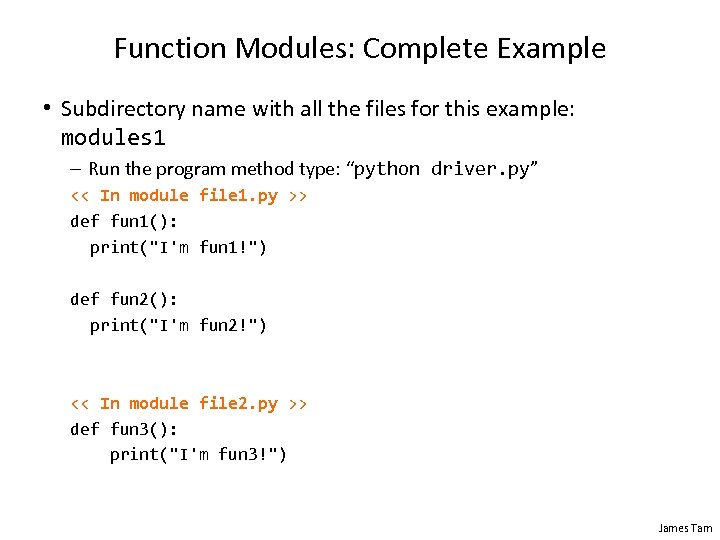
Function Modules: Complete Example • Subdirectory name with all the files for this example: modules 1 – Run the program method type: “python driver. py” << In module file 1. py >> def fun 1(): print("I'm fun 1!") def fun 2(): print("I'm fun 2!") << In module file 2. py >> def fun 3(): print("I'm fun 3!") James Tam
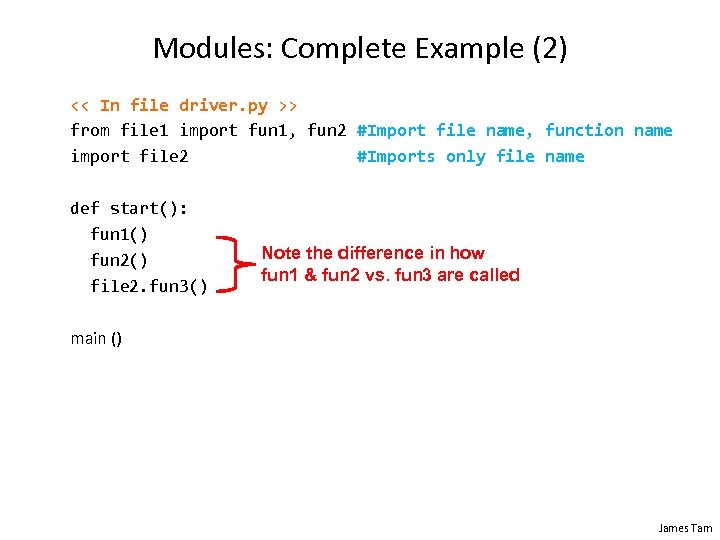
Modules: Complete Example (2) << In file driver. py >> from file 1 import fun 1, fun 2 #Import file name, function name import file 2 #Imports only file name def start(): fun 1() fun 2() file 2. fun 3() Note the difference in how fun 1 & fun 2 vs. fun 3 are called main () James Tam
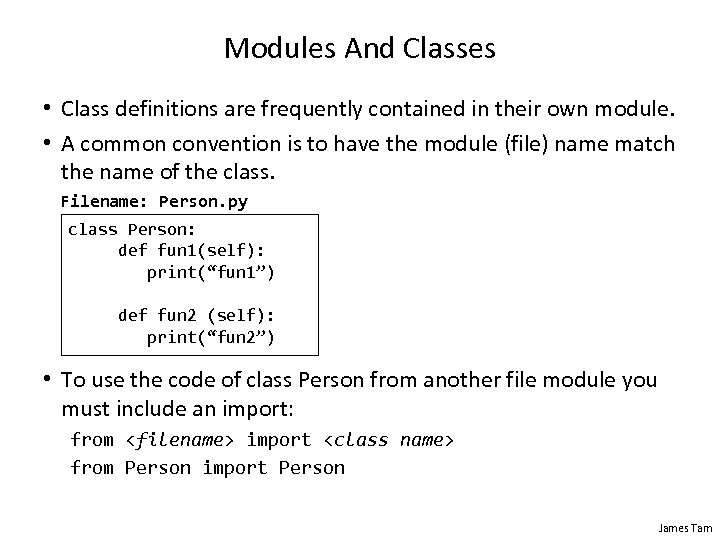
Modules And Classes • Class definitions are frequently contained in their own module. • A common convention is to have the module (file) name match the name of the class. Filename: Person. py class Person: def fun 1(self): print(“fun 1”) def fun 2 (self): print(“fun 2”) • To use the code of class Person from another file module you must include an import: from <filename> import <class name> from Person import Person James Tam
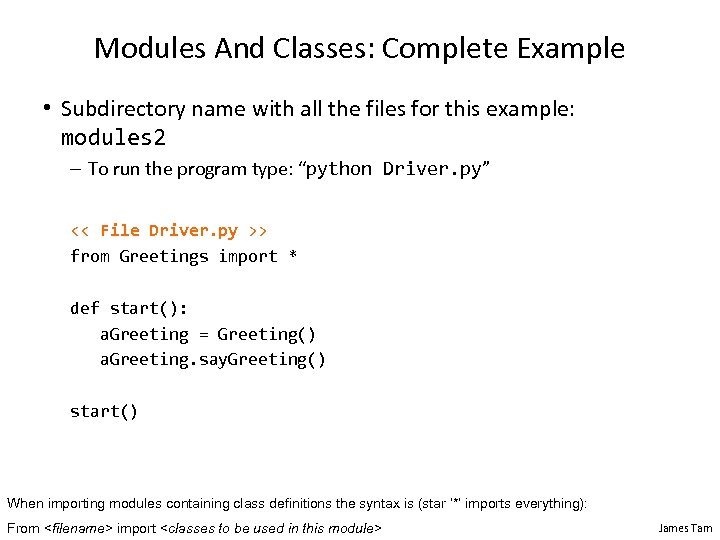
Modules And Classes: Complete Example • Subdirectory name with all the files for this example: modules 2 – To run the program type: “python Driver. py” << File Driver. py >> from Greetings import * def start(): a. Greeting = Greeting() a. Greeting. say. Greeting() start() When importing modules containing class definitions the syntax is (star ‘*’ imports everything): From <filename> import <classes to be used in this module> James Tam
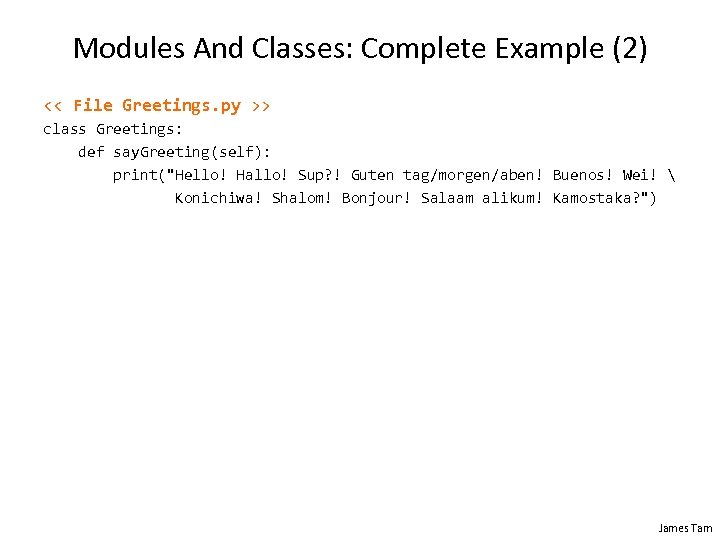
Modules And Classes: Complete Example (2) << File Greetings. py >> class Greetings: def say. Greeting(self): print("Hello! Hallo! Sup? ! Guten tag/morgen/aben! Buenos! Wei! Konichiwa! Shalom! Bonjour! Salaam alikum! Kamostaka? ") James Tam
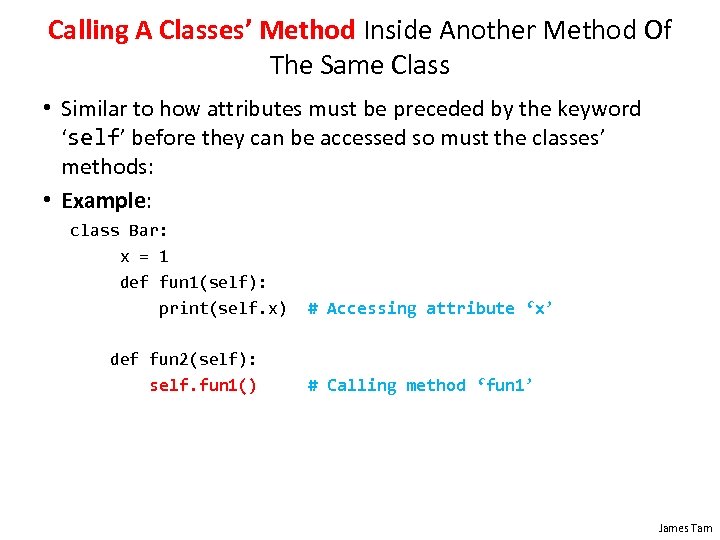
Calling A Classes’ Method Inside Another Method Of The Same Class • Similar to how attributes must be preceded by the keyword ‘self’ before they can be accessed so must the classes’ methods: • Example: class Bar: x = 1 def fun 1(self): print(self. x) def fun 2(self): self. fun 1() # Accessing attribute ‘x’ # Calling method ‘fun 1’ James Tam
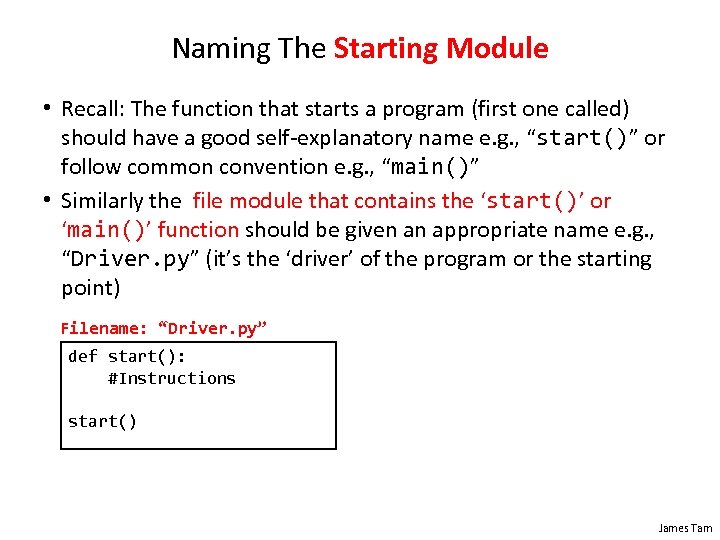
Naming The Starting Module • Recall: The function that starts a program (first one called) should have a good self-explanatory name e. g. , “start()” or follow common convention e. g. , “main()” • Similarly the file module that contains the ‘start()’ or ‘main()’ function should be given an appropriate name e. g. , “Driver. py” (it’s the ‘driver’ of the program or the starting point) Filename: “Driver. py” def start(): #Instructions start() James Tam
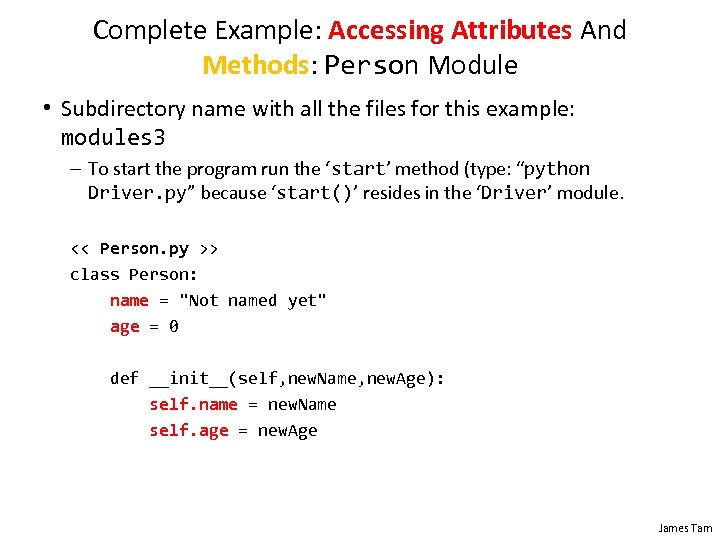
Complete Example: Accessing Attributes And Methods: Person Module • Subdirectory name with all the files for this example: modules 3 – To start the program run the ‘start’ method (type: “python Driver. py” because ‘start()’ resides in the ‘Driver’ module. << Person. py >> class Person: name = "Not named yet" age = 0 def __init__(self, new. Name, new. Age): self. name = new. Name self. age = new. Age James Tam
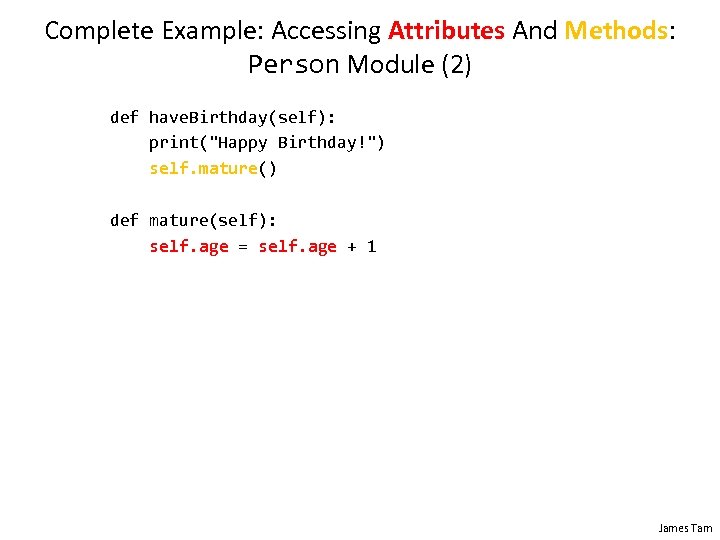
Complete Example: Accessing Attributes And Methods: Person Module (2) def have. Birthday(self): print("Happy Birthday!") self. mature() def mature(self): self. age = self. age + 1 James Tam
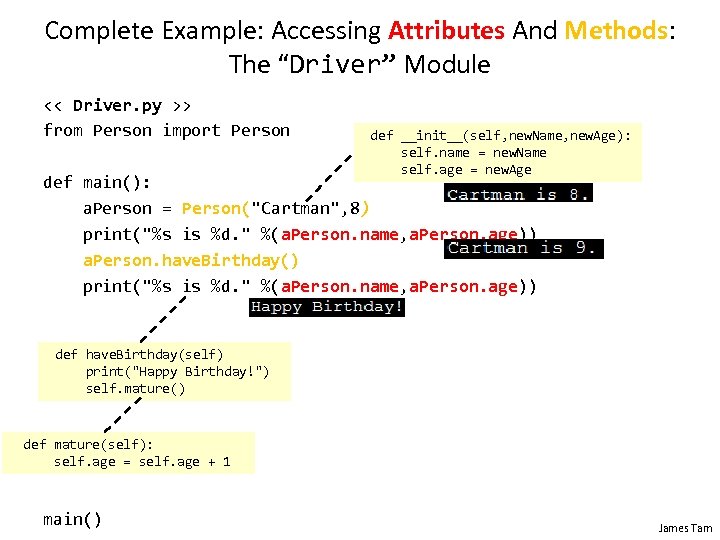
Complete Example: Accessing Attributes And Methods: The “Driver” Module << Driver. py >> from Person import Person def __init__(self, new. Name, new. Age): self. name = new. Name self. age = new. Age def main(): a. Person = Person("Cartman", 8) print("%s is %d. " %(a. Person. name, a. Person. age)) a. Person. have. Birthday() print("%s is %d. " %(a. Person. name, a. Person. age)) def have. Birthday(self) print("Happy Birthday!") self. mature() def mature(self): self. age = self. age + 1 main() James Tam
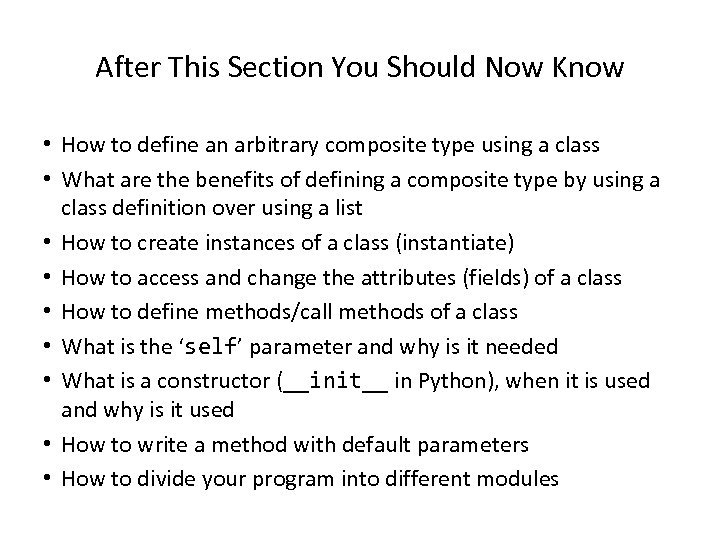
After This Section You Should Now Know • How to define an arbitrary composite type using a class • What are the benefits of defining a composite type by using a class definition over using a list • How to create instances of a class (instantiate) • How to access and change the attributes (fields) of a class • How to define methods/call methods of a class • What is the ‘self’ parameter and why is it needed • What is a constructor (__init__ in Python), when it is used and why is it used • How to write a method with default parameters • How to divide your program into different modules

Copyright Notification • “Unless otherwise indicated, all images in this presentation are used with permission from Microsoft. ” slide 42 James Tam
Скачать презентацию CPSC 231 Classes and Objects You will learn
49046d68a40151fba6305b486d6096f3.ppt