


 Скачать презентацию CPSC 156 The Internet Co-Evolution of Technology and
c297a4898cc6811cc047d7069b578bce.ppt
- Количество слайдов: 29
 CPSC 156: The Internet Co-Evolution of Technology and Society Lecture 10: February 15, 2007 Search
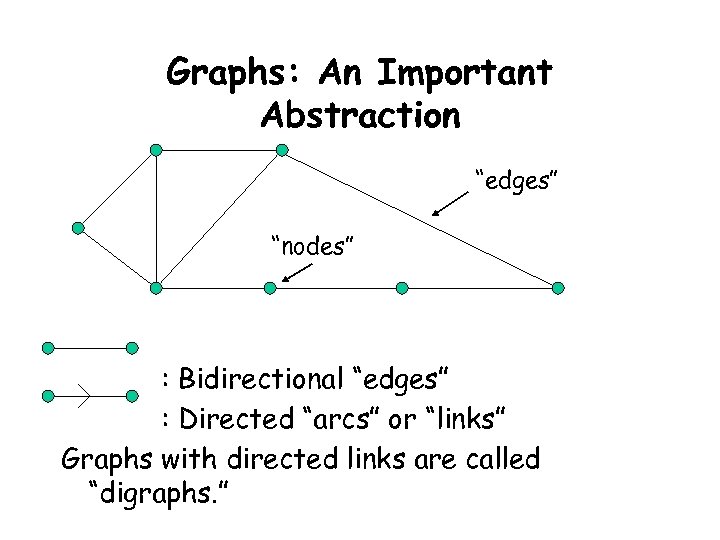 Graphs: An Important Abstraction “edges” “nodes” : Bidirectional “edges” : Directed “arcs” or “links” Graphs with directed links are called “digraphs. ”
 Digraphs are Ubiquitous in Computer Science • Used as models of systems – Nodes represent components. – Links represent interactions or relationships. • Examples we’ve seen in CPSC 156 a: – Computer networks: Nodes represent computers (e. g. , hosts or routers), and links represent direct (“hardwired”) connections. – The WWW: Nodes represent web pages, and links represent. . . “links” (e. g. , html code pointing from one page to another).
 Two Aspects of WWW Searching • Analyze contents of pages – Text (e. g. , search terms) – Structure (e. g. , HTML tags) • Analyze structure of WWW digraph – Links to page P indicate interest in the contents of of P. – Importance depends on who is interested. – Requires global analysis of digraph.
 The WWW Digraph • Massive, Distributed, Explicit Digraph • Many Billions of Nodes (Pages) • Sparse: Average Degree (links per page) is 5 -15. • Can be crawled (i. e. , every node visited) in time linear in the total number of links (using classical methods).
 “Hot” Research Area • • Graph Representation Duplicate Elimination Clustering Ranking Search Results
 Finding Information on the Internet The Internet is so successful partly because it is so easy to publish information on the World Wide Web. • No central authority on what pages exist, where they exist, or when they exist. • Too much to sort through, anyway. • Question: How do we find what we need on the web?
 WWW Search Engines • Answer: Set up websites that people can use to search for information by performing a search query. • Not such an easy solution! In addition to the technical problems, we have these business questions: – How do people know about the search engine websites? – How do you make money off of this? (Especially now that the service is free. )
 Solutions (? ) to Technical Problems • How do we keep track of what pages are on the WWW? – Have a crawler or spider scan the web and links between pages to find new, updated, and removed pages. • How do we store the content we find? – Design a way to map keywords in queries to documents so we can return a usefully ordered list to the user. • What happens when pages are temporarily unavailable? – Use caching: keep a local copy of documents as we crawl the web. (Need lots of space!)
 Solutions (? ) to Technical Problems (continued) • How do we store all the information? – Use a large network of disks (and maybe a clever method of compression) that can be easily searched. • How do we handle so many different requests? – Use a cluster of computers that work together to process queries. There is still ongoing research to find better ways to solve these problems!
 Google History • 1998: Founders Larry Page and Sergey Brin (Ph. D. students at Stanford) raise $1 million from family, friends, and angel investors. Google is incorporated Sept. 7. Site receives 10, 000 queries per day and is listed in PC Magazine’s top 100 search websites list. • 1 st half 1999: Google has 8 employees and answers 500, 000 queries/day. Red Hat (Linux distributor) becomes first customer. Google gets $25 million equity funding.
 Google History (2) • 2 nd half 1999: 39 employees, 3 million queries/day. Partners with Virgilio of Italy to provide search services. • 2000: Becomes largest web search engine, having indexed 1 billion documents. Answers 18 million queries/day. Gains more partners, including Yahoo! Starts web directory.
 Google History (3) • 2001: Acquires Deja. com’s Usenet archive, adding newsgroups to Google’s index. Improves and adds services including browser plug-ins, image searching, PDF searching, cellphone and handheld compatibility, and queries and document searches in many languages. Advertising services used by over 350 Premium Sponsorship customers. • Spring 2003: 3. 3 billion web pages, 800 million newsgroup messages, and 425 million images indexed. Serves 200 million queries/day.
 Google’s Business Model Scalable Search Services: • Google provides customized search services for websites. • Has become the dominant search engine, used by many portal and ISP websites as well as individuals. Advertising: • Premium Sponsorship: sponsored text links separated from search results; based on search category. • Ad. Words: keyword-targeted, self-service advertising method. Choose keywords or phrases where text ads will appear to the right of the search result list. • No banner ads or graphics!
 Technical Highlights • Page. Rank Technology: Linear-algebraic, objective calculations of the “importance” of a webpage. – Link from Page A to Page B is a “vote” for B. – Importance of A is factored into the vote. – Page owners cannot pay to have their Page. Ranks modified. (Note the difference between buying a “sponsored link” and getting a higher Page. Rank. ) – Google employees can modify a Page. Rank in exceptional circumstances (e. g. , security threats).
 Technical Highlights (2) – Readings on how Page. Rank works: http: //www. google. com/technology/index. html “Google’s Page. Rank explained, and how to make the most of it, ” by P. Craven. http: //www. webworkshop. net/pagerank. html • Hypertext-Matching Analysis: The HTML tags are taken into account when examining the contents of a page. Headings, fonts, positions, and content of neighboring pages influence the analysis.
 Technical Highlights (3) • Scalable Core Technology: Calculations are performed by the largest commercial Linux cluster of over 10, 000 servers. Can grow with the Internet! • Complex-File Searching: Google can now index files in “non-Internet” formats, e. g. : – – – Post. Script, PDF (Adobe) Word, Excel, Power. Point, Works (Microsoft) Word. Pro, 1 -2 -3 (IBM/Lotus Smart. Suite) Mac. Write Rich Text (RTF), plain text
 Technical Highlights (4) • Bayesian Spelling-Suggestion Program: Offers suggestions for misspelled words in queries, making searching easier. (“Did you mean…? ” ) • Internationalization: – Google is developing technology to index pages with complex scripts, e. g. : • Some East Asian languages have no spaces between words. • Hebrew and Arabic are written right-to-left; Chinese is sometimes top-to-bottom. – Google has a translation engine and provides its interface in many languages. – Current research question: How to detect the language(s) of a page?
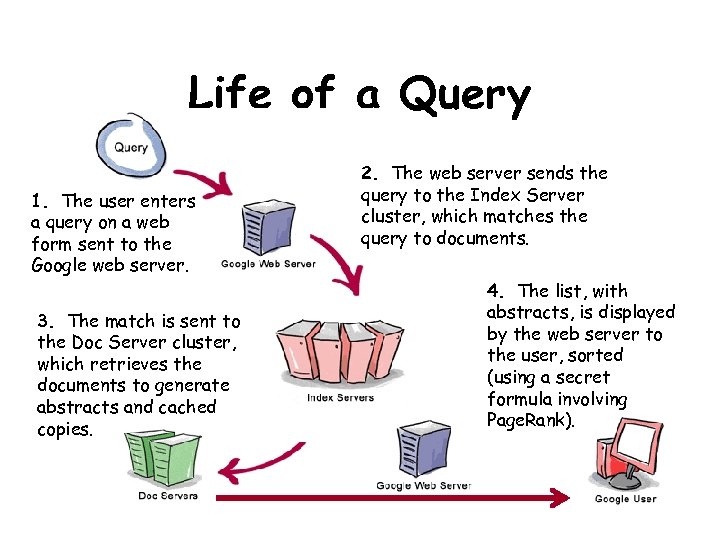 Life of a Query 1. The user enters a query on a web form sent to the Google web server. 3. The match is sent to the Doc Server cluster, which retrieves the documents to generate abstracts and cached copies. 2. The web server sends the query to the Index Server cluster, which matches the query to documents. 4. The list, with abstracts, is displayed by the web server to the user, sorted (using a secret formula involving Page. Rank).
 Hub-and-Authority Framework The next eight slides are a linearalgebraic interlude for mathematically inclined students. They are not required reading for CPSC 156.
 The Hub-and-Authority Framework • Linear-algebraic interlude for technically minded students. • NOT required for the exam! • Introduced simultaneously with Google’s Page. Rank. – Like Page. Rank, uses “wisdom” implied by WWW links. – Like Page. Rank, has provable mathematical properties. – Specific algorithm differs from that of Page. Rank. • Invented by Jon Kleinberg, then at IBM, now at Cornell. • See http: //www. cs. cornell. edu/home/kleinber/ for many related papers.
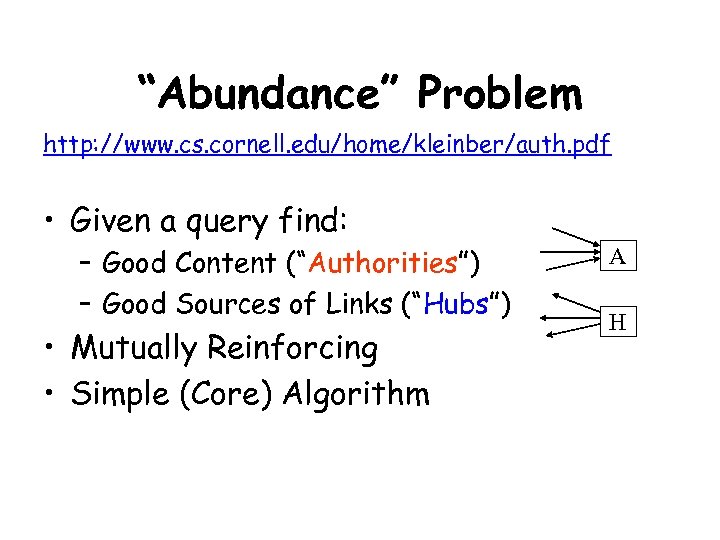 “Abundance” Problem http: //www. cs. cornell. edu/home/kleinber/auth. pdf • Given a query find: – Good Content (“Authorities”) – Good Sources of Links (“Hubs”) • Mutually Reinforcing • Simple (Core) Algorithm A H
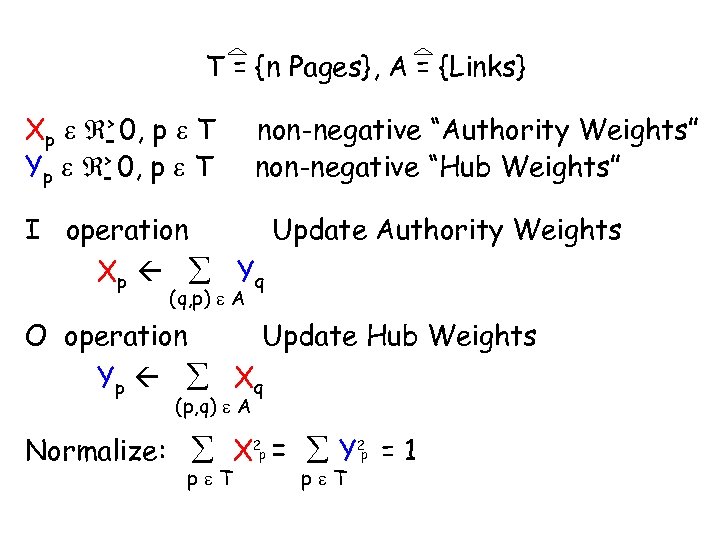 T = {n Pages}, A = {Links} Xp > 0, p T Yp > 0, p T non-negative “Authority Weights” non-negative “Hub Weights” I operation Update Authority Weights X p Yq (q, p) A O operation Update Hub Weights Yp X q (p, q) A Normalize: X 2 p = Y 2 p = 1 p T
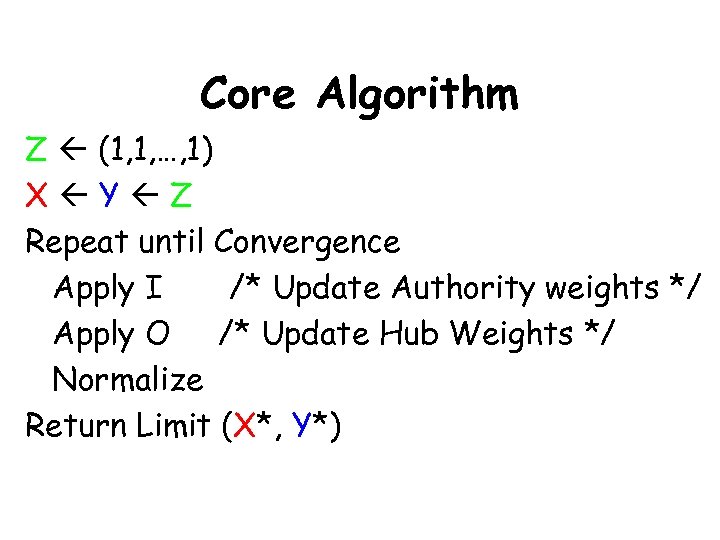 Core Algorithm Z (1, 1, …, 1) X Y Z Repeat until Convergence Apply I /* Update Authority weights */ Apply O /* Update Hub Weights */ Normalize Return Limit (X*, Y*)
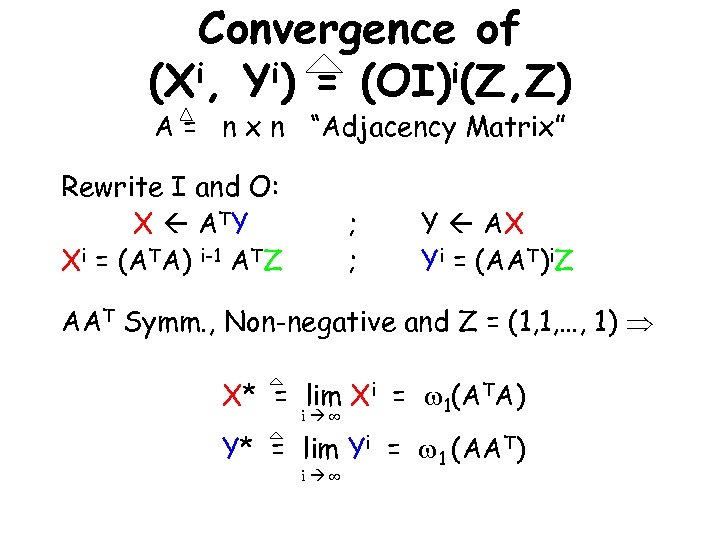 Convergence of (Xi, Yi) = (OI)i(Z, Z) A = n x n “Adjacency Matrix” Rewrite I and O: X A TY Xi = (ATA) i-1 ATZ ; ; Y AX Yi = (AAT)i. Z AAT Symm. , Non-negative and Z = (1, 1, …, 1) X* = lim Xi = 1(ATA) i Y* = lim Yi = 1 (AAT) i
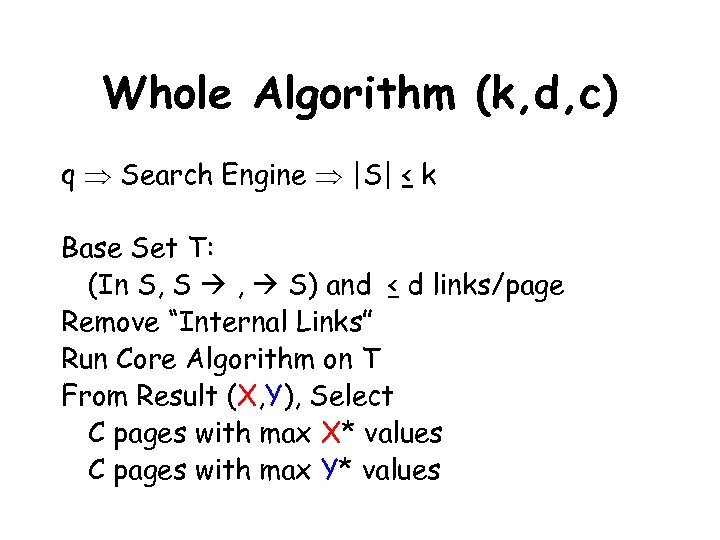 Whole Algorithm (k, d, c) q Search Engine |S| < k Base Set T: (In S, S , S) and < d links/page Remove “Internal Links” Run Core Algorithm on T From Result (X, Y), Select C pages with max X* values C pages with max Y* values
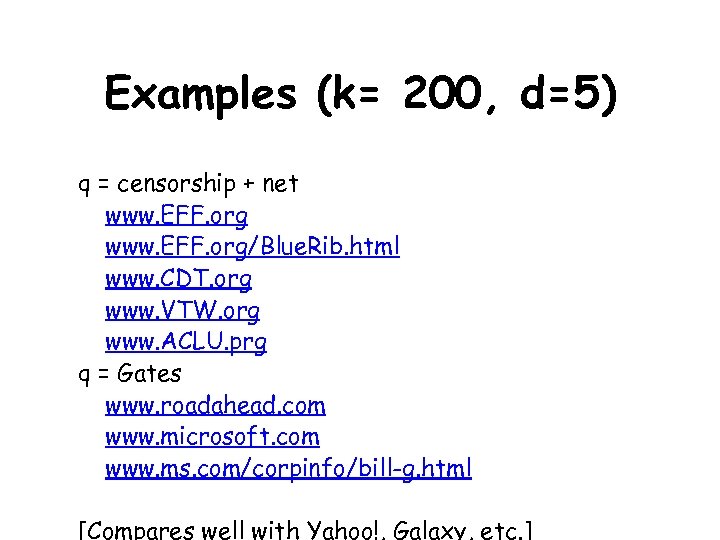 Examples (k= 200, d=5) q = censorship + net www. EFF. org/Blue. Rib. html www. CDT. org www. VTW. org www. ACLU. prg q = Gates www. roadahead. com www. microsoft. com www. ms. com/corpinfo/bill-g. html [Compares well with Yahoo!, Galaxy, etc. ]
 Approach to “Massiveness”: Throw Out Most of G!! • Non-principal Eigenvectors correspond to “Non-principal Communities” • Open (? ): Objective Performance Criteria Dependence on Search Engine Nondeterministic Choice of S and T
 Assignments • Written assignment due February 22, 2007 (http: //zoo. cs. yale. edu/classes/cs 156/assi gnments/assignment 3. html) • Reading assignment: • http: //www. newyorker. com/printables/fact /070205 fa_fact_toobin • http: //aeibrookings. org/admin/authorpdfs/page. php? id=1251 • http: //www. policybandwidth. com/doc/googl eprint. pdf