


 Скачать презентацию CPSC 156 The Internet Co-Evolution of Technology and
1d300533e885c2796869b9573ab62ce9.ppt
- Количество слайдов: 24
 CPSC 156: The Internet Co-Evolution of Technology and Society Lecture 12: February 22, 2007 Open Source 1
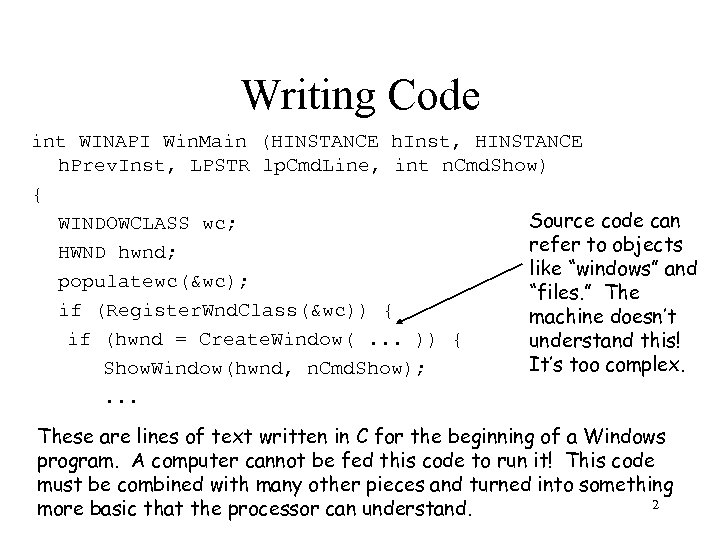 Writing Code int WINAPI Win. Main (HINSTANCE h. Inst, HINSTANCE h. Prev. Inst, LPSTR lp. Cmd. Line, int n. Cmd. Show) { Source code can WINDOWCLASS wc; refer to objects HWND hwnd; like “windows” and populatewc(&wc); “files. ” The if (Register. Wnd. Class(&wc)) { machine doesn’t if (hwnd = Create. Window(. . . )) { understand this! It’s too complex. Show. Window(hwnd, n. Cmd. Show); . . . These are lines of text written in C for the beginning of a Windows program. A computer cannot be fed this code to run it! This code must be combined with many other pieces and turned into something 2 more basic that the processor can understand.
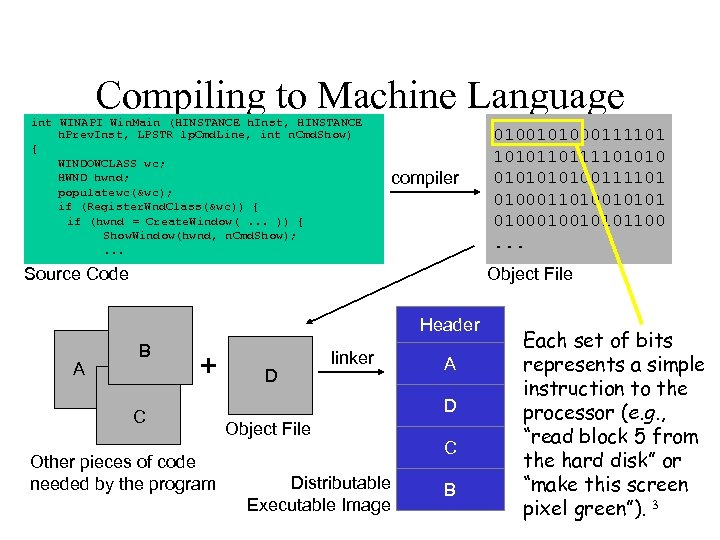 Compiling to Machine Language int WINAPI Win. Main (HINSTANCE h. Inst, HINSTANCE h. Prev. Inst, LPSTR lp. Cmd. Line, int n. Cmd. Show) { WINDOWCLASS wc; HWND hwnd; populatewc(&wc); if (Register. Wnd. Class(&wc)) { if (hwnd = Create. Window(. . . )) { Show. Window(hwnd, n. Cmd. Show); . . . compiler Source Code Object File Header A 0100101000111101 10101101111010100111101 0100011010010101100. . . B + C Other pieces of code needed by the program D linker A D Object File Distributable Executable Image C B Each set of bits represents a simple instruction to the processor (e. g. , “read block 5 from the hard disk” or “make this screen pixel green”). 3
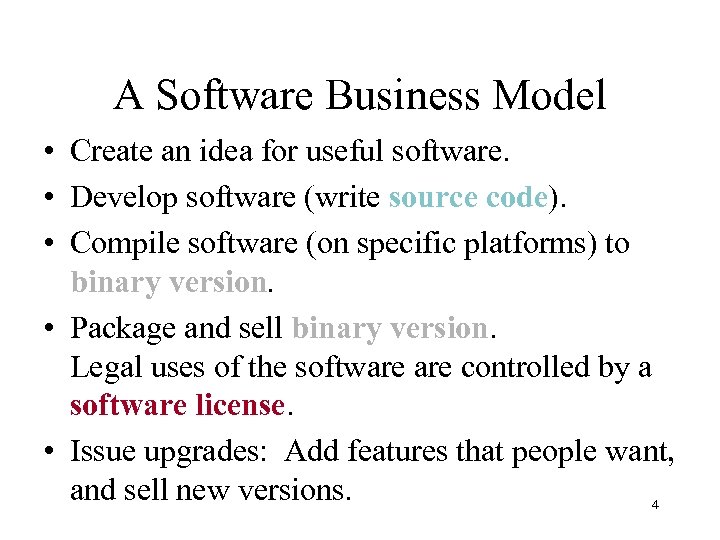 A Software Business Model • Create an idea for useful software. • Develop software (write source code). • Compile software (on specific platforms) to binary version. • Package and sell binary version. Legal uses of the software controlled by a software license. • Issue upgrades: Add features that people want, and sell new versions. 4
 Business-Model Pros • The developers’ intellectual property rights are protected. – People use the software exactly as the developers want them to. – Users never see how the software works and so others can’t steal the nuts and bolts. • Developers receive compensation for their hard work! There’s an incentive to code and create new ideas. • “The market” determines what is good, including software and hardware platforms. – Operating systems and machine architectures good for users and developers are the ones that flourish. 5
 Business-Model Cons • Users can’t customize software to their needs, and the developer may not be able to satisfy all users’ requests for changes. • Binary versions run on certain machines only: – Forces people to buy specific platforms – Can’t necessarily use one machine to do everything • “Standards” can cause monopolies (? ) • Source code hidden – Can’t be improved and studied by others – Hard to design interoperable products (why does MS Office on MS Windows work especially well? ) • Using computers is expensive! 6
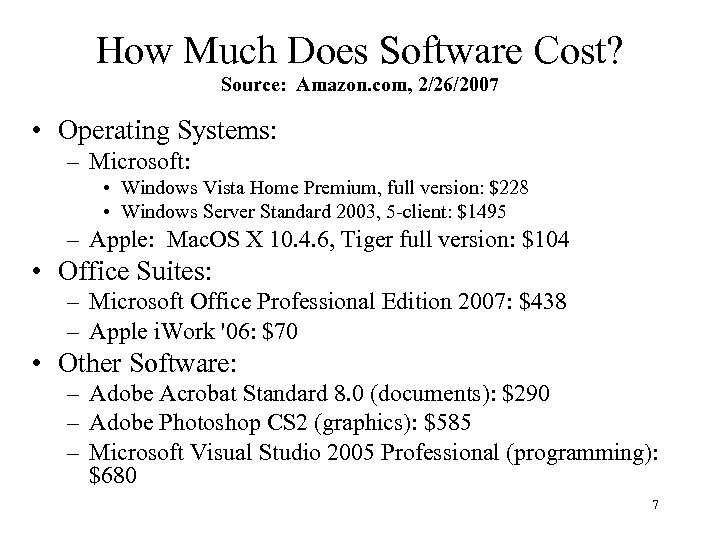 How Much Does Software Cost? Source: Amazon. com, 2/26/2007 • Operating Systems: – Microsoft: • Windows Vista Home Premium, full version: $228 • Windows Server Standard 2003, 5 -client: $1495 – Apple: Mac. OS X 10. 4. 6, Tiger full version: $104 • Office Suites: – Microsoft Office Professional Edition 2007: $438 – Apple i. Work '06: $70 • Other Software: – Adobe Acrobat Standard 8. 0 (documents): $290 – Adobe Photoshop CS 2 (graphics): $585 – Microsoft Visual Studio 2005 Professional (programming): $680 7
 An Alternative Approach • “Free” software: Gives users the power to use software as they wish. – “‘Free software’ is a matter of liberty, not price …‘free’ as in ‘free speech, ’ not as in ‘free beer’…” -- Free Software Foundation • Development is not controlled by a small group; people can learn from the code. • Revenue models can still develop around software distributed with a free license ! 8
 Open Source • Technical definition: Anyone can look at the source code. • Benefits: – Interoperability – Education – Cross-platform compatibility (if code can be compiled by users) • Still protects intellectual property: – Uses of code are still limited by a license. – Developers maintain rights to code and official releases of the product. 9
 Consequences of Open Source • Software can be closely scrutinized; performance can be analyzed and attributed to parts of code. • Ideas behind code can become standards. • Distributors can specialize in building more features on top of open-source software, offering customized packages with support options. • “Open source” is a more business-friendly term than “free. ” 10
 Free Software • Technical definition (from the Free Software Foundation): Users have the freedom to: (1) run the software, for any purpose; (2) study how the program works and adapt it to their needs; (3) redistribute copies; (4) improve the program and release improvements to the public. • Access to source code is necessary for (2) and (4); so, “Free” can include “Open Source. ” 11
 Consequences of Free Software • “Free” software can be modified, used, and even sold as users see fit. • Selling free software requires having additional services that the user wants: – Packaging, delivery, installation mechanisms – Help, support, training – Customizing software for specific needs • Better versions of software can be released by any user. 12
 Software Licenses • The software license indicates what users can do with software and code. • Traditional licenses strictly govern use of software based on purchase. • Open-source and free licenses indicate how code can be used, reused, and distributed, usually asserting user rights like the “four freedoms. ” 13
 GNU General Public License (GPL) • Formalization of ideal software-distribution model by the Free Software Foundation and the GNU Project. • Developers can choose to release their “free” software under the GPL license. • Requires that users maintain the original copyright on the code and clearly mark any changes when distributing it. • Source code is included, and users can modify and compile it where and how they see fit. • Copyleft: Redistributed versions must give users the same rights (must include source code that can be modified, etc. ). 14
 Other Popular Licenses • Many licenses exist that come from organizations that develop “free” software. • GPL-compatible licenses are those that allow software covered to be combined with GPLcovered software to produce larger “free” products. – Examples (non-copyleft): MIT, BSD (Berkeley), X 11 (windowing system) • Other public licenses: Netscape-Java. Script, Artistic, W 3 C Software 15
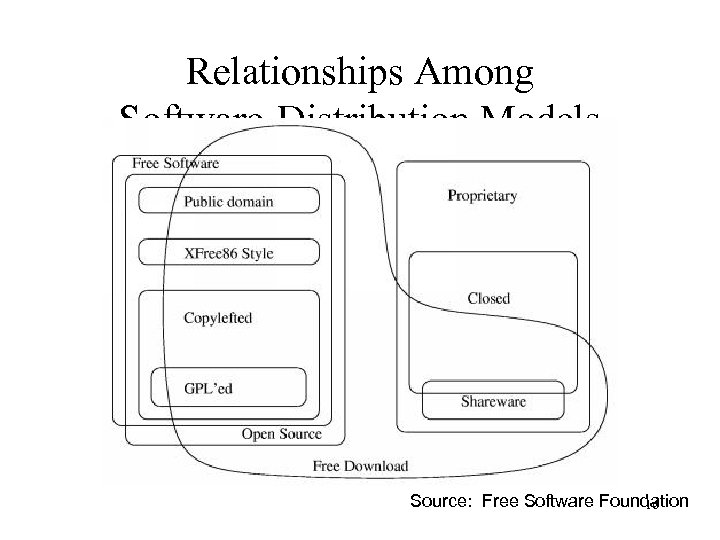 Relationships Among Software-Distribution Models Source: Free Software Foundation 16
 How The Movement Began • 1983: GNU Project developed – Goal: to produce a UNIX-compatible freesoftware system (GNU = “GNU’s not Unix!”) – Idea conceived by Richard Stallman, who worked in an MIT group that exclusively used free software (~1975). • 1985: Free Software Foundation – Group that manages GNU project and distributes GNU software 17
 GNU History (continued) • 1985: GNU Emacs editor available First major piece of usable, free software • 1990 s: Most pieces of free system complete, except operating system kernel. Combined with Linux kernel by Linus Torvalds to produce a GNU/Linux OS distribution. This is a complete UNIX-compatible system that contains free-software tools. 18
 Free UNIX-Compatible Systems • MINIX (1987 -) and Linux (1992 -) are free OS kernels (originally) developed for academic use. • GNU/Linux and BSD (Berkeley) are the two most popular UNIX-like OSs. • Stable, robust systems incorporating: – standard Internet and networking protocols – standard development tools – many other free, widely-used tools • Allow users to set up servers and workstations at little cost that can do almost anything PC- and Maccompatible systems can do! 19
 Tools in Free OS Distributions • Web server, e. g. , Apache • Mail server, e. g. , Sendmail • Other Internet and network daemons, e. g. , SAMBA and other file servers, Open. SSH, FTP servers. • Development tools, e. g. , compilers for many programming languages • User tools, e. g. , web browsers, graphics tools, editors, spreadsheets, Ghostscript and other document tools, sound players and media tools • Graphical user interfaces, e. g. , Gnome, KDE, and other windowing systems 20
 Making Money From Open-Source Software model. It “Open source is the foundation of Red Hat's business represents a fundamental shift in how software is created. The code that makes up the software is available to anyone. Developers who use the software free to improve the software. The result: rapid innovation. … Red Hat delivers the innovation of open source to our customers. ” “Red Hat solutions combine Red Hat Linux, developer and embedded technologies, training, management services, technical support—all enabled through a single delivery platform: Red Hat Network. ” --- Red Hat Investor Fact Sheet, 1/16/2001 21
 Clever Distribution of Linux • Red Hat offers its GNU/Linux-based OS for free download from its website, but offers no technical support. Download is huge and is only for experts! • Red Hat sells packaged versions: CDs with manuals, technical-support options, and an easy installer that works with many computers. • Red Hat will customize and install its OS for companies that make special-purpose devices, have specific security concerns, etc. • Red Hat partners with computer manufacturers (e. g. , Dell) to create a cheaper alternative to Microsoft OSs. 22
 The Marketing Spin • “Red Hat Enterprise Linux, ” “Red Hat Enterprise Network, ” and “Red Hat Stronghold Enterprise” provide a Linux-based server core and management tools for businesses. • Convince businesses that they will lower costs, have a smooth migration to Red Hat Linux, get support and training, and achieve more reliability and security. – The software is open source, so it adheres to standards, can be examined for flaws, and has many developers contributing to it. – Claim: It is worth paying Red Hat for the initial training and support. The switching costs are lower than the cost of maintaining more expensive (e. g. , Windows) systems. 23
 Discussion Point • As you heard in Katz’s lecture on February 20, open-source software can be a component of A 2 K (access to knowledge) in developing economies. • Google has made powerful search technology available to everyone on the Internet without anyone’s having to buy it; the entire technology platform is advertiser-supported. Could advertising provide a comprehensive, alternative approach to A 2 K in developing economies? 24