


 Скачать презентацию CPS 296 1 Utility theory Vincent Conitzer conitzer cs
04459cd7e5daf0d315bed8dcb9570d5b.ppt
- Количество слайдов: 8
 CPS 296. 1 Utility theory Vincent Conitzer conitzer@cs. duke. edu
 Risk attitudes • Which would you prefer? – A lottery ticket that pays out $10 with probability. 5 and $0 otherwise, or – A lottery ticket that pays out $3 with probability 1 • How about: – A lottery ticket that pays out $100, 000 with probability. 5 and $0 otherwise, or – A lottery ticket that pays out $30, 000 with probability 1 • Usually, people do not simply go by expected value • An agent is risk-neutral if she only cares about the expected value of the lottery ticket • An agent is risk-averse if she always prefers the expected value of the lottery ticket to the lottery ticket – Most people are like this • An agent is risk-seeking if she always prefers the lottery ticket to the expected value of the lottery ticket
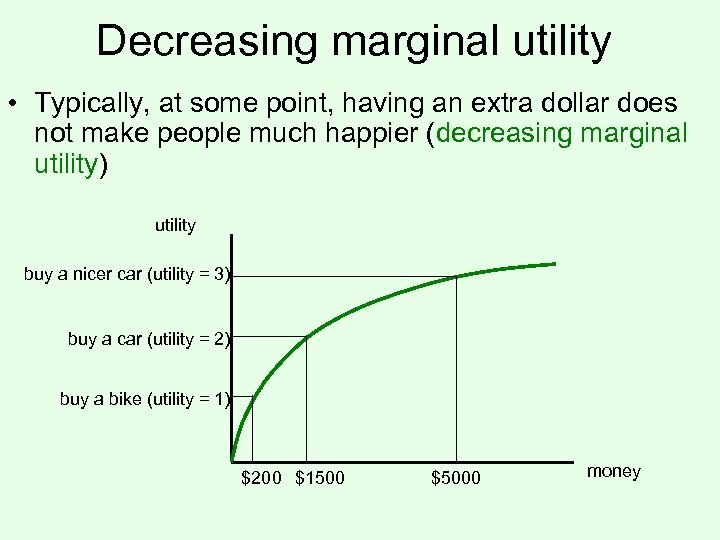 Decreasing marginal utility • Typically, at some point, having an extra dollar does not make people much happier (decreasing marginal utility) utility buy a nicer car (utility = 3) buy a car (utility = 2) buy a bike (utility = 1) $200 $1500 $5000 money
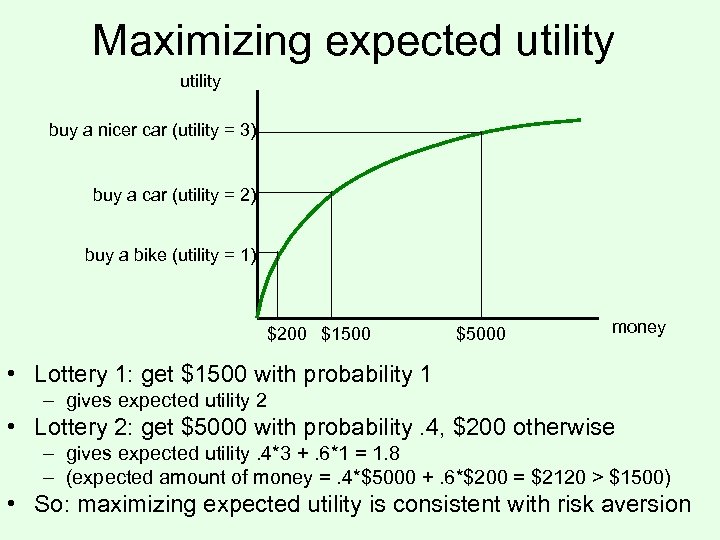 Maximizing expected utility buy a nicer car (utility = 3) buy a car (utility = 2) buy a bike (utility = 1) $200 $1500 $5000 money • Lottery 1: get $1500 with probability 1 – gives expected utility 2 • Lottery 2: get $5000 with probability. 4, $200 otherwise – gives expected utility. 4*3 +. 6*1 = 1. 8 – (expected amount of money =. 4*$5000 +. 6*$200 = $2120 > $1500) • So: maximizing expected utility is consistent with risk aversion
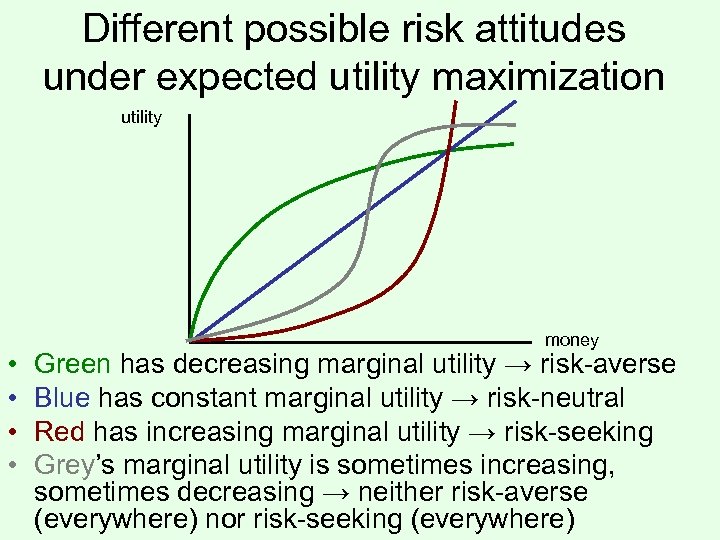 Different possible risk attitudes under expected utility maximization utility • • money Green has decreasing marginal utility → risk-averse Blue has constant marginal utility → risk-neutral Red has increasing marginal utility → risk-seeking Grey’s marginal utility is sometimes increasing, sometimes decreasing → neither risk-averse (everywhere) nor risk-seeking (everywhere)
 What is utility, anyway? • Function u: O → (O is the set of “outcomes” that lotteries randomize over) • What are its units? – It doesn’t really matter – If you replace your utility function by u’(o) = a + bu(o), your behavior will be unchanged • Why would you want to maximize expected utility? – This is a question about preferences over lotteries
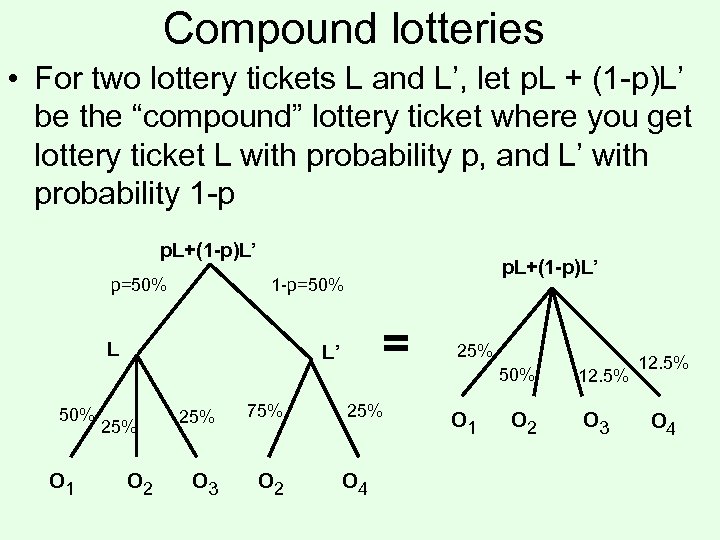 Compound lotteries • For two lottery tickets L and L’, let p. L + (1 -p)L’ be the “compound” lottery ticket where you get lottery ticket L with probability p, and L’ with probability 1 -p p. L+(1 -p)L’ p=50% 1 -p=50% L 50% o 1 p. L+(1 -p)L’ = L’ 25% o 2 25% 75% o 3 o 2 25% o 4 25% 50% o 1 o 2 12. 5% o 3 12. 5% o 4
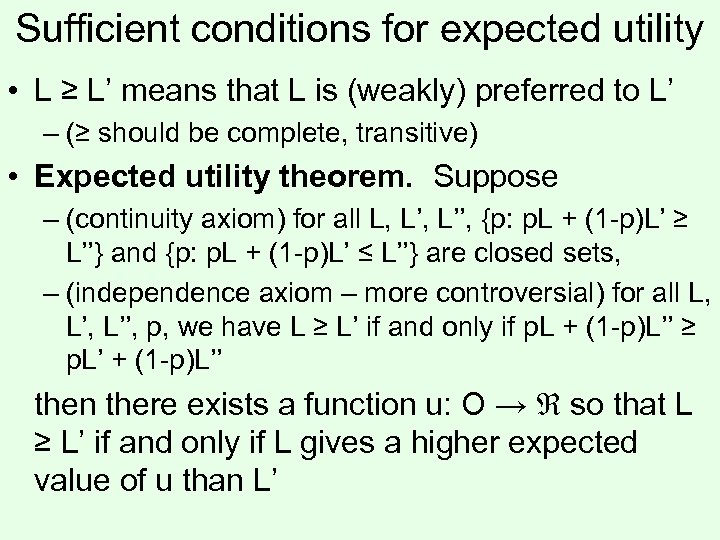 Sufficient conditions for expected utility • L ≥ L’ means that L is (weakly) preferred to L’ – (≥ should be complete, transitive) • Expected utility theorem. Suppose – (continuity axiom) for all L, L’’, {p: p. L + (1 -p)L’ ≥ L’’} and {p: p. L + (1 -p)L’ ≤ L’’} are closed sets, – (independence axiom – more controversial) for all L, L’’, p, we have L ≥ L’ if and only if p. L + (1 -p)L’’ ≥ p. L’ + (1 -p)L’’ then there exists a function u: O → so that L ≥ L’ if and only if L gives a higher expected value of u than L’