


 Скачать презентацию CPS 296 1 Preference elicitation iterative mechanisms Vincent
ebfe79abaf06a9994731fd02aec9a3fe.ppt
- Количество слайдов: 15
 CPS 296. 1 Preference elicitation/ iterative mechanisms Vincent Conitzer conitzer@cs. duke. edu
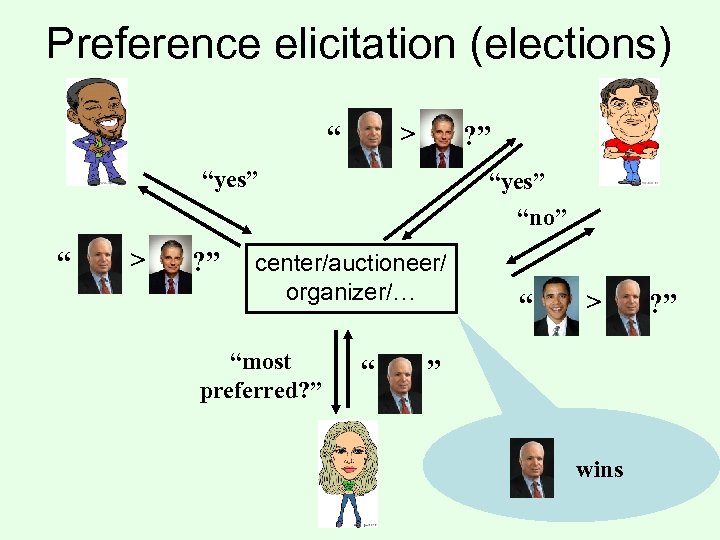 Preference elicitation (elections) > “ ? ” “yes” “ > ? ” “yes” “no” center/auctioneer/ organizer/… “most preferred? ” “ “ > ” wins ? ”
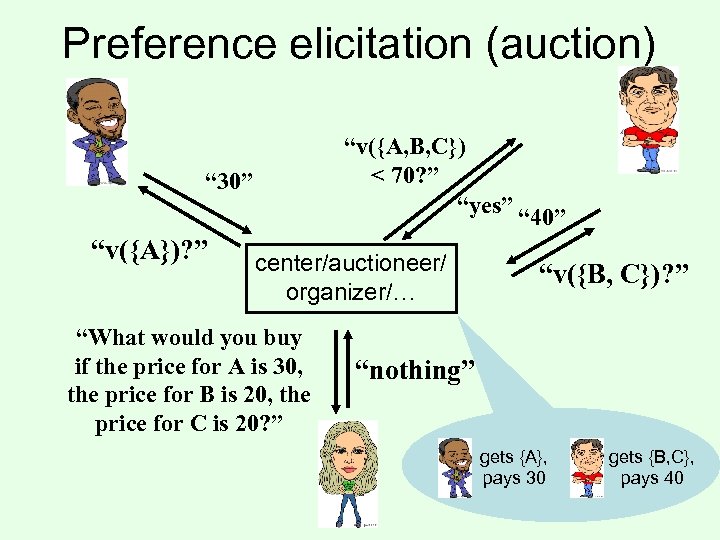 Preference elicitation (auction) “v({A, B, C}) < 70? ” “yes” “ 40” “ 30” “v({A})? ” center/auctioneer/ organizer/… “What would you buy if the price for A is 30, the price for B is 20, the price for C is 20? ” “v({B, C})? ” “nothing” gets {A}, pays 30 gets {B, C}, pays 40
 Unnecessary communication • We have seen that mechanisms often force agents to communicate large amounts of information – E. g. , in combinatorial auctions, should in principle communicate a value for every single bundle! • Much of this information will be irrelevant, e. g. : – Suppose each item has already received a bid >$1 – Bidder 1 values the grand bundle of all items at v 1(I) = $1 – To find the optimal allocation, we need not know anything more about 1’s valuation function (assuming free disposal) – We may still need more detail on 1’s valuation function to compute Clarke payments… – … but not if each item has received two bids >$1 • Can we spare bidder 1 the burden of communicating (and figuring out) her whole valuation function?
 Single-stage mechanisms • If all agents must report their valuations (types) at the same time (e. g. , sealed-bid), then almost no communication can be saved – E. g. , if we do not know that other bidders have already placed high bids on items, we may need to know more about bidder 1’s valuation function – Can only save communication of information that is irrelevant regardless of what other agents report • E. g. if a bidder’s valuation is below the reserve price, it does not matter exactly where below the reserve price it is • E. g. a voter’s second-highest candidate under plurality rule • Could still try to design the mechanism so that most information is (unconditionally) irrelevant – E. g. [Hyafil & Boutilier IJCAI 07]
 Multistage mechanisms • In a multistage (or iterative) mechanism, – bidders communicate something, – then find out something about what others communicated, – then communicate again, etc. • After enough information has been communicated, the mechanism declares an outcome • What multistage mechanisms have we seen already?
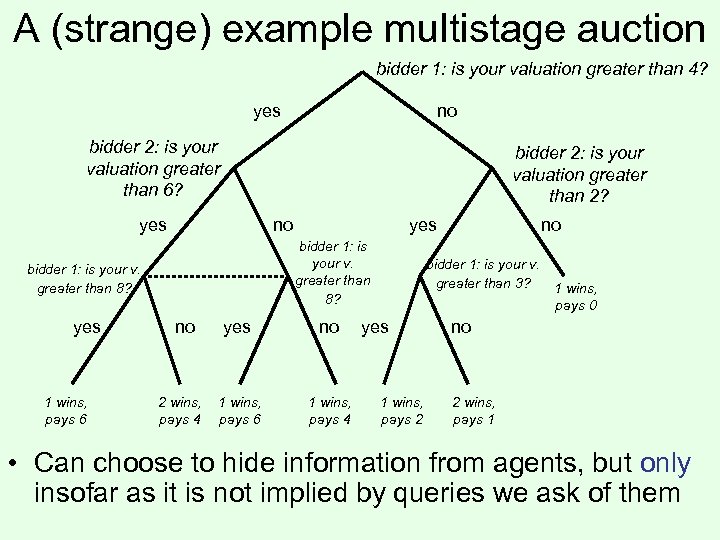 A (strange) example multistage auction bidder 1: is your valuation greater than 4? yes no bidder 2: is your valuation greater than 6? bidder 2: is your valuation greater than 2? yes no bidder 1: is your v. greater than 8? yes 1 wins, pays 6 yes no 2 wins, pays 4 yes no 1 wins, pays 6 1 wins, pays 4 no bidder 1: is your v. greater than 3? yes 1 wins, pays 2 1 wins, pays 0 no 2 wins, pays 1 • Can choose to hide information from agents, but only insofar as it is not implied by queries we ask of them
 Converting single-stage to multistage • One possibility: start with a single-stage mechanism (mapping o from Θ 1 x Θ 2 x … x Θn to O) • Center asks the agents queries about their types – E. g. , “Is your valuation greater than v? ” – May or may not (explicitly) reveal results of queries to others • Until center knows enough about θ 1, θ 2, …, θn to determine o(θ 1, θ 2, …, θn) • The center’s strategy for asking queries is an elicitation algorithm for computing o • E. g. , Japanese auction is an elicitation algorithm for the second-price auction
 Elicitation algorithms • Suppose agents always answer truthfully • Design elicitation algorithm to minimize queries for given rule • What is a good elicitation algorithm for STV? • What about Bucklin?
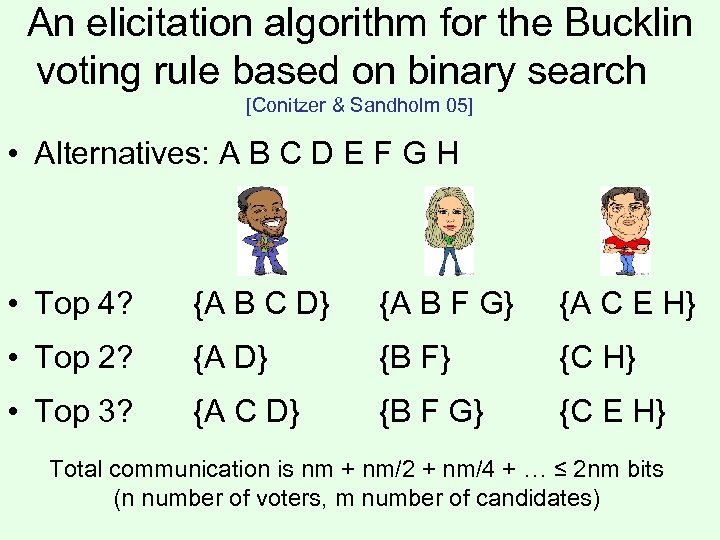 An elicitation algorithm for the Bucklin voting rule based on binary search [Conitzer & Sandholm 05] • Alternatives: A B C D E F G H • Top 4? {A B C D} {A B F G} {A C E H} • Top 2? {A D} {B F} {C H} • Top 3? {A C D} {B F G} {C E H} Total communication is nm + nm/2 + nm/4 + … ≤ 2 nm bits (n number of voters, m number of candidates)
 Funky strategic phenomena in multistage mechanisms • Suppose we sell two items A and B in parallel English auctions to bidders 1 and 2 – Minimum bid increment of 1 • No complementarity/substitutability • v 1(A) = 30, v 1(B) = 20, v 2(A) = 20, v 2(B) = 30, all of this is common knowledge • 1’s strategy: “I will bid 1 on B and 0 on A, unless 2 starts bidding on B, in which case I will bid up to my true valuations for both. ” • 2’s strategy: “I will bid 1 on A and 0 on B, unless 1 starts bidding on A, in which case I will bid up to my true valuations for both. ” • This is an equilibrium! – Inefficient allocation – Self-enforcing collusion – Bidding truthfully (up to true valuation) is not a dominant strategy
 Ex-post equilibrium • In a Bayesian game, a profile of strategies is an ex-post equilibrium if for each agent, following the strategy is optimal for every vector of types (given the others’ strategies) – That is, even if you are told what everyone’s type was after the fact, you never regret what you did – Stronger than Bayes-Nash equilibrium – Weaker than dominant-strategies equilibrium • Although, single-stage mechanisms are ex-post incentive compatible if and only if they are dominant-strategies incentive compatible • If a single-stage mechanism is dominant-strategies incentivecompatible, then any elicitation protocol for it (any corresponding multistage mechanism) will be ex-post incentive compatible • E. g. , if we elicit enough information to determine the Clarke payments, telling the truth will be an ex-post equilibrium (but not dominant strategies)
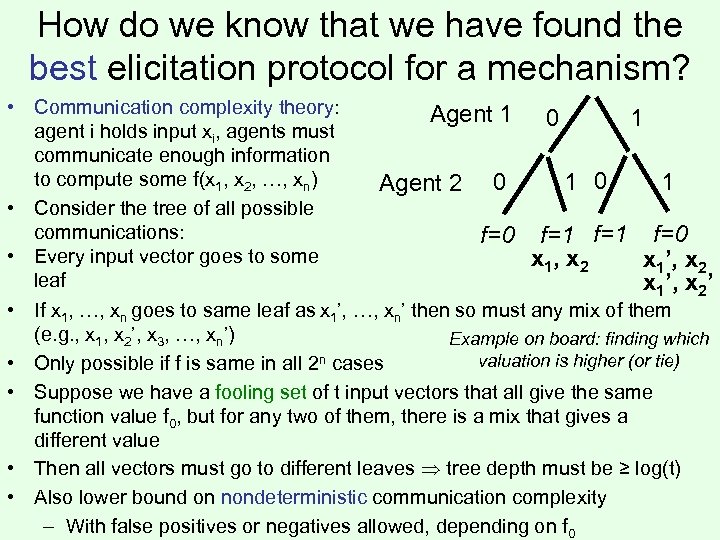 How do we know that we have found the best elicitation protocol for a mechanism? • Communication complexity theory: Agent 1 0 1 agent i holds input xi, agents must communicate enough information to compute some f(x 1, x 2, …, xn) 1 0 1 Agent 2 0 • Consider the tree of all possible communications: f=0 f=1 f=0 • Every input vector goes to some x 1, x 2 x 1’, x 2 leaf x 1’, x 2’ • If x 1, …, xn goes to same leaf as x 1’, …, xn’ then so must any mix of them (e. g. , x 1, x 2’, x 3, …, xn’) Example on board: finding which valuation is higher (or tie) • Only possible if f is same in all 2 n cases • Suppose we have a fooling set of t input vectors that all give the same function value f 0, but for any two of them, there is a mix that gives a different value • Then all vectors must go to different leaves tree depth must be ≥ log(t) • Also lower bound on nondeterministic communication complexity – With false positives or negatives allowed, depending on f 0
![Combinatorial auction WDP requires exponential communication [Nisan & Segal JET 06] • … even](https://present5.com/presentation/ebfe79abaf06a9994731fd02aec9a3fe/image-14.jpg "Combinatorial auction WDP requires exponential communication [Nisan & Segal JET 06] • … even") Combinatorial auction WDP requires exponential communication [Nisan & Segal JET 06] • … even with two bidders! • Let us construct a fooling set • Consider valuation functions with – v(S) = 0 for |S| < m/2 – v(S) = 1 for |S| > m/2 – v(S) = 0 or 1 for |S| = m/2 • If m is even, there are 2^(m choose m/2) such valuation functions (doubly exponential) • In the fooling set, bidder 1 will have one such valuation function, and bidder 2 will have the dual such valuation function, that is, v 2(S) = 1 - v 1(I S) • Best allocation gives total value of 1 • However, now suppose we take distinct (v 1, v 2), (v 1’, v 2’) • WLOG there must be some set S such that v 1(S) = 1 and v 1’(S) = 0 (hence v 2’(I S) = 1) • So on (v 1, v 2’) we can get a total allocation value of 2!
Combinatorial auction WDP requires exponential communication [Nisan & Segal JET 06] • … even with two bidders! • Let us construct a fooling set • Consider valuation functions with – v(S) = 0 for |S| < m/2 – v(S) = 1 for |S| > m/2 – v(S) = 0 or 1 for |S| = m/2 • If m is even, there are 2^(m choose m/2) such valuation functions (doubly exponential) • In the fooling set, bidder 1 will have one such valuation function, and bidder 2 will have the dual such valuation function, that is, v 2(S) = 1 - v 1(I S) • Best allocation gives total value of 1 • However, now suppose we take distinct (v 1, v 2), (v 1’, v 2’) • WLOG there must be some set S such that v 1(S) = 1 and v 1’(S) = 0 (hence v 2’(I S) = 1) • So on (v 1, v 2’) we can get a total allocation value of 2!
![i. Bundle: an ascending CA [Parkes & Ungar 00] • Each round, each bidder](https://present5.com/presentation/ebfe79abaf06a9994731fd02aec9a3fe/image-15.jpg "i. Bundle: an ascending CA [Parkes & Ungar 00] • Each round, each bidder") i. Bundle: an ascending CA [Parkes & Ungar 00] • Each round, each bidder i faces separate price pi(S) for each bundle S – Note: different bidders may face different prices for the same bundle – Prices start at 0 • A bidder (is assumed to) bid pi(S) on the bundle(s) S that maximize(s) her utility given the current prices, i. e. , that maximize(s) vi(S) - pi(S) (straightforward bidding) – Bidder drops out if all bundles would give negative utility • Winner determination problem is solved with these bids • If some (active) bidder i did not win anything, that bidder’s prices are increased by ε on each of the bundles that she bid on (and supersets thereof), and we go to the next round • Otherwise, we terminate with this allocation & these prices
i. Bundle: an ascending CA [Parkes & Ungar 00] • Each round, each bidder i faces separate price pi(S) for each bundle S – Note: different bidders may face different prices for the same bundle – Prices start at 0 • A bidder (is assumed to) bid pi(S) on the bundle(s) S that maximize(s) her utility given the current prices, i. e. , that maximize(s) vi(S) - pi(S) (straightforward bidding) – Bidder drops out if all bundles would give negative utility • Winner determination problem is solved with these bids • If some (active) bidder i did not win anything, that bidder’s prices are increased by ε on each of the bundles that she bid on (and supersets thereof), and we go to the next round • Otherwise, we terminate with this allocation & these prices