


 Скачать презентацию CPS 296 1 Application of Linear and Integer
5072b65b2646ea1c2342a709a64bc88e.ppt
- Количество слайдов: 32
 CPS 296. 1 Application of Linear and Integer Programming: Automated Mechanism Design Guest Lecture by Mingyu Guo
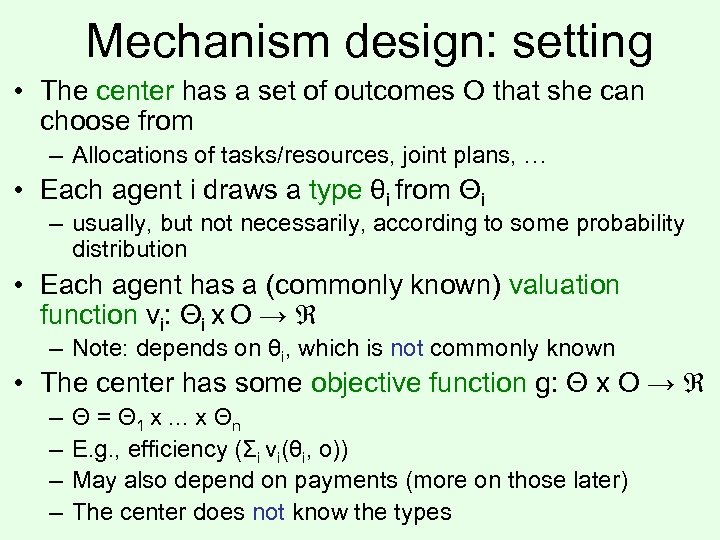 Mechanism design: setting • The center has a set of outcomes O that she can choose from – Allocations of tasks/resources, joint plans, … • Each agent i draws a type θi from Θi – usually, but not necessarily, according to some probability distribution • Each agent has a (commonly known) valuation function vi: Θi x O → – Note: depends on θi, which is not commonly known • The center has some objective function g: Θ x O → – – Θ = Θ 1 x. . . x Θn E. g. , efficiency (Σi vi(θi, o)) May also depend on payments (more on those later) The center does not know the types
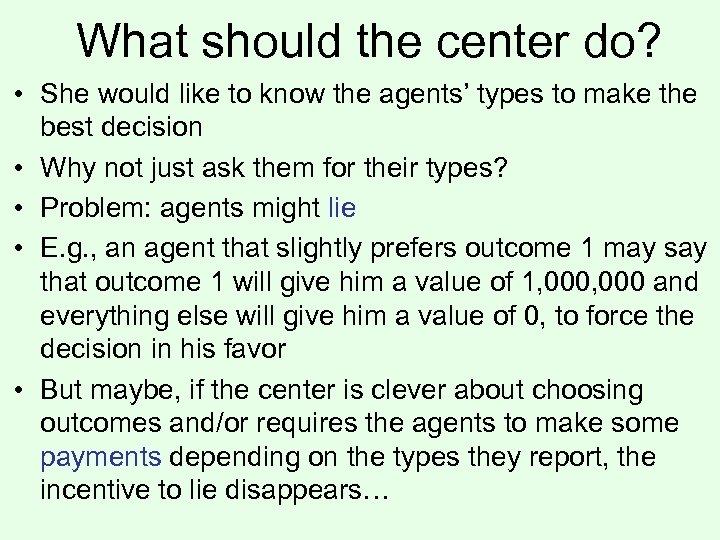 What should the center do? • She would like to know the agents’ types to make the best decision • Why not just ask them for their types? • Problem: agents might lie • E. g. , an agent that slightly prefers outcome 1 may say that outcome 1 will give him a value of 1, 000 and everything else will give him a value of 0, to force the decision in his favor • But maybe, if the center is clever about choosing outcomes and/or requires the agents to make some payments depending on the types they report, the incentive to lie disappears…
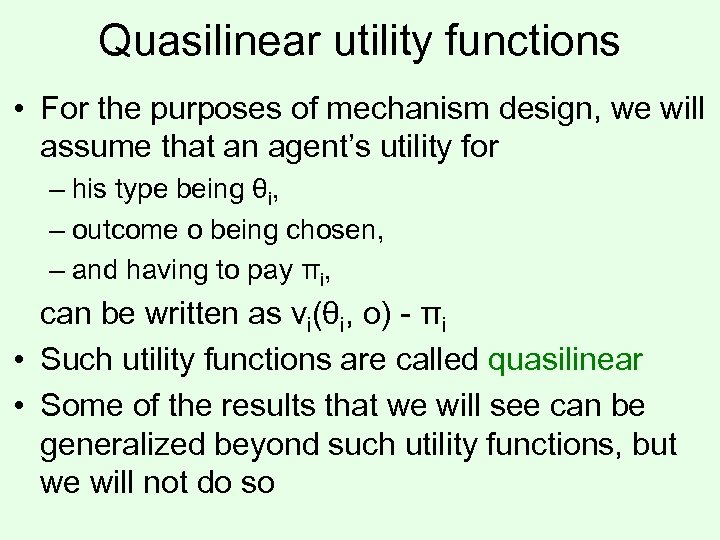 Quasilinear utility functions • For the purposes of mechanism design, we will assume that an agent’s utility for – his type being θi, – outcome o being chosen, – and having to pay πi, can be written as vi(θi, o) - πi • Such utility functions are called quasilinear • Some of the results that we will see can be generalized beyond such utility functions, but we will not do so
![The Clarke (aka. VCG) mechanism [Clarke 71] • The Clarke mechanism chooses some outcome](https://present5.com/presentation/5072b65b2646ea1c2342a709a64bc88e/image-5.jpg "The Clarke (aka. VCG) mechanism [Clarke 71] • The Clarke mechanism chooses some outcome") The Clarke (aka. VCG) mechanism [Clarke 71] • The Clarke mechanism chooses some outcome o that maximizes Σi vi(θi’, o) – θi’ = the type that i reports • To determine the payment that agent j must make: – Pretend j does not exist, and choose o-j that maximizes Σi≠j vi(θi’, o-j) – j pays Σi≠j vi(θi’, o-j) - Σi≠j vi(θi’, o) = Σi≠j (vi(θi’, o-j) - vi(θi’, o)) • We say that each agent pays the externality that she imposes on the other agents • (VCG = Vickrey, Clarke, Groves)
The Clarke (aka. VCG) mechanism [Clarke 71] • The Clarke mechanism chooses some outcome o that maximizes Σi vi(θi’, o) – θi’ = the type that i reports • To determine the payment that agent j must make: – Pretend j does not exist, and choose o-j that maximizes Σi≠j vi(θi’, o-j) – j pays Σi≠j vi(θi’, o-j) - Σi≠j vi(θi’, o) = Σi≠j (vi(θi’, o-j) - vi(θi’, o)) • We say that each agent pays the externality that she imposes on the other agents • (VCG = Vickrey, Clarke, Groves)
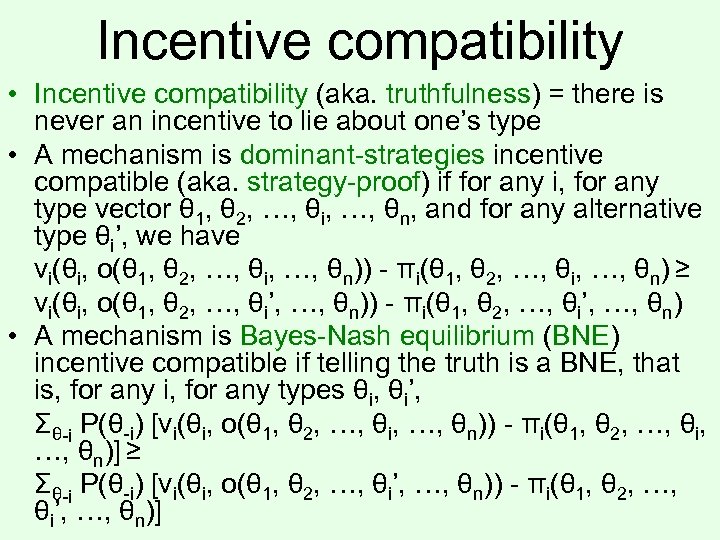 Incentive compatibility • Incentive compatibility (aka. truthfulness) = there is never an incentive to lie about one’s type • A mechanism is dominant-strategies incentive compatible (aka. strategy-proof) if for any i, for any type vector θ 1, θ 2, …, θi, …, θn, and for any alternative type θi’, we have vi(θi, o(θ 1, θ 2, …, θi, …, θn)) - πi(θ 1, θ 2, …, θi, …, θn) ≥ vi(θi, o(θ 1, θ 2, …, θi’, …, θn)) - πi(θ 1, θ 2, …, θi’, …, θn) • A mechanism is Bayes-Nash equilibrium (BNE) incentive compatible if telling the truth is a BNE, that is, for any i, for any types θi, θi’, Σθ-i P(θ-i) [vi(θi, o(θ 1, θ 2, …, θi, …, θn)) - πi(θ 1, θ 2, …, θi, …, θn)] ≥ Σθ-i P(θ-i) [vi(θi, o(θ 1, θ 2, …, θi’, …, θn)) - πi(θ 1, θ 2, …, θi’, …, θn)]
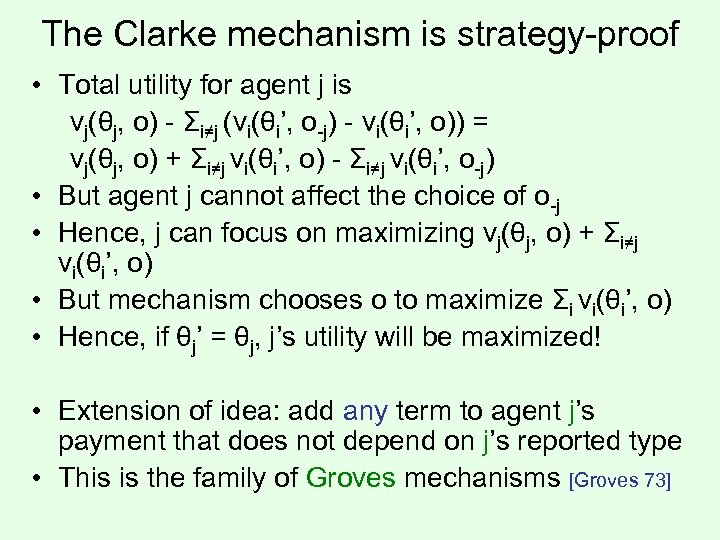 The Clarke mechanism is strategy-proof • Total utility for agent j is vj(θj, o) - Σi≠j (vi(θi’, o-j) - vi(θi’, o)) = vj(θj, o) + Σi≠j vi(θi’, o) - Σi≠j vi(θi’, o-j) • But agent j cannot affect the choice of o-j • Hence, j can focus on maximizing vj(θj, o) + Σi≠j vi(θi’, o) • But mechanism chooses o to maximize Σi vi(θi’, o) • Hence, if θj’ = θj, j’s utility will be maximized! • Extension of idea: add any term to agent j’s payment that does not depend on j’s reported type • This is the family of Groves mechanisms [Groves 73]
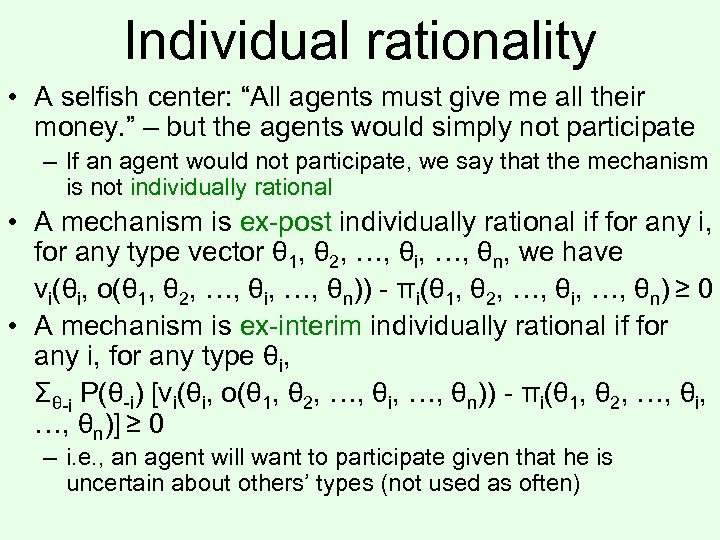 Individual rationality • A selfish center: “All agents must give me all their money. ” – but the agents would simply not participate – If an agent would not participate, we say that the mechanism is not individually rational • A mechanism is ex-post individually rational if for any i, for any type vector θ 1, θ 2, …, θi, …, θn, we have vi(θi, o(θ 1, θ 2, …, θi, …, θn)) - πi(θ 1, θ 2, …, θi, …, θn) ≥ 0 • A mechanism is ex-interim individually rational if for any i, for any type θi, Σθ-i P(θ-i) [vi(θi, o(θ 1, θ 2, …, θi, …, θn)) - πi(θ 1, θ 2, …, θi, …, θn)] ≥ 0 – i. e. , an agent will want to participate given that he is uncertain about others’ types (not used as often)
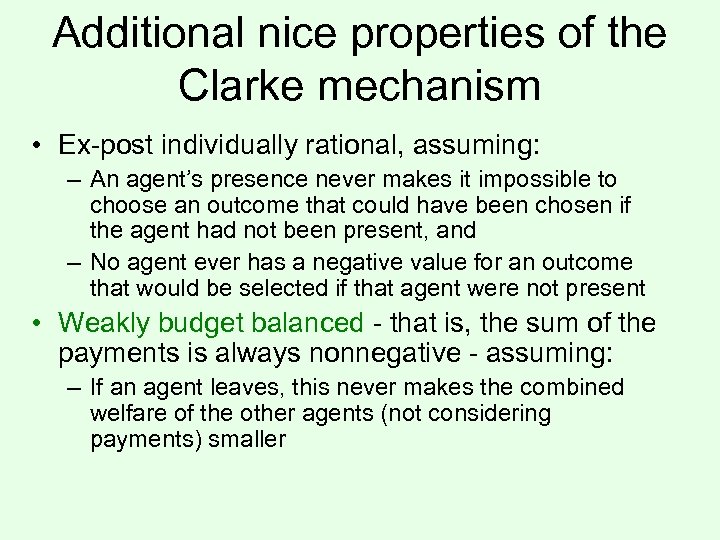 Additional nice properties of the Clarke mechanism • Ex-post individually rational, assuming: – An agent’s presence never makes it impossible to choose an outcome that could have been chosen if the agent had not been present, and – No agent ever has a negative value for an outcome that would be selected if that agent were not present • Weakly budget balanced - that is, the sum of the payments is always nonnegative - assuming: – If an agent leaves, this never makes the combined welfare of the other agents (not considering payments) smaller
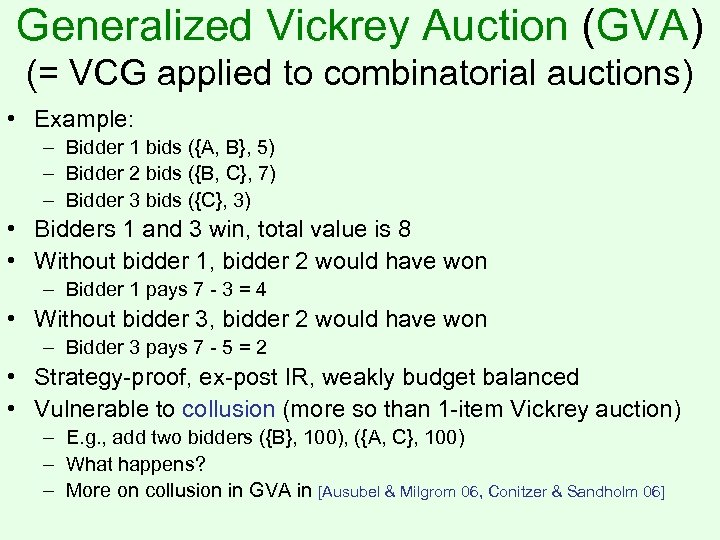 Generalized Vickrey Auction (GVA) (= VCG applied to combinatorial auctions) • Example: – Bidder 1 bids ({A, B}, 5) – Bidder 2 bids ({B, C}, 7) – Bidder 3 bids ({C}, 3) • Bidders 1 and 3 win, total value is 8 • Without bidder 1, bidder 2 would have won – Bidder 1 pays 7 - 3 = 4 • Without bidder 3, bidder 2 would have won – Bidder 3 pays 7 - 5 = 2 • Strategy-proof, ex-post IR, weakly budget balanced • Vulnerable to collusion (more so than 1 -item Vickrey auction) – E. g. , add two bidders ({B}, 100), ({A, C}, 100) – What happens? – More on collusion in GVA in [Ausubel & Milgrom 06, Conitzer & Sandholm 06]
 Clarke mechanism is not perfect • Requires payments + quasilinear utility functions • In general money needs to flow away from the system – Strong budget balance = payments sum to 0 – In general, this is impossible to obtain in addition to the other nice properties [Green & Laffont 77] • Vulnerable to collusion – E. g. , suppose two agents both declare a ridiculously large value (say, $1, 000) for some outcome, and 0 for everything else. What will happen? • Maximizes sum of agents’ utilities (if we do not count payments), but sometimes the center is not interested in this – E. g. , sometimes the center wants to maximize revenue
 Why restrict attention to truthful direct-revelation mechanisms? • Bob has an incredibly complicated mechanism in which agents do not report types, but do all sorts of other strange things • E. g. : Bob: “In my mechanism, first agents 1 and 2 play a round of rock-paper-scissors. If agent 1 wins, she gets to choose the outcome. Otherwise, agents 2, 3 and 4 vote over the other outcomes using the Borda rule. If there is a tie, everyone pays $100, and…” • Bob: “The equilibria of my mechanism produce better results than any truthful direct revelation mechanism. ” • Could Bob be right?
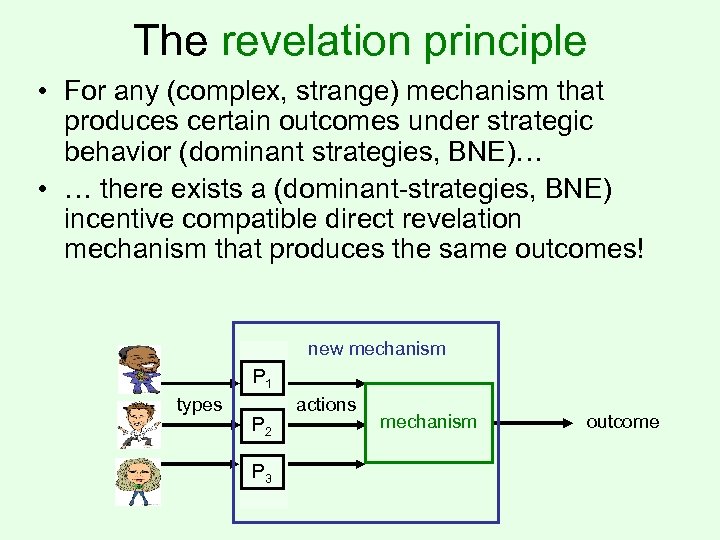 The revelation principle • For any (complex, strange) mechanism that produces certain outcomes under strategic behavior (dominant strategies, BNE)… • … there exists a (dominant-strategies, BNE) incentive compatible direct revelation mechanism that produces the same outcomes! new mechanism P 1 types P 2 P 3 actions mechanism outcome
 General vs. specific mechanisms • Mechanisms such as Clarke (VCG) mechanism are very general… • … but will instantiate to something specific in any specific setting – This is what we care about
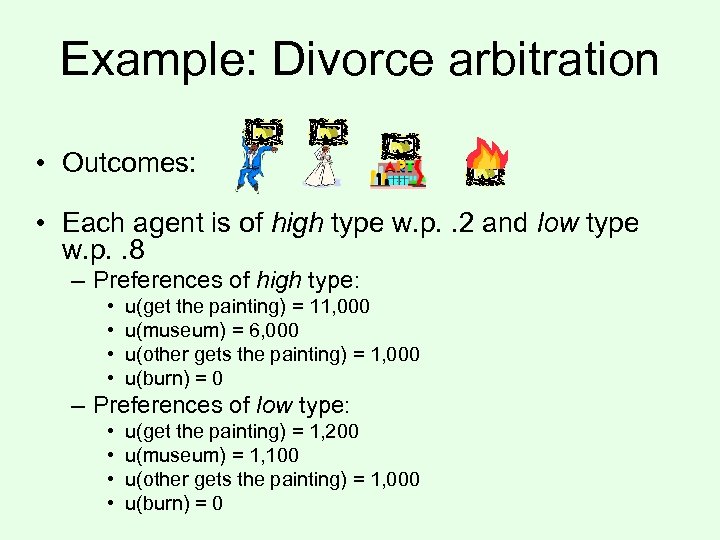 Example: Divorce arbitration • Outcomes: • Each agent is of high type w. p. . 2 and low type w. p. . 8 – Preferences of high type: • • u(get the painting) = 11, 000 u(museum) = 6, 000 u(other gets the painting) = 1, 000 u(burn) = 0 – Preferences of low type: • • u(get the painting) = 1, 200 u(museum) = 1, 100 u(other gets the painting) = 1, 000 u(burn) = 0
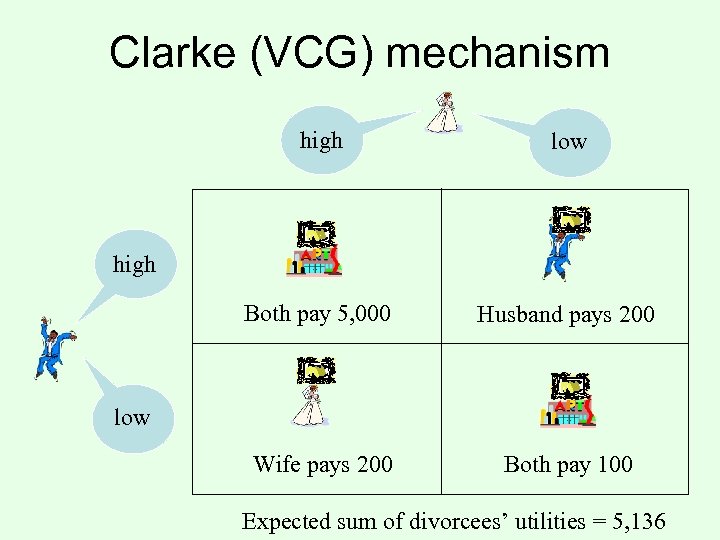 Clarke (VCG) mechanism high low Both pay 5, 000 Husband pays 200 Wife pays 200 Both pay 100 high low Expected sum of divorcees’ utilities = 5, 136
 “Manual” mechanism design has yielded • some positive results: – “Mechanism x achieves properties P in any setting that belongs to class C” • some impossibility results: – “There is no mechanism that achieves properties P for all settings in class C”
 Difficulties with manual mechanism design • Design problem instance comes along – Set of outcomes, agents, set of possible types for each agent, prior over types, … • What if no canonical mechanism covers this instance? – Unusual objective, or payments not possible, or … – Impossibility results may exist for the general class of settings • But instance may have additional structure (restricted preferences or prior) so good mechanisms exist (but unknown) • What if a canonical mechanism does cover the setting? – Can we use instance’s structure to get higher objective value? – Can we get stronger nonmanipulability/participation properties? • Manual design for every instance is prohibitively slow
![Automated mechanism design (AMD) [Conitzer & Sandholm UAI-02, later papers] • Idea: Solve mechanism](https://present5.com/presentation/5072b65b2646ea1c2342a709a64bc88e/image-19.jpg "Automated mechanism design (AMD) [Conitzer & Sandholm UAI-02, later papers] • Idea: Solve mechanism") Automated mechanism design (AMD) [Conitzer & Sandholm UAI-02, later papers] • Idea: Solve mechanism design as optimization problem automatically • Create a mechanism for the specific setting at hand rather than a class of settings • Advantages: – Can lead to greater value of designer’s objective than known mechanisms – Sometimes circumvents economic impossibility results & always minimizes the pain implied by them – Can be used in new settings & for unusual objectives – Can yield stronger incentive compatibility & participation properties – Shifts the burden of design from human to machine
Automated mechanism design (AMD) [Conitzer & Sandholm UAI-02, later papers] • Idea: Solve mechanism design as optimization problem automatically • Create a mechanism for the specific setting at hand rather than a class of settings • Advantages: – Can lead to greater value of designer’s objective than known mechanisms – Sometimes circumvents economic impossibility results & always minimizes the pain implied by them – Can be used in new settings & for unusual objectives – Can yield stronger incentive compatibility & participation properties – Shifts the burden of design from human to machine
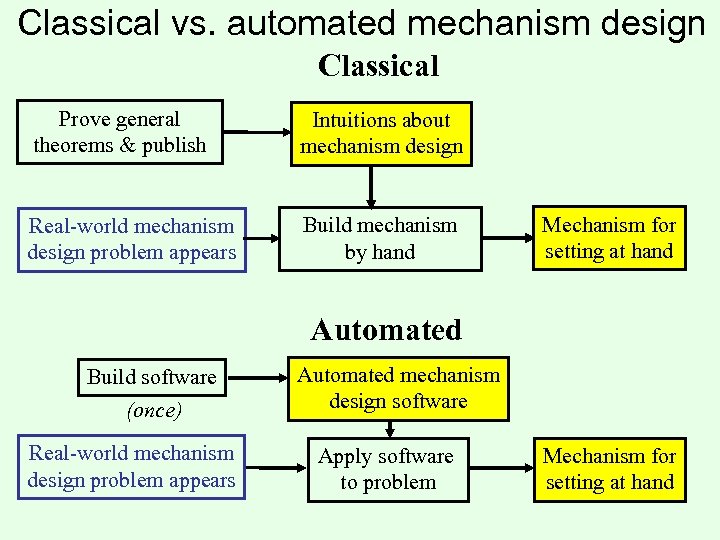 Classical vs. automated mechanism design Classical Prove general theorems & publish Intuitions about mechanism design Real-world mechanism design problem appears Build mechanism by hand Mechanism for setting at hand Automated Build software (once) Real-world mechanism design problem appears Automated mechanism design software Apply software to problem Mechanism for setting at hand
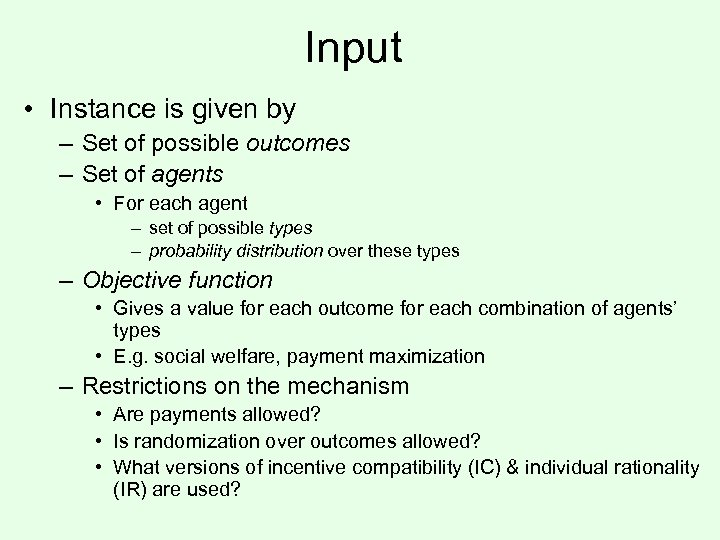 Input • Instance is given by – Set of possible outcomes – Set of agents • For each agent – set of possible types – probability distribution over these types – Objective function • Gives a value for each outcome for each combination of agents’ types • E. g. social welfare, payment maximization – Restrictions on the mechanism • Are payments allowed? • Is randomization over outcomes allowed? • What versions of incentive compatibility (IC) & individual rationality (IR) are used?
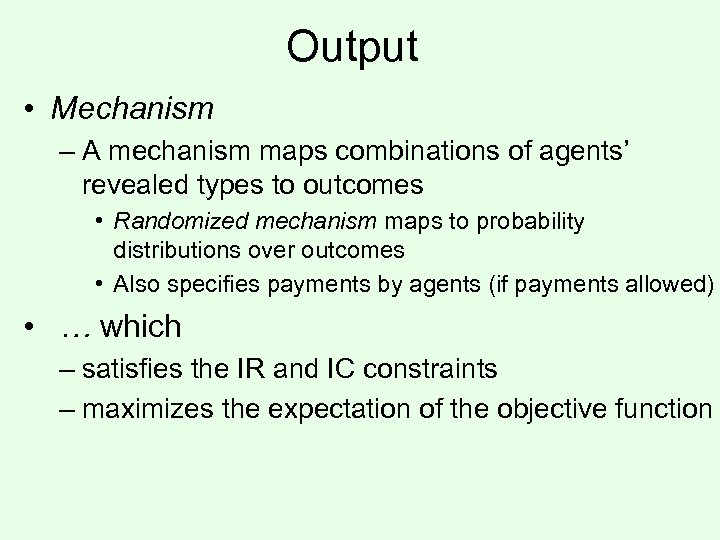 Output • Mechanism – A mechanism maps combinations of agents’ revealed types to outcomes • Randomized mechanism maps to probability distributions over outcomes • Also specifies payments by agents (if payments allowed) • … which – satisfies the IR and IC constraints – maximizes the expectation of the objective function
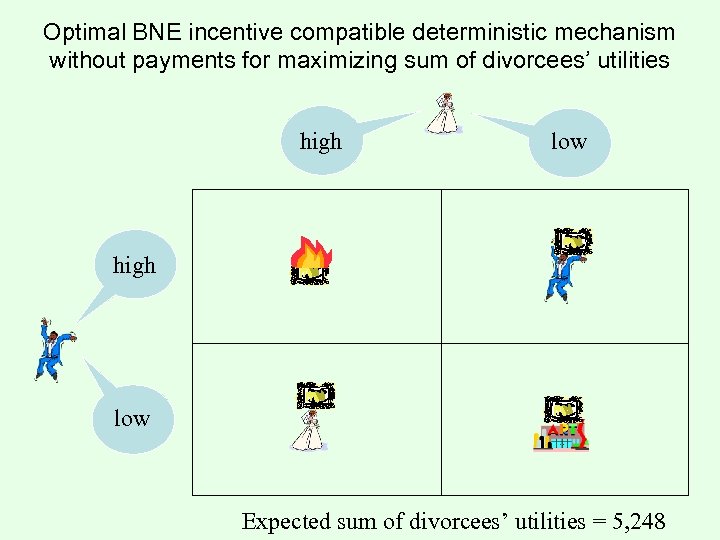 Optimal BNE incentive compatible deterministic mechanism without payments for maximizing sum of divorcees’ utilities high low Expected sum of divorcees’ utilities = 5, 248
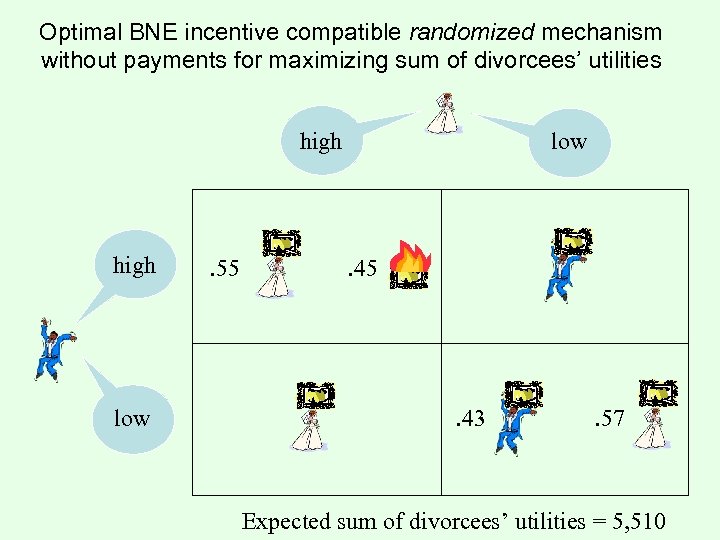 Optimal BNE incentive compatible randomized mechanism without payments for maximizing sum of divorcees’ utilities high low . 55 low . 45 . 43 . 57 Expected sum of divorcees’ utilities = 5, 510
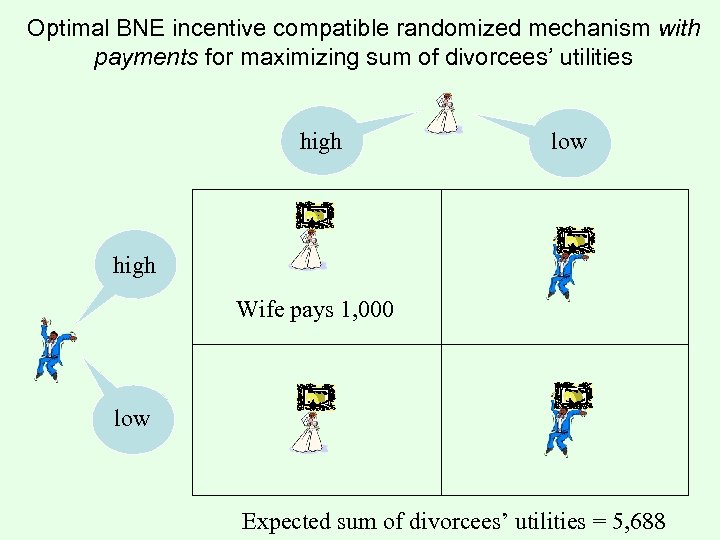 Optimal BNE incentive compatible randomized mechanism with payments for maximizing sum of divorcees’ utilities high low high Wife pays 1, 000 low Expected sum of divorcees’ utilities = 5, 688
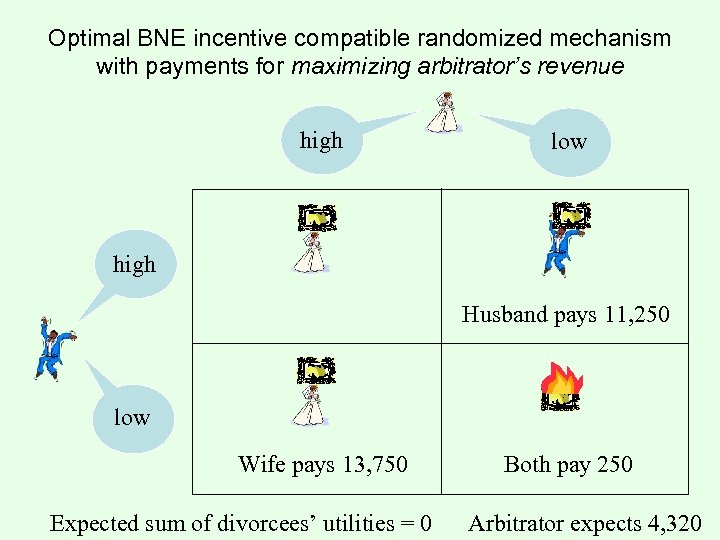 Optimal BNE incentive compatible randomized mechanism with payments for maximizing arbitrator’s revenue high low high Husband pays 11, 250 low Wife pays 13, 750 Expected sum of divorcees’ utilities = 0 Both pay 250 Arbitrator expects 4, 320
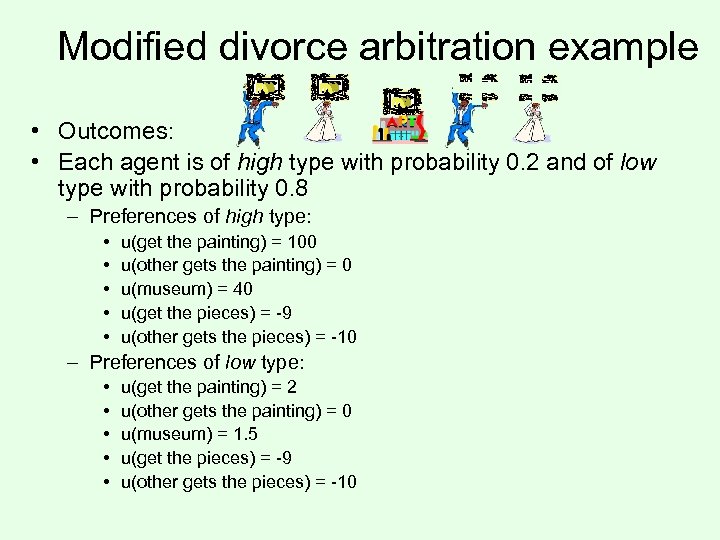 Modified divorce arbitration example • Outcomes: • Each agent is of high type with probability 0. 2 and of low type with probability 0. 8 – Preferences of high type: • • • u(get the painting) = 100 u(other gets the painting) = 0 u(museum) = 40 u(get the pieces) = -9 u(other gets the pieces) = -10 – Preferences of low type: • • • u(get the painting) = 2 u(other gets the painting) = 0 u(museum) = 1. 5 u(get the pieces) = -9 u(other gets the pieces) = -10
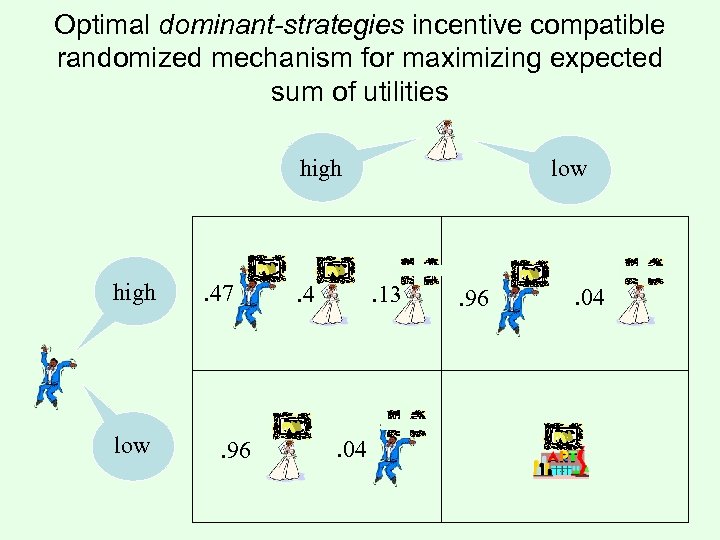 Optimal dominant-strategies incentive compatible randomized mechanism for maximizing expected sum of utilities high low . 47 . 96 . 4 low . 13 . 04 . 96 . 04
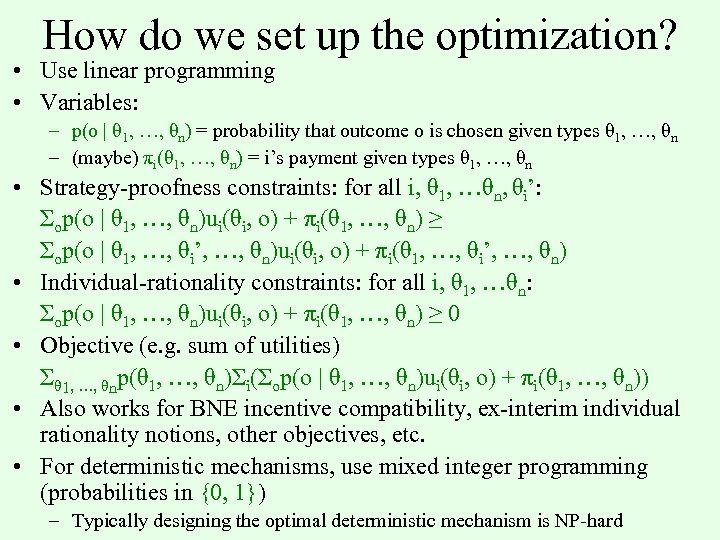 How do we set up the optimization? • Use linear programming • Variables: – p(o | θ 1, …, θn) = probability that outcome o is chosen given types θ 1, …, θn – (maybe) πi(θ 1, …, θn) = i’s payment given types θ 1, …, θn • Strategy-proofness constraints: for all i, θ 1, …θn, θi’: Σop(o | θ 1, …, θn)ui(θi, o) + πi(θ 1, …, θn) ≥ Σop(o | θ 1, …, θi’, …, θn)ui(θi, o) + πi(θ 1, …, θi’, …, θn) • Individual-rationality constraints: for all i, θ 1, …θn: Σop(o | θ 1, …, θn)ui(θi, o) + πi(θ 1, …, θn) ≥ 0 • Objective (e. g. sum of utilities) Σθ 1, …, θnp(θ 1, …, θn)Σi(Σop(o | θ 1, …, θn)ui(θi, o) + πi(θ 1, …, θn)) • Also works for BNE incentive compatibility, ex-interim individual rationality notions, other objectives, etc. • For deterministic mechanisms, use mixed integer programming (probabilities in {0, 1}) – Typically designing the optimal deterministic mechanism is NP-hard
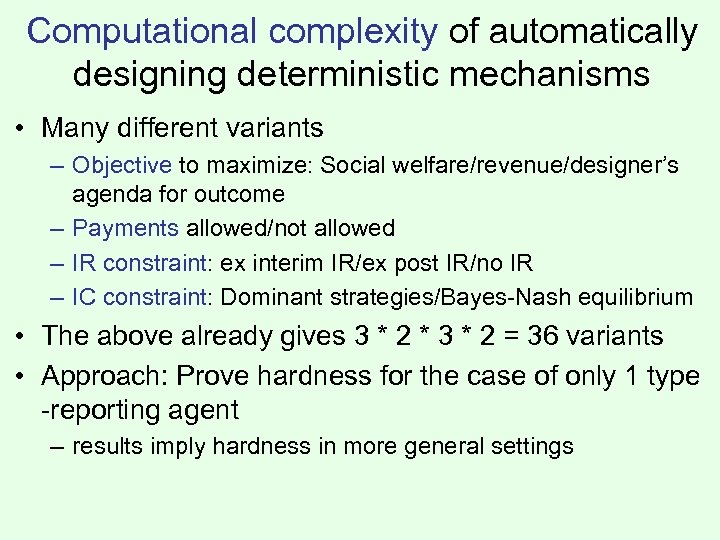 Computational complexity of automatically designing deterministic mechanisms • Many different variants – Objective to maximize: Social welfare/revenue/designer’s agenda for outcome – Payments allowed/not allowed – IR constraint: ex interim IR/ex post IR/no IR – IC constraint: Dominant strategies/Bayes-Nash equilibrium • The above already gives 3 * 2 * 3 * 2 = 36 variants • Approach: Prove hardness for the case of only 1 type -reporting agent – results imply hardness in more general settings
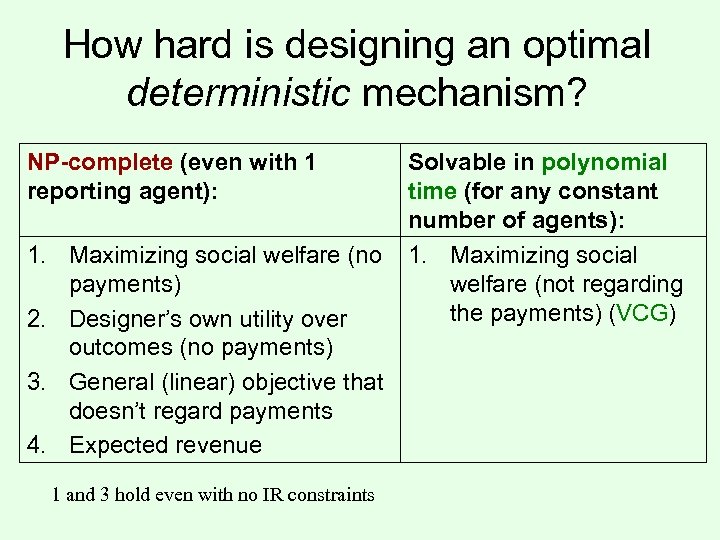 How hard is designing an optimal deterministic mechanism? NP-complete (even with 1 reporting agent): 1. Maximizing social welfare (no payments) 2. Designer’s own utility over outcomes (no payments) 3. General (linear) objective that doesn’t regard payments 4. Expected revenue 1 and 3 hold even with no IR constraints Solvable in polynomial time (for any constant number of agents): 1. Maximizing social welfare (not regarding the payments) (VCG)
 Additional & future directions • Scalability is a major concern – Can sometimes create more concise LP formulations • Sometimes, some constraints are implied by others – In restricted domains faster algorithms sometimes exist • Can sometimes make use of partial characterizations of the optimal mechanism • Automatically generated mechanisms can be complex/hard to understand – Can we make automatically designed mechanisms more intuitive? • Using AMD to create conjectures about general mechanisms