


 Скачать презентацию CPS 196 2 Proper scoring rules Vincent Conitzer
e9eb81f969b6f2b5c460a3772335f044.ppt
- Количество слайдов: 15
 CPS 196. 2 Proper scoring rules Vincent Conitzer conitzer@cs. duke. edu
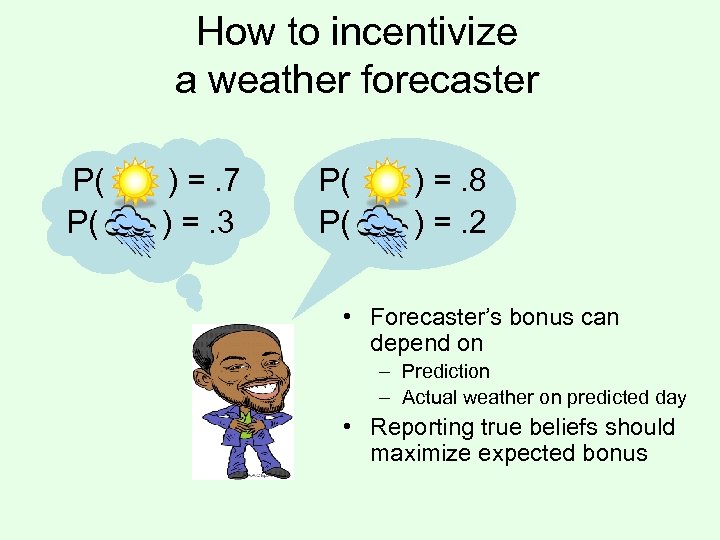 How to incentivize a weather forecaster P( P( ) =. 7 ) =. 3 P( P( ) =. 8 ) =. 2 • Forecaster’s bonus can depend on – Prediction – Actual weather on predicted day • Reporting true beliefs should maximize expected bonus
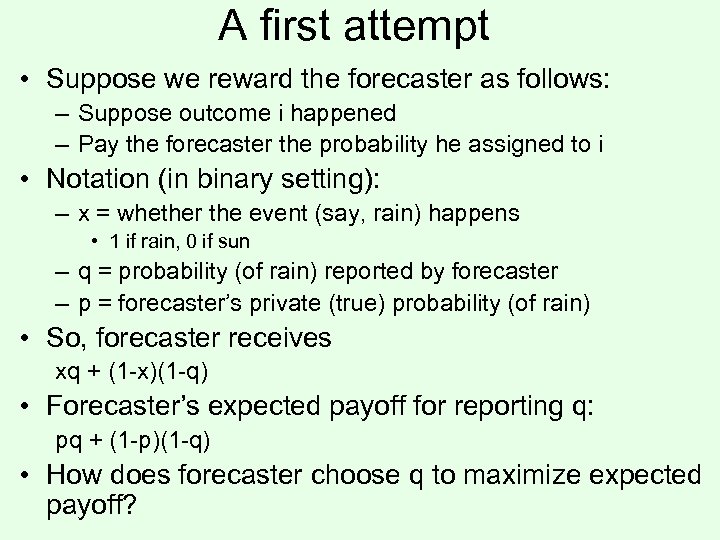 A first attempt • Suppose we reward the forecaster as follows: – Suppose outcome i happened – Pay the forecaster the probability he assigned to i • Notation (in binary setting): – x = whether the event (say, rain) happens • 1 if rain, 0 if sun – q = probability (of rain) reported by forecaster – p = forecaster’s private (true) probability (of rain) • So, forecaster receives xq + (1 -x)(1 -q) • Forecaster’s expected payoff for reporting q: pq + (1 -p)(1 -q) • How does forecaster choose q to maximize expected payoff?
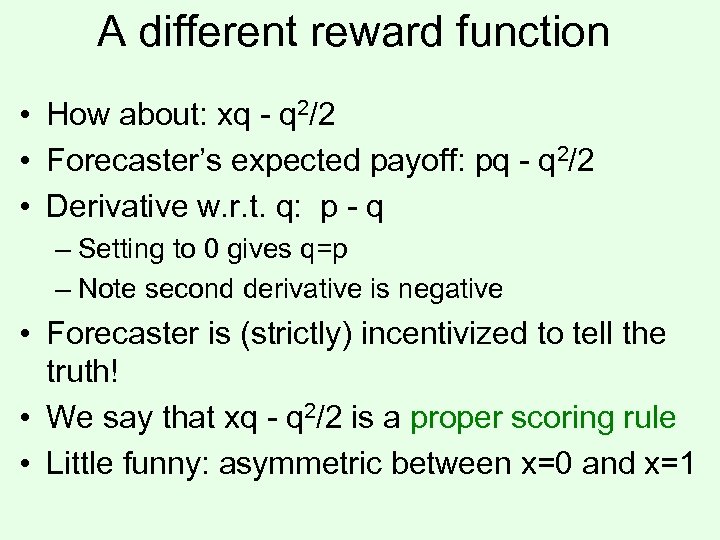 A different reward function • How about: xq - q 2/2 • Forecaster’s expected payoff: pq - q 2/2 • Derivative w. r. t. q: p - q – Setting to 0 gives q=p – Note second derivative is negative • Forecaster is (strictly) incentivized to tell the truth! • We say that xq - q 2/2 is a proper scoring rule • Little funny: asymmetric between x=0 and x=1
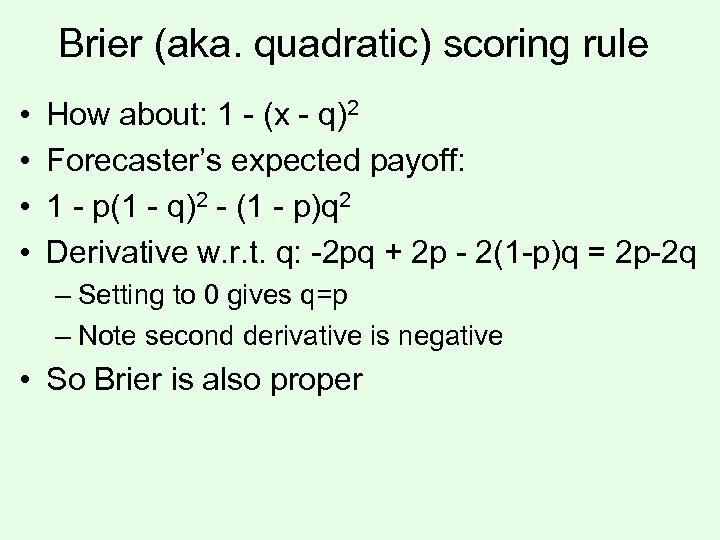 Brier (aka. quadratic) scoring rule • • How about: 1 - (x - q)2 Forecaster’s expected payoff: 1 - p(1 - q)2 - (1 - p)q 2 Derivative w. r. t. q: -2 pq + 2 p - 2(1 -p)q = 2 p-2 q – Setting to 0 gives q=p – Note second derivative is negative • So Brier is also proper
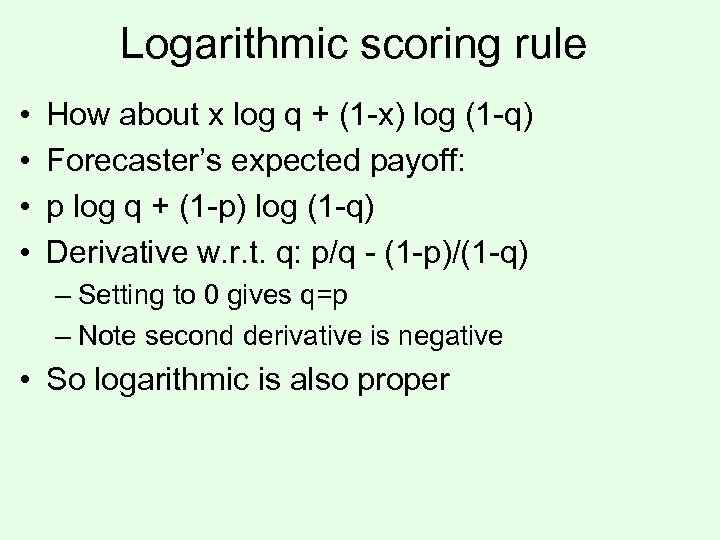 Logarithmic scoring rule • • How about x log q + (1 -x) log (1 -q) Forecaster’s expected payoff: p log q + (1 -p) log (1 -q) Derivative w. r. t. q: p/q - (1 -p)/(1 -q) – Setting to 0 gives q=p – Note second derivative is negative • So logarithmic is also proper
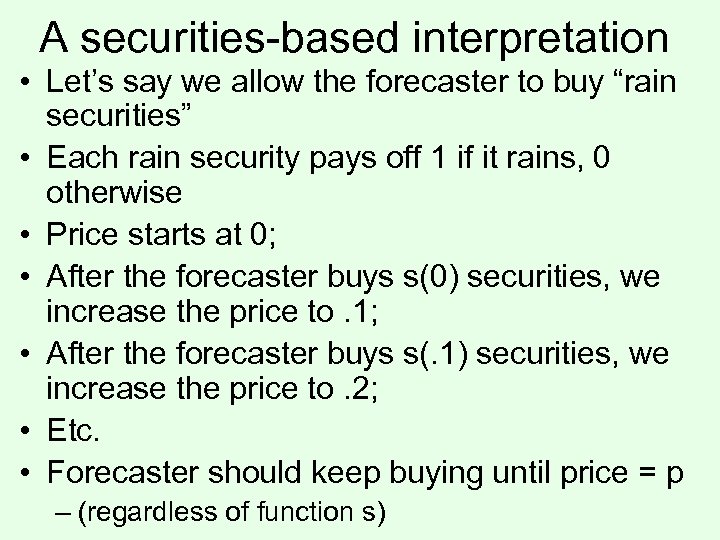 A securities-based interpretation • Let’s say we allow the forecaster to buy “rain securities” • Each rain security pays off 1 if it rains, 0 otherwise • Price starts at 0; • After the forecaster buys s(0) securities, we increase the price to. 1; • After the forecaster buys s(. 1) securities, we increase the price to. 2; • Etc. • Forecaster should keep buying until price = p – (regardless of function s)
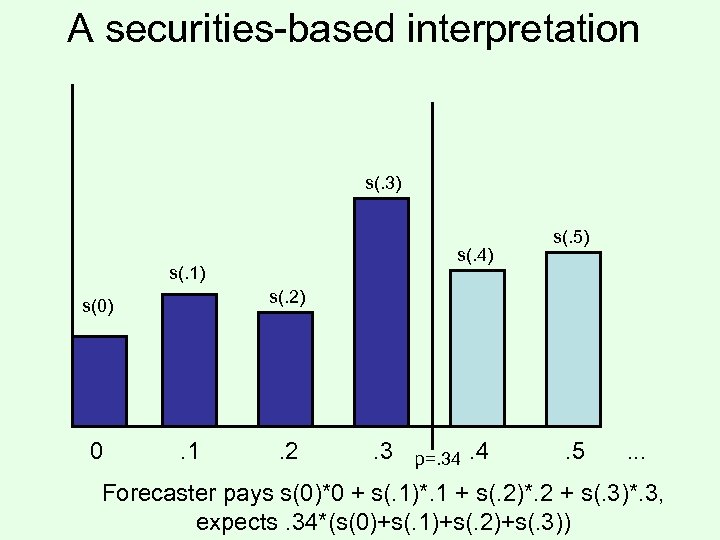 A securities-based interpretation s(. 3) s(. 4) s(. 1) s(. 2) s(0) 0 s(. 5) . 1 . 2 . 3 p=. 34 . 5 . . . Forecaster pays s(0)*0 + s(. 1)*. 1 + s(. 2)*. 2 + s(. 3)*. 3, expects. 34*(s(0)+s(. 1)+s(. 2)+s(. 3))
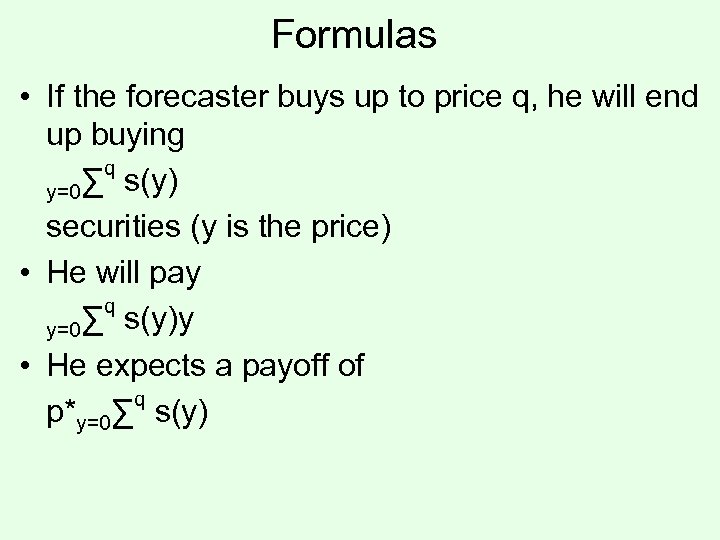 Formulas • If the forecaster buys up to price q, he will end up buying q y=0∑ s(y) securities (y is the price) • He will pay q y=0∑ s(y)y • He expects a payoff of q p*y=0∑ s(y)
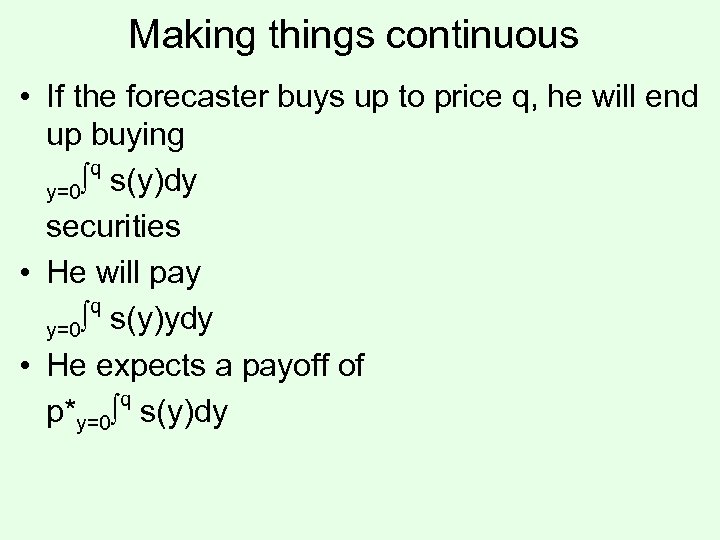 Making things continuous • If the forecaster buys up to price q, he will end up buying q y=0∫ s(y)dy securities • He will pay q y=0∫ s(y)ydy • He expects a payoff of q p*y=0∫ s(y)dy
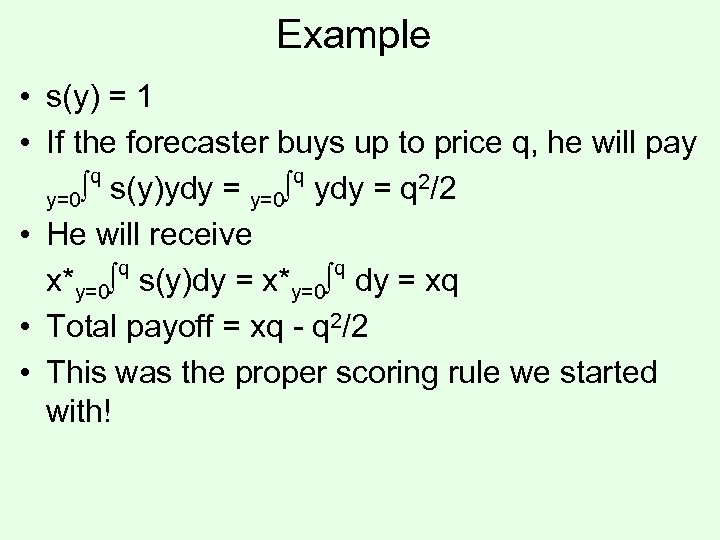 Example • s(y) = 1 • If the forecaster buys up to price q, he will pay q q ∫ s(y)ydy = y=0∫ ydy = q 2/2 y=0 • He will receive q q x*y=0∫ s(y)dy = x*y=0∫ dy = xq • Total payoff = xq - q 2/2 • This was the proper scoring rule we started with!
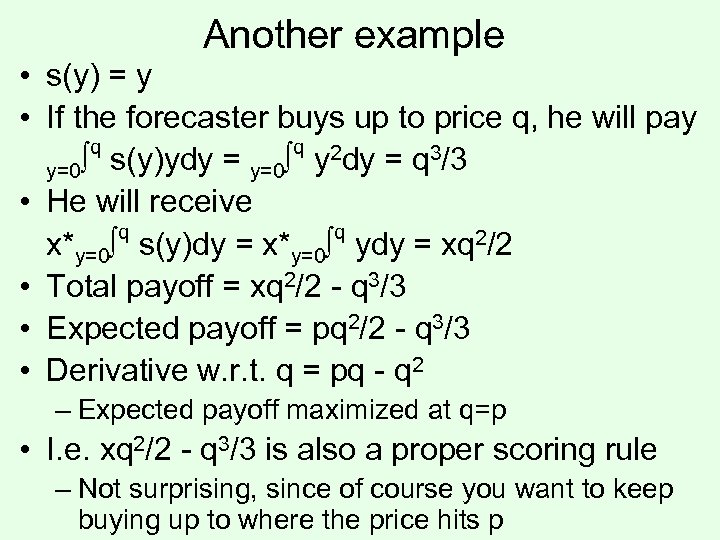 Another example • s(y) = y • If the forecaster buys up to price q, he will pay q q 2 ∫ s(y)ydy = y=0∫ y dy = q 3/3 y=0 • He will receive q q x*y=0∫ s(y)dy = x*y=0∫ ydy = xq 2/2 • Total payoff = xq 2/2 - q 3/3 • Expected payoff = pq 2/2 - q 3/3 • Derivative w. r. t. q = pq - q 2 – Expected payoff maximized at q=p • I. e. xq 2/2 - q 3/3 is also a proper scoring rule – Not surprising, since of course you want to keep buying up to where the price hits p
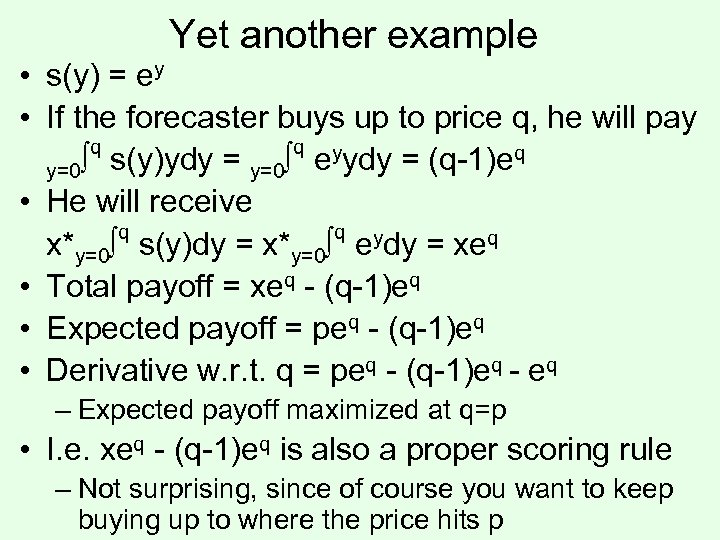 Yet another example • s(y) = ey • If the forecaster buys up to price q, he will pay q q y ∫ s(y)ydy = y=0∫ e ydy = (q-1)eq y=0 • He will receive q q y x*y=0∫ s(y)dy = x*y=0∫ e dy = xeq • Total payoff = xeq - (q-1)eq • Expected payoff = peq - (q-1)eq • Derivative w. r. t. q = peq - (q-1)eq - eq – Expected payoff maximized at q=p • I. e. xeq - (q-1)eq is also a proper scoring rule – Not surprising, since of course you want to keep buying up to where the price hits p
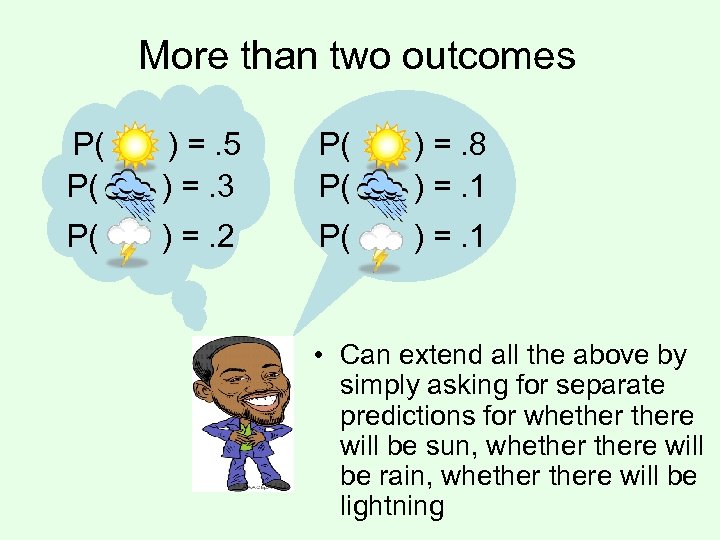 More than two outcomes P( P( ) =. 5 ) =. 3 P( P( ) =. 8 ) =. 1 P( ) =. 2 P( ) =. 1 • Can extend all the above by simply asking for separate predictions for whethere will be sun, whethere will be rain, whethere will be lightning
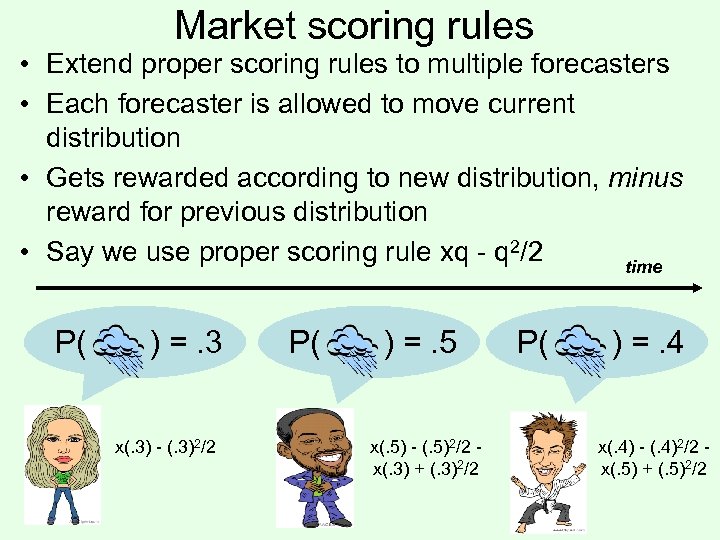 Market scoring rules • Extend proper scoring rules to multiple forecasters • Each forecaster is allowed to move current distribution • Gets rewarded according to new distribution, minus reward for previous distribution • Say we use proper scoring rule xq - q 2/2 time P( ) =. 3 x(. 3) - (. 3)2/2 P( ) =. 5 x(. 5) - (. 5)2/2 x(. 3) + (. 3)2/2 P( ) =. 4 x(. 4) - (. 4)2/2 x(. 5) + (. 5)2/2