


 Скачать презентацию CPS 196 2 Preference elicitation iterative mechanisms Vincent
2b5829ed00002208c2e8eede0c31163c.ppt
- Количество слайдов: 8
 CPS 196. 2 Preference elicitation/ iterative mechanisms Vincent Conitzer conitzer@cs. duke. edu
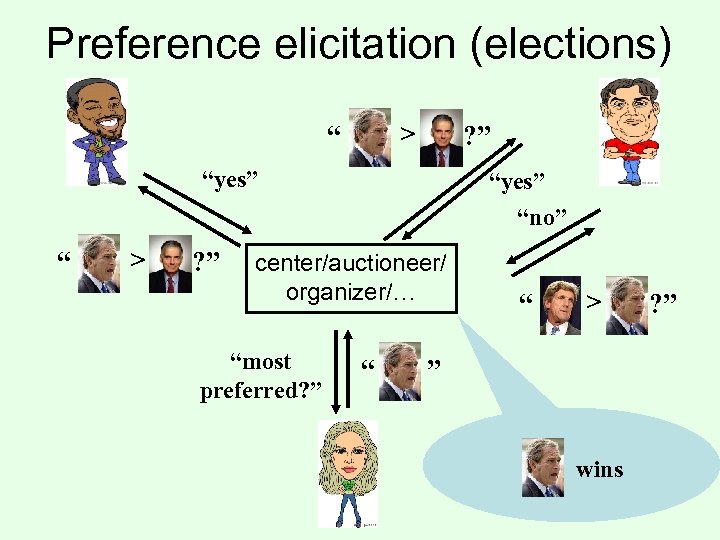 Preference elicitation (elections) > “ ? ” “yes” “ > ? ” “yes” “no” center/auctioneer/ organizer/… “most preferred? ” “ “ > ” wins ? ”
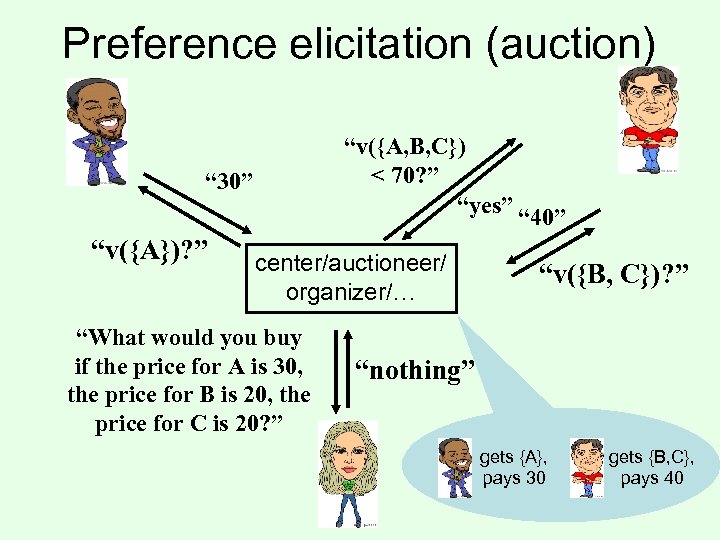 Preference elicitation (auction) “v({A, B, C}) < 70? ” “yes” “ 40” “ 30” “v({A})? ” center/auctioneer/ organizer/… “What would you buy if the price for A is 30, the price for B is 20, the price for C is 20? ” “v({B, C})? ” “nothing” gets {A}, pays 30 gets {B, C}, pays 40
 Benefits • Less communication needed • Agents do not always need to determine all of their preferences – Only where their preferences matter
 Elicitation algorithms • Suppose agents always answer truthfully • Some elicitation algorithms will always choose the same winner as (say) the STV (instant runoff) rule – Elicitation algorithm for STV • Design elicitation algorithm to minimize queries for given rule • What is a good elicitation algorithm for STV? • What about Bucklin?
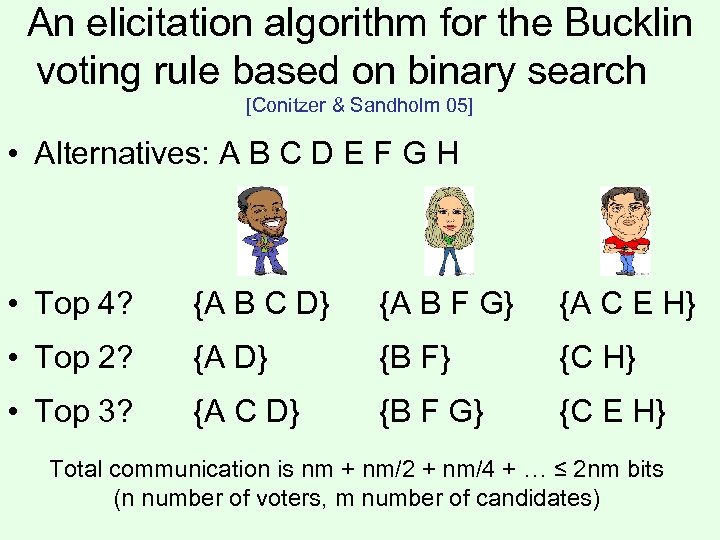 An elicitation algorithm for the Bucklin voting rule based on binary search [Conitzer & Sandholm 05] • Alternatives: A B C D E F G H • Top 4? {A B C D} {A B F G} {A C E H} • Top 2? {A D} {B F} {C H} • Top 3? {A C D} {B F G} {C E H} Total communication is nm + nm/2 + nm/4 + … ≤ 2 nm bits (n number of voters, m number of candidates)
![i. Bundle: an ascending CA [Parkes & Ungar 00] • Each round, each bidder](https://present5.com/presentation/2b5829ed00002208c2e8eede0c31163c/image-7.jpg "i. Bundle: an ascending CA [Parkes & Ungar 00] • Each round, each bidder") i. Bundle: an ascending CA [Parkes & Ungar 00] • Each round, each bidder i faces separate price pi(S) for each bundle S – Note: different bidders may face different prices for the same bundle – Prices start at 0 • A bidder (is assumed to) bid pi(S) on the bundle(s) S that maximize(s) her utility given the current prices, i. e. that maximize(s) vi(S) - pi(S) (straightforward bidding) – Bidder drops out if all bundles would give negative utility • Winner determination problem is solved with these bids • If some (active) bidder i did not win anything, that bidder’s prices are increased by ε on each of the bundles that she bid on (and supersets thereof), and we go to the next round • Otherwise, we terminate with this allocation & these prices
i. Bundle: an ascending CA [Parkes & Ungar 00] • Each round, each bidder i faces separate price pi(S) for each bundle S – Note: different bidders may face different prices for the same bundle – Prices start at 0 • A bidder (is assumed to) bid pi(S) on the bundle(s) S that maximize(s) her utility given the current prices, i. e. that maximize(s) vi(S) - pi(S) (straightforward bidding) – Bidder drops out if all bundles would give negative utility • Winner determination problem is solved with these bids • If some (active) bidder i did not win anything, that bidder’s prices are increased by ε on each of the bundles that she bid on (and supersets thereof), and we go to the next round • Otherwise, we terminate with this allocation & these prices
 Lower bounds on communication • Communication complexity theory can be used to show lower bounds – “Any elicitation algorithm for rule r requires communication of at least N bits (in the worst case)” • Voting [Conitzer & Sandholm 05] – Bucklin requires at least on the order of nm bits – STV requires at least on the order of n log m bits • Natural algorithm uses on the order of n(log m)2 bits • Combinatorial auction winner determination requires exponentially many bits [Nisan & Segal 06] – … unless only a limited set of valuation functions is allowed