 Скачать презентацию CPRE 583 Reconfigurable Computing Lecture 12 Wed 10 6 2010
98b7f5bde343565fbcb327c5ddd8f5cc.ppt
- Количество слайдов: 57



CPRE 583 Reconfigurable Computing Lecture 12: Wed 10/6/2010 (Compute Models) Instructor: Dr. Phillip Jones (phjones@iastate. edu) Reconfigurable Computing Laboratory Iowa State University Ames, Iowa, USA http: //class. ee. iastate. edu/cpre 583/ 1 - CPRE 583 (Reconfigurable Computing): Compute Models Iowa State University (Ames)
Announcements/Reminders • HW 2: Due Wed 10/6 (today) – Problem 2 will have a separate deadline (to be announced) • Midterm: – Take home portion (40%) given Friday 10/15, due Tue 10/20 (midnight) – In class portion (60%) Wed 10/20 • Distance students will have in class portion given via a timed Web. CT (2 hour) session (take on Wed, Thur or Friday). • Start thinking of class projects and forming teams – Submit teams and project ideas: Mon 10/11 midnight – Project proposal presentations: Fri 10/22 • MP 3: Power. PC Coprocessor offload overview 2 - CPRE 583 (Reconfigurable Computing): Compute Models Iowa State University (Ames)
Initial Project Proposal Slides (5 -10 slides) • Project team list: Name, Responsibility (who is project leader) – Team size: 3 -4 (5 case-by-case) • Project idea • Motivation (why is this interesting, useful) • What will be the end result • High-level picture of final product • High-level Plan – Break project into mile stones • Provide initial schedule: I would initially schedule aggressively to have project complete by Thanksgiving. Issues will pop up to cause the schedule to slip. – System block diagrams – High-level algorithms (if any) – Concerns • Implementation • Conceptual • Research papers related to you project idea 3 - CPRE 583 (Reconfigurable Computing): Compute Models Iowa State University (Ames)
Projects Ideas: Relevant conferences • • • FPL FPT FCCM FPGA DAC ICCAD Reconfig RTSS RTAS ISCA • • Micro Super Computing HPCA IPDPS 4 - CPRE 583 (Reconfigurable Computing): Compute Models Iowa State University (Ames)
Initial Project Proposal Slides (5 -10 slides) • Project team list: Name, Responsibility (who is project leader) • Project idea • Motivation (why is this interesting, useful) • What will be the end result • High-level picture of final product • High-level Plan – Break project into mile stones • Provide initial schedule: I would initially schedule aggressively to have project complete by Thanksgiving. Issues will pop up to cause the schedule to slip. – System block diagrams – High-level algorithms (if any) – Concerns • Implementation • Conceptual • Research papers related to you project idea 5 - CPRE 583 (Reconfigurable Computing): Compute Models Iowa State University (Ames)
Weekly Project Updates • The current state of your project write up – Even in the early stages of the project you should be able to write a rough draft of the Introduction and Motivation section • The current state of your Final Presentation – Your Initial Project proposal presentation (Due Fri 10/22). Should make for a starting point for you Final presentation • What things are work & not working • What roadblocks are you running into 6 - CPRE 583 (Reconfigurable Computing): Compute Models Iowa State University (Ames)
Projects: Target Timeline • Teams Formed and Idea: Mon 10/11 – Project idea in Power Point 3 -5 slides • Motivation (why is this interesting, useful) • What will be the end result • High-level picture of final product – Project team list: Name, Responsibility • High-level Plan/Proposal: Fri 10/22 – Power Point 5 -10 slides • System block diagrams • High-level algorithms (if any) • Concerns – Implementation – Conceptual • Related research papers (if any) 7 - CPRE 583 (Reconfigurable Computing): Compute Models Iowa State University (Ames)
Projects: Target Timeline • Work on projects: 10/22 - 12/8 – Weekly update reports • More information on updates will be given • Presentations: Last Wed/Fri of class – Present / Demo what is done at this point – 15 -20 minutes (depends on number of projects) • Final write up and Software/Hardware turned in: Day of final (TBD) 8 - CPRE 583 (Reconfigurable Computing): Compute Models Iowa State University (Ames)
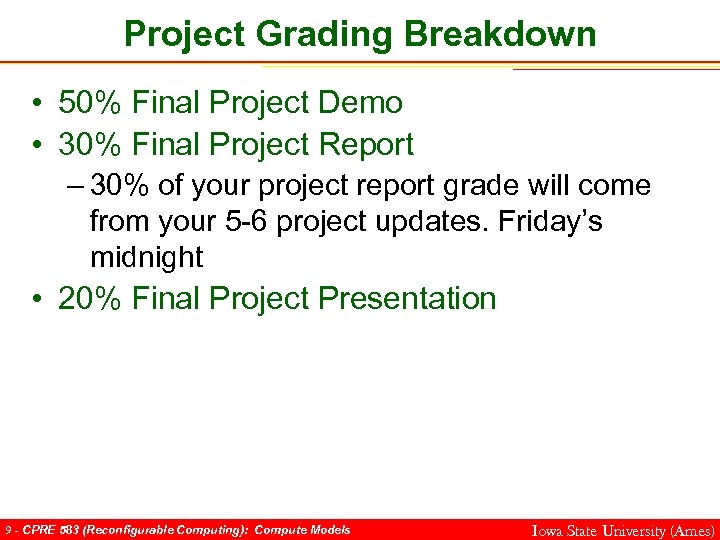
Project Grading Breakdown • 50% Final Project Demo • 30% Final Project Report – 30% of your project report grade will come from your 5 -6 project updates. Friday’s midnight • 20% Final Project Presentation 9 - CPRE 583 (Reconfigurable Computing): Compute Models Iowa State University (Ames)
Common Questions 10 - CPRE 583 (Reconfigurable Computing): Compute Models Iowa State University (Ames)
Common Questions 11 - CPRE 583 (Reconfigurable Computing): Compute Models Iowa State University (Ames)
Common Questions 12 - CPRE 583 (Reconfigurable Computing): Compute Models Iowa State University (Ames)
Common Questions 13 - CPRE 583 (Reconfigurable Computing): Compute Models Iowa State University (Ames)
Overview • Compute Models 14 - CPRE 583 (Reconfigurable Computing): Compute Models Iowa State University (Ames)
What you should learn • Introduction to Compute Models 15 - CPRE 583 (Reconfigurable Computing): Compute Models Iowa State University (Ames)
Outline • Design patterns (previous lecture) – Why are they useful? – Examples • Compute models (Abstraction) – Why are they useful? – Examples • System Architectures (Implementation) – Why are they useful? – Examples 16 - CPRE 583 (Reconfigurable Computing): Compute Models Iowa State University (Ames)
Outline • Design patterns (previous lecture) – Why are they useful? – Examples • Compute models (Abstraction) – Why are they useful? – Examples • System Architectures (Implementation) – Why are they useful? – Examples 17 - CPRE 583 (Reconfigurable Computing): Compute Models Iowa State University (Ames)
![References • Reconfigurable Computing (2008) [1] – Chapter 5: Compute Models and System Architectures](https://present5.com/presentation/98b7f5bde343565fbcb327c5ddd8f5cc/image-18.jpg "References • Reconfigurable Computing (2008) [1] – Chapter 5: Compute Models and System Architectures")
References • Reconfigurable Computing (2008) [1] – Chapter 5: Compute Models and System Architectures • Scott Hauck, Andre De. Hon • Design Patterns for Reconfigurable Computing [2] – Andre De. Hon (FCCM 2004) • Type Architectures, Shared Memory, and the Corollary of Modest Potential [3] – Lawrence Snyder: Annual Review of Computer Science (1986) 18 - CPRE 583 (Reconfigurable Computing): Compute Models Iowa State University (Ames)
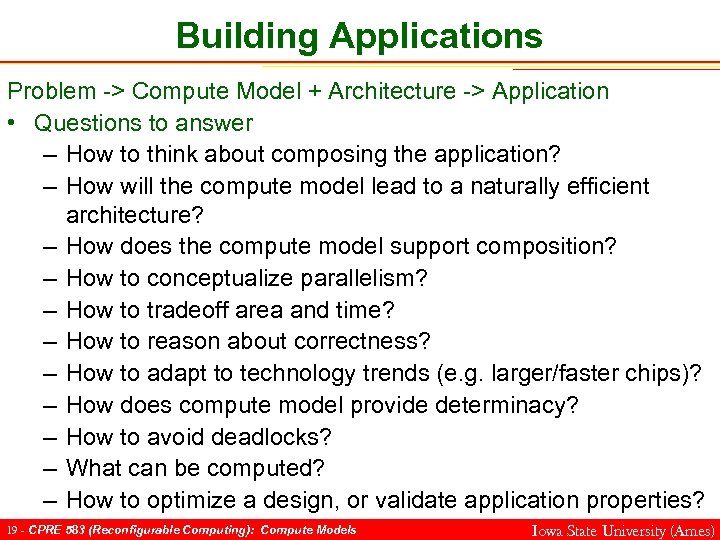
Building Applications Problem -> Compute Model + Architecture -> Application • Questions to answer – How to think about composing the application? – How will the compute model lead to a naturally efficient architecture? – How does the compute model support composition? – How to conceptualize parallelism? – How to tradeoff area and time? – How to reason about correctness? – How to adapt to technology trends (e. g. larger/faster chips)? – How does compute model provide determinacy? – How to avoid deadlocks? – What can be computed? – How to optimize a design, or validate application properties? 19 - CPRE 583 (Reconfigurable Computing): Compute Models Iowa State University (Ames)
![Compute Models • Compute Models [1]: High-level models of the flow of computation. •](https://present5.com/presentation/98b7f5bde343565fbcb327c5ddd8f5cc/image-20.jpg "Compute Models • Compute Models [1]: High-level models of the flow of computation. •")
Compute Models • Compute Models [1]: High-level models of the flow of computation. • Useful for: – Capturing parallelism – Reasoning about correctness – Decomposition – Guide designs by providing constraints on what is allowed during a computation • Communication links • How synchronization is performed • How data is transferred 20 - CPRE 583 (Reconfigurable Computing): Compute Models Iowa State University (Ames)
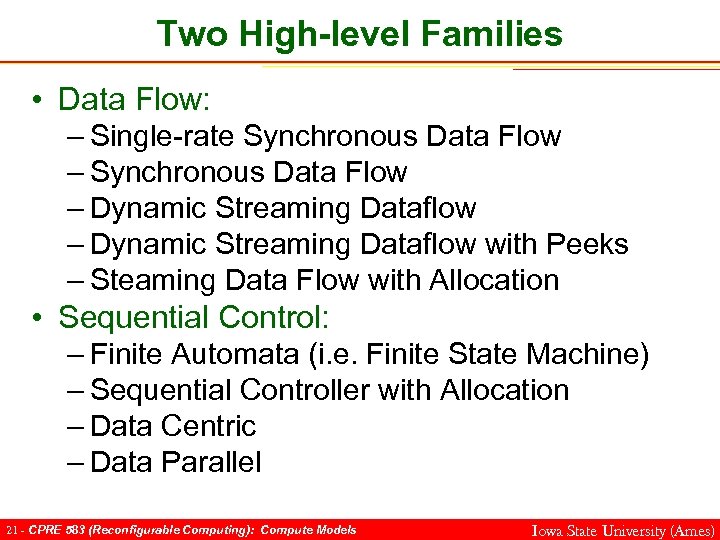
Two High-level Families • Data Flow: – Single-rate Synchronous Data Flow – Dynamic Streaming Dataflow with Peeks – Steaming Data Flow with Allocation • Sequential Control: – Finite Automata (i. e. Finite State Machine) – Sequential Controller with Allocation – Data Centric – Data Parallel 21 - CPRE 583 (Reconfigurable Computing): Compute Models Iowa State University (Ames)
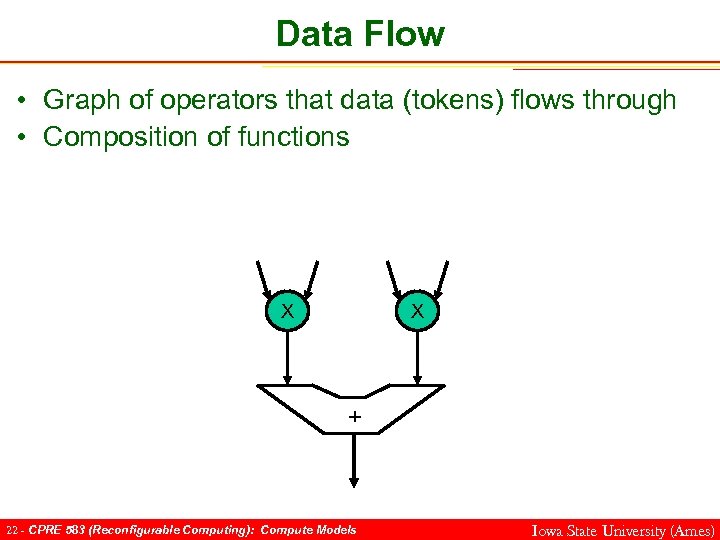
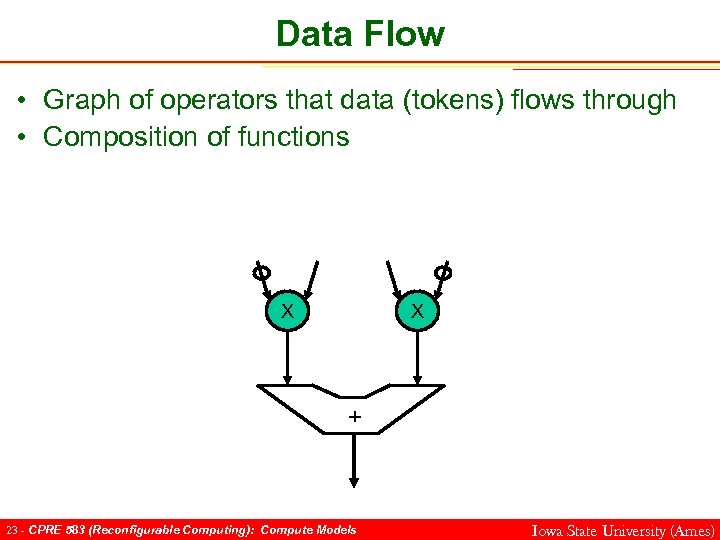
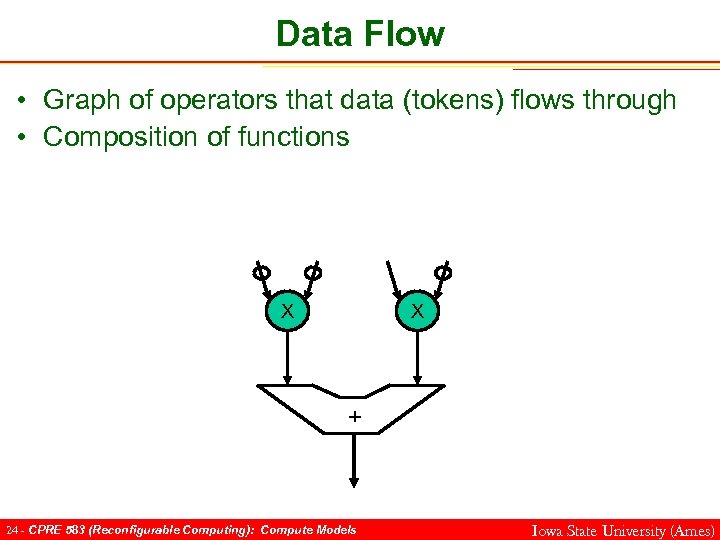
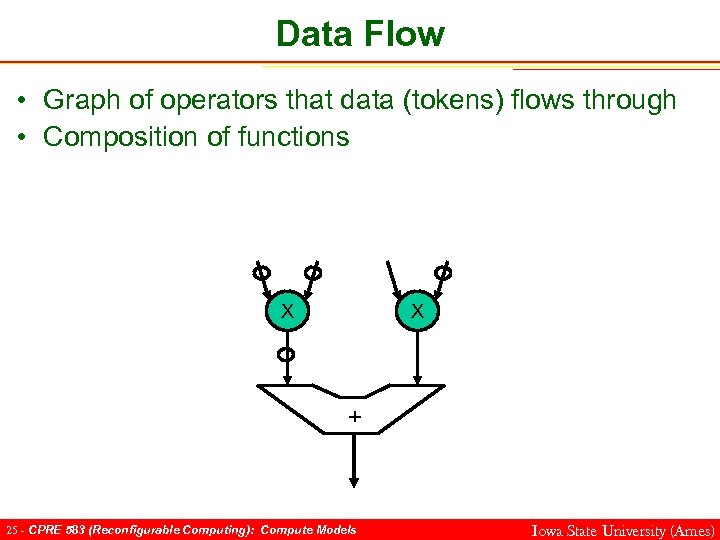
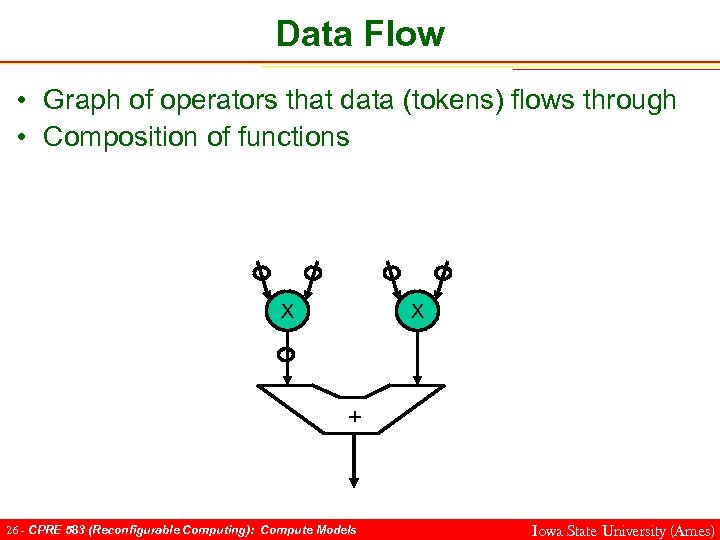
Data Flow • Graph of operators that data (tokens) flows through • Composition of functions X X + 22 - CPRE 583 (Reconfigurable Computing): Compute Models Iowa State University (Ames)
Data Flow • Graph of operators that data (tokens) flows through • Composition of functions X X + 23 - CPRE 583 (Reconfigurable Computing): Compute Models Iowa State University (Ames)
Data Flow • Graph of operators that data (tokens) flows through • Composition of functions X X + 24 - CPRE 583 (Reconfigurable Computing): Compute Models Iowa State University (Ames)
Data Flow • Graph of operators that data (tokens) flows through • Composition of functions X X + 25 - CPRE 583 (Reconfigurable Computing): Compute Models Iowa State University (Ames)
Data Flow • Graph of operators that data (tokens) flows through • Composition of functions X X + 26 - CPRE 583 (Reconfigurable Computing): Compute Models Iowa State University (Ames)
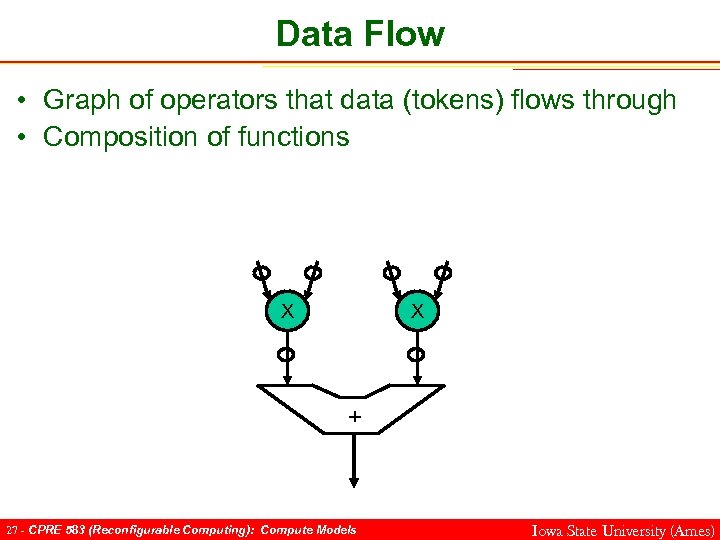
Data Flow • Graph of operators that data (tokens) flows through • Composition of functions X X + 27 - CPRE 583 (Reconfigurable Computing): Compute Models Iowa State University (Ames)
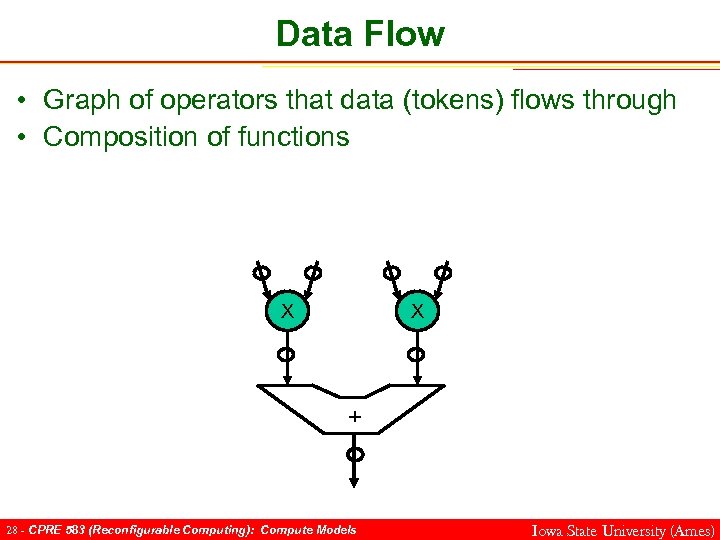
Data Flow • Graph of operators that data (tokens) flows through • Composition of functions X X + 28 - CPRE 583 (Reconfigurable Computing): Compute Models Iowa State University (Ames)
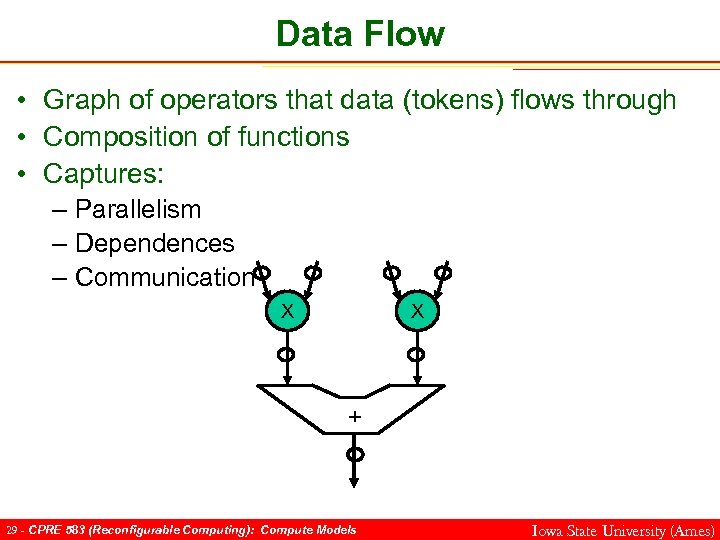
Data Flow • Graph of operators that data (tokens) flows through • Composition of functions • Captures: – Parallelism – Dependences – Communication X X + 29 - CPRE 583 (Reconfigurable Computing): Compute Models Iowa State University (Ames)
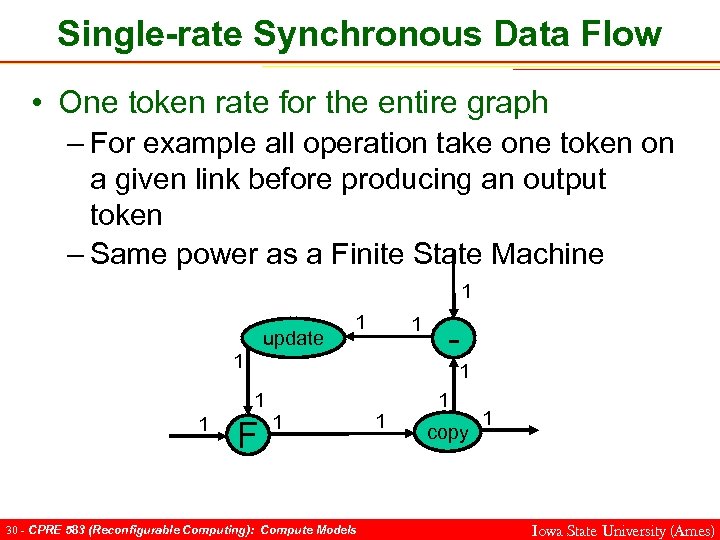
Single-rate Synchronous Data Flow • One token rate for the entire graph – For example all operation take one token on a given link before producing an output token – Same power as a Finite State Machine 1 update 1 1 1 F 1 30 - CPRE 583 (Reconfigurable Computing): Compute Models 1 1 copy 1 Iowa State University (Ames)
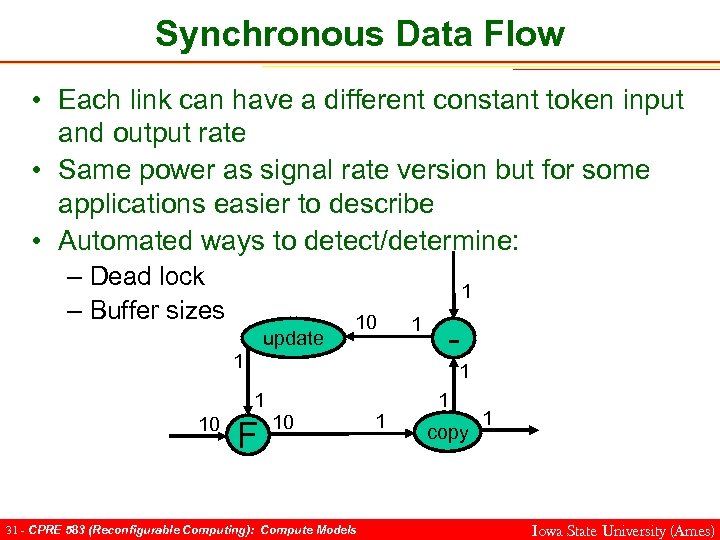
Synchronous Data Flow • Each link can have a different constant token input and output rate • Same power as signal rate version but for some applications easier to describe • Automated ways to detect/determine: – Dead lock – Buffer sizes 1 update 1 1 10 10 F 10 31 - CPRE 583 (Reconfigurable Computing): Compute Models 1 1 copy 1 Iowa State University (Ames)
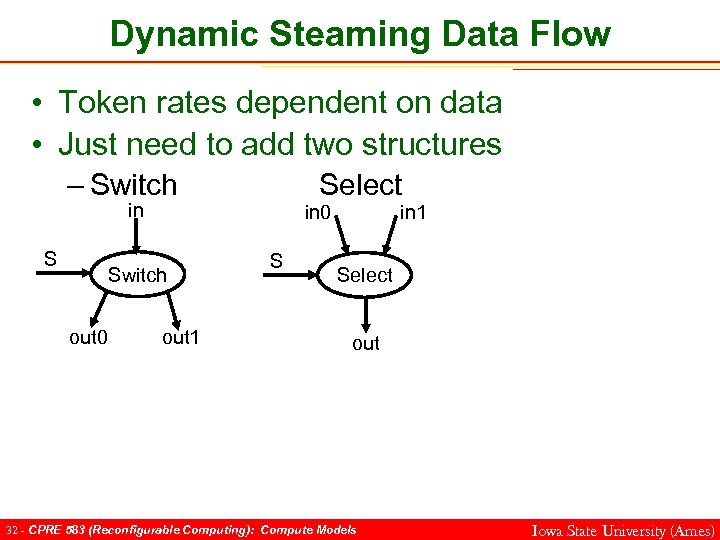
Dynamic Steaming Data Flow • Token rates dependent on data • Just need to add two structures – Switch Select in S Switch out 0 out 1 in 0 S in 1 Select out 32 - CPRE 583 (Reconfigurable Computing): Compute Models Iowa State University (Ames)
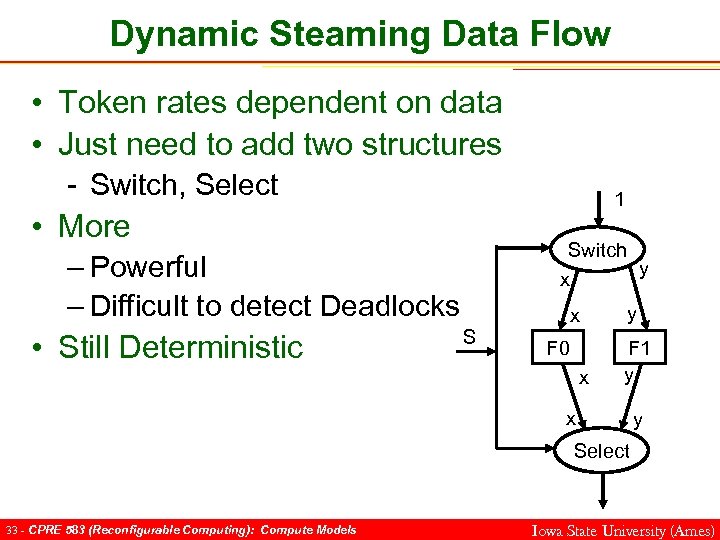
Dynamic Steaming Data Flow • Token rates dependent on data • Just need to add two structures - Switch, Select • More – Powerful – Difficult to detect Deadlocks S • Still Deterministic 1 Switch y x x F 0 x y F 1 y x y Select 33 - CPRE 583 (Reconfigurable Computing): Compute Models Iowa State University (Ames)
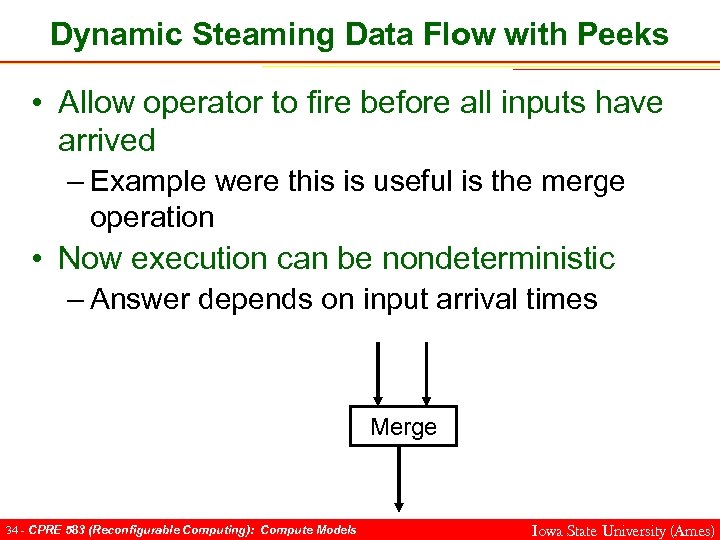
Dynamic Steaming Data Flow with Peeks • Allow operator to fire before all inputs have arrived – Example were this is useful is the merge operation • Now execution can be nondeterministic – Answer depends on input arrival times Merge 34 - CPRE 583 (Reconfigurable Computing): Compute Models Iowa State University (Ames)
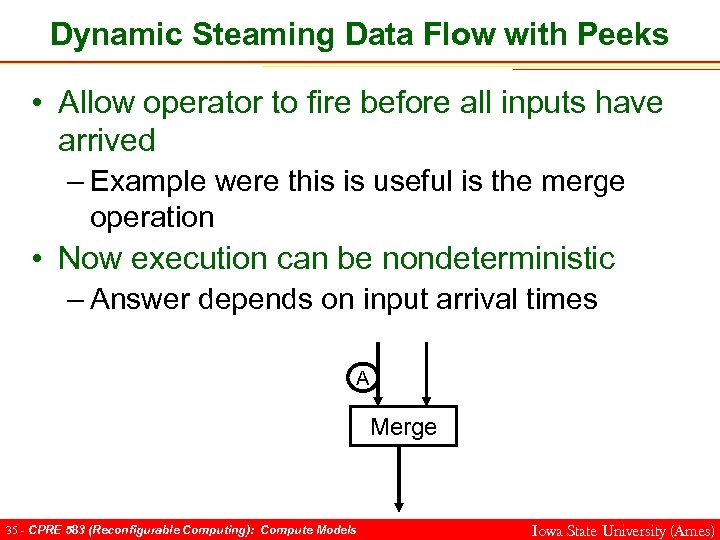
Dynamic Steaming Data Flow with Peeks • Allow operator to fire before all inputs have arrived – Example were this is useful is the merge operation • Now execution can be nondeterministic – Answer depends on input arrival times A Merge 35 - CPRE 583 (Reconfigurable Computing): Compute Models Iowa State University (Ames)
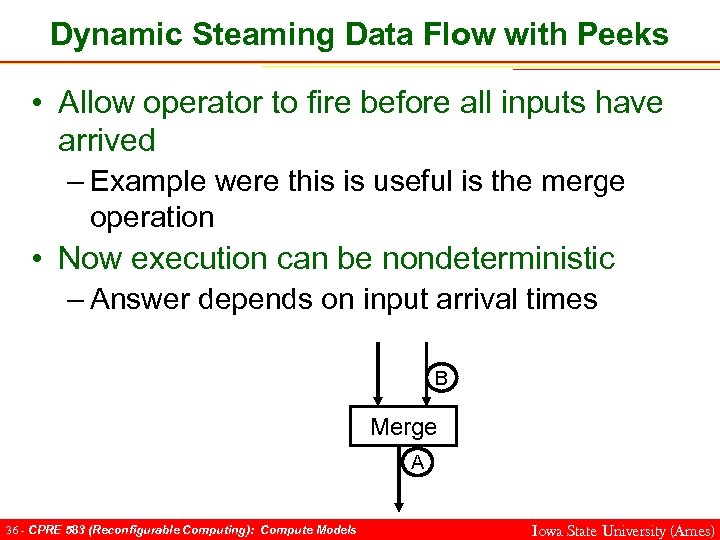
Dynamic Steaming Data Flow with Peeks • Allow operator to fire before all inputs have arrived – Example were this is useful is the merge operation • Now execution can be nondeterministic – Answer depends on input arrival times B Merge A 36 - CPRE 583 (Reconfigurable Computing): Compute Models Iowa State University (Ames)
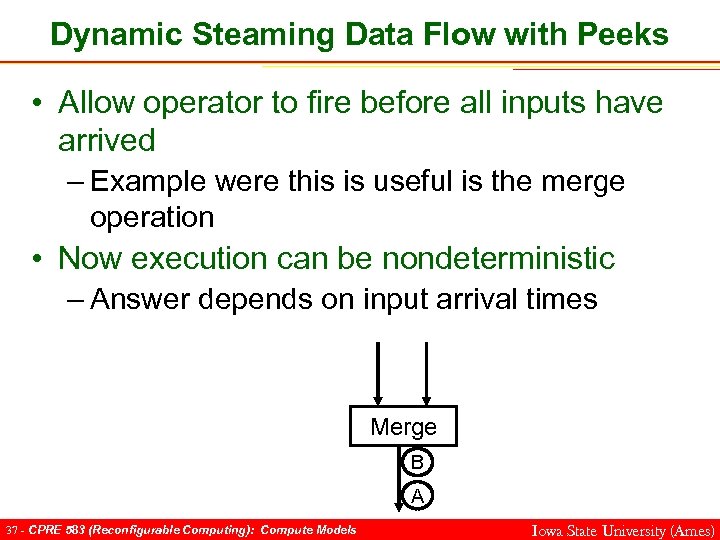
Dynamic Steaming Data Flow with Peeks • Allow operator to fire before all inputs have arrived – Example were this is useful is the merge operation • Now execution can be nondeterministic – Answer depends on input arrival times Merge B A 37 - CPRE 583 (Reconfigurable Computing): Compute Models Iowa State University (Ames)
Steaming Data Flow with Allocation • Removes the need for static links and operators. That is the Data Flow graph can change over time • More Power: Turing Complete • More difficult to analysis • Could be useful for some applications – Telecom applications. For example if a channel carries voice verses data the resources needed may vary greatly • Can take advantage of platforms that allow runtime reconfiguration 38 - CPRE 583 (Reconfigurable Computing): Compute Models Iowa State University (Ames)
Sequential Control • Sequence of sub routines – Programming languages (C, Java) – Hardware control logic (Finite State Machines) • Transform global data state 39 - CPRE 583 (Reconfigurable Computing): Compute Models Iowa State University (Ames)
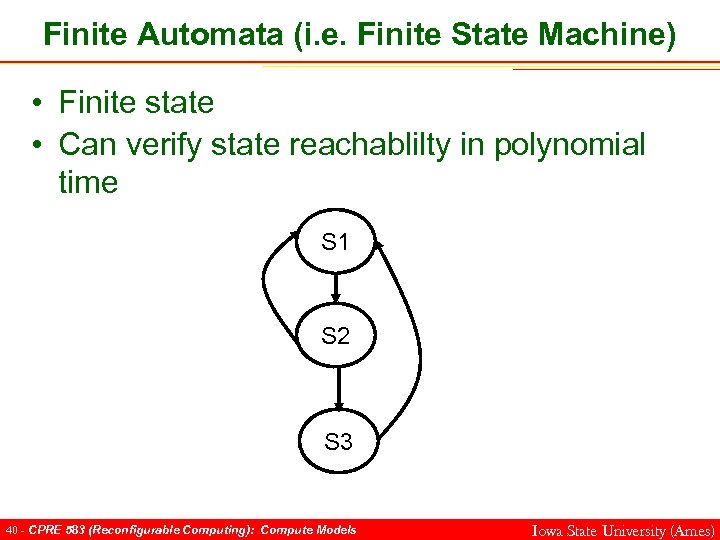
Finite Automata (i. e. Finite State Machine) • Finite state • Can verify state reachablilty in polynomial time S 1 S 2 S 3 40 - CPRE 583 (Reconfigurable Computing): Compute Models Iowa State University (Ames)
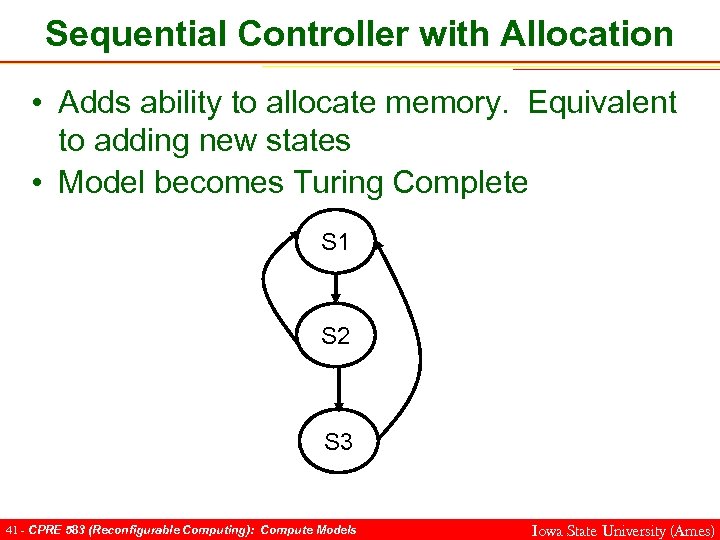
Sequential Controller with Allocation • Adds ability to allocate memory. Equivalent to adding new states • Model becomes Turing Complete S 1 S 2 S 3 41 - CPRE 583 (Reconfigurable Computing): Compute Models Iowa State University (Ames)
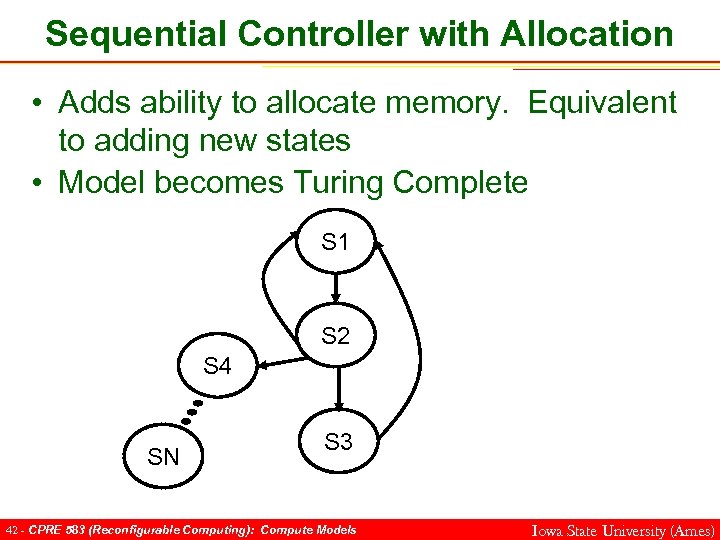
Sequential Controller with Allocation • Adds ability to allocate memory. Equivalent to adding new states • Model becomes Turing Complete S 1 S 2 S 4 SN S 3 42 - CPRE 583 (Reconfigurable Computing): Compute Models Iowa State University (Ames)
Data Parallel • Multiple instances of a operation type acting on separate pieces of data. For example: Single Instruction Multiple Data (SIMD) – Identical match test on all items in a database – Inverting the color of all pixels in an image 43 - CPRE 583 (Reconfigurable Computing): Compute Models Iowa State University (Ames)
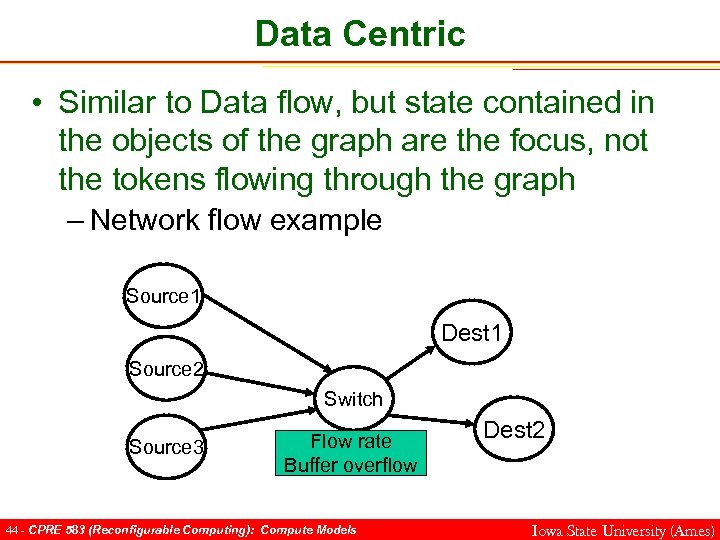
Data Centric • Similar to Data flow, but state contained in the objects of the graph are the focus, not the tokens flowing through the graph – Network flow example Source 1 Dest 1 Source 2 Switch Source 3 Flow rate Buffer overflow 44 - CPRE 583 (Reconfigurable Computing): Compute Models Dest 2 Iowa State University (Ames)
Multi-threaded • Multi-threaded: a compute model made up a multiple sequential controllers that have communications channels between them • Very general, but often too much power and flexibility. No guidance for: – Ensuring determinism – Dividing application into threads – Avoiding deadlock – Synchronizing threads • The models discussed can be defined in terms of a Multi-threaded compute model 45 - CPRE 583 (Reconfigurable Computing): Compute Models Iowa State University (Ames)
Multi-threaded (Illustration) 46 - CPRE 583 (Reconfigurable Computing): Compute Models Iowa State University (Ames)
Streaming Data Flow as Multithreaded • Thread: is an operator that performs transforms on data as it flows through the graph • Thread synchronization: Tokens sent between operators 47 - CPRE 583 (Reconfigurable Computing): Compute Models Iowa State University (Ames)
Data Parallel as Multithreaded • Thread: is a data item • Thread synchronization: data updated with each sequential instruction 48 - CPRE 583 (Reconfigurable Computing): Compute Models Iowa State University (Ames)
Caution with Multithreaded Model • Use when a stricter compute model does not give enough expressiveness. • Define restrictions to limit the amount of expressive power that can be used – Define synchronization policy – How to reason about deadlocking 49 - CPRE 583 (Reconfigurable Computing): Compute Models Iowa State University (Ames)
![Other Models • “A Framework for Comparing Models of computation” [1998] – E. Lee,](https://present5.com/presentation/98b7f5bde343565fbcb327c5ddd8f5cc/image-50.jpg "Other Models • “A Framework for Comparing Models of computation” [1998] – E. Lee,")
Other Models • “A Framework for Comparing Models of computation” [1998] – E. Lee, A. Sangiovanni-Vincentelli – Transactions on Computer-Aided Design of Integrated Circuits and Systems • “Concurrent Models of Computation for Embedded Software”[2005] – E. Lee, S. Neuendorffer – IEEE Proceedings – Computers and Digital Techniques 50 - CPRE 583 (Reconfigurable Computing): Compute Models Iowa State University (Ames)
Next Lecture • System Architectures 51 - CPRE 583 (Reconfigurable Computing): Compute Models Iowa State University (Ames)
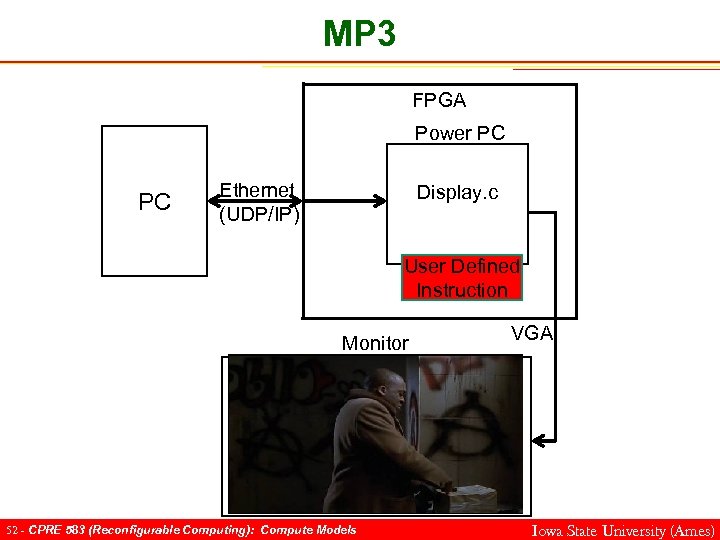
MP 3 FPGA Power PC PC Ethernet (UDP/IP) Display. c User Defined Instruction Monitor 52 - CPRE 583 (Reconfigurable Computing): Compute Models VGA Iowa State University (Ames)
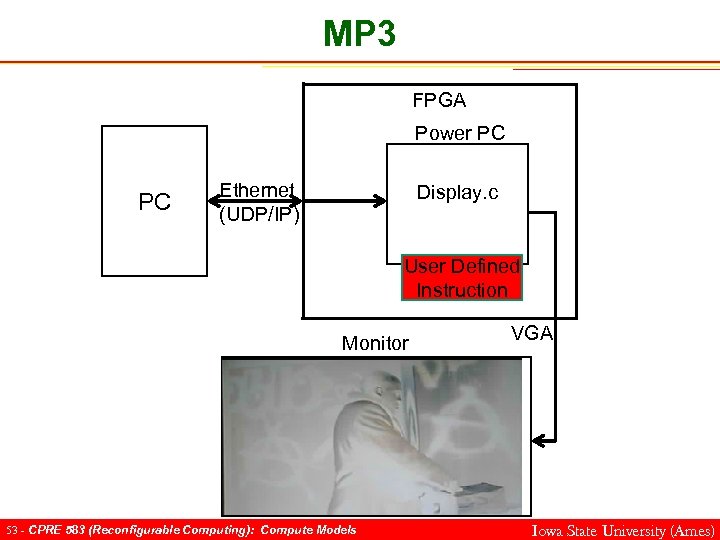
MP 3 FPGA Power PC PC Ethernet (UDP/IP) Display. c User Defined Instruction Monitor 53 - CPRE 583 (Reconfigurable Computing): Compute Models VGA Iowa State University (Ames)
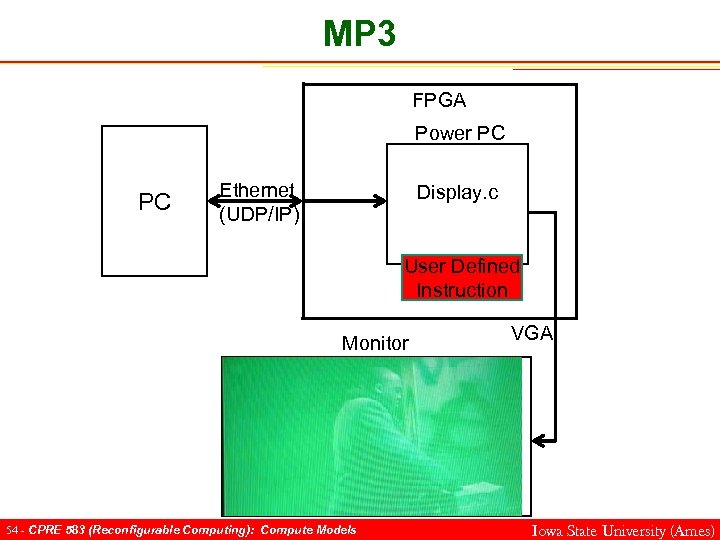
MP 3 FPGA Power PC PC Ethernet (UDP/IP) Display. c User Defined Instruction Monitor 54 - CPRE 583 (Reconfigurable Computing): Compute Models VGA Iowa State University (Ames)
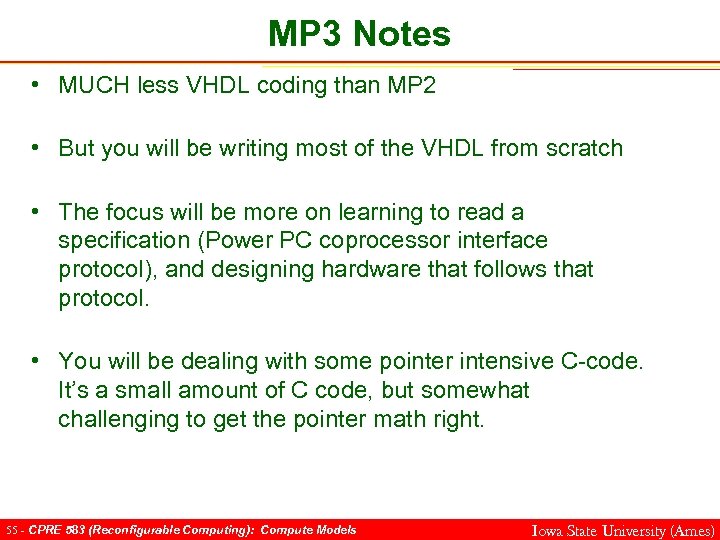
MP 3 Notes • MUCH less VHDL coding than MP 2 • But you will be writing most of the VHDL from scratch • The focus will be more on learning to read a specification (Power PC coprocessor interface protocol), and designing hardware that follows that protocol. • You will be dealing with some pointer intensive C-code. It’s a small amount of C code, but somewhat challenging to get the pointer math right. 55 - CPRE 583 (Reconfigurable Computing): Compute Models Iowa State University (Ames)
Questions/Comments/Concerns • Write down – Main point of lecture – One thing that’s still not quite clear OR – If everything is clear, then give an example of how to apply something from lecture 56 - CPRE 583 (Reconfigurable Computing): Compute Models Iowa State University (Ames)
Lecture Notes • kk 57 - CPRE 583 (Reconfigurable Computing): Compute Models Iowa State University (Ames)
Скачать презентацию CPRE 583 Reconfigurable Computing Lecture 12 Wed 10 6 2010
98b7f5bde343565fbcb327c5ddd8f5cc.ppt