


 Скачать презентацию CPIT 375 Data Network Designing and Evaluation Network
1712ed32bd813ca34bd5dbf523e62f02.ppt
- Количество слайдов: 21
 CPIT 375 Data Network Designing and Evaluation Network Requirements Analysis www. company. com
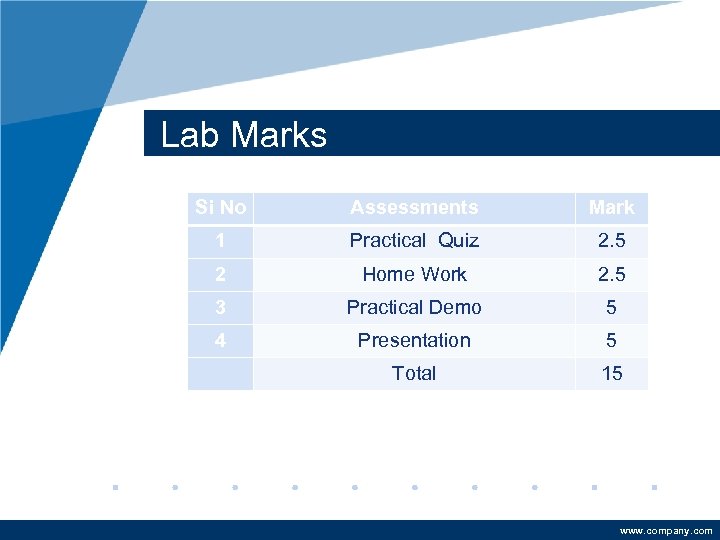 Lab Marks Si No Assessments Mark 1 Practical Quiz 2. 5 2 Home Work 2. 5 3 Practical Demo 5 4 Presentation 5 Total 15 www. company. com
 Outline: – Network Design Phases (Overview) – Requirements Analysis – Cloud Computing in Network Design www. company. com
 Objectives • network is part of a system that provides services to its end users • there are processes for developing an analysis, an architecture, and a design for a network • there are ways to characterize a network. www. company. com
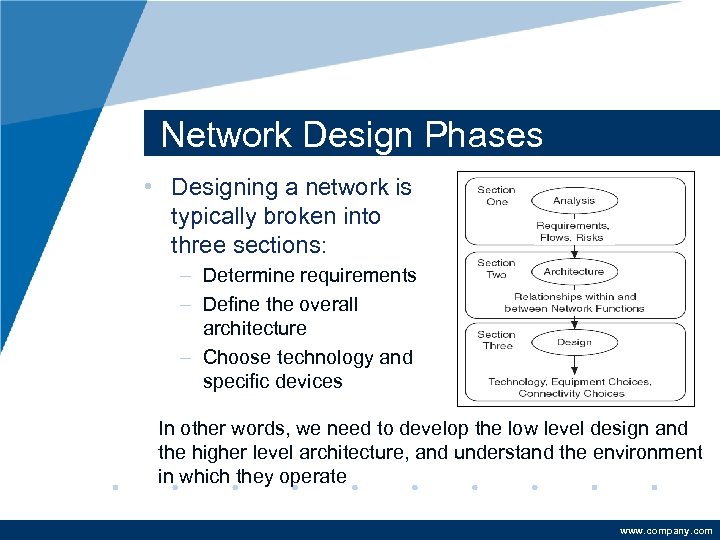 Network Design Phases • Designing a network is typically broken into three sections: – Determine requirements – Define the overall architecture – Choose technology and specific devices In other words, we need to develop the low level design and the higher level architecture, and understand the environment in which they operate www. company. com
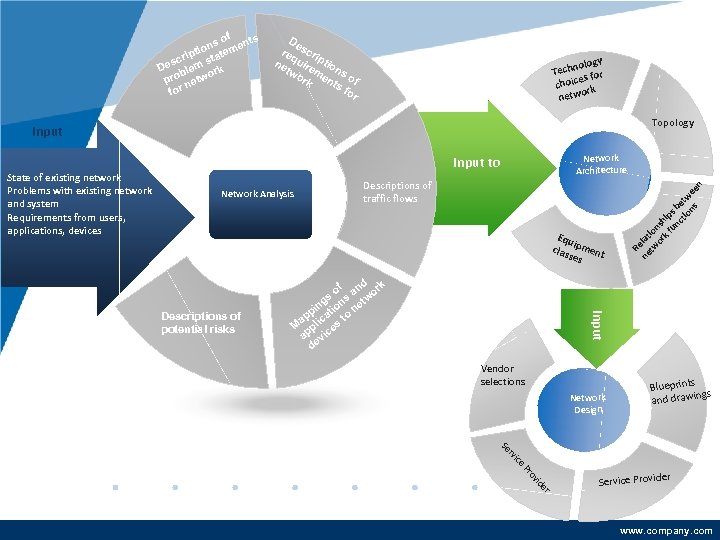 s of ns ment tio ate rip t esc lem s k D b or pro netw for De re scri q ne uire ptio n tw or men s of k ts for ology Techn for es choic k or netw Topology Input Network Analysis Descriptions of traffic flows Equ i clas pment ses Input Descriptions of potential risks d of an ork gs s tw in tion ne p ap lica s to M p ce ap vi de R ne elat tw ion or sh k f ip un s b ct et io w ns ee n State of existing network Problems with existing network and system Requirements from users, applications, devices Network Architecture Input to Vendor selections Network Design Blueprints gs and drawin rv Se ice ov Pr er id Service Provider www. company. com
 Requirements Analysis: • Understand the environment • We need a process to filter or classify requirements – Network requirements (often have high, medium, low priorities) – Future requirements (planned upgrades) – Rejected requirements (remember for future ref. ) – Informational requirements (ideas, not required) www. company. com
 Requirements Analysis • Requirements can come from many aspects of the network system: – User Requirements • the set of requirements gathered or derived from user input and is what is needed by users to successfully accomplish their tasks on the system. – Application Requirements • requirements that are determined from application information, experience, or testing; applications need these to successfully operate on the system. www. company. com
 Requirements Analysis – Device Requirements the requirements of devices that the network will support, particularly the types of devices, their performance characteristics, and location information – Network Requirements requirements for a network architecture/design must consider the requirements, services, and characteristics of any existing networks that will be incorporated into, or interface with, the new network. – Other Requirements There are other requirements that apply across all of the components of the system, such as financial and enterprise requirements. There are likely to be other such requirements for your network, and they would be included here. www. company. com
 Requirements Analysis: • Part of this process is managing the customer’s expectations • What services are expected from the network? – Typical performance levels might include capacity, delay time, reliability • Providing 1. 5 Mb/s peak capacity to a remote user – Functions include security, scheduling, management • Defining a security or privacy level for a group of users or an organization www. company. com
 Requirements Analysis: www. company. com
 Application Types • could be categorized as following: • Mission-critical applications have predictable, guaranteed, and/or high-performance RMA requirements. • Rate-critical applications have predictable, guaranteed, and/or high-performance capacity requirements. • Real-time and interactive applications have predictable, guaranteed, and/or high-performance delay requirements. www. company. com
 Lab Task • Discuss the following in groups of 3 and write the answers. Before the end of the lab class the guidelines for solutions will be discussed by the instructor. • 1. Why is requirements analysis important to network architecture and design? Give three reasons. www. company. com
 Lab Task • • 2. Categorize each of the following requirements as core (fundamental), feature, or informational. - A. Network must support Fast Ethernet and Gig. E interfaces for all devices on the network. - B. Network backbone should be upgradeable in capacity to 10 Gb/s within 2 years of deployment. - C. Finance department requires firewall protection for their server. - D. Existing network consists of 10 Base. T Ethernet and FDDI segments. - E. Network personnel would like to be able to bill users for network service. - F. Network core must not generate or terminate any user traffic. - G. Network must support digital video traffic from remote video cameras and may additionally support sound from these cameras. www. company. com
 Note • Please note that this requirement does NOT specify the technology used to deliver the requirement – in other words, the fundamental requirement for the network to support 100 Base. T and Gig. E does not imply that the digital video must run over Ethernet. In this case, the digital video is a fundamental requirement, but the methodology to provide the digital video may be a feature of a manufacturer to do so over Ethernet, or may be on a completely separate and parallel network infrastructure to the Ethernet backbone. www. company. com
 Lab Task • 3. Categorize each of the following requirements as user, application, device, or network. • - A. Database servers must run Brand XYZ software. • - B. Teleconferencing requires at least 350 kbs capacity. • - C. Users must be able to submit print jobs up to 25 MB in size. • - D. Each access network should be able to serve up to 200 users. www. company. com
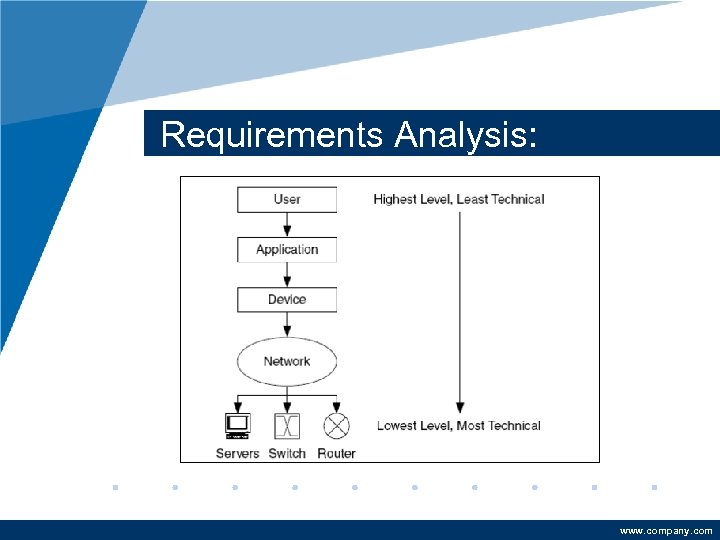
 Lab Task • 4. Give an example of a requirement as it flows from user to application to device to network. Show it becomes more technical at each component. • www. company. com
 Lab Task • 5. Which of the following customer requirements could be categorized as mission critical? As ratecritical? As real-time? As none of these? Give reasons for each choice. • - A. Processing telemetry data from a space shuttle launch and providing that data to mission control during launch (Customer: NASA). • - B. Processing requests from automated teller machines throughout a city. (Customer: Bank) • - C. Processing requires for Web pages from your servers. (Customer: Internet Service Provider) www. company. com
 Lab Task • 6. Give an example of a mission-critical application for each of these three environments: government, military, commercial. Why would each application be considered mission-critical? www. company. com
 Cloud Computing in Network Design • What is cloud computing ? – It is a type of computing that relies on sharing computing resources rather than having local servers or devices to handle the services of application. – In cloud computing, the word cloud is used as a metaphor for "the Internet, " so the phrase cloud computing means "a type of Internet-based computing, " where different services -- such as servers, data center and applications -- are delivered to an organization's computers and devices through the Internet. www. company. com
 Cloud Computing in Network Design • What is the benefits of migrate network to the cloud? – Cost – Speedy introduction of new applications/services – Availability www. company. com