 Скачать презентацию CPE CSC 481 Knowledge-Based Systems Dr Franz J Kurfess
77e1cd6a19a4f71bbd32fc9aa1c9c1e5.ppt
- Количество слайдов: 40



CPE/CSC 481: Knowledge-Based Systems Dr. Franz J. Kurfess Computer Science Department Cal Poly © 2002 Franz J. Kurfess Introduction 1
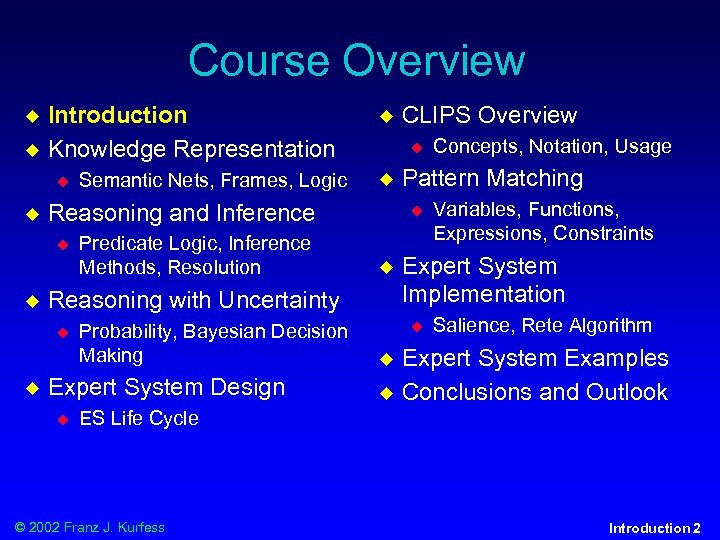
Course Overview u u Introduction Knowledge Representation u u Probability, Bayesian Decision Making Expert System Design u u Variables, Functions, Expressions, Constraints Expert System Implementation u u Concepts, Notation, Usage Pattern Matching u Reasoning with Uncertainty u u Predicate Logic, Inference Methods, Resolution CLIPS Overview u Reasoning and Inference u u Semantic Nets, Frames, Logic u Salience, Rete Algorithm Expert System Examples Conclusions and Outlook ES Life Cycle © 2002 Franz J. Kurfess Introduction 2
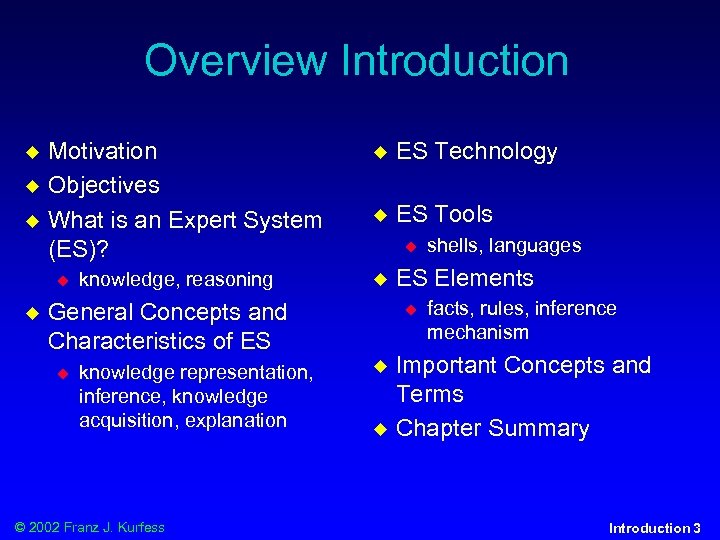
Overview Introduction u u u Motivation Objectives What is an Expert System (ES)? u u knowledge, reasoning u ES Technology u ES Tools u u General Concepts and Characteristics of ES u knowledge representation, inference, knowledge acquisition, explanation © 2002 Franz J. Kurfess ES Elements u u u shells, languages facts, rules, inference mechanism Important Concepts and Terms Chapter Summary Introduction 3
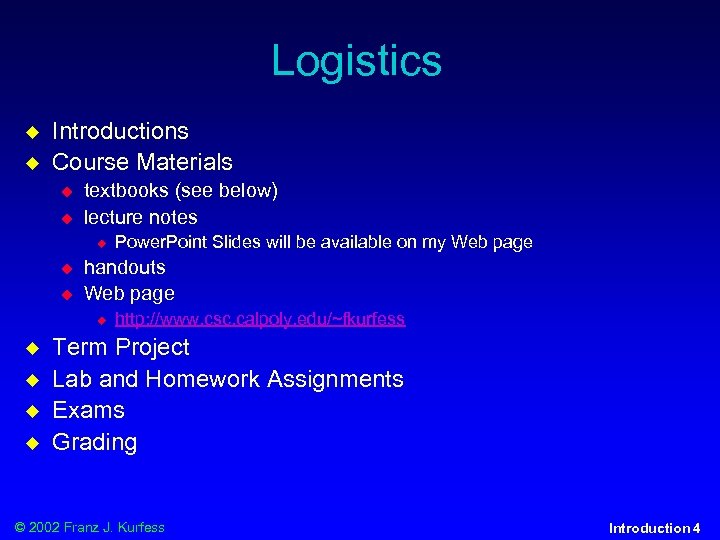
Logistics u u Introductions Course Materials u u textbooks (see below) lecture notes u u u handouts Web page u u u Power. Point Slides will be available on my Web page http: //www. csc. calpoly. edu/~fkurfess Term Project Lab and Homework Assignments Exams Grading © 2002 Franz J. Kurfess Introduction 4
![Textbooks u Required u u [Giarratano & Riley 1998] Joseph Giarratano and Gary Riley.](https://present5.com/presentation/77e1cd6a19a4f71bbd32fc9aa1c9c1e5/image-5.jpg "Textbooks u Required u u [Giarratano & Riley 1998] Joseph Giarratano and Gary Riley.")
Textbooks u Required u u [Giarratano & Riley 1998] Joseph Giarratano and Gary Riley. Expert Systems Principles and Programming. 3 rd ed. , PWS Publishing, Boston, MA, 1998 Recommended for additional reading u u [Awad 1996] Elias Awad. Building Expert Systems - Principles, Procedures, and Applications. West Publishing, Minneapolis/St. Paul, MN, 1996. [Durkin 1994] John Durkin. Expert Systems - Design and Development. Prentice Hall, Englewood Cliffs, NJ, 1994. [Jackson, 1999] Peter Jackson. Introduction to Expert Systems. 3 rd ed. , Addison-Wesley, 1999. [Russell & Norvig 1995] Stuart Russell and Peter Norvig, Artificial Intelligence A Modern Approach. Prentice Hall, 1995. © 2002 Franz J. Kurfess Introduction 5

Bridge-In © 2002 Franz J. Kurfess Introduction 6
Pre-Test © 2002 Franz J. Kurfess Introduction 7

Motivation © 2002 Franz J. Kurfess Introduction 8
Objectives © 2002 Franz J. Kurfess Introduction 9
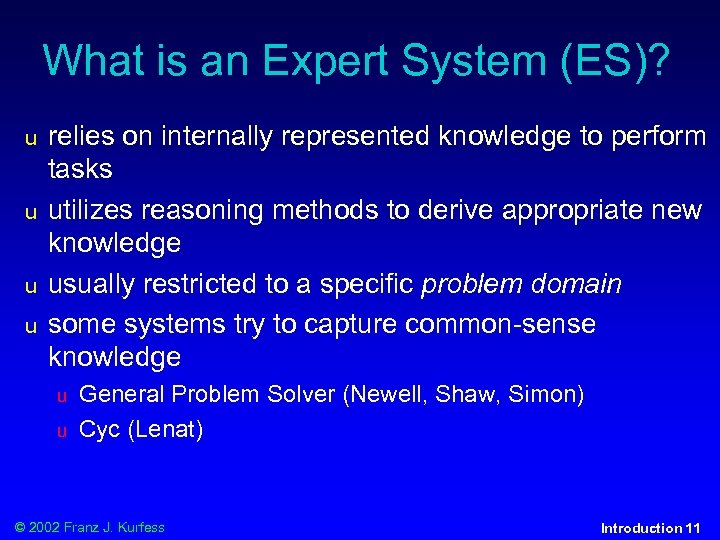
What is an Expert System (ES)? u u relies on internally represented knowledge to perform tasks utilizes reasoning methods to derive appropriate new knowledge usually restricted to a specific problem domain some systems try to capture common-sense knowledge u u General Problem Solver (Newell, Shaw, Simon) Cyc (Lenat) © 2002 Franz J. Kurfess Introduction 11
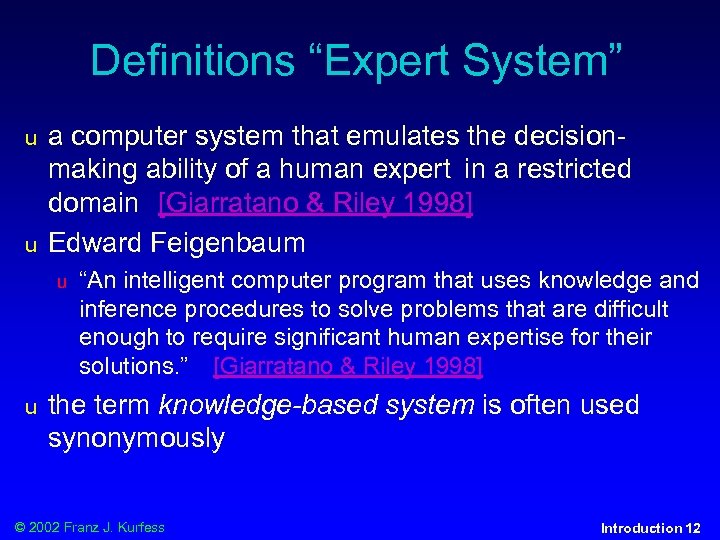
Definitions “Expert System” u u a computer system that emulates the decisionmaking ability of a human expert in a restricted domain [Giarratano & Riley 1998] Edward Feigenbaum u u “An intelligent computer program that uses knowledge and inference procedures to solve problems that are difficult enough to require significant human expertise for their solutions. ” [Giarratano & Riley 1998] the term knowledge-based system is often used synonymously © 2002 Franz J. Kurfess Introduction 12
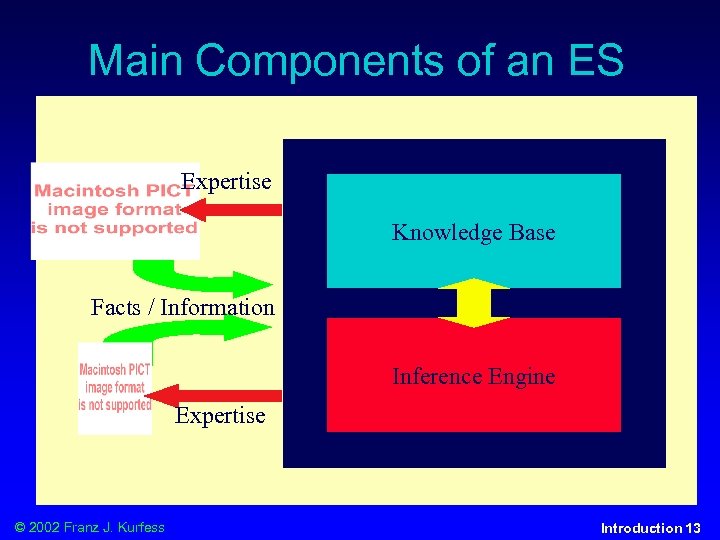
Main Components of an ES Expertise Knowledge Base Facts / Information Inference Engine Expertise © 2002 Franz J. Kurfess Introduction 13
ES Components u knowledge base u u u contains essential information about the problem domain often represented as facts and rules inference engine u u mechanism to derive new knowledge from the knowledge base and the information provided by the user often based on the use of rules © 2002 Franz J. Kurfess Introduction 14
General Concepts and Characteristics of ES u knowledge representation u u inference u u suitable for storing and processing knowledge in computers mechanism that allows the generation of new conclusions from existing knowledge in a computer knowledge acquisition u u transfer of knowledge from humans to computers sometimes knowledge can be acquired directly from the environment v u machine learning explanation u illustrates to the user how and why a particular solution was generated © 2002 Franz J. Kurfess Introduction 15
Development of ES Technology u strongly influenced by cognitive science and mathematics u u u the way humans solve problems formal foundations, especially logic and inference production rules as representation mechanism u u IF … THEN type rules reasonably close to human reasoning can be manipulated by computers appropriate granularity v knowledge “chunks” are manageable both for humans and for computers © 2002 Franz J. Kurfess [Dieng et al. 1999] Introduction 16
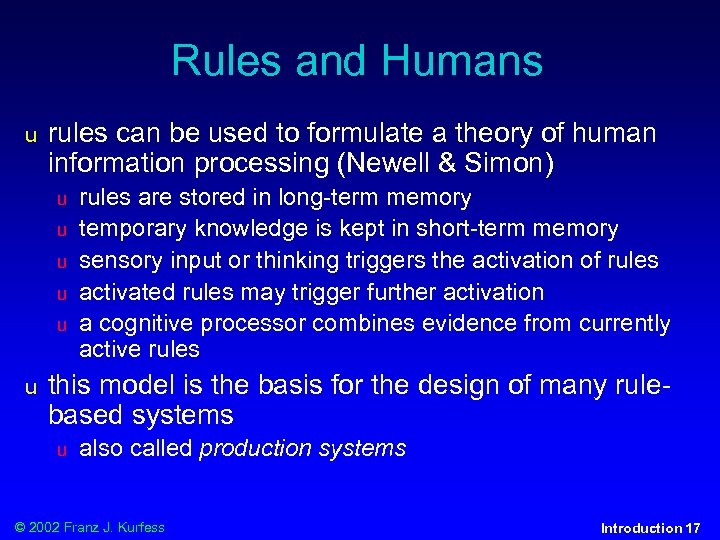
Rules and Humans u rules can be used to formulate a theory of human information processing (Newell & Simon) u u u rules are stored in long-term memory temporary knowledge is kept in short-term memory sensory input or thinking triggers the activation of rules activated rules may trigger further activation a cognitive processor combines evidence from currently active rules this model is the basis for the design of many rulebased systems u also called production systems © 2002 Franz J. Kurfess Introduction 17
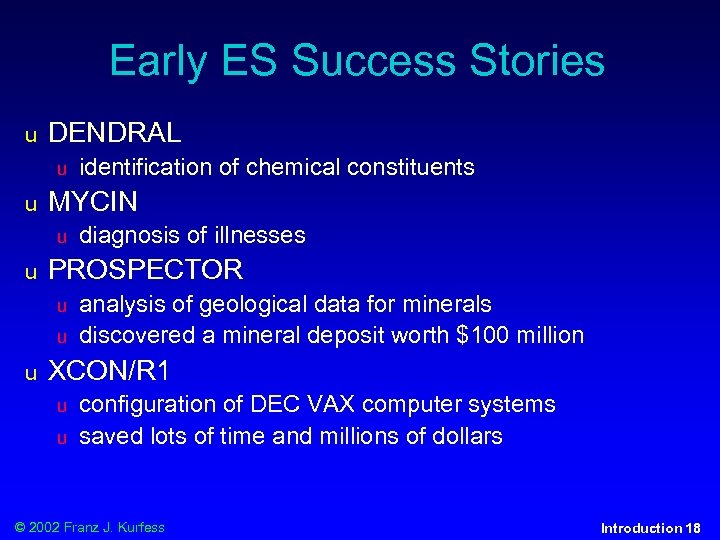
Early ES Success Stories u DENDRAL u u MYCIN u u diagnosis of illnesses PROSPECTOR u u u identification of chemical constituents analysis of geological data for minerals discovered a mineral deposit worth $100 million XCON/R 1 u u configuration of DEC VAX computer systems saved lots of time and millions of dollars © 2002 Franz J. Kurfess Introduction 18
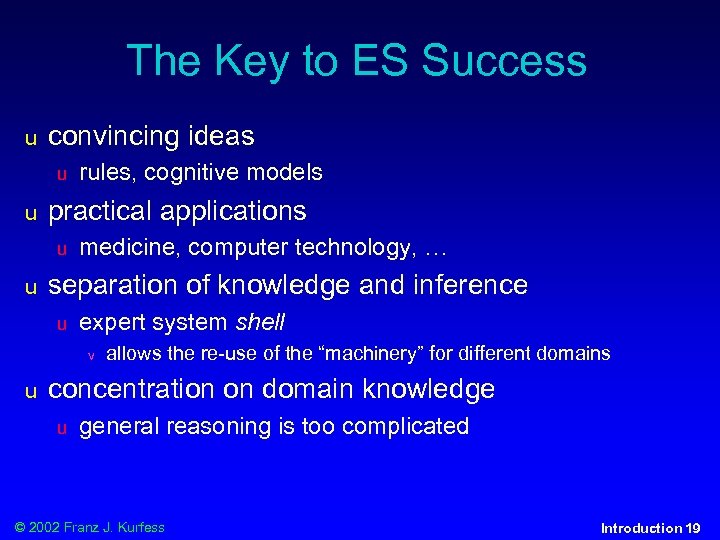
The Key to ES Success u convincing ideas u u practical applications u u rules, cognitive models medicine, computer technology, … separation of knowledge and inference u expert system shell v u allows the re-use of the “machinery” for different domains concentration on domain knowledge u general reasoning is too complicated © 2002 Franz J. Kurfess Introduction 19
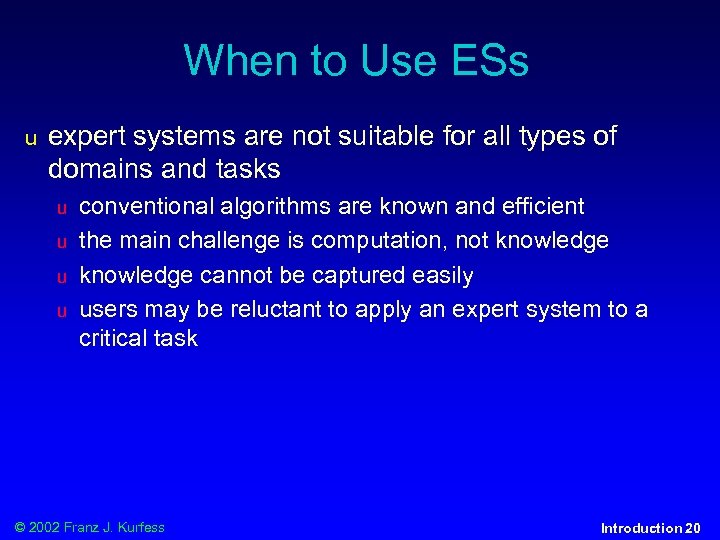
When to Use ESs u expert systems are not suitable for all types of domains and tasks u u conventional algorithms are known and efficient the main challenge is computation, not knowledge cannot be captured easily users may be reluctant to apply an expert system to a critical task © 2002 Franz J. Kurfess Introduction 20
ES Tools u ES languages u u u higher-level languages specifically designed for knowledge representation and reasoning SAIL, KRL, KQML shells u an ES development tool/environment where the user provides the knowledge base © 2002 Franz J. Kurfess Introduction 21
ES Elements u u u u knowledge base inference engine working memory agenda explanation facility knowledge acquisition facility user interface © 2002 Franz J. Kurfess Introduction 22
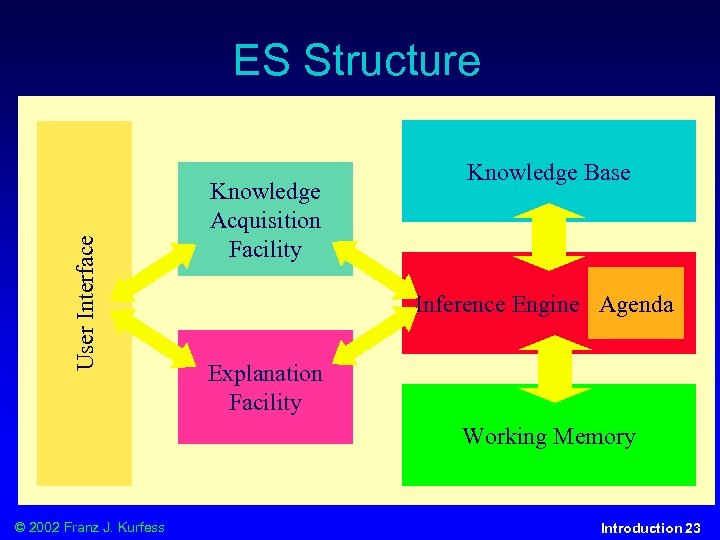
User Interface ES Structure Knowledge Acquisition Facility Knowledge Base Inference Engine Agenda Explanation Facility Working Memory © 2002 Franz J. Kurfess Introduction 23
Rule-Based ES u knowledge is encoded as IF … THEN rules u u the inference engine determines which rule antecedents are satisfied u u u these rules can also be written as production rules the left-hand side must “match” a fact in the working memory satisfied rules are placed on the agenda rules on the agenda can be activated (“fired”) u u an activated rule may generate new facts through its righthand side the activation of one rule may subsequently cause the activation of other rules © 2002 Franz J. Kurfess Introduction 24
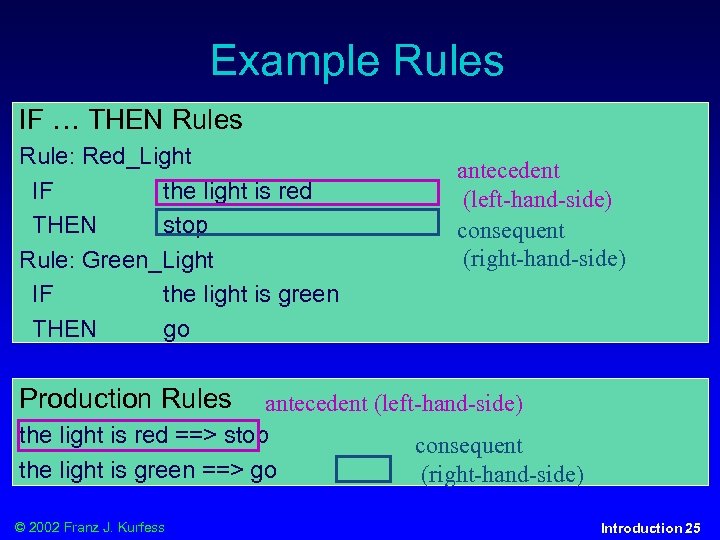
Example Rules IF … THEN Rules Rule: Red_Light IF the light is red THEN stop Rule: Green_Light IF the light is green THEN go antecedent (left-hand-side) consequent (right-hand-side) Production Rules antecedent (left-hand-side) the light is red ==> stop consequent the light is green ==> go (right-hand-side) © 2002 Franz J. Kurfess Introduction 25
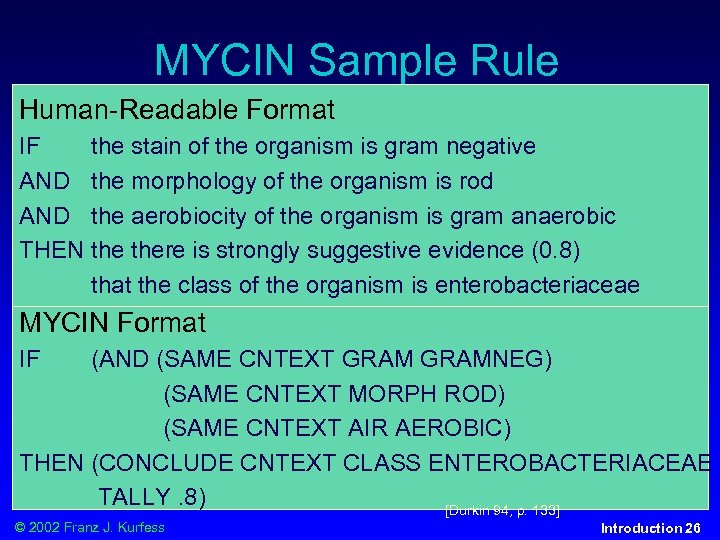
MYCIN Sample Rule Human-Readable Format IF the stain of the organism is gram negative AND the morphology of the organism is rod AND the aerobiocity of the organism is gram anaerobic THEN there is strongly suggestive evidence (0. 8) that the class of the organism is enterobacteriaceae MYCIN Format IF (AND (SAME CNTEXT GRAMNEG) (SAME CNTEXT MORPH ROD) (SAME CNTEXT AIR AEROBIC) THEN (CONCLUDE CNTEXT CLASS ENTEROBACTERIACEAE TALLY. 8) [Durkin 94, p. 133] © 2002 Franz J. Kurfess Introduction 26
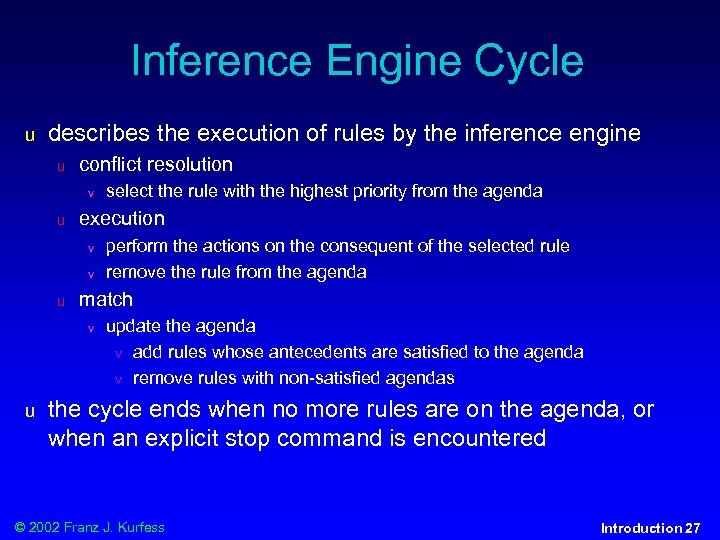
Inference Engine Cycle u describes the execution of rules by the inference engine u conflict resolution v u execution v v u perform the actions on the consequent of the selected rule remove the rule from the agenda match v u select the rule with the highest priority from the agenda update the agenda v add rules whose antecedents are satisfied to the agenda v remove rules with non-satisfied agendas the cycle ends when no more rules are on the agenda, or when an explicit stop command is encountered © 2002 Franz J. Kurfess Introduction 27
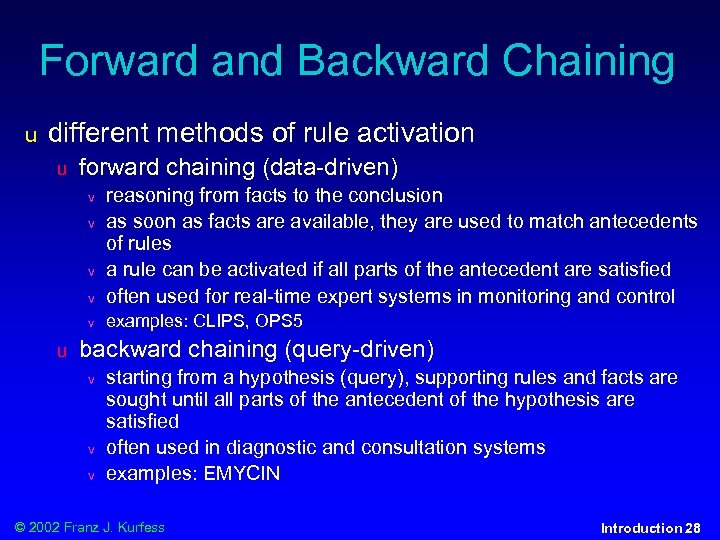
Forward and Backward Chaining u different methods of rule activation u forward chaining (data-driven) v reasoning from facts to the conclusion as soon as facts are available, they are used to match antecedents of rules a rule can be activated if all parts of the antecedent are satisfied often used for real-time expert systems in monitoring and control v examples: CLIPS, OPS 5 v v v u backward chaining (query-driven) v v v starting from a hypothesis (query), supporting rules and facts are sought until all parts of the antecedent of the hypothesis are satisfied often used in diagnostic and consultation systems examples: EMYCIN © 2002 Franz J. Kurfess Introduction 28
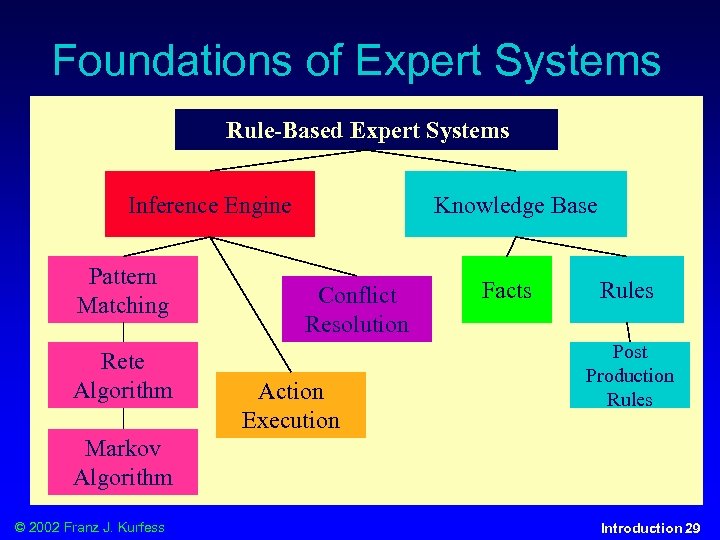
Foundations of Expert Systems Rule-Based Expert Systems Inference Engine Pattern Matching Rete Algorithm Knowledge Base Conflict Resolution Action Execution Facts Rules Post Production Rules Markov Algorithm © 2002 Franz J. Kurfess Introduction 29
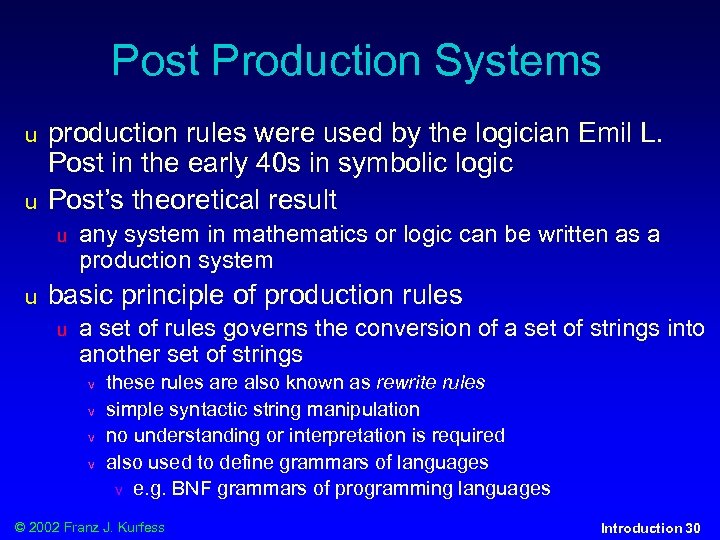
Post Production Systems u u production rules were used by the logician Emil L. Post in the early 40 s in symbolic logic Post’s theoretical result u u any system in mathematics or logic can be written as a production system basic principle of production rules u a set of rules governs the conversion of a set of strings into another set of strings v v these rules are also known as rewrite rules simple syntactic string manipulation no understanding or interpretation is required also used to define grammars of languages v e. g. BNF grammars of programming languages © 2002 Franz J. Kurfess Introduction 30
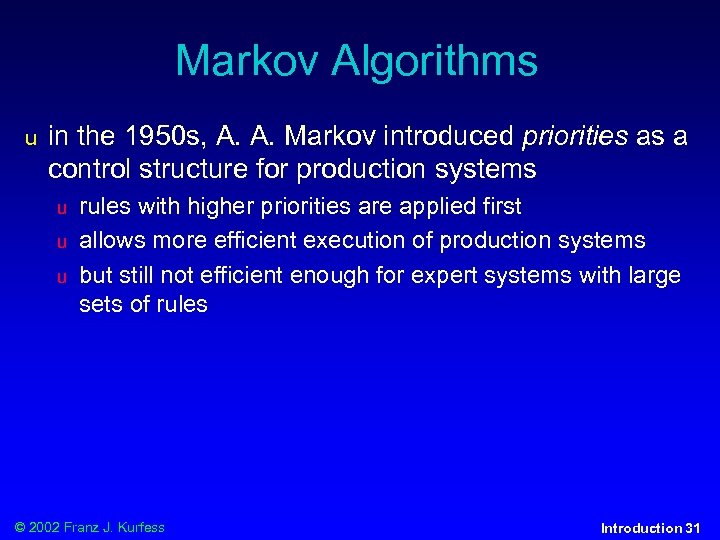
Markov Algorithms u in the 1950 s, A. A. Markov introduced priorities as a control structure for production systems u u u rules with higher priorities are applied first allows more efficient execution of production systems but still not efficient enough for expert systems with large sets of rules © 2002 Franz J. Kurfess Introduction 31
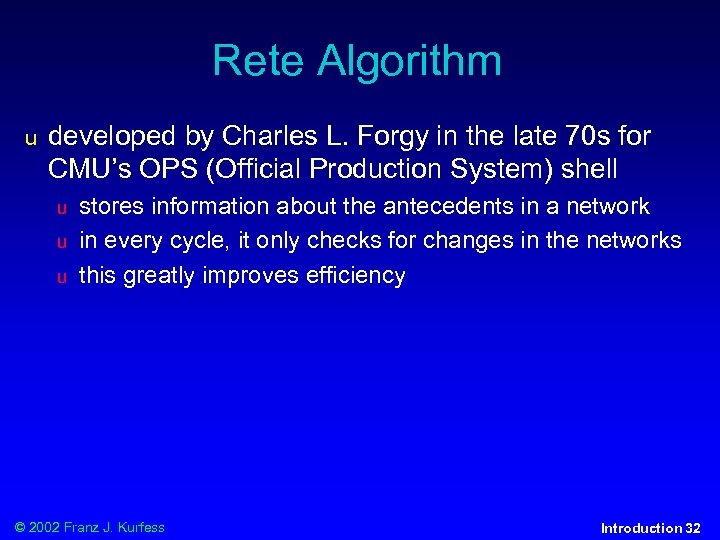
Rete Algorithm u developed by Charles L. Forgy in the late 70 s for CMU’s OPS (Official Production System) shell u u u stores information about the antecedents in a network in every cycle, it only checks for changes in the networks this greatly improves efficiency © 2002 Franz J. Kurfess Introduction 32
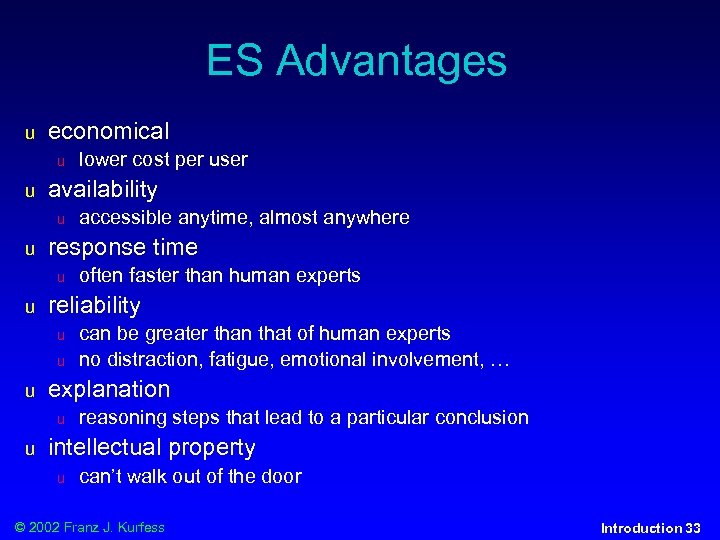
ES Advantages u economical u u availability u u u can be greater than that of human experts no distraction, fatigue, emotional involvement, … explanation u u often faster than human experts reliability u u accessible anytime, almost anywhere response time u u lower cost per user reasoning steps that lead to a particular conclusion intellectual property u can’t walk out of the door © 2002 Franz J. Kurfess Introduction 33
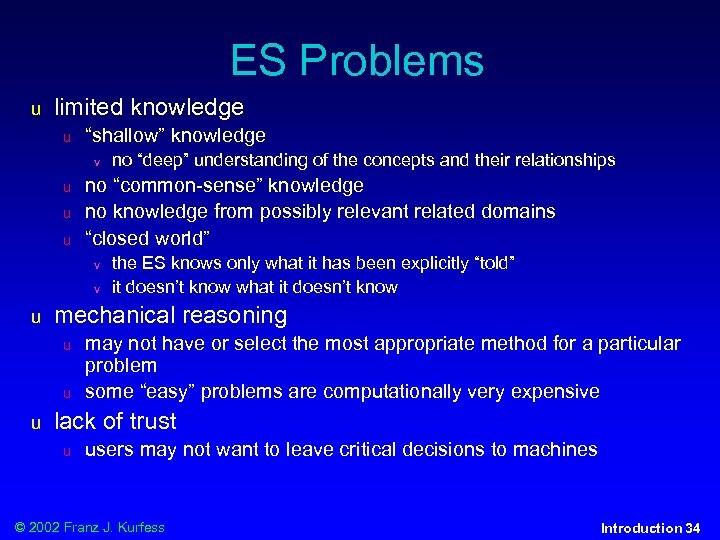
ES Problems u limited knowledge u “shallow” knowledge v u u u no “common-sense” knowledge no knowledge from possibly relevant related domains “closed world” v v u the ES knows only what it has been explicitly “told” it doesn’t know what it doesn’t know mechanical reasoning u u u no “deep” understanding of the concepts and their relationships may not have or select the most appropriate method for a particular problem some “easy” problems are computationally very expensive lack of trust u users may not want to leave critical decisions to machines © 2002 Franz J. Kurfess Introduction 34
![Reference [Dieng et al. 1999] u u [Dieng et al. 1999] [Giarratano & Riley](https://present5.com/presentation/77e1cd6a19a4f71bbd32fc9aa1c9c1e5/image-34.jpg "Reference [Dieng et al. 1999] u u [Dieng et al. 1999] [Giarratano & Riley")
Reference [Dieng et al. 1999] u u [Dieng et al. 1999] [Giarratano & Riley 1998] © 2002 Franz J. Kurfess Introduction 35
![Reference [Sommerville 01] u [Sommerville 01] © 2002 Franz J. Kurfess [Sommerville 01] Introduction](https://present5.com/presentation/77e1cd6a19a4f71bbd32fc9aa1c9c1e5/image-35.jpg "Reference [Sommerville 01] u [Sommerville 01] © 2002 Franz J. Kurfess [Sommerville 01] Introduction")
Reference [Sommerville 01] u [Sommerville 01] © 2002 Franz J. Kurfess [Sommerville 01] Introduction 36
Post-Test © 2002 Franz J. Kurfess Introduction 37
![References u u u u [Altenkrüger & Büttner] Doris Altenkrüger and Winfried Büttner. Wissensbasierte](https://present5.com/presentation/77e1cd6a19a4f71bbd32fc9aa1c9c1e5/image-37.jpg "References u u u u [Altenkrüger & Büttner] Doris Altenkrüger and Winfried Büttner. Wissensbasierte")
References u u u u [Altenkrüger & Büttner] Doris Altenkrüger and Winfried Büttner. Wissensbasierte Systems - Architektur, Enwicklung, Echtzeit-Anwendungen. Vieweg Verlag, 1992. [Awad 1996] Elias Awad. Building Expert Systems - Principles, Procedures, and Applications. West Publishing, Minneapolis/St. Paul, MN, 1996. [Bibel 1993] Wolfgang Bibel with Steffen Hölldobler and Torsten Schaub. Wissensrepräsentation und Inferenz - Eine grundlegende Einführung. Vieweg Verlag, 1993. [Durkin 1994] John Durkin. Expert Systems - Design and Development. Prentice Hall, Englewood Cliffs, NJ, 1994. [Giarratano & Riley 1998] Joseph Giarratano and Gary Riley. Expert Systems Principles and Programming. 3 rd ed. , PWS Publishing, Boston, MA, 1998 [Jackson, 1999] Peter Jackson. Introduction to Expert Systems. 3 rd ed. , Addison. Wesley, 1999. [Russell & Norvig 1995] Stuart Russell and Peter Norvig, Artificial Intelligence - A Modern Approach. Prentice Hall, 1995. © 2002 Franz J. Kurfess Introduction 39
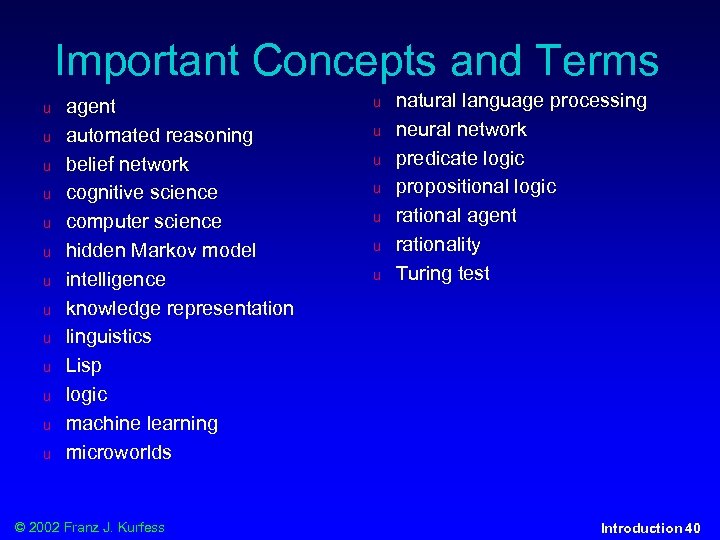
Important Concepts and Terms u u u u agent automated reasoning belief network cognitive science computer science hidden Markov model intelligence knowledge representation linguistics Lisp logic machine learning microworlds © 2002 Franz J. Kurfess u u u u natural language processing neural network predicate logic propositional logic rational agent rationality Turing test Introduction 40

Summary Chapter-Topic © 2002 Franz J. Kurfess Introduction 41

© 2002 Franz J. Kurfess Introduction 42
Скачать презентацию CPE CSC 481 Knowledge-Based Systems Dr Franz J Kurfess
77e1cd6a19a4f71bbd32fc9aa1c9c1e5.ppt