Скачать презентацию CPD OF TEACHERS IN THE CONTEXT OF EVOLVING
70f931c60e6f8fab9b2b809bc534cc65.ppt
- Количество слайдов: 34
 CPD OF TEACHERS IN THE CONTEXT OF EVOLVING EDUCATION REFORMS Athens, 2003, Tuende Kovacs-Cerovic, Ph. D Ministry of Education and Sports, Serbia
 Contextual features in SEE countries: • TT part of all aspects of reform • Diversity of offers and actors • Int’l support • “model programs”
 • Diverse offer of INSET programs: – NGOs, universities, int’l agencies, schools, individuals – Diversity of new teaching methods – Short courses to multi-level programs • National INSET programs: – for introducing new curricula – for supporting new evaluation systems – school improvement – inclusion of vulnerable groups, etc
 Typical barriers: • Scarce funding for INSET • Lack of or disfuncional institutional structures • Negative selection of teachers • Initial teacher education fragmented and outdated • Lack of incentives • Lack of quality assurance systems at other levels • And the evolving reform context with all of its uncertainties
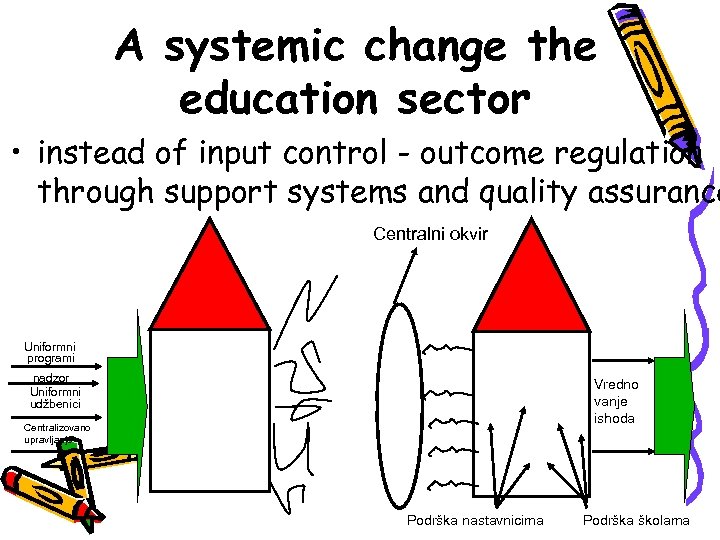 A systemic change the education sector • instead of input control - outcome regulation through support systems and quality assurance Centralni okvir Uniformni programi nadzor Uniformni udžbenici Vredno vanje ishoda Centralizovano upravljanje Podrška nastavnicima Podrška školama
 Typical policy dilemmas: • TT a prerequisite or consequence? build reform agenda on setting up a system of TT, or on curriculum and assessment reform? • Is there a long-term role of TT/TED institutions or not? support institution building or program delivery? • Who is in the focus: Teacher? School? TT program? support programs to reach out to schools/teachers or teachers/schools to find appealing programs ?
 Some more concrete dilemmas • How to support at the same time national programs and diversity of offer? • How do we know that the offer is meeting the needs? • How do we know that it is of high quality? • How can we ensure equal access of teachers to TT regionally?
 Real challenges: • How to ensure the possibility of coherent yet diversified CPD (teachers are humans as well /learning/change) in the context of: – – Diversified but not systematized offer Multiple priorities of a reform agenda Context of human change Lack of institutional structures/networks (NGO/University/schools/government)
 • How to ensure sustainable and meaningful use of INSET inputs • How to invite for selfevaluation in a context where: – Selfevaluation is not a routine practic at school level – INSET programs are competing for scarce funding – Teachers are buying everything
 What we need is to tie together in a meaningful way: • INSET provision • School improvement • Reform support implementation networks But: depending on donor support without well functioning institutional structures having in mind the human side of teachers change
 At least: • A sound teacher policy covering: – Accreditation of providers or programs – Teachers licencing and career advancement scheme • Institutional structures to implement and monitor the policy • And quite a lot of luck as well…
 Appendix: Summary of Education Reform in Serbia
 WHERE WE?
 REMINDER OF · Ruined, outdated, rigid, ideologically flavored, stagnating education system · International expert surveys conducted by the WB, OECD, UNICEF highlighted major problems · Setting the objectives and strategies of the Education Reform in Serbia by the newly formed Mo. ES (February 2001) 8 Local expert groups formed for developing the strategies for the first wave of Education Reform International expert input organized Local consultation process organized (Ro. R, 85 places, 9000 persons, Autumn 2001) · · · • Conceiving the first wave of education reform • Global areas: decentralization, democratization, teacher training and professional development, education quality evaluation • Particular education areas: preschool, secondary vocational, higher education, adult education
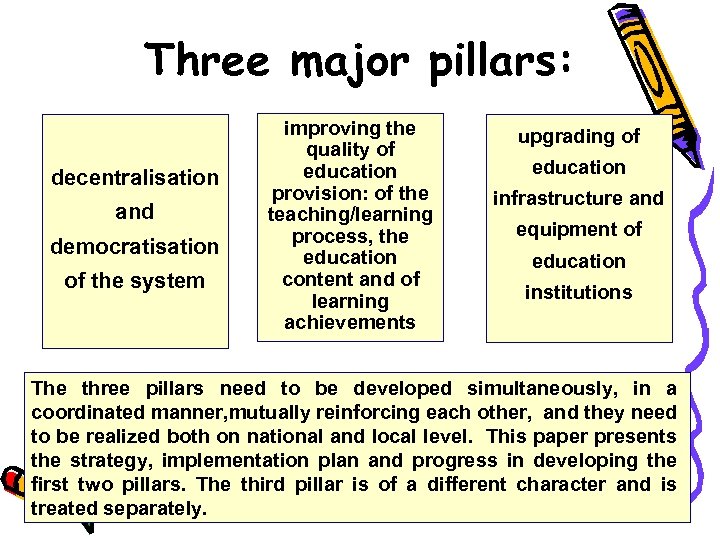 Three major pillars: decentralisation and democratisation of the system improving the quality of education provision: of the teaching/learning process, the education content and of learning achievements upgrading of education infrastructure and equipment of education institutions The three pillars need to be developed simultaneously, in a coordinated manner, mutually reinforcing each other, and they need to be realized both on national and local level. This paper presents the strategy, implementation plan and progress in developing the first two pillars. The third pillar is of a different character and is treated separately.
 VISION OF THE FUTURE EDUCATION SYSTEM: • Capable of responding to both local and global social and economic needs • That includes parents and teachers and students into the decision-making processes • That is governed in a decentralized way and managed economically and efficiently and the financing and administration of which are transparent and based on real indicators • That employs highly professional, reflexive, creative and motivated educational staff • That is directed at learning and standardbased, into which the perspective of lifelong learning is built, and in which teaching focuses on relevant contents,
 • That promotes a culture of evaluation, self -evaluation and school development, • That nurtures an atmosphere of tolerance and constructive communication, • That is just and capable of responding to the educational needs of minorities and children with special needs, and • That is continuously supported by suitable equipment and teaching tools Such a vision of the new education system becomes reality by relying on the best in our educational system as well as Int’l experiences and by developing solutions in the best interest of children and their
 WHERE ARE WE NOW?
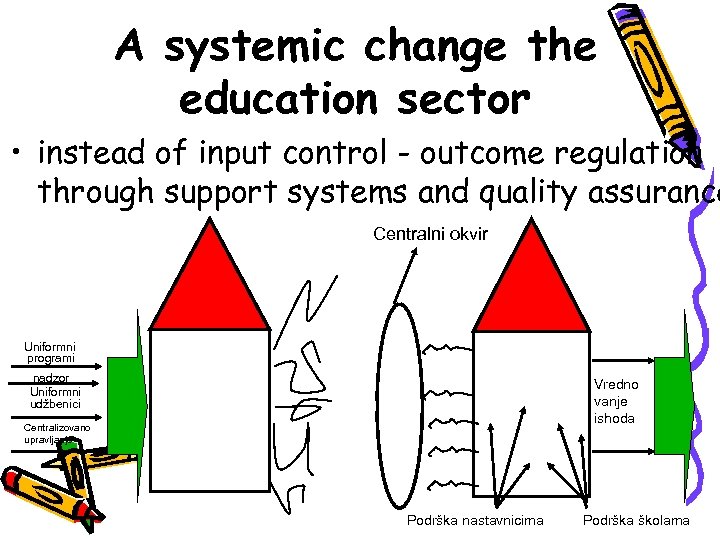 A systemic change the education sector • instead of input control - outcome regulation through support systems and quality assurance Centralni okvir Uniformni programi nadzor Uniformni udžbenici Vredno vanje ishoda Centralizovano upravljanje Podrška nastavnicima Podrška školama
 Democratization and decentralization: INTRODUCTION · New structure of school boards and the new procedure for selecting principals PREPARATION (amendments to the law on primary and secondary schooling) INTR. /EVAL · The planned program of training school boards and principals EVALUATION · The “School Development” program – pilot PREPARATION phase · Civic Education: optional subject, evaluation · Information system PREPARATION · Regional development through cooperation EVALUATION with European partners
 Assessment • The new system of entrance exams of secondary EVALUATION schools (and the concept of transferring to the system of final exams by 2006/07 is in PREPARATION preparation) • PISA: international comparative analysis of school achievements INTRODUCTION • The National Standards and Evaluation Center is being founded PREPARATION • Teacher training for new grading methods in DEVISING school • School self-evaluation: concept of pedagogical supervision and the School Development project DEVISING
 • Reform of inspectorates: • Legal inspection transferred to the municipalities • Pedagogical inspection and School self-evaluation at Regional level (capacity building for the new role during 2003)
 Teacher training and professional development • Preparation of the curricular INTRODUCTION reform for teachers’ faculties INTRODUCTION • Accreditation of teachers’ professional development programs • Teacher advancement (amendments ANNOUNC. to the law on primary and secondary schooling) • The national center for PREPARATION professional development is being founded • Regional centers for PREPARATION teachers’ professional development
 CURRICULUM REFORM for general education • Development of the national curriculum framework : The final version expected on March 15 th 2003, • Introduction of nine years compulsory education: The first ninth grade in 2006/2007 • Shifting the focus from content to educational outcomes – i. e. the knowledge, skills, attitudes and values which the pupils should possess and develop at the particular level of education • Flexibility – providing the space for creation of schoolbased curriculum
 Current developments: • Preparation of the new curricula for grade 1 entering schools in September 2003 • Teacher training program developed – Training of about 7000 teachers to implement new curriculum to start in February 2003. • Subject teams being formed • Implementation teams being formed
 Vocational Education and Training • • National Center for VET to be established VET schools association network set up, capacity building Economic cost of secondary education in Serbia determined The curriculum reform of VET schools under preparation with the support of EU Cards program, Support to the innovative programs ensured through the same program Pilot program and TT developed for economic and agricultural schools Pilot program developed for Agricultural schools with the support of GTZ.
 • Preschool education – Integrated into the Education system – New Law on Preschool Education prepared – Intensive training of pre-school teachers in new development methods and approaches ongoing (39 seminars with 1355 participants) • Higher education reform in progress • Adult education • Preparation for CARDS programm (establishing 5 centres for adult education)
 What is ahead of us?
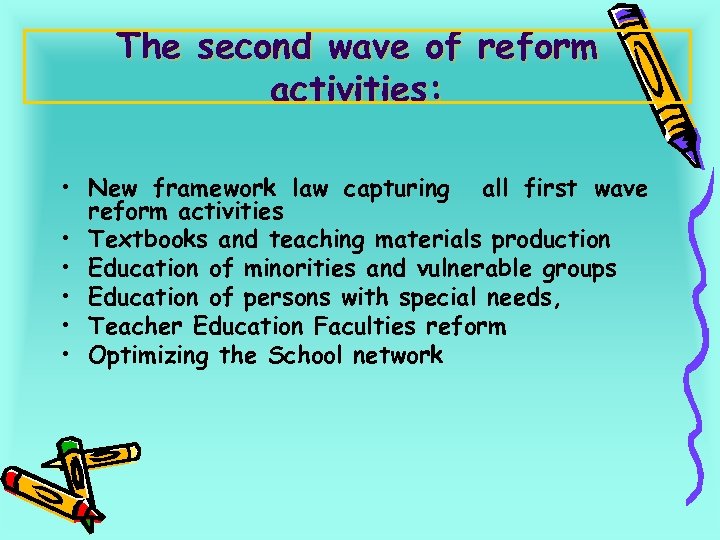 The second wave of reform activities: • New framework law capturing all first wave reform activities • Textbooks and teaching materials production • Education of minorities and vulnerable groups • Education of persons with special needs, • Teacher Education Faculties reform • Optimizing the School network
 What is ahead of us in academic 2003/04?
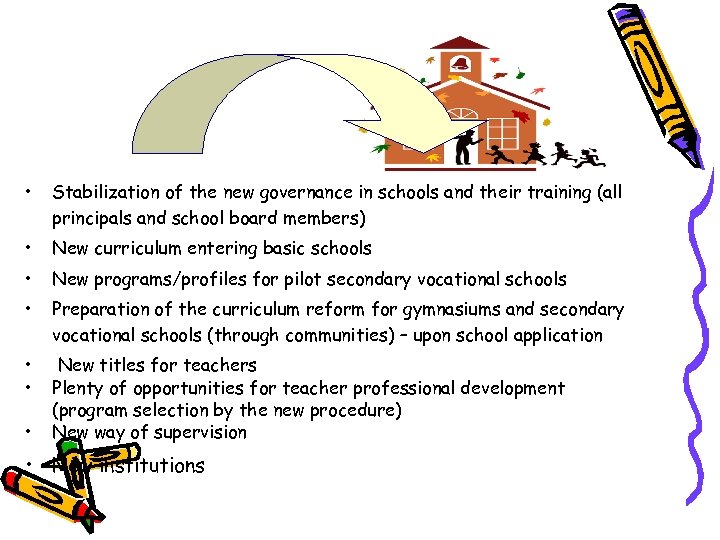 • Stabilization of the new governance in schools and their training (all principals and school board members) • New curriculum entering basic schools • New programs/profiles for pilot secondary vocational schools • Preparation of the curriculum reform for gymnasiums and secondary vocational schools (through communities) – upon school application • • New titles for teachers Plenty of opportunities for teacher professional development (program selection by the new procedure) New way of supervision • • New institutions
 We hope and expect
 That all of this will contribute to: • Higher quality of children’s learning (within schools, not outside of them) • Teachers’ greater satisfaction with their own job • Parents’ trust • The acquisition of knowledge and skills that are remembered long and used often, and long-lasting values • An education system to help the country to recover, and become truly European.