


 Скачать презентацию Course Summary What have we learned a huge
84792f06491d226adef6233d11ce5b3e.ppt
- Количество слайдов: 17
 Course Summary What have we learned: a huge amount! m principles m practice …. . using Internet to motivate examples 1
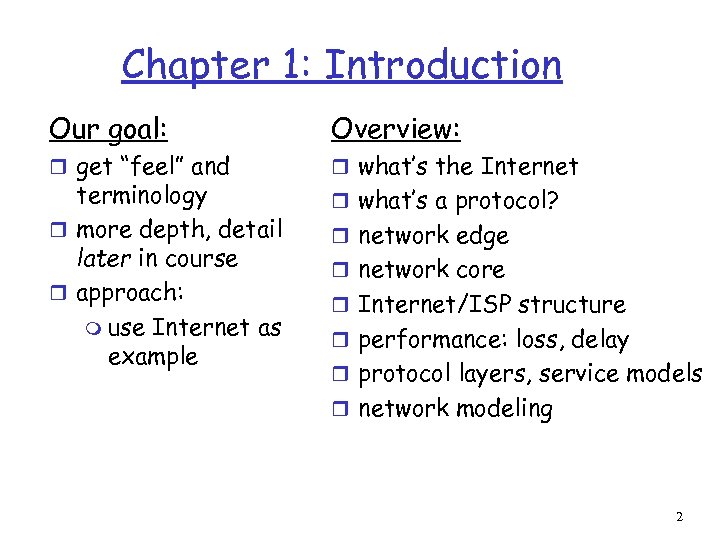 Chapter 1: Introduction Our goal: Overview: r get “feel” and r what’s the Internet terminology r more depth, detail later in course r approach: m use Internet as example r what’s a protocol? r network edge r network core r Internet/ISP structure r performance: loss, delay r protocol layers, service models r network modeling 2
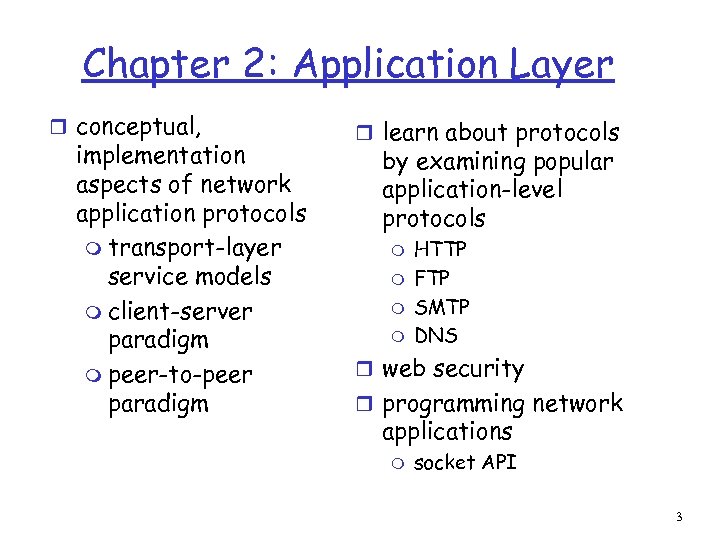 Chapter 2: Application Layer r conceptual, implementation aspects of network application protocols m transport-layer service models m client-server paradigm m peer-to-peer paradigm r learn about protocols by examining popular application-level protocols m m HTTP FTP SMTP DNS r web security r programming network applications m socket API 3
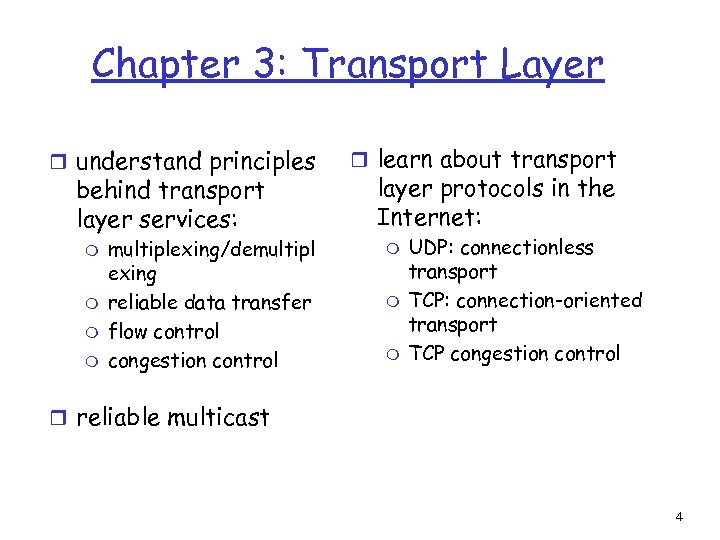 Chapter 3: Transport Layer r understand principles behind transport layer services: m m multiplexing/demultipl exing reliable data transfer flow control congestion control r learn about transport layer protocols in the Internet: m m m UDP: connectionless transport TCP: connection-oriented transport TCP congestion control r reliable multicast 4
 Chapter 4: Network Layer r understand principles behind network layer services: m forwarding m routing (path selection) – performance vs policy m dealing with scale m how a router works m NATs, IPv 6 r instantiation in the Internet r broadcast, multicast routing 5
 Chapter 5: The Data Link Layer r understand principles behind data link layer services: m m error detection, correction sharing a broadcast channel: multiple access • ALOHA (slotted and unslotted) • Ethernet m link layer addressing r Ethernet switches r link virtualization, brief introduction to ATM, virtual circuits 6
 Chapter 6: Wireless & Mobile Networks Wireless r Wireless links, characteristics r IEEE 802. 11 wireless LANs (“wi-fi”) r Cellular Internet Access m m architecture standards Mobility r Principles: addressing and routing to mobile users r Mobile IP r Handling mobility in cellular networks r Mobility and higherlayer protocols 7
 Chapter 8: Network Security r understand principles of network security: m cryptography and its many uses beyond “confidentiality” m authentication m message integrity m certificate authority r security in practice: m firewalls m security in application, transport, network, link layers (WEP) 8
 Chapter 7: Multimedia Networking Principles r making the best of best effort service m dealing with delay jitter and loss r mechanism for providing Qo. S m e. g. , leaky bucket, weighted fair queuing Protocols and Architectures r specific protocols for best-effort m e. g. , RTP/RTCP, SIP 9
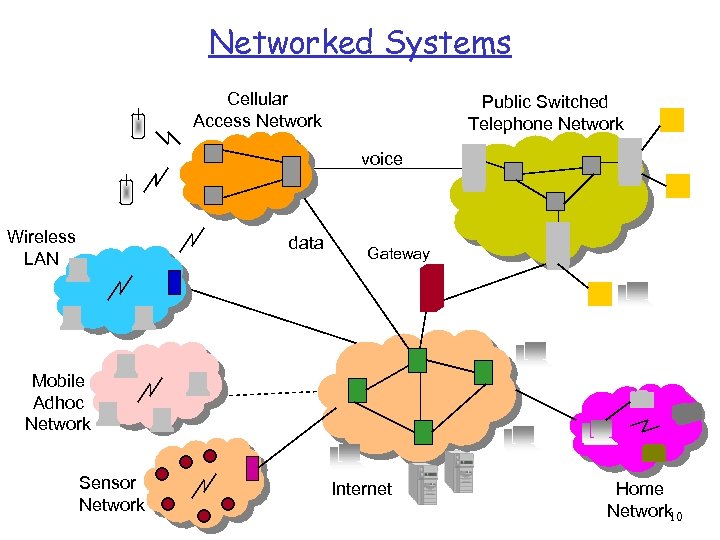 Networked Systems Cellular Access Network Public Switched Telephone Network voice Wireless LAN data Gateway Mobile Adhoc Network Sensor Network Internet Home Network 10
 Networking Applications r financial – stock trading, portfolio management r social – voice communication, email, chat, telecommuting r entertainment - games, music, video, surfing r medical – telemedicine r … r networked systems indispensable part of not just global communication infrastructure but our daily lives 11
 Q: Whither goest networking? A: nobody knows! General trends: r ubiquity of communications m m m IP dialtone, IP: like electricity: it’s everywhere! network-capable appliances (e. g. , IP toaster) issues of scale important: 100's of millions of networkconnected devices r mobility important: m people move, need to communicate r multimedia important: m it is how people communicate 12
 Q: Whither goest networking? r increasing link rates, but bandwidth not free in near future m m increased # "users" increased bandwidth requirements of enabled apps r high bandwidth to home (DSL, cable modems) a major driver for future m m m games, VR, education, information, entertainment merger of networking and telephony broadcast entertainment (TV) and WWW r security, reliability, management: critical concerns 13
 Our Very Last Note Page! r this course: m specific architectures, protocols m fundamental issues: APIs, reliable data transfer, flow/congestion control, routing, multiple access, addressing, security, multimedia networking r remember: you learned it HERE! 14
 Final Exam on 12/10/07 10: 30 AM to 12: 00 noon r Three parts m Part 0 – Name and course number – 1 point m Part 1 - about 26 questions (1 point each) + 1 bonus question (1 point) m Part 2 – 3 -4 questions based on the RSVP paper ~ 3 points (extra credit for cs 5480) r Closed book, closed notes, you can bring calculators r Post midterm material (however, expected to know important midterm concepts especially TCPs loss recovery, timeout estimation, etc. ) 15
 Final Exam on 12/10/07 10: 30 AM to 12: 00 noon Important Topics r Chapter 4: BGP, Broadcast/Multicast Routing, Virtual circuits r Chapter 5: Different types of medium access protocols, ALOHA, Ethernet protocols (derivations, numerical examples), Ethernet switches, MAC addressing r Chapter 6: IEEE 802. 11 protocol (understand CSMA/CA, SIFS/DIFS, RTS/CTS etc. ), IP & cellular network mobility (indirect, direct routing, HA/FA/COA, HLR/VLR, handover), TCP performance over mobile wireless networks r Chapter 7: Delay jitter, playout delays, loss concealment, RTP, SIP, WFQ, Token Bucket, delay guarantees r Chapter 8: Cryptography – symmetric key, public key, hash functions, Authentication Protocols, Firewalls and Gateways, WEP, IEEE 802. 11 i r Do not have to prepare the material taught by Prof. Patwari r cs 6480 – RSVP paper 16
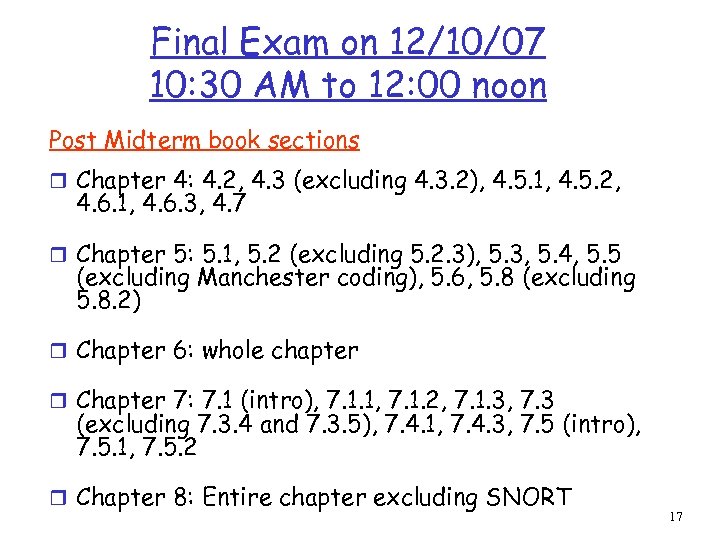 Final Exam on 12/10/07 10: 30 AM to 12: 00 noon Post Midterm book sections r Chapter 4: 4. 2, 4. 3 (excluding 4. 3. 2), 4. 5. 1, 4. 5. 2, 4. 6. 1, 4. 6. 3, 4. 7 r Chapter 5: 5. 1, 5. 2 (excluding 5. 2. 3), 5. 3, 5. 4, 5. 5 (excluding Manchester coding), 5. 6, 5. 8 (excluding 5. 8. 2) r Chapter 6: whole chapter r Chapter 7: 7. 1 (intro), 7. 1. 1, 7. 1. 2, 7. 1. 3, 7. 3 (excluding 7. 3. 4 and 7. 3. 5), 7. 4. 1, 7. 4. 3, 7. 5 (intro), 7. 5. 1, 7. 5. 2 r Chapter 8: Entire chapter excluding SNORT 17