


 Скачать презентацию Course Overview Review of Scrum Introduction to UML
dad80d3db7c9dbd2217811ba4dd33951.ppt
- Количество слайдов: 29
 Course Overview Review of Scrum. Introduction to UML. This lecture is based on two SCRUM presentations: Agile Software Development with SCRUM by Shveta Mehtani (http: //www. scribd. com/doc/6578688/SCRUMAEG) What is Scrum? by Richard Fennell (http: //www. slideshare. net/businessquests/black-marble-introduction-to-scrum) … as adapted by Michael Mateas UC Santa Cruz CMPS 171 – Game Design Studio II courses. soe. ucsc. edu/courses/cmps 171/Winter 12/01 ejw@cs. ucsc. edu 7 January 2013
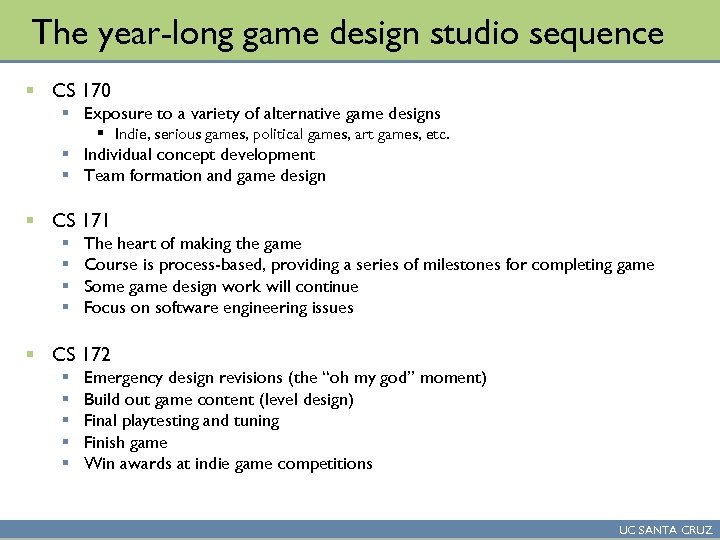 The year-long game design studio sequence § CS 170 § Exposure to a variety of alternative game designs § Indie, serious games, political games, art games, etc. § Individual concept development § Team formation and game design § CS 171 § § The heart of making the game Course is process-based, providing a series of milestones for completing game Some game design work will continue Focus on software engineering issues § CS 172 § § § Emergency design revisions (the “oh my god” moment) Build out game content (level design) Final playtesting and tuning Finish game Win awards at indie game competitions UC SANTA CRUZ
 Class mechanics § Syllabus online at § courses. soe. ucsc. edu/courses/cmps 171/Winter 13/01 § Piazza § piazza. com/ucsc/winter 2013/cmps 171/home § Team feedback tool § http: //cmps 172. soe. ucsc. edu/ UC SANTA CRUZ
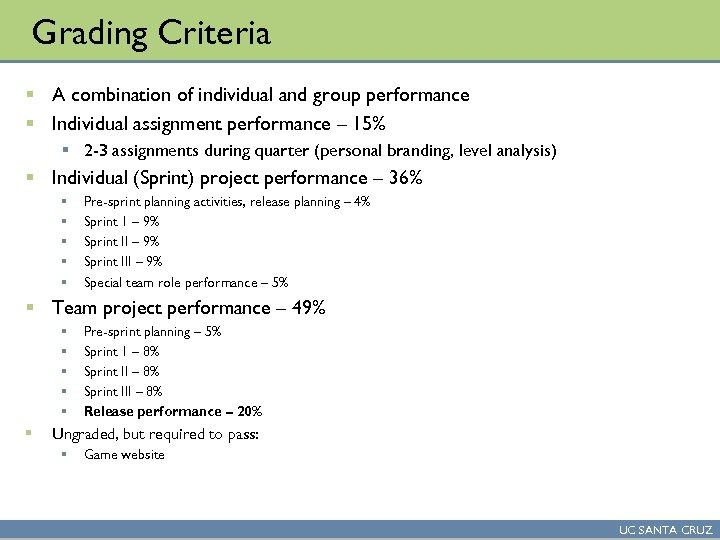 Grading Criteria § A combination of individual and group performance § Individual assignment performance – 15% § 2 -3 assignments during quarter (personal branding, level analysis) § Individual (Sprint) project performance – 36% § § § Pre-sprint planning activities, release planning – 4% Sprint 1 – 9% Sprint III – 9% Special team role performance – 5% § Team project performance – 49% § § § Pre-sprint planning – 5% Sprint 1 – 8% Sprint III – 8% Release performance – 20% Ungraded, but required to pass: § Game website UC SANTA CRUZ
 Team firing process § A team member can be fired from a team for lack of performance, or poor interactions with the rest of the team (“bad apple” behavior) § Detailed firing process is on course website § Briefly, two step process: § Remediation § Identify and try to fix the problem. § Letter describes concrete steps and timeline for improved behavior § Removal § 2/3 vote of CS 171 members of team will fire team member § Fired team member has two weeks to find a new team, or fails the class UC SANTA CRUZ
 Learning Goals § Scrum software development process § § § § Software design § § Concept of a personal brand, development of personal brand Level design § § Unit testing Black box and white box testing Different classes of code test coverage (all paths, def-use, etc. ) Personal branding § § Game playtesting, concept and application Gameplay metrics Software testing § § Unified modeling language (UML) UML structure and sequence diagrams Experience using UML to represent software designs Game testing § § § Release and Sprint planning Experience performing several Sprints and one Release Project management using Scrum (burndown charts, task boards, daily scrums) Hands-on experience in the Scrum Master role "Bad apple" behavior and how it affects teams Coordination with artists and musicians Elements of level design, analysis of levels for their design Elementary typography UC SANTA CRUZ
 Upcoming deadlines § Wednesday (Jan. 9): Release Plan due § A big effort. Start now. § Due by midnight § See website for information and template § Thursday (Jan. 10): Sprint 1 Plan due § Due by midnight § See website for information and template § Wednesday (Jan. 9): Sprint 1 begins § Friday (Jan. 11): team status reporting § Due by midnight § Report on team activities this week § Friday (Jan. 18): Technical design document due § UML diagrams describing the technical design of your game § A big task, need to spin 2 -3 people up on this by end of the week UC SANTA CRUZ
 Sammy Awards § Friday, June 14 § Rio Theater (pending final confirmation) UC SANTA CRUZ
 Introducing Cameron Alston § Ace TA for the class § Details on how to submit assignments § Continue to submit using SVN, using same repository as last quarter § Need to set up time to have Cameron be present during one scrum meeting each week § Part of Sprint 1 plan document UC SANTA CRUZ
 Artists, Musicians, etc. Independent Study § Most artists should be taking companion class in Art Department § But, there might be some artists who are unable to take this class § Musicians may need to take an independent study, if they want credit § Filling out independent study form UC SANTA CRUZ
 Photos § On Monday, January 14, I will be taking photos of each team during class. § Please invite your artists and musicial team members to come to class that day, if they can, to be part of the team photo. § Photos will be posted on the class website, along with your name. § Very useful for putting names to faces § Let me know if you do not want to be part of the team photo, and/or have your name online UC SANTA CRUZ
 Professor meetings § I will be meeting with each team weekly, for up to 1 hour § On Friday, Cameron will match teams to available timeslots. § As preparation, your team needs to collect schedules from every team member, and find time blocks where most of the team can meet. § I don’t expect that every team member will be able to make the meeting with me. UC SANTA CRUZ
 Review of Scrum UC SANTA CRUZ
 Release § A release is a major milestone in the development of a software project § A release contains a series of product features § Features are expressed in the form of user stories § The goal of release planning is to determine which user stories (features) will be included. This involves: § Taking the game concept and decomposing it into user stories § Estimating the time required to perform each user story (using story points) § Prioritizing the user stories § The release plan forms the input into the Sprint planning process UC SANTA CRUZ
 User stories § A product feature is expressed in the form of a user story. § This can be viewed as a specific technique for eliciting and writing software requirements. § A user story is a software requirement § User story format § As a {user role}, I want {goal} [so that {reason}] § Examples: § As a player, I need control over a laser pointer so that the cat will follow it. § As a player, I need to pick up gameworld objects so that I can collect food and ammunition. § As a playtest manager, I need automated collection of gameplay metrics so that levels can be analyzed for areas that are too difficult. § Class exercise developing a few user stories for your game UC SANTA CRUZ
 Estimating size of user stories § The relative size (implementation effort) of each user story is estimated using measure known as story points. § Story points are unitless § Are not person-months, meters, hours, etc. § Key idea is to focus estimating effort on relative size § Use of unitless numbers avoids arguments § “That won’t take a week to implement – that’s easily a week and two days” § … but the point is trying to determine which tasks are O(days), O(weeks), and O(months) – +/- a few days doesn’t matter! § Story points are linear § A user story requiring 0. 5 story points takes half the time to complete as one requiring 1 story point § Similary, a user story requiring 3 story points is the same size as one requiring 1 story point and another requiring 2 story points UC SANTA CRUZ
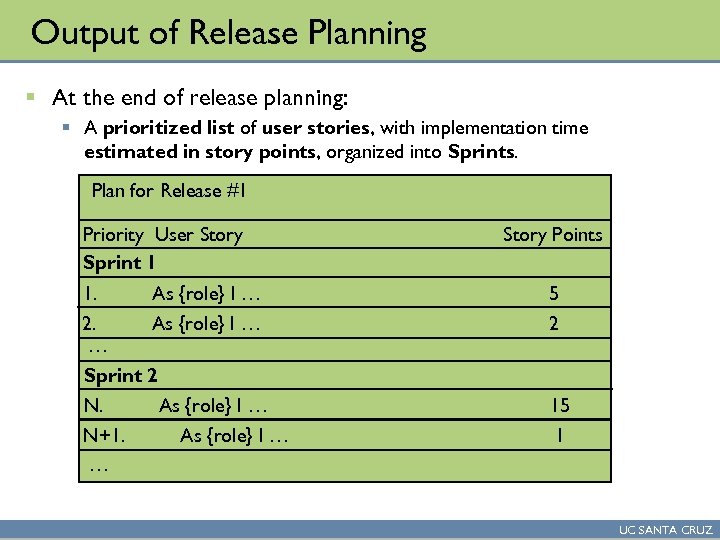 Output of Release Planning § At the end of release planning: § A prioritized list of user stories, with implementation time estimated in story points, organized into Sprints. Plan for Release #1 Priority User Story Sprint 1 1. Story Points As {role} I … 5 2. As {role} I … … Sprint 2 2 N. 15 N+1. … … As {role} I … 1 UC SANTA CRUZ
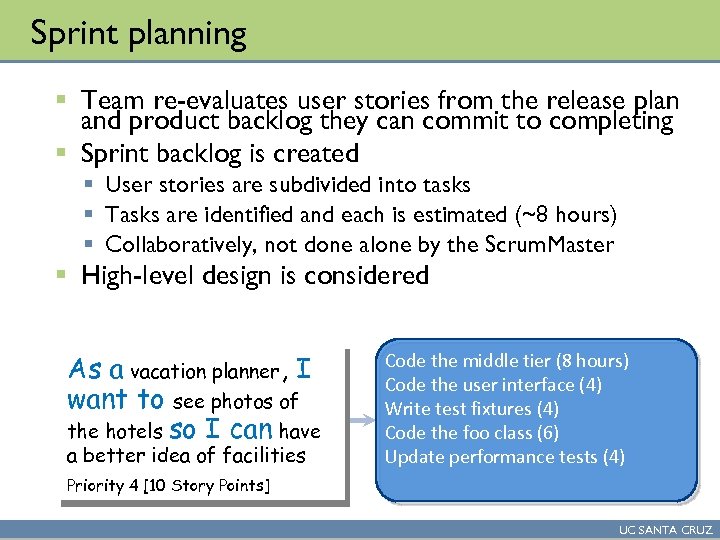 Sprint planning § Team re-evaluates user stories from the release plan and product backlog they can commit to completing § Sprint backlog is created § User stories are subdivided into tasks § Tasks are identified and each is estimated (~8 hours) § Collaboratively, not done alone by the Scrum. Master § High-level design is considered As a vacation planner, I want to see photos of the hotels so I can have a better idea of facilities Code the middle tier (8 hours) Code the user interface (4) Write test fixtures (4) Code the foo class (6) Update performance tests (4) Priority 4 [10 Story Points] UC SANTA CRUZ
 Sprint planning (2) § Task estimation § Performed as a group, using Planning Poker § Here, units of estimation are “ideal work hours” § The amount of work you can get done under ideal conditions § Full knowledge, no interruptions § Actual hours elapsed will be greater than ideal hours § Task estimates are a commitment to accomplish a development task in a certain period of time § How many ideal work hours can each person perform? § Good question – so far, your group has no track record on this § For now, pick a conservative figure, such as 10 -12 ideal hours/week § So, each group member can do 30 -36 ideal hours of work per Sprint UC SANTA CRUZ
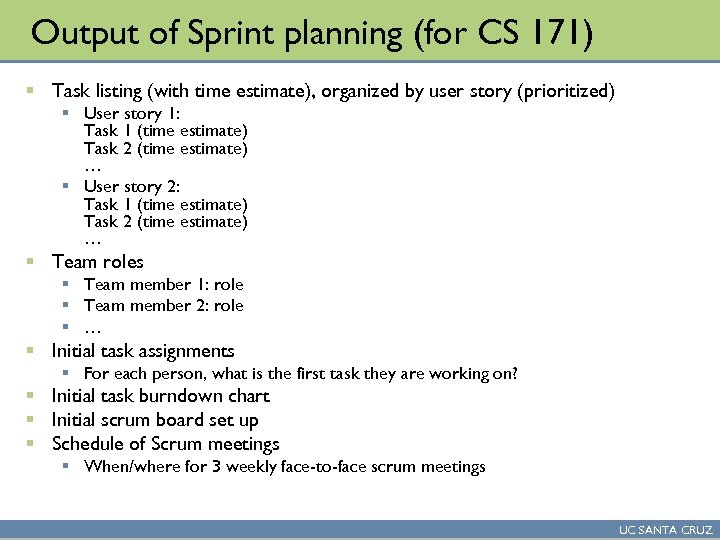 Output of Sprint planning (for CS 171) § Task listing (with time estimate), organized by user story (prioritized) § User story 1: Task 1 (time estimate) Task 2 (time estimate) … § User story 2: Task 1 (time estimate) Task 2 (time estimate) … § Team roles § Team member 1: role § Team member 2: role § … § Initial task assignments § For each person, what is the first task they are working on? § Initial task burndown chart § Initial scrum board set up § Schedule of Scrum meetings § When/where for 3 weekly face-to-face scrum meetings UC SANTA CRUZ
 Introduction to UML UC SANTA CRUZ
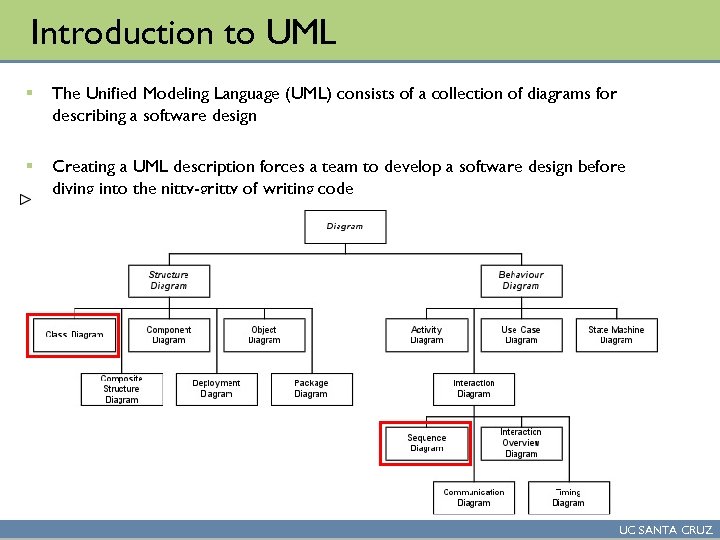 Introduction to UML § The Unified Modeling Language (UML) consists of a collection of diagrams for describing a software design § Creating a UML description forces a team to develop a software design before diving into the nitty-gritty of writing code UC SANTA CRUZ
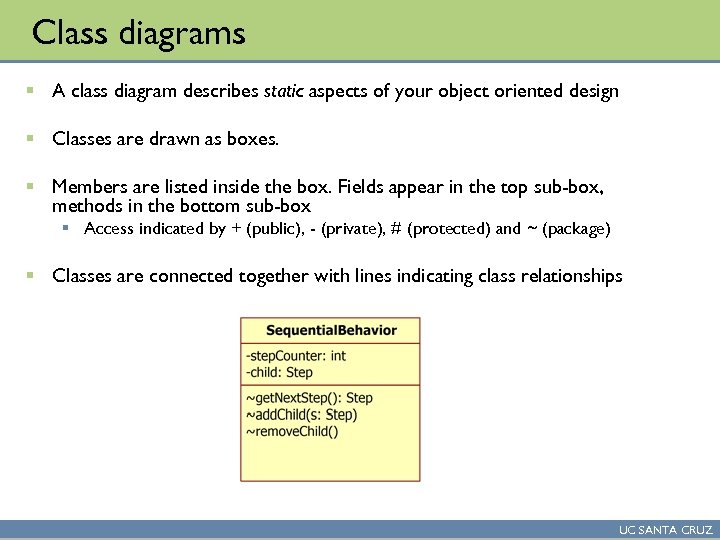 Class diagrams § A class diagram describes static aspects of your object oriented design § Classes are drawn as boxes. § Members are listed inside the box. Fields appear in the top sub-box, methods in the bottom sub-box § Access indicated by + (public), - (private), # (protected) and ~ (package) § Classes are connected together with lines indicating class relationships UC SANTA CRUZ
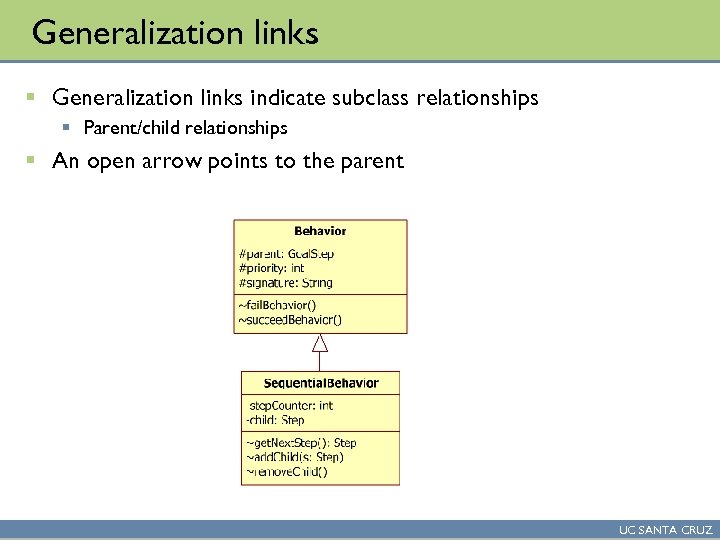 Generalization links § Generalization links indicate subclass relationships § Parent/child relationships § An open arrow points to the parent UC SANTA CRUZ
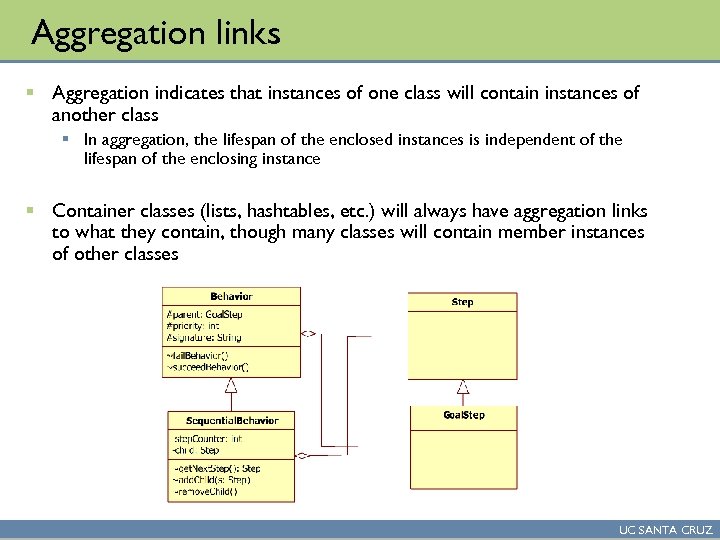 Aggregation links § Aggregation indicates that instances of one class will contain instances of another class § In aggregation, the lifespan of the enclosed instances is independent of the lifespan of the enclosing instance § Container classes (lists, hashtables, etc. ) will always have aggregation links to what they contain, though many classes will contain member instances of other classes UC SANTA CRUZ
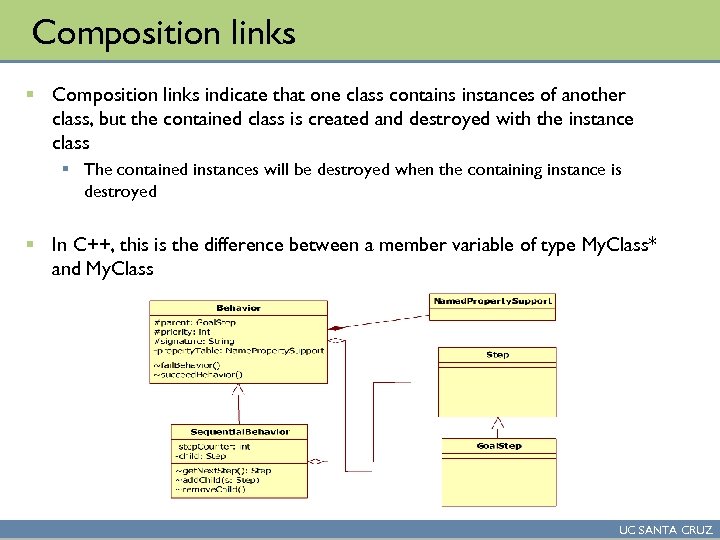 Composition links § Composition links indicate that one class contains instances of another class, but the contained class is created and destroyed with the instance class § The contained instances will be destroyed when the containing instance is destroyed § In C++, this is the difference between a member variable of type My. Class* and My. Class UC SANTA CRUZ
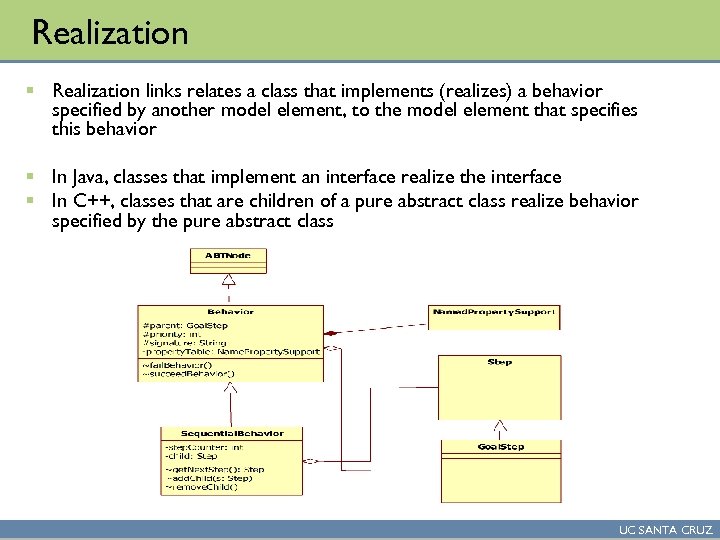 Realization § Realization links relates a class that implements (realizes) a behavior specified by another model element, to the model element that specifies this behavior § In Java, classes that implement an interface realize the interface § In C++, classes that are children of a pure abstract class realize behavior specified by the pure abstract class UC SANTA CRUZ
 Dependency links § Dependency links represent arbitrary relationship between classes, where a change made to one class may require a change to another class § The arrow points from the dependent towards the independent class § You’ll want to use link labels for dependency links § On the class diagram, only indicate important dependency relationships (ones that help communicate in the team) UC SANTA CRUZ
 UML Tools § There are many good, free UML tools § Some that seem interesting: § § Gliffy (http: //www. gliffy. com/) - web based Creately (http: //creately. com/) – web based UMLet (http: //umlet. com/) Dia (https: //live. gnome. org/Dia) UC SANTA CRUZ