


 Скачать презентацию Course of Software Engineering 2 A A 2001
8d6cfb80586405dd64b893f052cb1455.ppt
- Количество слайдов: 55
 Course of Software Engineering 2 A. A. 2001 -2002 Microsoft. NET A introduction to the new set of Microsoftware technologies Presented by: Fabio Rossi 1997 s 022@educ. disi. unige. it
 Contents n n n n n . NET History What is. NET? . NET goals Basic elements Five services Example: The Hospital and the Doctor. NET versus J 2 EE Conclusion References
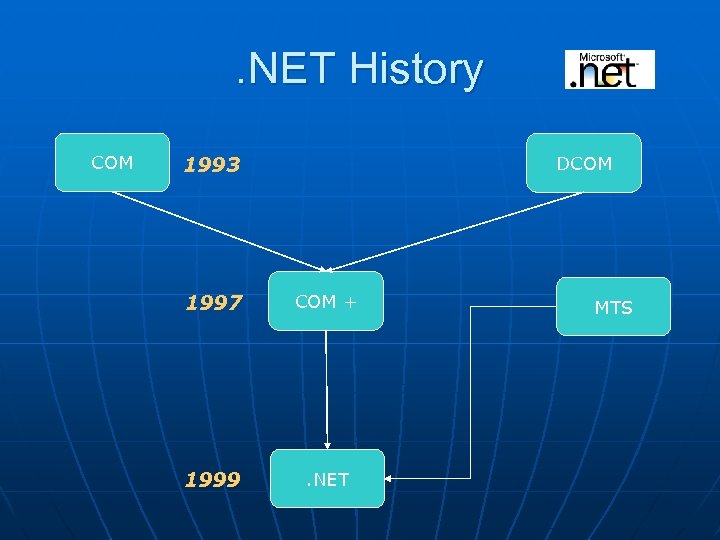 . NET History COM 1993 DCOM 1997 COM + 1999 . NET MTS
 What is. NET? Idea: n n Web as a collaborative environment. More automated, voice-activated, anywhere, anytime Web environment. 1/3
 What Is. NET? n n A set of services and technologies (an infrastructure) that will enable a programmable, next generation Internet. A complete remake of the company’s entire product line. 2/3
 What Is. NET? n n software integration through the use of XML Web services. small, discrete, building-block applications that connect to each other— as well as to other, larger applications— via the Internet. 3/3
 . NET goals 1. 2. 3. 4. 5. 7. 8. 9. 10. Cross-platform interoperability Multi-language support Code reuse Automatic resource management Type safety Debugging Error handling Elimination of DLL hell Security
 Interoperability n n Examples A routine written in a language L 1 may call another routine written in a different language L 2. A module in L 1 may declare a variable whose type is a class declared in L 2, and then call the corresponding L 2 routines on that variable. If both languages are object oriented, a class in L 1 can inherit from a class in L 2. Exceptions triggered by a routine written in L 1 and not handled on the L 1 side will be passed to the caller, which—if written in L 2—will process it using L 2's own exception-handling mechanism.
 Multi-language support n n The. NET platform supports many programming languages. A new compiler must be implemented for each language. Programmers do not need to be retrained in a completely new language in order to gain the benefits of. NET.
 Code Reuse n n Apps do not need to be rewritten in a completely new language in order to gain the benefits of. NET. For example all the billions of lines of COBOL code with some porting effort, could become useable within the. NET environment.
 Automatic resource management n n No need to allocate memory No need to deallocate memory • Garbage collector n the runtime automatically handles object layout and manages references to objects, releasing them when they are no longer being used. This automatic memory management resolves the two most common application errors, memory leaks and invalid memory references.
 Type safety n n Every data structure in all. NET supported languages has the same layout. This means that some code can consume types and instances declared in other languages.
 Debugging During a debugging session, you may move freely and seamlessly across modules written in L 1 and L 2.
 Error handling n n . NET provides structured exception handling, similar to that in C++ or Java, as a fundamental feature available to all languages. This architecture solves many of the problems that have dogged error handling in the past.
 DLL hell n n n Maintaining a Windows PC is a chore, because applications are quite complex. They consist of many files, registry entries, shortcuts, and so on. Different applications can share certain DLLs, and installing a new application can overwrite a DLL an existing application depends on, possibly breaking an old application (“DLL hell”). Removing an application is complex and is often imperfectly done.
 DLL n n Stands for “Dynamic Link Library”. Pieces of code that apps could take runtime.
 Security n n Managed components are awarded varying degrees of trust, depending on a number of factors that include their origin (such as the Internet, enterprise network, or local computer). This means that a managed component might or might not be able to perform fileaccess operations, registry-access operations, or other sensitive functions. 1/2
 Security n n n The runtime enforces code security. For example, users can trust that an executable embedded in a Web page can play an animation on screen or sing a song, but cannot access their personal data, file system, or network. The security features of the runtime thus enable legitimate Internet-deployed software to be exceptionally feature rich. 2/2
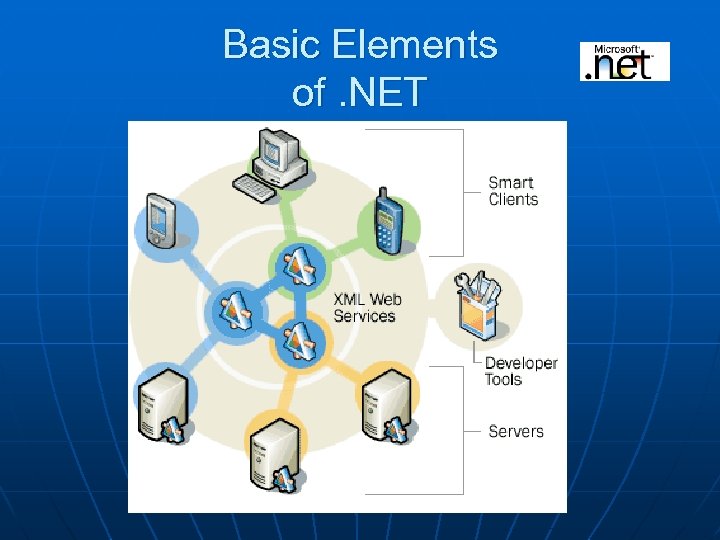 Basic Elements of. NET
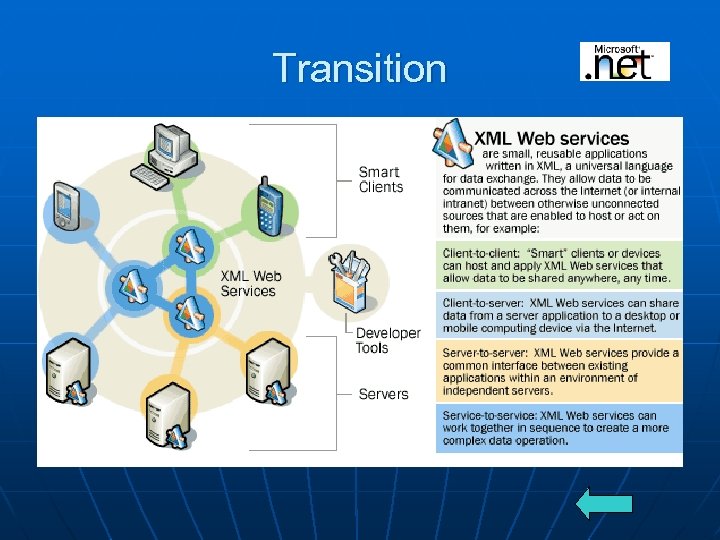
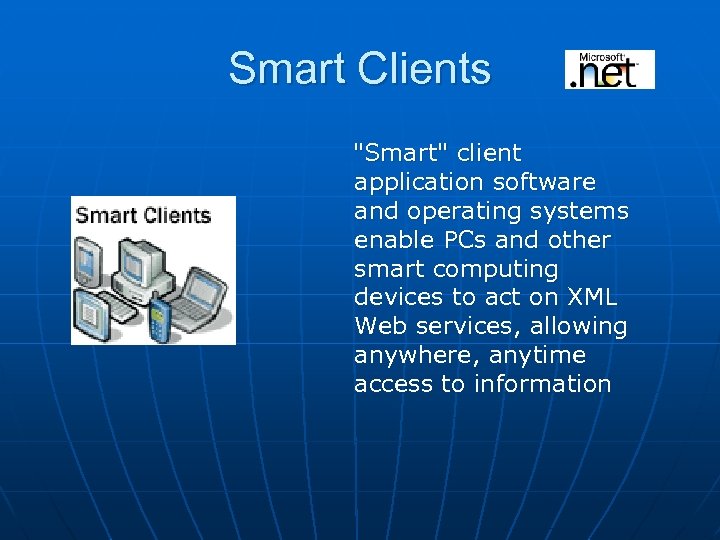 Smart Clients "Smart" client application software and operating systems enable PCs and other smart computing devices to act on XML Web services, allowing anywhere, anytime access to information
 XML Web Services A core set XML Web services that can be combined with other XML Web services or used directly with smart client applications.
 Servers Microsoft provides server infrastructure n n Microsoft Windows® 2000 server family. NET Enterprise Servers For deploying, managing, and orchestrating XML Web services
 Developer Tools Microsoft Visual Studio. NET is the solution proposed for developers to build and deploy XML Web services.
 Transition
 The 5 Services n n n Framework. Net ASP. Net Web Services Windows Form ADO. Net
 Framework. Net n n The. NET Framework is the programming model of the. NET platform. It manages much of the plumbing, enabling developers to focus on writing the business logic code for their applications. 1/8
 Framework. Net The. NET Framework includes: 1. The Common Language Runtime 2. The Class Libraries. 2/8
 The Common Language Runtime n Intermediate Language called MSIL (Microsoft Intermediate Language) n CLR: environment for MSIL n JITer (Just in Time compiler) 3/8
 The Common Language Runtime The CLR is responsible for run-time services such as: 1. 2. 3. 4. 5. 6. Language integration Security enforcement Memory Process Thread management. Versioning 4/8
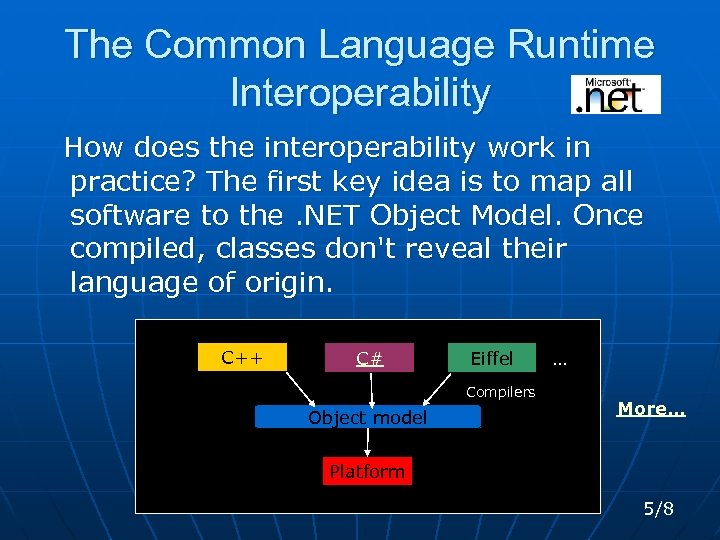 The Common Language Runtime Interoperability How does the interoperability work in practice? The first key idea is to map all software to the. NET Object Model. Once compiled, classes don't reveal their language of origin. C++ C# Eiffel Compilers Object model … More… Platform 5/8
 The Common Language Runtime Type safety n n n The runtime enforces code robustness by implementing a strict type- and codeverification infrastructure called the Common Type System (CTS). The CTS ensures that all managed code is self-describing. The various Microsoft and third-party language compilers generate managed code that conforms to the CTS. 6/8
 The Common Language Runtime Versioning n n n . NET introduce a mechanism to obviate to the “DLL hell” problem. Every app have to specify what DLL use, and what version. every DLL version needed by apps is host in the system 7/8
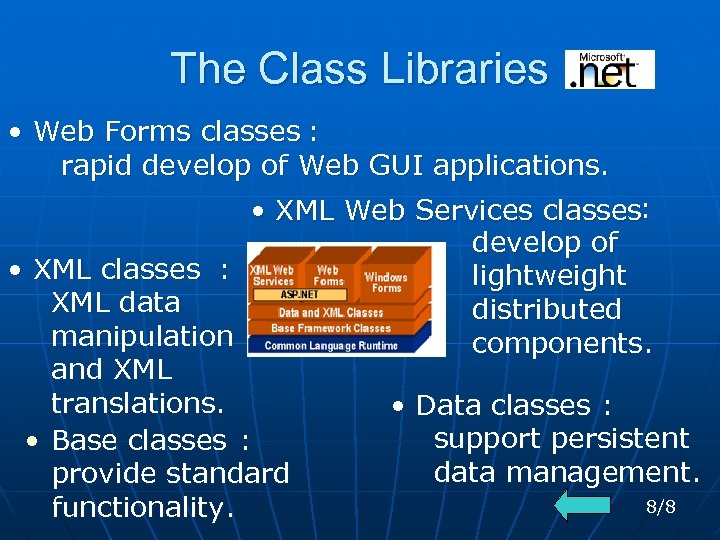 The Class Libraries • Web Forms classes : rapid develop of Web GUI applications. • XML Web Services classes: develop of • XML classes : lightweight XML data distributed manipulation components. and XML translations. • Data classes : support persistent • Base classes : data management. provide standard 8/8 functionality.
 Asp. Net n The new version of ASP n A set of technologies for building Web applications and XML Web Services. n n ASP. NET pages execute on the server and generate markup such as XML that is sent to a desktop or mobile browser. ASP. NET pages use a compiled, event-driven programming model that enables the separation of application logic and user interface. More…
 XML Web Services n n Cornerstone of the. NET programming model. Applications access Web Services via ubiquitous Web protocols and data formats with no need to worry about how each Web Service is implemented. More… 1/2
 XML Web Services n Microsoft will distribute a set of default XML web services called “My Services” 2/2
 Windows Form n Win Forms flow from the System Class Library • System. Win. Forms n Similar model to existing VB forms n Different technology from VB forms n Based on class libraries More…
 Windows Form n n WF controls have semi-trusted access to a user's computer. This means that binary or natively executing code can access some of the resources on the user's system (such as GUI elements and limited file access) without being able to access or compromise other resources. Because of code access security, many applications that once needed to be installed on a user's system can now be safely deployed through the Web. Your applications can implement the features of a local application while being deployed like a Web page.
 ADO. NET n n ADO. NET is an improvement to Microsoft ADO that provides platform interoperability and scalable data access. Using Extensible Markup Language (XML), ADO. NET can ensure the efficient transfer of data to any application on any platform. More… 1/2
 ADO. NET characteristic n n n n New data access technology Designed for disconnected operation Optimized for data viewing XML based Increased flexibility Increased readability of code No real change from a developer's perspective. 2/2
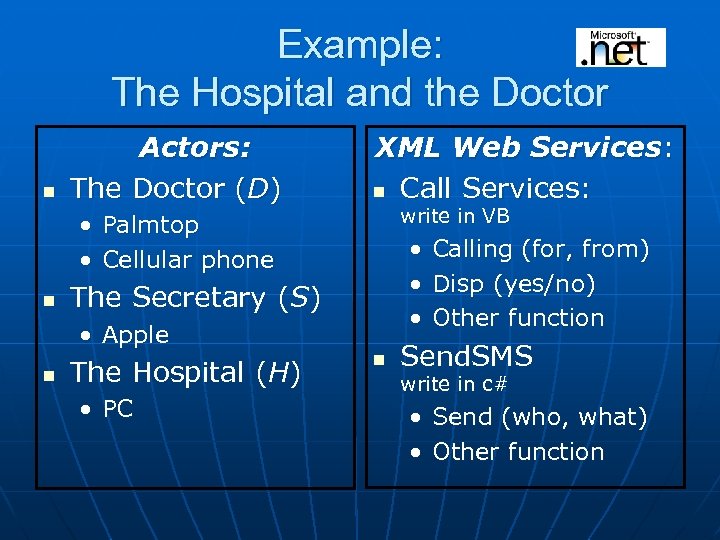 Example: The Hospital and the Doctor n Actors: The Doctor (D) XML Web Services: n Call Services: write in VB • Palmtop • Cellular phone n • • • The Secretary (S) • Apple n The Hospital (H) • PC n Calling (for, from) Disp (yes/no) Other function Send. SMS write in c# • Send (who, what) • Other function
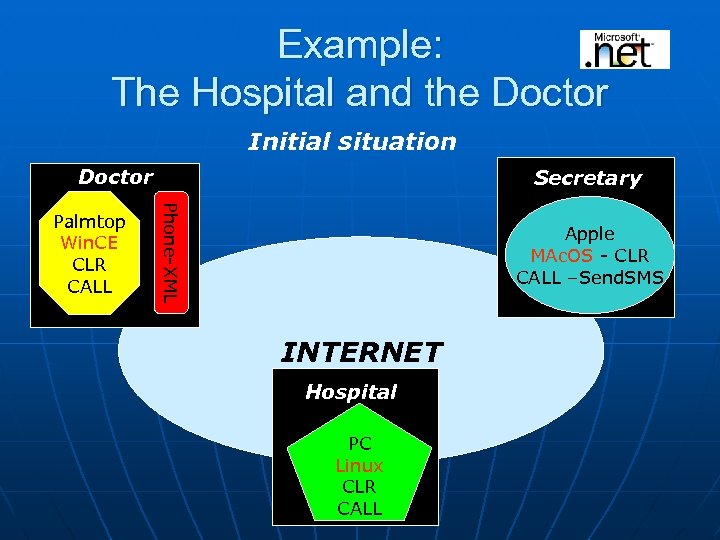 Example: The Hospital and the Doctor Initial situation Doctor Phone-XML Palmtop Win. CE CLR CALL Secretary Apple MAc. OS - CLR CALL –Send. SMS INTERNET Hospital PC Linux CLR CALL
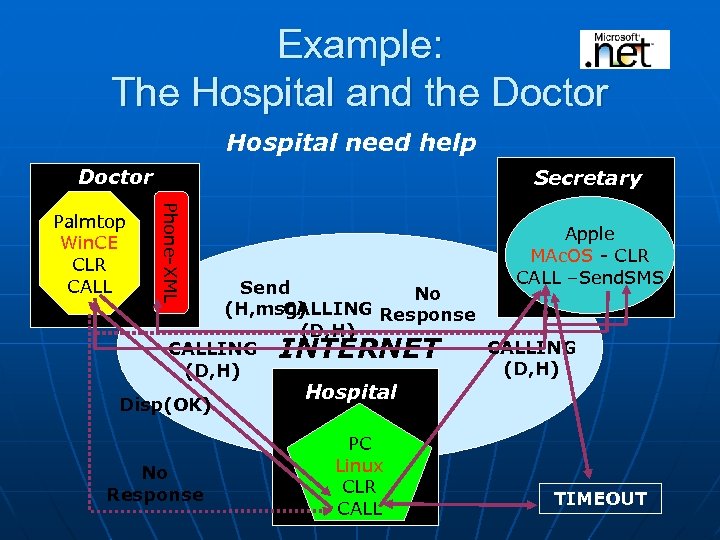 Example: The Hospital and the Doctor Hospital need help Doctor Phone-XML Palmtop Win. CE CLR CALL Secretary Apple MAc. OS - CLR CALL –Send. SMS Send No CALLING Response (H, msg) (D, H) CALLING INTERNET (D, H) Disp(OK) No Response Hospital PC Linux CLR CALL TIMEOUT
 . NET vs J 2 EE n n n J 2 EE and. NET are evolutions of existing application server technology used to build enterprise applications. The earlier versions of these technologies have historically not been used to build web services. Now that web services has arrived, both camps are repositioning their solutions as platforms that you can also use to build web services.
 . NET vs J 2 EE n n The shared vision between both J 2 EE and. NET is that there is an incredible amount of 'plumbing' that goes into building web services, such as XML interoperability, load-balancing, and transactions. Rather than writing all that plumbing yourself, you can write an application that runs within a container that provides those tricky services for you.
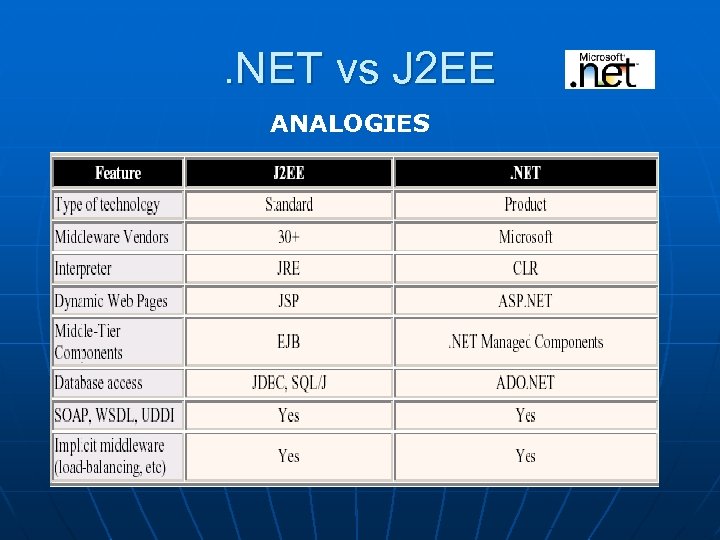 . NET vs J 2 EE ANALOGIES
 . NET vs J 2 EE Time-to-Market Features n n Both provide runtime mechanisms that insulate software developers from particular dependencies. Sun J 2 EE and Microsoft. NET offer language-level intermediation via the Java Runtime Environment (JRE) and the Common Language Runtime (CLR) respectively.
 . NET vs J 2 EE Time-to-Market Features – J 2 EE better than. NET n n State management services enable developers to write less code and not worry about managing state, resulting in a higher degree of rapid application development. State management services enable you to build components that hold state. Persistence services (entity beans) enable developers to write applications without coding data access logic; database-independent applications are easier to build and maintain.
 . NET vs J 2 EE Time-to-Market Features –. NET better than J 2 EE n n ASP. NET is independent of client device, and allows for user interfaces to be rendered to alternative user interfaces without rewriting code. Microsoft also offers Queued Components which are superior to Message. Driven Beans. Microsoft has tried to simplify server-side programming greatly by removing support for features found in traditional enterprise applications, such as stateful servers and simple transactions. Microsoft also provides business process management and E-Commerce capabilities, which are available in some J 2 EE implementations but not all.
 . NET vs J 2 EE Language Support – J 2 EE n n n J 2 EE promotes Java-centric computing, and all components deployed into a J 2 EE deployment (such as EJB components and servlets) must be written in the Java language. To use J 2 EE, you must commit to coding at least some of your e. Business systems using the Java programming language. Other languages can be bridged into a J 2 EE solution through web services, CORBA, JNI, or the JCA, however, these languages cannot be intermixed with Java code. In theory, JVM bytecode is language-neutral, however in practice, this bytecode is only used with Java.
 . NET vs J 2 EE Language Support –. NET n n n . NET supports development in any language that Microsoft's tools support due to the new CLR. With the exception of Java, all major languages will be supported. Microsoft has also recently introduced its new C# language which is equivalent (with the exception of portability) to Java and is also available as a programming language within the Visual Studio. NET environment. All languages supported by the CLR are interoperable in that all such languages, once translated to IL, are now effectively a “common” language. A single. NET component can therefore be written in several languages.
 . NET vs J 2 EE Data Access n n ADO. NET is built on the premise of XML data interchange (between remote data objects and layers of multi-tier apps) on top of HTTP (SOAP…). EJB, JDBC, etc. leave the data interchange protocol at the developer's discretion, and operate on top of either HTTP, RMI, etc…
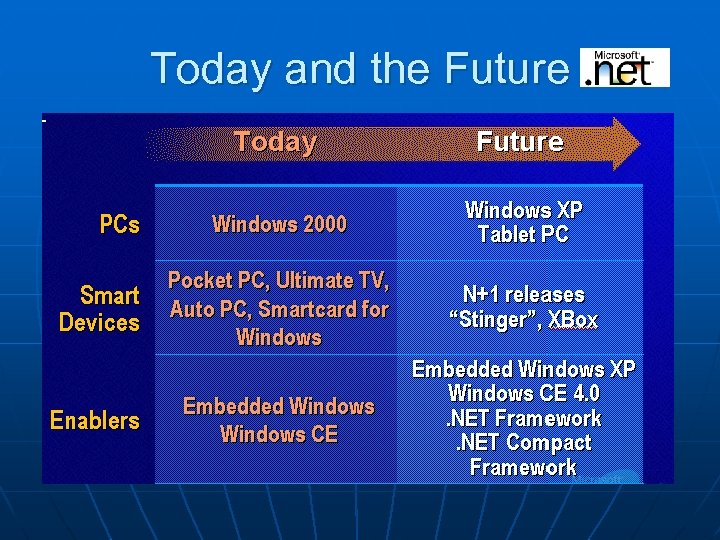 Today and the Future
 References n The Introduction to. NET and its components David S. Platt Introducing Microsoft. NET Microsoft Press – 2001 n The basic elements of. NET and other www. microsoft. comnet n . NET Framework Resource Management www. gotdotnet. com n Articles on components and architecture www. itportal. com 1/2
 References n J 2 EE vs. NET 1. 2. n java. oreilly. com/news/farley_0800. html Chad Wavter and Ed Roman – J 2 EE vs. NET www. middleware-company. com About Interoperability www. sdmagazine. com/documents/s=7134/sdm 0205 j/0205 j. htm 2/2