


 Скачать презентацию Course — DT 249 1 DT 249 1 P Module
1d705348a6c17c3333ea91cf73ede666.ppt
- Количество слайдов: 32
 Course - DT 249/1, DT 249/1 P Module (Subject) Information Systems in Organisations Semester 1, Week 1 COURSE SUBJECT OVERVIEW 1
 Lecturer Details Art Sloan Office location: KE 1 -013 a Phone No: 01 402 4972 E-Mail Art. Sloan@dit. ie Web page: http: //www. comp. dit. ie/asloan/ISO. htm Notes and news will appear here, from week to week. (All lecture notes will be available, as hyperlinks, by @ Week 13) 2
 Teaching Methods Lectures (Art Sloan) ◦ Tuesday evenings, 3 -hour time-slot in lecture theatre KE 4 -008 6. 30 – 9. 30 with 10 – 15 minute break @ 7. 45 Tutorials ◦ Will be arranged as and when required 3
 Course Content (1 of 2) 1. 2. 3. 4. 5. 6. 7. Modern organisations and their structure Models of Information Systems organisational departments and individual roles Business and Information Systems strategic alignment Modelling Information Systems concepts Modern Information Systems applications Selection and acquisition of Information Systems Building Information Systems Continued. . . / 4
 Course Content (2 of 2) 8. 9. 10. 11. 12. 13. 14. Managing information systems operation Introduction to Information Systems security Information Technology regulation and compliance Interacting with computers Information systems projects and their stages Project planning and estimating Project management and control 5
 Semester Time Available Weeks 1 – 6, normal lectures Week 7 for revision of notes Weeks 8 – 13, normal lectures Exam Week 1: 15 – 19 December End of Semester 1: 18 December 2015 Exam Weeks 2 and 3: ◦ 4 – 8 January 2016 ◦ 11 – 15 January 6
 Semester Time Available (2) After the introduction this evening, and revision in Week 13, there are eleven lecture weeks available and there are fourteen topics listed. Topics 1 and 2, 8 and 9 and 10 and 11 can double up because they are short topics. The assessment will be a case study in the form of an essay/report. It will be given to you @ Week 4 to be handed in @ week 8. 7
 The Topics in More Detail The next 14 slides repeat the 14 proposed topics with a few subheadings to clarify what the topics entail. The content of each subject may be subject to some change – but not too much. IMPORTANT – Some of the subtopics will serve as a list for the structure of the assessment and much of the content that appears in the lecture notes will form all of the sample solutions to exam questions. 8
 Modern Organisations and their Structure Businesses and other organisations Organisation types Structural types ‘People types’ How the structure affects Information Systems How Information Systems affect the structure 9
 Models of IS Organisational Departments and Individual Roles Examples of organisational structure using departments and a closer look at the people’s roles within them How roles relate to information systems 10
 Business and Information Systems Strategic Alignment The strategies of organisations in relation to structure The strategies of organisations in relation to Information Technology If, how and when these strategies combine 11
 Modelling Information Systems Concepts Analysis and design of appropriate information systems Life cycle models Design models Other documented concepts and considerations 12
 Modern Information Systems Applications Examples of information systems ‘at work’ Case studies Information Systems as solutions to ‘problems’ Problem Information systems 13
 Selection and Acquisition of Information Systems Choosing the right information Technology Deciding on the acquisition of information systems and other technology Issues relating to selection Issues relating to acquisition 14
 Building Information Systems Alternatives in acquiring information systems: ◦ Off the shelf ◦ Bespoke systems ◦ ‘do-it-yourself’ systems ◦ Combinations of these three 15
 Managing Information Systems Operation Information systems management: ◦ Who manages the technology? ◦ How do they manage the technology? ◦ What are the issues? 16
 Introduction to Information Systems Security Securing Information Systems Physical security Backing up information Keeping out hackers and other nefarious individuals Administrative issues relating to security 17
 IT Regulation and Compliance ‘It’s the law…’ Legal requirements Internal policies Effects of these 18
 Interacting with Computers Resistance to change User interfaces and ‘fitness for purpose’ A return to: ◦ People’s roles ◦ Designing systems ◦ Managing systems ◦ Legal and policy issues 19
 Information System Projects The need for IS projects Projects in organisations Time and budgets People in technical projects Comparing systems life cycle to project plans 20
 Project Planning Proposals Developing a project plan Structuring a project plan Managing a project plan 21
 Project Management What is project management? Who is the project manager? Why is project management important? Completing a project Reviewing a project How does the organisation benefit? 22
 Revision One or two sessions (+ tutorials) on a past exam paper and the main topics covered – expected to be in Week 13 - just in time for the ‘exam season’ and as an aid to exam preparation for this subject. Included: description of the exam in terms of time allocated, number of questions and question options… tips on pacing answers to questions… what is expected of a scripted answer… questions from the group answered. 23
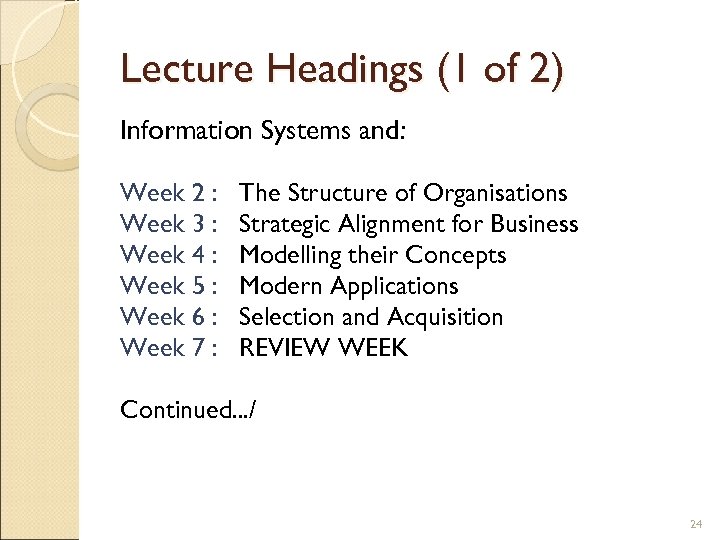 Lecture Headings (1 of 2) Information Systems and: Week 2 : Week 3 : Week 4 : Week 5 : Week 6 : Week 7 : The Structure of Organisations Strategic Alignment for Business Modelling their Concepts Modern Applications Selection and Acquisition REVIEW WEEK Continued. . . / 24
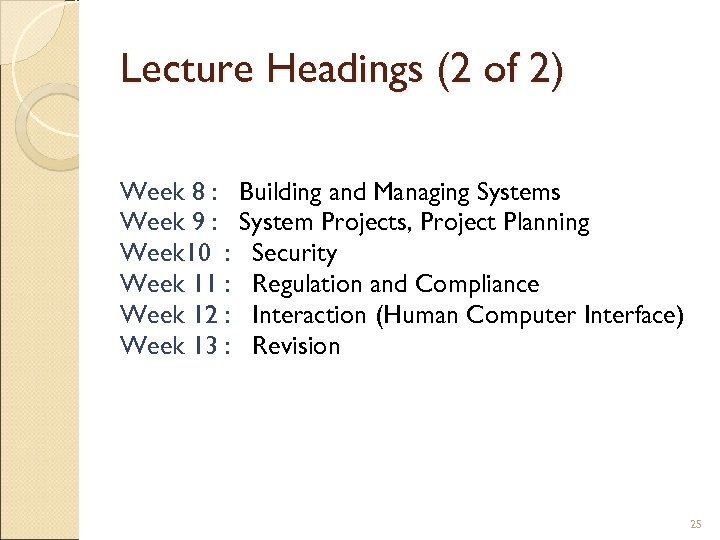 Lecture Headings (2 of 2) Week 8 : Week 9 : Week 10 : Week 11 : Week 12 : Week 13 : Building and Managing Systems System Projects, Project Planning Security Regulation and Compliance Interaction (Human Computer Interface) Revision 25
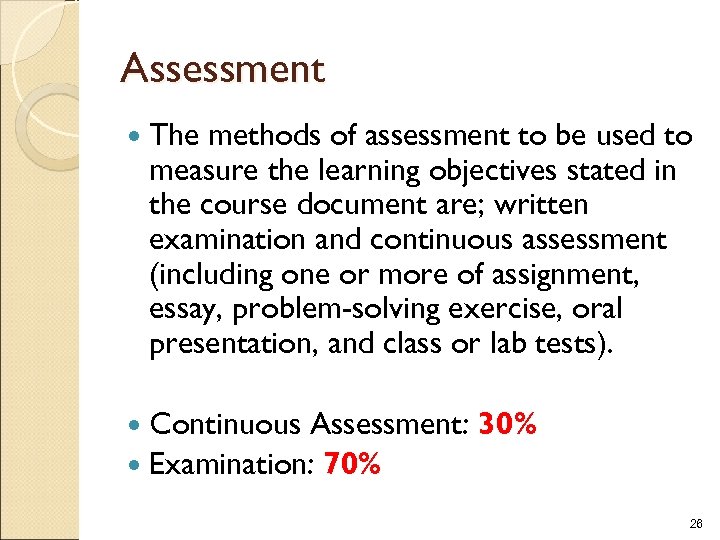 Assessment The methods of assessment to be used to measure the learning objectives stated in the course document are; written examination and continuous assessment (including one or more of assignment, essay, problem-solving exercise, oral presentation, and class or lab tests). Continuous Assessment: 30% Examination: 70% 26
 A Reading List The ‘core text’ is this book: Laudon K. and Laudon, J. (Latest edition) Management Information Systems, Prentice Hall, New Jersey, USA. A good book – but it is not absolutely necessary to buy this for the course. 27
 A Reading List (2) Supplemental Reading Curtis, G. , (Latest edition) Business Information Systems, Addison-Wesley, Wokingham, England, UK ISO/IEC 2382 -1: 1993 Information technology. Vocabulary. Fundamental terms ISO 2382 -3: 1987 Information processing systems. Vocabulary. Equipment technology ISO/IEC 2382 -20: 1990 Information technology. Vocabulary. System development 28
 A Reading List (3) Management of Information Technology (4 th Edition) Carroll Frenzel, John Frenzel Thompson Course Technology Expect to pay around € 45 Management Information Systems (Several titles) Haag, Cummings and Phillips (@ € 70!) 29
 A Reading List (4) Business Information Technology: Technology, Development and Management for the E-Business by Bocij, Paul, Chaffey, Dave, Greasley, Andrew and Hickie, Simon, 4 th Ed. Pearson Education Ltd. (2008) (Expect to pay @ € 70) 30
 End of Introduction That describes the course content and some of the features and events of Information Systems in Organisations. Any questions? 31
 Thanks. Safe home. See you next week! 32