


 Скачать презентацию Course Accounting and financial statements according to international
Lecture 1.IFRS.pptx
- Количество слайдов: 25
 Course: Accounting and financial statements according to international standards Тopic 1. Essence of International Financial Reporting Standards and the basic procedures for their implementation. Lector: Associate Professor Renata Korshykova Business Accounting Department
 Lecture plan 1. Meaning, structure, and status of International Financial Reporting Standards (IFRS). 2. Goals and functions of the IFRS Institution. 3. Main highlights of IFRS Conceptual Framework.
 Meaning, Structure, and Status of International Financial Reporting Standards (IFRS) is a single set of accounting standards, developed and maintained by the IASB with the intention of those standards being capable of being applied on a globally consistent basis—by developed and developing economies—thus providing investors and other users of financial statements with the ability to compare the financial performance of publicly listed companies on a like for like basis with their international partners
 Meaning, Structure, and Status of International Financial Reporting Standards (IFRS) consist of: • International Accounting Standards (IAS) • International Financial Reporting Standards (IFRS) • SIC Interpretations • IFRIC Interpretations
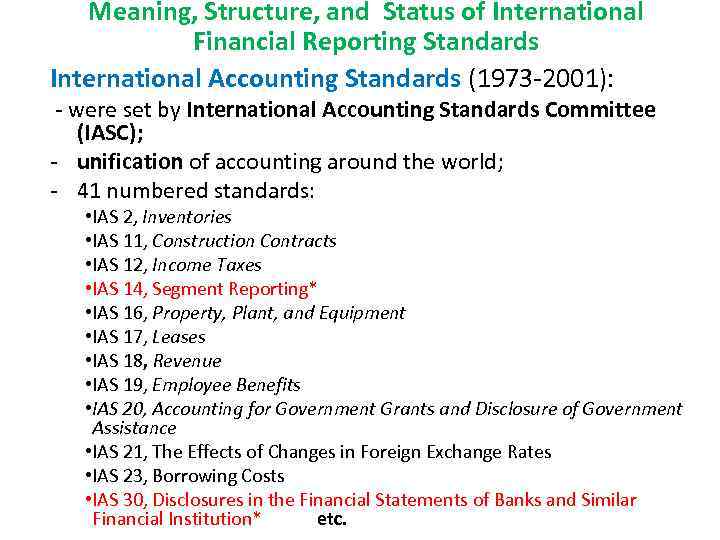 Meaning, Structure, and Status of International Financial Reporting Standards International Accounting Standards (1973 2001): were set by International Accounting Standards Committee (IASC); unification of accounting around the world; 41 numbered standards: • IAS 2, Inventories • IAS 11, Construction Contracts • IAS 12, Income Taxes • IAS 14, Segment Reporting* • IAS 16, Property, Plant, and Equipment • IAS 17, Leases • IAS 18, Revenue • IAS 19, Employee Benefits • IAS 20, Accounting for Government Grants and Disclosure of Government Assistance • IAS 21, The Effects of Changes in Foreign Exchange Rates • IAS 23, Borrowing Costs • IAS 30, Disclosures in the Financial Statements of Banks and Similar Financial Institution* etc.
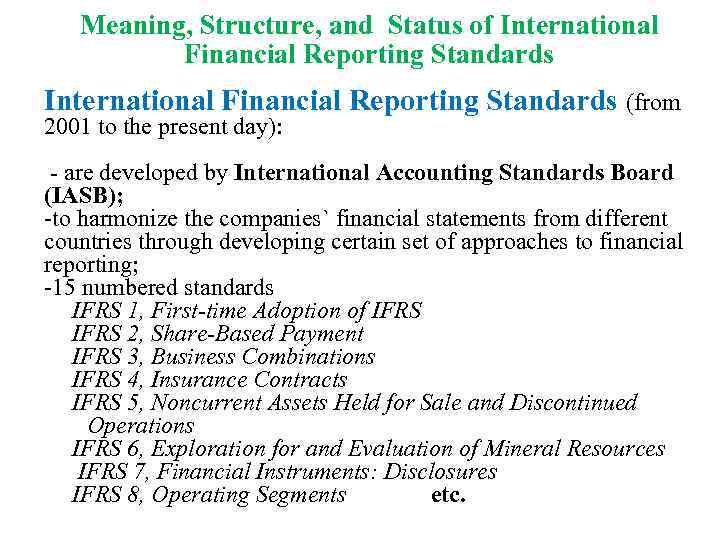 Meaning, Structure, and Status of International Financial Reporting Standards (from 2001 to the present day): - are developed by International Accounting Standards Board (IASB); -to harmonize the companies` financial statements from different countries through developing certain set of approaches to financial reporting; -15 numbered standards IFRS 1, First-time Adoption of IFRS 2, Share-Based Payment IFRS 3, Business Combinations IFRS 4, Insurance Contracts IFRS 5, Noncurrent Assets Held for Sale and Discontinued Operations IFRS 6, Exploration for and Evaluation of Mineral Resources IFRS 7, Financial Instruments: Disclosures IFRS 8, Operating Segments etc.
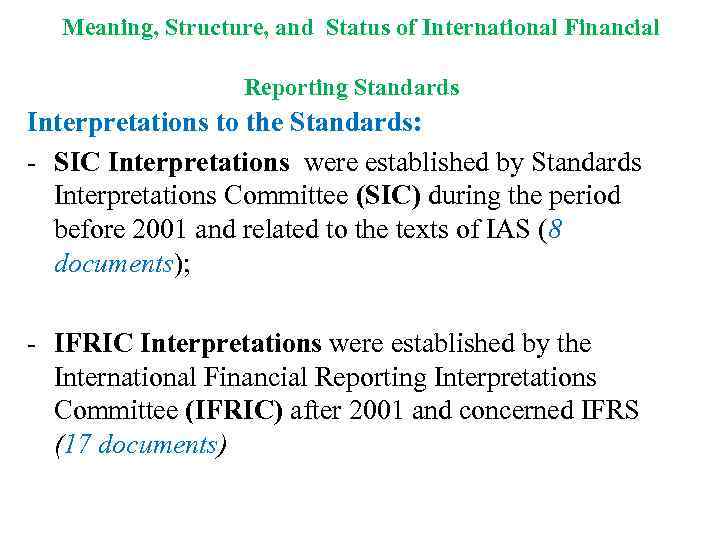 Meaning, Structure, and Status of International Financial Reporting Standards Interpretations to the Standards: - SIC Interpretations were established by Standards Interpretations Committee (SIC) during the period before 2001 and related to the texts of IAS (8 documents); - IFRIC Interpretations were established by the International Financial Reporting Interpretations Committee (IFRIC) after 2001 and concerned IFRS (17 documents)
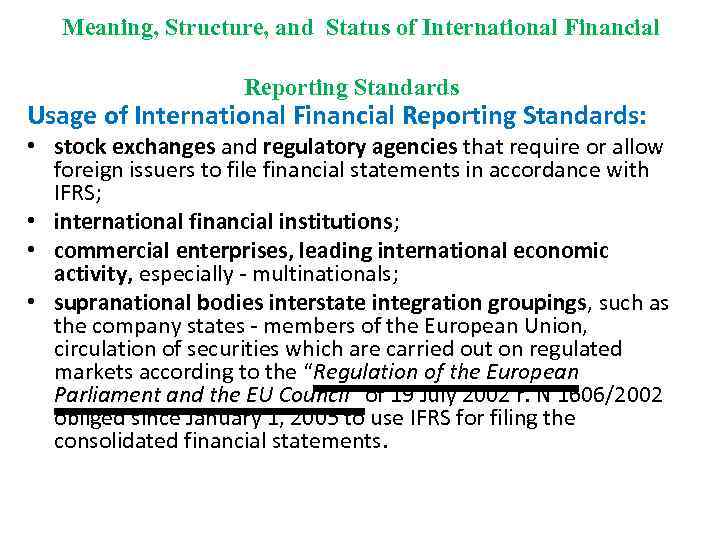 Meaning, Structure, and Status of International Financial Reporting Standards Usage of International Financial Reporting Standards: • stock exchanges and regulatory agencies that require or allow foreign issuers to file financial statements in accordance with IFRS; • international financial institutions; • commercial enterprises, leading international economic activity, especially multinationals; • supranational bodies interstate integration groupings, such as the company states members of the European Union, circulation of securities which are carried out on regulated markets according to the “Regulation of the European Parliament and the EU Council” of 19 July 2002 r. N 1606/2002 obliged since January 1, 2005 to use IFRS for filing the consolidated financial statements.
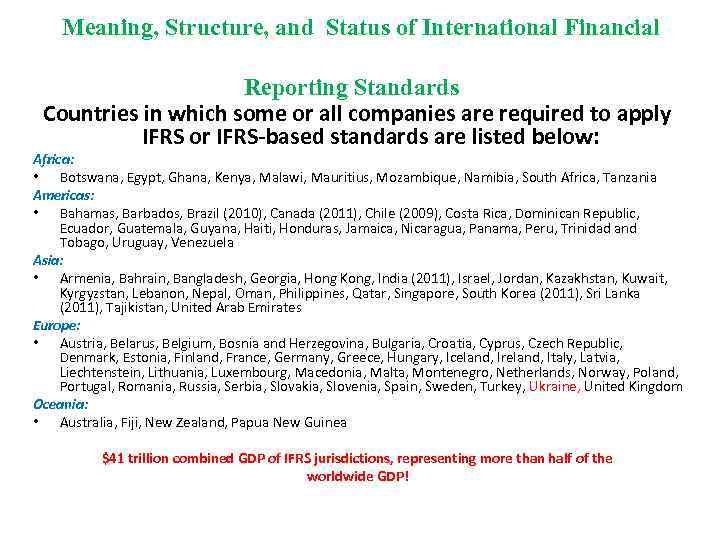 Meaning, Structure, and Status of International Financial Reporting Standards Countries in which some or all companies are required to apply IFRS or IFRS-based standards are listed below: Africa: • Botswana, Egypt, Ghana, Kenya, Malawi, Mauritius, Mozambique, Namibia, South Africa, Tanzania Americas: • Bahamas, Barbados, Brazil (2010), Canada (2011), Chile (2009), Costa Rica, Dominican Republic, Ecuador, Guatemala, Guyana, Haiti, Honduras, Jamaica, Nicaragua, Panama, Peru, Trinidad and Tobago, Uruguay, Venezuela Asia: • Armenia, Bahrain, Bangladesh, Georgia, Hong Kong, India (2011), Israel, Jordan, Kazakhstan, Kuwait, Kyrgyzstan, Lebanon, Nepal, Oman, Philippines, Qatar, Singapore, South Korea (2011), Sri Lanka (2011), Tajikistan, United Arab Emirates Europe: • Austria, Belarus, Belgium, Bosnia and Herzegovina, Bulgaria, Croatia, Cyprus, Czech Republic, Denmark, Estonia, Finland, France, Germany, Greece, Hungary, Iceland, Ireland, Italy, Latvia, Liechtenstein, Lithuania, Luxembourg, Macedonia, Malta, Montenegro, Netherlands, Norway, Poland, Portugal, Romania, Russia, Serbia, Slovakia, Slovenia, Spain, Sweden, Turkey, Ukraine, United Kingdom Oceania: • Australia, Fiji, New Zealand, Papua New Guinea $41 trillion combined GDP of IFRS jurisdictions, representing more than half of the worldwide GDP!
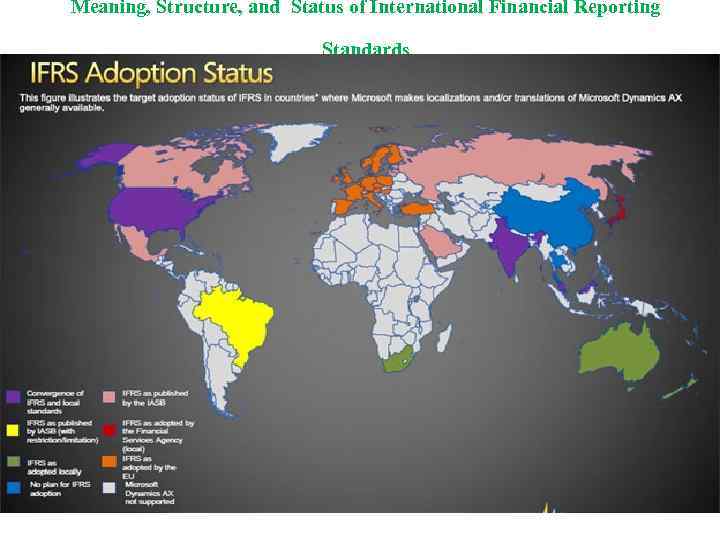 Meaning, Structure, and Status of International Financial Reporting Standards
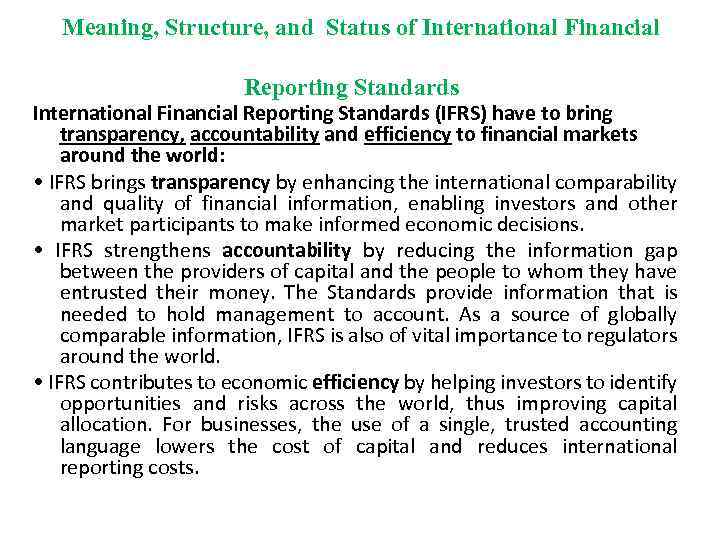 Meaning, Structure, and Status of International Financial Reporting Standards (IFRS) have to bring transparency, accountability and efficiency to financial markets around the world: • IFRS brings transparency by enhancing the international comparability and quality of financial information, enabling investors and other market participants to make informed economic decisions. • IFRS strengthens accountability by reducing the information gap between the providers of capital and the people to whom they have entrusted their money. The Standards provide information that is needed to hold management to account. As a source of globally comparable information, IFRS is also of vital importance to regulators around the world. • IFRS contributes to economic efficiency by helping investors to identify opportunities and risks across the world, thus improving capital allocation. For businesses, the use of a single, trusted accounting language lowers the cost of capital and reduces international reporting costs.
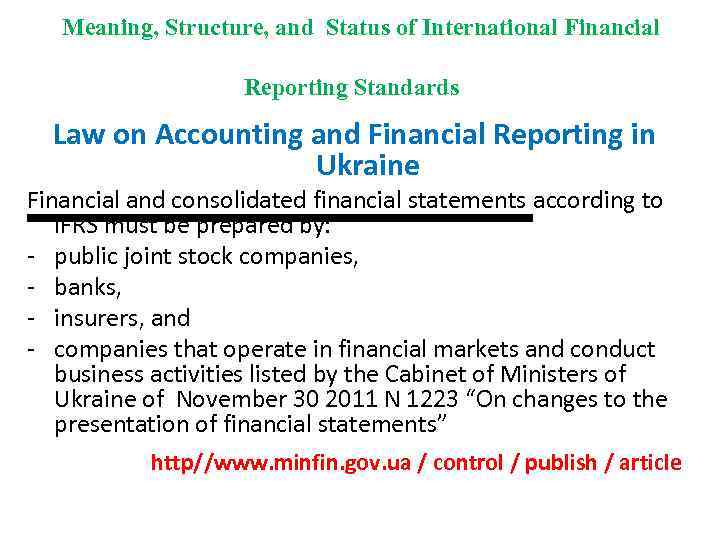 Meaning, Structure, and Status of International Financial Reporting Standards Law on Accounting and Financial Reporting in Ukraine Financial and consolidated financial statements according to IFRS must be prepared by: public joint stock companies, banks, insurers, and companies that operate in financial markets and conduct business activities listed by the Cabinet of Ministers of Ukraine of November 30 2011 N 1223 “On changes to the presentation of financial statements” http//www. minfin. gov. ua / control / publish / article
 Goals and functions of the IFRS Institutions IASC - international organization formed in 1973 by an agreement between the accounting bodies of some countries as the USA, the UK, Canada, Australia, Mexico, Japan, France, Germany, the Netherlands, New Zealand IASC developed and promoted the use of the International Accounting Standards (IAS). It was reorganized in 2000.
 Goals and functions of the IFRS Institutions IFRS Foundation: The main objectives of IFRS Foundation are: - to develop, in the public interest, a single set of high quality, understandable and enforceable global accounting standards that require high quality, transparent and comparable information in financial statements and other financial reporting to help participants in the world’s capital markets and other users make economic decisions, and - to bring about convergence of national accounting standards and International Financial Reporting Standards to high-quality solutions. .
 Goals and functions of the IFRS Institutions
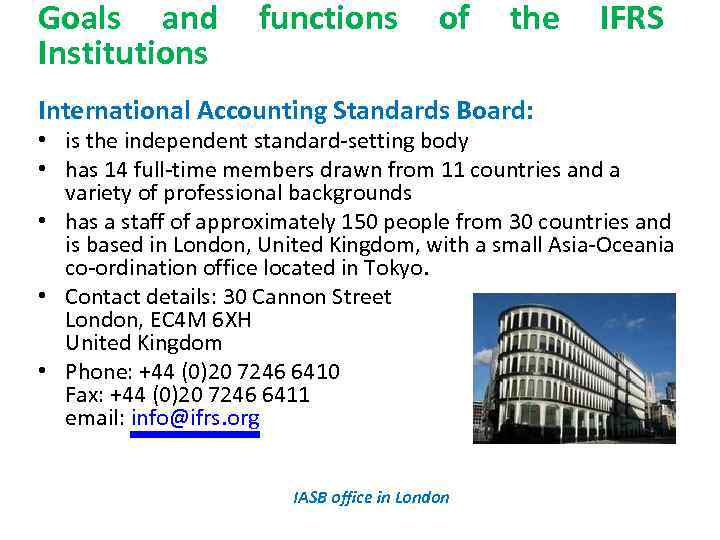 Goals and Institutions functions of the International Accounting Standards Board: IFRS • is the independent standard setting body • has 14 full time members drawn from 11 countries and a variety of professional backgrounds • has a staff of approximately 150 people from 30 countries and is based in London, United Kingdom, with a small Asia Oceania co ordination office located in Tokyo. • Contact details: 30 Cannon Street London, EC 4 M 6 XH United Kingdom • Phone: +44 (0)20 7246 6410 Fax: +44 (0)20 7246 6411 email: info@ifrs. org IASB office in London
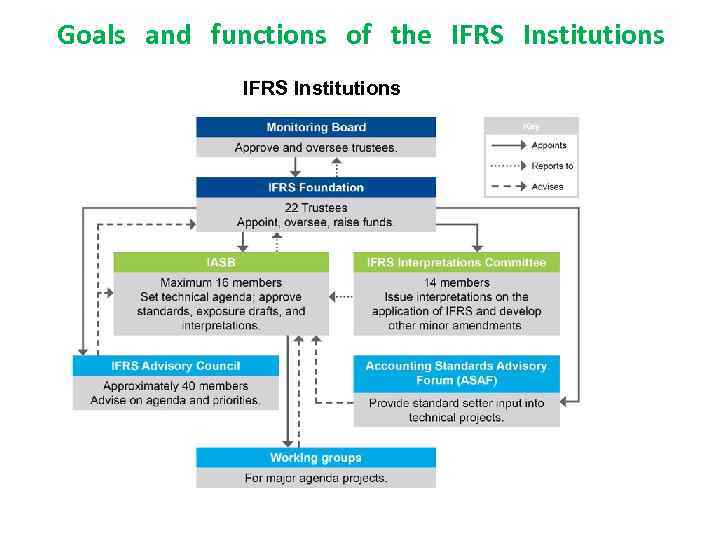
 Goals and Institutions functions of the IFRS The process of developing new or revising old Standards: after the consultations with the IFRS Advisory Council IASB staff develops a discussion document known as Discussion Paper. Then the Board publishes an Exposure Draft of the proposed Standard for public comment in order to obtain the views of all interested parties within a specified period. the Board also publishes a “Basis for Conclusions” to its Exposure Drafts and Standards to explain how it reached its conclusions and to give background information. to obtain advice on major projects, the Board often forms advisory committees or other spe cialist groups and may also hold public hearings and conduct field tests on proposed Standards. new or revised Standard is approved by a simple majority of the members of Board. •
 Goals and Institutions functions of the IFRS The IFRS Interpretations Committee is the interpretative body of the IASB. It re review on a timely basis the accounting issues that have arisen within the context of current IFRS and provides guidance (IFRICs ) on those issues Standards Advisory Council has about 40 members appointed by the Trustee. It provides a forum for organizations and individuals with an interest in international financial reporting to provide advice on IASB agenda decisions and priorities. Members currently include chief financial and accounting officers from some of the world’s largest corporations and international organizations, leading financial analysts and academics, regulators, accounting stan dard setters, and partners from leading accounting firms.
 Main highlights of IFRS Conceptual Framework The Conceptual Framework - document describes the objective of, and the concepts for, general purpose financial reporting The Framework does not have the force of a Standard!!!
 Main highlights Framework of IFRS Conceptual The Conceptual Framework: • assists the IASB to develop Standards that are based on consistent concepts; • assists preparers to develop consistent accounting policies when no Standard applies to a particular transaction or event, or when a Standard allows a choice of accounting policy; and • assists others to understand interpret the Standards.
 Main highlights of IFRS Conceptual Framework History of the Framework: • April 1989 Framework for the Preparation and Presentation of Financial Statements (the Framework) was approved by the IASC Board • July 1989 Framework was published • April 2001 Framework adopted by the IASB • September 2010 Conceptual Framework for Financial Reporting 2010 (the IFRS Framework) approved by the IASB New project milestones (to be completed in 2015): • July 2013 Discussion Paper ”A Review of the Conceptual Framework for Financial Reporting published (Comment deadline 14 January 2014); • May 2015 Exposure Drafts “Conceptual Framework for Financial Reporting” and “Updating References to the Conceptual Framework” published (Comment deadline 26 October 2016)
 Main highlights Framework of IFRS Conceptual The Conceptual Framework deals with: • the objective of financial statements; • the definition, recognition, and measurement of the elements of financial statements are constructed; • underlying assumptions; • the qualitative characteristics that determine the usefulness of information in financial statements; • concepts of capital and capital maintenance
 Main highlights Framework of IFRS Conceptual The elements of financial statements are: • Assets. An asset is a resource controlled by the entity as a result of past events and from which future economic benefits are expected to flow to the entity. • Liabilities. A liability is a present obligation of the entity arising from past events, the settle ment of which is expected to result in an outflow from the entity of resources embodying economic benefits. • Equity is the residual interest in the assets of the entity after deducting all its liabili ties.
 Main highlights Framework of IFRS Conceptual The elements of financial statements are: • Income is increases in economic benefits during the accounting period in the form of inflows or enhancements of assets or decreases of liabilities that result in increases in eq uity, other than those relating to contributions from equity participants. • Expenses are decreases in economic benefits during the accounting period in the form of outflows or depletions of assets or incurrences of liabilities that result in decreases in equity, other than those relating to distributions to equity participants. •
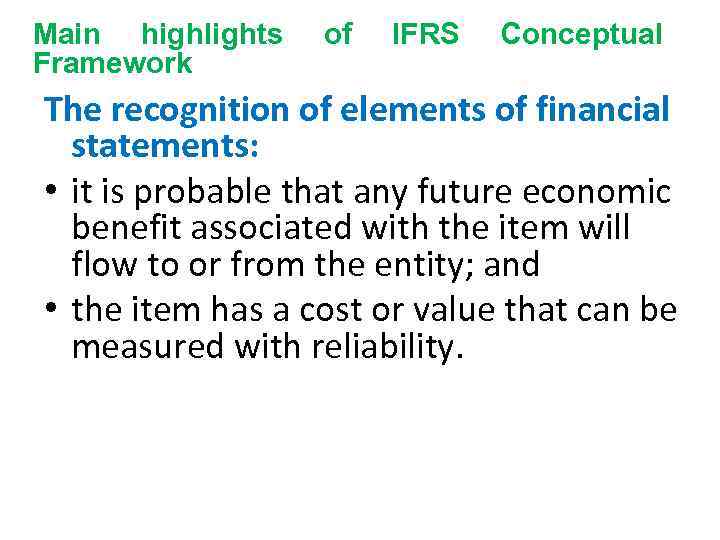 Main highlights Framework of IFRS Conceptual The recognition of elements of financial statements: • it is probable that any future economic benefit associated with the item will flow to or from the entity; and • the item has a cost or value that can be measured with reliability.