


 Скачать презентацию Coupled HWRF-HYCOM Hy HWRF and Forecast Performance Results
a5e772ce001ddfada9e1302138c67af8.ppt
- Количество слайдов: 15
 Coupled HWRF-HYCOM (Hy. HWRF) and Forecast Performance Results by HYCOM team MMAB/EMC/NWS/NCEP/NOAA and HWRF team EMC/NWS/NCEP/NOAA
 Outline: 1. Introduction to Hy. HWRF 2. Motivations 3. Progress in NCEP/EMC 4. Validation of Ocean Simulations 5. AXBT Data Assimilation 6. Hy. HWRF Pre-Ops Testing Results 7. Risks 8. Summary
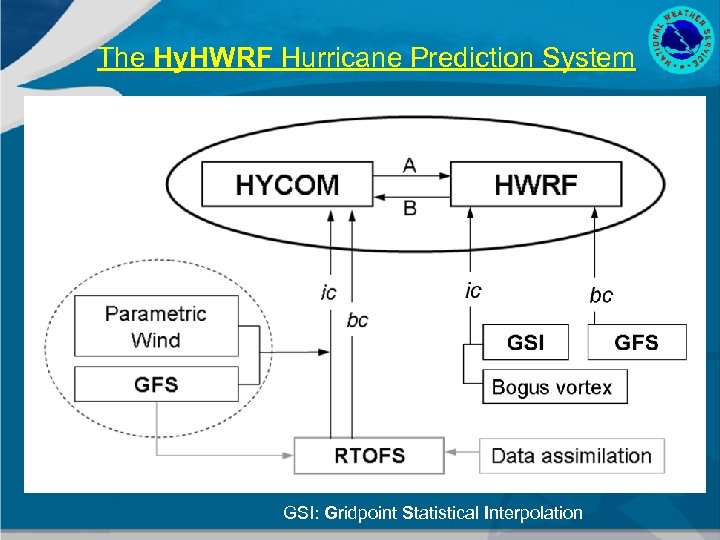 The Hy. HWRF Hurricane Prediction System GSI: Gridpoint Statistical Interpolation
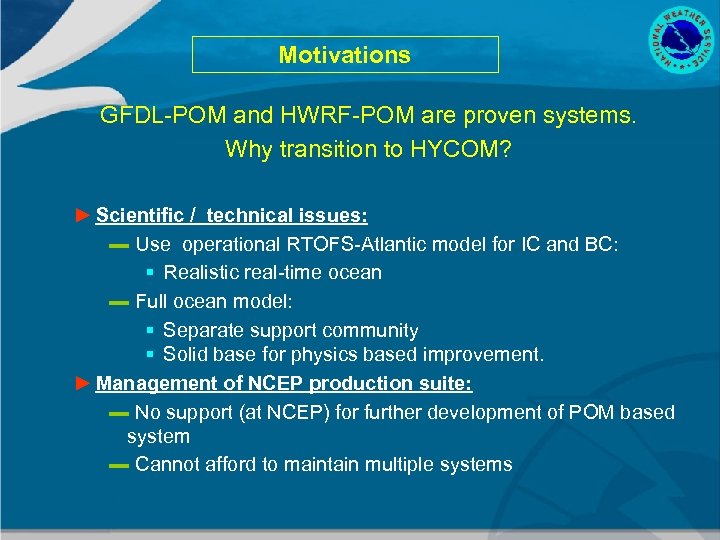 Motivations GFDL-POM and HWRF-POM are proven systems. Why transition to HYCOM? ► Scientific / technical issues: ▬ Use operational RTOFS-Atlantic model for IC and BC: § Realistic real-time ocean ▬ Full ocean model: § Separate support community § Solid base for physics based improvement. ► Management of NCEP production suite: ▬ No support (at NCEP) for further development of POM based system ▬ Cannot afford to maintain multiple systems
 NCEP/EMC progress HYCOM – HWRF (Hy. HWRF) ► System reaching maturity at the end of 2008 ▬ Initial development not with operational HWRF: § Needing H 050 baseline for sensible coupling § HR issues ► Parallel testing with frozen system for 2009 Atlantic Hurricane Season: ▬ Goal: Show potential impact of POM-HYCOM replacement ▬ Compare to operational HWRF ► In pre-op testing for possible 2010 operational implementation ▬ Fully integrated with HWRF development path ▬ Goal: Replacing POM with HYCOM should do no harm ► AXBT data assimilation in RTOFS ▬ Pipe line set up from NCO to RTOFS ▬ AXBT data assimilation tested
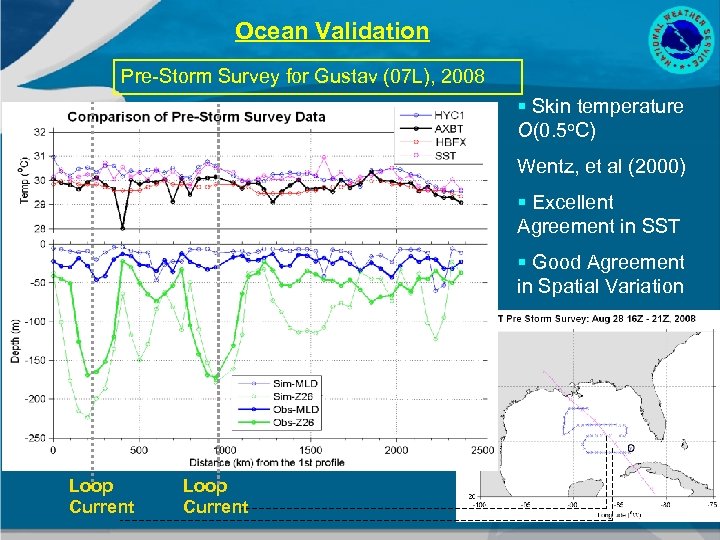 Ocean Validation Pre-Storm Survey for Gustav (07 L), 2008 § Skin temperature O(0. 5 o. C) Wentz, et al (2000) § Excellent Agreement in SST § Good Agreement in Spatial Variation Loop Current
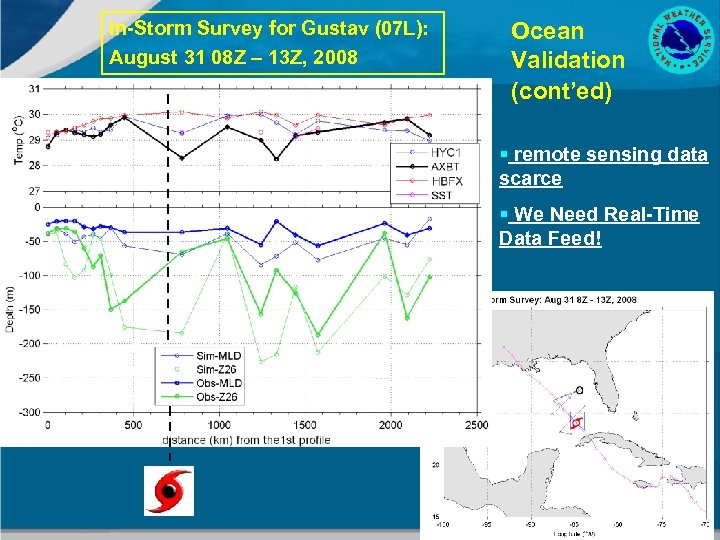 In-Storm Survey for Gustav (07 L): August 31 08 Z – 13 Z, 2008 Ocean Validation (cont’ed) § remote sensing data scarce § We Need Real-Time Data Feed!
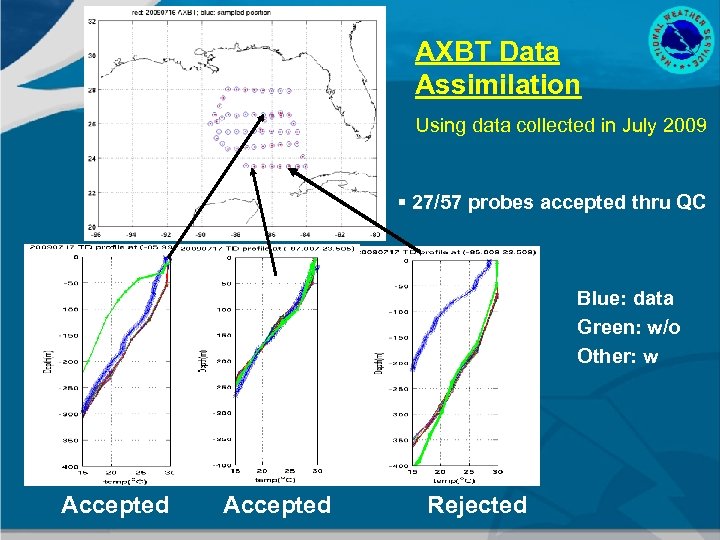 AXBT Data Assimilation Using data collected in July 2009 § 27/57 probes accepted thru QC Blue: data Green: w/o Other: w Accepted Rejected
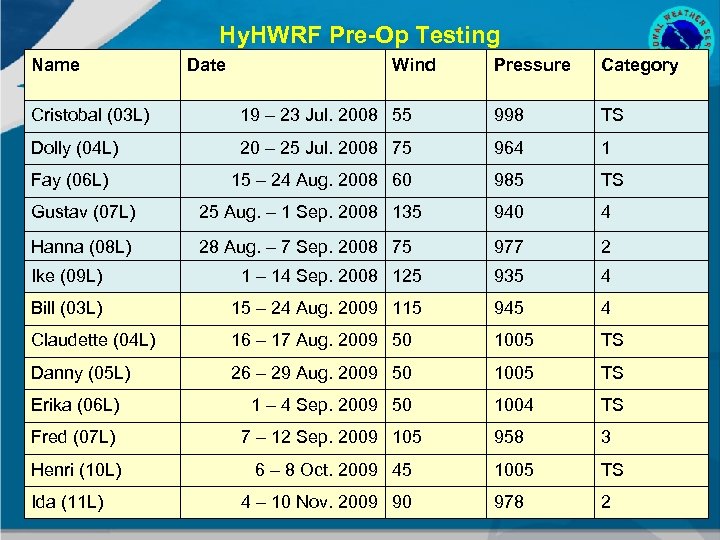 Hy. HWRF Pre-Op Testing Name Date Wind Pressure Category Cristobal (03 L) 19 – 23 Jul. 2008 55 998 TS Dolly (04 L) 20 – 25 Jul. 2008 75 964 1 Fay (06 L) 15 – 24 Aug. 2008 60 985 TS Gustav (07 L) 25 Aug. – 1 Sep. 2008 135 940 4 Hanna (08 L) 28 Aug. – 7 Sep. 2008 75 977 2 Ike (09 L) 1 – 14 Sep. 2008 125 935 4 Bill (03 L) 15 – 24 Aug. 2009 115 945 4 Claudette (04 L) 16 – 17 Aug. 2009 50 1005 TS Danny (05 L) 26 – 29 Aug. 2009 50 1005 TS Erika (06 L) 1 – 4 Sep. 2009 50 1004 TS Fred (07 L) 7 – 12 Sep. 2009 105 958 3 Henri (10 L) 6 – 8 Oct. 2009 45 1005 TS 978 2 Ida (11 L) 4 – 10 Nov. 2009 90
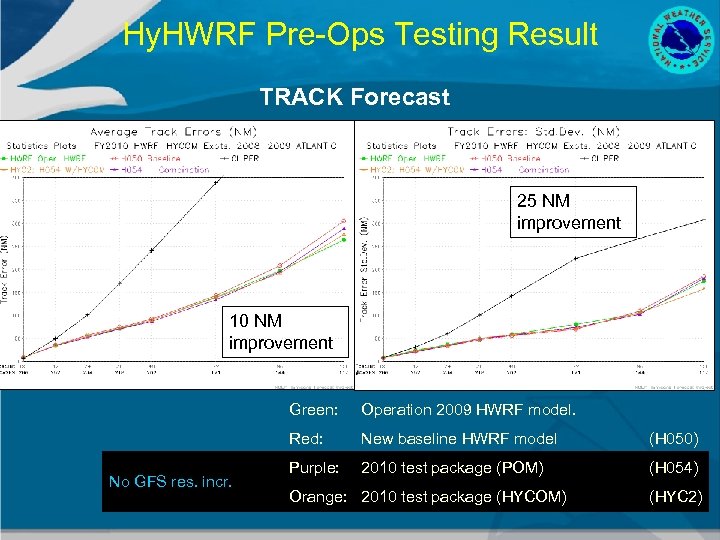 Hy. HWRF Pre-Ops Testing Result TRACK Forecast 25 NM improvement 10 NM improvement Green: Red: No GFS res. incr. Operation 2009 HWRF model. New baseline HWRF model (H 050) Purple: 2010 test package (POM) (H 054) Orange: 2010 test package (HYCOM) (HYC 2)
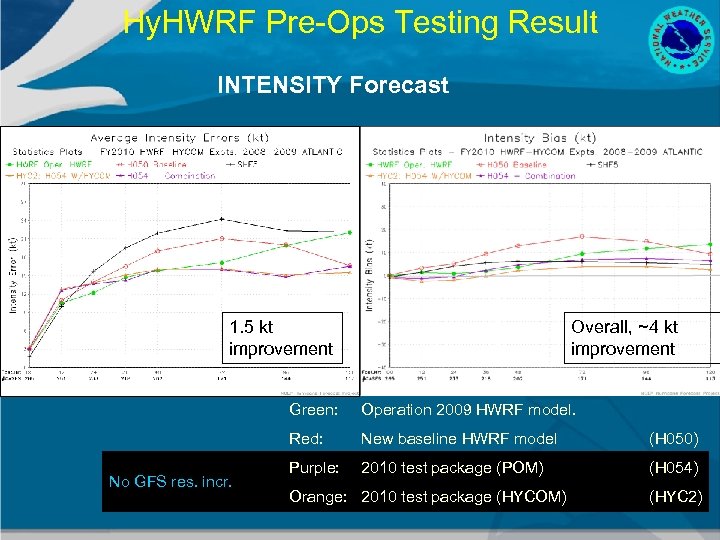 Hy. HWRF Pre-Ops Testing Result INTENSITY Forecast 1. 5 kt improvement Overall, ~4 kt improvement Green: Red: No GFS res. incr. Operation 2009 HWRF model. New baseline HWRF model (H 050) Purple: 2010 test package (POM) (H 054) Orange: 2010 test package (HYCOM) (HYC 2)
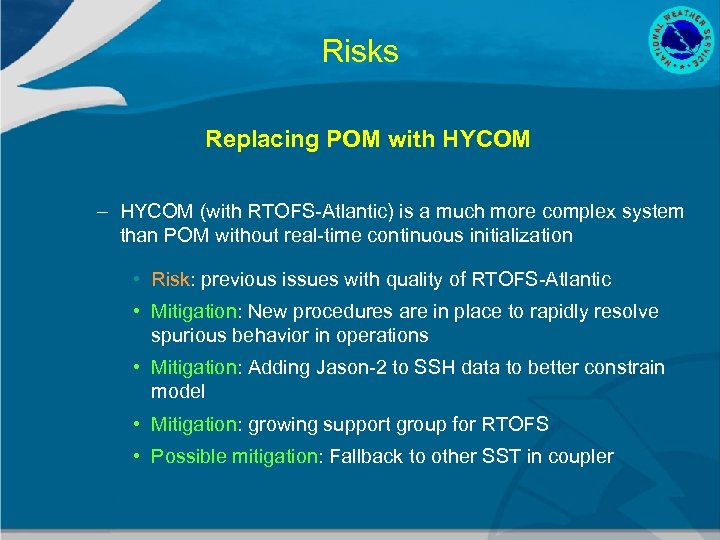 Risks Replacing POM with HYCOM – HYCOM (with RTOFS-Atlantic) is a much more complex system than POM without real-time continuous initialization • Risk: previous issues with quality of RTOFS-Atlantic • Mitigation: New procedures are in place to rapidly resolve spurious behavior in operations • Mitigation: Adding Jason-2 to SSH data to better constrain model • Mitigation: growing support group for RTOFS • Possible mitigation: Fallback to other SST in coupler
 Risks (cont’ed) – HYCOM-HWRF coupling is more complex • Risk: Small support group for coupled system • Mitigation: Dedicated group expanded from 1 to 3 • Mitigation: Community support (FSU, AOML, …) • Risk: Complexity of system may make it more prone to failure • Reality: This system will be fully supported in-house, the present POM base system is not • Reality: This system was robust in parallel testing • Possible mitigation: Fallback to other SST in coupler
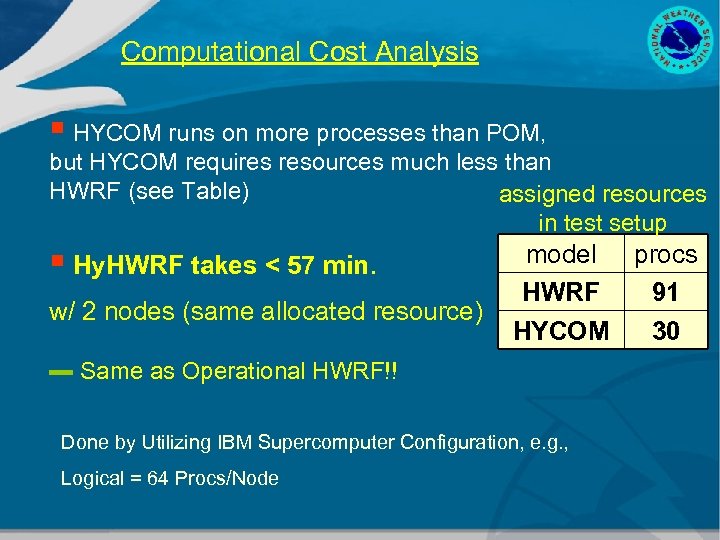 Computational Cost Analysis § HYCOM runs on more processes than POM, but HYCOM requires resources much less than HWRF (see Table) assigned resources in test setup § Hy. HWRF takes < 57 min. w/ 2 nodes (same allocated resource) model procs HWRF 91 HYCOM 30 ▬ Same as Operational HWRF!! Done by Utilizing IBM Supercomputer Configuration, e. g. , Logical = 64 Procs/Node
 Summary: 1. HYCOM is complex, and HYCOM-HWRF is more complex. However, HYCOM is based on Solid Physics; 2. Hy. HWRF has shown Consistent and Persistent Predictions; 3. In-House Infrastructure for IC and BC, as well as Routes for Real-Time Streamline Data; 4. In-House Support as well as Community Support. 5. Computation Time: HYCOM-HWRF = POM-HWRF