


 Скачать презентацию Country Report of Thailand on Income Generation and
4ed6aef4e237a6c75ec02add4f03da1f.ppt
- Количество слайдов: 45
 Country Report of Thailand on Income Generation and Poverty Reduction for Development By Kanjana Malaikritsanachalee Ravivan Suwansin 16 March – 10 April, 2009 1
 Overview of Thailand 2
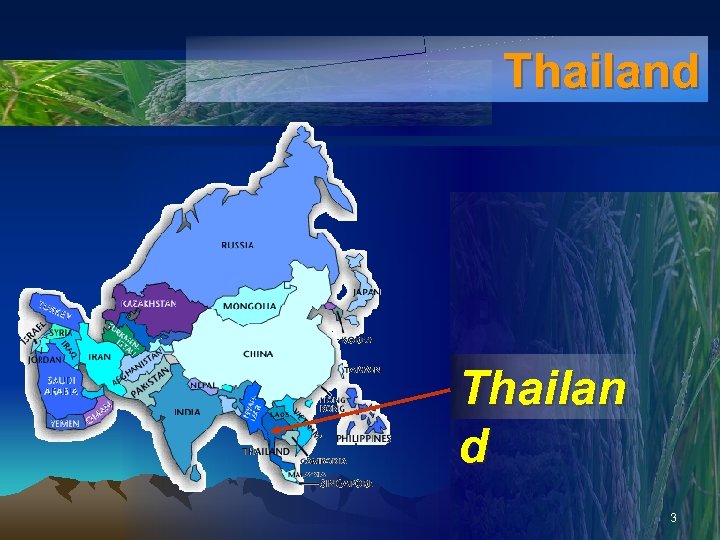 Thailand Thailan d 3
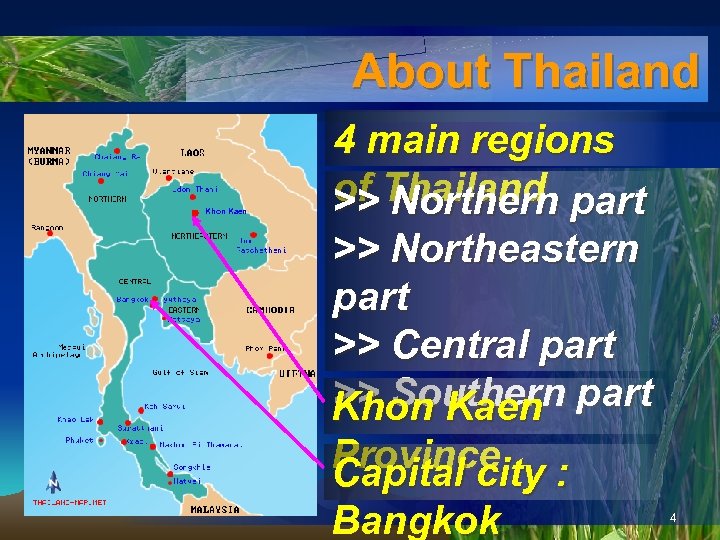 About Thailand Khon Kaen 4 main regions of Northern >> Thailand part >> Northeastern part >> Central part >> Southern part Khon Kaen Province : Capital city Bangkok 4
 Symbols of Thailand 5
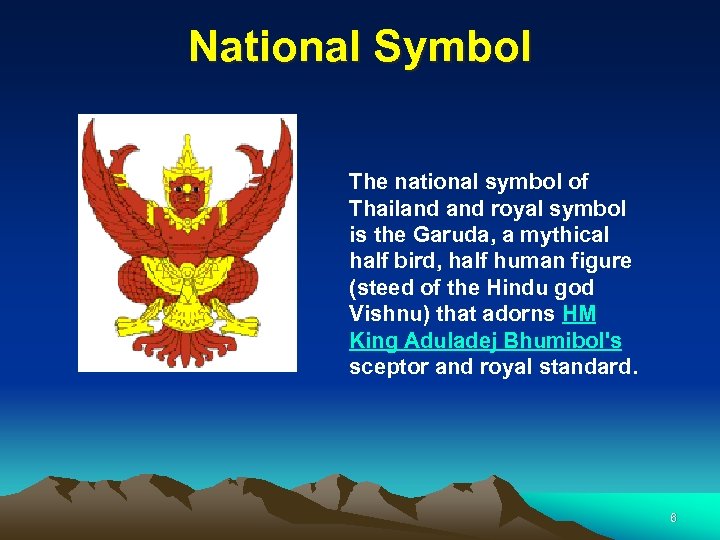 National Symbol The national symbol of Thailand royal symbol is the Garuda, a mythical half bird, half human figure (steed of the Hindu god Vishnu) that adorns HM King Aduladej Bhumibol's sceptor and royal standard. 6
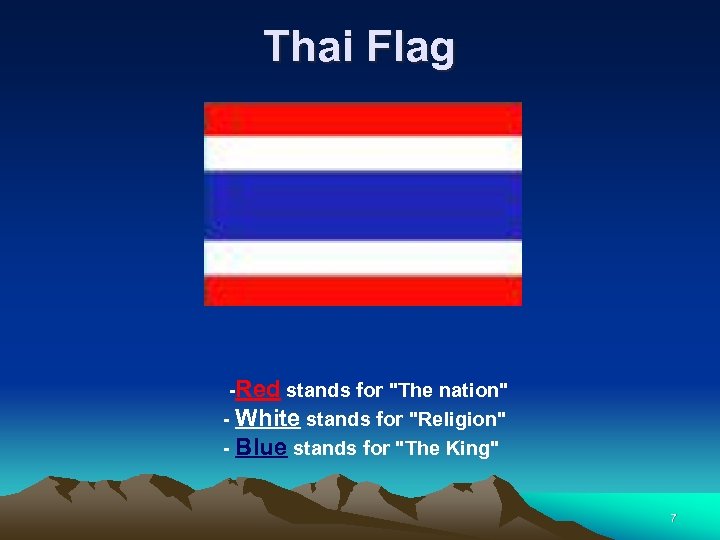 Thai Flag -Red stands for "The nation" - White stands for "Religion" - Blue stands for "The King" 7
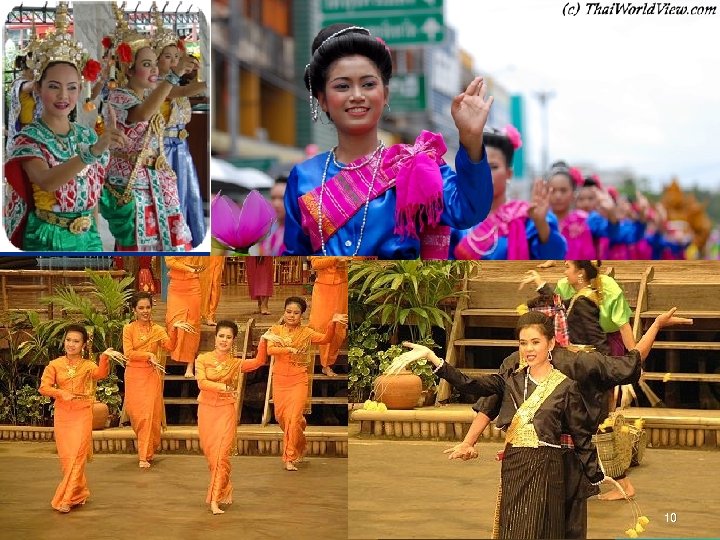
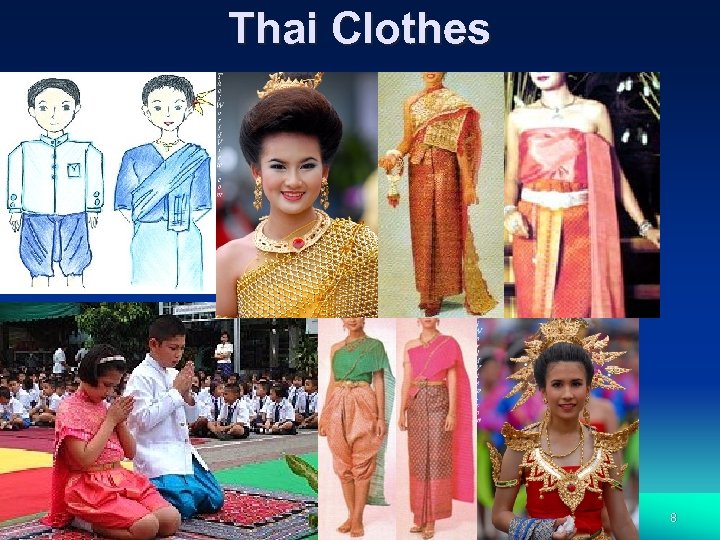 Thai Clothes 8
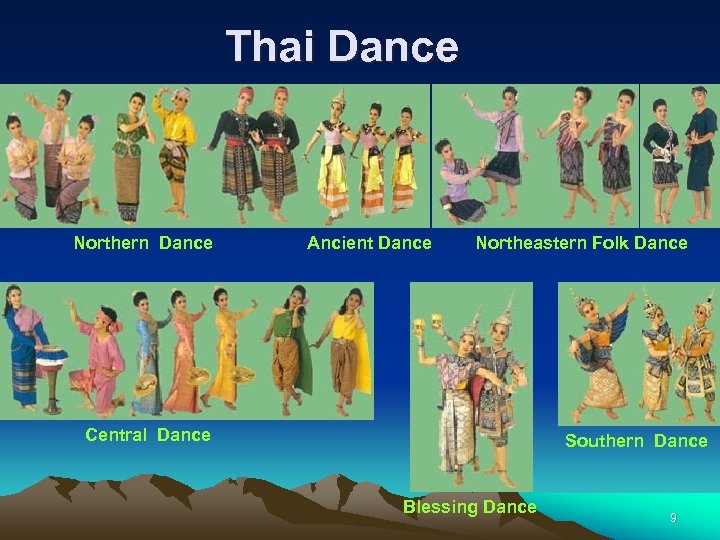 Thai Dance Northern Dance Ancient Dance Northeastern Folk Dance Central Dance Southern Dance Blessing Dance 9
 10
10
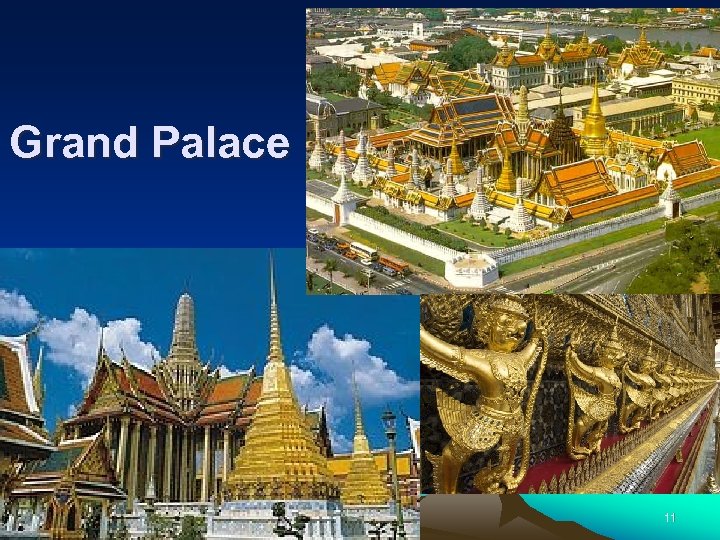 Grand Palace 11
 12
12
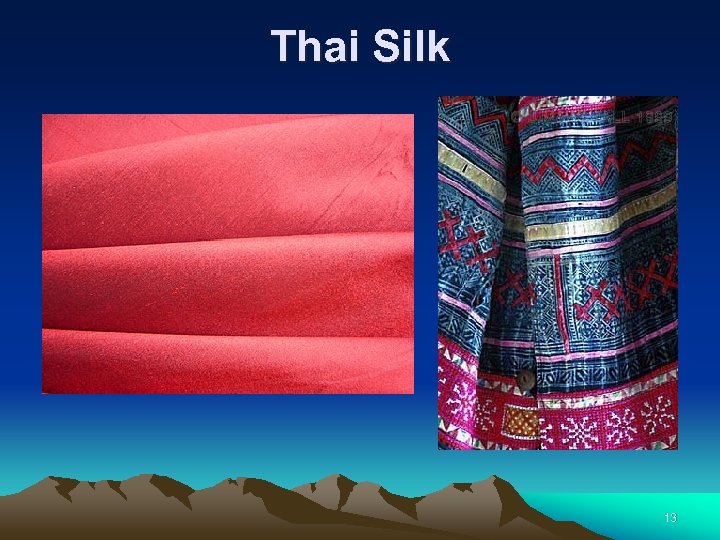 Thai Silk 13
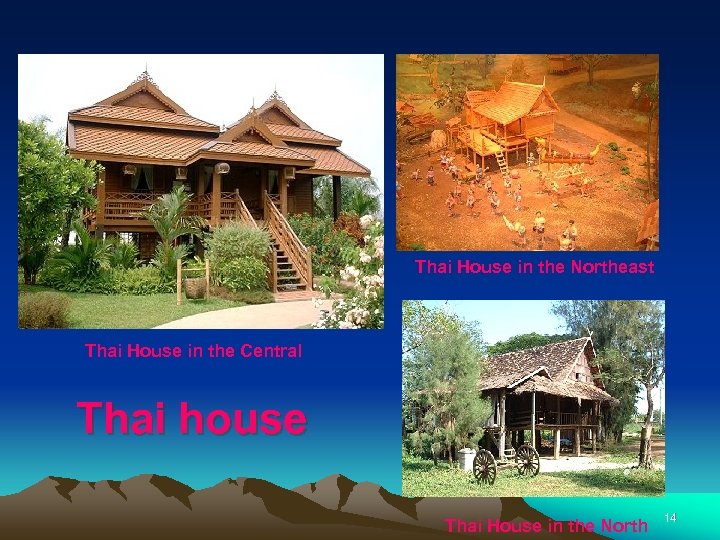 Thai House in the Northeast Thai House in the Central Thai house Thai House in the North 14
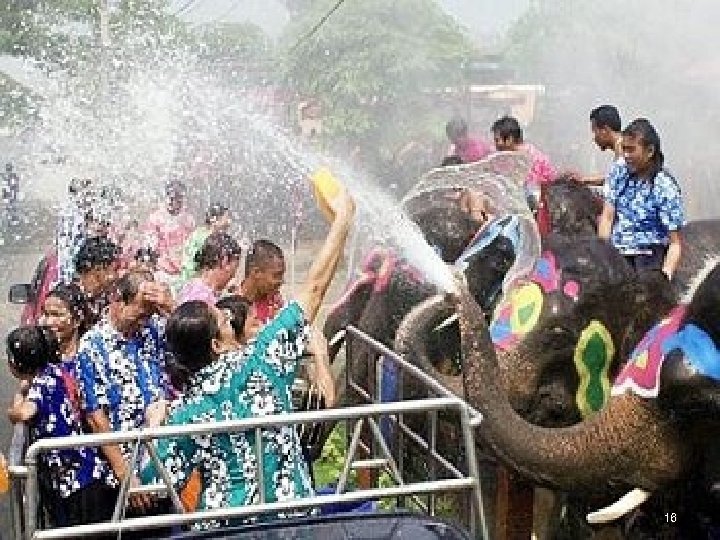
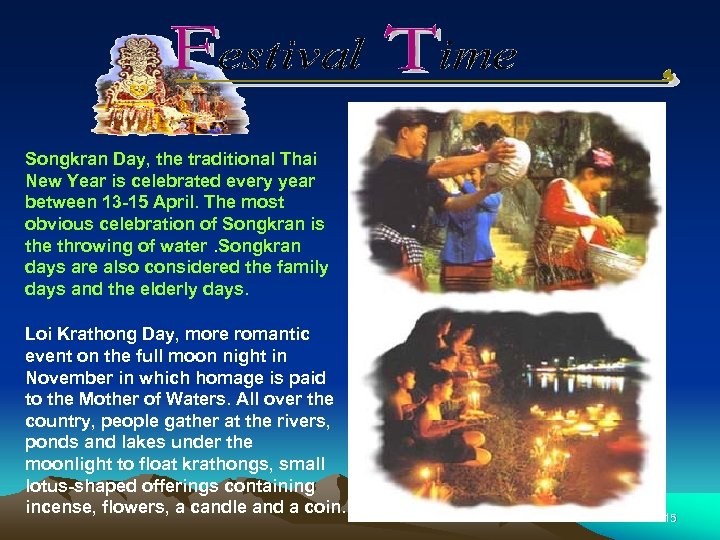 Songkran Day, the traditional Thai New Year is celebrated every year between 13 -15 April. The most obvious celebration of Songkran is the throwing of water. Songkran days are also considered the family days and the elderly days. Loi Krathong Day, more romantic event on the full moon night in November in which homage is paid to the Mother of Waters. All over the country, people gather at the rivers, ponds and lakes under the moonlight to float krathongs, small lotus-shaped offerings containing incense, flowers, a candle and a coin. 15
 16
16
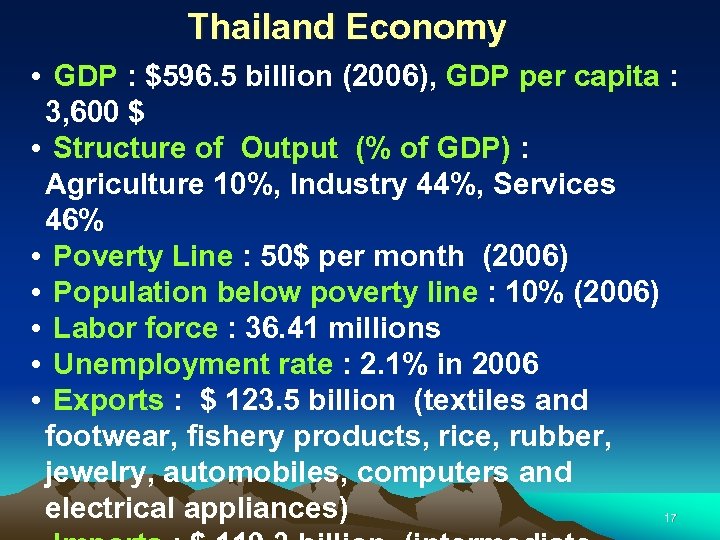 Thailand Economy • GDP : $596. 5 billion (2006), GDP per capita : 3, 600 $ • Structure of Output (% of GDP) : Agriculture 10%, Industry 44%, Services 46% • Poverty Line : 50$ per month (2006) • Population below poverty line : 10% (2006) • Labor force : 36. 41 millions • Unemployment rate : 2. 1% in 2006 • Exports : $ 123. 5 billion (textiles and footwear, fishery products, rice, rubber, jewelry, automobiles, computers and electrical appliances) 17
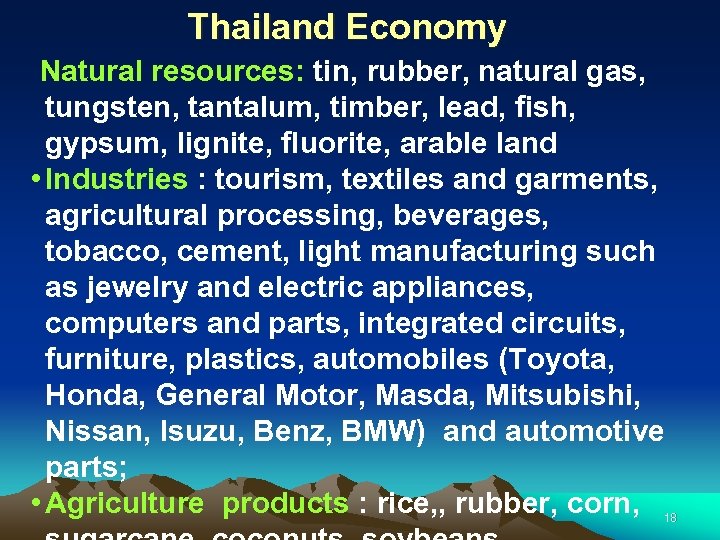 Thailand Economy Natural resources: tin, rubber, natural gas, tungsten, tantalum, timber, lead, fish, gypsum, lignite, fluorite, arable land • Industries : tourism, textiles and garments, agricultural processing, beverages, tobacco, cement, light manufacturing such as jewelry and electric appliances, computers and parts, integrated circuits, furniture, plastics, automobiles (Toyota, Honda, General Motor, Masda, Mitsubishi, Nissan, Isuzu, Benz, BMW) and automotive parts; • Agriculture products : rice, , rubber, corn, 18
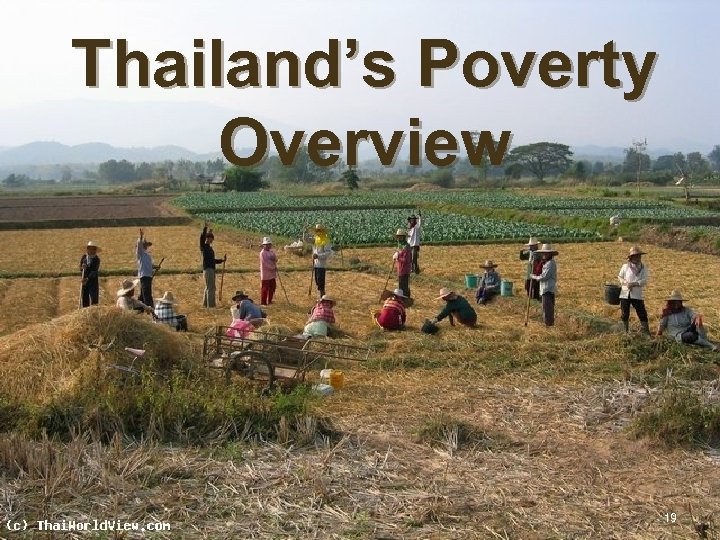 Thailand’s Poverty Overview 19
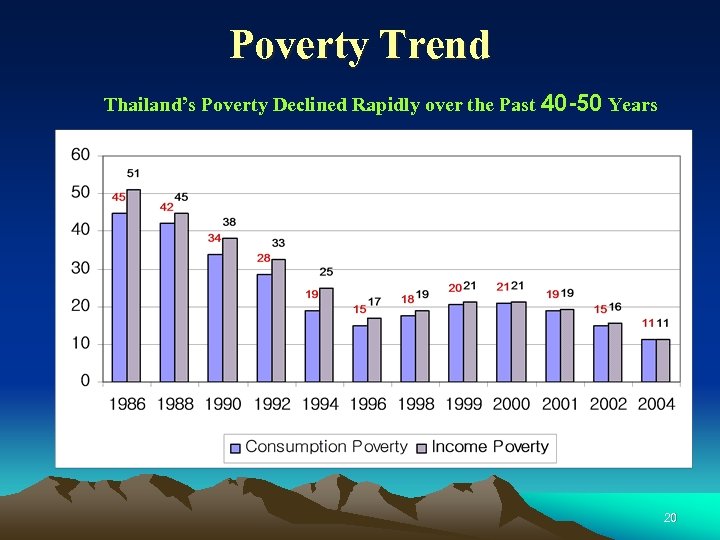 Poverty Trend Thailand’s Poverty Declined Rapidly over the Past 40 -50 Years 20
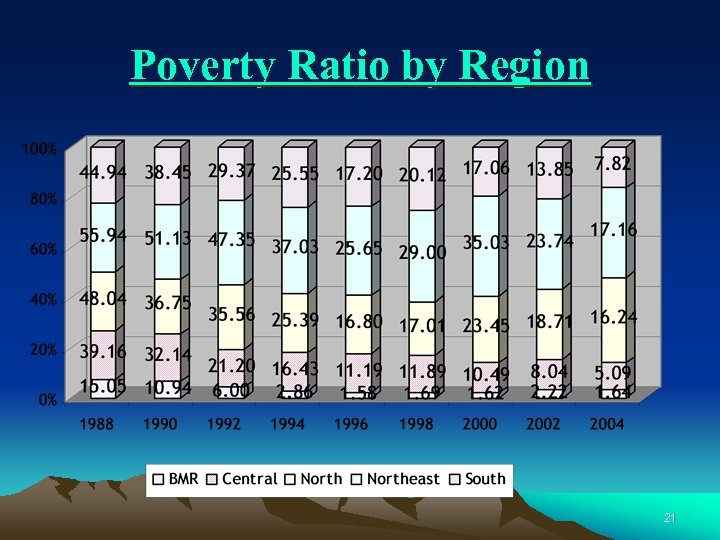 Poverty Ratio by Region 21
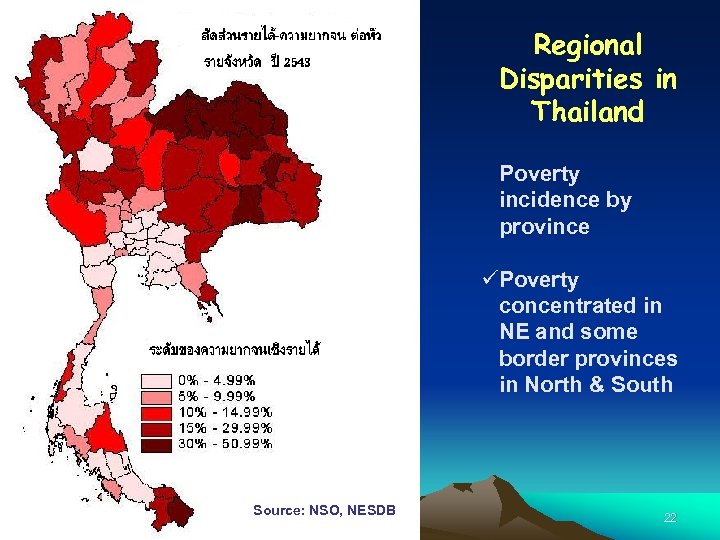 Regional Disparities in Thailand Poverty incidence by province üPoverty concentrated in NE and some border provinces in North & South Source: NSO, NESDB 22
 Poverty Measuring in Thailand • The new national poverty line is revised in 2004 • Thailand measures poverty incidence at household level by comparing per capita household income against poverty line 23
 Characteristics of the Poor – Half of the poor in Thailand were in agricultural sector, majority of them were landless farm workers – Poverty is much higher among large households – Poverty rises perceptibly with higher aged of the heads of households – The poor household heads with lower educational levels face serious problem to be poor – Incidence of poverty among children is generally much higher than the average for the whole Kingdom, the incidence of poverty among elderly is not as severe as among children 24
 Government and Non-government organizations’ intervention To maintain and increase income of people l To decrease cost of living l To support and encourage society and quality of life l To develop Thai economics; especially the agricultural sector l 25
 Best practices “Sufficiency Economy” The Best Practices of Thai nations 26
 The definition of the philosophy of “Sufficiency Economy” is a philosophy that stresses the middle path as an overriding principle for appropriate conduct by the populace at all levels. This applies to conduct starting from the level of the families, communities, as well as the level of nation in development and administration so as to modernize in line with the forces of globalization. 27
 What is “Sufficiency Economy”? l l l Guides the way of living or behavior of people at all levels through a middle path. Aim to create balance and be able to cope with critical challenges arising from extensive and rapid changes. Its application domain is scalable and universal Complete and govern everything from motivation to criteria and from behavior to system Address all issues within a dynamic setting 28
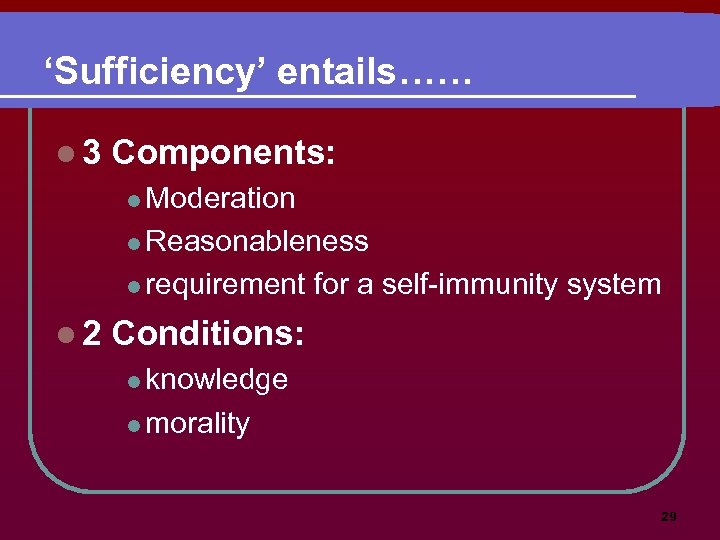 ‘Sufficiency’ entails…… l 3 Components: l Moderation l Reasonableness l requirement l 2 for a self-immunity system Conditions: l knowledge l morality 29
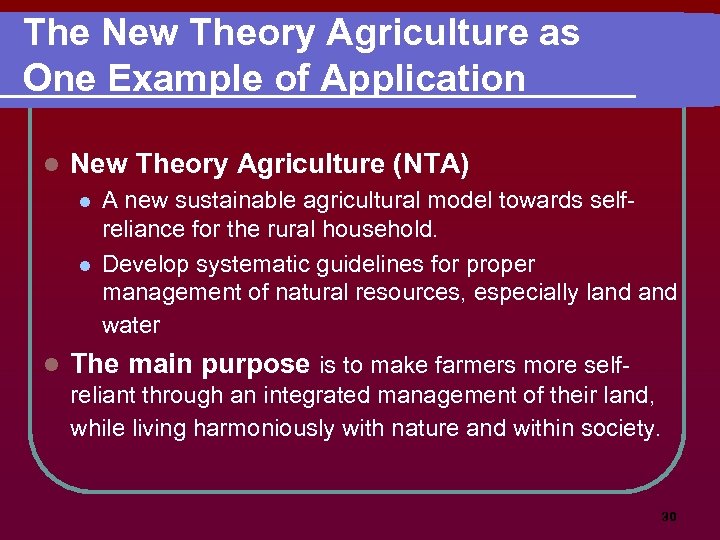 The New Theory Agriculture as One Example of Application l New Theory Agriculture (NTA) l l l A new sustainable agricultural model towards selfreliance for the rural household. Develop systematic guidelines for proper management of natural resources, especially land water The main purpose is to make farmers more selfreliant through an integrated management of their land, while living harmoniously with nature and within society. 30
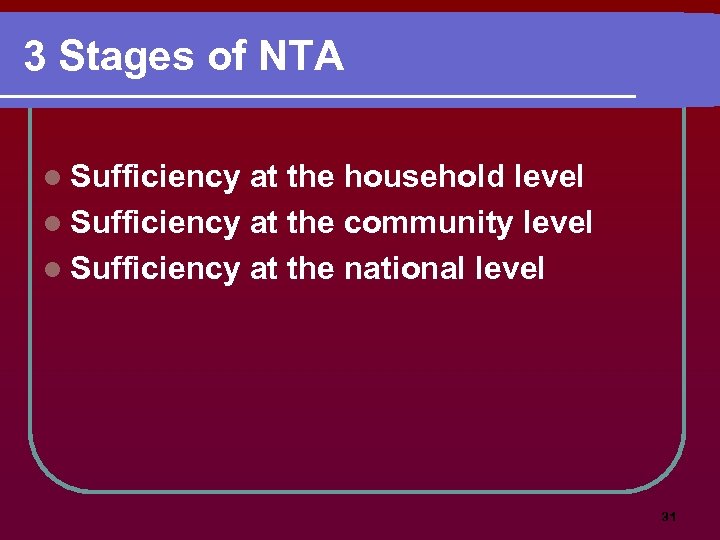 3 Stages of NTA l Sufficiency at the household level l Sufficiency at the community level l Sufficiency at the national level 31
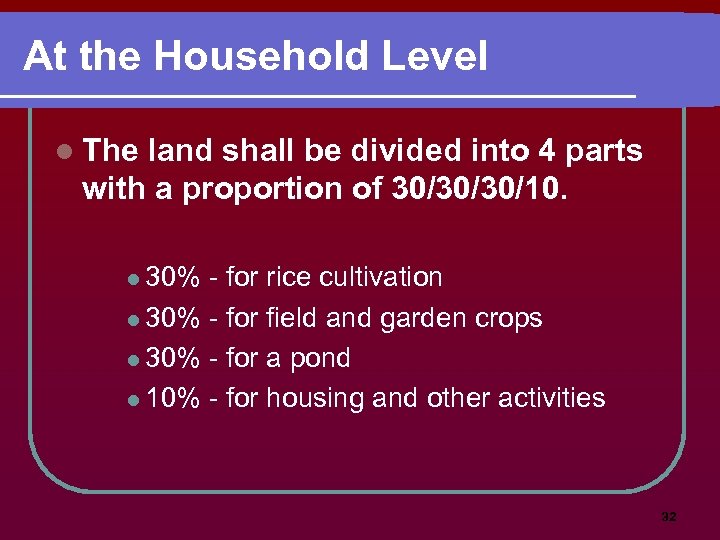 At the Household Level l The land shall be divided into 4 parts with a proportion of 30/30/30/10. l 30% - for rice cultivation l 30% - for field and garden crops l 30% - for a pond l 10% - for housing and other activities 32
 At the Community Level l Based on cooperative activities with members within community, on a concept of sharing excess resources of each household. l Example: rice bank, cow/buffalo bank, bio-fertilizer production group, saving group, community healthcare center, community learning center, etc. l Lead to a more self-reliance, strength of each community, capacity of community members, reducing costs of living, increasing income, or creating community social safety net 33
 At the National Level Expand the activities to other communities, co-operative firms, banks, and other outside sources l Compare to developing a value-chain in production. l Examples of the expanded activities: fund raising, creating direct sales channel, seeking fund for establishing community rice mill or cooperative stores l 34
 At the National Level (Cont. ) l Various institutions will join hands to create sufficiency at the provincial or national level l Private firms can initiate corporate social responsibility to reach out to communities. l Public sector is to promote different types of associations l Non-governmental organizations can collaborate in various activities they are keen in to strengthen the sufficiency at all levels. 35
 Community Sufficiency Economic Learning Center Project Ministry of Agriculture and Cooperatives 36
 Learning by Doing - Rotate land for agriculture - Provide land for farmers - Registered farmers are helped - Improve land - farmers gain benefits 37
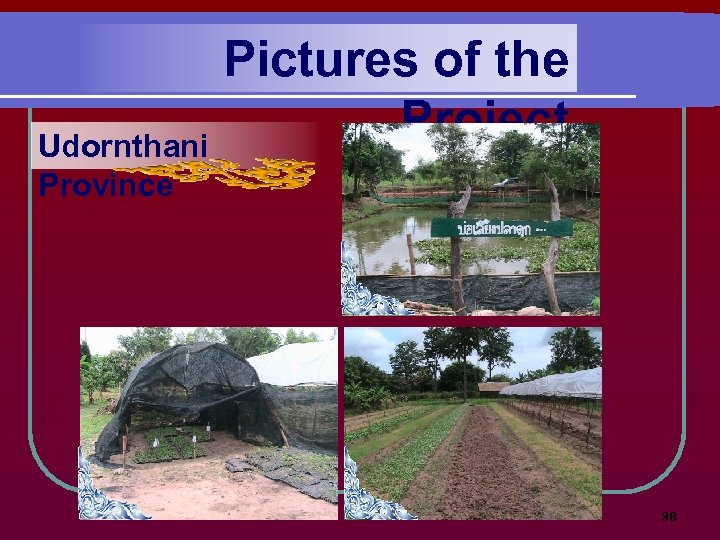 Pictures of the Project Udornthani Province 38
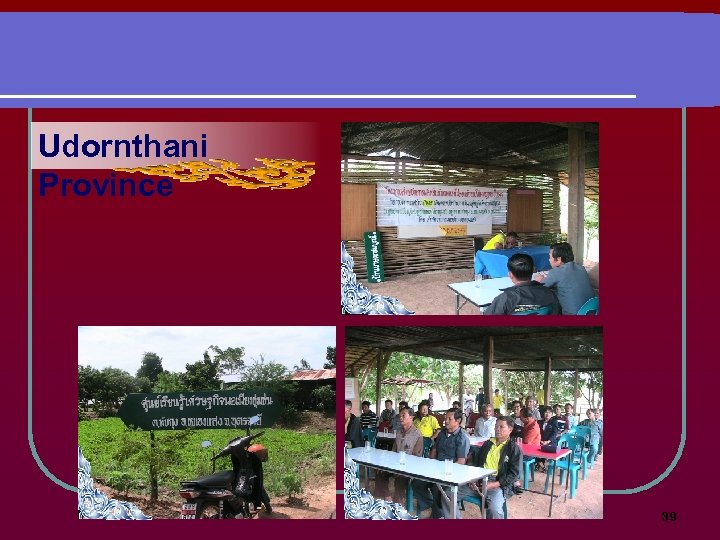 Udornthani Province 39
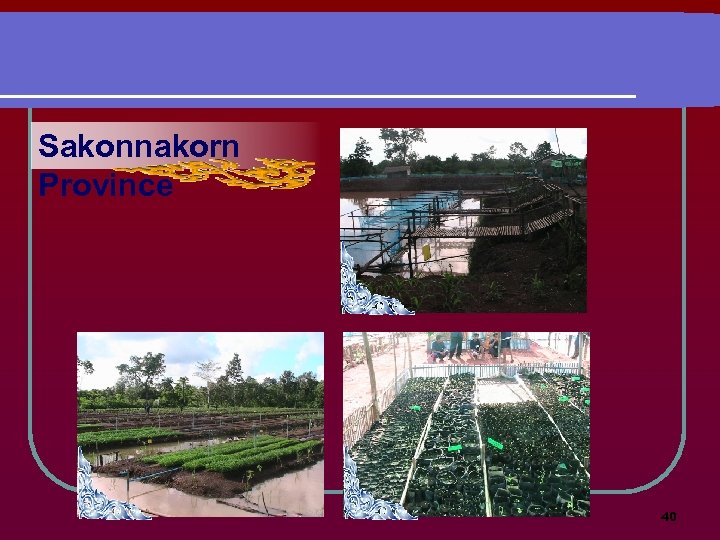 Sakonnakorn Province 40
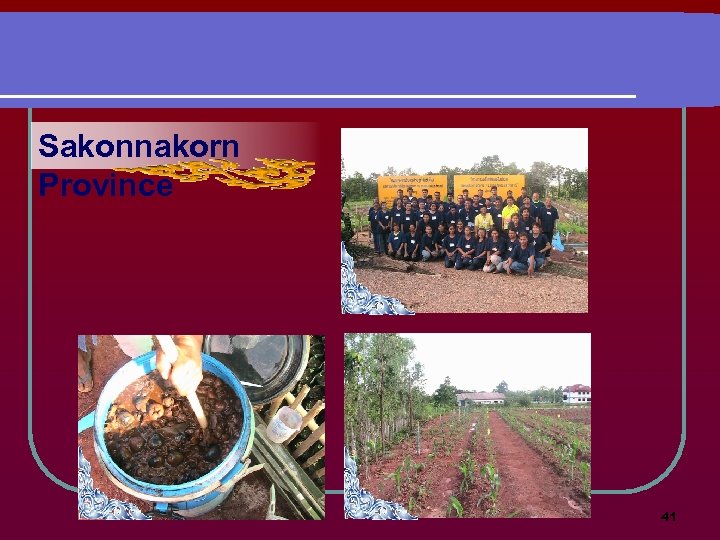 Sakonnakorn Province 41
 Problems and Challenges Concentration of economic activities in Bangkok and urban areas l Failure of the Thai government to provide social safety nets amid the country's rapid growth and industrialization l l Weak educational system 42
 Problems and Challenges (Cont. ) Failure of the government to implement agricultural land reform policies l Increase in the number of farm tenants l Young people are scarcely become next generation of farmers l Products from the agricultural sector mostly tends to be primary products l 43
 Opportunities l Thailand has been known as “the kitchen of the world” l Have the new theory concept, the Philosophy of Sufficiency Economy, and lots of projects initiated by his Majesty King Bhumibol Adulyadej l With local knowledge, farmers produce various kinds of products; particularly the ones having a theme from nature are more popular nowadays. (OTOP: One Tambon One Product) 44
 Thank you 45