


 Скачать презентацию Country presentations on using the IIEP UNESCO C DRR Tool
9c0553c427003b36d39c45e09d638291.ppt
- Количество слайдов: 52
 Country presentations on using the IIEP/UNESCO C/DRR Tool Status of Nepal Regional Consultation Meeting on Education and Resilience, 6 November 2014, Philippines Chiranjibi Poudel Section Officer Department of Education Nepal
 Presentation Outline 1. 2. 3. 4. 5. Country Context Our Expected results on C/DRR Progress on C/DRR in Nepal C/DRR Related Program and Activities in Nepal Updated of Self Monitoring & Reporting of IIEP/UNESCO C/DRR Tools and Strategies 6. Usefulness of self monitoring and reporting questionnaire of C/DRR 7. Limitations and Challenges on C/DRR
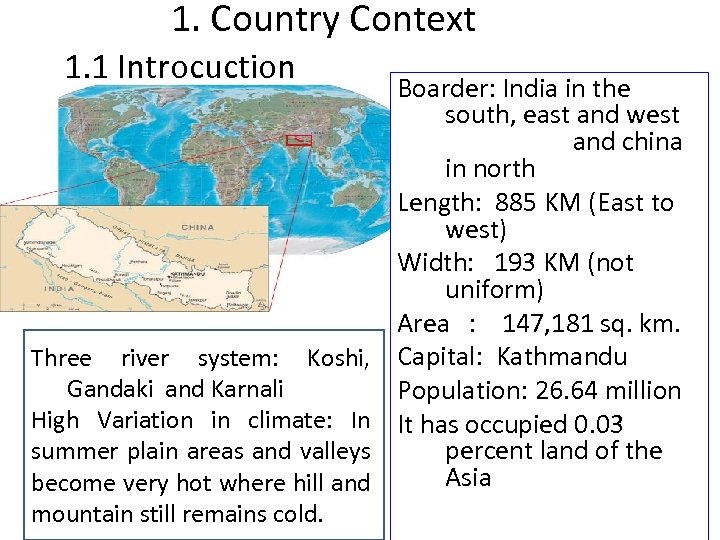 1. Country Context 1. 1 Introcuction Three river system: Koshi, Gandaki and Karnali High Variation in climate: In summer plain areas and valleys become very hot where hill and mountain still remains cold. Boarder: India in the south, east and west and china in north Length: 885 KM (East to west) Width: 193 KM (not uniform) Area : 147, 181 sq. km. Capital: Kathmandu Population: 26. 64 million It has occupied 0. 03 percent land of the Asia
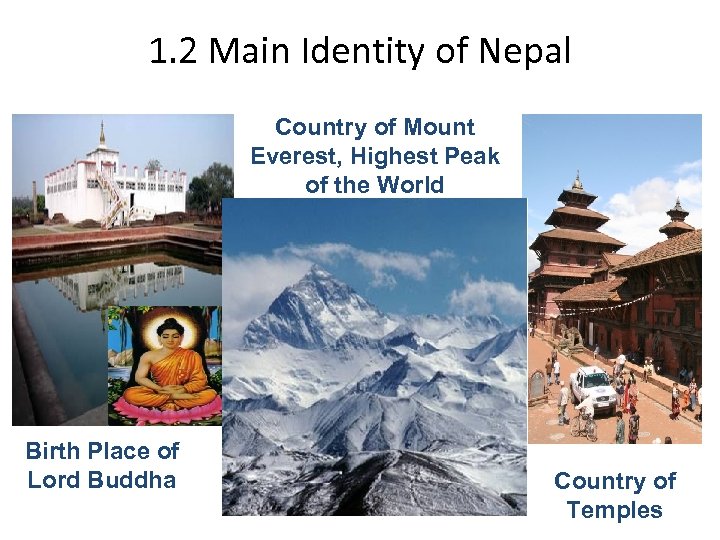 1. 2 Main Identity of Nepal Country of Mount Everest, Highest Peak of the World Birth Place of Lord Buddha Country of Temples
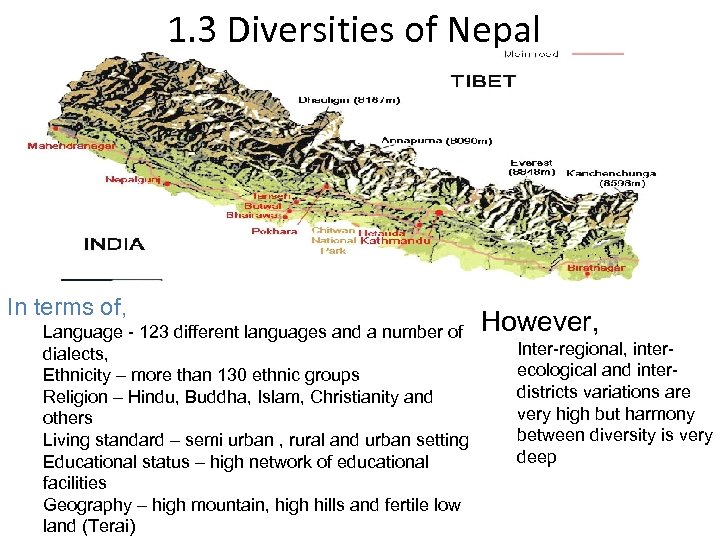 1. 3 Diversities of Nepal In terms of, Language - 123 different languages and a number of dialects, Ethnicity – more than 130 ethnic groups Religion – Hindu, Buddha, Islam, Christianity and others Living standard – semi urban , rural and urban setting Educational status – high network of educational facilities Geography – high mountain, high hills and fertile low land (Terai) However, Inter-regional, interecological and interdistricts variations are very high but harmony between diversity is very deep
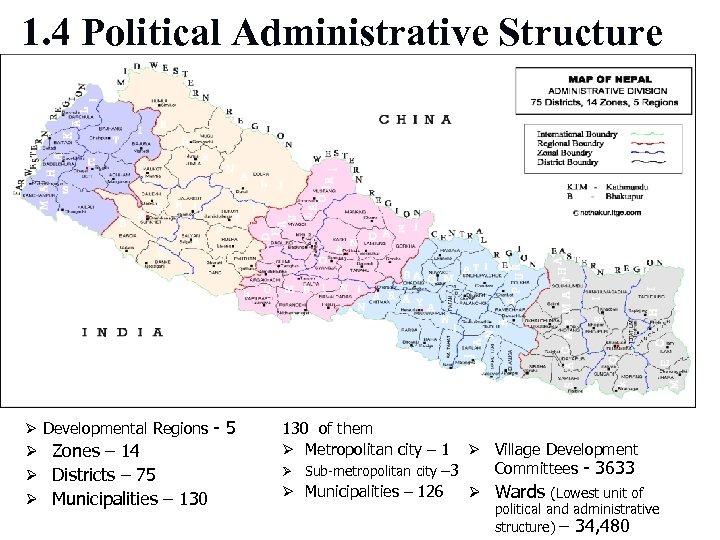 1. 4 Political Administrative Structure Ø Developmental Regions Ø Zones – 14 Ø Districts – 75 Ø Municipalities – 130 -5 130 of them Ø Metropolitan city – 1 Ø Village Development Committees - 3633 Ø Sub-metropolitan city – 3 Ø Municipalities – 126 Ø Wards (Lowest unit of political and administrative structure) – 34, 480
 1. 5 Population and demography: (Census 2011) • Total population: 26494504 (26. 5 million) • Pop by Sex: – Male: (48. 50%, ) – female : (51. 50%) • Pop. by region: Mountain 6. 73%, Hill 43. 0%, Terai 50. 27% • Urban: 14% , Rural: 86% • Pop growth rate: 1. 35 • There is high regional variation in population growth rate and density
 1. 5 Population and demography: contd…. • • • Family size: 4. 88 persons. Density: 180 Per skm Under 15 years of age : 43. 9% Age group of 15 -59 population : 51% Literacy rate: 65. 9% (2567963 illiterate peoples) – Male: 75. 1% – Female: 57. 4
 1. 6 Governance Federal democratic republic, Administratively Nepal is divided into: • five development regions, • 14 zones, • 75 districts, • 58 municipalities and 3915 Village Development Committees (VDCs).
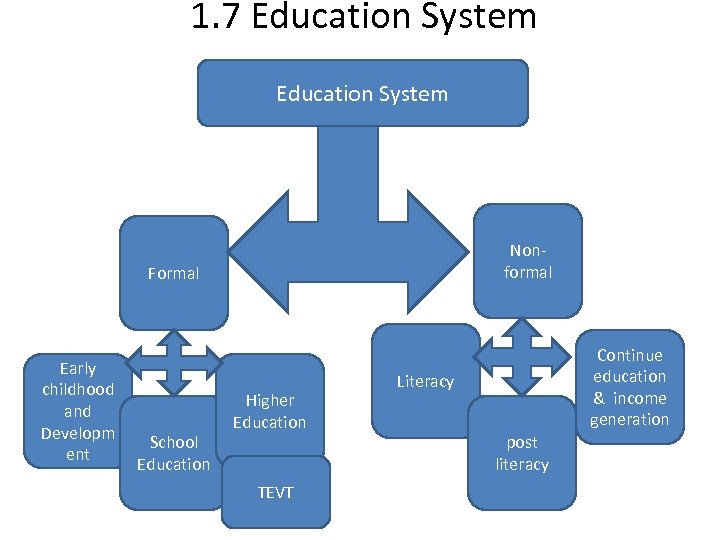 1. 7 Education System Nonformal Formal Early childhood and Developm ent School Education Higher Education TEVT Continue education & income generation Literacy post literacy
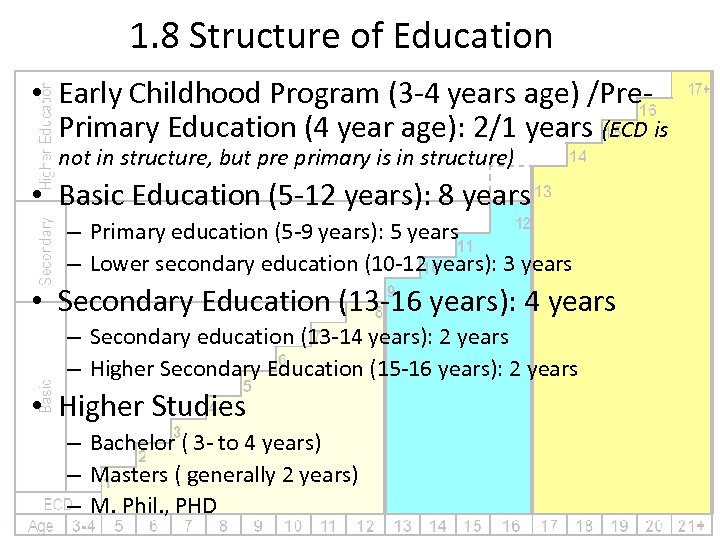 1. 8 Structure of Education • Early Childhood Program (3 -4 years age) /Pre. Primary Education (4 year age): 2/1 years (ECD is not in structure, but pre primary is in structure) • Basic Education (5 -12 years): 8 years – Primary education (5 -9 years): 5 years – Lower secondary education (10 -12 years): 3 years • Secondary Education (13 -16 years): 4 years – Secondary education (13 -14 years): 2 years – Higher Secondary Education (15 -16 years): 2 years • Higher Studies – Bachelor ( 3 - to 4 years) – Masters ( generally 2 years) – M. Phil. , PHD
 1. 9 Types of Schools • Community Schools – Aided Community – approved teachers position – Unaided Community – no approved teacher position – Community Managed – approved teacher position and managed by community • Institutional Schools – Registered in Trust – public and private – Registered under Company Act 12
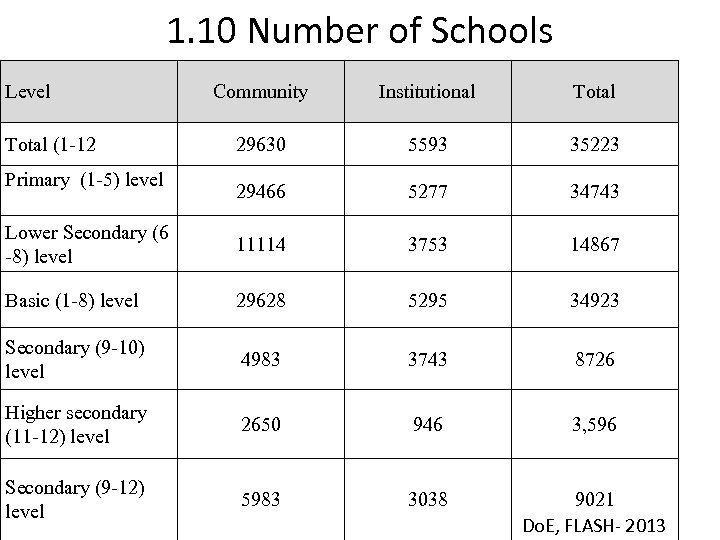 1. 10 Number of Schools Level Community Institutional Total 29630 5593 35223 29466 5277 34743 Lower Secondary (6 -8) level 11114 3753 14867 Basic (1 -8) level 29628 5295 34923 Secondary (9 -10) level 4983 3743 8726 Higher secondary (11 -12) level 2650 946 3, 596 Secondary (9 -12) level 5983 3038 9021 Do. E, FLASH- 2013 Total (1 -12 Primary (1 -5) level
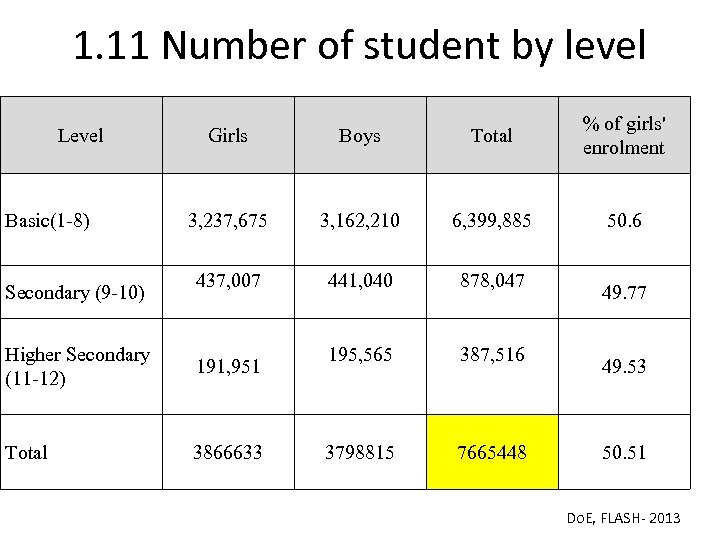 1. 11 Number of student by level Level Basic(1 -8) Secondary (9 -10) Girls Boys Total % of girls' enrolment 3, 237, 675 3, 162, 210 6, 399, 885 50. 6 437, 007 441, 040 878, 047 195, 565 387, 516 3798815 7665448 Higher Secondary (11 -12) 191, 951 Total 3866633 49. 77 49. 53 50. 51 Do. E, FLASH- 2013
 1. 12 Summary of the SSRP Key Performance Indicators
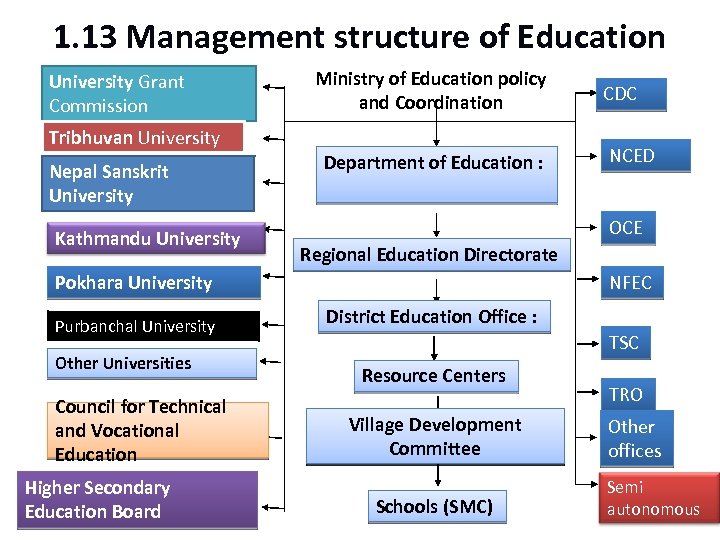 1. 13 Management structure of Education University Grant Commission Ministry of Education policy and Coordination Tribhuvan University Nepal Sanskrit University Kathmandu University Department of Education : Other Universities Council for Technical and Vocational Education Higher Secondary Education Board NCED OCE Regional Education Directorate Pokhara University Purbanchal University CDC NFEC District Education Office : TSC Resource Centers Village Development Committee Schools (SMC) TRO Other offices Semi autonomous
 1. 14 Delivery Mechanism for C/DRR • Through exiting government mechanism ( supporting Govt/ partners) • Mobilizing cluster agencies • Technical support from the partners • Inter- sectoral coordination • Working with the existing networking ( flagship, cluster ) • Working with community groups ( SMC/ PTA, child Clubs, Youth groups, NFE )
 2. Our Expected results in C/DRR 2. 1. Integrating C/DRR into the education sector plan 2. 2. Development of National DRR framework 2. 3. Establishment and functioning of Education Cluster Group for Education in Emergencies. 2. 4. Capacity building of different stakeholders
 3. Progress on C/DRR in Nepal 3. 1. Integrating C/DRR into the education sector plan • Review of curriculum, textbooks, teachers guides and teacher training packages carried out • Setting the DRR competencies is in process • Contents have been selected • Resource book for teachers on DRR has been developed • DRR is one of the areas of Teachers Professional Development Package
 3. 2. Development of National DRR framework and Policies Matter • Vulnerable Community Development Framework • National ESD Framework • Environment Management Framework • Policy and strategy for school safety
 3. 3. Establishment and functioning of Education Cluster Group for Education in Emergencies. • • Contingency plan in districts Local level capacity building Minimum standard for INEE Use of survey tools
 • • • 3. 4. Capacity building of different stakeholders Trainings and workshops for curriculum, textbooks writers and trainers. Mo. E managers Members of the Community Learning Centers Drilling and preparedness awareness programme Organized international Student summit on earthquake safety
 3. 5. Institutional Arrangements • Coordination Committee in Ministry of Home Affairs • Clusters: Education, Health etc.
 4. C/DRR Related Program and Activities in Nepal • Program in SSRP & EFA-CDP: Local level ( District/School) • Pulling and non-pulling fund • Supported by Government and DPs • More then 30 Activities in SSRP • Budget allocation US$ 216. 55 Million for this FY 2014 -15
 5. Updated of Self Monitoring & Reporting of IIEP/UNESCO C/DRR Tools and Strategies
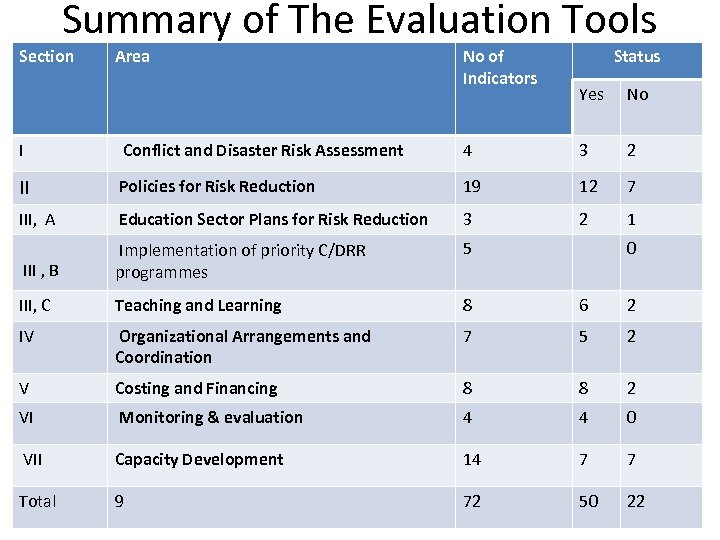 Summary of The Evaluation Tools Section Area No of Indicators Status Yes No I Conflict and Disaster Risk Assessment 4 3 2 II Policies for Risk Reduction 19 12 7 III, A Education Sector Plans for Risk Reduction 3 2 1 III , B Implementation of priority C/DRR programmes 5 III, C Teaching and Learning 8 6 2 IV Organizational Arrangements and Coordination 7 5 2 V Costing and Financing 8 8 2 VI Monitoring & evaluation 4 4 0 VII Capacity Development 14 7 7 Total 9 72 50 22 0
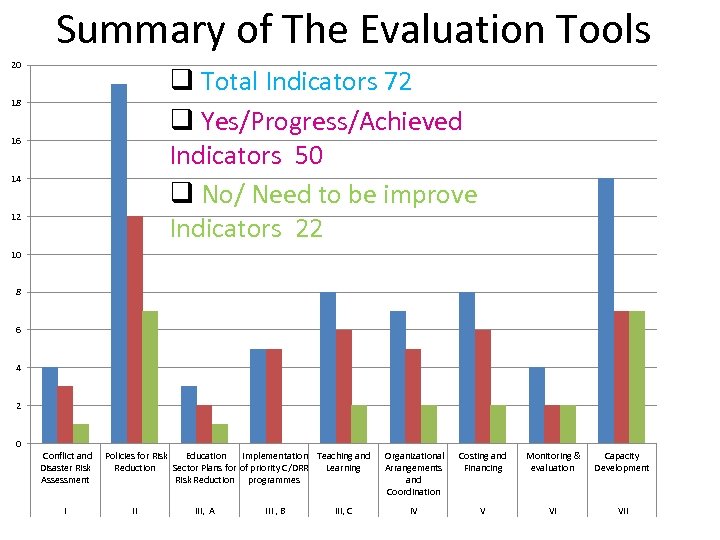 Summary of The Evaluation Tools 20 q Total Indicators 72 q Yes/Progress/Achieved Indicators 50 q No/ Need to be improve Indicators 22 18 16 14 12 10 8 6 4 2 0 Conflict and Disaster Risk Assessment I Policies for Risk Education Implementation Teaching and Reduction Sector Plans for of priority C/DRR Learning Risk Reduction programmes II III, A III , B III, C Organizational Arrangements and Coordination Costing and Financing Monitoring & evaluation Capacity Development IV V VI VII
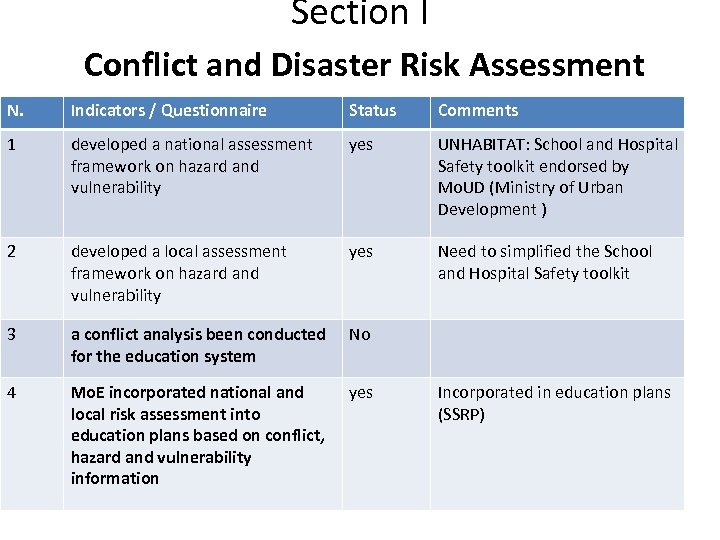 Section I Conflict and Disaster Risk Assessment N. Indicators / Questionnaire Status Comments 1 developed a national assessment framework on hazard and vulnerability yes UNHABITAT: School and Hospital Safety toolkit endorsed by Mo. UD (Ministry of Urban Development ) 2 developed a local assessment framework on hazard and vulnerability yes Need to simplified the School and Hospital Safety toolkit 3 a conflict analysis been conducted for the education system No 4 Mo. E incorporated national and local risk assessment into education plans based on conflict, hazard and vulnerability information yes Incorporated in education plans (SSRP)
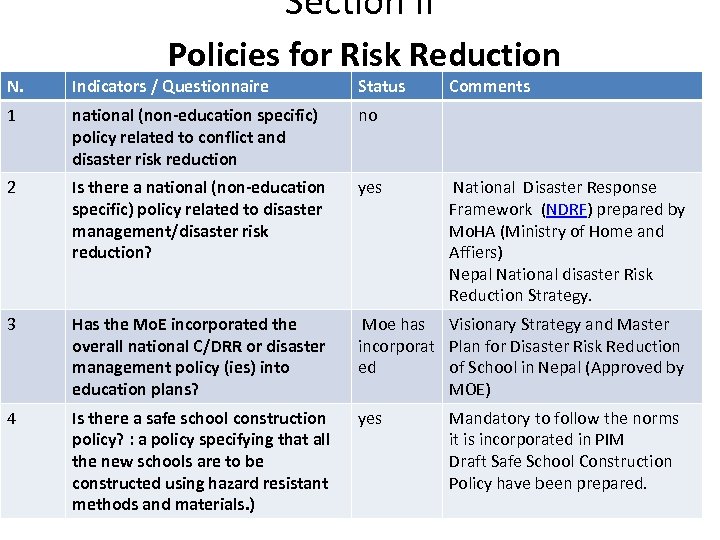 Section II Policies for Risk Reduction N. Indicators / Questionnaire Status Comments 1 national (non-education specific) policy related to conflict and disaster risk reduction no 2 Is there a national (non-education specific) policy related to disaster management/disaster risk reduction? yes 3 Has the Mo. E incorporated the overall national C/DRR or disaster management policy (ies) into education plans? Moe has Visionary Strategy and Master incorporat Plan for Disaster Risk Reduction ed of School in Nepal (Approved by MOE) 4 Is there a safe school construction policy? : a policy specifying that all the new schools are to be constructed using hazard resistant methods and materials. ) yes National Disaster Response Framework (NDRF) prepared by Mo. HA (Ministry of Home and Affiers) Nepal National disaster Risk Reduction Strategy. Mandatory to follow the norms it is incorporated in PIM Draft Safe School Construction Policy have been prepared.
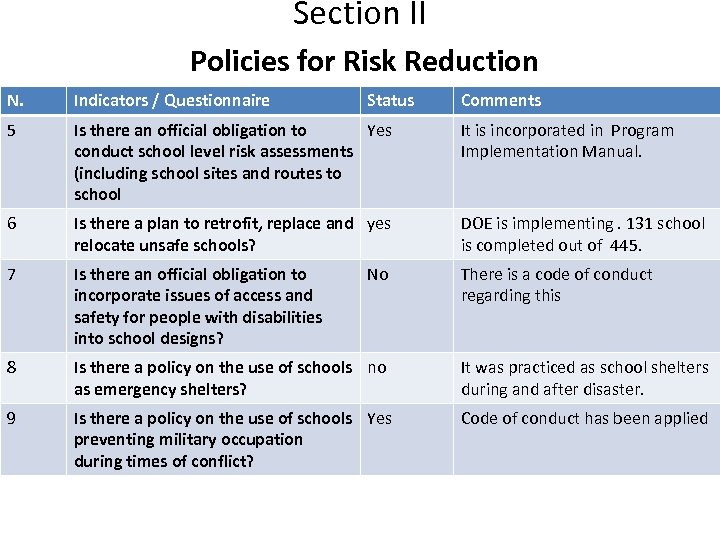 Section II Policies for Risk Reduction N. Indicators / Questionnaire Status 5 Is there an official obligation to Yes conduct school level risk assessments (including school sites and routes to school It is incorporated in Program Implementation Manual. 6 Is there a plan to retrofit, replace and yes relocate unsafe schools? DOE is implementing. 131 school is completed out of 445. 7 Is there an official obligation to incorporate issues of access and safety for people with disabilities into school designs? There is a code of conduct regarding this 8 Is there a policy on the use of schools no as emergency shelters? It was practiced as school shelters during and after disaster. 9 Is there a policy on the use of schools Yes preventing military occupation during times of conflict? Code of conduct has been applied No Comments
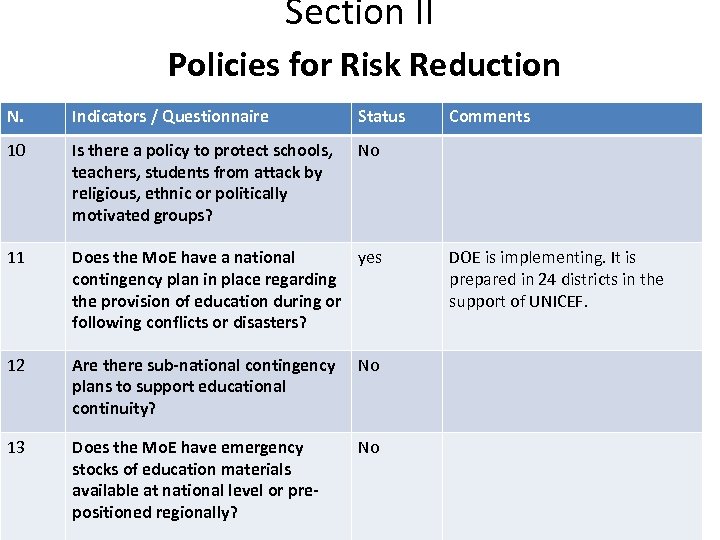 Section II Policies for Risk Reduction N. Indicators / Questionnaire Status 10 Is there a policy to protect schools, teachers, students from attack by religious, ethnic or politically motivated groups? No 11 Does the Mo. E have a national yes contingency plan in place regarding the provision of education during or following conflicts or disasters? 12 Are there sub-national contingency plans to support educational continuity? No 13 Does the Mo. E have emergency stocks of education materials available at national level or prepositioned regionally? No Comments DOE is implementing. It is prepared in 24 districts in the support of UNICEF.
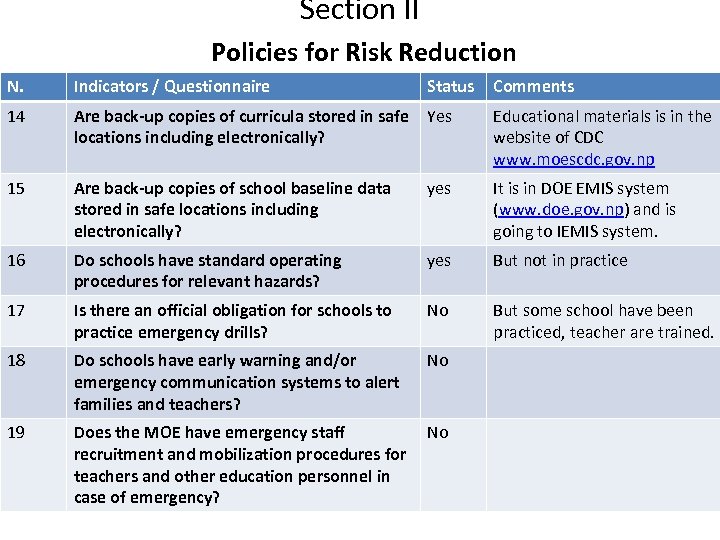 Section II Policies for Risk Reduction N. Indicators / Questionnaire Status Comments 14 Are back-up copies of curricula stored in safe locations including electronically? Yes Educational materials is in the website of CDC www. moescdc. gov. np 15 Are back-up copies of school baseline data stored in safe locations including electronically? yes It is in DOE EMIS system (www. doe. gov. np) and is going to IEMIS system. 16 Do schools have standard operating procedures for relevant hazards? yes But not in practice 17 Is there an official obligation for schools to practice emergency drills? No But some school have been practiced, teacher are trained. 18 Do schools have early warning and/or emergency communication systems to alert families and teachers? No 19 Does the MOE have emergency staff recruitment and mobilization procedures for teachers and other education personnel in case of emergency? No
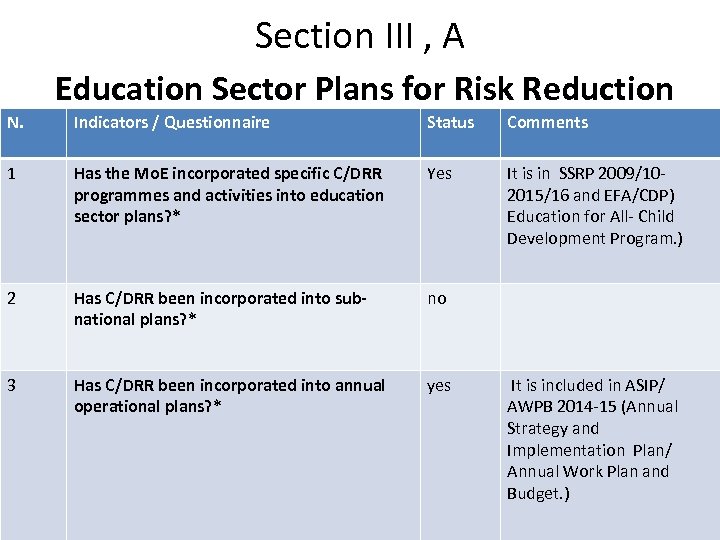 Section III , A Education Sector Plans for Risk Reduction N. Indicators / Questionnaire Status Comments 1 Has the Mo. E incorporated specific C/DRR programmes and activities into education sector plans? * Yes It is in SSRP 2009/102015/16 and EFA/CDP) Education for All- Child Development Program. ) 2 Has C/DRR been incorporated into subnational plans? * no 3 Has C/DRR been incorporated into annual operational plans? * yes It is included in ASIP/ AWPB 2014 -15 (Annual Strategy and Implementation Plan/ Annual Work Plan and Budget. )
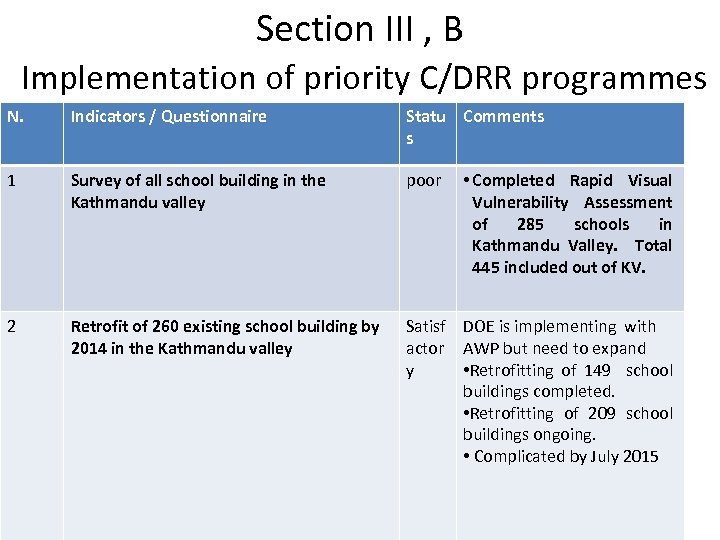 Section III , B Implementation of priority C/DRR programmes N. Indicators / Questionnaire Statu Comments s 1 Survey of all school building in the Kathmandu valley poor 2 Retrofit of 260 existing school building by 2014 in the Kathmandu valley Satisf DOE is implementing with actor AWP but need to expand y • Retrofitting of 149 school buildings completed. • Retrofitting of 209 school buildings ongoing. • Complicated by July 2015 • Completed Rapid Visual Vulnerability Assessment of 285 schools in Kathmandu Valley. Total 445 included out of KV.
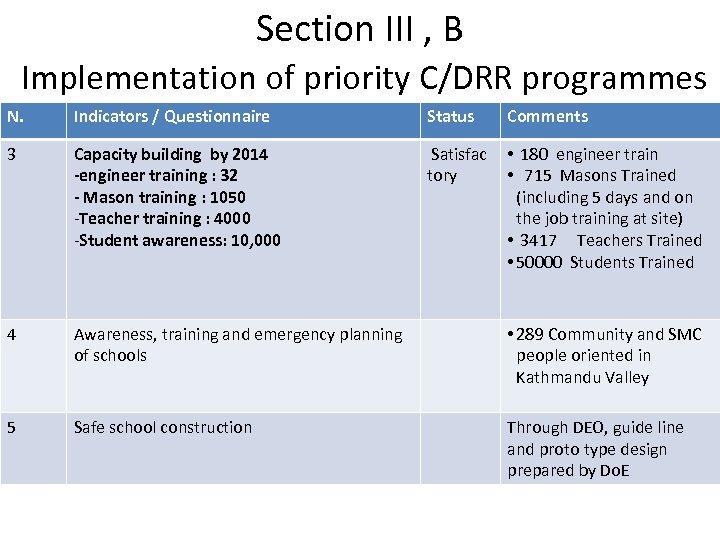 Section III , B Implementation of priority C/DRR programmes N. Indicators / Questionnaire Status Comments 3 Capacity building by 2014 -engineer training : 32 - Mason training : 1050 -Teacher training : 4000 -Student awareness: 10, 000 Satisfac tory • 180 engineer train • 715 Masons Trained (including 5 days and on the job training at site) • 3417 Teachers Trained • 50000 Students Trained 4 Awareness, training and emergency planning of schools • 289 Community and SMC people oriented in Kathmandu Valley 5 Safe school construction Through DEO, guide line and proto type design prepared by Do. E
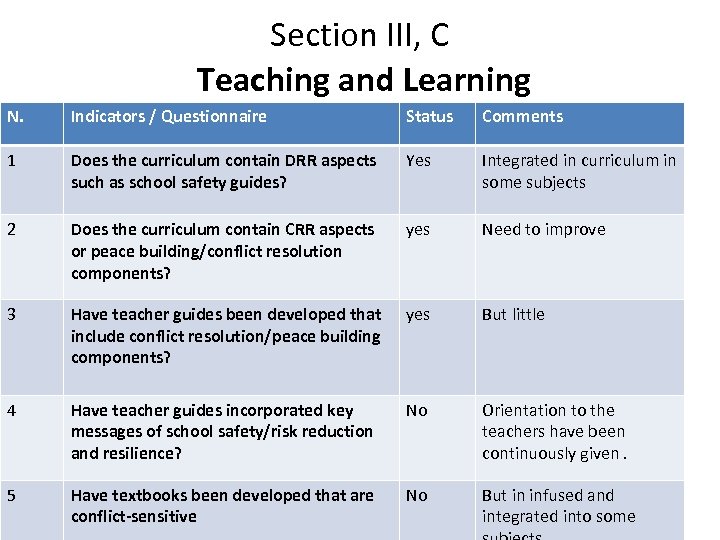 Section III, C Teaching and Learning N. Indicators / Questionnaire Status Comments 1 Does the curriculum contain DRR aspects such as school safety guides? Yes Integrated in curriculum in some subjects 2 Does the curriculum contain CRR aspects or peace building/conflict resolution components? yes Need to improve 3 Have teacher guides been developed that include conflict resolution/peace building components? yes But little 4 Have teacher guides incorporated key messages of school safety/risk reduction and resilience? No Orientation to the teachers have been continuously given. 5 Have textbooks been developed that are conflict-sensitive No But in infused and integrated into some
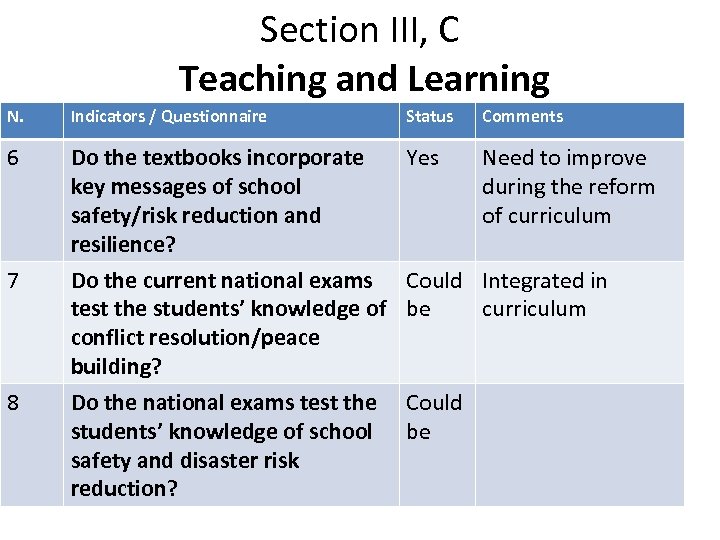 Section III, C Teaching and Learning N. Indicators / Questionnaire Status Comments 6 Do the textbooks incorporate key messages of school safety/risk reduction and resilience? Do the current national exams test the students’ knowledge of conflict resolution/peace building? Do the national exams test the students’ knowledge of school safety and disaster risk reduction? Yes Need to improve during the reform of curriculum 7 8 Could Integrated in be curriculum Could be
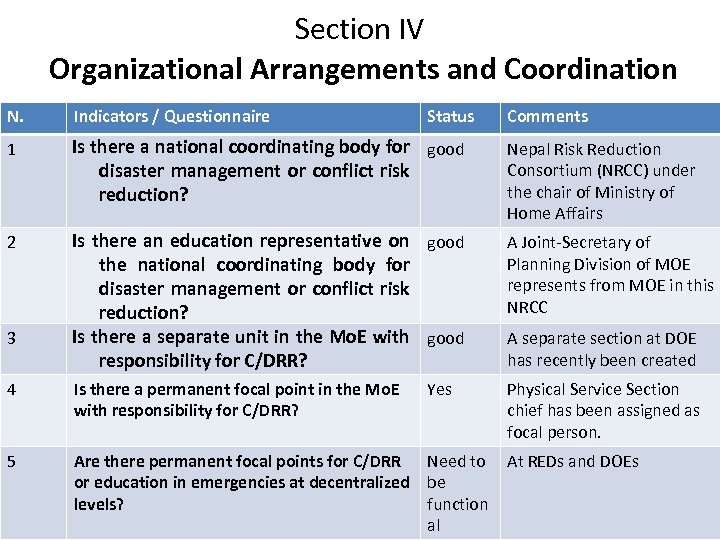 Section IV Organizational Arrangements and Coordination N. Indicators / Questionnaire 1 Is there a national coordinating body for good disaster management or conflict risk reduction? Nepal Risk Reduction Consortium (NRCC) under the chair of Ministry of Home Affairs 2 Is there an education representative on good the national coordinating body for disaster management or conflict risk reduction? Is there a separate unit in the Mo. E with good responsibility for C/DRR? A Joint-Secretary of Planning Division of MOE represents from MOE in this NRCC 4 Is there a permanent focal point in the Mo. E with responsibility for C/DRR? Physical Service Section chief has been assigned as focal person. 5 Are there permanent focal points for C/DRR Need to or education in emergencies at decentralized be levels? function al 3 Status Yes Comments A separate section at DOE has recently been created At REDs and DOEs
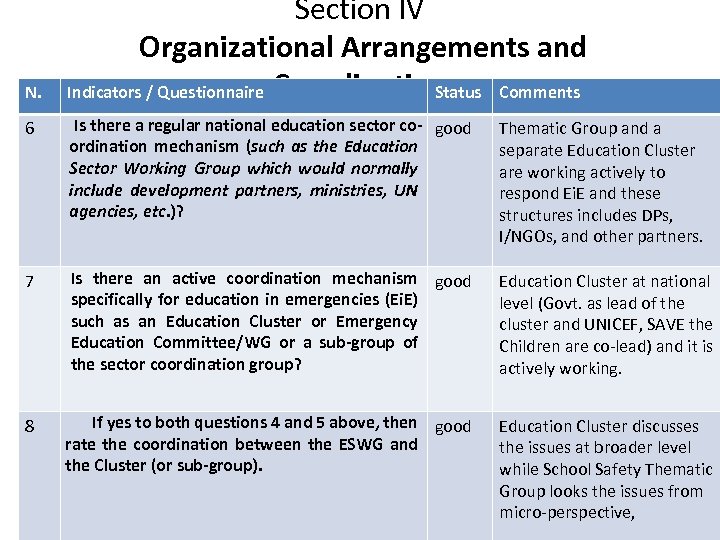 N. Section IV Organizational Arrangements and Indicators / Questionnaire Coordination Status Comments 6 Is there a regular national education sector co- good ordination mechanism (such as the Education Sector Working Group which would normally include development partners, ministries, UN agencies, etc. )? Thematic Group and a separate Education Cluster are working actively to respond Ei. E and these structures includes DPs, I/NGOs, and other partners. 7 Is there an active coordination mechanism good specifically for education in emergencies (Ei. E) such as an Education Cluster or Emergency Education Committee/WG or a sub-group of the sector coordination group? Education Cluster at national level (Govt. as lead of the cluster and UNICEF, SAVE the Children are co-lead) and it is actively working. 8 If yes to both questions 4 and 5 above, then good rate the coordination between the ESWG and the Cluster (or sub-group). Education Cluster discusses the issues at broader level while School Safety Thematic Group looks the issues from micro-perspective,
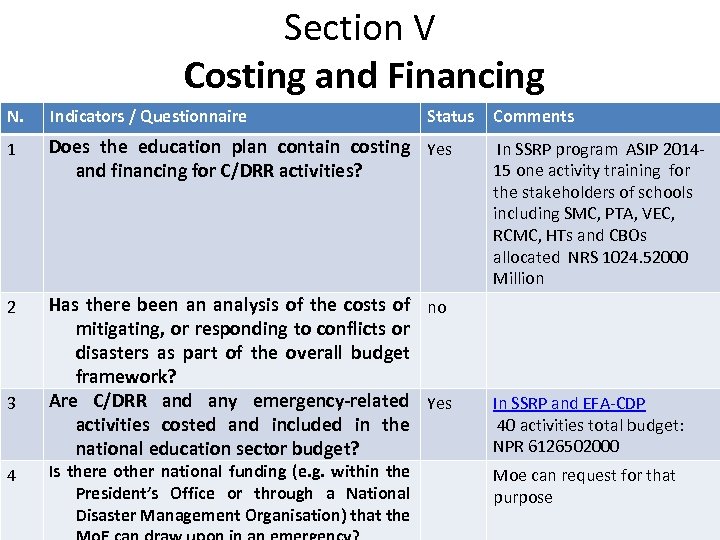 Section V Costing and Financing N. Indicators / Questionnaire 1 Does the education plan contain costing Yes and financing for C/DRR activities? 2 Has there been an analysis of the costs of no mitigating, or responding to conflicts or disasters as part of the overall budget framework? Are C/DRR and any emergency-related Yes activities costed and included in the national education sector budget? 3 4 Is there other national funding (e. g. within the President’s Office or through a National Disaster Management Organisation) that the Status Comments In SSRP program ASIP 201415 one activity training for the stakeholders of schools including SMC, PTA, VEC, RCMC, HTs and CBOs allocated NRS 1024. 52000 Million In SSRP and EFA-CDP 40 activities total budget: NPR 6126502000 Moe can request for that purpose
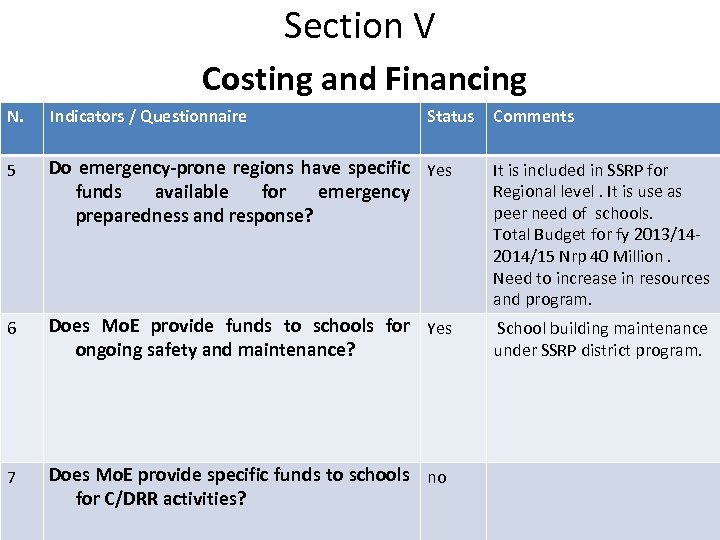 Section V Costing and Financing N. Indicators / Questionnaire Status Comments 5 Do emergency-prone regions have specific Yes funds available for emergency preparedness and response? It is included in SSRP for Regional level. It is use as peer need of schools. Total Budget for fy 2013/142014/15 Nrp 40 Million. Need to increase in resources and program. 6 Does Mo. E provide funds to schools for Yes ongoing safety and maintenance? School building maintenance under SSRP district program. 7 Does Mo. E provide specific funds to schools no for C/DRR activities?
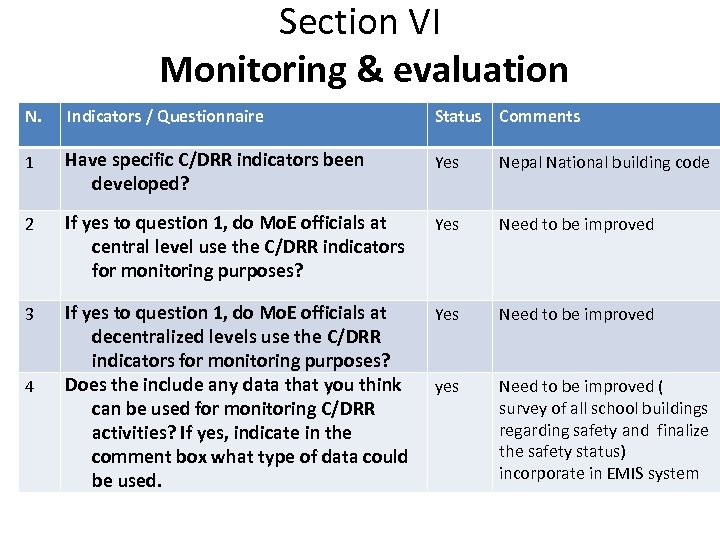 Section VI Monitoring & evaluation N. Indicators / Questionnaire Status Comments 1 Have specific C/DRR indicators been developed? Yes Nepal National building code 2 If yes to question 1, do Mo. E officials at central level use the C/DRR indicators for monitoring purposes? Yes Need to be improved 3 If yes to question 1, do Mo. E officials at decentralized levels use the C/DRR indicators for monitoring purposes? Does the include any data that you think can be used for monitoring C/DRR activities? If yes, indicate in the comment box what type of data could be used. Yes Need to be improved yes Need to be improved ( survey of all school buildings regarding safety and finalize the safety status) incorporate in EMIS system 4
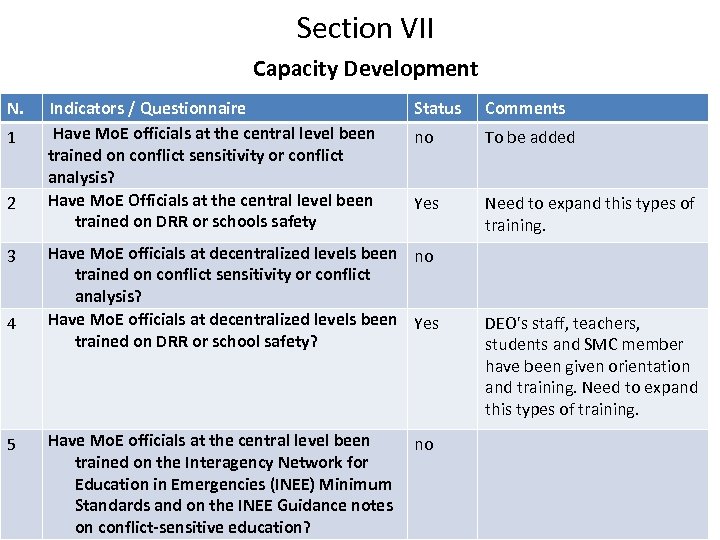 Section VII Capacity Development N. 1 2 3 4 5 Indicators / Questionnaire Have Mo. E officials at the central level been trained on conflict sensitivity or conflict analysis? Have Mo. E Officials at the central level been trained on DRR or schools safety Status Comments no To be added Yes Need to expand this types of training. Have Mo. E officials at decentralized levels been no trained on conflict sensitivity or conflict analysis? Have Mo. E officials at decentralized levels been Yes trained on DRR or school safety? Have Mo. E officials at the central level been trained on the Interagency Network for Education in Emergencies (INEE) Minimum Standards and on the INEE Guidance notes on conflict-sensitive education? no DEO's staff, teachers, students and SMC member have been given orientation and training. Need to expand this types of training.
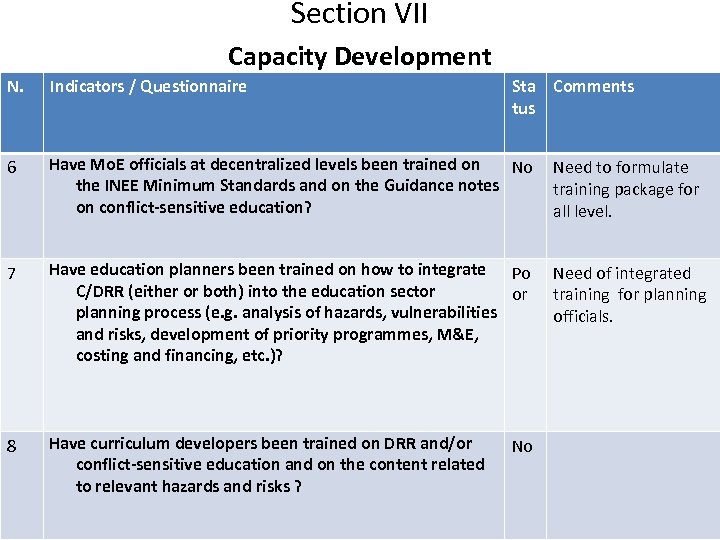 Section VII Capacity Development N. Indicators / Questionnaire Sta Comments tus 6 Have Mo. E officials at decentralized levels been trained on No the INEE Minimum Standards and on the Guidance notes on conflict-sensitive education? Need to formulate training package for all level. 7 Have education planners been trained on how to integrate Po C/DRR (either or both) into the education sector or planning process (e. g. analysis of hazards, vulnerabilities and risks, development of priority programmes, M&E, costing and financing, etc. )? Need of integrated training for planning officials. 8 Have curriculum developers been trained on DRR and/or conflict-sensitive education and on the content related to relevant hazards and risks ? No
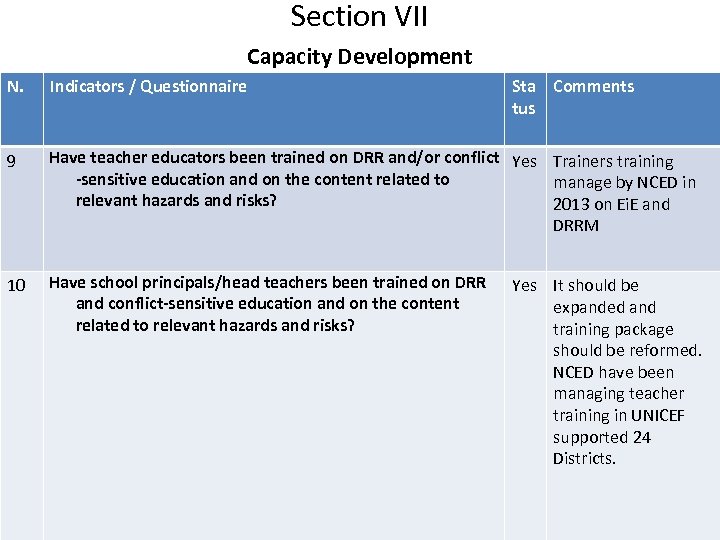 Section VII Capacity Development N. Indicators / Questionnaire Sta Comments tus 9 Have teacher educators been trained on DRR and/or conflict Yes Trainers training -sensitive education and on the content related to manage by NCED in relevant hazards and risks? 2013 on Ei. E and DRRM 10 Have school principals/head teachers been trained on DRR and conflict-sensitive education and on the content related to relevant hazards and risks? Yes It should be expanded and training package should be reformed. NCED have been managing teacher training in UNICEF supported 24 Districts.
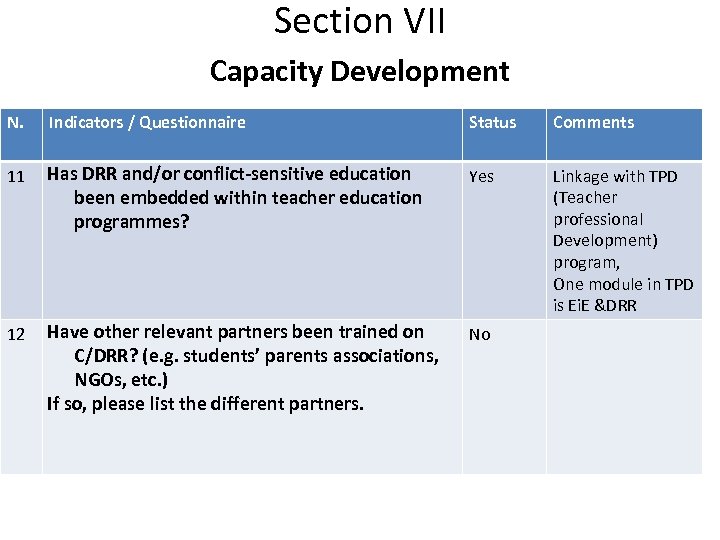 Section VII Capacity Development N. Indicators / Questionnaire Status Comments 11 Has DRR and/or conflict-sensitive education been embedded within teacher education programmes? Yes Linkage with TPD (Teacher professional Development) program, One module in TPD is Ei. E &DRR 12 Have other relevant partners been trained on C/DRR? (e. g. students’ parents associations, NGOs, etc. ) If so, please list the different partners. No
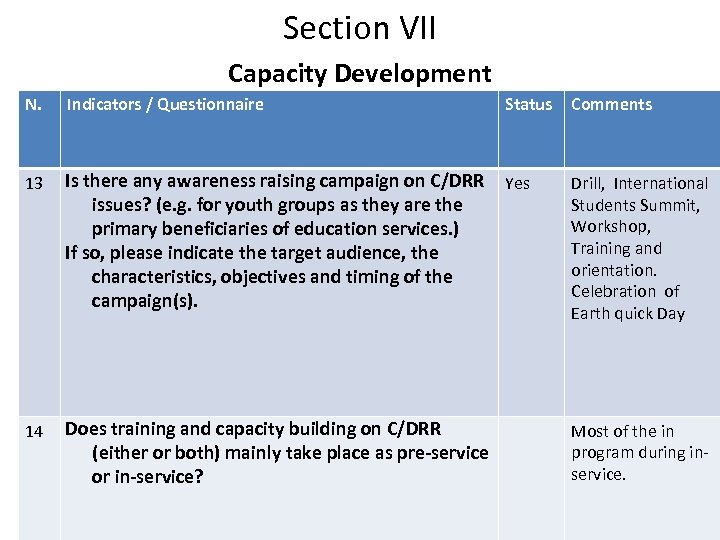 Section VII Capacity Development N. Indicators / Questionnaire Status Comments 13 Is there any awareness raising campaign on C/DRR issues? (e. g. for youth groups as they are the primary beneficiaries of education services. ) If so, please indicate the target audience, the characteristics, objectives and timing of the campaign(s). Yes Drill, International Students Summit, Workshop, Training and orientation. Celebration of Earth quick Day 14 Does training and capacity building on C/DRR (either or both) mainly take place as pre-service or in-service? Most of the in program during inservice.
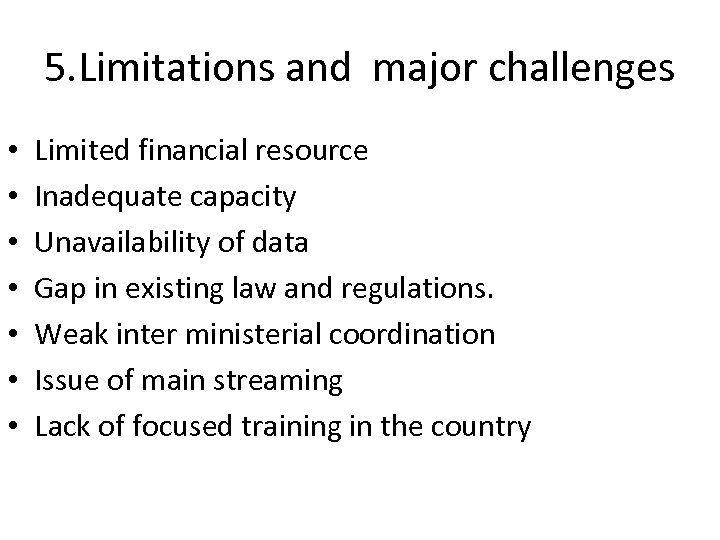 5. Limitations and major challenges • • Limited financial resource Inadequate capacity Unavailability of data Gap in existing law and regulations. Weak inter ministerial coordination Issue of main streaming Lack of focused training in the country
 5. Limitations and major challenges contd…. • Ensuring delivery of the DRR message and life skills to the children • Ensuring the inclusion of the vulnerable groups (children with disabilities, pre-primary aged children, Out of School Children, etc. ) • Mo. E is working with different DRR activities designated different personnel • Plan, implementation and Quality Implementation of Retrofitting
 6. Usefulness of the self monitoring and reporting questionnaire • For systematizing the data – Nepal is a disaster prone country. Due to its geographical and other reasons, information can not be obtained in time and adequately. – The information from this questionnaire will be integrated into the existing EMIS and use for planning, coordinating and monitoring and assessment • However the questionnaire need to be adapted according to the Nepalese context.
 7. Recommendation on Monitoring Tools • Contextualize the self monitoring and reporting questionnaire • Infuse/integrate the C/DRR into the curricula • Integrating the DRR related questionnaire into the existing EMIS after testing and piloting • Translate the questionnaire into the local languages • Enhancing and strengthening the coordination and networking
 Thank You!