


 Скачать презентацию Country Presentation Sri Lanka J R W Dissanayake
04559913b5ceca519c2c95b7fbe09016.ppt
- Количество слайдов: 18
 Country Presentation Sri Lanka J R W Dissanayake, Secretary Ministry of Environment, Sri Lanka Anura Jayatilake, Director, ( Envt. Economics & Global Affairs) Ministry of Environment , Sri Lanka
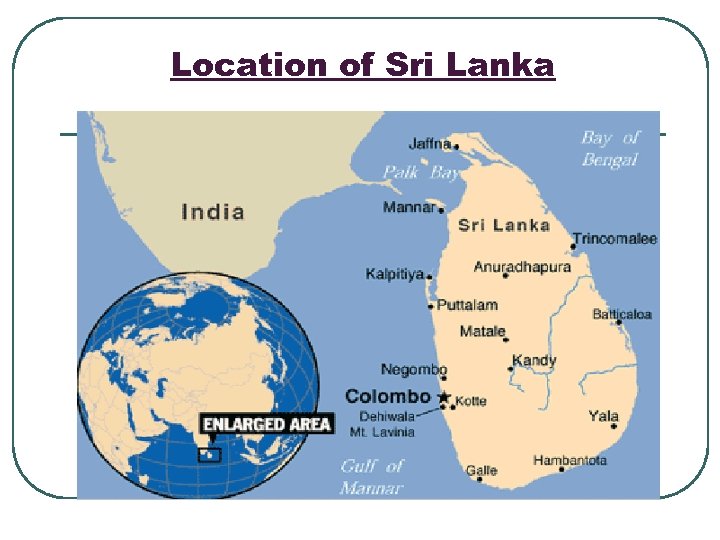 Location of Sri Lanka
 Presentation Outline l l l l Introduction Sri Lanka Introduction to the Climate Change Activities Introduction to the Clean Development Mechanism National Sustainable Development Priorities CDM Sectoral Opportunities CDM Approval Procedure Further Measures Needed
 Introduction to the Climate Change Activities l l l Ratified UNFCCC in 1994 First National Communication submitted 2000 Green house Gas Inventory -1995 63 Studies on Climate Change conducted Center for Climate Change Studies Established at Met. Department
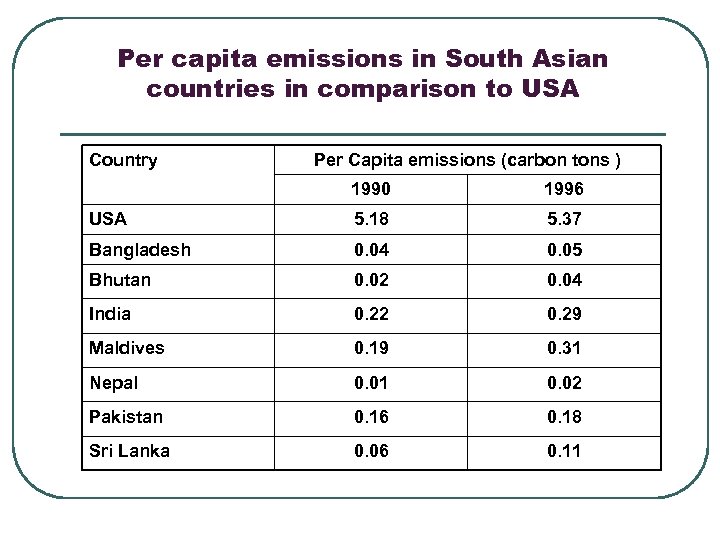 Per capita emissions in South Asian countries in comparison to USA Country Per Capita emissions (carbon tons ) 1990 1996 USA 5. 18 5. 37 Bangladesh 0. 04 0. 05 Bhutan 0. 02 0. 04 India 0. 22 0. 29 Maldives 0. 19 0. 31 Nepal 0. 01 0. 02 Pakistan 0. 16 0. 18 Sri Lanka 0. 06 0. 11
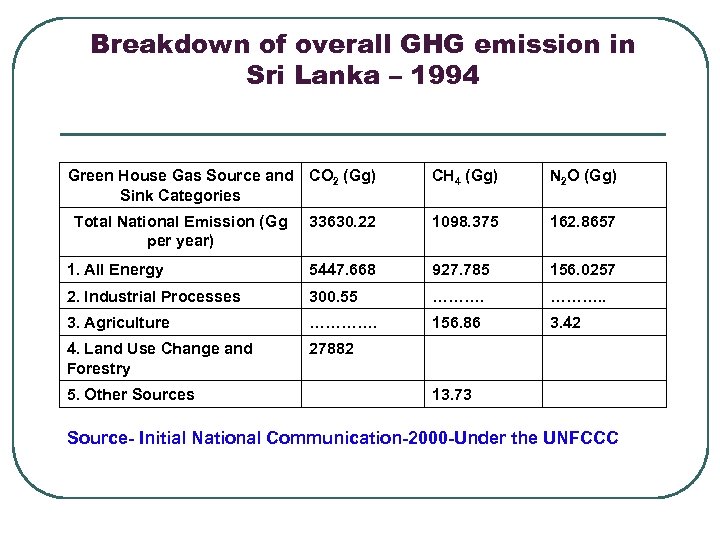 Breakdown of overall GHG emission in Sri Lanka – 1994 Green House Gas Source and CO 2 (Gg) Sink Categories CH 4 (Gg) N 2 O (Gg) 33630. 22 1098. 375 162. 8657 1. All Energy 5447. 668 927. 785 156. 0257 2. Industrial Processes 300. 55 ………. . 3. Agriculture …………. 156. 86 3. 42 4. Land Use Change and Forestry 27882 Total National Emission (Gg per year) 5. Other Sources 13. 73 Source- Initial National Communication-2000 -Under the UNFCCC
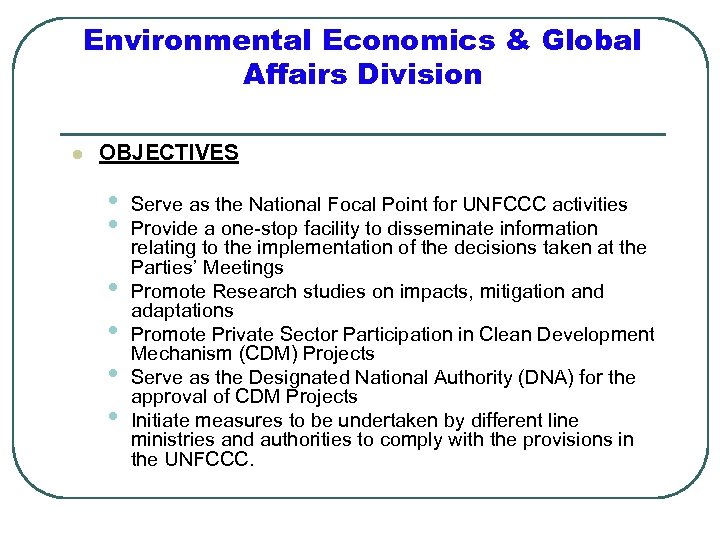 Environmental Economics & Global Affairs Division l OBJECTIVES • • • Serve as the National Focal Point for UNFCCC activities Provide a one-stop facility to disseminate information relating to the implementation of the decisions taken at the Parties’ Meetings Promote Research studies on impacts, mitigation and adaptations Promote Private Sector Participation in Clean Development Mechanism (CDM) Projects Serve as the Designated National Authority (DNA) for the approval of CDM Projects Initiate measures to be undertaken by different line ministries and authorities to comply with the provisions in the UNFCCC.
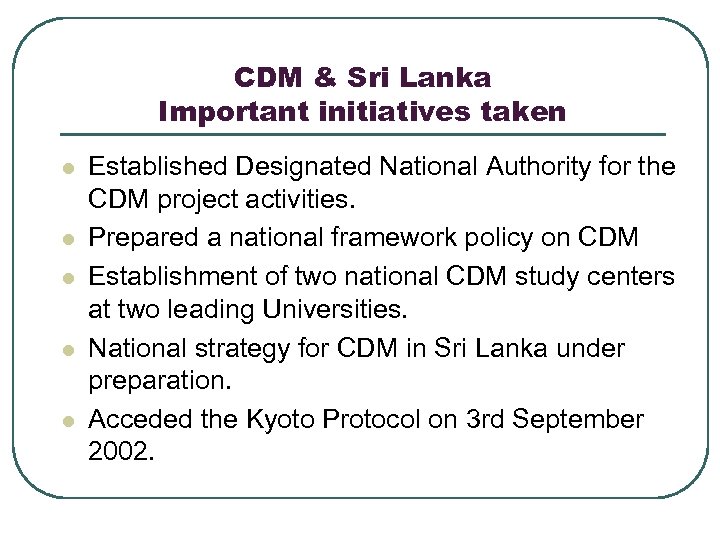 CDM & Sri Lanka Important initiatives taken l l l Established Designated National Authority for the CDM project activities. Prepared a national framework policy on CDM Establishment of two national CDM study centers at two leading Universities. National strategy for CDM in Sri Lanka under preparation. Acceded the Kyoto Protocol on 3 rd September 2002.
 Partners of the National Expert Committee on CDM l l l Ministry of Environment Ministry of Power and Energy Ministry of Agriculture Ministry of Science and Technology Ministry of Industries Forest Department Meteorology Department Universities Ministry of Transport and Highways Private Sector Non Governmental Organization
 National Policy on Clean Development Mechanism l Objective l To contribute to sustainable development through developing and establishing the institutional, financial, human resources and legislative framework necessary to participate in Clean Development Mechanism (CDM) activities under the Kyoto Protocol while developing a mechanism for trading “Certified Emissions Reductions” (CER) and “Removal Units” (RMU) earned through CDM activities.
 CDM Implementation Criteria l l l The DNA (Ministry /Environment) shall ensure that the project developers follow the guidelines of the IPCC and the UNFCCC Government shall not be held responsible for delivery of the CER and RU contracted by CDM projects shall be subject to the Environment Impact Assessment (EIA) process and other applicable laws, as relevant.
 Eligibility of CDM Participation in Sri Lanka l l l CDM Project proposals shall be evaluated based on their feasibility and national benefits. Proponents of CDM projects shall be entities incorporated in Sri Lanka Small CDM projects - Bonn Agreement adopted at the (COP-6).
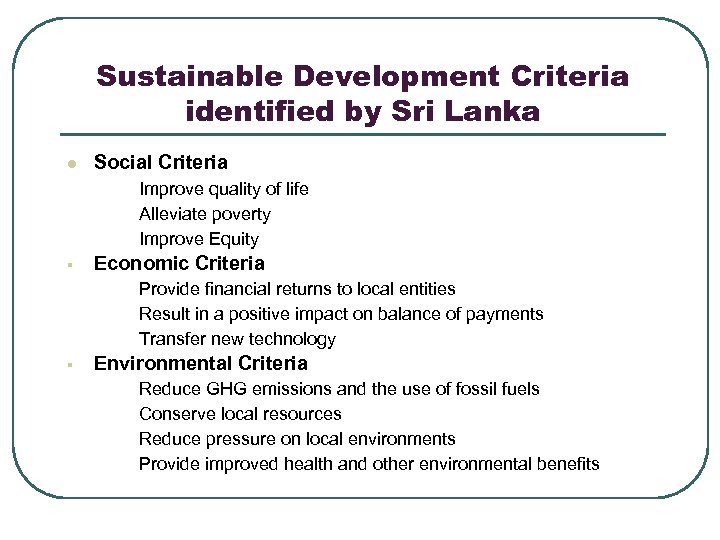 Sustainable Development Criteria identified by Sri Lanka l Social Criteria Improve quality of life Alleviate poverty Improve Equity § Economic Criteria Provide financial returns to local entities Result in a positive impact on balance of payments Transfer new technology § Environmental Criteria Reduce GHG emissions and the use of fossil fuels Conserve local resources Reduce pressure on local environments Provide improved health and other environmental benefits
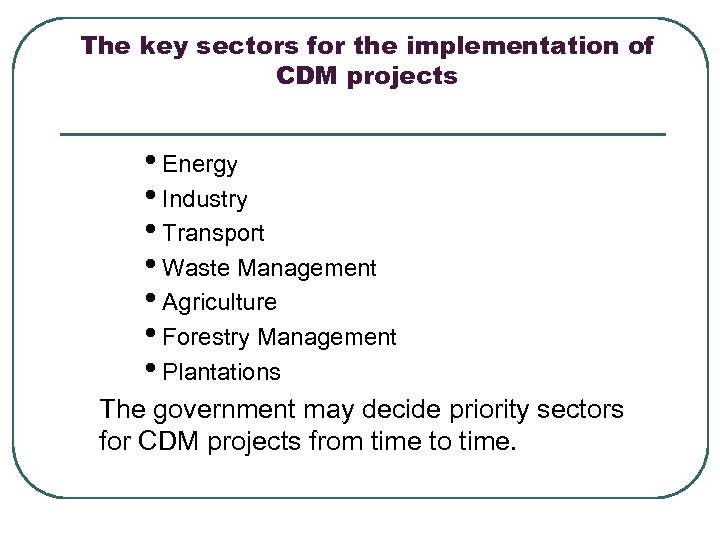 The key sectors for the implementation of CDM projects • Energy • Industry • Transport • Waste Management • Agriculture • Forestry Management • Plantations The government may decide priority sectors for CDM projects from time to time.
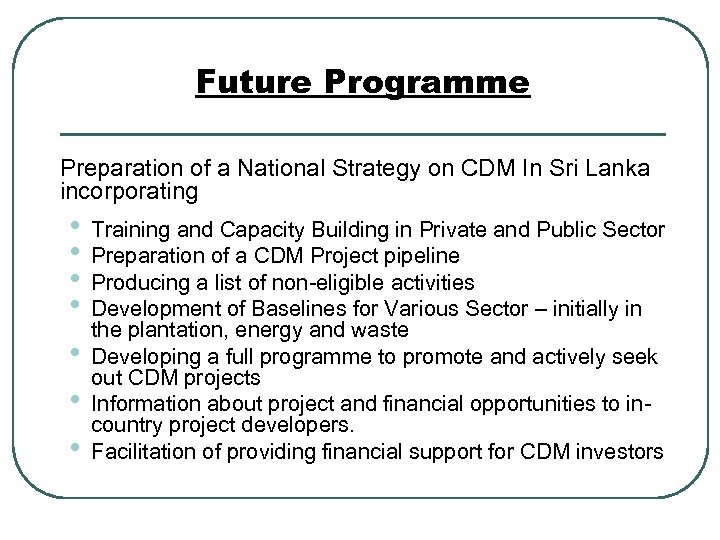 Future Programme Preparation of a National Strategy on CDM In Sri Lanka incorporating • • Training and Capacity Building in Private and Public Sector Preparation of a CDM Project pipeline Producing a list of non-eligible activities Development of Baselines for Various Sector – initially in the plantation, energy and waste Developing a full programme to promote and actively seek out CDM projects Information about project and financial opportunities to incountry project developers. Facilitation of providing financial support for CDM investors
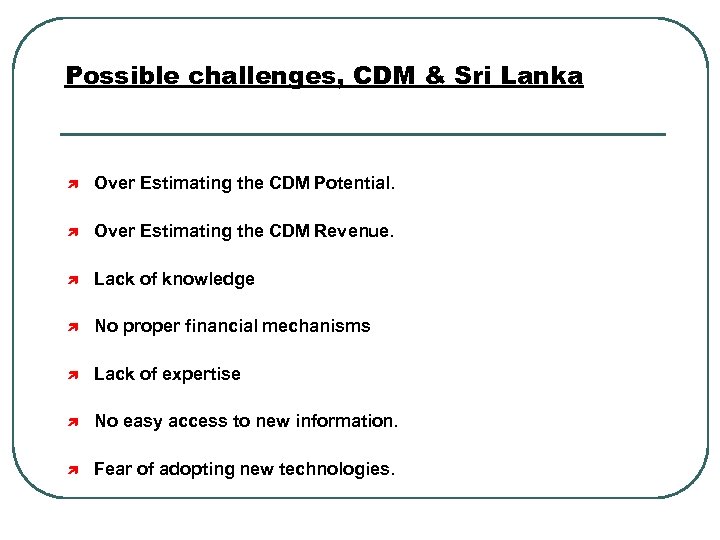 Possible challenges, CDM & Sri Lanka ì Over Estimating the CDM Potential. ì Over Estimating the CDM Revenue. ì Lack of knowledge ì No proper financial mechanisms ì Lack of expertise ì No easy access to new information. ì Fear of adopting new technologies.
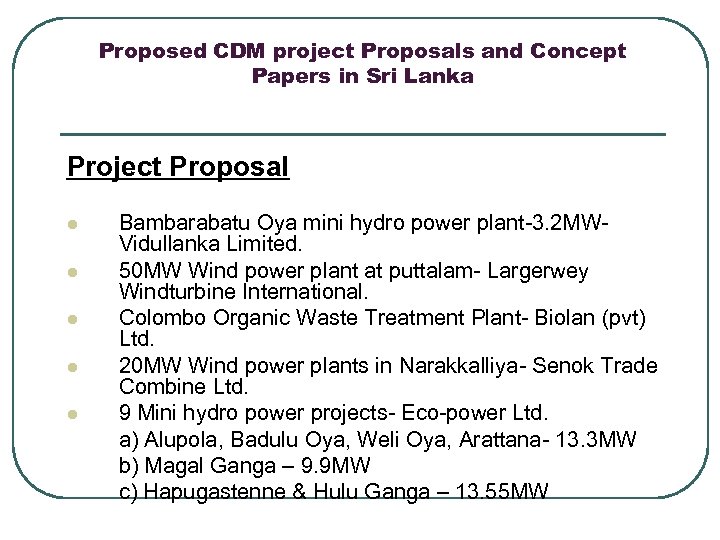 Proposed CDM project Proposals and Concept Papers in Sri Lanka Project Proposal l l Bambarabatu Oya mini hydro power plant-3. 2 MWVidullanka Limited. 50 MW Wind power plant at puttalam- Largerwey Windturbine International. Colombo Organic Waste Treatment Plant- Biolan (pvt) Ltd. 20 MW Wind power plants in Narakkalliya- Senok Trade Combine Ltd. 9 Mini hydro power projects- Eco-power Ltd. a) Alupola, Badulu Oya, Weli Oya, Arattana- 13. 3 MW b) Magal Ganga – 9. 9 MW c) Hapugastenne & Hulu Ganga – 13. 55 MW
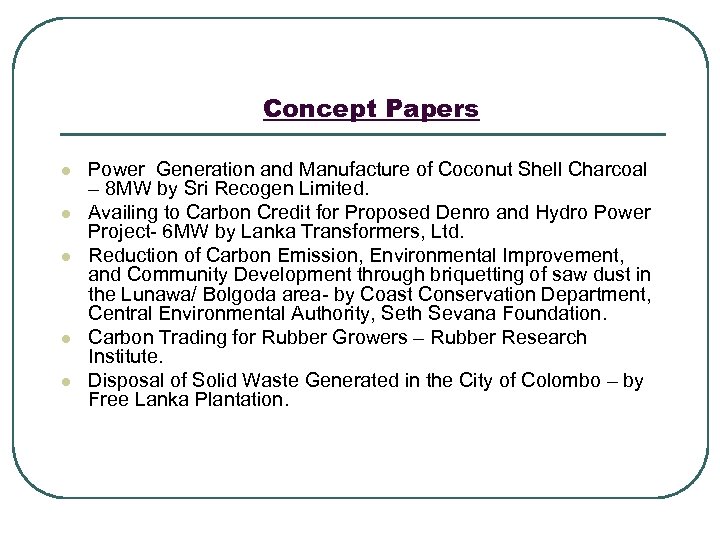 Concept Papers l l l Power Generation and Manufacture of Coconut Shell Charcoal – 8 MW by Sri Recogen Limited. Availing to Carbon Credit for Proposed Denro and Hydro Power Project- 6 MW by Lanka Transformers, Ltd. Reduction of Carbon Emission, Environmental Improvement, and Community Development through briquetting of saw dust in the Lunawa/ Bolgoda area- by Coast Conservation Department, Central Environmental Authority, Seth Sevana Foundation. Carbon Trading for Rubber Growers – Rubber Research Institute. Disposal of Solid Waste Generated in the City of Colombo – by Free Lanka Plantation.