 Скачать презентацию Country Presentation Kenya Professor George Godia EBS Permanent
e9bdc2532db0855df4e583f5fd08c8b7.ppt
- Количество слайдов: 55




Country Presentation: Kenya Professor George Godia EBS Permanent Secretary, Ministry of Education Dr Caroline Wanjiru Kariuki Director, Kenya Education Management Institute UNESCO School Leadership Experts Meeting, Paris, France, 14 -15 January 2013
Outline • Background: International Commitments, National Frameworks, and Education Frameworks and Programme • The Status of Education: Achievements and Challenges as determined in the 2001 -2010 EFA National Assessment • School Leadership: Definition, Policy, Current Status, Programme, Challenges and Training Needs 2

BACKGROUND 3

Background: International Commitments • Signatory to major declarations and conventions, such as the Universal Declaration of Human Rights, the Convention on the Rights of the Child, and CEDAW • Commitment to, and action towards, the achievement of the Millennium Development Goals and Education for All by 2015
Background: National Frameworks • Vision 2030: Critical role of education and training to transform Kenya into a middleincome country that provides high quality life for all citizens by 2030. • The Constitution of 2010: The right of all Kenyans to education – every child to free, compulsory basic education; persons with disabilities to educational institutions and facilities; and young people (15 -35 Age Group) to access relevant training
Background: National Frameworks • The Basic Education Bill, 2012: An Act of Parliament to make provisions for the promotion and regulation of free and compulsory basic education; to provide for accreditation, registration, governance and management of institutions of basic education; and for connected purposes. 6
Background: Education Policy Framework/Programme • Sessional Paper No 14 on Reforming Education and Training Sector, 2012 : a sector-wide framework to realign education and training sector to Vision 2030 and the Constitution of 2010. • The 2 nd Medium Term Plan for Vision 2030 and National Education Sector Support Programme (NESSP) for 2013/14 -2017/18: a five-year plan and programme to implement the Basic Education Act and operationalize the Policy Framework
National Education Sector Support Programme (NESSP) § A five-year (2013/2014 – 2017/2018) investment programme using SWAp and informed by the EFA National Assessment and the Kenya Education Sector Programme (2005 -2010); § The NESSP addresses quality, equity, access and governance issues in the education sector 8

THE STATUS OF EDUCATION IN KENYA: ACHIEVEMENTS, ISSUES AND CHALLENGES AS IDENTIFIED IN THE 2001 -2010 NATIONAL EDUCATION FOR ALL ASSESSMENT 9
Achievements • Sustained commitment to, and investment in, education and training • Major policies, frameworks, standards and curricula in place • Investment in the teaching force • Significant expansion, in particular in basic education, as a result of FPE and FDSE • Greater concern for quality of education 10
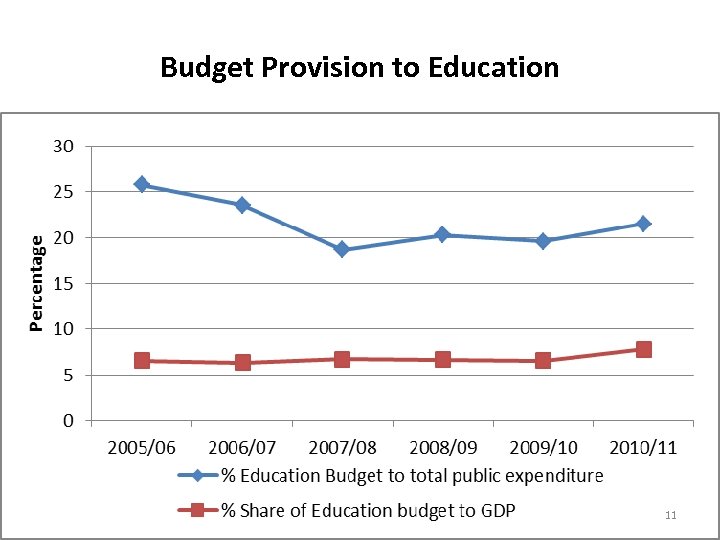
Budget Provision to Education Average 21. 5 % of the public expenditure, and 7% Share of GDP 11
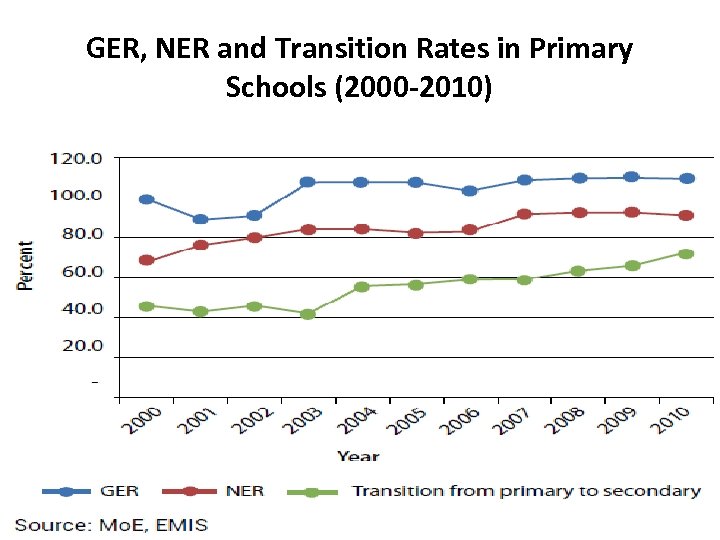
GER, NER and Transition Rates in Primary Schools (2000 -2010) 12
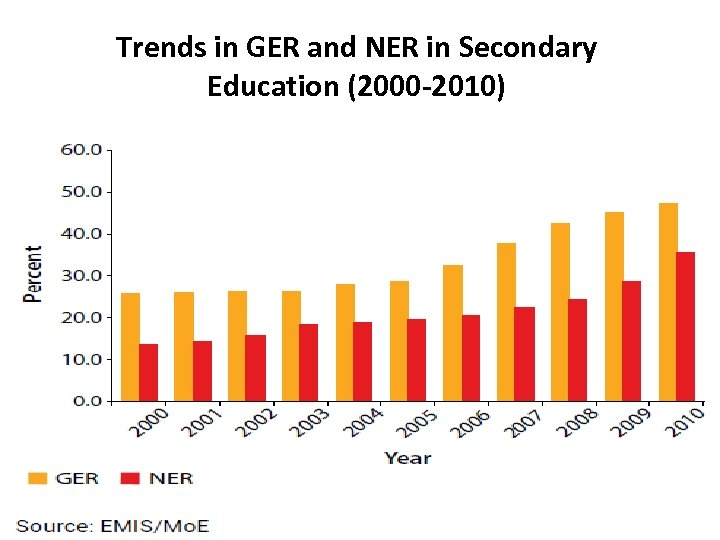
Trends in GER and NER in Secondary Education (2000 -2010) 13
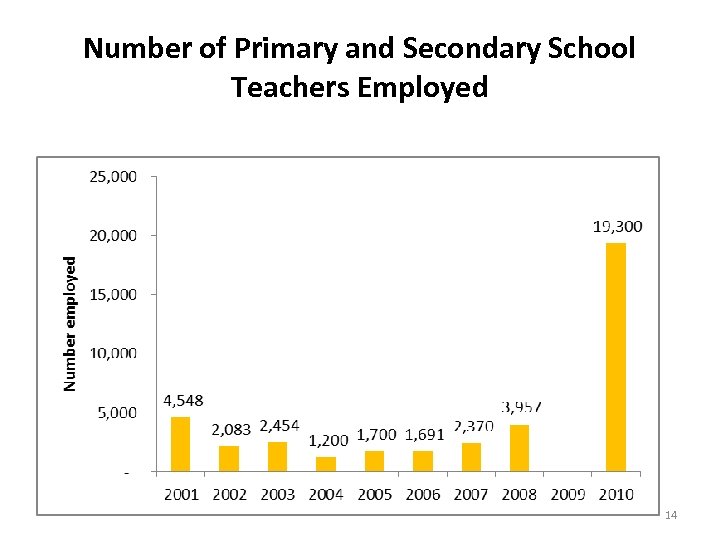
Number of Primary and Secondary School Teachers Employed 14
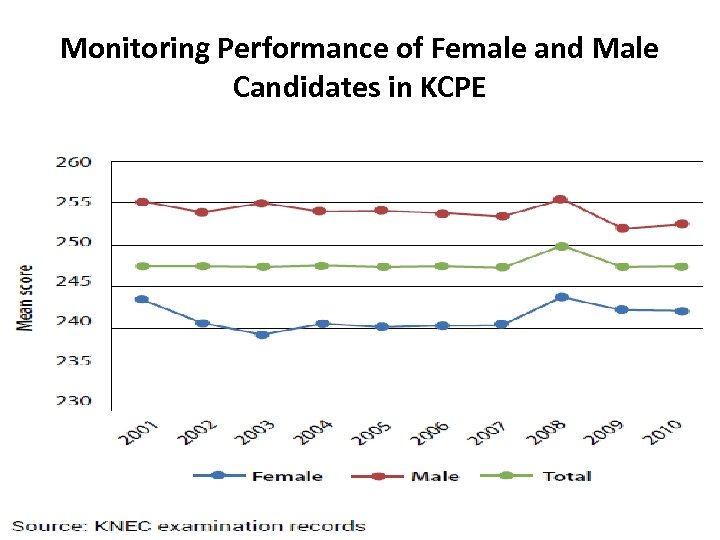
Monitoring Performance of Female and Male Candidates in KCPE 15
Issues and Constraints • Expanded vision of education and learning: from early childhood and adulthood • Concepts and definitions – not clearly defined/multiple definitions (ECCE, Literacy, lifeskills, lifelong learning, etc. ) • Data: availability and quality, lack of disaggregation for certain data, and quantitative vs. qualitative • Significant disparities (geographical, gender, socioeconomic) • Emerging issues (HIV and AIDS, peace, refugee education, etc. ) 16
Issues and constraints • Goals that are still a challenge to monitor & measure – ECCE, Lifeskills & Literacy • Intra-sectoral coordination (UBE, quality) • Inter-sectoral and –ministerial coordination and partnership with the civil society (ECCE, life skills and Literacy) • Implementation capacities at all levels • Governance and management issues 17
SCHOOL LEADERSHIP: DEFINITION, POLICY, CURRENT STATUS, ISSUES AND CHALLENGES AND NEEDS 18
Definition of a head teacher/school leader “Means the lead educator or administrator in a primary school level education institution appointed by the Commission and as such responsible for the implementation of education policy guidelines and professional practices” (Teacher Service Commission Act, 2012) 19
Definition of a principal/school leader “Means the lead educator or administrator in a post- primary school level education institution appointed by the Teacher Service Commission and as such responsible for the implementation of education policy guidelines and professional practices” (Teacher Service Commission Act, 2012) 20
Policy on teacher/leadership management • A Sessional Paper No 14 on Reforming Education and Training Sector 2012 undertakes to ‘Develop a Teacher Development and Management Policy that will institute Continuous Professional Development (CPD) for teachers including those in leadership. • In-service training programmes for education leadership concerned with curriculum management and delivery will be strengthened. 21
Current Status • Headship is a deployment position on basis of seniority and qualification, but not as a result of training in leadership. • There a variety of leadership trainers both state and non-state • The courses offered are unaccredited and are not properly harmonized 22
Current Status, cont’d • The School Empowerment Programme (SEP) is ongoing. This is a blended learning programme focusing on strengthening management and leadership capacity and pedagogic effectiveness in all public primary schools. • Primary and Secondary Education leaders undergo a Diploma in education management through distance and e-learning media • Teacher Unions, and the Kenya Secondary Heads Association are also offering some courses 23
Issues and Challenges • Inadequate school infrastructure • Teacher shortages by 38, 468 teachers for primary schools and 36, 574 for post-primary institutions bringing the shortage to 75, 042 and as such teachers have to take a heavy teaching load ad do administration • Interference by stakeholders in the management of schools 24
Issues and Challenges, cont’d • Inadequate application of technology in school management. • inadequate teacher development strategies to prepare school administrators • Non accreditation of leadership courses offered by different providers • Lack of harmonization in the provision of leadership programs 25
Issues and Challenges, cont’d • Weak Private- Partnership framework. • Exposure of learners to unsuitable social media • Teacher training curriculum does not adequately prepare school leaders • Elusive rationalization of staffing at school level 26
Issues and Challenges, cont’d • Weak capacity in resources management • Weak curriculum delivery supervisory competencies • Lack of innovative resource mobilization strategies thus over-reliance on government disbursements 27
Leadership Strategies proposed under NESSP • Recruitment of adequate number of teachers for all public institutions. • Building capacity of education administrators on financial management • Development of a framework for teacher career planning and development • Build capacity of leaders on financial management and use of ICT 28
Leadership Strategies proposed under NESSP • Establishment of TSC Resource Centres in the counties. • Establishment of institutional based quality standards management (QSM) in curriculum implementation and delivery through performance appraisal system and performance contracting. • Standardized Monitoring and Evaluation (M&E) framework for Teacher management activities 29
PRINCIPAL/SCHOOL LEADERSHIP THE KEMI, ISSSUES AND CHALLENGES AND TRAINING NEEDS 30
What is the Kenya Education Management Institute (KEMI)? • KEMI is the Capacity Building Agency of the Ministry of Education mandated to undertake management training, research and consultancy. • Target group: Education Officers, QASOs, Principals, Head teachers, Deans, Heads of Department's, Senior Teachers, BOGs, SMCs, Specialized staff e. g. . Accounts clerks
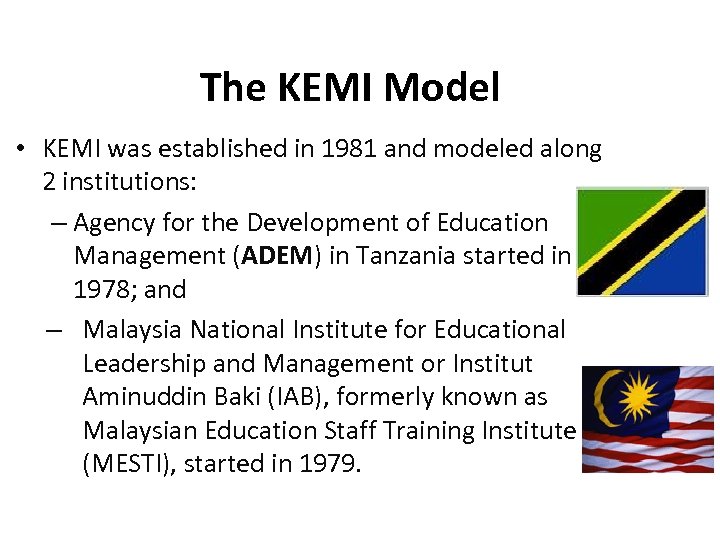
The KEMI Model • KEMI was established in 1981 and modeled along 2 institutions: – Agency for the Development of Education Management (ADEM) in Tanzania started in 1978; and – Malaysia National Institute for Educational Leadership and Management or Institut Aminuddin Baki (IAB), formerly known as Malaysian Education Staff Training Institute (MESTI), started in 1979.
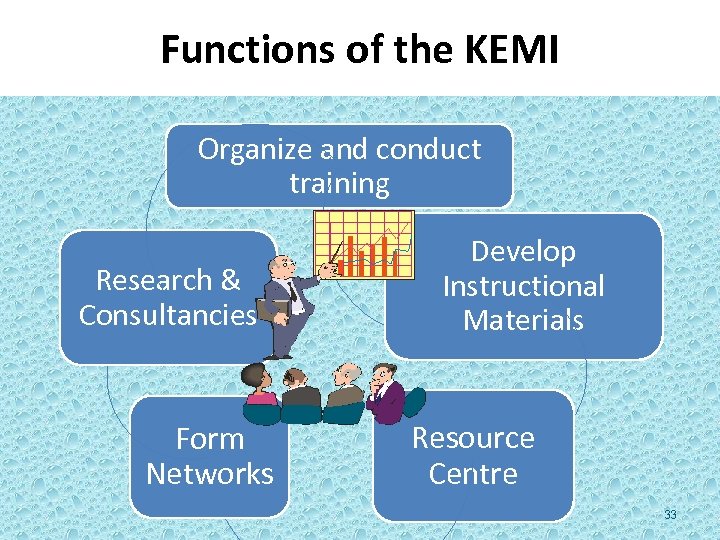
Functions of the KEMI Organize and conduct training Research & Consultancies Form Networks Develop Instructional Materials Resource Centre 33
Training Targets set by MOE – The Kenya Education Sector Support Program (KESSP) was made up of 23 investment programs. – KEMI was in charge of the capacity building investment program of KESSP. – Under the KESSP the institute was given a target to train 45000 education managers within a 5 year period (2005 -2010).
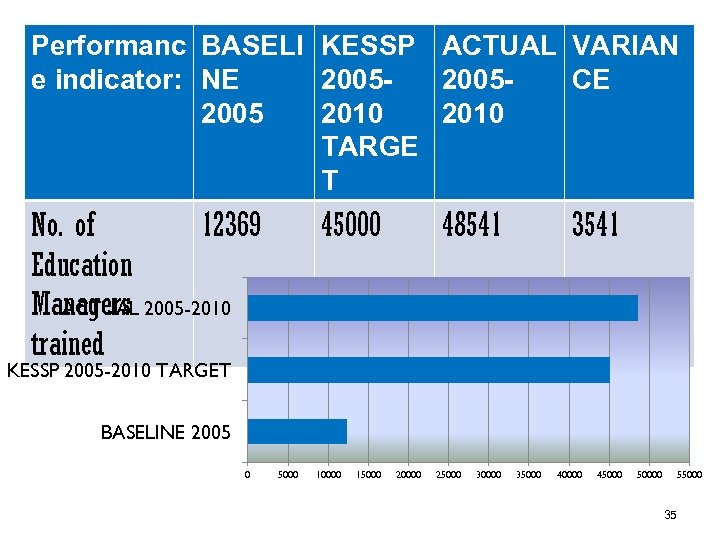
Performanc BASELI KESSP ACTUAL VARIAN e indicator: NE 2005 CE 2005 2010 TARGE T No. of 12369 Education ACTUAL Managers 2005 -2010 trained 45000 48541 3541 KESSP 2005 -2010 TARGET BASELINE 2005 0 5000 10000 15000 20000 25000 30000 35000 40000 450000 55000 35
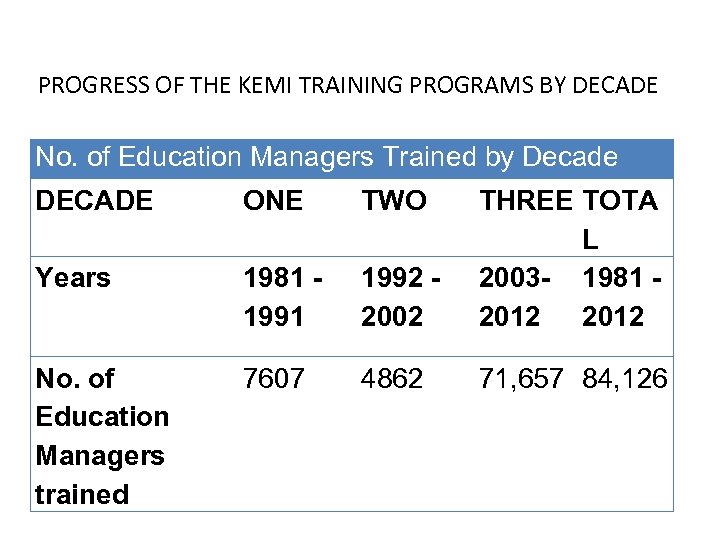
PROGRESS OF THE KEMI TRAINING PROGRAMS BY DECADE No. of Education Managers Trained by Decade DECADE ONE TWO Years 1981 - 1991 1992 - 2002 THREE TOTA L 2003 - 1981 - 2012 No. of Education Managers trained 7607 4862 71, 657 84, 126
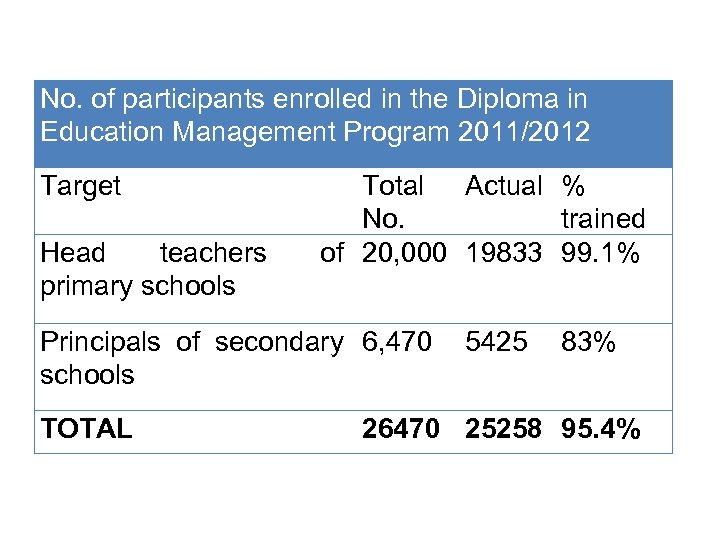
No. of participants enrolled in the Diploma in Education Management Program 2011/2012 Target Head teachers primary schools Total Actual % No. trained of 20, 000 19833 99. 1% Principals of secondary 6, 470 schools TOTAL 5425 83% 26470 25258 95. 4%
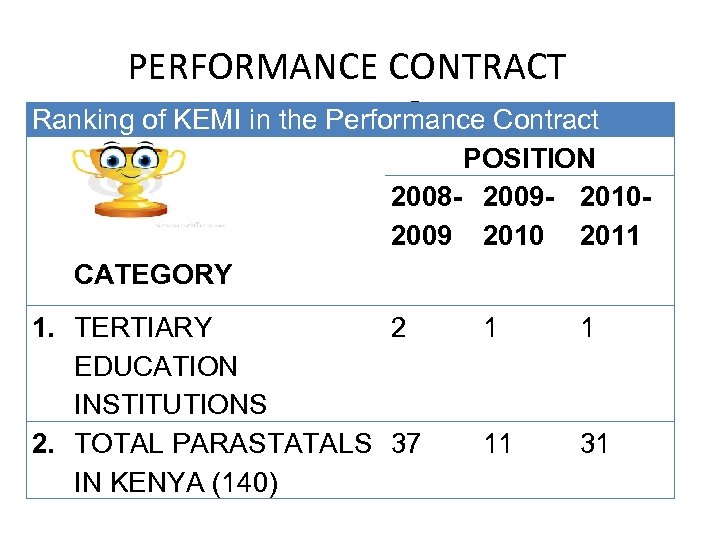
PERFORMANCE CONTRACT EVALUATION Ranking of KEMI in the Performance Contract POSITION 2008 - 2009 - 20102009 2010 2011 CATEGORY 1. TERTIARY 2 EDUCATION INSTITUTIONS 2. TOTAL PARASTATALS 37 IN KENYA (140) 1 1 11 31
LEADERSHIP ISSUES RELEVANT TO TRAINING
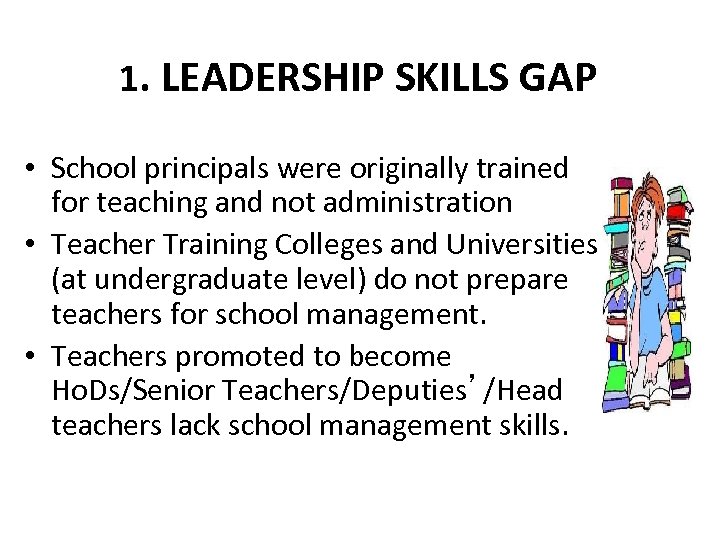
1. LEADERSHIP SKILLS GAP • School principals were originally trained for teaching and not administration • Teacher Training Colleges and Universities (at undergraduate level) do not prepare teachers for school management. • Teachers promoted to become Ho. Ds/Senior Teachers/Deputies’/Head teachers lack school management skills.
2. GOOD GOVERNANCE AND ACCOUNTABILITY • In August 2010, the Republic of Kenya enacted a new constitution, which is progressive and rights-based offering an opportunity to build a human rights state and society. • It introduces a devolved government for greater citizen participation and greater accountability from all duty bearers at all levels.
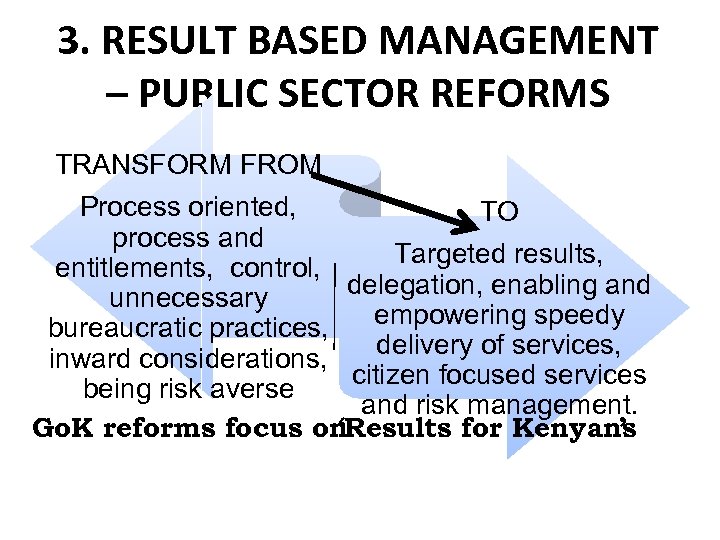
3. RESULT BASED MANAGEMENT – PUBLIC SECTOR REFORMS TRANSFORM FROM Process oriented, TO process and Targeted results, entitlements, control, delegation, enabling and unnecessary empowering speedy bureaucratic practices, inward considerations, delivery of services, citizen focused services being risk averse and risk management. Go. K reforms focus on ‘Results for Kenyans ’
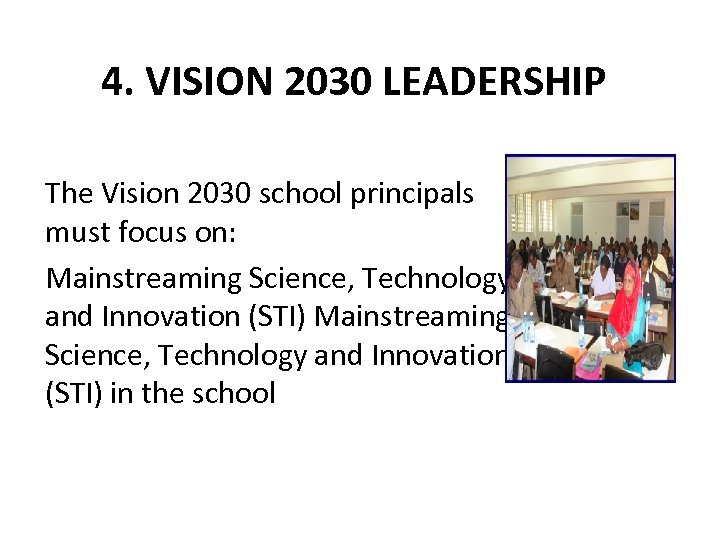
4. VISION 2030 LEADERSHIP The Vision 2030 school principals must focus on: Mainstreaming Science, Technology and Innovation (STI) in the school
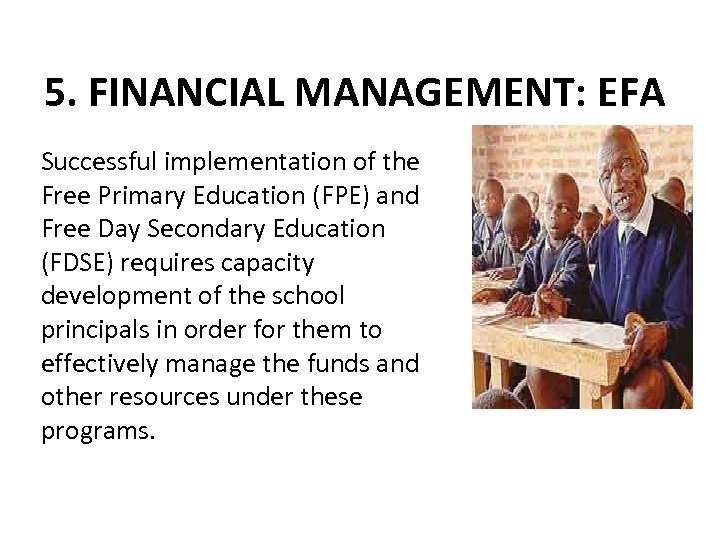
5. FINANCIAL MANAGEMENT: EFA Successful implementation of the Free Primary Education (FPE) and Free Day Secondary Education (FDSE) requires capacity development of the school principals in order for them to effectively manage the funds and other resources under these programs.
CHALLENGES BASED ON KEMI SURVEY
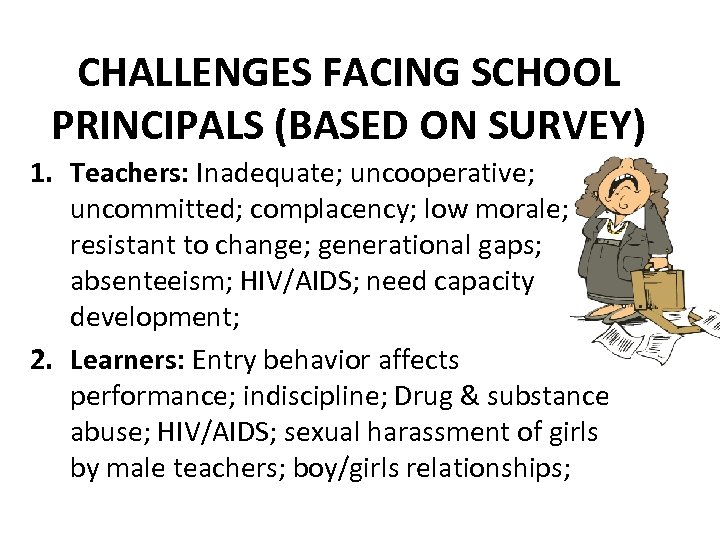
CHALLENGES FACING SCHOOL PRINCIPALS (BASED ON SURVEY) 1. Teachers: Inadequate; uncooperative; uncommitted; complacency; low morale; resistant to change; generational gaps; absenteeism; HIV/AIDS; need capacity development; 2. Learners: Entry behavior affects performance; indiscipline; Drug & substance abuse; HIV/AIDS; sexual harassment of girls by male teachers; boy/girls relationships;
CHALLENGES FACING SCHOOL PRINCIPALS cont. 5. Funding: Inadequate; delayed remittances; delay in fee payment 6. Facilities: Inadequate facilities e. g. classes, lab equipment, ICT rooms/equipment; 7. Leadership skills: Principals need training in school management, financial management, law, ICT etc.
CHALLENGES FACING SCHOOL PRINCIPALS cont. 11. Public policies: Rigid procurement regulations; ineffective policies/directives 12: School Management (BOG/PTA/SMC): Uncooperative; uneducated; 13: Interference: politicians; community; sponsors 14. Technical education: Apathy to technical/tertiary education
TRAINING NEEDS
Training Needs 1. Devolution of government services 2. Good governance and accountability 3. Result based Management Public Sector reforms 4. Vision 2030 – Mainstreaming STIs 5. Financial Management
Training Needs 6. Public Administration 7. Organization Climate 8. Student discipline 9. Pedagogical leadership 10. Child friendly schools 11. ICT 12. Contemporary issues
CAPACITY DEVELOPMENT - PARADIGM SHIFT 1. Capacity at the individual level – e. g. Training Personnel for leadership transformation - Financial, Procurement, and Good Governance training 2. Capacity building at the organizational level: e. g. Develop strategic plans; incentive and reward systems; Develop the capacity to monitor performance in the process of building capacity and service delivery 3. Capacity building methodologies: e. g. Devolved delivery methodologies; use of distance/e-learning methodology
You must be the change you wish to see in the world (Mahtma Gandhi) 53

54

THANK YOU 55
Скачать презентацию Country Presentation Kenya Professor George Godia EBS Permanent
e9bdc2532db0855df4e583f5fd08c8b7.ppt