


 Скачать презентацию COUNTRY PRESENTATION An Overview Of Food Nutrition
4cea4568563c0011019ea43c793cd1b0.ppt
- Количество слайдов: 42
 COUNTRY PRESENTATION An Overview Of Food, Nutrition & Health in Islamic Republic of Pakistan Intercountry Technical Consultation on National Food based Dietary Guidelines. 6 th to 9 th Dec. 2004 WHO-EMRO, Cairo, Egypt Presented By: Prof. Dr. Perveen Liaqat 1
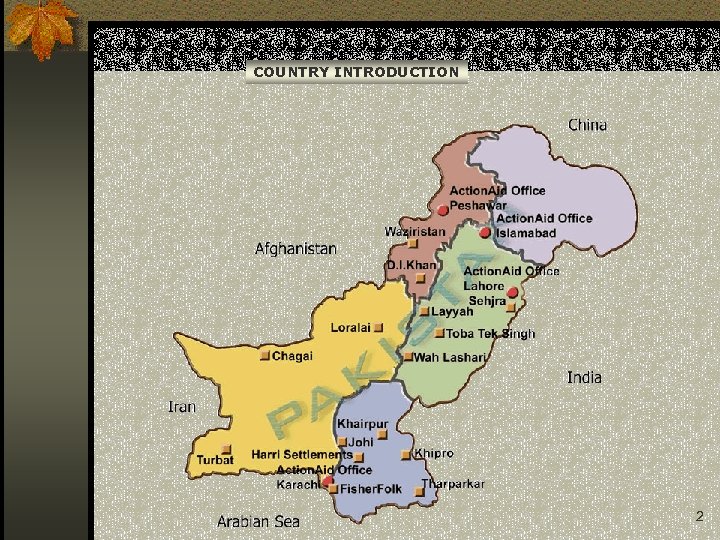 COUNTRY INTRODUCTION 2
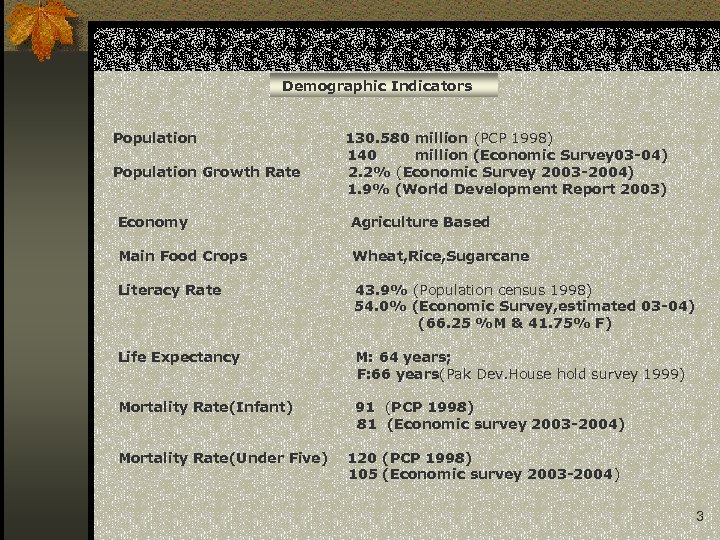 Demographic Indicators Population Growth Rate 130. 580 million (PCP 1998) 140 million (Economic Survey 03 -04) 2. 2% (Economic Survey 2003 -2004) 1. 9% (World Development Report 2003) Economy Agriculture Based Main Food Crops Wheat, Rice, Sugarcane Literacy Rate 43. 9% (Population census 1998) 54. 0% (Economic Survey, estimated 03 -04) (66. 25 %M & 41. 75% F) Life Expectancy M: 64 years; F: 66 years(Pak Dev. House hold survey 1999) Mortality Rate(Infant) 91 (PCP 1998) 81 (Economic survey 2003 -2004) Mortality Rate(Under Five) 120 (PCP 1998) 105 (Economic survey 2003 -2004) 3
 1. Food Security Situation in Pakistan Food security according to World Food Summit is defined as “When all people, at all times, have physical and economic access to sufficient, safe and nutritious food and to meet their dietary needs and food preferences for an active and healthy life”. 1. Adequacy of Food 2. Ample Access to Food 3. Reliability of Both Supply and Access 4
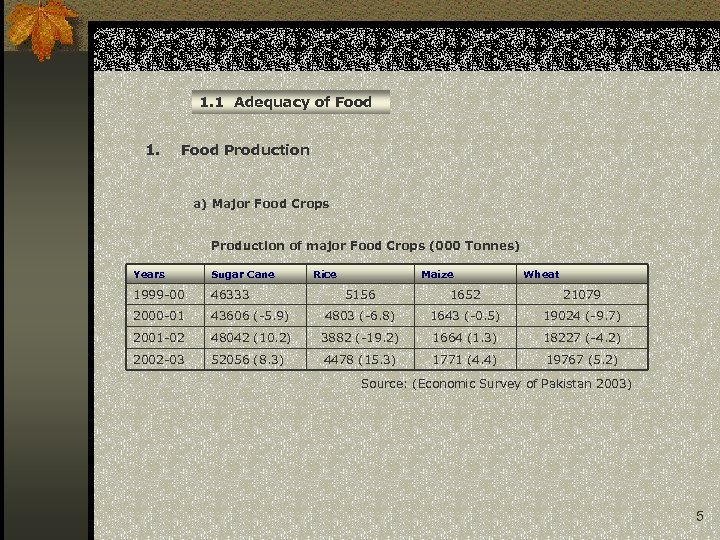 1. 1 Adequacy of Food 1. Food Production a) Major Food Crops Production of major Food Crops (000 Tonnes) Years Sugar Cane 1999 -00 46333 2000 -01 Rice Maize Wheat 5156 1652 21079 43606 (-5. 9) 4803 (-6. 8) 1643 (-0. 5) 19024 (-9. 7) 2001 -02 48042 (10. 2) 3882 (-19. 2) 1664 (1. 3) 18227 (-4. 2) 2002 -03 52056 (8. 3) 4478 (15. 3) 1771 (4. 4) 19767 (5. 2) Source: (Economic Survey of Pakistan 2003) 5
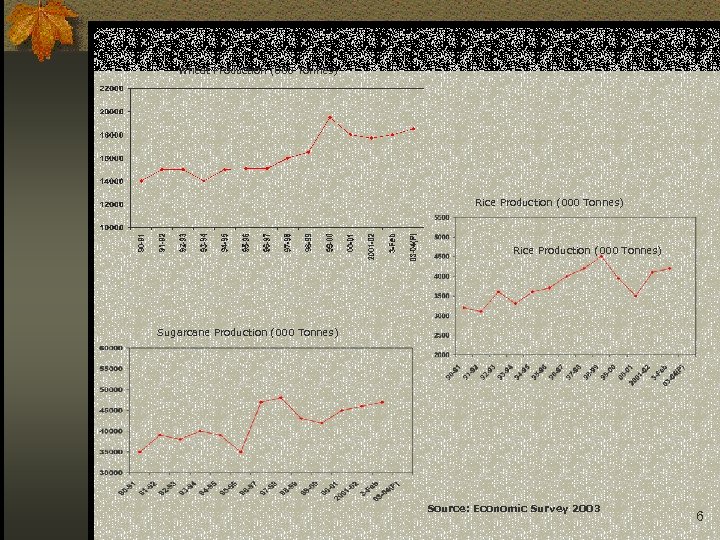 Wheat Production (000 Tonnes) Rice Production (000 Tonnes) Sugarcane Production (000 Tonnes) Source: Economic Survey 2003 6
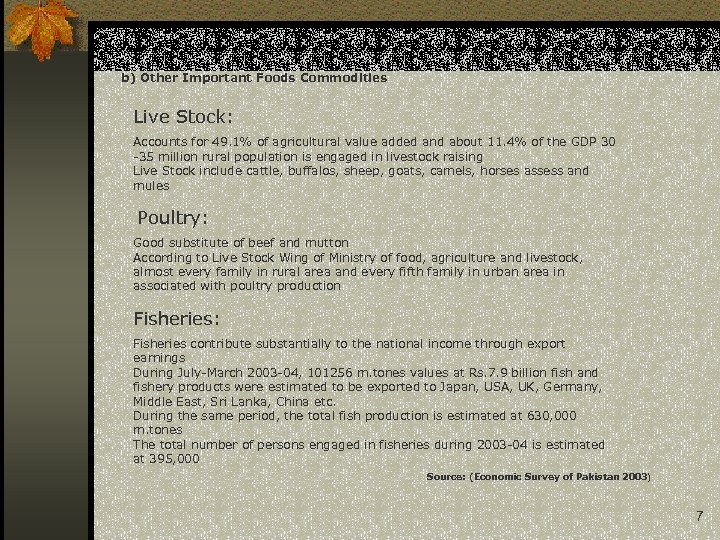 b) Other Important Foods Commodities Live Stock: Accounts for 49. 1% of agricultural value added and about 11. 4% of the GDP 30 -35 million rural population is engaged in livestock raising Live Stock include cattle, buffalos, sheep, goats, camels, horses assess and mules Poultry: Good substitute of beef and mutton According to Live Stock Wing of Ministry of food, agriculture and livestock, almost every family in rural area and every fifth family in urban area in associated with poultry production Fisheries: Fisheries contribute substantially to the national income through export earnings During July-March 2003 -04, 101256 m. tones values at Rs. 7. 9 billion fish and fishery products were estimated to be exported to Japan, USA, UK, Germany, Middle East, Sri Lanka, China etc. During the same period, the total fish production is estimated at 630, 000 m. tones The total number of persons engaged in fisheries during 2003 -04 is estimated at 395, 000 Source: (Economic Survey of Pakistan 2003) 7
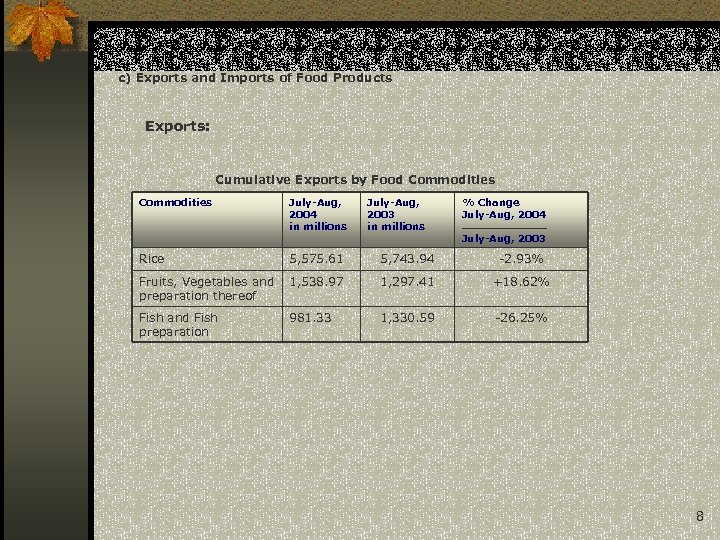 c) Exports and Imports of Food Products Exports: Cumulative Exports by Food Commodities Rice July-Aug, 2004 in millions July-Aug, 2003 in millions % Change July-Aug, 2004 July-Aug, 2003 5, 575. 61 5, 743. 94 -2. 93% Fruits, Vegetables and 1, 538. 97 preparation thereof 1, 297. 41 +18. 62% Fish and Fish preparation 1, 330. 59 -26. 25% 981. 33 8
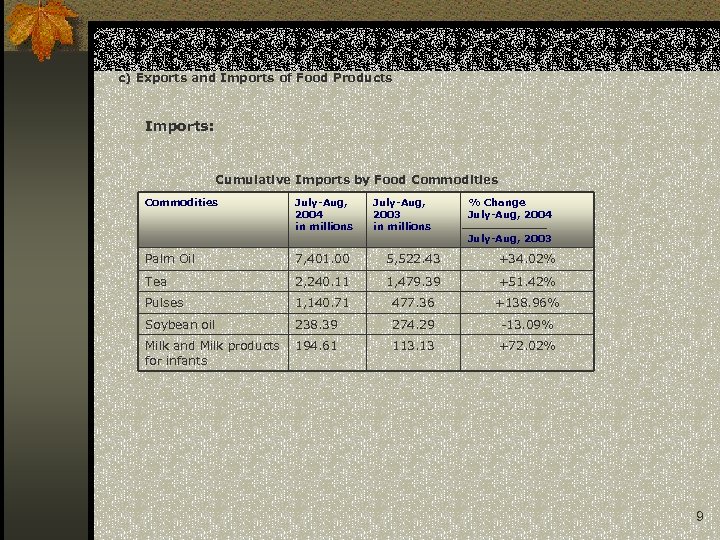 c) Exports and Imports of Food Products Imports: Cumulative Imports by Food Commodities July-Aug, 2004 in millions July-Aug, 2003 in millions % Change July-Aug, 2004 July-Aug, 2003 Palm Oil 7, 401. 00 5, 522. 43 +34. 02% Tea 2, 240. 11 1, 479. 39 +51. 42% Pulses 1, 140. 71 477. 36 +138. 96% Soybean oil 238. 39 274. 29 -13. 09% Milk and Milk products 194. 61 for infants 113. 13 +72. 02% 9
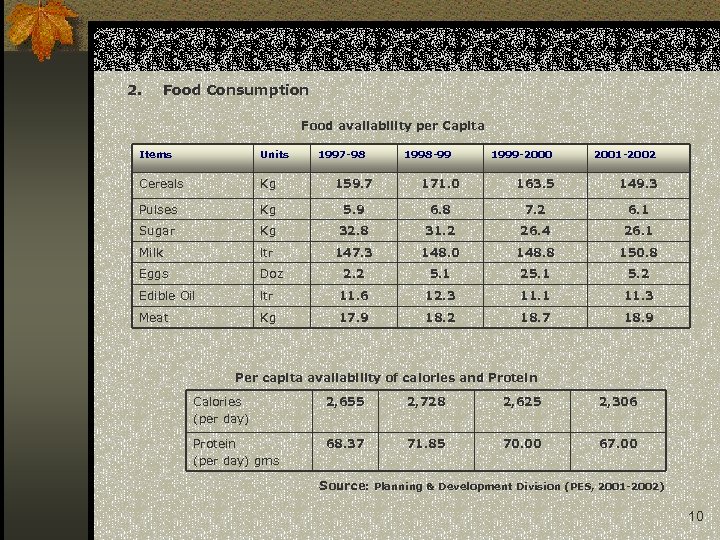 2. Food Consumption Food availability per Capita Items Units 1997 -98 Cereals Kg 159. 7 Pulses Kg Sugar 1998 -99 1999 -2000 2001 -2002 171. 0 163. 5 149. 3 5. 9 6. 8 7. 2 6. 1 Kg 32. 8 31. 2 26. 4 26. 1 Milk ltr 147. 3 148. 0 148. 8 150. 8 Eggs Doz 2. 2 5. 1 25. 1 5. 2 Edible Oil ltr 11. 6 12. 3 11. 1 11. 3 Meat Kg 17. 9 18. 2 18. 7 18. 9 Per capita availability of calories and Protein Calories (per day) 2, 655 2, 728 2, 625 2, 306 Protein (per day) gms 68. 37 71. 85 70. 00 67. 00 Source: Planning & Development Division (PES, 2001 -2002) 10
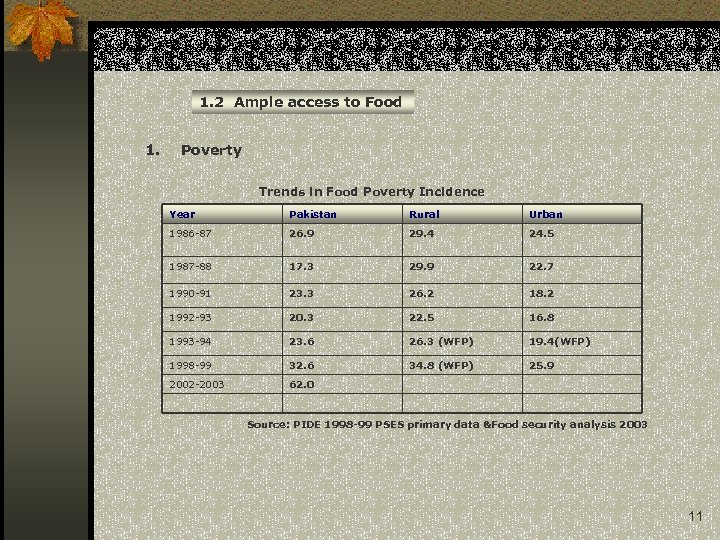 1. 2 Ample access to Food 1. Poverty Trends in Food Poverty Incidence Year Pakistan Rural Urban 1986 -87 26. 9 29. 4 24. 5 1987 -88 17. 3 29. 9 22. 7 1990 -91 23. 3 26. 2 18. 2 1992 -93 20. 3 22. 5 16. 8 1993 -94 23. 6 26. 3 (WFP) 19. 4(WFP) 1998 -99 32. 6 34. 8 (WFP) 25. 9 2002 -2003 62. 0 Source: PIDE 1998 -99 PSES primary data &Food security analysis 2003 11
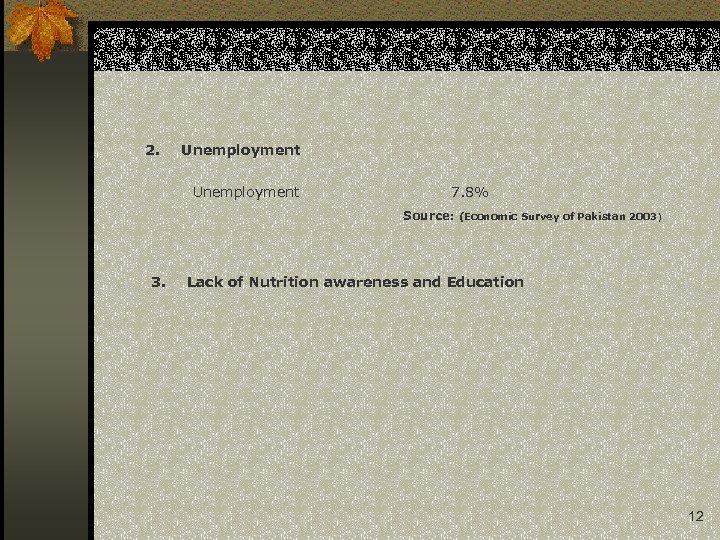 2. Unemployment 7. 8% Source: (Economic Survey of Pakistan 2003) 3. Lack of Nutrition awareness and Education 12
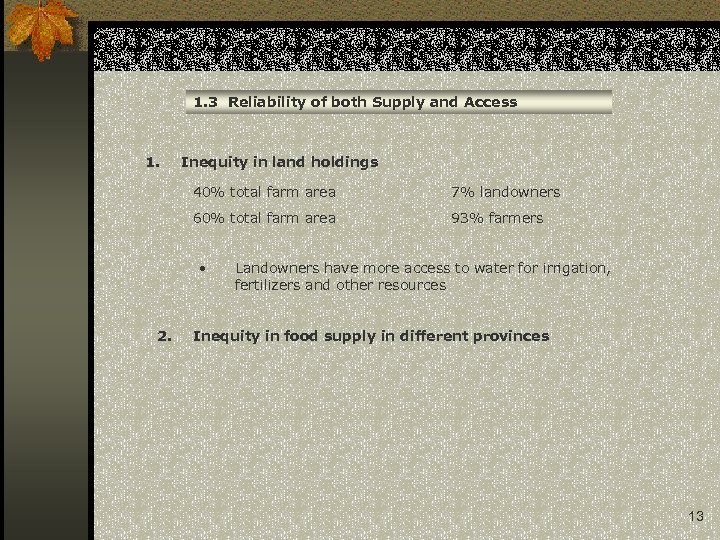 1. 3 Reliability of both Supply and Access 1. Inequity in land holdings 40% total farm area 7% landowners 60% total farm area 93% farmers • 2. Landowners have more access to water for irrigation, fertilizers and other resources Inequity in food supply in different provinces 13
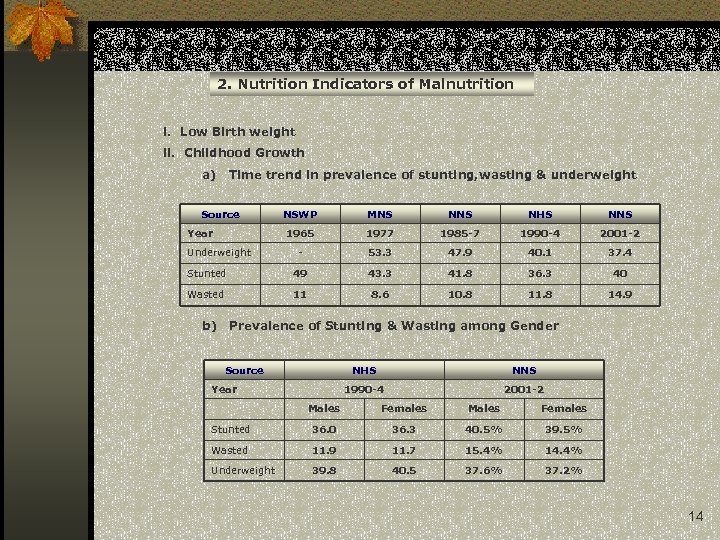 2. Nutrition Indicators of Malnutrition i. Low Birth weight ii. Childhood Growth a) Time trend in prevalence of stunting, wasting & underweight Source NSWP MNS NHS NNS 1965 1977 1985 -7 1990 -4 2001 -2 - 53. 3 47. 9 40. 1 37. 4 Stunted 49 43. 3 41. 8 36. 3 40 Wasted 11 8. 6 10. 8 11. 8 14. 9 Year Underweight b) Prevalence of Stunting & Wasting among Gender Source NHS 1990 -4 Year NNS 2001 -2 Males Females Stunted 36. 0 36. 3 40. 5% 39. 5% Wasted 11. 9 11. 7 15. 4% 14. 4% Underweight 39. 8 40. 5 37. 6% 37. 2% 14
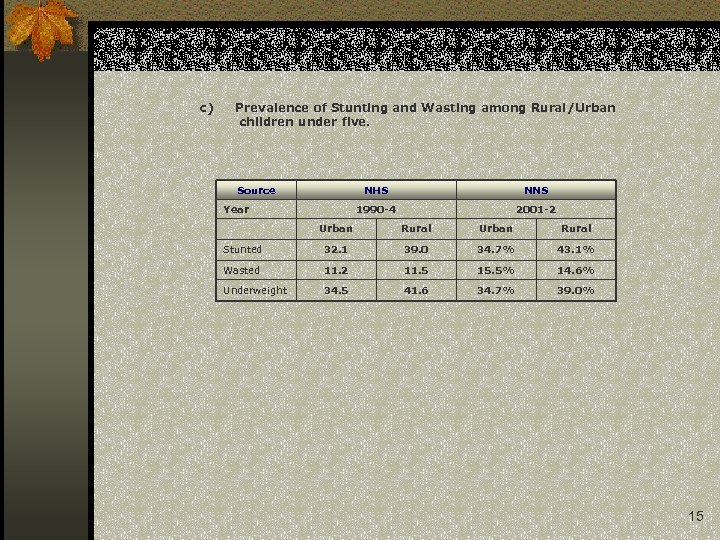 c) Prevalence of Stunting and Wasting among Rural/Urban children under five. Source NHS 1990 -4 Year NNS 2001 -2 Urban Rural Stunted 32. 1 39. 0 34. 7% 43. 1% Wasted 11. 2 11. 5 15. 5% 14. 6% Underweight 34. 5 41. 6 34. 7% 39. 0% 15
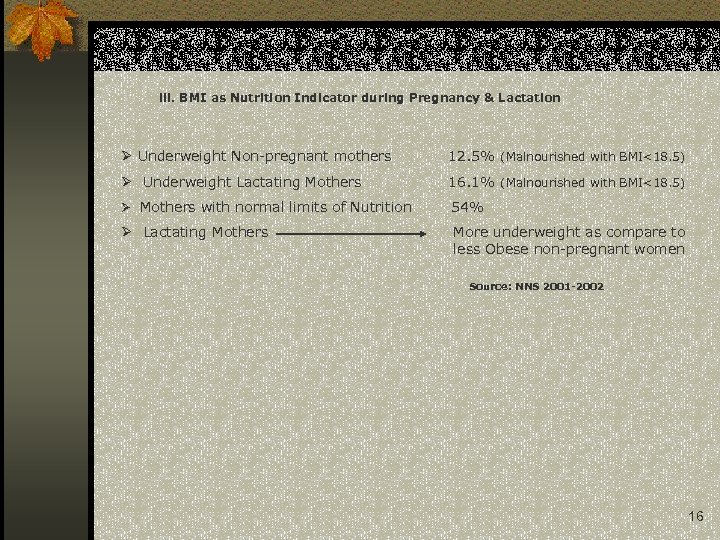 iii. BMI as Nutrition Indicator during Pregnancy & Lactation Ø Underweight Non-pregnant mothers 12. 5% (Malnourished with BMI<18. 5) Ø Underweight Lactating Mothers 16. 1% (Malnourished with BMI<18. 5) Ø Mothers with normal limits of Nutrition 54% Ø Lactating Mothers More underweight as compare to less Obese non-pregnant women Source: NNS 2001 -2002 16
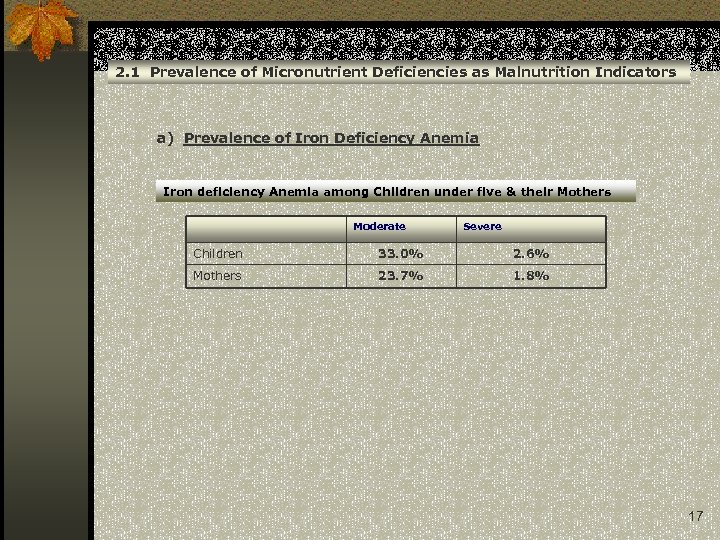 2. 1 Prevalence of Micronutrient Deficiencies as Malnutrition Indicators a) Prevalence of Iron Deficiency Anemia Iron deficiency Anemia among Children under five & their Mothers Moderate Severe Children 33. 0% 2. 6% Mothers 23. 7% 1. 8% 17
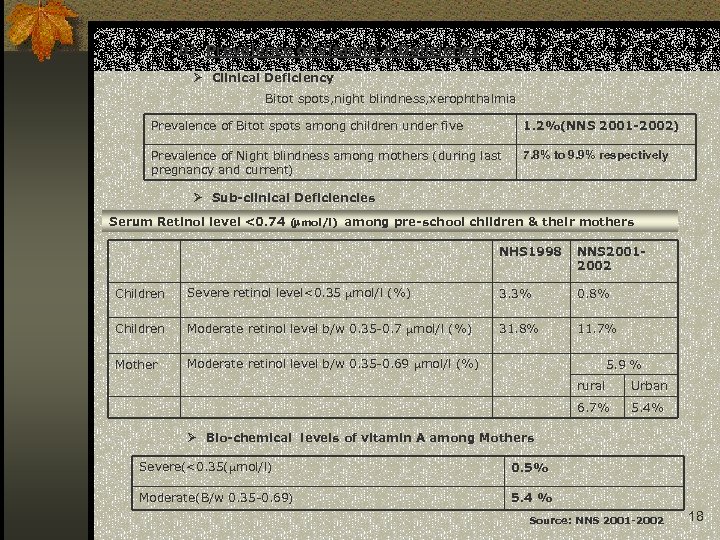 b) Prevalence of Vitamin A Deficiency Ø Clinical Deficiency Bitot spots, night blindness, xerophthalmia Prevalence of Bitot spots among children under five 1. 2%(NNS 2001 -2002) Prevalence of Night blindness among mothers (during last pregnancy and current) 7. 8% to 9. 9% respectively Ø Sub-clinical Deficiencies Serum Retinol level <0. 74 ( mol/l) among pre-school children & their mothers NHS 1998 NNS 20012002 Children Severe retinol level<0. 35 mol/l (%) 3. 3% 0. 8% Children Moderate retinol level b/w 0. 35 -0. 7 mol/l (%) 31. 8% 11. 7% Mother Moderate retinol level b/w 0. 35 -0. 69 mol/l (%) 5. 9 % rural Urban 6. 7% 5. 4% Ø Bio-chemical levels of vitamin A among Mothers Severe(<0. 35( mol/l) 0. 5% Moderate(B/w 0. 35 -0. 69) 5. 4 % Source: NNS 2001 -2002 18
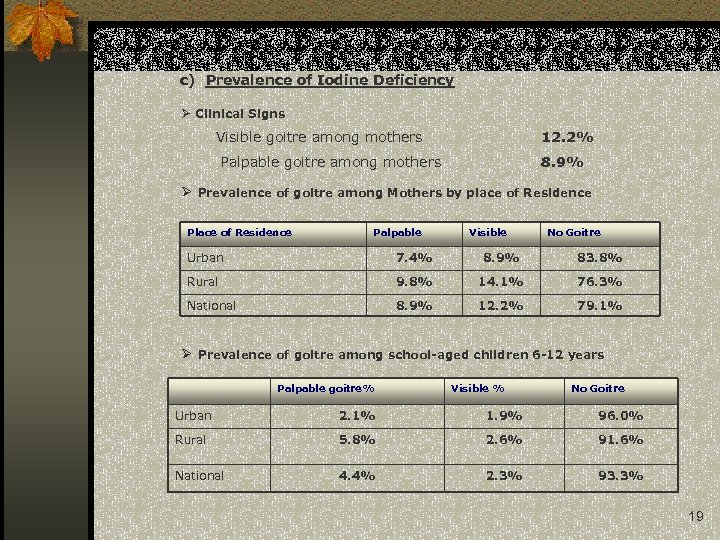 c) Prevalence of Iodine Deficiency Ø Clinical Signs Visible goitre among mothers 12. 2% Palpable goitre among mothers 8. 9% Ø Prevalence of goitre among Mothers by place of Residence Palpable Visible No Goitre Urban 7. 4% 8. 9% 83. 8% Rural 9. 8% 14. 1% 76. 3% National 8. 9% 12. 2% 79. 1% Ø Prevalence of goitre among school-aged children 6 -12 years Palpable goitre% Visible % No Goitre Urban 2. 1% 1. 9% 96. 0% Rural 5. 8% 2. 6% 91. 6% National 4. 4% 2. 3% 93. 3% 19
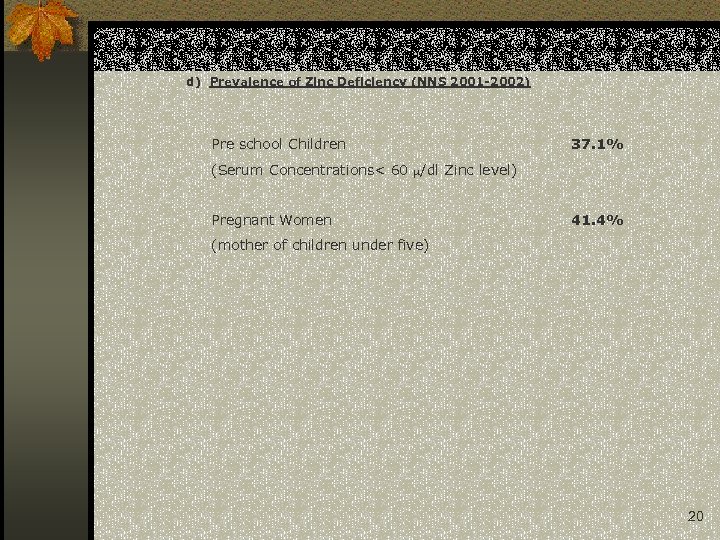 d) Prevalence of Zinc Deficiency (NNS 2001 -2002) Pre school Children 37. 1% (Serum Concentrations< 60 /dl Zinc level) Pregnant Women 41. 4% (mother of children under five) 20
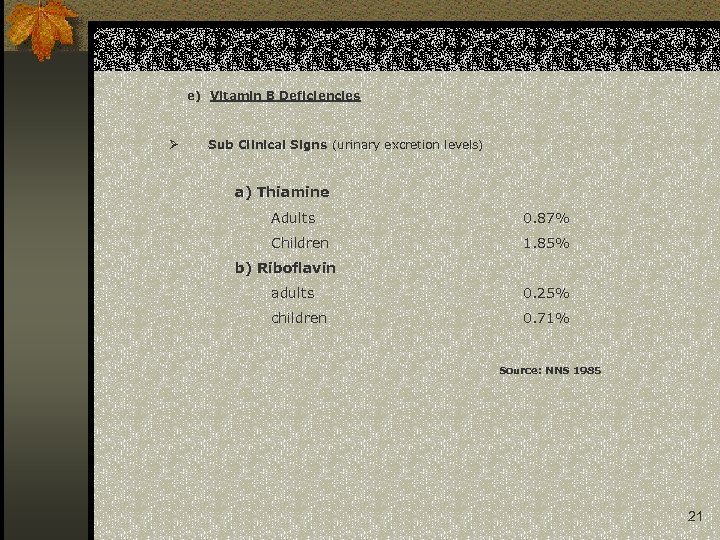 e) Vitamin B Deficiencies Ø Sub Clinical Signs (urinary excretion levels) a) Thiamine Adults 0. 87% Children 1. 85% b) Riboflavin adults 0. 25% children 0. 71% Source: NNS 1985 21
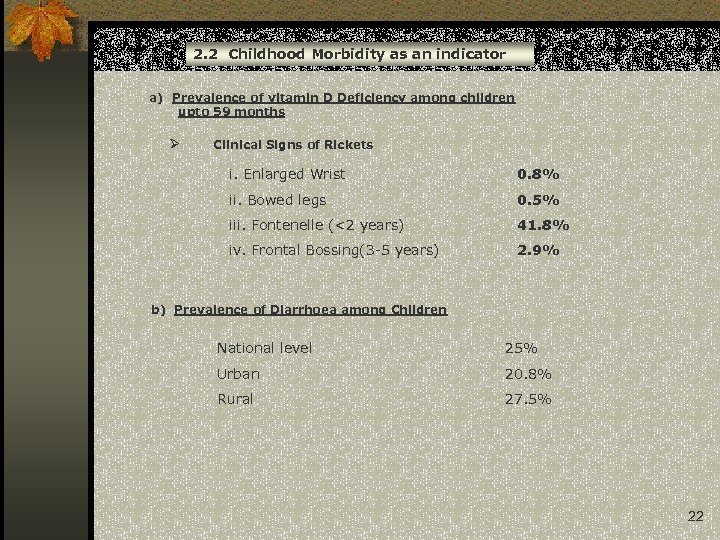 2. 2 Childhood Morbidity as an indicator a) Prevalence of vitamin D Deficiency among children upto 59 months Ø Clinical Signs of Rickets i. Enlarged Wrist 0. 8% ii. Bowed legs 0. 5% iii. Fontenelle (<2 years) 41. 8% iv. Frontal Bossing(3 -5 years) 2. 9% b) Prevalence of Diarrhoea among Children National level 25% Urban 20. 8% Rural 27. 5% 22
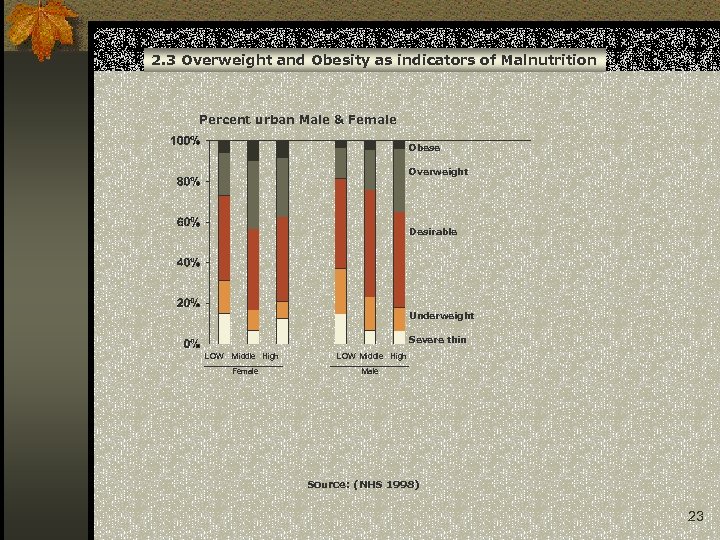 2. 3 Overweight and Obesity as indicators of Malnutrition Percent urban Male & Female Obese Overweight Desirable Underweight Severe thin LOW Middle High Female LOW Middle High Male Source: (NHS 1998) 23
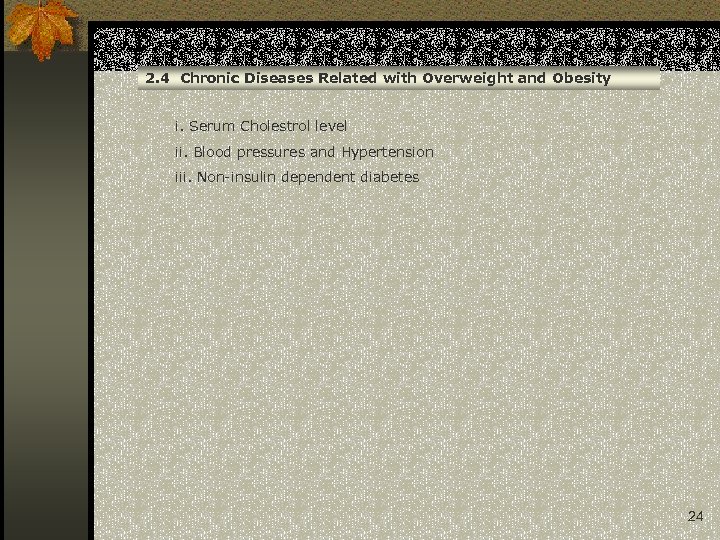 2. 4 Chronic Diseases Related with Overweight and Obesity i. Serum Cholestrol level ii. Blood pressures and Hypertension iii. Non-insulin dependent diabetes 24
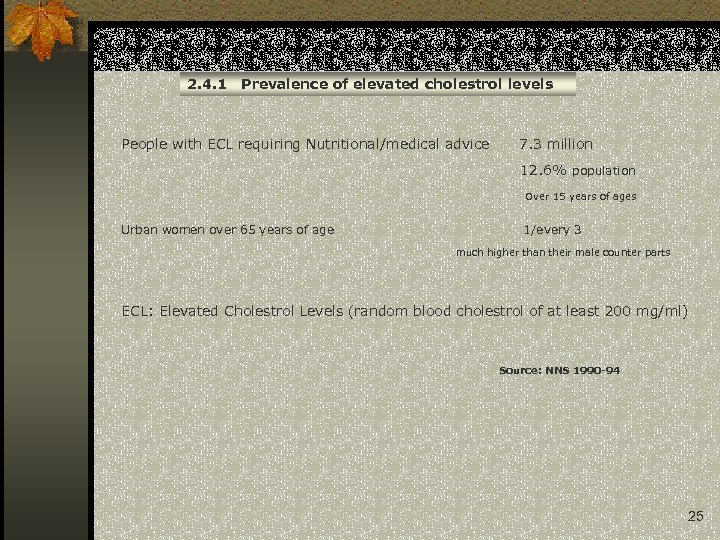 2. 4. 1 Prevalence of elevated cholestrol levels People with ECL requiring Nutritional/medical advice 7. 3 million 12. 6% population Over 15 years of ages Urban women over 65 years of age 1/every 3 much higher than their male counter parts ECL: Elevated Cholestrol Levels (random blood cholestrol of at least 200 mg/ml) Source: NNS 1990 -94 25
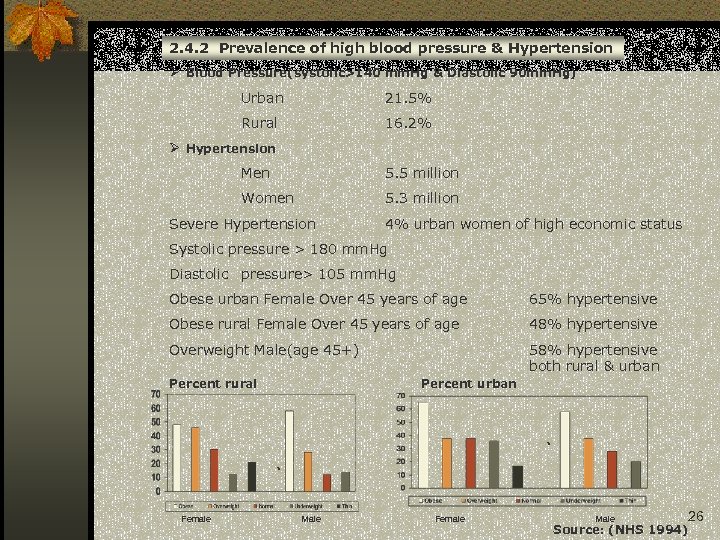 2. 4. 2 Prevalence of high blood pressure & Hypertension Ø Blood Pressure(systolic>140 mm. Hg & Diastolic 90 mm. Hg) Urban 21. 5% Rural 16. 2% Ø Hypertension Men 5. 5 million Women 5. 3 million Severe Hypertension 4% urban women of high economic status Systolic pressure > 180 mm. Hg Diastolic pressure> 105 mm. Hg Obese urban Female Over 45 years of age 65% hypertensive Obese rural Female Over 45 years of age 48% hypertensive Overweight Male(age 45+) 58% hypertensive both rural & urban Percent rural Percent urban * * Female Male 26 Source: (NHS 1994)
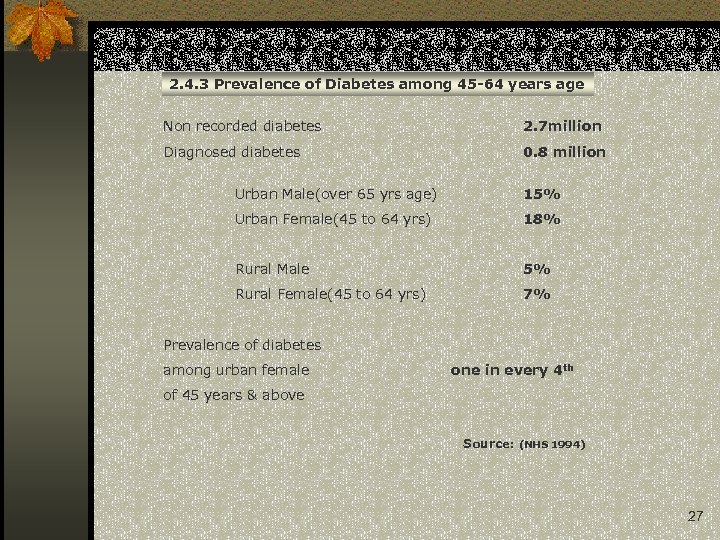 2. 4. 3 Prevalence of Diabetes among 45 -64 years age Non recorded diabetes 2. 7 million Diagnosed diabetes 0. 8 million Urban Male(over 65 yrs age) 15% Urban Female(45 to 64 yrs) 18% Rural Male 5% Rural Female(45 to 64 yrs) 7% Prevalence of diabetes among urban female one in every 4 th of 45 years & above Source: (NHS 1994) 27
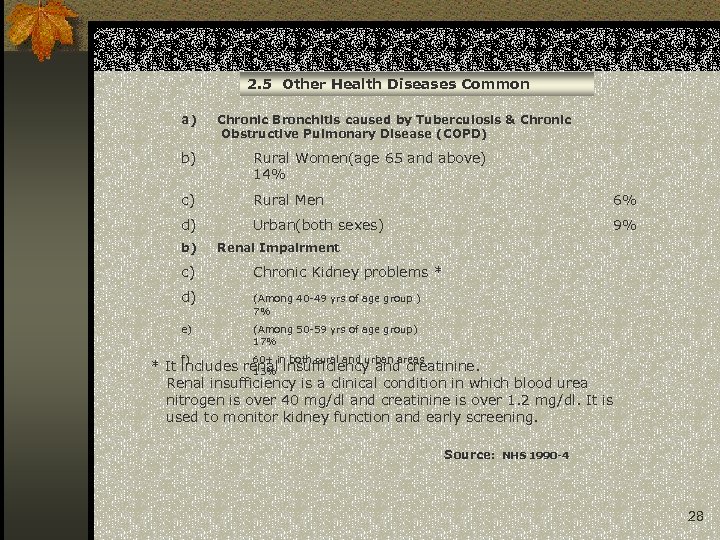 2. 5 Other Health Diseases Common a) Chronic Bronchitis caused by Tuberculosis & Chronic Obstructive Pulmonary Disease (COPD) b) Rural Women(age 65 and above) 14% c) Rural Men 6% d) Urban(both sexes) 9% b) Renal Impairment c) Chronic Kidney problems * d) (Among 40 -49 yrs of age group ) 7% e) (Among 50 -59 yrs of age group) 17% f) 60+ in both rural and urban areas * It includes renal insufficiency and creatinine. 13% Renal insufficiency is a clinical condition in which blood urea nitrogen is over 40 mg/dl and creatinine is over 1. 2 mg/dl. It is used to monitor kidney function and early screening. Source: NHS 1990 -4 28
 3. DAILY FOOD INTAKE PATTERN 3. 1 Average daily intake of food by Mothers (NNS 2001 -02) 3. 2 Average Intake of Food by Children-by Food Groups 3. 3 Type of Bread Consumed by Regions 1. 3. 4 Consumption Frequency of different food items for weak 2. 3. 5 Pakistan Food Basket based on 2100 Calories 3. 29
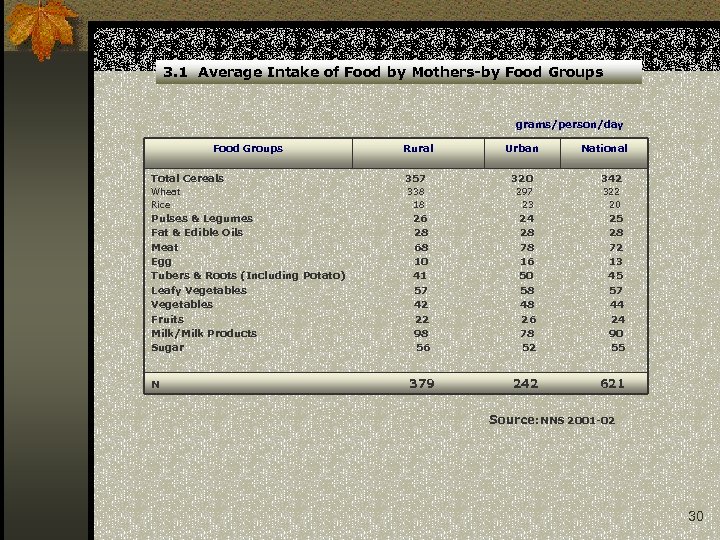 3. 1 Average Intake of Food by Mothers-by Food Groups grams/person/day Food Groups Total Cereals Rural Urban 357 320 National 342 Wheat 338 297 322 Rice 18 23 20 Pulses & Legumes Fat & Edible Oils Meat Egg Tubers & Roots (Including Potato) Leafy Vegetables Fruits Milk/Milk Products Sugar N 26 28 68 10 41 57 42 22 98 56 24 28 78 16 50 58 48 26 78 52 25 28 72 13 45 57 44 24 90 55 379 242 621 Source: NNS 2001 -02 30
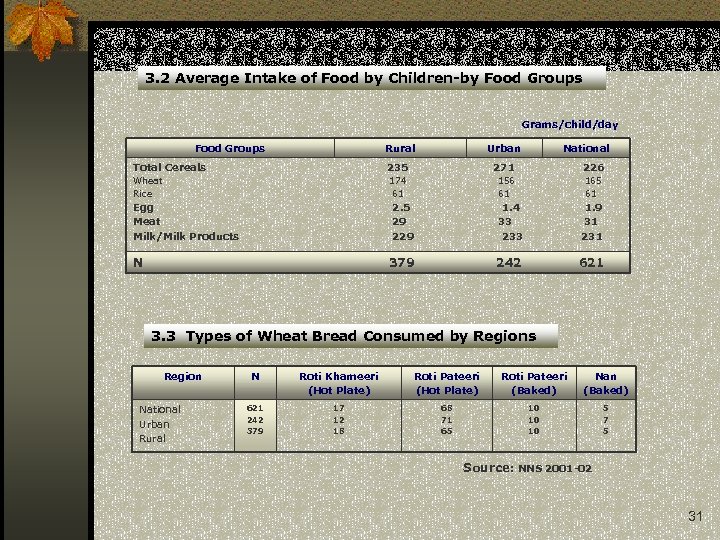 3. 2 Average Intake of Food by Children-by Food Groups Grams/child/day Food Groups Rural 235 Total Cereals Urban National 271 226 Wheat 174 156 165 Rice 61 Egg Meat Milk/Milk Products 2. 5 29 229 1. 9 31 231 379 N 1. 4 33 242 621 3. 3 Types of Wheat Bread Consumed by Regions Region National Urban Rural N Roti Khameeri (Hot Plate) Roti Pateeri (Baked) Nan (Baked) 621 242 379 17 12 18 68 71 65 10 10 10 5 7 5 Source: NNS 2001 -02 31
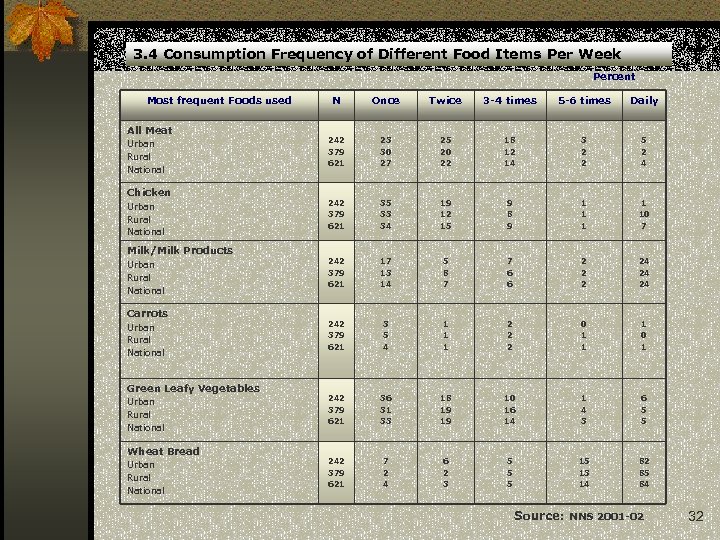 3. 4 Consumption Frequency of Different Food Items Per Week Percent Most frequent Foods used All Meat Urban Rural National Chicken Urban Rural National Milk/Milk Products Urban Rural National Carrots Urban Rural National Green Leafy Vegetables Urban Rural National Wheat Bread Urban Rural National N Once Twice 3 -4 times 5 -6 times Daily 242 379 621 23 30 27 25 20 22 18 12 14 3 2 2 5 2 4 242 379 621 35 33 34 19 12 15 9 8 9 1 1 10 7 242 379 621 17 13 14 5 8 7 7 6 6 2 24 242 379 621 3 5 4 1 1 1 2 2 2 0 1 1 1 0 1 242 379 621 36 31 33 18 19 19 10 16 14 1 4 3 6 5 5 242 379 621 7 2 4 6 2 3 5 5 5 15 13 14 82 85 84 Source: NNS 2001 -02 32
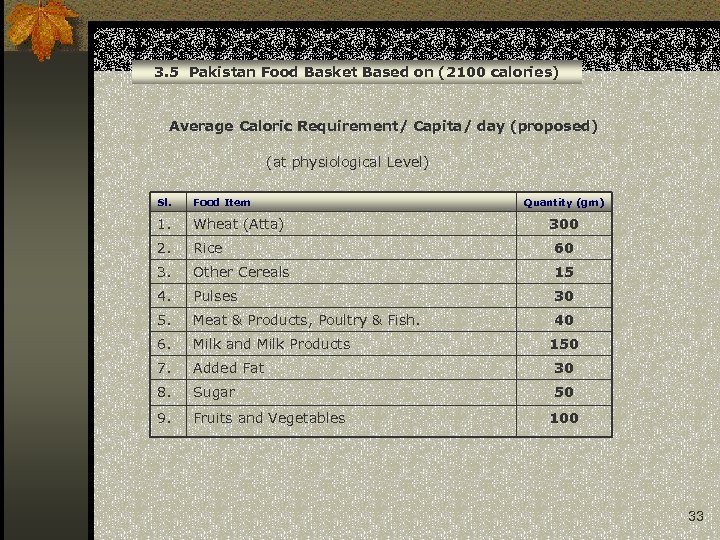 3. 5 Pakistan Food Basket Based on (2100 calories) Average Caloric Requirement/ Capita/ day (proposed) (at physiological Level) Sl. Food Item Quantity (gm) 1. Wheat (Atta) 2. Rice 60 3. Other Cereals 15 4. Pulses 30 5. Meat & Products, Poultry & Fish. 40 6. Milk and Milk Products 7. Added Fat 30 8. Sugar 50 9. Fruits and Vegetables 300 150 100 33
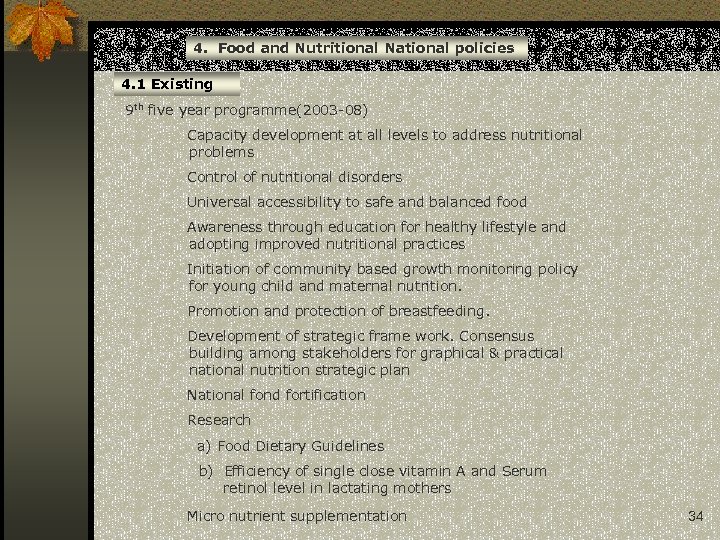 4. Food and Nutritional National policies 4. 1 Existing 9 th five year programme(2003 -08) Capacity development at all levels to address nutritional problems Control of nutritional disorders Universal accessibility to safe and balanced food Awareness through education for healthy lifestyle and adopting improved nutritional practices Initiation of community based growth monitoring policy for young child and maternal nutrition. Promotion and protection of breastfeeding. Development of strategic frame work. Consensus building among stakeholders for graphical & practical national nutrition strategic plan National fond fortification Research a) Food Dietary Guidelines b) Efficiency of single close vitamin A and Serum retinol level in lactating mothers Micro nutrient supplementation 34
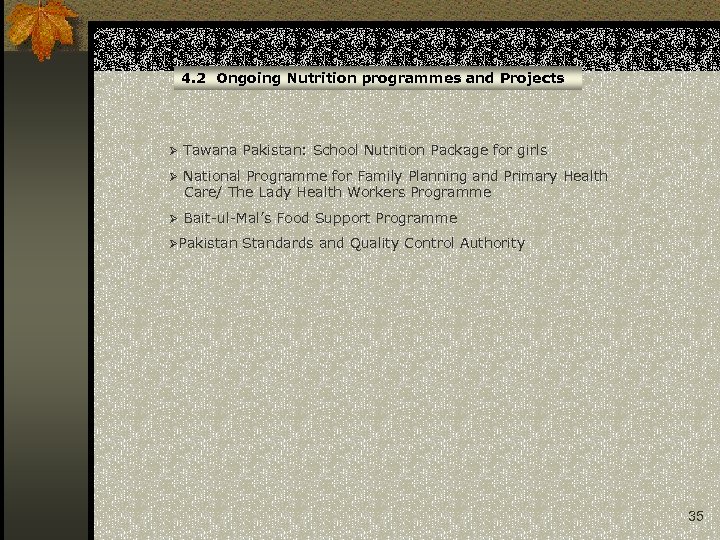 4. 2 Ongoing Nutrition programmes and Projects Ø Tawana Pakistan: School Nutrition Package for girls Ø National Programme for Family Planning and Primary Health Care/ The Lady Health Workers Programme Ø Bait-ul-Mal’s Food Support Programme ØPakistan Standards and Quality Control Authority 35
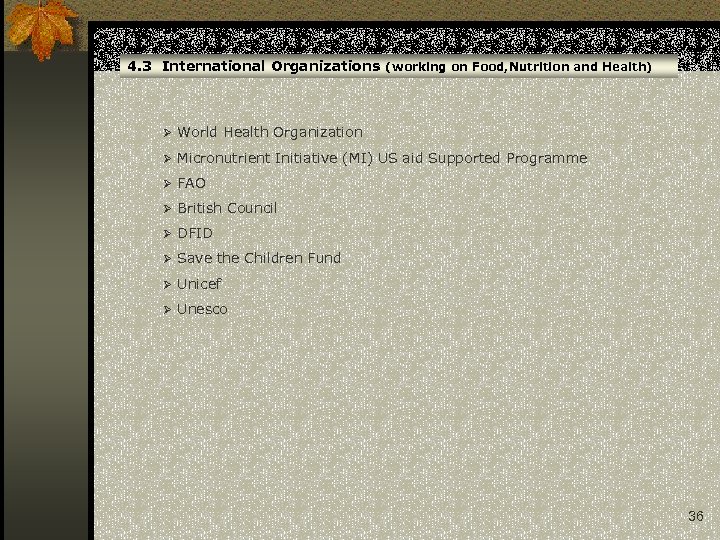 4. 3 International Organizations (working on Food, Nutrition and Health) Ø World Health Organization Ø Micronutrient Initiative (MI) US aid Supported Programme Ø FAO Ø British Council Ø DFID Ø Save the Children Fund Ø Unicef Ø Unesco 36
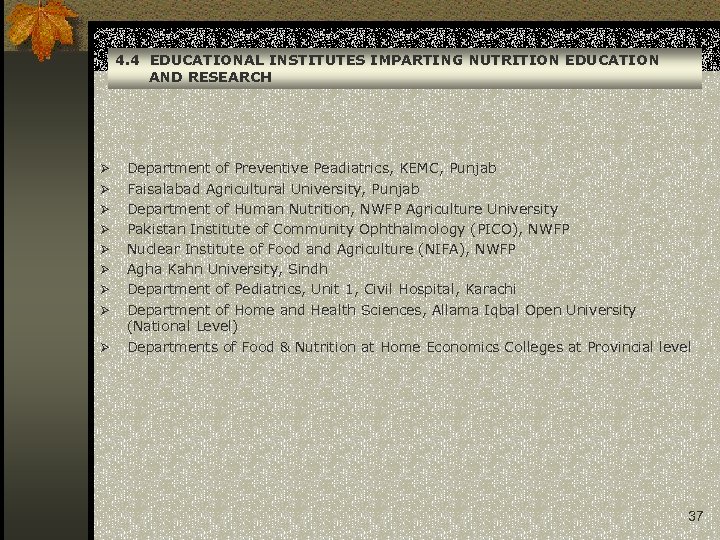 4. 4 EDUCATIONAL INSTITUTES IMPARTING NUTRITION EDUCATION AND RESEARCH Ø Ø Ø Ø Ø Department of Preventive Peadiatrics, KEMC, Punjab Faisalabad Agricultural University, Punjab Department of Human Nutrition, NWFP Agriculture University Pakistan Institute of Community Ophthalmology (PICO), NWFP Nuclear Institute of Food and Agriculture (NIFA), NWFP Agha Kahn University, Sindh Department of Pediatrics, Unit 1, Civil Hospital, Karachi Department of Home and Health Sciences, Allama Iqbal Open University (National Level) Departments of Food & Nutrition at Home Economics Colleges at Provincial level 37
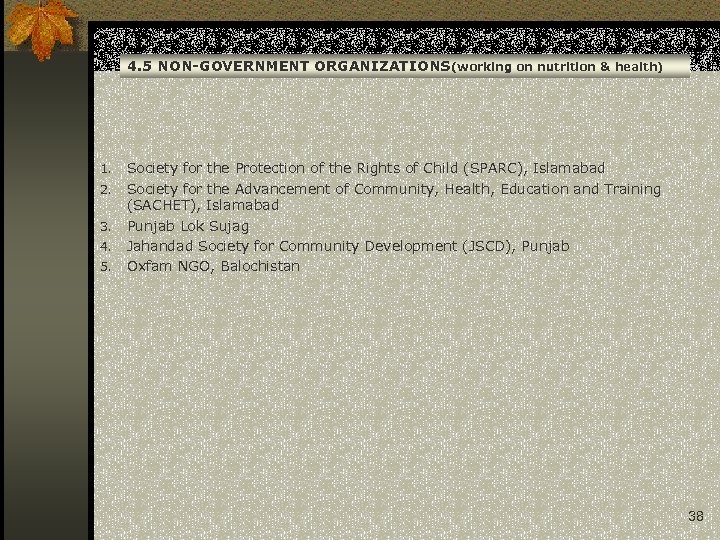 4. 5 NON-GOVERNMENT ORGANIZATIONS(working on nutrition & health) 1. 2. 3. 4. 5. Society for the Protection of the Rights of Child (SPARC), Islamabad Society for the Advancement of Community, Health, Education and Training (SACHET), Islamabad Punjab Lok Sujag Jahandad Society for Community Development (JSCD), Punjab Oxfam NGO, Balochistan 38
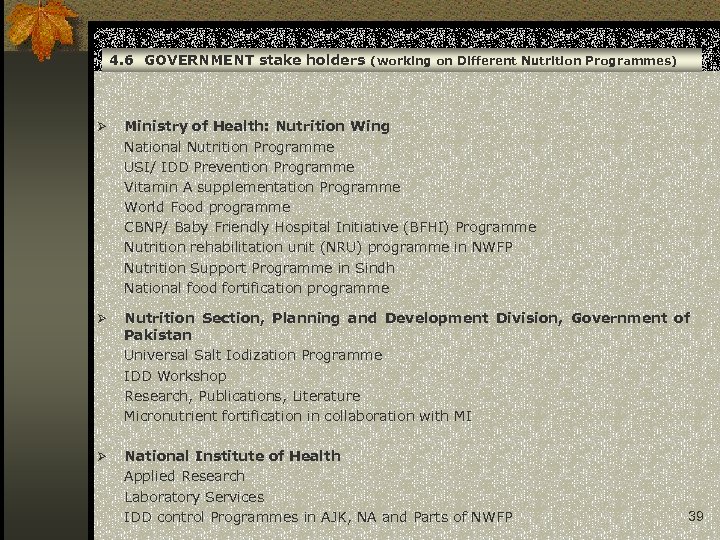 4. 6 GOVERNMENT stake holders (working on Different Nutrition Programmes) Ø Ministry of Health: Nutrition Wing National Nutrition Programme USI/ IDD Prevention Programme Vitamin A supplementation Programme World Food programme CBNP/ Baby Friendly Hospital Initiative (BFHI) Programme Nutrition rehabilitation unit (NRU) programme in NWFP Nutrition Support Programme in Sindh National food fortification programme Ø Nutrition Section, Planning and Development Division, Government of Pakistan Universal Salt Iodization Programme IDD Workshop Research, Publications, Literature Micronutrient fortification in collaboration with MI Ø National Institute of Health Applied Research Laboratory Services IDD control Programmes in AJK, NA and Parts of NWFP 39
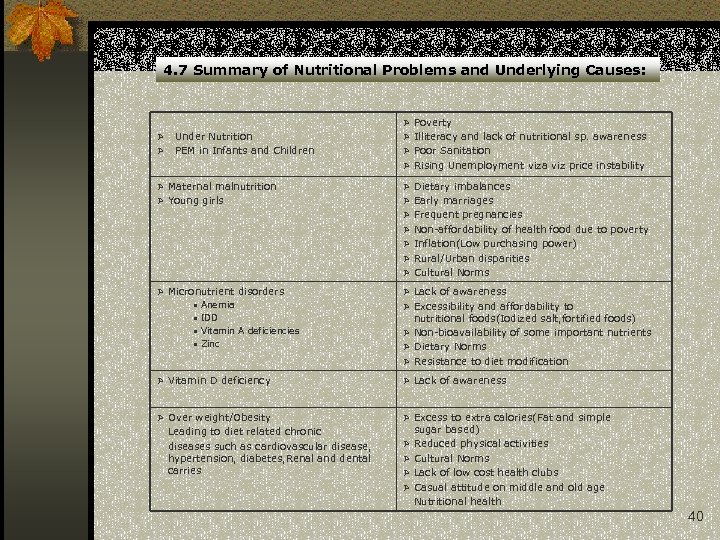 4. 7 Summary of Nutritional Problems and Underlying Causes: Ø Poverty Ø Under Nutrition Ø Illiteracy and lack of nutritional sp. awareness Ø PEM in Infants and Children Ø Poor Sanitation Ø Rising Unemployment viza viz price instability Ø Maternal malnutrition Ø Dietary imbalances Ø Young girls Ø Early marriages Ø Frequent pregnancies Ø Non-affordability of health food due to poverty Ø Inflation(Low purchasing power) Ø Rural/Urban disparities Ø Cultural Norms Ø Micronutrient disorders • Anemia • IDD • Vitamin A deficiencies • Zinc Ø Lack of awareness Ø Vitamin D deficiency Ø Lack of awareness Ø Over weight/Obesity Ø Excess to extra calories(Fat and simple Leading to diet related chronic diseases such as cardiovascular disease, hypertension, diabetes, Renal and dental carries Ø Excessibility and affordability to nutritional foods(Iodized salt, fortified foods) Ø Non-bioavailability of some important nutrients Ø Dietary Norms Ø Resistance to diet modification sugar based) Ø Reduced physical activities Ø Cultural Norms Ø Lack of low cost health clubs Ø Casual attitude on middle and old age Nutritional health 40
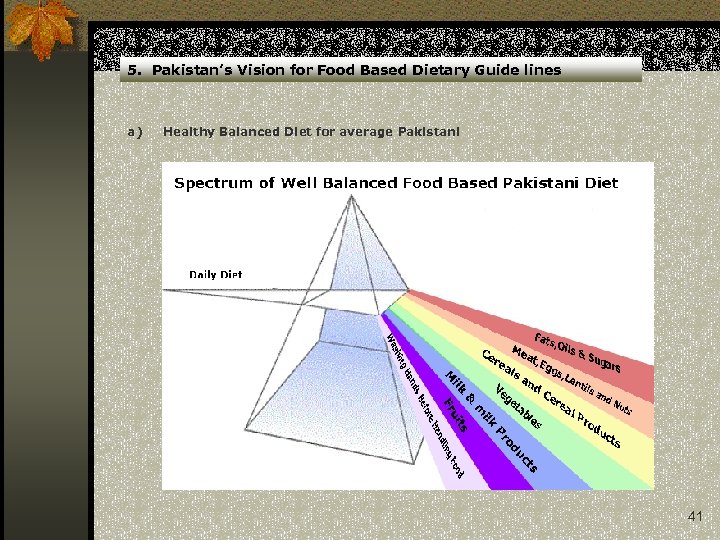 5. Pakistan’s Vision for Food Based Dietary Guide lines a) Healthy Balanced Diet for average Pakistani 41
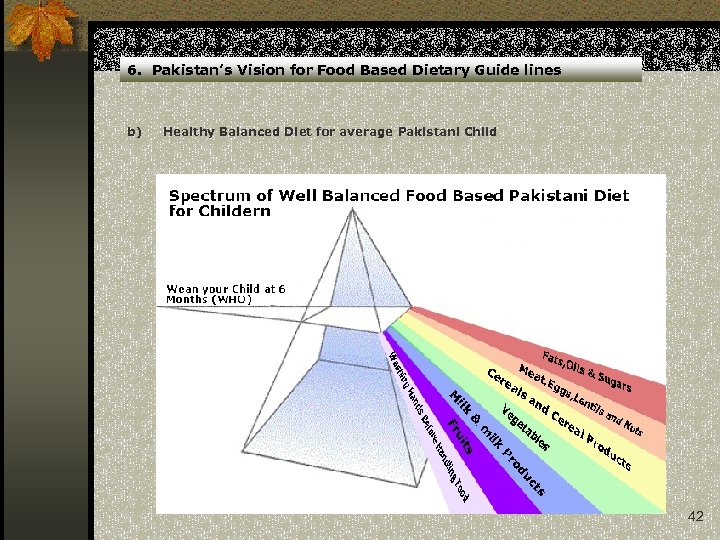 6. Pakistan’s Vision for Food Based Dietary Guide lines b) Healthy Balanced Diet for average Pakistani Child 42