


 Скачать презентацию Country Paper- International Conclave 2006 INFRASTRUCTURE STATUS REGULATION
9481d3e36ac48b3e06f04caed2ed1f34.ppt
- Количество слайдов: 73
 Country Paper- International Conclave 2006 INFRASTRUCTURE STATUS, REGULATION & QUALITY CONTROL OF INDIAN MEDICINE DR. S. K. SHARMA, M. D. (AY. ), Ph. D. ADVISER (AYURVEDA) Department of Ayurveda, Yoga & Naturopathy, Unani, Siddha, Homoeopathy (AYUSH) Ministry of Health & Family Welfare, Government of India www. indianmedicine. nic. in Telefax : 011 -23328576 E-mail : adv_ayurveda@yahoo. com
 TRADITIONAL INDIAN HEALTH KNOWLEDGE • • Rich bio-diversity of India. 12 agro-climatic zones. Wide range of medicinal plant species. Long history of use of medicinal plants and health practices (Ayurveda 5000 BC). • Codified, organized, documented and officially recognized health systems • Ayurveda-Siddha-Unani & Yoga.
 OFFICIALLY RECOGNIZED SYSTEMS • Ayurveda * Yoga * Naturopathy • Unani • Siddha • Homeopathy * Yoga & Naturopahty are drugless therapies. * Homoeopathy is of German origin.
 ANTIQUITY OF AYURVEDA Ayurveda is a very well documented System of Health Care Practiced in Indian Sub-Continent The Antiquity dates back to 1000 -500 BC. - It is believed that Lord Brahma created Ayurveda along with the creation of mankind and universe - Vedas (5000 B. C. ) describe about 100 plants and - Since the 1000 -500 BC, Ashtang Ayurveda (eight specialities of Ayurveda) are in practice in one or the other way - Official Recognition by Government - Siddha Medicine has also a long history of origin B. C. - Unani Medicine started in Greece in B. C. era treatment of various diseases
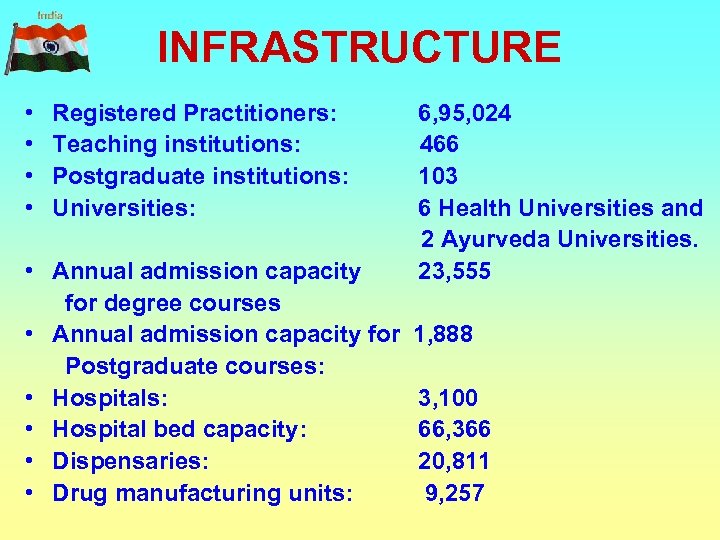 INFRASTRUCTURE • Registered Practitioners: 6, 95, 024 • Teaching institutions: 466 • Postgraduate institutions: 103 • Universities: 6 Health Universities and 2 Ayurveda Universities. • Annual admission capacity 23, 555 for degree courses • Annual admission capacity for 1, 888 Postgraduate courses: • Hospitals: 3, 100 • Hospital bed capacity: 66, 366 • Dispensaries: 20, 811 • Drug manufacturing units: 9, 257
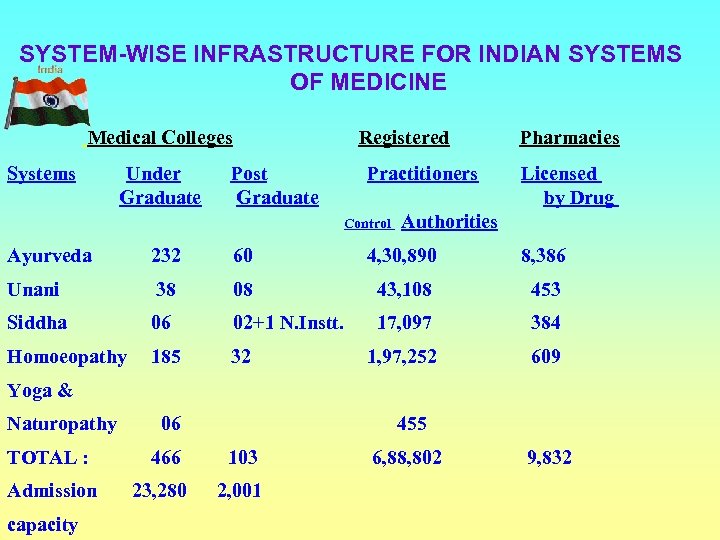 SYSTEM-WISE INFRASTRUCTURE FOR INDIAN SYSTEMS OF MEDICINE Medical Colleges Registered Pharmacies Systems Under Post Practitioners Licensed Graduate by Drug Control Authorities Ayurveda 232 60 4, 30, 890 8, 386 Unani 38 08 43, 108 453 Siddha 06 02+1 N. Instt. 17, 097 384 1, 97, 252 609 Homoeopathy 185 32 Yoga & Naturopathy 06 TOTAL : 466 455 103 Admission 23, 280 2, 001 capacity 6, 88, 802 9, 832
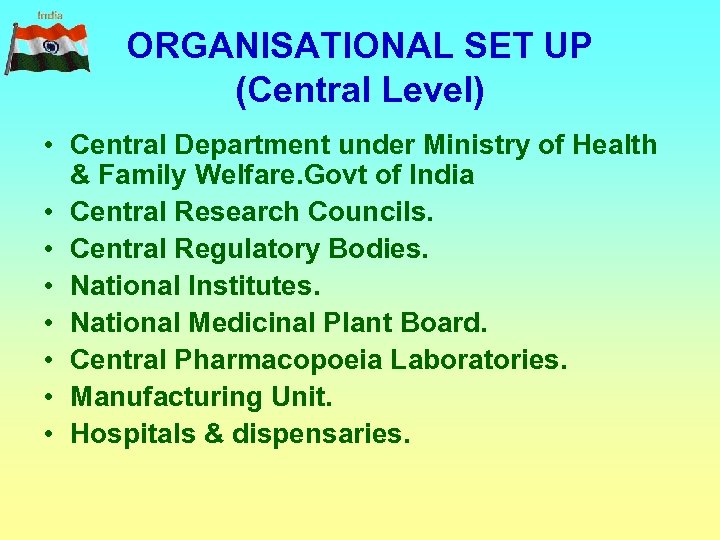 ORGANISATIONAL SET UP (Central Level) • Central Department under Ministry of Health & Family Welfare. Govt of India • Central Research Councils. • Central Regulatory Bodies. • National Institutes. • National Medicinal Plant Board. • Central Pharmacopoeia Laboratories. • Manufacturing Unit. • Hospitals & dispensaries.
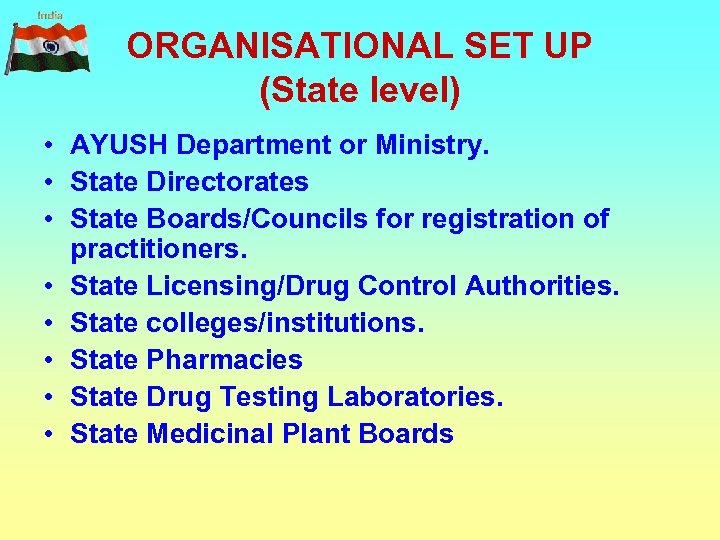 ORGANISATIONAL SET UP (State level) • AYUSH Department or Ministry. • State Directorates • State Boards/Councils for registration of practitioners. • State Licensing/Drug Control Authorities. • State colleges/institutions. • State Pharmacies • State Drug Testing Laboratories. • State Medicinal Plant Boards
 POLICY SUPPORT • Independent Policy for AYUSH -2002. • Systems enjoy Government support since independence. • Health Policy-1983 envisaged integrated role of AYUSH in health delivery. • National Population Policy provides for utilization of AYUSH practitioners in population stabilization Programmes. • National policy in conformity with WHO strategy for traditional medicine.
 NATIONAL INSTITUTES · National Institute of Ayurveda, Jaipur · Institute of Postgraduate Training & Research in Ayurveda, Gujarat Ayurveda University Jamnagar. · National Institute of Unani Medicine, Bangalore · National Institute of Naturopathy, Pune · Morarji Desai National Institute of Yoga, New Delhi · National Institute of Siddha, Chennai · National Academy of Ayurveda, New Delhi · National Institute of Homoeopathy, Calcutta · *All India Institute of Ayurveda, New Delhi
 CENTRAL RESEARCH COUNCILS • Central Council for Research in Ayurveda & Siddha(CCRAS) -39 Units Central Council for Research in Homoeopathy (CCRH) -40 Units Central Council for Research in Unani Medicine (CCRUM) -25 Units Central Council for Research in Yoga & Naturopathy (CCRYN)
 COURSES OF STUDY • • Degree course – BAMS/BUMS/BSMS/BHMS Postgraduate course –M. D. (Ayu)/S/U/H Post doctorate course- Ph. D. Membership course of National Ayurveda Academy. • Short & mid term courses. • Diploma, degree and postgraduate courses for Pharmacy education.
 MATERIAL SOURCE OF MEDICINAL RAW MATERIALS • 95% raw materials of plant origin. • About 1, 000 medicinal plants commonly used. • 58 different types of metals and minerals. • 54 products of animal and marine origin.
 NATIONAL MEDICINAL PLANT BOARD & STATE BOARDS • • Cultivation & conservation of medicinal plants. Supply of quality raw and planting materials. Assessment of demand & supply position. Standardization & quality control of medicinal plants. • Scientific, technological and economic research on medicinal plants. • Development of agro-technology and harvesting, semi-processing and value addition techniques. • Trade and export of medicinal plant products.
 REGULATORY LAWS • Indian Medicine Central Council Act, 1970. • Drugs & Cosmetics Act, 1940 • Drugs & Magic Remedies (Objectionable Advertisements) Act • Bio-diversity Act. • Wild Life Protection Act. • Indian Forests Act.
 LAW FOR EDUCATION FOR AYURVEDA, SIDDHA & UNANI I. M. C. C. ACT 1970 • Central Government is vested with powers to grant permission for opening of new colleges, increase of admission capacity and starting of new or higher courses of study. • Central Government grants permission on the basis of recommendations of State Government, affiliating university and regulatory council and availability of infrastructure as per prescribed norms.
 LAW FOR PRACTICE I. M. C. C. ACT 1970 • Registration of practitioners mandatory. • Registration requires possession of recognized qualification. • Qualifications awarded by universities are included in the Act with the approval of Central Government.
 LAW FOR REGULATION OF DRUGS & COSMETICS • Separate chapter and rules for Ayurveda, Siddha and Unani drugs in Drugs & Cosmetics Act, 1940. • Drug Technical Advisory Board for matters related to quality control and standardization • Drugs Consultative Committee for securing uniform administration of the legal provisions in different states.
 Contd… • Licensing of manufacturing units and drugs mandatory. • Central Government empowered to prohibit manufacture and sale of certain drugs in public interest. • Government Drug Analysts- Qualifications and Duties. • Appointment of Drug inspectors. • Penalty for manufacture, sale etc. of drugs in contravention of Act.
 Contd… • To prescribe methods of drug testing and analysis. • Listing of schedule E drugs –poisonous materials. • Definition of misbranded, adulterated and spurious drugs for punitive action. • Good Manufacturing Practices (GMP). • Good Laboratory Practices. • Labeling/Packing provisions. • Recognition of private and public drug testing laboratories for sample analysis.
 PHARMACOPOEIAL STANDARDIZATION AND TESTING FACILITIES • Pharmacopoeial Laboratory for Indian Medicine (PLIM) established in 1970. • 24 State Drug Testing Laboratories. • Laboratories of universities and research councils.
 PHARMACOPOEIAL WORK • Scientific institutions/laboratories undertake basic work of standardization. • Experts of Ayurveda, Unani, Siddha phytochemistry, pharmaceutical science, pharmacognosy and medicinal plants remain associated. • Pharmacopoeia Committee notified by the Government approves the pharmacopoeial standards.
 PHARMACOPOEIA, FORMULARIES & ESSENTIAL DRUG LISTS • • • Ayurvedic Pharmacopoeia: 418 monographs Ayurvedic Formulary: 636 formulations Unani Pharmacopoeia: 45 monographs Unani Formulary: 745 formulations Siddha Formulary: 248 formulations Essential drug lists published.
 COMPONENTS OF AYURVEDIC MEDICINES • Plants : 90 -95 % • Minerals : 1 -2 % • Metals : 1 -2 % • Animal Products : 1 -2 % • Marine Products : 1 -2 % These are used in single and multiple ingredients forms
 Concept of Shodhana of a Drug (Purification & Detoxification of the Raw Drugs) Objects to ensure Safety: 1. To remove the un desirous effect of raw drugs. 2. To remove the toxic effect of raw drug 3. To make the drug suitable as medicine 4. The purification is done by various processes of mixing, boiling of the raw drug with other substances with specific properties, Drying etc.
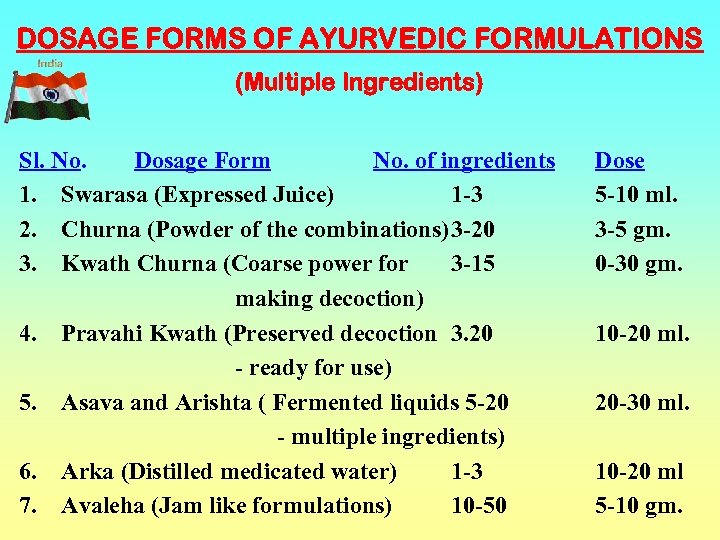 DOSAGE FORMS OF AYURVEDIC FORMULATIONS (Multiple Ingredients) Sl. No. Dosage Form No. of ingredients 1. Swarasa (Expressed Juice) 1 -3 2. Churna (Powder of the combinations)3 -20 3. Kwath Churna (Coarse power for 3 -15 making decoction) 4. Pravahi Kwath (Preserved decoction 3. 20 - ready for use) 5. Asava and Arishta ( Fermented liquids 5 -20 - multiple ingredients) 6. Arka (Distilled medicated water) 1 -3 7. Avaleha (Jam like formulations) 10 -50 Dose 5 -10 ml. 3 -5 gm. 0 -30 gm. 10 -20 ml. 20 -30 ml. 10 -20 ml 5 -10 gm.
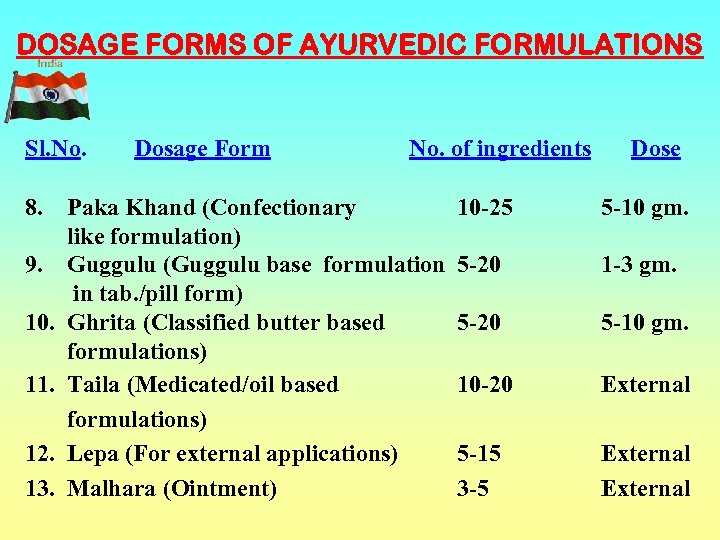 DOSAGE FORMS OF AYURVEDIC FORMULATIONS Sl. No. Dosage Form No. of ingredients Dose 8. Paka Khand (Confectionary 10 -25 5 -10 gm. like formulation) 9. Guggulu (Guggulu base formulation 5 -20 1 -3 gm. in tab. /pill form) 10. Ghrita (Classified butter based 5 -20 5 -10 gm. formulations) 11. Taila (Medicated/oil based 10 -20 External formulations) 12. Lepa (For external applications) 5 -15 External 13. Malhara (Ointment) 3 -5 External
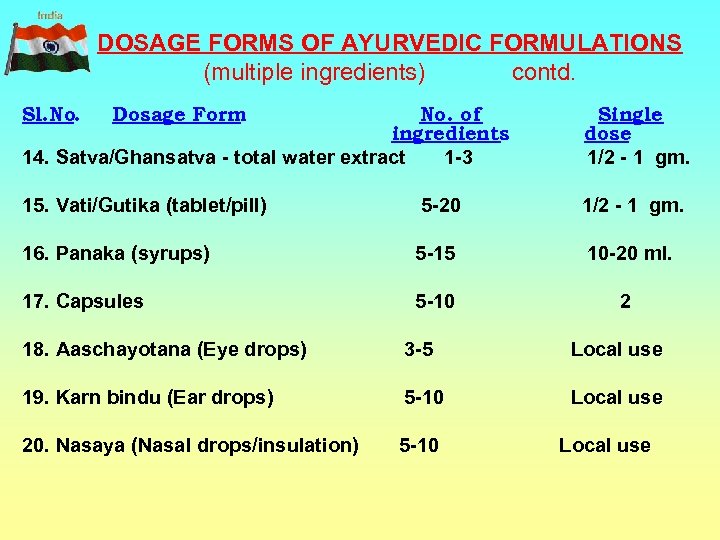 DOSAGE FORMS OF AYURVEDIC FORMULATIONS (multiple ingredients) contd. Sl. No. Dosage Form No. of Single ingredients dose 14. Satva/Ghansatva - total water extract 1 -3 1/2 - 1 gm. 15. Vati/Gutika (tablet/pill) 5 -20 1/2 - 1 gm. 16. Panaka (syrups) 5 -15 10 -20 ml. 17. Capsules 5 -10 18. Aaschayotana (Eye drops) 3 -5 Local use 19. Karn bindu (Ear drops) 5 -10 Local use 20. Nasaya (Nasal drops/insulation) 5 -10 Local use 2
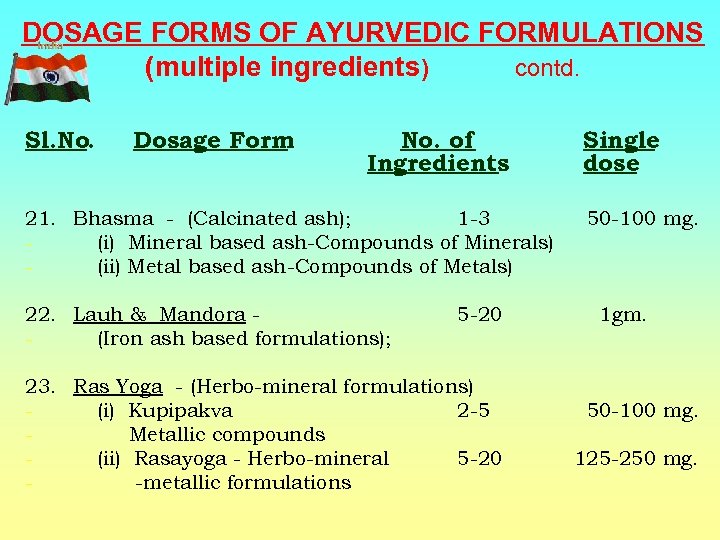 DOSAGE FORMS OF AYURVEDIC FORMULATIONS (multiple ingredients) contd. Sl. No. Dosage Form No. of Ingredients 21. Bhasma - (Calcinated ash); 1 -3 (i) Mineral based ash-Compounds of Minerals) (ii) Metal based ash-Compounds of Metals) 22. Lauh & Mandora (Iron ash based formulations); 5 -20 23. Ras Yoga - (Herbo-mineral formulations) (i) Kupipakva 2 -5 Metallic compounds (ii) Rasayoga - Herbo-mineral 5 -20 -metallic formulations Single dose 50 -100 mg. 1 gm. 50 -100 mg. 125 -250 mg.
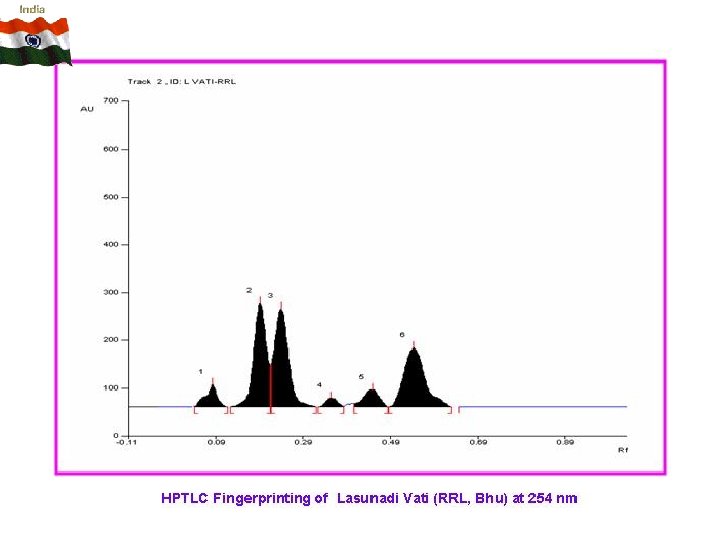
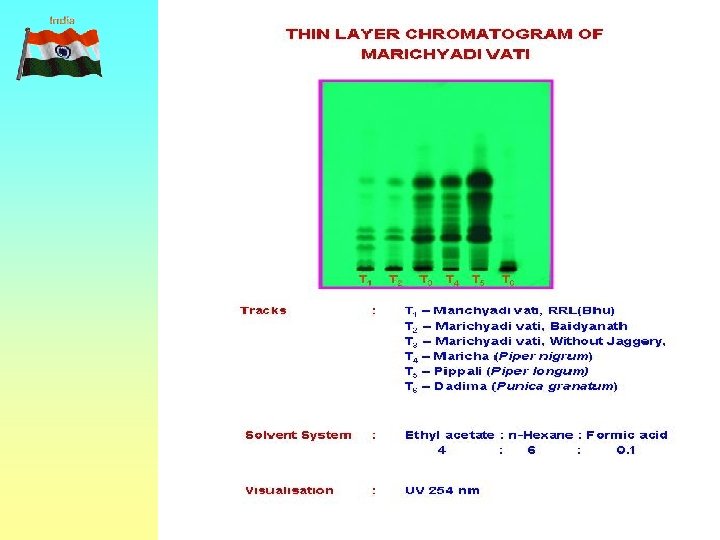
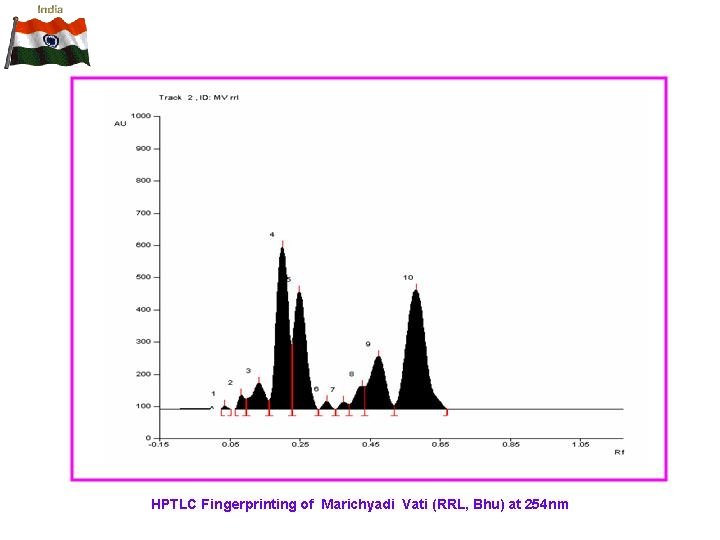
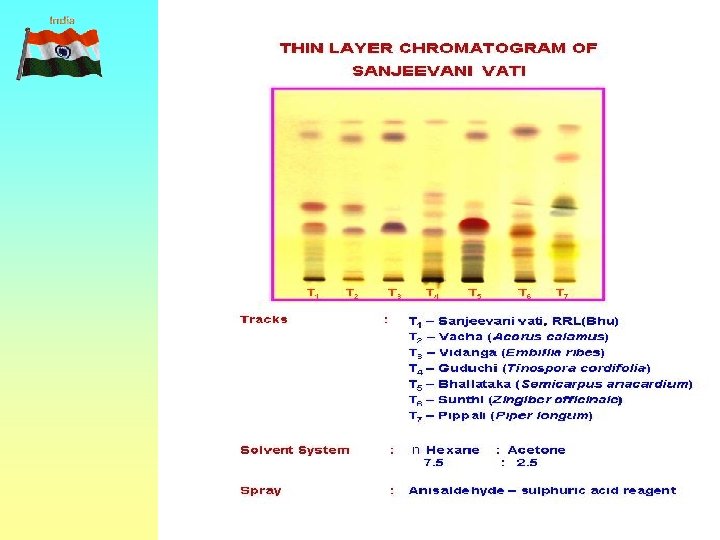
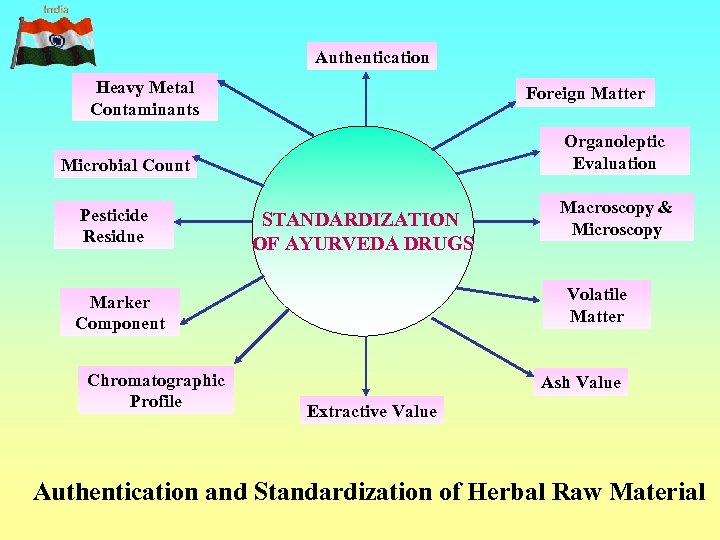 Authentication Heavy Metal Contaminants Foreign Matter Organoleptic Evaluation Microbial Count Pesticide Residue STANDARDIZATION OF AYURVEDA DRUGS Volatile Matter Marker Component Chromatographic Profile Macroscopy & Microscopy Ash Value Extractive Value Authentication and Standardization of Herbal Raw Material
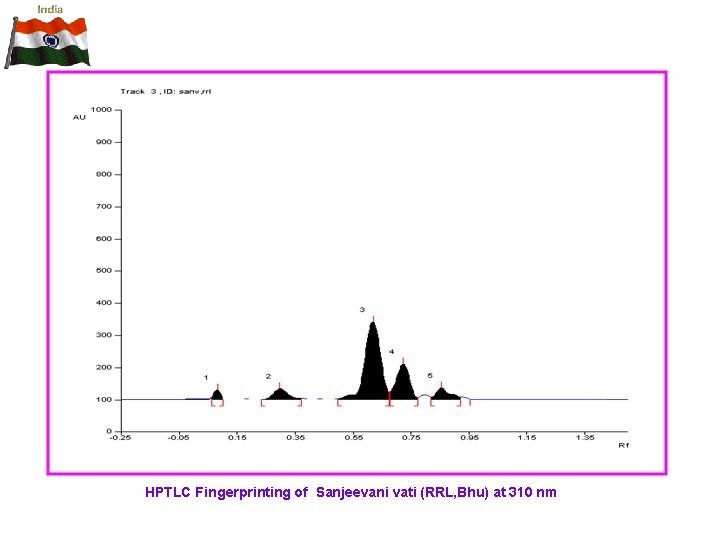
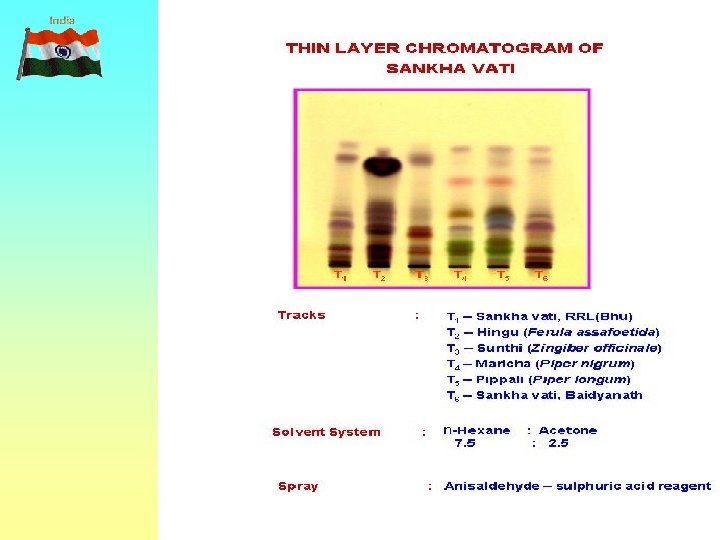
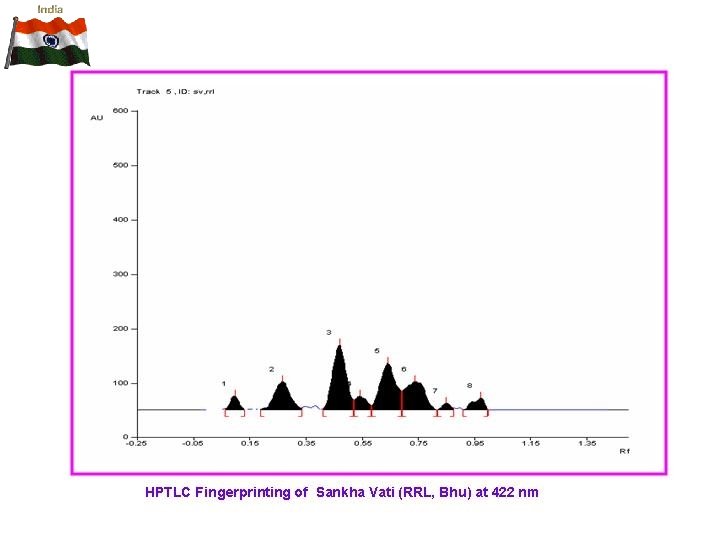
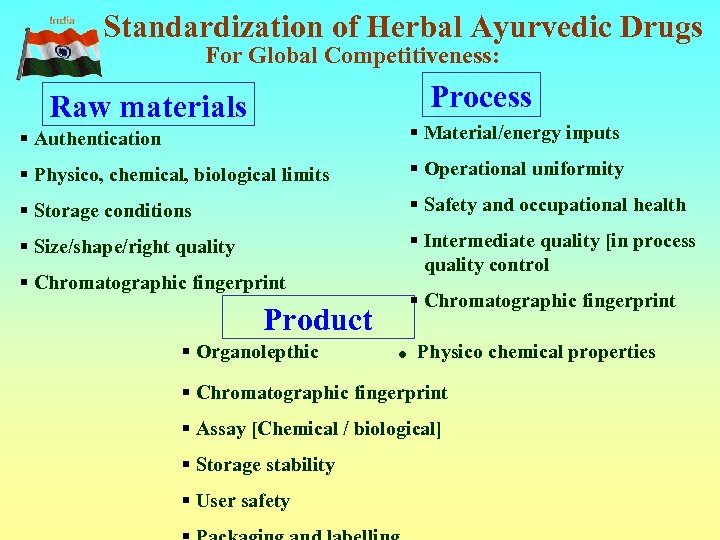 Standardization of Herbal Ayurvedic Drugs For Global Competitiveness: Process Raw materials § Authentication § Material/energy inputs § Physico, chemical, biological limits § Operational uniformity § Storage conditions § Safety and occupational health § Size/shape/right quality § Intermediate quality [in process quality control § Chromatographic fingerprint Product § Organolepthic § Chromatographic fingerprint . Physico chemical properties § Chromatographic fingerprint § Assay [Chemical / biological] § Storage stability § User safety
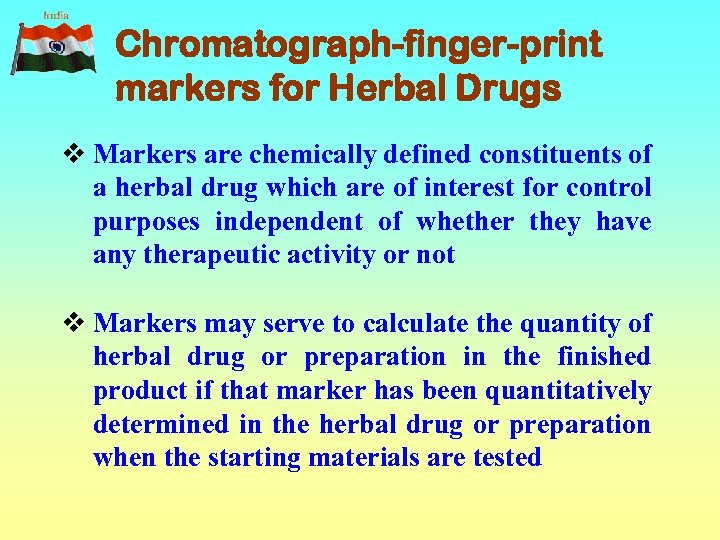 Chromatograph-finger-print markers for Herbal Drugs v Markers are chemically defined constituents of a herbal drug which are of interest for control purposes independent of whether they have any therapeutic activity or not v Markers may serve to calculate the quantity of herbal drug or preparation in the finished product if that marker has been quantitatively determined in the herbal drug or preparation when the starting materials are tested
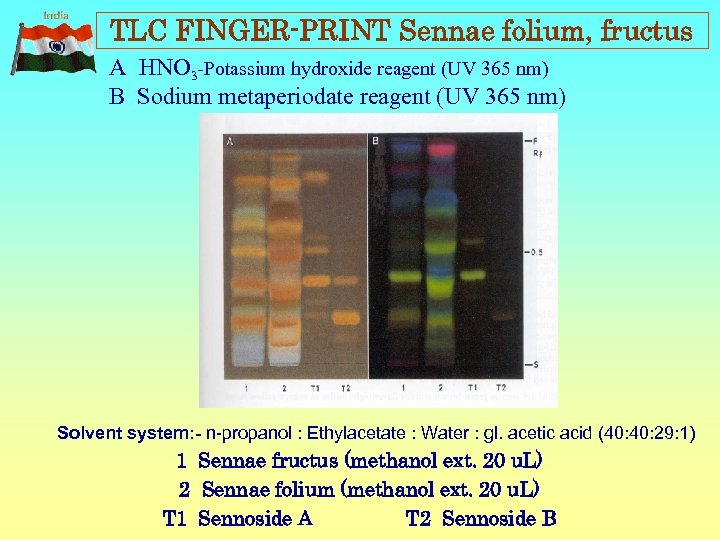 TLC FINGER-PRINT Sennae folium, fructus A HNO 3 -Potassium hydroxide reagent (UV 365 nm) B Sodium metaperiodate reagent (UV 365 nm) Solvent system: - n-propanol : Ethylacetate : Water : gl. acetic acid (40: 29: 1) 1 Sennae fructus (methanol ext. 20 u. L) 2 Sennae folium (methanol ext. 20 u. L) T 1 Sennoside A T 2 Sennoside B
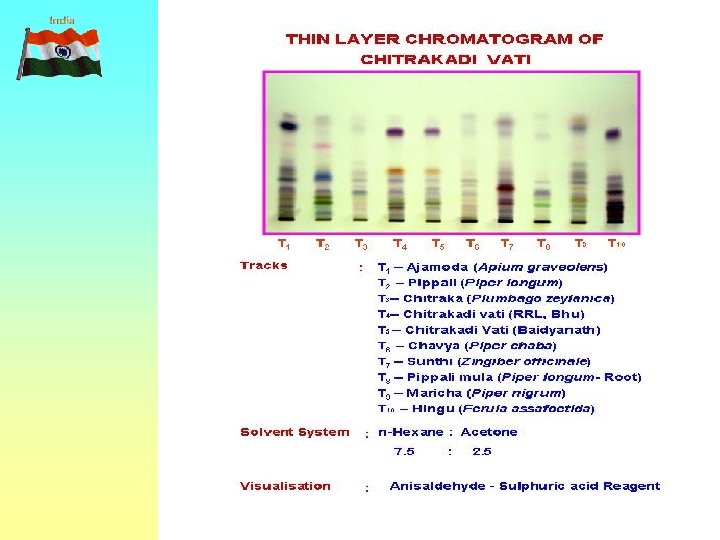
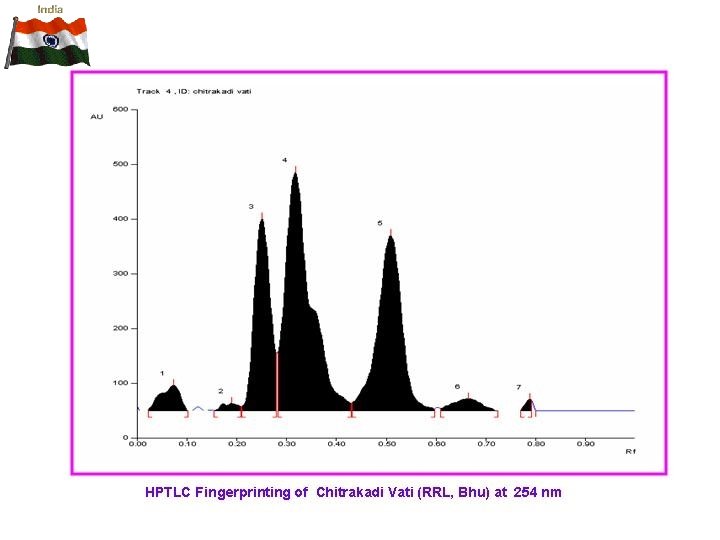
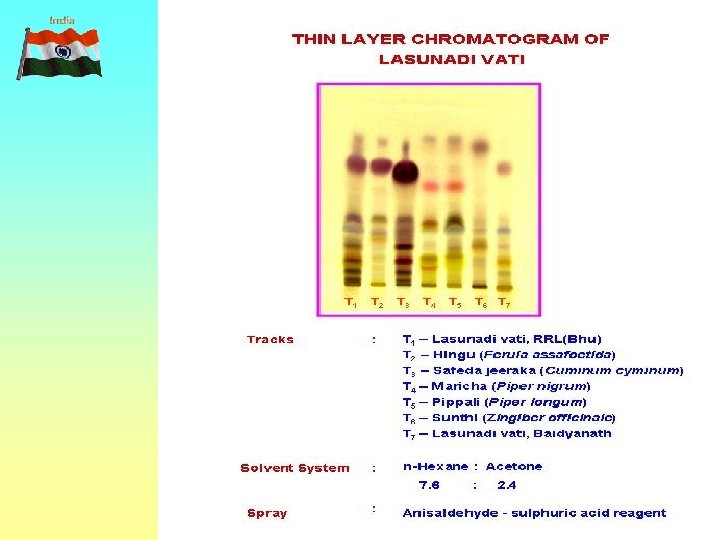
 PHARMACOPOEIAL MONOGRAPHS ON AYURVEDIC DRUGS AND FORMULATIONS AIMS CONTROL OF PRODUCT QUALITY IN TERMS OF: ØIdentity ØPurity ØStrength • PLANT DRUGS -> UNPROCESSED PLANT PARTS AS DRUGS (PD) 44
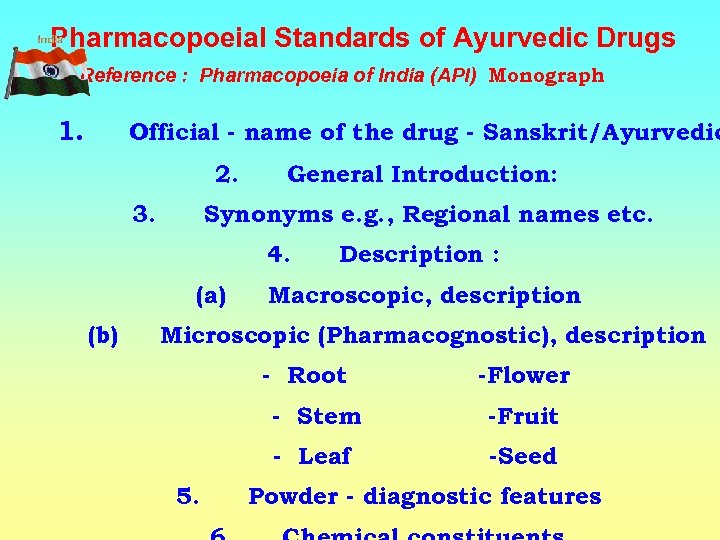 Pharmacopoeial Standards of Ayurvedic Drugs Reference : Pharmacopoeia of India (API) Monograph 1. Official - name of the drug - Sanskrit/Ayurvedic 2. 3. General Introduction: Synonyms e. g. , Regional names etc. 4. (a) (b) Description : Macroscopic, description Microscopic (Pharmacognostic), description - Root -Flower - Stem - Leaf 5. -Fruit -Seed Powder - diagnostic features
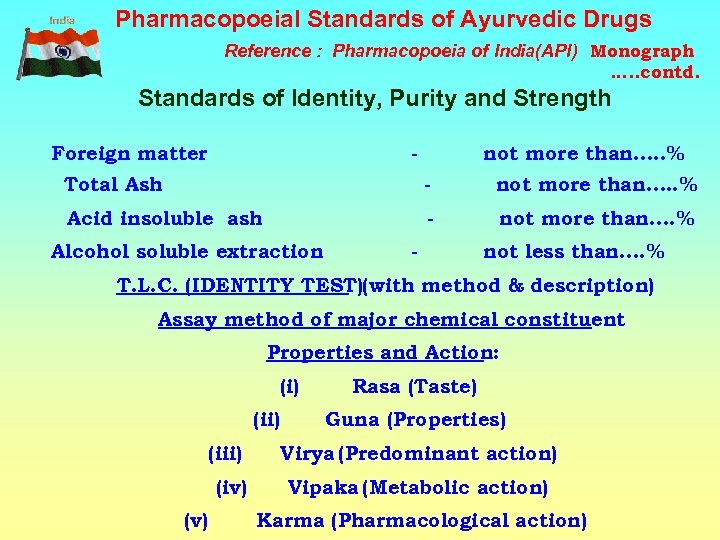 Pharmacopoeial Standards of Ayurvedic Drugs Reference : Pharmacopoeia of India(API) Monograph …. . contd. Standards of Identity, Purity and Strength Foreign matter - not more than…. . % Total Ash - not more than…. . % Acid insoluble ash - not more than…. % Alcohol soluble extraction - not less than…. % T. L. C. (IDENTITY TEST)(with method & description) Assay method of major chemical constituent Properties and Action: (i) (iii) (iv) (v) Rasa (Taste) Guna (Properties) Virya (Predominant action) Vipaka (Metabolic action) Karma (Pharmacological action)
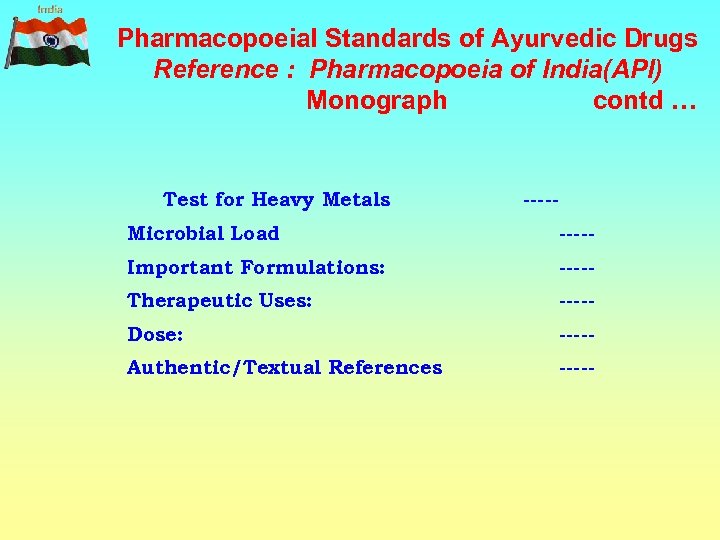 Pharmacopoeial Standards of Ayurvedic Drugs Reference : Pharmacopoeia of India(API) Monograph contd … Test for Heavy Metals ----- Microbial Load ----- Important Formulations: ----- Therapeutic Uses: ----- Dose: ----- Authentic/Textual References -----
![AYURVEDIC PHARMACOPOEIA OF INDIA [API] v ABOUT 1000 SINGLE DRUGS AND 8000 COMPOUND FORMULATIONS](https://present5.com/presentation/9481d3e36ac48b3e06f04caed2ed1f34/image-48.jpg "AYURVEDIC PHARMACOPOEIA OF INDIA [API] v ABOUT 1000 SINGLE DRUGS AND 8000 COMPOUND FORMULATIONS") AYURVEDIC PHARMACOPOEIA OF INDIA [API] v ABOUT 1000 SINGLE DRUGS AND 8000 COMPOUND FORMULATIONS OF RECOGNIZED MERIT ARE USED IN INDIA. v AYURVEDIC PHARMACOPOEIAL COMMITTEE [APC] TARGETED STUDY ON 600 SINGLE DRUGS. v FIVE VOLUMES OF AYURVEDIC PHARMACOPOEIA OF INDIA (API) HAVE BEEN PUBLISHED. à API VOL I 80 drugs à API VOL III 100 drugs à API VOL IV 68 drugs à API VOL. V 92 drugs 78 drugs à Total 418 drugs à API Vol. VI & VII are in pipeline - 160 drugs
AYURVEDIC PHARMACOPOEIA OF INDIA [API] v ABOUT 1000 SINGLE DRUGS AND 8000 COMPOUND FORMULATIONS OF RECOGNIZED MERIT ARE USED IN INDIA. v AYURVEDIC PHARMACOPOEIAL COMMITTEE [APC] TARGETED STUDY ON 600 SINGLE DRUGS. v FIVE VOLUMES OF AYURVEDIC PHARMACOPOEIA OF INDIA (API) HAVE BEEN PUBLISHED. à API VOL I 80 drugs à API VOL III 100 drugs à API VOL IV 68 drugs à API VOL. V 92 drugs 78 drugs à Total 418 drugs à API Vol. VI & VII are in pipeline - 160 drugs
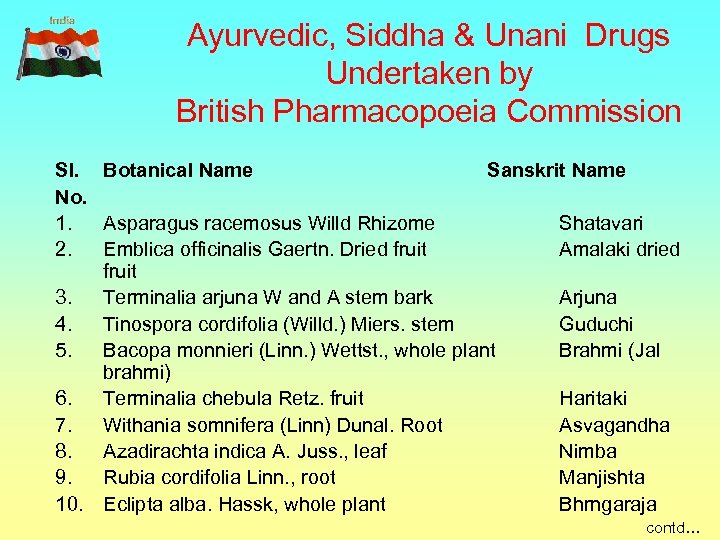 Ayurvedic, Siddha & Unani Drugs Undertaken by British Pharmacopoeia Commission Sl. Botanical Name Sanskrit Name No. 1. Asparagus racemosus Willd Rhizome Shatavari 2. Emblica officinalis Gaertn. Dried fruit Amalaki dried fruit 3. Terminalia arjuna W and A stem bark Arjuna 4. Tinospora cordifolia (Willd. ) Miers. stem Guduchi 5. Bacopa monnieri (Linn. ) Wettst. , whole plant Brahmi (Jal brahmi) 6. Terminalia chebula Retz. fruit Haritaki 7. Withania somnifera (Linn) Dunal. Root Asvagandha 8. Azadirachta indica A. Juss. , leaf Nimba 9. Rubia cordifolia Linn. , root Manjishta 10. Eclipta alba. Hassk, whole plant Bhrngaraja contd…
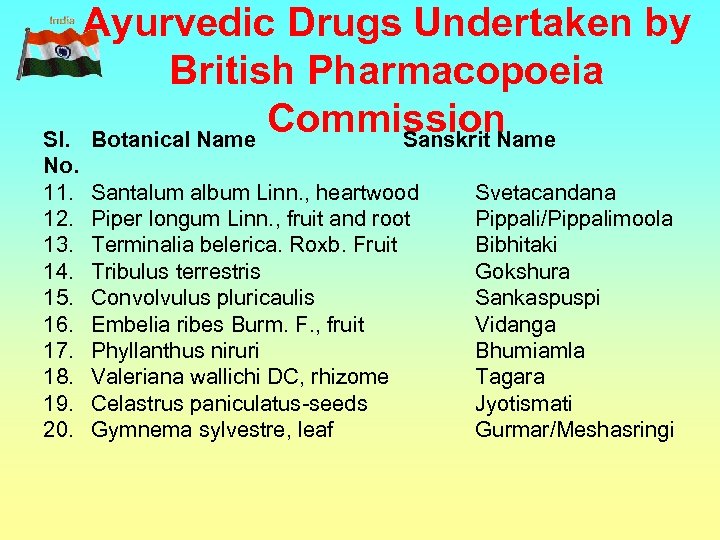 Ayurvedic Drugs Undertaken by British Pharmacopoeia Commission Sl. Botanical Name Sanskrit Name No. 11. 12. 13. 14. 15. 16. 17. 18. 19. 20. Santalum album Linn. , heartwood Piper longum Linn. , fruit and root Terminalia belerica. Roxb. Fruit Tribulus terrestris Convolvulus pluricaulis Embelia ribes Burm. F. , fruit Phyllanthus niruri Valeriana wallichi DC, rhizome Celastrus paniculatus-seeds Gymnema sylvestre, leaf Svetacandana Pippali/Pippalimoola Bibhitaki Gokshura Sankaspuspi Vidanga Bhumiamla Tagara Jyotismati Gurmar/Meshasringi
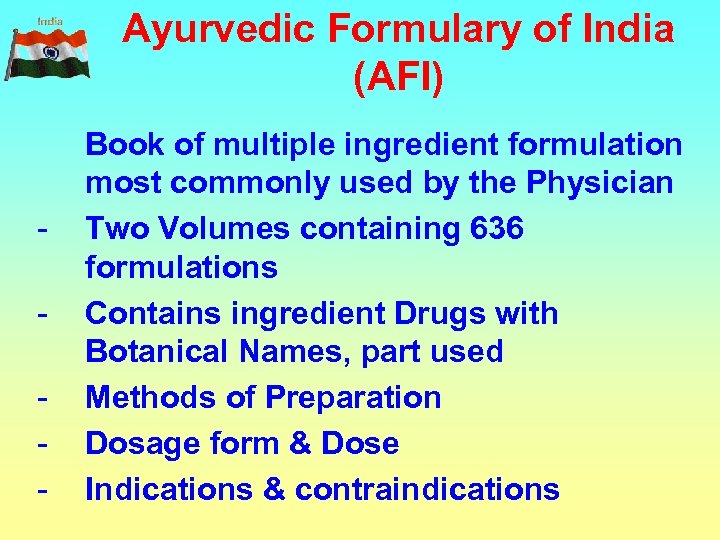 Ayurvedic Formulary of India (AFI) - Book of multiple ingredient formulation most commonly used by the Physician Two Volumes containing 636 formulations Contains ingredient Drugs with Botanical Names, part used Methods of Preparation Dosage form & Dose Indications & contraindications
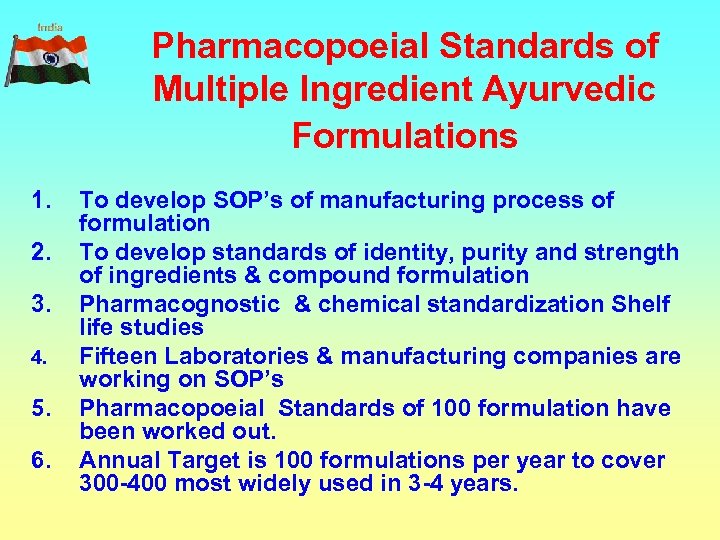 Pharmacopoeial Standards of Multiple Ingredient Ayurvedic Formulations 1. 2. 3. 4. 5. 6. To develop SOP’s of manufacturing process of formulation To develop standards of identity, purity and strength of ingredients & compound formulation Pharmacognostic & chemical standardization Shelf life studies Fifteen Laboratories & manufacturing companies are working on SOP’s Pharmacopoeial Standards of 100 formulation have been worked out. Annual Target is 100 formulations per year to cover 300 -400 most widely used in 3 -4 years.
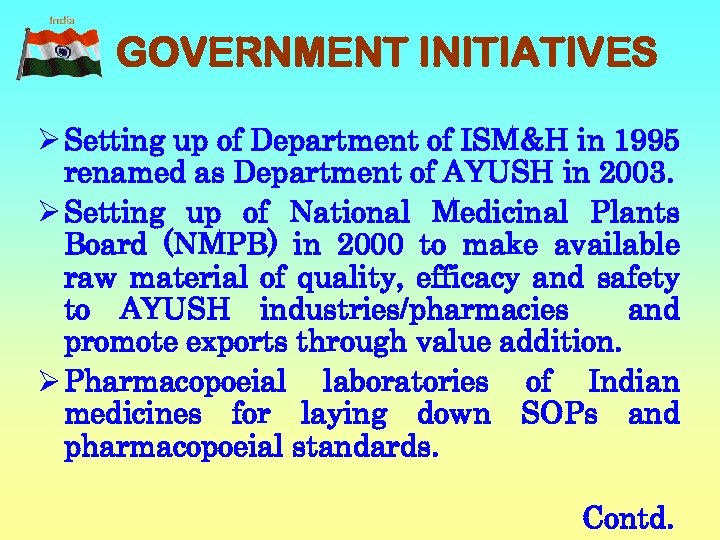 GOVERNMENT INITIATIVES Ø Setting up of Department of ISM&H in 1995 renamed as Department of AYUSH in 2003. Ø Setting up of National Medicinal Plants Board (NMPB) in 2000 to make available raw material of quality, efficacy and safety to AYUSH industries/pharmacies and promote exports through value addition. Ø Pharmacopoeial laboratories of Indian medicines for laying down SOPs and pharmacopoeial standards. Contd.
 GOVERNMENT INITIATIVES… Ø Preparation of pharmacopoeias of Ayurveda– so far five volumes of API containing standards for 418 drugs. Ø Separate chapter for ASU medicines in Drugs & Cosmetics Act, 1940. Ø Good Manufacturing Practices (GMPs), non GMP units to be delicensed. Ø Provisions regarding mandatory testing for heavy metals made mandatory from 1 st January, 2006.
 PHARMACOPOEIAL LABS & TESTING FACILITIES FOR AYURVEDIC DRUGS 1. Pharmacopoeial Laboratory for Indian Medicine (PLIM) established in 1970 & 20 other laboratories (For evolving Pharmacopoeial Standards of Ayurveda drugs) 2. University/Council for Scientific & Industrial Research and other National Laboratories are associated for pharmacopoeial work
 G. M. P. FOR AYURVEDIC MEDICINES Good Manufacturing Practices (GMP) for Ayurvedic, Unani and Siddha drugs have been implemented on 23 rd June, 2000. WHO guidelines have been kept in mind while preparing the document. • 5500 Units are GMP compliant Non-GMP 2500 units compliant • stopped production
 G. M. P. FOR AYURVEDIC MEDICINES: Standards laid down for: • • • Storage of raw material/proper authentication Manufacturing area, machines & processing Record keeping, SOPs In-house quality control & quality assurance Finished goods store Working conditions of all sections
 On GMP for Ayurveda/Siddha/Unani Drugs • GMP certificate is a must if you are going to produce any Ayurveda products GMP Requirements - Raw Materials-prescribed quality and free from contamination - Manufacturing process-infrastructure, staff - QC-adequate measure to be adopted, documents - To achieve the objectives listed above, each licensee shall evolve methodology and procedures for following the prescribed process of manufacturing of drugs which should be documented as a manual and kept for reference and inspection *Ref: Schedule T, Drugs & Cosmetic Act Notification (June, 2000), ISM & H, Min Health, GOI
 INDIAN DRUGS & COSMETIC ACT, 1940 REGULATION OF AYURVEDIC DRUGS • Separate Chapter IVA for Ayurveda, Siddha & Unani medicines deals with the Section 33 -C of the Drugs & Cosmetics Act, 1940 in 1982. • Separate Drug Technical Advisory Board under Drugs & Cosmetics Act, 1940 for ASU drugs to advise Government on all aspects related to quality control and drug standardization. • Separate Drugs Consultative Committees set up for securing uniform administration of the Act throughout India. • State wise Drugs Licensing/Controlling Authorities.
 IMPORTANT PROVISIONS OF INDIAN DRUGS & COSMETICS ACT * Regulation of manufacture for sale of Ayurvedic drugs through drug manufacturing license system. * Prohibition of manufacture and sale of certain drugs. * Power of Central Government to prohibit manufacture etc. of drugs in public interest. * Provision for Government Drug Analysts. * Provision for Inspectors to visit factory. contd. . .
 IMPORTANT PROVISIONS OF INDIAN DRUGS & COSMETICS ACT RELATING TO AYURVEDIC MEDICINES * Penalty for manufacture, sale etc. , of drugs in contravention of the Act (Section 33 J). * Penalty for subsequent offences. • Prescribe qualifications and duties of the Government Analysts. • Prescribe methods of testing and analysis. • To establish Laboratories for Testing and Analysis of Drugs. • Schedule - E of Drug Act prescribe list of poisonous material used in ASU drugs require special safeguards contd…
 IMPORTANT PROVISIONS OF INDIAN DRUGS & COSMETICS ACT RELATING TO AYURVEDIC MEDICINES contd…. . - Describe mis-branded (Section 33 E) adulterated (Section 33 EE) and spurious drugs (Section 33 EEE) for punitive action (fine/imprisonment) - Power of Central Government to make Rules under the Act - Schedule-T, Prescribe Good Manufacturing Practices(GMP) - Labeling/packing provisions for domestic use as well as export - Rule 160 -A Recognize public, private Drug Testing Laboratories for sample analysis - Guidelines of Good Laboratory Practices (GLP)
 Indian Drugs & Cosmetic Act - Spurious Drugs (ASU) 1. Section 33 E – Mis-branded drugs 2. Section 33 EE – Adulterated drugs 3. Section 33 EEE – Spurious Drugs Penalty: Section 33 J Imprisonment up to six months and (fine not less than Rs. 1, 000)
 Labeling provisions (Rule-161) Label must have the following: 1. 2. 3. 4. Name of formulation True list of ingredients used in the formulation together with the quantity of each ingredient If the list is long a separate list be enclosed with the packing and reference be made on the label. If ingredients are from schedule E(I) – the word “Caution: to be taken under medical supervision” should be printed both in English & Hindi”. Contd. .
 Contd… Labeling provisions (Rule-161) 5. 6. 7. 8. 9. 10. Correct statement of weights & measures Name and address of the Manufacturer Manufacturing License Number. Batch Number. Date of Manufacturing & Expiry Date Specifically indicates Ayurveda Medicine/Siddha Medicine/Unani Medicine 11. “FOR EXTERNAL USE ONLY”(whenever applicable be printed) 12. Testing for Heavy Metal limits for export is mandatory w. e. f. 1. 1. 2006 for export.
 Research in Ayurveda 1. 2. 3. 4. 5. 6. 7. 8. CCRAS- Central Council for Research in Ayurveda & Siddha ICMR-Indian Council for Medical Research CSIR- Council for Scientific & Industrial Research DST – Department of Science & Technology DBT – Department of Bio-technology No. of Allopathic Medical Colleges BHU, AIIMS, NIMHANS Golden Triangle Initiative (GTP) of AYUSH, CSIR & ICMR
 New Futuristic Initiatives 1. AYUSH –Ayurvedic Pharmacopoeia Commission 2. Golden Triangle Projects [G. T. P] to validate Ayurvedic Products 3. Standardization of Ayurvedic Education , Publication of minimum Standards of Education 4. Support to Ayush Drugs Industries 5. More Focus on Collaborative Research in Ayurveda. 6. Initiative for Global promotion of Ayurveda 7. Continuation of TKDL Project to safe guard patents
 QUALITY CONTROL MEASURES • • • Publication of Pharmacopoeial standards. Publication of Formularies. Publication of Essential Drug Lists. Enforcement of GMP. Scheduled list of poisonous materials. Prohibition on misleading & objectionable advertisements. • Scientific validation of classical/traditionally used medicines for safety and efficacy.
 Contd…. . • Schedule for mandatory licensing of drug manufacturers. • Misbranded, spurious and adulterated drugs defined. • Legal provision for punitive action for acting in contravention of Drugs & Cosmetics Act. • Mandatory testing of exported drugs for heavy metals. • Self-certification of quality by manufacturers. • Financial assistance to manufacturing units and Drug Testing Laboratories for improving structural and functional capacity.
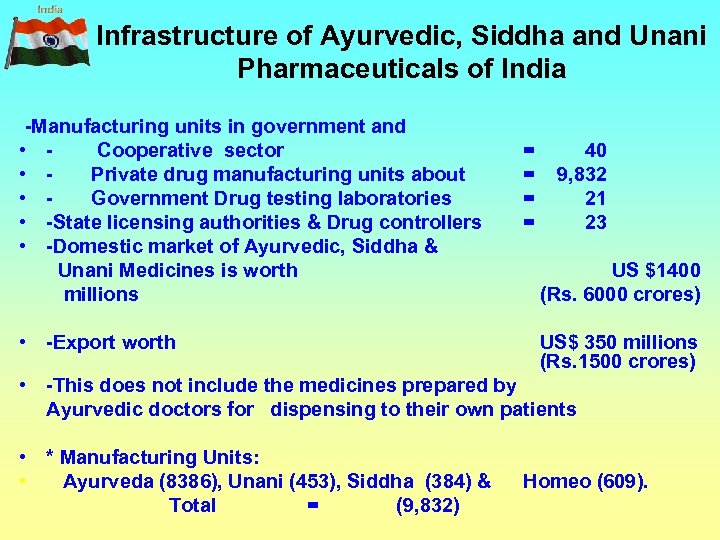 Infrastructure of Ayurvedic, Siddha and Unani Pharmaceuticals of India -Manufacturing units in government and • - Cooperative sector = 40 • Private drug manufacturing units about = 9, 832 • Government Drug testing laboratories = 21 • -State licensing authorities & Drug controllers = 23 • -Domestic market of Ayurvedic, Siddha & Unani Medicines is worth US $1400 millions (Rs. 6000 crores) • -Export worth US$ 350 millions (Rs. 1500 crores) • -This does not include the medicines prepared by Ayurvedic doctors for dispensing to their own patients • * Manufacturing Units: • Ayurveda (8386), Unani (453), Siddha (384) & Total = (9, 832) Homeo (609).
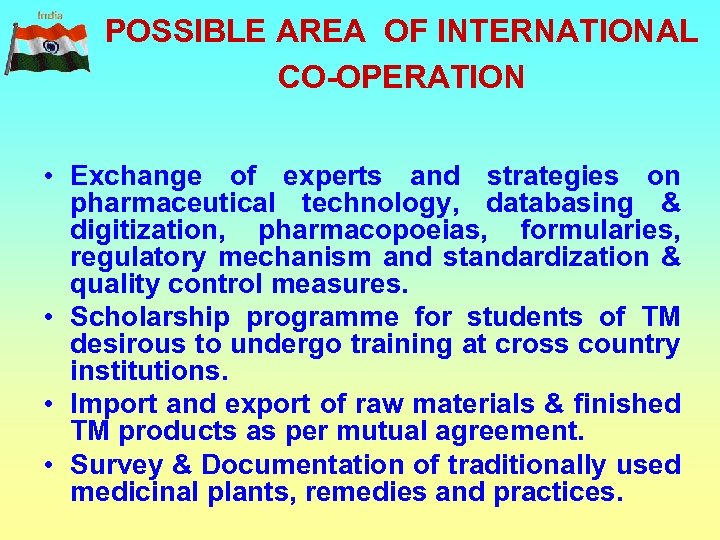 POSSIBLE AREA OF INTERNATIONAL CO-OPERATION • Exchange of experts and strategies on pharmaceutical technology, databasing & digitization, pharmacopoeias, formularies, regulatory mechanism and standardization & quality control measures. • Scholarship programme for students of TM desirous to undergo training at cross country institutions. • Import and export of raw materials & finished TM products as per mutual agreement. • Survey & Documentation of traditionally used medicinal plants, remedies and practices.
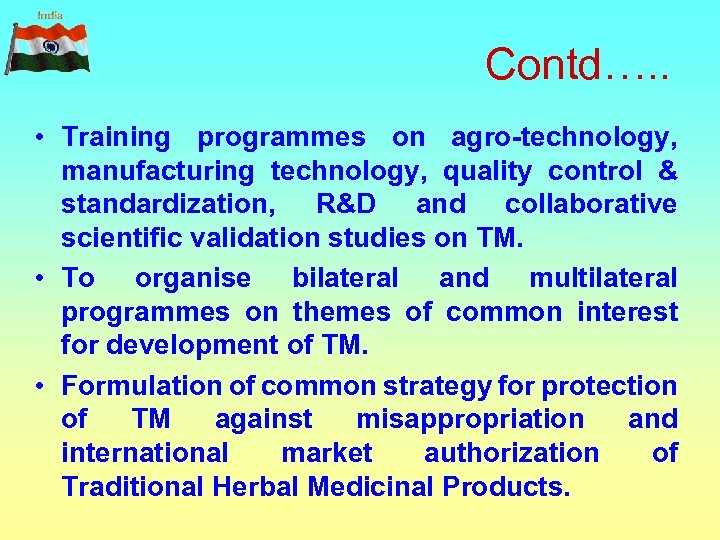 Contd…. . • Training programmes on agro-technology, manufacturing technology, quality control & standardization, R&D and collaborative scientific validation studies on TM. • To organise bilateral and multilateral programmes on themes of common interest for development of TM. • Formulation of common strategy for protection of TM against misappropriation and international market authorization of Traditional Herbal Medicinal Products.
 THANKS