 Скачать презентацию Countable and Uncountable Nouns Grammar Guide Introduction
aabad74af82816b932363e3f99412530.ppt
- Количество слайдов: 24



Countable and Uncountable Nouns Grammar Guide
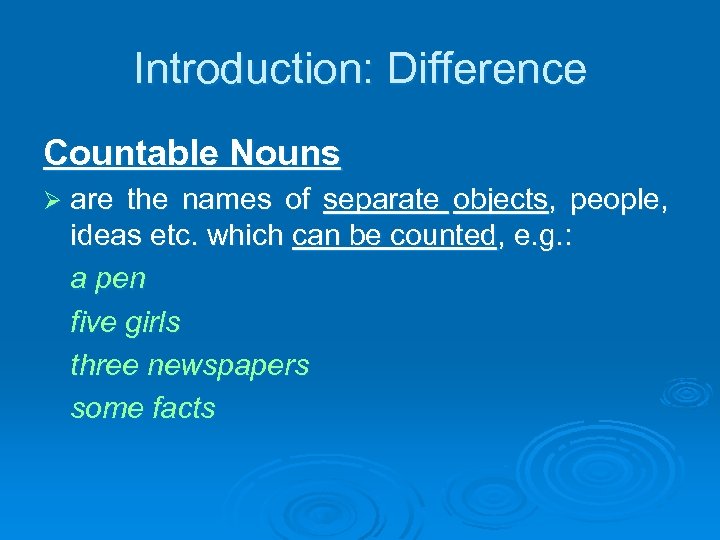
Introduction: Difference Countable Nouns Ø are the names of separate objects, people, ideas etc. which can be counted, e. g. : a pen five girls three newspapers some facts
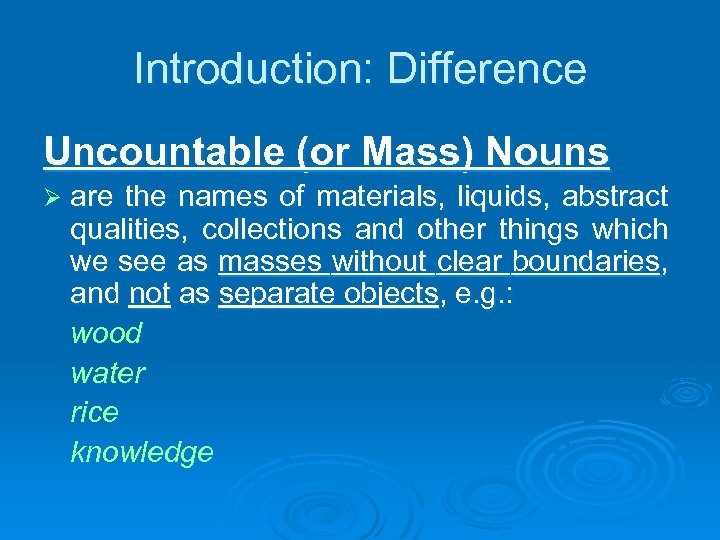
Introduction: Difference Uncountable (or Mass) Nouns Ø are the names of materials, liquids, abstract qualities, collections and other things which we see as masses without clear boundaries, and not as separate objects, e. g. : wood water rice knowledge
![NOUNS COUNTABLE UNCOUNTABLE singular plural a/an some [+] [? ]* any [-] [? ]](https://present5.com/presentation/aabad74af82816b932363e3f99412530/image-4.jpg "NOUNS COUNTABLE UNCOUNTABLE singular plural a/an some [+] [? ]* any [-] [? ]")
NOUNS COUNTABLE UNCOUNTABLE singular plural a/an some [+] [? ]* any [-] [? ] (how) many [-] [? ] (how) much [-] [? ] a few [+] a little [+] a lot of / lots of [+] [? ]* : offers and requests singular
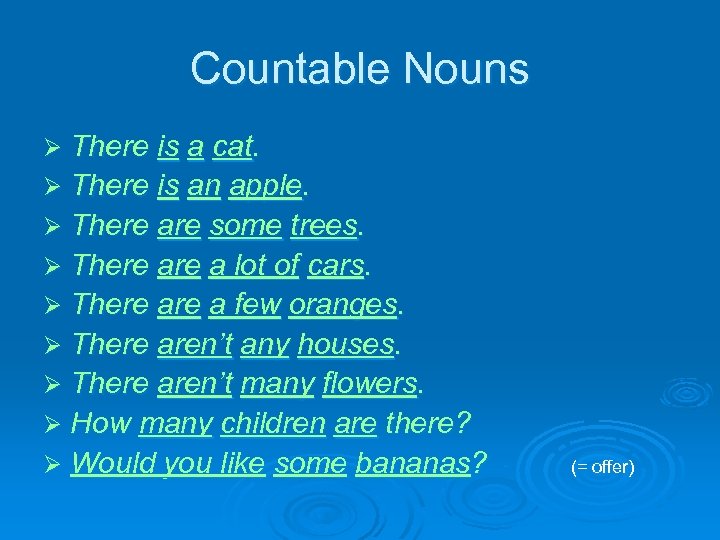
Countable Nouns Ø There is a cat. Ø There is an apple. Ø There are some trees. Ø There a lot of cars. Ø There a few oranges. Ø There aren’t any houses. Ø There aren’t many flowers. Ø How many children are there? Ø Would you like some bananas? (= offer)
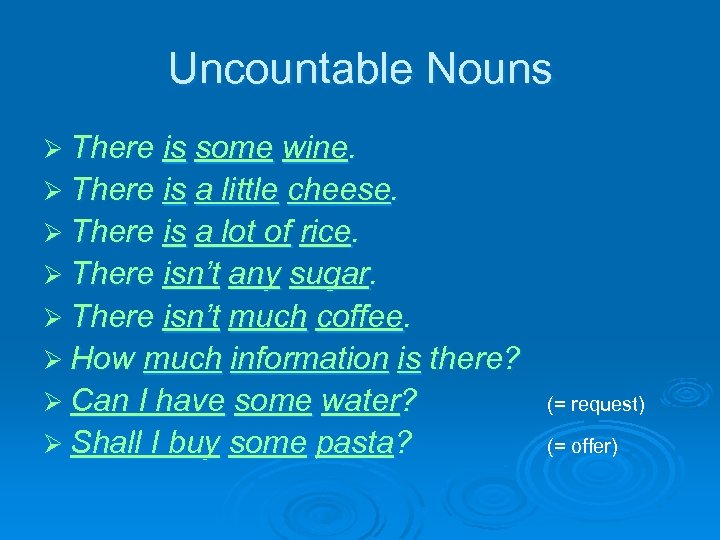
Uncountable Nouns Ø There is some wine. Ø There is a little cheese. Ø There is a lot of rice. Ø There isn’t any sugar. Ø There isn’t much coffee. Ø How much information is there? Ø Can I have some water? (= request) Ø Shall I buy some pasta? (= offer)
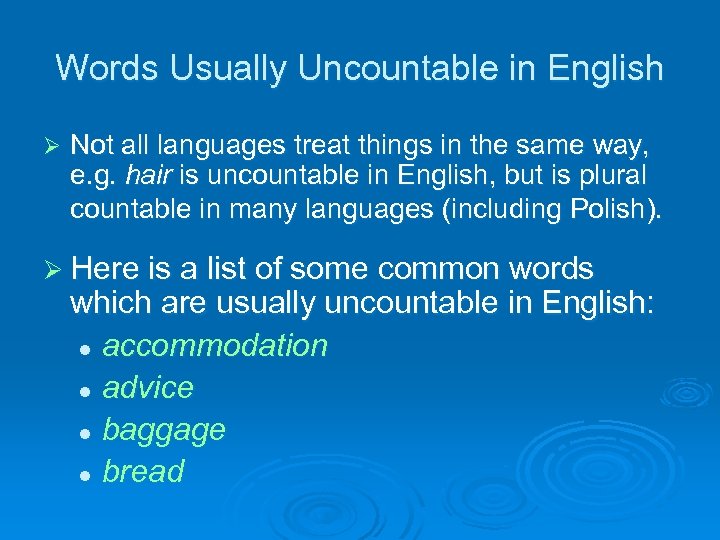
Words Usually Uncountable in English Ø Not all languages treat things in the same way, e. g. hair is uncountable in English, but is plural countable in many languages (including Polish). Ø Here is a list of some common words which are usually uncountable in English: l accommodation l advice l baggage l bread
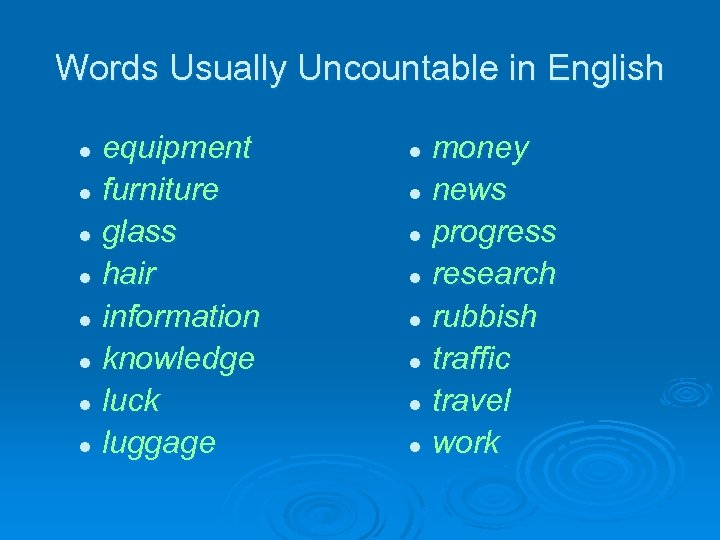
Words Usually Uncountable in English equipment l furniture l glass l hair l information l knowledge l luck l luggage l money l news l progress l research l rubbish l traffic l travel l work l
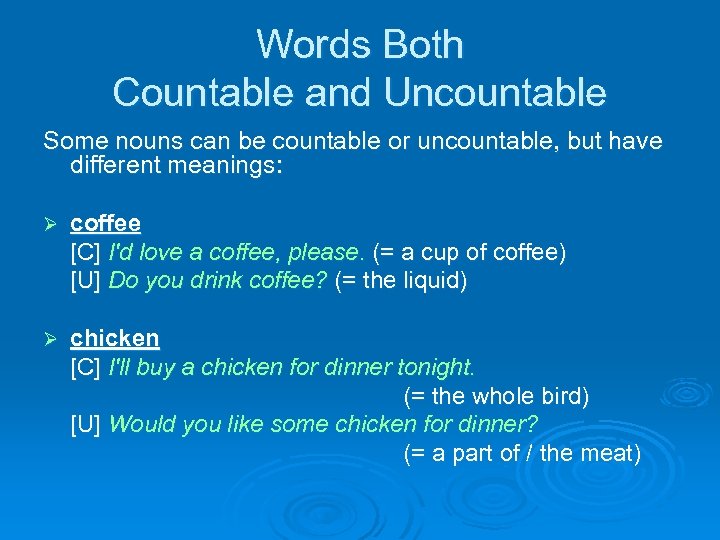
Words Both Countable and Uncountable Some nouns can be countable or uncountable, but have different meanings: Ø coffee [C] I'd love a coffee, please. (= a cup of coffee) [U] Do you drink coffee? (= the liquid) Ø chicken [C] I'll buy a chicken for dinner tonight. (= the whole bird) [U] Would you like some chicken for dinner? (= a part of / the meat)
![Words Both Countable and Uncountable Ø drawing [C] This is an amazing drawing by](https://present5.com/presentation/aabad74af82816b932363e3f99412530/image-10.jpg "Words Both Countable and Uncountable Ø drawing [C] This is an amazing drawing by")
Words Both Countable and Uncountable Ø drawing [C] This is an amazing drawing by Leonardo. (= a picture) [U] My son is very good at drawing. (= the activity) stone [C] Someone threw a stone at our window. (= one item) [U] In that flat landscape of bushes and stone. . . (= the material) Ø time [C] I go out with friends two of three times a week. (= how often? ) [U] I don’t have much time for relaxation. (= clock time) Ø
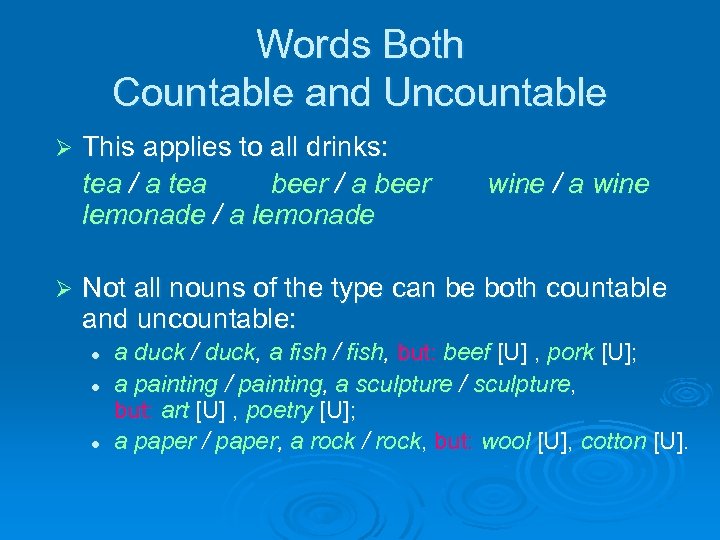
Words Both Countable and Uncountable Ø Ø This applies to all drinks: tea / a tea beer / a beer lemonade / a lemonade wine / a wine Not all nouns of the type can be both countable and uncountable: l l l a duck / duck, a fish / fish, but: beef [U] , pork [U]; a painting / painting, a sculpture / sculpture, but: art [U] , poetry [U]; a paper / paper, a rock / rock, but: wool [U], cotton [U].
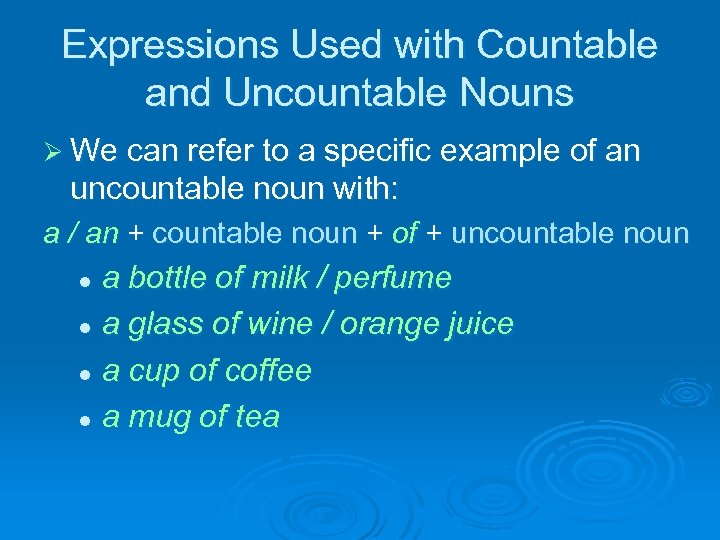
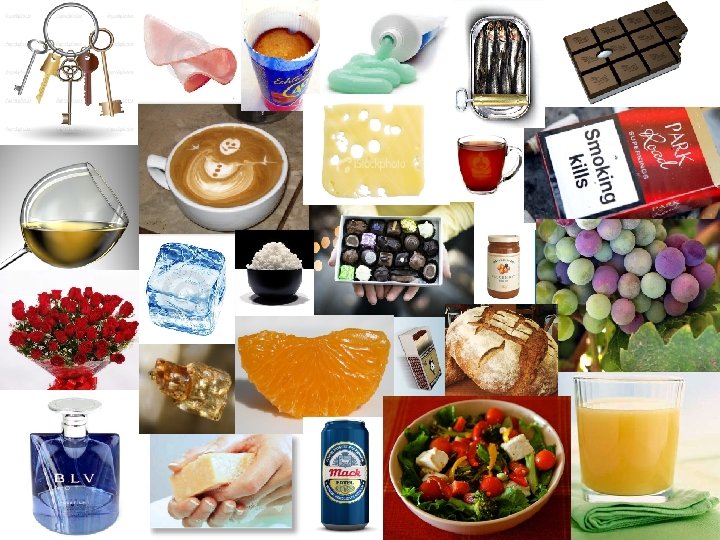
Expressions Used with Countable and Uncountable Nouns Ø We can refer to a specific example of an uncountable noun with: a / an + countable noun + of + uncountable noun a bottle of milk / perfume l a glass of wine / orange juice l a cup of coffee l a mug of tea l
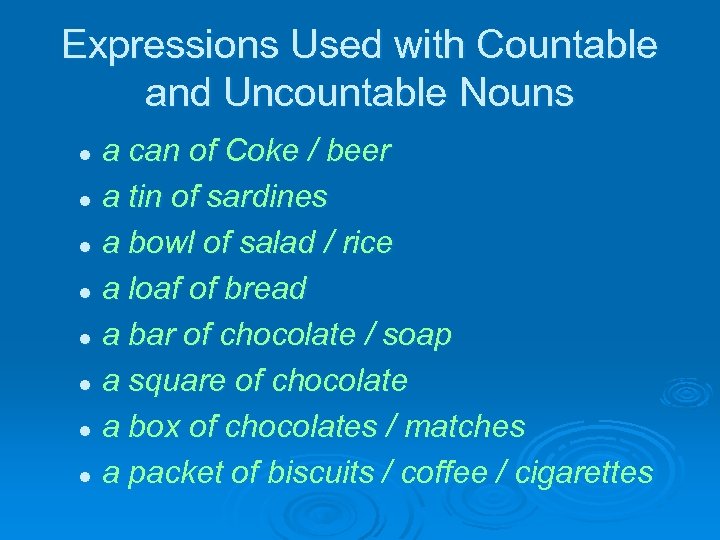
Expressions Used with Countable and Uncountable Nouns a can of Coke / beer l a tin of sardines l a bowl of salad / rice l a loaf of bread l a bar of chocolate / soap l a square of chocolate l a box of chocolates / matches l a packet of biscuits / coffee / cigarettes l
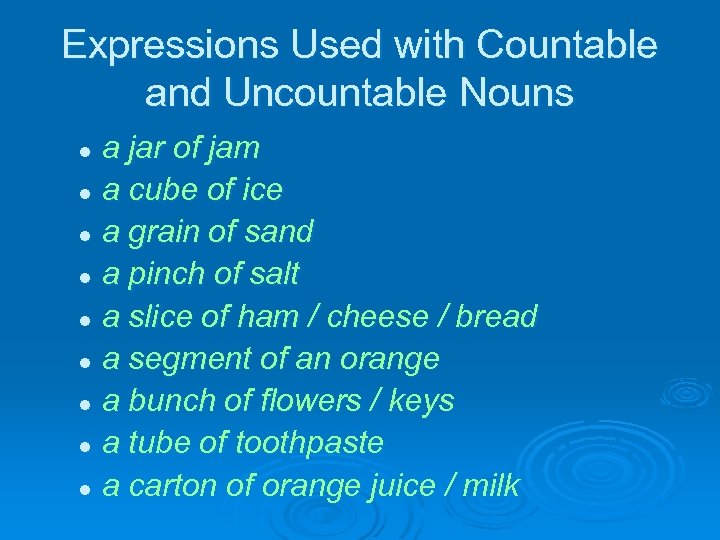
Expressions Used with Countable and Uncountable Nouns a jar of jam l a cube of ice l a grain of sand l a pinch of salt l a slice of ham / cheese / bread l a segment of an orange l a bunch of flowers / keys l a tube of toothpaste l a carton of orange juice / milk l
Countable and uncountable nouns are not difficult. Just think about them.
Survey On an average day, how many people … … put some sugar in tea or coffee. … eat some chips. Find out.
Survey Ø Write down questions: Do you put any sugar in tea or coffee on an average day? Do you eat any chips on an average day?
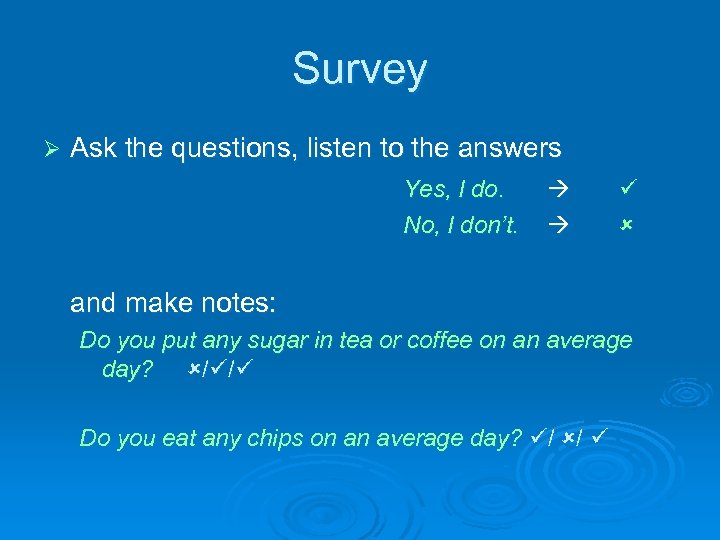
Survey Ø Ask the questions, listen to the answers Yes, I do. No, I don’t. and make notes: Do you put any sugar in tea or coffee on an average day? / / Do you eat any chips on an average day? / /
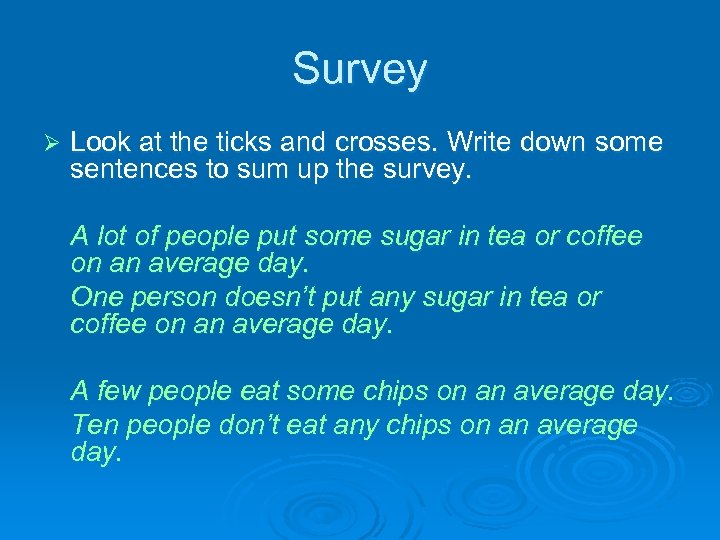
Survey Ø Look at the ticks and crosses. Write down some sentences to sum up the survey. A lot of people put some sugar in tea or coffee on an average day. One person doesn’t put any sugar in tea or coffee on an average day. A few people eat some chips on an average day. Ten people don’t eat any chips on an average day.
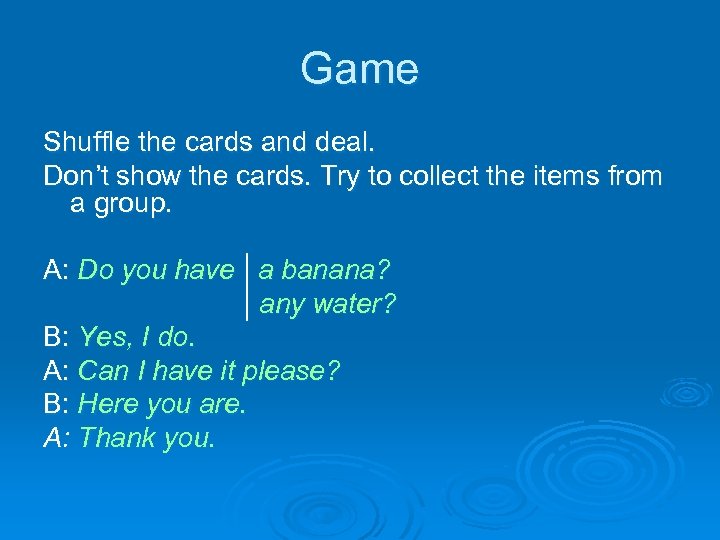
Game Shuffle the cards and deal. Don’t show the cards. Try to collect the items from a group. A: Do you have a banana? any water? B: Yes, I do. A: Can I have it please? B: Here you are. A: Thank you.
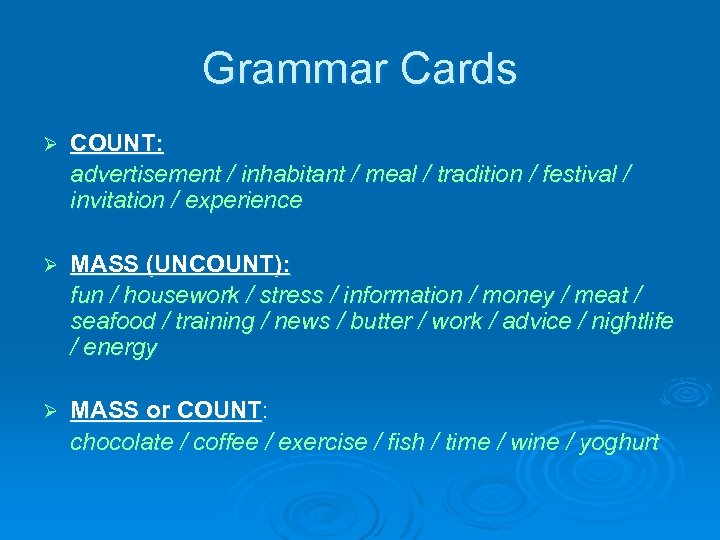
Grammar Cards Ø COUNT: advertisement / inhabitant / meal / tradition / festival / invitation / experience Ø MASS (UNCOUNT): fun / housework / stress / information / money / meat / seafood / training / news / butter / work / advice / nightlife / energy Ø MASS or COUNT: chocolate / coffee / exercise / fish / time / wine / yoghurt
Grammar Practice Complete using the correct form of the verb in brackets. 1. The clothes you bought me for my birthday ……… (be) wonderful. 2. It turned out that the information we had received ……… (be) wrong. 3. My new jeans ……… (be) in the wash and I wanted to wear them tonight. 4. The luggage on a plane ……… (take) up a lot of room. 5. Your hair ……… (look) really nice and shiny. 6. I could tell by the look on her face that the news ……… (not / be) good. 7. Oh, no! My money ……… (be) in my other jacket!
Grammar Practice Check the answers. 1. The clothes you bought me for my birthday are / were wonderful. 2. It turned out that the information we had received was wrong. 3. My new jeans are in the wash and I wanted to wear them tonight. 4. The luggage on a plane takes up a lot of room. 5. Your hair looks really nice and shiny. 6. I could tell by the look on her face that the news wasn’t good. 7. Oh, no! My money is in my other jacket!
Скачать презентацию Countable and Uncountable Nouns Grammar Guide Introduction
aabad74af82816b932363e3f99412530.ppt