


 Скачать презентацию Côte d Ivoire May Shelter Cluster Factsheet 2012 Highlights
4337835f62aa47b46f0be54796bae182.ppt
- Количество слайдов: 2
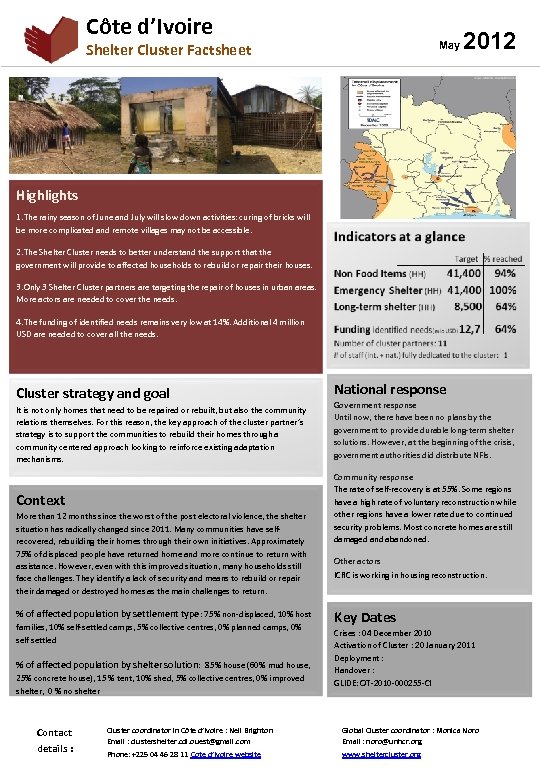 Côte d’Ivoire May Shelter Cluster Factsheet 2012 Highlights 1. The rainy season of June and July will slow down activities: curing of bricks will be more complicated and remote villages may not be accessible. 2. The Shelter Cluster needs to better understand the support that the government will provide to affected households to rebuild or repair their houses. 3. Only 3 Shelter Cluster partners are targeting the repair of houses in urban areas. More actors are needed to cover the needs. 4. The funding of identified needs remains very low at 14%. Additional 4 million USD are needed to cover all the needs. National response Cluster strategy and goal It is not only homes that need to be repaired or rebuilt, but also the community relations themselves. For this reason, the key approach of the cluster partner’s strategy is to support the communities to rebuild their homes through a community centered approach looking to reinforce existing adaptation mechanisms. Context More than 12 months since the worst of the post electoral violence, the shelter situation has radically changed since 2011. Many communities have selfrecovered, rebuilding their homes through their own initiatives. Approximately 75% of displaced people have returned home and more continue to return with assistance. However, even with this improved situation, many households still face challenges. They identify a lack of security and means to rebuild or repair their damaged or destroyed homes as the main challenges to return. % of affected population by settlement type: 75% non-displaced, 10% host families, 10% self-settled camps, 5% collective centres, 0% planned camps, 0% self settled % of affected population by shelter solution: 85% house (60% mud house, 25% concrete house), 15 % tent, 10% shed, 5% collective centres, 0% improved shelter, 0 % no shelter Government response Until now, there have been no plans by the government to provide durable long-term shelter solutions. However, at the beginning of the crisis, government authorities did distribute NFIs. Community response The rate of self-recovery is at 55%. Some regions have a high rate of voluntary reconstruction while other regions have a lower rate due to continued security problems. Most concrete homes are still damaged and abandoned. Other actors ICRC is working in housing reconstruction. Key Dates Crises : 04 December 2010 Activation of Cluster : 20 January 2011 Deployment : Handover : GLIDE: OT-2010 -000255 -CI Contact details : Cluster coordinator in Côte d’Ivoire : Neil Brighton Email : clustershelter. cdi. ouest@gmail. com Global Cluster coordinator : Monica Noro Email : noro@unhcr. org Phone: +225 04 46 28 11 Cote d’Ivoire website www. sheltercluster. org
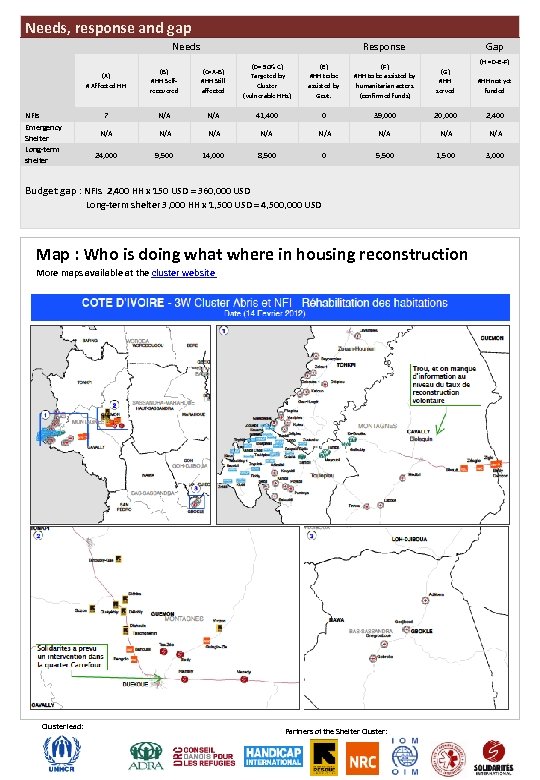 Needs, response and gap Needs Response Gap (A) # Affected HH NFIs Emergency Shelter Long-term shelter (B) #HH Self- recovered (C=A-B) #HH Still affected (D= 50% C) Targeted by Cluster (vulnerable HHs) (E) #HH to be assisted by Govt. (F) #HH to be assisted by humanitarian actors (confirmed funds) (G) #HH served ? (H =D-E-F) #HH not yet funded N/A 41, 400 0 39, 000 20, 000 2, 400 N/A N/A 24, 000 9, 500 14, 000 8, 500 0 5, 500 1, 500 3, 000 Budget gap : NFIs 2, 400 HH x 150 USD = 360, 000 USD Long-term shelter 3, 000 HH x 1, 500 USD = 4, 500, 000 USD Map : Who is doing what where in housing reconstruction More maps available at the cluster website Cluster lead: Partners of the Shelter Cluster: