 Скачать презентацию Cost of Services N 9205 October 3 2000
e6db0893b38d559d663a9fb7053b118a.ppt
- Количество слайдов: 25




Cost of Services N 9205 October 3, 2000

What are the questions? Columbia University School of Nursing M 6920, Spring 2000
How much does X cost? l l over time? in different places? as done by different individuals? as compared with the cost of Y? Columbia University School of Nursing M 6920, Spring 2000
How is X paid for? l l by whom? with what associated incentives/disincentives? Columbia University School of Nursing M 6920, Spring 2000

Key concepts l price elasticity • Does the demand for a produce change with a change in price? l supply and demand curves • How does supply of a produce affect demand vice versa? Columbia University School of Nursing M 6920, Spring 2000

Key concepts, cont. l l l average cost = cost of each item, calculated by dividing total cost by number produced total cost = all costs of production marginal cost= the average cost of the next item produced Columbia University School of Nursing M 6920, Spring 2000
Key concepts, cont. l costs • materials, time, profit l charges • the price tag l cost shifting • charging one customer high enough to cover unpaid costs of another Columbia University School of Nursing M 6920, Spring 2000
Key concepts, cont. l hidden costs/lost opportunity costs often ignored • time • capital investment • foregone earnings Columbia University School of Nursing M 6920, Spring 2000
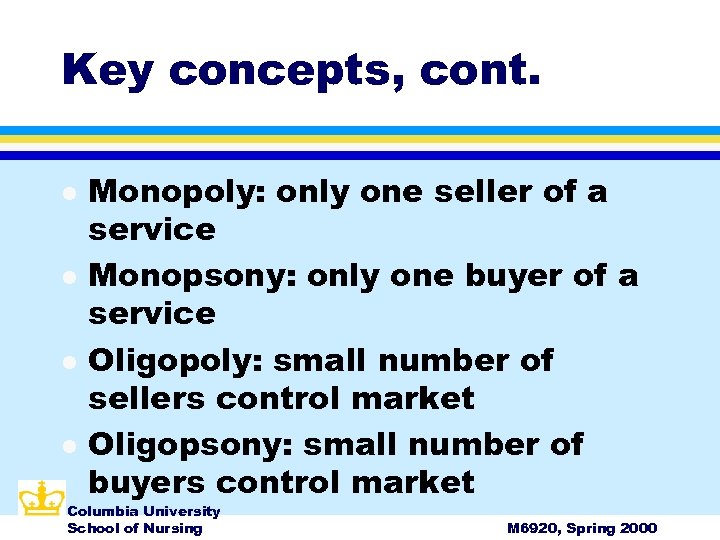
Key concepts, cont. l l Monopoly: only one seller of a service Monopsony: only one buyer of a service Oligopoly: small number of sellers control market Oligopsony: small number of buyers control market Columbia University School of Nursing M 6920, Spring 2000

Data sources: l l l billing information budgets annual reports patient/individual surveys employer surveys Columbia University School of Nursing M 6920, Spring 2000
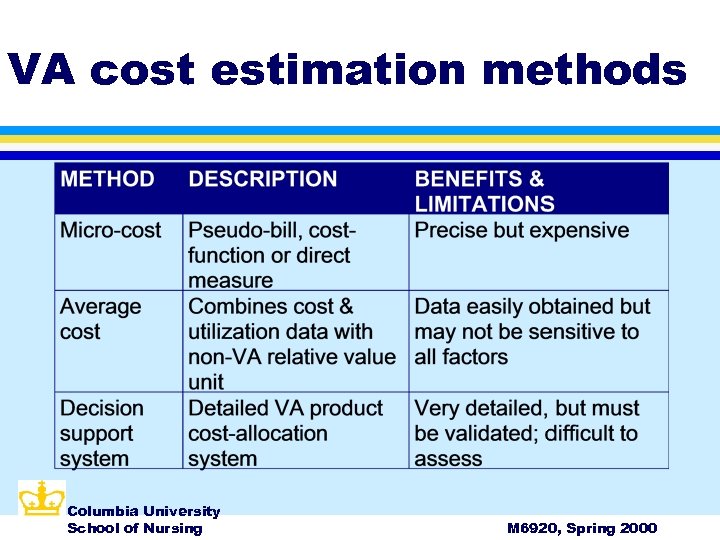
VA cost estimation methods Columbia University School of Nursing M 6920, Spring 2000
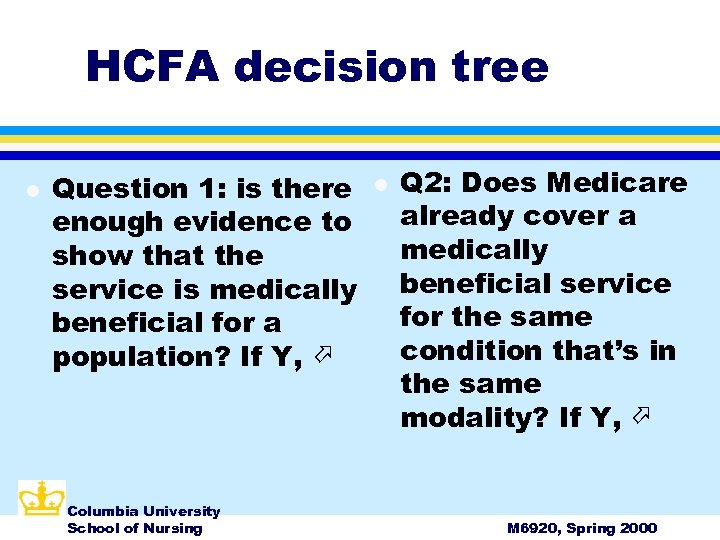
HCFA decision tree l Question 1: is there enough evidence to show that the service is medically beneficial for a population? If Y, Columbia University School of Nursing l Q 2: Does Medicare already cover a medically beneficial service for the same condition that’s in the same modality? If Y, M 6920, Spring 2000
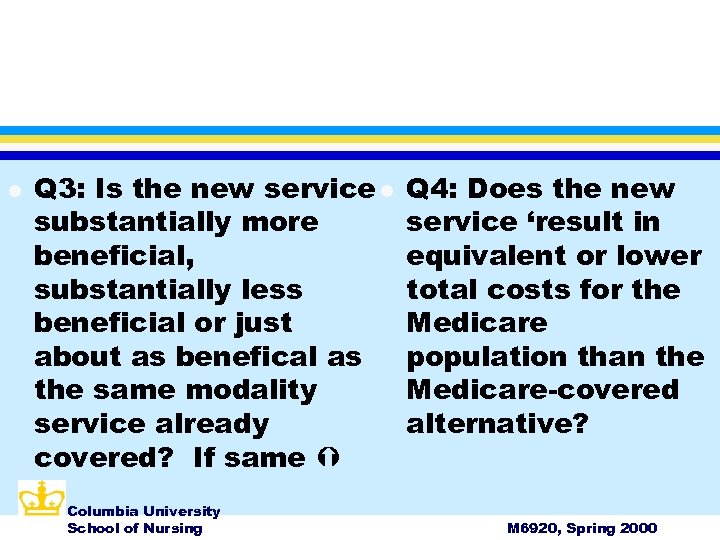
l Q 3: Is the new service l substantially more beneficial, substantially less beneficial or just about as benefical as the same modality service already covered? If same Columbia University School of Nursing Q 4: Does the new service ‘result in equivalent or lower total costs for the Medicare population than the Medicare-covered alternative? M 6920, Spring 2000
Zhou et al. l l l Illustrative of level of analytic sophistication often needed Should increase potential for discussion of analysis with statistician Should suggest that carefully doing the wrong methodology only leads you astray! Columbia University School of Nursing M 6920, Spring 2000
Ginsberg et al. l l Objective: examine costs and benefits of 2 schedules of HIB vaccine in Israel Finding: the costs of the program exceed the benefits when limited to the health service costs; when all social costs are included the program becomes beneficial Columbia University School of Nursing M 6920, Spring 2000
Ginsberg cont l Cost of program • vaccine • labor to give • transportation for vaccine and nurses • cold chain costs • costs of adverse reactions Columbia University School of Nursing M 6920, Spring 2000
Ginsberg cont l Benefits of program (cost of disease minus cost of program) • ambulatory care • ER care • hospitalization • prophylaxis for contacts • special ed/long term care for those with sequelae Columbia University School of Nursing M 6920, Spring 2000
Ginsberg cont l Requires knowing attack rate, secondary infection rate, long term care issues Columbia University School of Nursing M 6920, Spring 2000
Mc. Govern et al l l l Descriptive study of long-term costs Workers Comp sample, 1992 Medical costs from insurers Lost wages, etc from state Insurance expense estimated Lost fringe/household time imputed Columbia University School of Nursing M 6920, Spring 2000
Mc. Govern et al l l human capital--individual produces a stream of output over time cost in a base year = total lifetime cost of all cases injured that year direct cost=actual $$ spent indirect cost=value of what wasn’t done Columbia University School of Nursing M 6920, Spring 2000
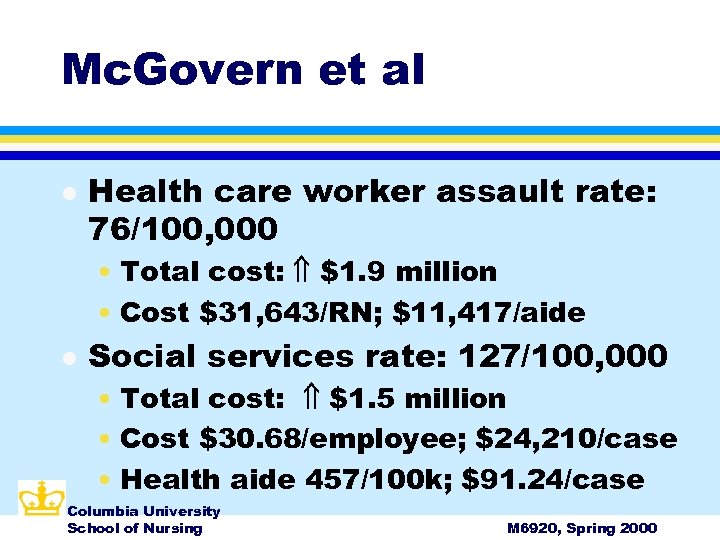
Mc. Govern et al l Health care worker assault rate: 76/100, 000 • Total cost: $1. 9 million • Cost $31, 643/RN; $11, 417/aide l Social services rate: 127/100, 000 • Total cost: $1. 5 million • Cost $30. 68/employee; $24, 210/case • Health aide 457/100 k; $91. 24/case Columbia University School of Nursing M 6920, Spring 2000
Lanz et al l Randomized trial Single medical practice Cost carefully tracked research costs and several possible levels of application Columbia University School of Nursing M 6920, Spring 2000

Lanz et al l Critique the conclusion: • Appropriate for and acceptable to low income, managed care populations with full benefit coverage for cancer screening tests Columbia University School of Nursing M 6920, Spring 2000

Eilbert et al l Effort to build toward a national data base Theoretical framework not fully tested/accepted Comparability severely compromised Columbia University School of Nursing M 6920, Spring 2000
Two useful readings: l l Ferrill MJ 1999 p values and confidence intervals Drug Facts and Comparisons NEWS March (20 -23) Schwartz S, Carpenter KM 1999 The right answer for the wrong question: consequences of type III error for public health research 89: 8 (117580) Columbia University School of Nursing M 6920, Spring 2000
Скачать презентацию Cost of Services N 9205 October 3 2000
e6db0893b38d559d663a9fb7053b118a.ppt